
Sweden Renewable Gas Waste Feedstock Management Market Size and Share
Market Overview
| Study Period | 2020 - 2031 |
|---|---|
| Forecast Data Period | 2026 - 2031 |
| Base Year Market Size (2025) | USD 0.61 Billion |
| Market Size (2026) | USD 0.66 Billion |
| Market Size (2031) | USD 1.02 Billion |
| Growth Rate (2026 - 2031) | 9.10 % |
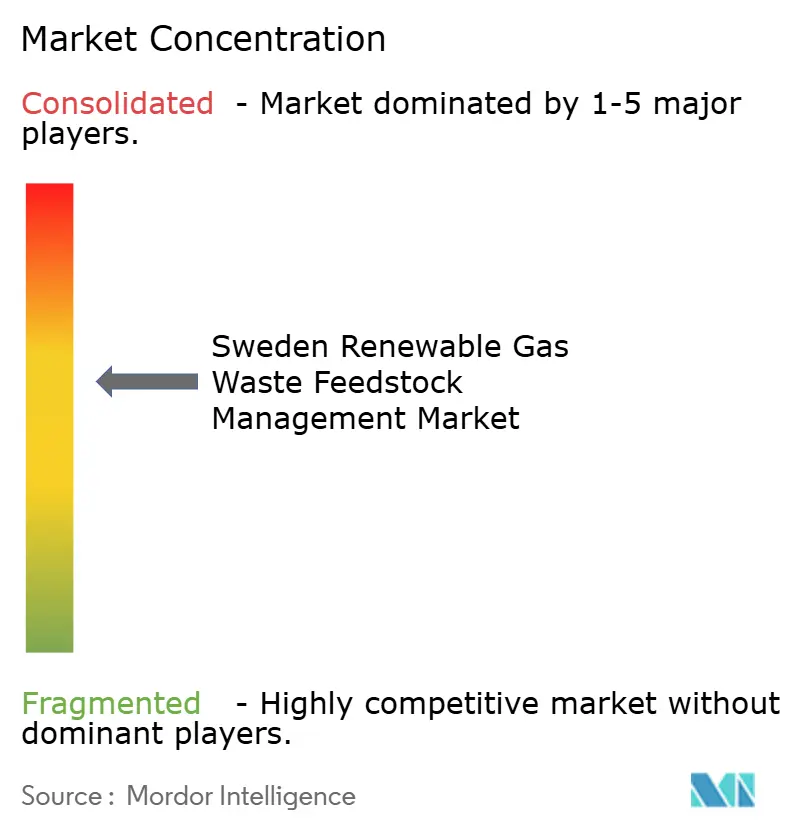
| Market Concentration | Medium |
Major Players *Disclaimer: Major Players sorted in no particular order Image © Mordor Intelligence. Reuse requires attribution under CC BY 4.0. | |
Sweden Renewable Gas Waste Feedstock Management Market Analysis by Mordor Intelligence
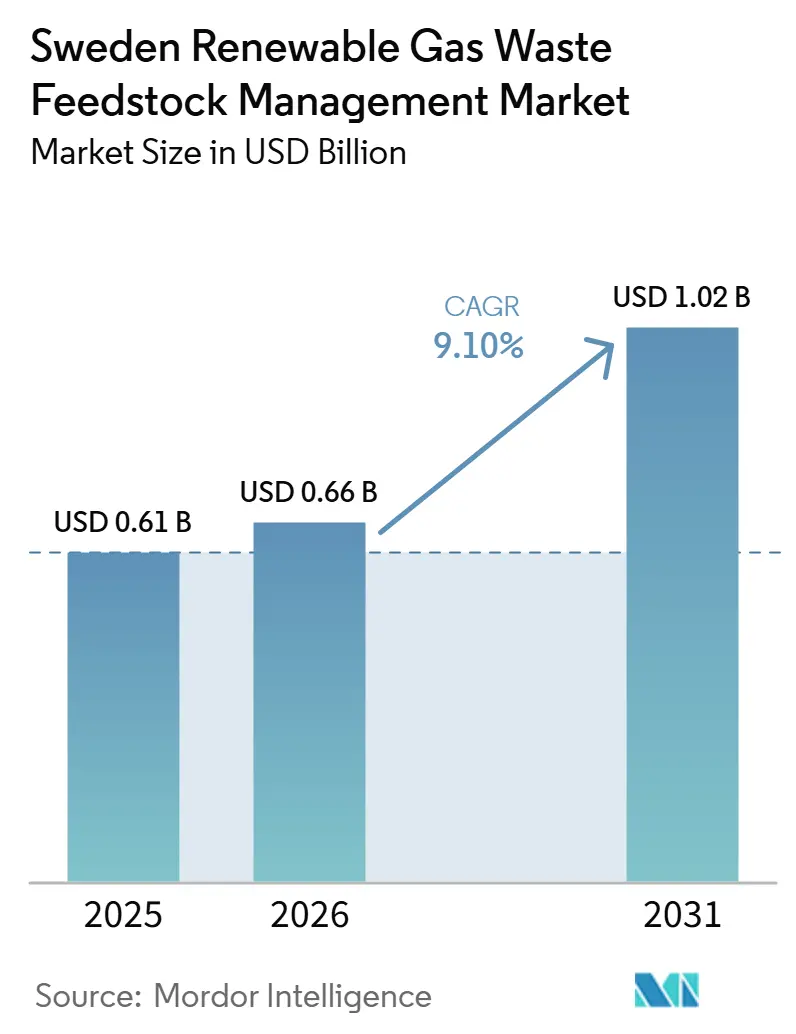
The Sweden Renewable Gas Waste Feedstock Management Market size is projected to be USD 0.61 billion in 2025, USD 0.66 billion in 2026, and reach USD 1.02 billion by 2031, growing at a CAGR of 9.10% from 2026 to 2031.
The stronger outlook reflects a more stable policy setting after Sweden regained the tax exemption for non-food-based biogas, which restored commercial confidence across production, distribution, and end-use markets. Growth is also being supported by Sweden’s mandatory bio-waste separation rules, which are widening the supply of sorted organic material and improving feedstock visibility for project developers. At the same time, record support through Klimatklivet, rising liquefied biogas demand from heavy transport, and grid connection investments in western Sweden are shifting the market from a municipal utility base toward a larger industrial fuel and infrastructure opportunity. The main limits remain competition for sustainable feedstock from other bioeconomy uses, the gap between current domestic production and the sector’s 2030 ambition, and the absence of a harmonized guarantee-of-origin route that would improve cross-border pricing for Swedish renewable gas.
Key Report Takeaways
- By feedstock type, municipal solid waste held 30.8% of the Sweden renewable gas waste feedstock management market share in 2025, while food and beverage processing waste is forecast to grow at a 10.5% CAGR through 2031.
- By end-use facility type, anaerobic digestion plants held 42.8% of Sweden renewable gas waste feedstock management market size in 2025, while gasification and thermal treatment facilities are forecast to grow at an 11.2% CAGR through 2031.
- By service type, feedstock collection and transport held 28.9% of revenue in 2025, while digital feedstock monitoring platforms are forecast to grow at a 15.3% CAGR through 2031.
Note: Market size and forecast figures in this report are generated using Mordor Intelligence’s proprietary estimation framework, updated with the latest available data and insights as of January 2026.
Sweden Renewable Gas Waste Feedstock Management Market Trends and Insights
Drivers Impact Analysis*
| Driver | (~) % Impact on CAGR Forecast | Geographic Relevance | Impact Timeline |
|---|---|---|---|
| Production Incentive Programs Accelerate Renewable Waste Feedstock Utilization | +2.1% | National, with concentration in Skåne, Västra Götaland, and the Stockholm region | Short term (≤ 2 years) |
| Advanced Municipal Bio-Waste Collection Strengthens Feedstock Availability | +1.6% | National, with early gains in Stockholm, Gothenburg, and Malmö | Short term (≤ 2 years) |
| Growing Biomethane Consumption Across Heavy Mobility and Industrial Energy | +1.3% | National, especially along the E4 and E6 transport corridors | Medium term (2-4 years) |
| Diverse Organic Residue Base Enhances Feedstock Supply Security | +1.0% | Västra Götaland, Skåne, and Östergötland | Medium term (2-4 years) |
| Circular Economy Policies Drive Higher Waste-to-Gas Conversion Rates | +0.9% | National, with implications for EU biomethane certificate trade | Medium term (2-4 years) |
| Expansion of Biomethane Infrastructure Improves Feedstock Commercialization | +0.8% | National, including LBG logistics corridors in southern and central Sweden | Long term (≥ 4 years) |
| Source: Mordor Intelligence | |||
Production Incentive Programs Accelerate Renewable Waste Feedstock Utilization
Sweden’s production support program has made qualified organic waste more valuable to biomethane producers. Applications for 2026 support exceeded the SEK 1.035 billion (USD 105.5 million) annual budget, with requests totaling SEK 1.058 billion (USD 107.8 million) for 3.8 TWh of production, 25% more volume than in the prior application cycle.[1] This pressure encourages producers to sign longer supply agreements for manure, municipal biowaste, and food-processing residues. The support is paid in advance, but production must begin in the same calendar year, which increases the need for dependable feedstock and pre-treatment capacity. The government added SEK 100 million (USD 10.10 million) in 2025 and planned further funding increases for 2026 and 2027, which improves visibility for plant investments.[2] Eligibility rules under RED III separate feedstocks that can access premium support from material that must depend more heavily on gate-fee economics. This distinction makes traceability and sustainability certification central to feedstock contracting in the Sweden renewable gas waste feedstock management market.
Advanced Municipal Bio-Waste Collection Strengthens Feedstock Availability
Sweden’s mandatory separate collection of biowaste continues to expand following nationwide implementation, increasing the availability of cleaner organic feedstocks for renewable gas production. Updated national collection volumes for 2025 have not yet been published. However, municipalities continue to strengthen source-segregated collection systems and increase participation among households and commercial waste generators. The organic material that remains in residual waste indicates significant potential to increase feedstock availability by diverting biodegradable waste from incineration. The Bio+ program is expected to launch a project in April 2026 to evaluate mechanically sorted biowaste recovered from residual waste as a supplementary substrate source. Tekniska verken receives food waste from 35 municipalities at its Linköping operations, demonstrating the scale and reliability that coordinated municipal collection contracts can provide. Waste policy reforms and clearer commercial waste collection responsibilities, expected to take effect in July 2026, are likely to bring additional organic waste from restaurants, retailers, and food manufacturers into regulated collection systems.
Growing Biomethane Consumption Across Heavy Mobility and Industrial Energy
Demand for liquefied biogas (LBG) in Sweden continues to rise as heavy-duty transport, shipping, and industrial users accelerate the transition to renewable fuels to meet decarbonization targets. Industry assessments indicate that 8,000 LBG-capable heavy trucks by 2030 would require approximately 6 TWh of LBG annually, exceeding Sweden's recent domestic biogas consumption and reinforcing the need for a larger and more reliable supply of renewable gas feedstocks. This widening demand-supply gap is increasing the importance of long-term feedstock sourcing agreements, expanded collection networks, and diversified organic waste supplies. St1 Biokraft is strengthening its integrated supply chain while targeting 50 LBG refueling stations across Finland, Sweden, and Norway by 2028, supporting long-term demand for sustainably sourced feedstocks. The Swedish industry has also identified a need for around 10 TWh of biogas by 2030 to support process heat, renewable fuel production, and fossil fuel substitution across energy-intensive sectors. As demand for biomethane continues to expand, feedstock management providers are expected to play a larger role in securing reliable supplies of food waste, fats, oils, and grease (FOG), manure, and agricultural residues through efficient collection, quality assurance, contamination control, and traceability systems. Consequently, the Sweden renewable gas waste feedstock management market is expected to benefit from growing demand for feedstock aggregation, pre-treatment, and long-term supply management services.
Diverse Organic Residue Base Enhances Feedstock Supply Security
Sweden’s mix of municipal biowaste, manure, sewage sludge, food-processing residues, and industrial organic waste gives renewable gas operators several supply options. This diversity reduces reliance on a single waste stream when seasonal conditions, competing uses, or collection disruptions affect availability. Manure-based biogas accounted for 16% of Sweden’s total biogas production in 2024, while production from farm facilities increased 52% between 2019 and 2024. Sewage sludge and biosolids also contributed 22% of biogas feedstock in 2024, providing a stable material base for wastewater treatment facilities and co-digestion plants. Agricultural regions such as Västra Götaland, Skåne, and Östergötland can combine manure and crop residues with municipal and industrial organic waste, helping facilities maintain more balanced feedstock blends. For the Sweden renewable gas waste feedstock management market, this wider residue base supports supply continuity, although operators still need quality testing and certification to secure the most valuable contracts.
Restraints Impact Analysis*
| Restraint | (~) % Impact on CAGR Forecast | Geographic Relevance | Impact Timeline |
|---|---|---|---|
| Intensifying Competition for High-Quality Organic Waste Resources | -0.8% | National, strongest in urban southern and central Sweden | Medium term (2-4 years) |
| High Collection and Transportation Costs Reduce Feedstock Economics | -0.7% | National, with potential spillover to imported-feedstock scenarios | Short term (≤ 2 years) |
| Feedstock Availability Constraints Limit Long-Term Capacity Expansion | -0.6% | National, particularly in agricultural-sparse northern regions | Long term (≥ 4 years) |
| Seasonal Variability Creates Inconsistent Biomass Supply | -0.4% | National, especially at farm-based and agricultural-residue facilities | Medium term (2-4 years) |
| Source: Mordor Intelligence | |||
Intensifying Competition for High-Quality Organic Waste Resources
Rising competition for clean organic waste is restricting feedstock availability for biomethane producers as Sweden expands anaerobic digestion and gas upgrading capacity. Composting facilities, direct agricultural land application, thermal treatment, and other circular economy pathways are competing for food waste, fats, oils, and grease (FOG), limiting high-quality feedstock for renewable gas production. New biomethane projects are expected to intensify competition for premium substrates, especially in densely populated urban regions with the highest collection volumes. Feedstock quality is becoming a critical competitive factor, as substrate composition, contamination levels, and consistency affect methane yields and gate-fee revenues. According to a VTI analysis, producing 100 GWh of biogas requires approximately 86,184 tons of source-separated food waste, compared with 726,692 tons of manure, showing the significantly higher gas productivity of clean urban organic waste. This difference raises the commercial value of municipal food waste collection routes and encourages operators to secure long-term supply agreements with municipalities, retailers, food processors, and hospitality businesses before competitors do.
High Collection and Transportation Costs Reduce Feedstock Economics
Collection logistics continue to create persistent cost pressure in the Sweden renewable gas waste feedstock management market, particularly when operators source feedstock from dispersed farms, food processors, and rural municipalities. Research by the Swedish National Road and Transport Research Institute (VTI) indicates that manure requires significantly higher transport volume per unit of gas produced than source-separated food waste due to its lower energy density and higher moisture content. This requirement increases fuel consumption, vehicle utilization, and labor costs across the collection chain. Procurement requirements for fossil-free collection fleets, including biomethane- and electric-powered vehicles, also increase upfront capital investment for waste collection operators, although they support Sweden’s broader decarbonization objectives. Operators can recover these costs more effectively through long-term municipal and industrial collection contracts, which provide predictable feedstock volumes and stable revenue streams. In northern Sweden, lower population density, longer transport distances, and fewer gas upgrading and injection facilities can increase collection costs per ton to two to three times the levels observed in the more densely populated south-central regions. Seasonal weather conditions and limited backhaul opportunities further reduce logistics efficiency in these areas. While government production support and investment incentives improve project economics, they do not fully offset the structural cost disadvantage linked to remote feedstock collection.
*Our forecasts treat driver/restraint impacts as directional, not additive. The impact forecasts reflect baseline growth, mix effects, and variable interactions.
Segment Analysis
By Feedstock Type: Municipal Waste Provides Volume While Food Processing Waste Supports Growth
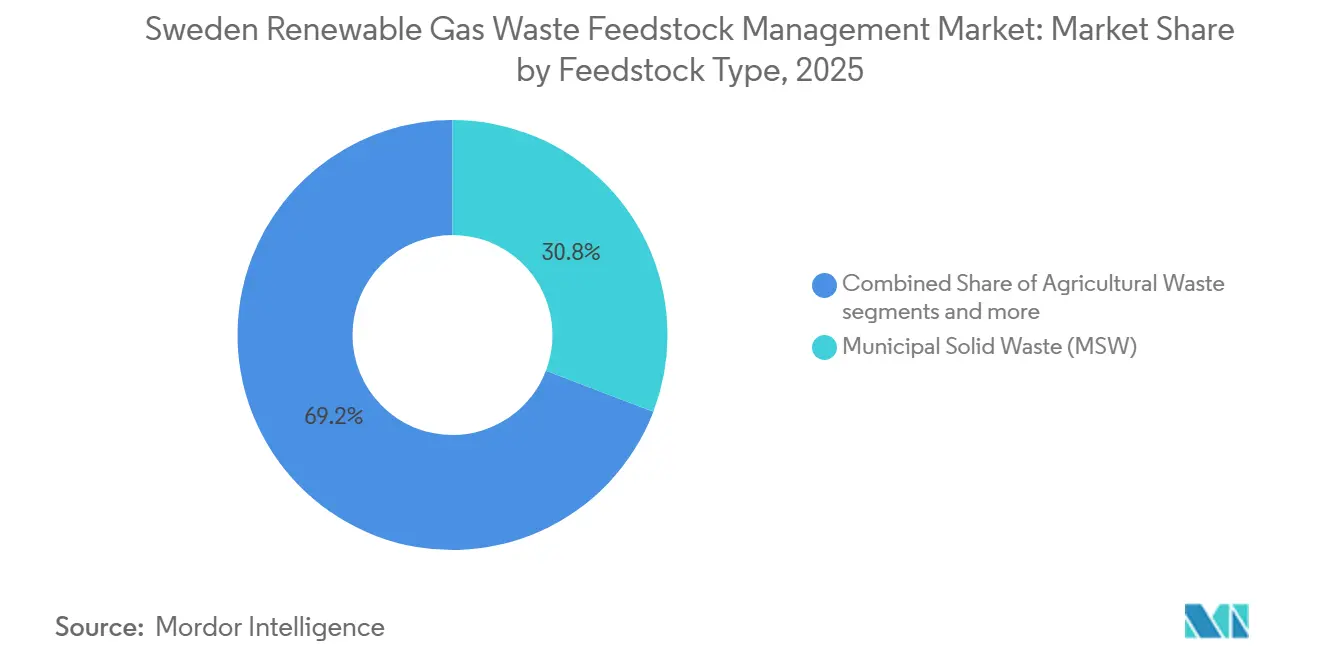
Municipal solid waste (MSW), particularly the source-separated organic fraction, is expected to account for 30.8% of the Sweden renewable gas waste feedstock management market share in 2025. Predictable collection volumes, long-term municipal service contracts, and well-established source-segregation systems support its leading position by ensuring a consistent supply of relatively clean feedstock for anaerobic digestion. Sweden continues to expand separate biowaste collection under national and EU waste legislation, increasing the availability of municipal organic waste for biomethane production. Food and beverage processing waste is projected to register a CAGR of 10.5% through 2031, supported by its relatively low contamination levels, established collection streams, and favorable gate-fee arrangements that enhance its commercial value. Food manufacturers, breweries, dairies, and beverage processors generate relatively homogeneous organic residues that require less pre-treatment than mixed municipal waste. As demand for high-quality industrial feedstocks continues to increase, operators are investing in specialized collection and reception infrastructure to improve handling efficiency and maintain feedstock quality. Tekniska verken's expanded Linköping operations include dedicated solid- and liquid-waste reception facilities and an automated food-waste crane system, demonstrating how operators are strengthening their capacity to manage clean, source-separated organic waste streams. As renewable gas demand increases, competition for high-quality municipal and industrial food waste is expected to intensify, encouraging longer-term supply agreements and continued investment in advanced sorting and pre-treatment infrastructure.
Agricultural waste remains a strategically important feedstock because it provides one of Sweden's largest domestic organic resource bases and supports methane emission reductions from livestock production. Continued investment in farm-scale anaerobic digestion projects and government production incentives is increasing the contribution of manure and other agricultural residues to renewable gas production. Although manure generally delivers lower methane yields than food waste, it benefits from dedicated production support and contributes to nutrient recycling through biofertilizer production. Sewage sludge and biosolids provide a stable year-round feedstock stream for municipal wastewater treatment plants, although evolving environmental regulations and digestate quality requirements continue to influence future growth. Industrial organic waste, including residues from food manufacturing, pulp and paper processing, and other bio-based industries, complements municipal and agricultural feedstocks by improving feedstock diversity and enabling more flexible substrate blending.

By End-Use Facility Type: Anaerobic Digestion Leads While Thermal Treatment Expands
Anaerobic digestion (AD) plants are expected to account for 42.8% of the Sweden renewable gas waste feedstock management market in 2025. Their leading position is supported by their ability to process a wide range of organic feedstocks, including source-separated food waste, sewage sludge, livestock manure, and fats, oils, and grease (FOG), while producing biomethane and nutrient-rich biofertilizer. Continued investment in municipal co-digestion facilities and farm-scale digesters is expanding Sweden's renewable gas production capacity and strengthening regional feedstock utilization. The more Biogas plant in Kalmar processes food waste, manure, and other organic residues through a flexible co-digestion model, demonstrating how mixed-feedstock operations improve operational resilience. Wastewater treatment plants also provide a dependable year-round supply of sewage sludge and increasingly combine it with higher-energy organic substrates where treatment capacity, digestate quality requirements, and local regulations permit.
Gasification and thermal treatment facilities are projected to record an 11.2% CAGR through 2031, the highest among facility types. These technologies provide an alternative treatment pathway for contaminated, woody, and other organic residues that are unsuitable for conventional anaerobic digestion, expanding the range of feedstocks that can be recovered and processed. Growing investment in advanced thermal treatment technologies, including Plagazi's Gävle Circular Park project, reflects increasing interest in diversifying treatment options for difficult-to-process organic waste streams. Landfill operators continue to recover value from existing organic waste through landfill gas capture, while stricter waste diversion policies are increasing the movement of source-separated organic waste toward dedicated treatment facilities. Pyrolysis and hydrothermal treatment remain at an early stage of commercial deployment but are attracting research and pilot-scale investment as complementary pathways for managing organic residues that cannot be efficiently processed through biological treatment.
By Service Type: Collection Leads Revenue While Digital Monitoring Gains Importance
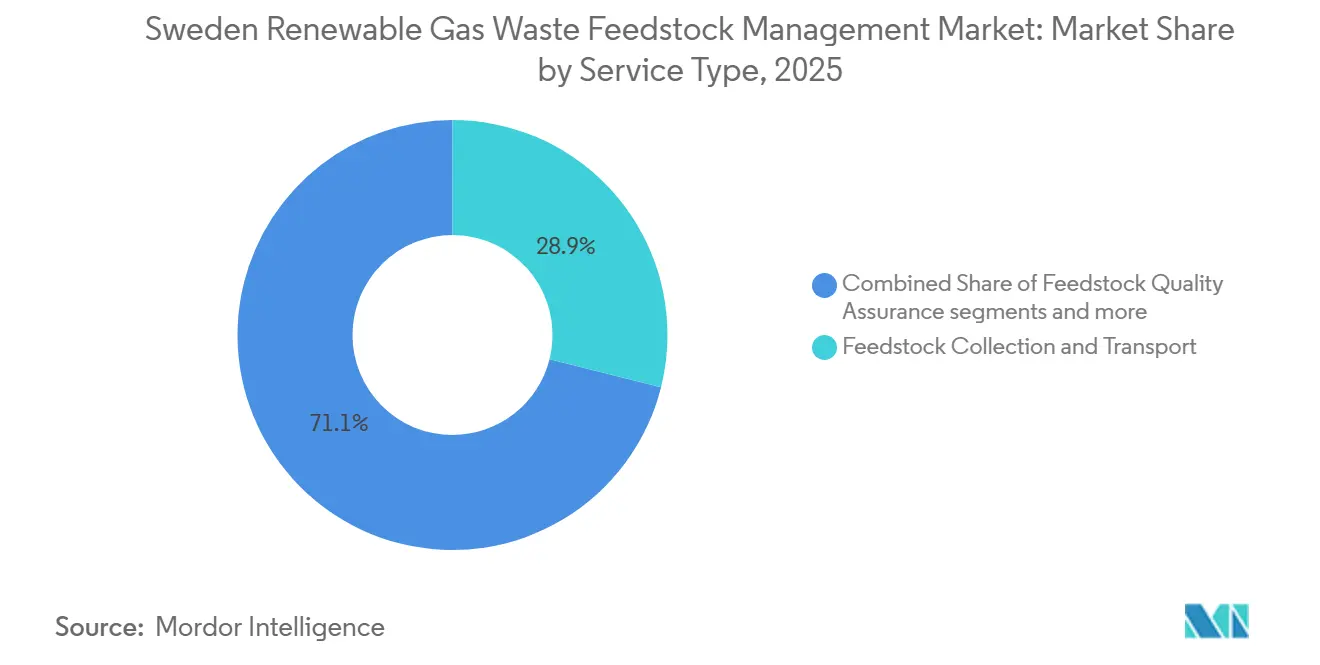
Feedstock collection and transport held 28.9% of service revenue in 2025. It is the largest activity because every substrate must be collected, consolidated, and delivered before processing begins. Commercial waste collection responsibilities that take effect in July 2026 can expand contracted route volumes. Fossil-free fleet requirements raise upfront costs, though longer municipal contracts can distribute those costs over more material. Testing and quality assurance support accurate reporting because incorrect production-support volumes can trigger repayment obligations.
Digital feedstock monitoring platforms are forecast to grow at a 15.3% CAGR through 2031. The Bio+ program's project with Örebro University has been active since 2025, supporting the development of practical digital tools for feedstock monitoring and quality assessment. During 2025, Datrix and Femo Gas deployed artificial intelligence systems in Swedish biogas facilities to improve feedstock monitoring, traceability, contamination detection, and data-driven procurement decisions. Enhanced monitoring helps identify low-quality or contaminated feedstocks at an early stage, reducing handling losses and supporting more informed feedstock purchasing and quality assurance. Supply chain management and consulting services also assist operators in sourcing, handling, and certifying manure and pharmaceutical organic effluents that require specialized logistics and traceability systems.
Geography Analysis
Southern and central Sweden account for most feedstock throughput and anaerobic digestion capacity, led by Skåne, Västra Götaland, Östergötland, and Stockholm. Biogas accounted for 39.3% of the gas supplied through the West Swedish gas network in the first quarter of 2025, marking the highest share ever recorded in the network. Dense urban feedstock generation, extensive source-separated food waste collection, and nearby industrial gas consumers reduce collection and delivery distances across the Gothenburg-Malmö corridor, improving operational efficiency and lowering transport costs. Municipal investments in organic waste sorting and long-established district heating infrastructure also support stable year-round feedstock availability. Tekniska verken’s Linköping plant produces 200 GWh of bioLNG annually and sources food waste from 35 municipalities, demonstrating the benefits of coordinated regional feedstock aggregation. These integrated collection, upgrading, and distribution assets strengthen the Sweden renewable gas waste feedstock management market by enabling operators to achieve higher utilization rates, more predictable feedstock quality, and lower logistics costs in high-density catchments.
Northern and inland regions have lower population density, higher collection costs, and less developed gas injection infrastructure, making feedstock aggregation more challenging. Longer transport distances require optimized logistics networks and larger collection zones to maintain commercial viability. The Gräfsåsen plant in Östersund, which began producing gas in March 2025, processes household food waste, slaughterhouse residues, and dairy by-products collected from eight municipalities, illustrating how regional cooperation can consolidate dispersed feedstocks. However, transportation accounts for a larger share of operating costs in these regions than in southern Sweden. Industrial residue streams, including forestry by-products, pulp and paper effluents, and agricultural waste, offer an important growth opportunity for northern projects. Domsjö Fabriker has proposed using paper mill effluents and biorefinery residues to upgrade industrial biogas into liquefied biogas (LBG) at High Coast Innovation Park, highlighting the region’s potential to diversify beyond municipal waste feedstocks. Future expansion in these areas will depend on long-term feedstock contracts, secure offtake agreements, and continued investment in transport and upgrading infrastructure.
Sweden has set an explicit ambition to produce 10 TWh of biomethane by 2030, providing long-term policy direction for investment across the renewable gas value chain. National guarantee-of-origin systems and sustainability certification frameworks are already operational, supporting the verification, traceability, and certification of waste-derived biomethane for domestic and export markets. As the European Union continues to expand common tracking and certification requirements, Swedish producers with well-documented feedstock supply chains are expected to benefit from improved cross-border market access and streamlined certification processes. Growing demand for renewable fuels in heavy transport, shipping, and industrial decarbonization is also expected to encourage further investment in feedstock management systems, digital traceability platforms, and pre-treatment infrastructure, supporting the long-term growth of the Sweden renewable gas waste feedstock management market.
Competitive Landscape
The Sweden renewable gas waste feedstock management market exhibits a medium level of market concentration, with competition shared among integrated renewable gas developers, municipal utilities, waste management organizations, and specialized feedstock service providers. St1 Biokraft's integration of Scandinavian Biogas Fuels International strengthened its vertically integrated operating model by combining feedstock sourcing, biomethane production, liquefaction, distribution assets, and long-term feedstock supply agreements.[3] Municipal utilities, including Tekniska verken, Borås Energi och Miljö, Stockholm Exergi, and regional waste associations, maintain reliable access to publicly managed organic waste streams through long-term collection contracts. Private feedstock aggregators compete by establishing partnerships with municipalities, food processors, retailers, and agricultural cooperatives to secure organic feedstocks for commercial use. As a result, competitive positioning depends largely on access to feedstock, long-term supply agreements, and efficient collection networks.
Technology differentiation is becoming an increasingly important source of competitive advantage across the feedstock management value chain. Equipment and technology providers such as Purac, Wärtsilä Biogas Solutions, and MalmbergGruppen compete by supplying feedstock pre-treatment, biogas upgrading, digital traceability, contamination monitoring, and quality assurance solutions rather than directly competing in feedstock collection or aggregation. Digital monitoring platforms, automated feedstock handling systems, and real-time feedstock quality assessment tools are gaining wider adoption as operators seek to strengthen traceability, improve contamination detection, and support more informed feedstock procurement and quality management decisions.
Strategic investments continue to strengthen the competitive position of larger integrated operators. St1 Biokraft's expansion of feedstock sourcing, liquefaction capacity, and refueling infrastructure demonstrates a strategy of strengthening supply security across the renewable gas value chain. Tekniska verken's investments in automated food waste reception, advanced biogas upgrading, and biogenic carbon dioxide recovery expand the value derived from collected organic waste while diversifying revenue opportunities. Stockholm Exergi's 2025 decision to build a SEK 13 billion (USD 1.32 billion) BECCS facility at Värtaverket further reinforces long-term demand for sustainably sourced biomass. Looking ahead, competition is expected to increasingly center on feedstock security, collection efficiency, digital traceability, and integrated feedstock management capabilities as Sweden continues to expand biomethane production toward its 2030 target.
Sweden Renewable Gas Waste Feedstock Management Industry Leaders
-
St1 Biokrafts
-
Gasum Oy
-
Tekniska verken i Linköping AB
-
Biofrigas Sweden AB
-
Borås Energi och Miljö
- *Disclaimer: Major Players sorted in no particular order
Recent Industry Developments
- September 2025: Biogas Västra Skaraborg AB launched construction of a 70 GWh bio-LNG plant in Vara in partnership with EnviTec Biogas and Nordsol. The facility will process 370,000 tons of manure annually, with commissioning targeted for Q4 2026.
- March 2025: Stockholm Exergi made a final investment decision to build the world’s first large-scale BECCS facility at Värtaverket, with a SEK 13 billion (USD 1.32 billion) investment and 800,000 tons of annual carbon dioxide capture capacity, supported by a SEK 20 billion (USD 2.04 billion) Swedish Energy Agency commitment and a carbon removal agreement with Microsoft.
- March 2025: Gräfsåsen Biogas plant in Östersund began producing biogas through a SEK 230 million (USD 23.44 million) Purac-delivered project processing food waste, slaughterhouse, and dairy residues from 8 municipalities in Jämtland and Härjedalen.
Sweden Renewable Gas Waste Feedstock Management Market Report Scope
The Sweden Renewable Gas Waste Feedstock Management Market is Segmented By Feedstock Type (Municipal Solid Waste, Agricultural Waste, Sewage Sludge / Biosolids and more) By End-Use Facility Type (Anaerobic Digestion (AD) Plants, Landfill Gas Recovery Sites and more), By Service Type (Feedstock Collection & Transport, Feedstock Testing & Laboratory Services and more). The Market Forecasts are Provided in Terms of Value (USD).
| Municipal Solid Waste (Organic Fraction / Source-Separated) |
| Agricultural Waste (Manure, Slurry, Crop Residues) |
| Sewage Sludge / Biosolids |
| Food & Beverage Processing Waste (FOG, Spent Grains, Off-Spec Product) |
| Industrial Organic Waste (Breweries, Paper Mills, Pharma Effluent) |
| Others |
| Anaerobic Digestion (AD) Plants |
| Landfill Gas Recovery Sites |
| Gasification / Thermal Treatment Facilities |
| Wastewater Treatment Plants (Co-Digestion) |
| Others (Pyrolysis, Hydrothermal) |
| Feedstock Collection & Transport |
| Feedstock Testing & Laboratory Services |
| Feedstock Quality Assurance |
| Digital Feedstock Monitoring Platforms |
| Feedstock Supply Chain Management & Consultancy |
| By Feedstock Type | Municipal Solid Waste (Organic Fraction / Source-Separated) |
| Agricultural Waste (Manure, Slurry, Crop Residues) | |
| Sewage Sludge / Biosolids | |
| Food & Beverage Processing Waste (FOG, Spent Grains, Off-Spec Product) | |
| Industrial Organic Waste (Breweries, Paper Mills, Pharma Effluent) | |
| Others | |
| By End-Use Facility Type | Anaerobic Digestion (AD) Plants |
| Landfill Gas Recovery Sites | |
| Gasification / Thermal Treatment Facilities | |
| Wastewater Treatment Plants (Co-Digestion) | |
| Others (Pyrolysis, Hydrothermal) | |
| By Service Type | Feedstock Collection & Transport |
| Feedstock Testing & Laboratory Services | |
| Feedstock Quality Assurance | |
| Digital Feedstock Monitoring Platforms | |
| Feedstock Supply Chain Management & Consultancy |
Key Questions Answered in the Report
What is the projected value of Sweden renewable gas waste feedstock management market by 2031?
The sector is forecast to reach USD 1.02 billion by 2031, rising from USD 0.67 billion in 2026 at a 9.1% CAGR.
Which feedstock has the largest role in Sweden renewable gas production chain?
The source-separated organic fraction of municipal solid waste held 30.8% of revenue in 2025 because municipal contracts provide stable volumes.
Which feedstock category is growing fastest through 2031?
Food and beverage processing waste is forecast to grow at a 10.5% CAGR because it can provide high methane yield and favorable gate-fee economics.
Why is digital monitoring becoming important for Swedish biogas operators?
Digital platforms are forecast to grow at a 15.3% CAGR because operators need better visibility into substrate quality, contamination, and blending performance.
What is the major supply challenge for biomethane producers in Sweden?
High-quality organic waste is increasingly contested by digestion, composting, land application, and thermal treatment operators, while rural collection remains costly.
Which facility type has the largest share of feedstock management activity?
Anaerobic digestion plants held 42.8% of revenue in 2025 because they can process a wide range of municipal, agricultural, and wastewater-derived substrates.