
Renewable Gas Waste Feedstock Management Market Size and Share
Market Overview
| Study Period | 2020 - 2031 |
|---|---|
| Market Size (2026) | USD 20.34 Billion |
| Market Size (2031) | USD 31.42 Billion |
| Growth Rate (2026 - 2031) | 9.09 % |
| Fastest Growing Market | Asia-Pacific |
| Largest Market | Europe |
| Market Concentration | Medium |
Major Players *Disclaimer: Major Players sorted in no particular order Image © Mordor Intelligence. Reuse requires attribution under CC BY 4.0. | |
Renewable Gas Waste Feedstock Management Market Analysis by Mordor Intelligence
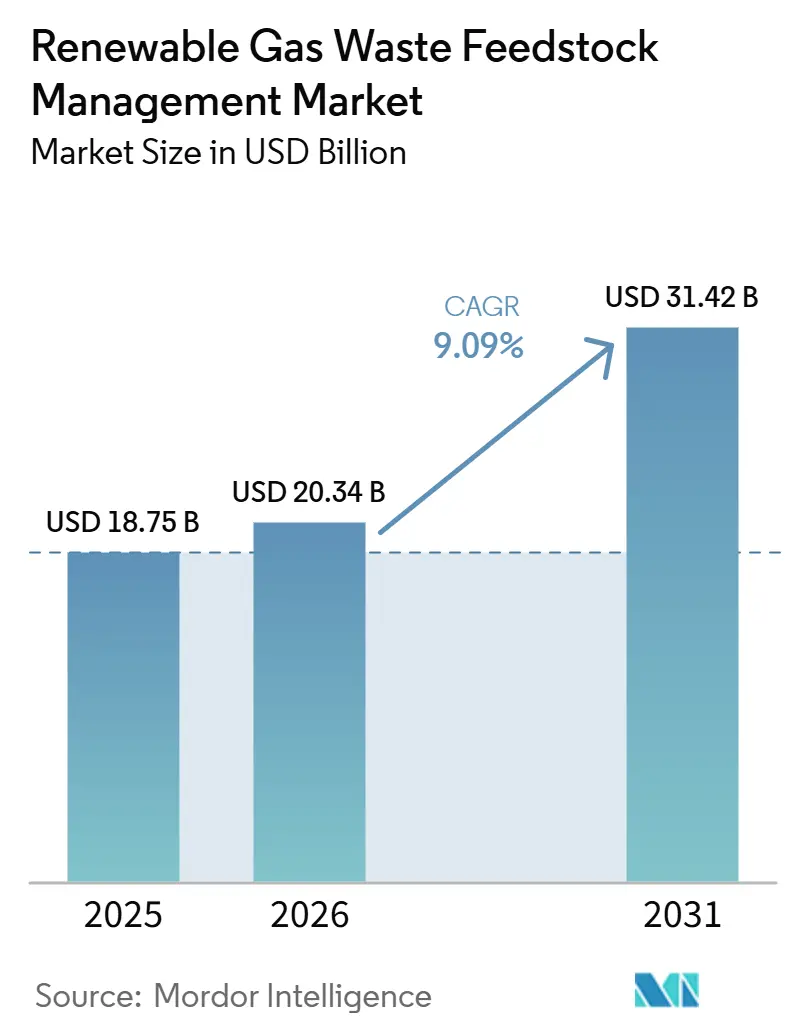
The Renewable Gas Waste Feedstock Management Market size was valued at USD 18.75 billion in 2025 and is estimated to grow from USD 20.34 billion in 2026 to reach USD 31.42 billion by 2031, at a CAGR of 9.09% during the forecast period (2026-2031).
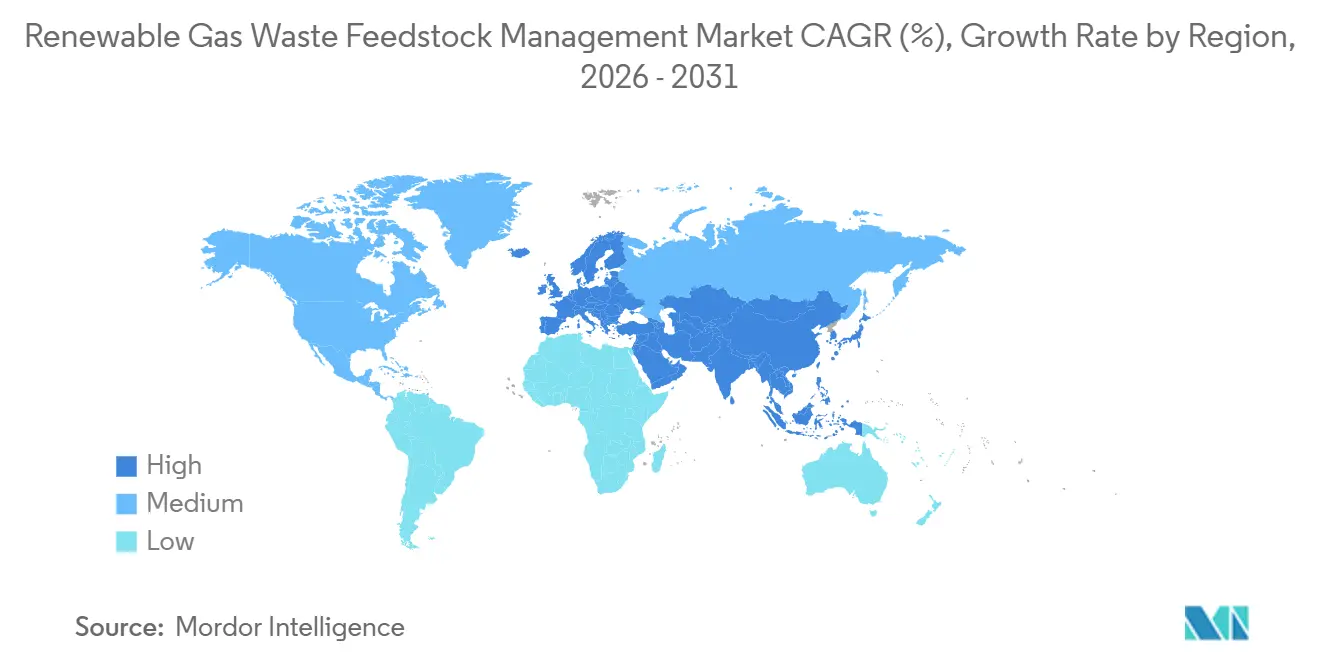
The renewable gas waste feedstock management market is moving toward contracted waste supply because landfill rules and diversion requirements make organic waste a compliance issue for generators. Gate fees can strengthen project revenue and reduce reliance on gas prices, since they reward operators for accepting and managing waste. Greater biomethane capacity also raises the value of reliable feedstock contracts, testing, and quality control. Integrated operators can link collection, pre-treatment, and gas sales, while specialist providers can serve operators that need better monitoring or contamination control. Europe remains the largest regional base, while Asia Pacific has the highest projected growth rate as policy frameworks and digestion capacity develop.
Key Report Takeaways
- By feedstock type, municipal solid waste held 35.4% of the renewable gas waste feedstock management market share in 2025, while food & beverage processing waste is forecast to expand at a 10.2% CAGR through 2031.
- By end-use facility type, anaerobic digestion (AD) plants accounted for 44.1% of the renewable gas waste feedstock management market size in 2025, while gasification/thermal treatment facilities are projected to grow at a 11.5% CAGR through 2031.
- By service type, feedstock collection & transport accounted for 28.5% in 2025, while digital feedstock monitoring platforms are forecast to grow at a 13.8% CAGR through 2031.
- By geography, Europe held 35.6% of the market share in 2025, while Asia-Pacific is projected to record the highest CAGR at 16.32% through 2031.
Note: Market size and forecast figures in this report are generated using Mordor Intelligence’s proprietary estimation framework, updated with the latest available data and insights as of January 2026.
Market Trends and Insights
Drivers Impact Analysis of Renewable Gas Waste Feedstock Management Market*
| Driver | (~) % Impact on CAGR Forecast | Geographic Relevance | Impact Timeline |
|---|---|---|---|
| Mandatory Organic Waste Diversion and Landfill Bans | +2.5% | Global, concentrated in the EU-27, the United Kingdom, and the eastern United States regions | Short term (≤ 2 years) |
| Agricultural Methane Rules for Manure Management | +2.0% | EU-27, North America, dairy-focused United States regions, and Canadian provinces | Medium term (2-4 years) |
| Growth in Global Anaerobic Digestion Capacity | +1.5% | Global, strongest in the EU-27, the United States, China, and India | Medium term (2-4 years) |
| Corporate Food Waste Reduction Commitments | +1.2% | EU-27, the United Kingdom, North America, and multinational supply chains in the Asia Pacific | Medium term (2-4 years) |
| Gate-Fee Revenue for Waste Operators | +0.9% | Global, most developed in the EU-27 and North America | Short term (≤ 2 years) |
| Pre-Treatment and Monitoring Advances | +0.6% | EU-27, the United Kingdom, North America, and expanding Asia Pacific markets | Long term (≥ 4 years) |
| Source: Mordor Intelligence | |||
Mandatory Organic Waste Diversion and Landfill Bans
Mandatory separate collection of bio-waste is directing material from landfill and incineration toward managed recovery routes in the renewable gas waste feedstock management market. The EU Waste Framework Directive required separate bio-waste collection across member states from January 1, 2024. A 2025 assessment found that only 26% of theoretical bio-waste potential was captured across the EU-27, Norway, and the United Kingdom, leaving substantial material outside formal recovery systems.[1] In the United States, New York reduced its covered food-scrap generator threshold from 2 tons to 1 ton per week in January 2026, with a further reduction planned for 2029. New Jersey also established a commercial food-waste diversion requirement for generators of 52 or more tons per year in 2026. These rules give the renewable gas waste feedstock management market a clearer flow of material and make collection contracts more valuable to digestion and treatment operators.
Agricultural Methane Rules for Manure Management
Methane policies are changing manure from a farm disposal burden into a feedstock with financial value. RED III supports manure-derived biomethane for transport fuel applications through double counting, potentially improving project economics for livestock-based supply contracts. In the United States, the 45Z clean fuel production credit applies to qualifying fuel pathways and has encouraged interest in dairy manure renewable natural gas projects. A 2025 filing by Aemetis, Calgren, and California Bioenergy requested more site-specific treatment of dairy manure pathways in the GREET model. Long-term manure agreements can now support investment decisions where farms have enough scale and collection systems are in place. The renewable gas waste feedstock management market benefits because operators can provide aggregation, storage, testing, and transport around these contracts. The effect is strongest in dairy-intensive regions of North America and in European livestock areas.
Growth in Global Anaerobic Digestion Capacity
Each new anaerobic digestion plant requires dependable feedstock volumes over the long term. Global biogas and biomethane production is expected to increase 22% between 2025 and 2030, while China’s medium- and large-scale output is projected to increase 80% over the same period. Europe had 1,975 biomethane plants operating in July 2026, up from 1,678 a year earlier. European production capacity reached 8.2 billion cubic meters per year in June 2026, but average plant utilization was 70%, suggesting that feedstock availability and quality continue to limit output. This makes well-characterized supply contracts more important than simple access to waste volumes. The renewable gas waste feedstock management market, therefore, benefits from services that verify contamination levels, biochemical methane potential, and delivery performance.
Corporate Food Waste Reduction Commitments
Corporate waste commitments are creating an additional route for food waste to enter formal recovery systems. ENGIE and PepsiCo signed a 10-year biomethane purchase agreement in January 2026 for a 60 GWh annual anaerobic digestion plant in northern England that will use local agricultural waste. The agreement links an industrial buyer’s emissions program with a long-term feedstock and gas supply arrangement. The United States Food Waste Pact continued to expand commercial participation through 2025 and identified anaerobic digestion as a preferred diversion route. Food manufacturers, retailers, and service companies can offer material with more predictable volumes than mixed municipal collection. This supports route planning, dedicated collection schedules, and higher-value contracts in the renewable gas waste feedstock management market.
Restraints Impact Analysis of Renewable Gas Waste Feedstock Management Market*
| Restraint | (~) % Impact on CAGR Forecast | Geographic Relevance | Impact Timeline |
|---|---|---|---|
| High Pre-Treatment Equipment Capital Expenditure | -1.8% | Global, most acute in emerging Asia Pacific and Latin America markets, and North American mid-scale projects | Medium term (2-4 years) |
| Feedstock Contamination from Plastics and Heavy Metals | -1.4% | Global, especially municipal solid waste facilities in the EU-27, the United Kingdom, and North America | Short term (≤ 2 years) |
| Uneven Regulations across Geographies | -1.0% | Asia Pacific, the Middle East and Africa, Latin America, and uneven national implementation in Europe | Medium term (2-4 years) |
| Seasonal and Variable Agricultural Feedstock Supply | -0.6% | Rural EU-27 areas, India, and Southeast Asia | Long term (≥ 4 years) |
| Source: Mordor Intelligence | |||
High Pre-Treatment Equipment Capital Expenditure
Mixed waste in the renewable gas waste feedstock management market requires depackaging, screening, separation, pasteurization, and other equipment before it can enter many conversion systems. An IEA Bioenergy review found that manure-based anaerobic digestion projects in Canada ranged from CAD 18 million (USD 12.77 million) to CAD 70 million (USD 50.07 million), with several halted due to higher equipment, transport, and construction costs.[2]A 2024 European study found that plants handling public feedstock mixes had, on average, pre-treatment capital costs 80% higher than plants handling single-source agricultural feedstocks. These costs favor operators that already have collection assets, engineering capacity, and high throughput. Project development can also take 18 to 36 months, which adds financing risk when supply contracts remain uncertain. The renewable gas waste feedstock management market may become less diverse, where smaller providers cannot finance quality-control infrastructure. Fragmented rules and seasonal agricultural supply add uncertainty by reducing the consistency of available volumes across locations and seasons.
Feedstock Contamination from Plastics and Heavy Metals
Plastics and heavy metals can reduce biogas output and damage the value of digestate from mixed organic waste. A 2024 peer-reviewed study found food waste from mechanical biological treatment among the most contaminated bio-waste categories, with copper, zinc, and plastics as frequent contaminants. The study found contaminated municipal waste fractions had biochemical methane potential below 368 normal milliliters per gram of volatile solids. Food-processing waste performed better, with biochemical methane potential above 549 normal milliliters per gram and biodegradability above 86%. A 2025 review also reported that microplastics persist in sludge and can combine with heavy metals, thereby inhibiting methanogenesis. The renewable gas waste feedstock management market needs more screening, testing, and traceability where municipal streams are poorly separated.
*Our forecasts treat driver/restraint impacts as directional, not additive. The impact forecasts reflect baseline growth, mix effects, and variable interactions.
Renewable Gas Waste Feedstock Management Market Segment Analysis
By Feedstock Type:
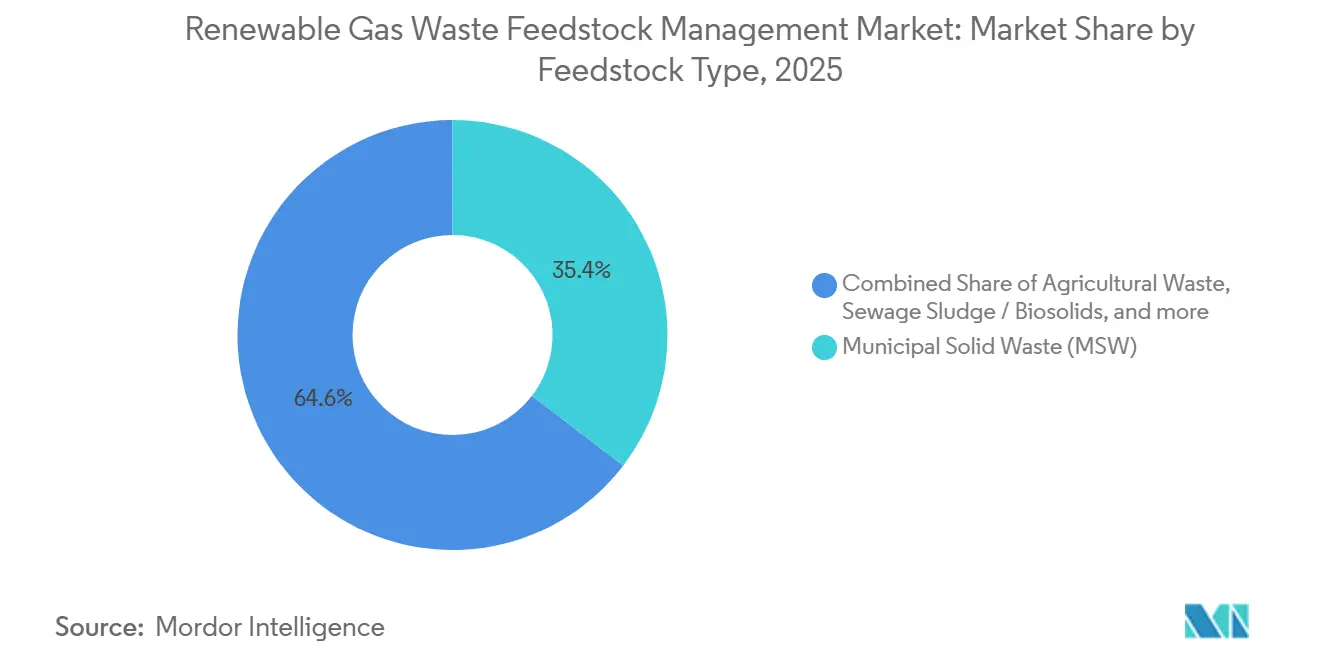
Municipal Waste Leads, While Food and Beverage Waste Has Higher GrowthMunicipal solid waste, including organic and source-separated fractions, accounted for 35.4% of the renewable gas waste feedstock management market in 2025. Existing collection networks, gate-fee structures, and landfill diversion rules support its use across Europe and North America. Agricultural waste formed another major supply group, including manure, slurry, and crop residues. Manure can yield greater economic benefits in Europe through RED III treatment for transport fuel applications. Sewage sludge and biosolids remain relevant where wastewater facilities already have storage and processing systems for co-digestion. Industrial organic waste from breweries, paper mills, and pharmaceutical operations offers a consistent composition and can reduce testing and contamination costs.
Food and beverage processing waste is the fastest-growing feedstock category, with a 10.2% CAGR from 2026 to 2031. Fats, oils, grease, spent grains, and off-specification products can deliver consistent biochemical methane potential. This consistency can reduce pre-treatment needs and support more predictable gas production. Corporate food waste targets also encourage manufacturers and retailers to establish dedicated collection arrangements. The ENGIE and PepsiCo agreement shows how an emissions program can be connected to long-term feedstock and biomethane supply. The others category, which includes textile effluents and pharmaceutical organics, remains an emerging area for future feedstock development.
By End-Use Facility Type:
Anaerobic Digestion Leads While Gasification Grows FasterAnaerobic digestion plants held 44.1% of the renewable gas waste feedstock management market in 2025. Technology maturity, established policy support, and gate-fee revenue make these plants the primary destination for many organic waste streams. Landfill gas recovery sites also handle large volumes of in-place organic material, particularly in North America. Montauk Renewables reported annual renewable natural gas production of 5.6 million MMBtu from its landfill gas recovery network. Wastewater treatment plants can use food waste co-digestion to increase biogas production from underutilized sludge digesters. Pyrolysis and hydrothermal liquefaction remain smaller routes, but they provide an option for operators seeking broader processing capability.
Gasification and thermal treatment facilities are forecast to expand at 11.5% CAGR from 2026 to 2031. These facilities can handle heterogeneous or partly contaminated material that anaerobic digestion may not accept economically. A 2026 pilot study found that thermal hydrolysis improved sludge disintegration, enhancing feedstock conditioning before conversion. Similarly, a 2025 engineering study highlighted that thermal pre-treatment can improve feedstock biodegradability and consistency, enabling more efficient handling of mixed organic waste streams. These technologies support feedstock management by reducing contaminants, improving feedstock quality, and increasing the suitability of diverse waste streams for renewable gas production.[3]
By Service Type:
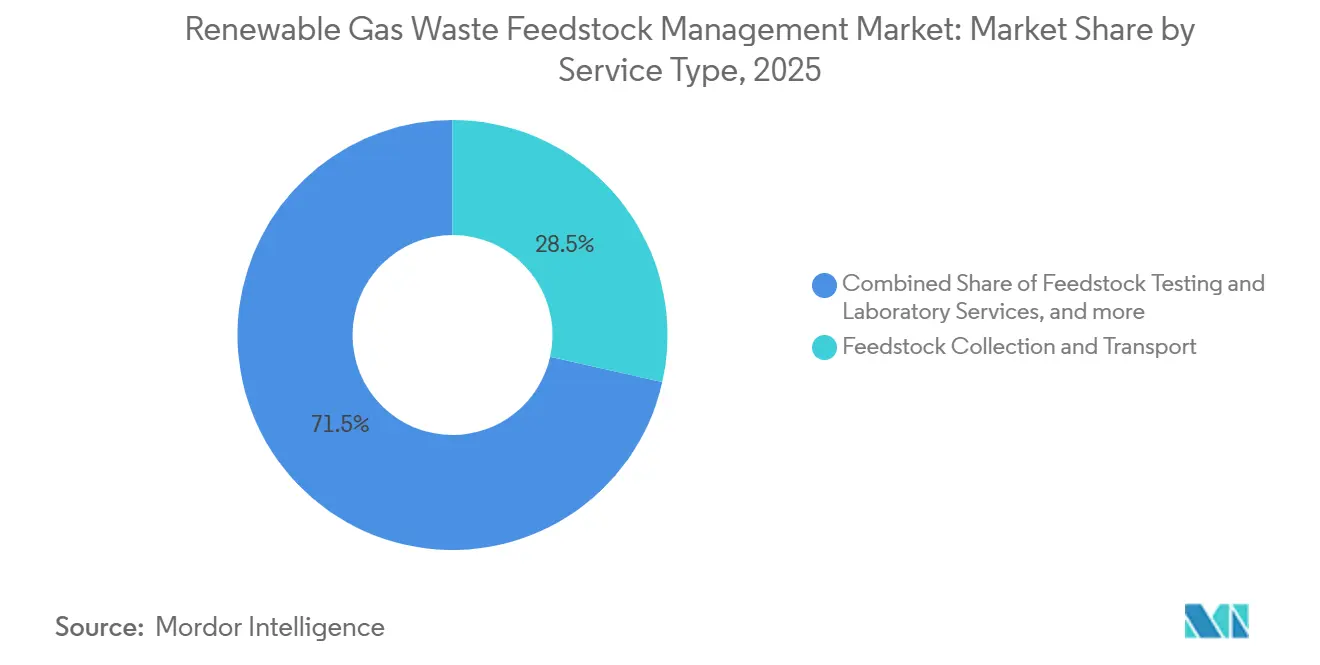
Collection Is Largest While Digital Monitoring Has the Highest GrowthFeedstock collection and transport held 28.5% of the renewable gas waste feedstock management market in 2025. Organic material in the renewable gas waste feedstock management market must be collected from households, farms, retailers, and industrial sites before it can be processed. Large providers benefit from route density, specialized vehicles, and exclusive agreements that can last 5 to 15 years. Laboratory services remain important because biochemical methane potential, heavy metals, pathogens, and other attributes affect gate-fee pricing and compliance. Quality-assurance services handle material inspection, reject management, and reporting. Supply-chain management and advisory work are becoming more important in regions where project developers are building their first structured feedstock networks.
Digital feedstock monitoring platforms are forecast to grow at a CAGR of 13.8% from 2026 to 2031, as operators seek greater control over mixed, variable inputs. A 2025 study found that AI-supported optimization can improve biogas yield and reduce operating costs in anaerobic digestion systems, especially where feedstock changes frequently. Providers are moving from one-time sensor sales toward recurring platform contracts. Real-time biochemical methane potential sensing can help operators adjust blends before instability occurs in the digester. These systems can reduce downtime and make quality assurance a more central service rather than a downstream check.
Geography Analysis
Europe Renewable Gas Waste Feedstock Management Market
Europe accounted for 35.6% of the renewable gas waste feedstock management market in 2025. The region combines dense biogas infrastructure with waste, renewable energy, and digestate rules. EU biomethane production increased by 14% in 2024, and Germany accounted for 29% of output, while France, Italy, Denmark, and the Netherlands accounted for 93% of EU output. The European renewable gas waste feedstock management market had 1,975 biomethane plants operating in July 2026 and a capacity of 8.2 billion cubic meters per year. Investment commitments reached EUR 36 billion (USD 39.6 billion) in July 2026. The limited capture of theoretical bio-waste potential indicates further room for improvement in supply systems.
APAC Renewable Gas Waste Feedstock Management Market
Asia Pacific recorded the highest projected growth rate, with the renewable gas waste feedstock management market size in the region forecast to grow at a CAGR of 16.3% from 2026 to 2031. India reported 979 operational biogas plants under the GOBARdhan scheme in January 2026. The country is developing an integrated compressed biogas policy that addresses feedstock availability, prices, and off-take. China’s NB/T 11925-2025 bio-natural gas design guidance took effect in June 2026 and set a clearer framework for large-scale projects. China’s output from medium- and large-scale biogas and biomethane facilities is projected to grow by 80% between 2025 and 2030. Indonesia and Malaysia have biogas capacity targets of 810 MW and 1,065 MW, respectively, supporting demand for organized logistics and quality services.
The Americas and MEA Renewable Gas Waste Feedstock Management Market
North America is shifting from landfill gas recovery to the digestion of agricultural and food waste. In 2025, 95% of new United States biomethane plants were renewable natural gas facilities, raising the need for lower contamination and closer monitoring. State food-waste rules, renewable fuel credits, and California’s Low Carbon Fuel Standard support this change. South America has significant untapped sugarcane vinasse and cattle manure resources, with Brazil’s RenovaBio program providing an initial signal for the use of agricultural waste. Argentina and Chile offer early development opportunities where waste-management infrastructure is less established. The Middle East and Africa remain at an earlier stage, with pilots in the United Arab Emirates, Saudi Arabia, and South Africa. At the same time, uneven regulatory support limits the duration and scale of supply contracts.
Competitive Landscape
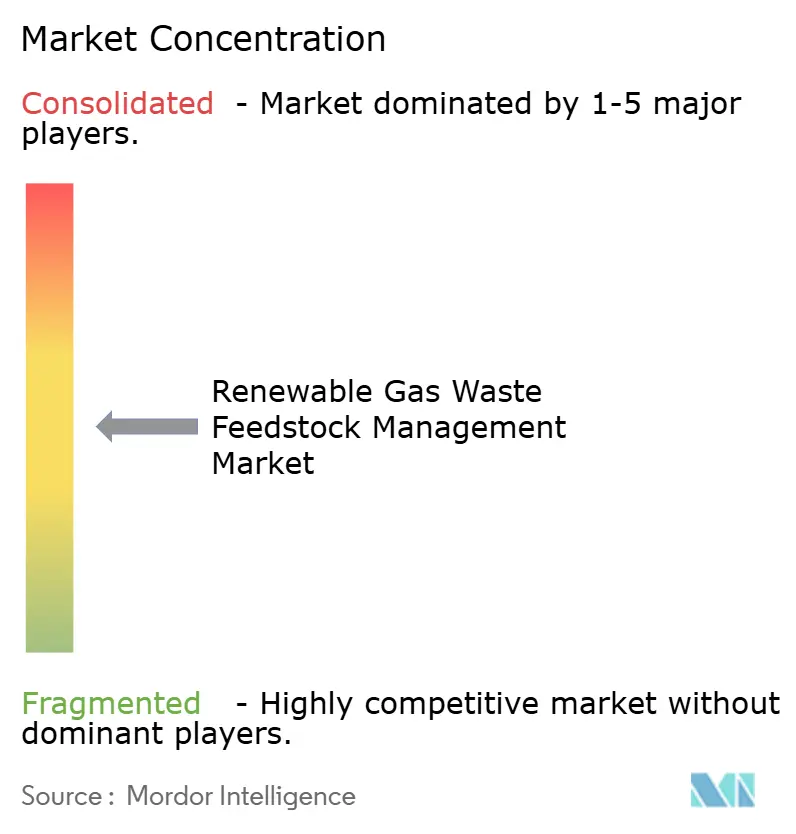
The renewable gas waste feedstock management market has a medium level of market concentration, with a mix of large integrated waste management companies and specialised service providers. Established players benefit from extensive collection networks, logistics infrastructure, and long-term contracts, while integrated operators leverage feedstock sourcing, pre-treatment, and renewable gas production to achieve operational efficiencies. Integrated providers compete by combining sourcing, pretreatment, and gas sales into a single operating model. EnviTec Biogas operated 87 owned plants and reported an annual biogas generation capacity of 1,800 GWh in 2025. This structure lets larger providers spread quality-control costs across a broad network.
Specialist technology firms and digital providers compete where collection scale is less decisive. They can offer depackaging, thermal hydrolysis, laboratory analysis, sensors, and feedstock blending tools to plant operators. Quality requirements for grid-injected biomethane give these services a clearer role in the renewable gas waste feedstock management market. Patent activity around thermal hydrolysis for mixed municipal waste shows that equipment suppliers are seeking technical differentiation. Smaller and mid-sized digesters remain a potential customer group for digital monitoring, as many lack internal optimization resources. Co-digestion advisory services may also be relevant in the Asia Pacific and Latin America, where facilities handle multiple waste streams with varying characteristics.
Competition is increasingly influenced by long-term feedstock supply and biomethane off-take agreements alongside operational capabilities. While companies such as BP plc and Shell plc participate through investments in biomethane and feedstock supply infrastructure, specialised feedstock management providers compete on collection, pre-treatment, quality assurance, and logistics services. Providers with secure feedstock contracts and strong quality management capabilities are well positioned to maintain a competitive advantage in the market.
Renewable Gas Waste Feedstock Management Industry Leaders
-
Veolia Environnement S.A.
-
Waste Management, Inc.
-
SUEZ S.A.
-
Anaergia Inc.
-
EnviTec Biogas AG
- *Disclaimer: Major Players sorted in no particular order
Renewable Gas Waste Feedstock Management Market Companies Covered in this Report
- Feedstock Collectors & Aggregators:
- Pre-Treatment Technology Providers:
- Integrated Feedstock + RNG Operators:
- Strategic Entrants:
Recent Industry Developments in Renewable Gas Waste Feedstock Management Market
- July 2026: The European Biogas Association and Gas Infrastructure Europe published the European Biomethane Map, recording European biomethane production capacity at 8.2 billion cubic meters per year, a 17% year-on-year increase, with 1,975 plants operational and investment commitments rising from EUR 28 billion (USD 31.60 billion) to EUR 36 billion (USD 39.6 billion). The data underscores the scale of contracted feedstock demand that European waste management operators are expected to serve through 2031.
- June 2026: China’s National Energy Administration implemented the NB/T 11925-2025 Guide for Process Design of Bio-natural Gas Projects, its first standardized process design framework for large-scale biogas facilities. The standard codifies feedstock handling specifications, pre-treatment requirements, and gas quality parameters.
- January 2026: ENGIE and PepsiCo signed a 10-year Biomethane Purchase Agreement for a new 60 GWh annual anaerobic digestion plant in northern England. The facility will use locally sourced agricultural waste and is projected to reduce PepsiCo United Kingdom’s CO₂ emissions by more than 10,900 tons per year relative to a 2022 baseline.
Global Renewable Gas Waste Feedstock Management Market Report Scope
The Renewable Gas Waste Feedstock Management Market Report is Segmented by Feedstock Type (Municipal Solid Waste, Agricultural Waste, and More), by End-Use Facility Type (Anaerobic Digestion (AD) Plants, and More), by Service Type (Feedstock Collection & Transport, Feedstock Testing & Laboratory Services, and More), and by Geography (Asia-Pacific, Europe, and More). The Market Forecasts are Provided in Terms of Value (USD).
| Municipal Solid Waste (Organic Fraction / Source-Separated) |
| Agricultural Waste (Manure, Slurry, Crop Residues) |
| Sewage Sludge / Biosolids |
| Food & Beverage Processing Waste (FOG, Spent Grains, Off-Spec Product) |
| Industrial Organic Waste (Breweries, Paper Mills, Pharma Effluent) |
| Others |
| Anaerobic Digestion (AD) Plants |
| Landfill Gas Recovery Sites |
| Gasification / Thermal Treatment Facilities |
| Wastewater Treatment Plants (Co-Digestion) |
| Others (Pyrolysis, Hydrothermal) |
| Feedstock Collection & Transport |
| Feedstock Testing & Laboratory Services |
| Feedstock Quality Assurance |
| Digital Feedstock Monitoring Platforms |
| Feedstock Supply Chain Management & Consultancy |
| North America | United States |
| Canada | |
| Mexico | |
| South America | Brazil |
| Argentina | |
| Chile | |
| Peru | |
| Rest of South America | |
| Europe | Germany |
| United Kingdom | |
| France | |
| Italy | |
| Spain | |
| Benelux (Belgium, Netherlands, and Luxembourg) | |
| NORDICS (Denmark, Finland, Iceland, Norway, and Sweden | |
| Rest of Europe | |
| Asia-Pacific | China |
| India | |
| Japan | |
| South Korea | |
| Australia | |
| Southeast Asia (Indonesia, Vietnam, Thailand, Malaysia, Philippines) | |
| Rest of Asia-Pacific | |
| Middle East & Africa | United Arab Emirates |
| Saudi Arabia | |
| South Africa | |
| Egypt | |
| Rest of Middle East & Africa |
| By Feedstock Type | Municipal Solid Waste (Organic Fraction / Source-Separated) | |
| Agricultural Waste (Manure, Slurry, Crop Residues) | ||
| Sewage Sludge / Biosolids | ||
| Food & Beverage Processing Waste (FOG, Spent Grains, Off-Spec Product) | ||
| Industrial Organic Waste (Breweries, Paper Mills, Pharma Effluent) | ||
| Others | ||
| By End-Use Facility Type | Anaerobic Digestion (AD) Plants | |
| Landfill Gas Recovery Sites | ||
| Gasification / Thermal Treatment Facilities | ||
| Wastewater Treatment Plants (Co-Digestion) | ||
| Others (Pyrolysis, Hydrothermal) | ||
| By Service Type | Feedstock Collection & Transport | |
| Feedstock Testing & Laboratory Services | ||
| Feedstock Quality Assurance | ||
| Digital Feedstock Monitoring Platforms | ||
| Feedstock Supply Chain Management & Consultancy | ||
| By Geography | North America | United States |
| Canada | ||
| Mexico | ||
| South America | Brazil | |
| Argentina | ||
| Chile | ||
| Peru | ||
| Rest of South America | ||
| Europe | Germany | |
| United Kingdom | ||
| France | ||
| Italy | ||
| Spain | ||
| Benelux (Belgium, Netherlands, and Luxembourg) | ||
| NORDICS (Denmark, Finland, Iceland, Norway, and Sweden | ||
| Rest of Europe | ||
| Asia-Pacific | China | |
| India | ||
| Japan | ||
| South Korea | ||
| Australia | ||
| Southeast Asia (Indonesia, Vietnam, Thailand, Malaysia, Philippines) | ||
| Rest of Asia-Pacific | ||
| Middle East & Africa | United Arab Emirates | |
| Saudi Arabia | ||
| South Africa | ||
| Egypt | ||
| Rest of Middle East & Africa | ||
Key Questions Answered in the Report
What is the forecast for renewable gas waste feedstock management?
The sector is projected to reach USD 31.42 billion by 2031 from USD 20.34 billion in 2026, at a 9.09% CAGR.
Which feedstock category is growing fastest?
Food and beverage processing waste is forecast to grow at a CAGR of 10.2% through 2031, driven by its consistent quality and high biochemical methane potential.
Why are gate fees important for project economics?
Gate fees generate revenue for operators by accepting waste, reducing dependence on biogas, and responding to price movements in renewable natural gas.
Which treatment facilities are expanding fastest?
Gasification and thermal treatment facilities are forecast to grow at a CAGR of 11.5% through 2031 because they can process difficult and mixed material streams.
Which region has the strongest growth outlook?
Asia Pacific is forecast to grow at a CAGR of 16.3% through 2031, supported by activity in India, China, and Southeast Asia.
What is the main operational risk for anaerobic digestion feedstock?
Plastics and heavy metals can lower biogas performance and reduce digestate quality, making screening and testing essential.