
Market Overview
| Study Period | 2020 - 2031 |
|---|---|
| Forecast Data Period | 2026 - 2031 |
| Base Year Market Size (2025) | USD 132.52 Billion |
| Market Size (2026) | USD 134.72 Billion |
| Market Size (2031) | USD 146.3 Billion |
| Growth Rate (2026 - 2031) | 1.66 % |
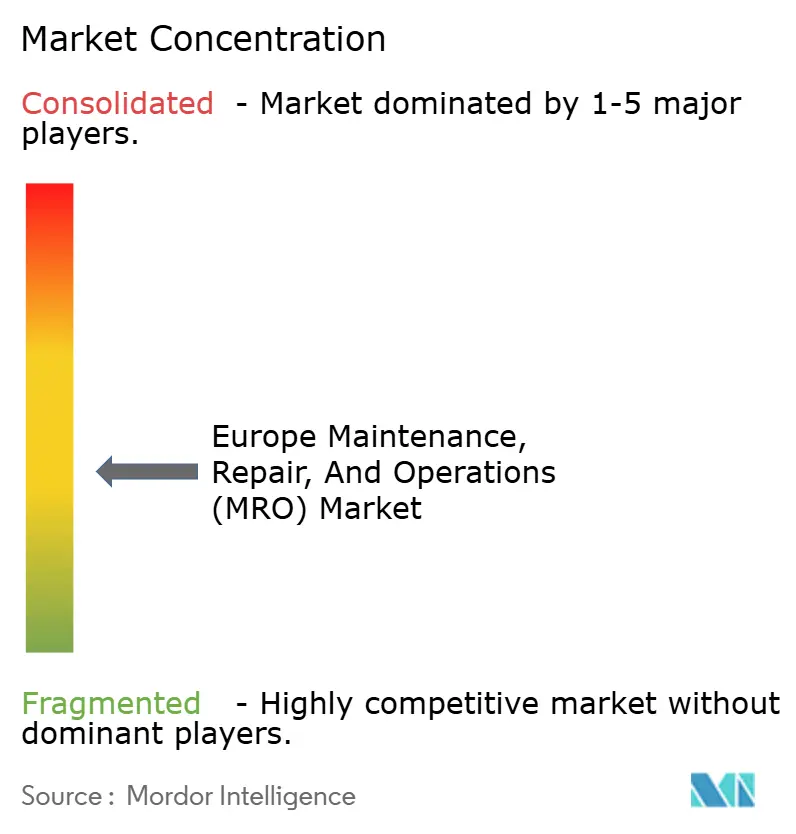
| Market Concentration | Medium |
Major Players *Disclaimer: Major Players sorted in no particular order Image © Mordor Intelligence. Reuse requires attribution under CC BY 4.0. | |
Europe Maintenance, Repair, And Operations (MRO) Market Analysis by Mordor Intelligence
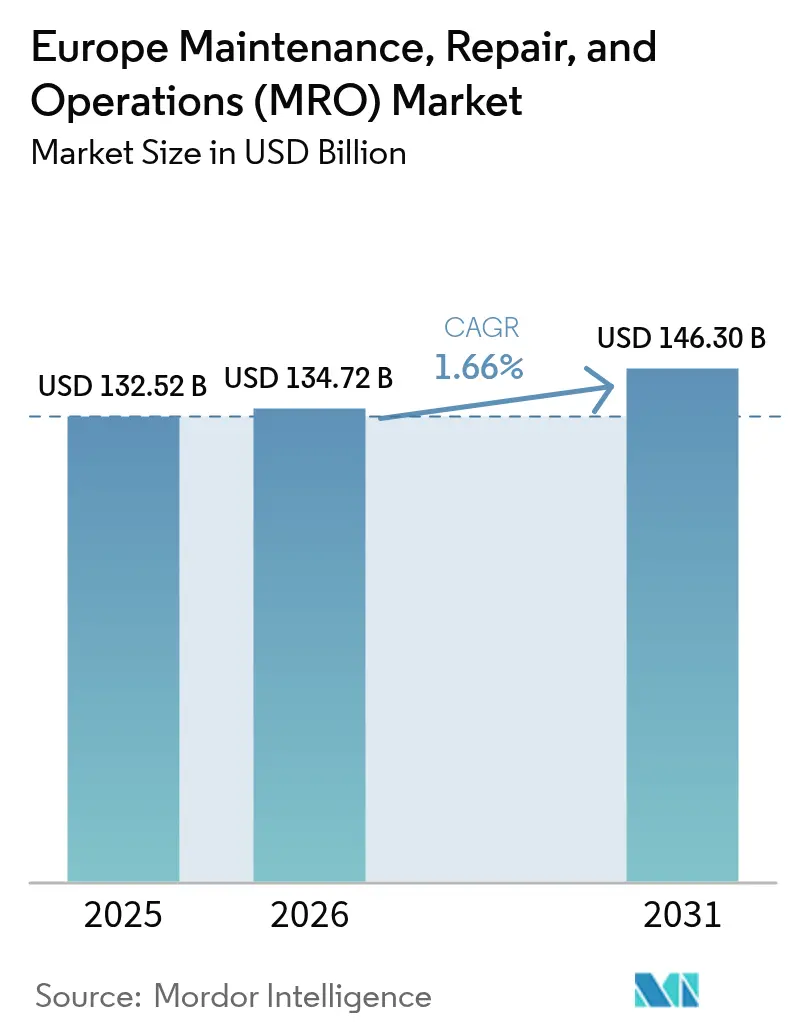
The European MRO market size was valued at USD 132.52 billion in 2025 and estimated to grow from USD 134.72 billion in 2026 to reach USD 146.3 billion by 2031, at a CAGR of 1.66% during the forecast period (2026-2031). This mature yet steadily expanding trajectory stems from mandatory right-to-repair rules, circular economy legislation, and a growing reliance on data-driven maintenance strategies across the region’s diversified industrial base. Germany’s deep automation footprint, the European green-deal agenda, and heightened supply-chain resilience programs all reinforce long-term demand for integrated maintenance solutions. Rapid digitalization raises the competitive stakes for service providers who can merge mechanical, electrical, and software support into a single, coordinated offer. Meanwhile, manufacturers are shifting budget priorities from capital investments to operating expenses, accelerating the uptake of external services, and creating new revenue streams for specialized vendors. Finally, sustainability disclosures mandated by the Corporate Sustainability Reporting Directive (CSRD) intensify the requirement for life-cycle-oriented maintenance documentation, providing an extra boost to analytics-enabled service contracts.
Key Report Takeaways
- By MRO type, Industrial MRO led with 45.88% revenue share in 2025, whereas Electrical MRO is forecast to advance at a 2.69% CAGR to 2031.
- By maintenance type, preventive routines held 57.02% of the European MRO market share in 2025, while predictive programs are projected to climb at a 6.82% CAGR through 2031.
- By sourcing model, internal teams controlled 62.05% of spending in 2025; yet, external services are poised for a 6.15% CAGR, as manufacturers favor asset-light strategies.
- By end-user industry, manufacturing accounted for 31.55% of the European MRO market size in 2025, whereas the energy and utilities sector is expected to expand at a 5.21% CAGR through 2031.
- By country, Germany accounted for 38.10% of regional demand in 2025, while Spain is expected to log the fastest 4.32% CAGR during the outlook period.
Note: Market size and forecast figures in this report are generated using Mordor Intelligence’s proprietary estimation framework, updated with the latest available data and insights as of 2026.
Europe Maintenance, Repair, And Operations (MRO) Market Trends and Insights
Drivers Impact Analysis*
| Driver | (~) % Impact on CAGR Forecast | Geographic Relevance | Impact Timeline |
|---|---|---|---|
| Regulatory push for predictive maintenance in European industry | +0.4% | Germany, France, the Netherlands, Nordic countries | Medium term (2-4 years) |
| Industrial automation and the need for uptime across the manufacturing base | +0.3% | Germany, Italy, the Czech Republic, and Poland | Long term (≥ 4 years) |
| Shift from capex to opex, favoring outsourced MRO contracts | +0.3% | Western Europe, early adoption in Scandinavia | Short term (≤ 2 years) |
| Sustainability legislation is driving circular and remanufactured parts | +0.3% | EU-wide, strongest in Germany, the Netherlands, and Denmark | Long term (≥ 4 years) |
| Aging aerospace and transportation fleets are demanding overhaul cycles | +0.2% | United Kingdom, France, Germany, Spain | Medium term (2-4 years) |
| E-commerce platforms optimizing MRO supply chains | +0.2% | Germany, the United Kingdom, France, Benelux | Short term (≤ 2 years) |
| Source: Mordor Intelligence | |||
Regulatory Push for Predictive Maintenance in European Industry
The Cyber Resilience Act requires connected-equipment manufacturers to incorporate continuous monitoring into their machines, effectively making predictive maintenance a compliance requirement.[1]European Commission, “Regulation (EU) 2024/2847 on Cybersecurity,” eur-lex.europa.eu Companies that comply early are already reducing unplanned downtime by up to 50%, a cost-saving measure that further stimulates demand for analytics-heavy MRO contracts. Germany’s government reserves EUR 2.1 billion (USD 2.26 billion) to subsidize Industry 4.0 rollouts, with 40% of that package specifically allocated for predictive infrastructure. As large OEMs increasingly require downstream suppliers to share machine health data, even mid-sized plants must adopt sensors and cloud-based analytics to remain on approved vendor lists. As the phased regulation runs until 2027, the European MRO market benefits from a staggered, multi-year investment cycle that sustains growth.
Industrial Automation and the Need for Uptime Across the Manufacturing Base
Europe’s factories operate closer to full capacity than most of their global peers, with leading German plants posting overall equipment effectiveness rates of nearly 90%. The stakes rose sharply after pandemic-era semiconductor shortages revealed how a single machine failure could ripple through entire supply networks. Automotive electrification now introduces high-voltage and battery-handling complexity, prompting firms such as Volkswagen to allocate EUR 89 billion (USD 95.8 billion) for electric-mobility infrastructure that requires specialized maintenance.[2]Volkswagen Group, “Investments in Electric Mobility,” volkswagen-group.com Czech and Polish exporters are following suit to keep pace with German benchmarks, reinforcing the region-wide priority on uptime. These dynamics draw continuous spending into the European MRO market as digital twins, smart sensors, and AI-driven diagnostics evolve from a nice-to-have to a competitive imperative.
Shift from Capex to Opex, Favoring Outsourced MRO Contracts
CSRD rules reward asset-light business models that can document lower carbon footprints and clearer cost allocation. Scandinavian manufacturers were first movers, increasing outsourced maintenance budgets by roughly one-third between 2022 and 2024 as they redeployed capital into core production. Siemens Digital Industries reports 28% year-over-year growth in external contract value, signaling a structural shift toward pay-as-you-go service models. Outsourcing also mitigates labor shortages by shifting recruitment risk to vendors, a potent incentive as Europe prepares for an estimated 145,000 technician shortfall. Consequently, specialist providers with multi-disciplinary teams and strong digital toolkits are winning longer, larger contracts across the European MRO market.
Sustainability Legislation Driving Circular and Remanufactured Parts Use
The Ecodesign for Sustainable Products Regulation mandates longer product life and material recovery, prompting companies to prioritize repairs over replacements. Denmark, the Netherlands, and Germany are showing early traction in the adoption of remanufactured parts, cutting waste while trimming maintenance costs by up to 15%. European steelmakers and component suppliers now market low-carbon or recycled-content spares, creating distinct value streams for repair-centric service providers. Over the long term, these mandates rebalance inventories toward refurbished components, deepening the skill set required of maintenance crews and broadening the scope of contracts—from standard service to complete circular economy compliance reporting.
Restraints Impact Analysis*
| Restraint | (~) % Impact on CAGR Forecast | Geographic Relevance | Impact Timeline |
|---|---|---|---|
| Skilled labor shortage of certified technicians | -0.3% | Germany, the United Kingdom, the Netherlands, Nordic countries | Long term (≥ 4 years) |
| Volatile raw-material prices are squeezing distributor margins | -0.2% | EU-wide, especially Eastern Europe | Short term (≤ 2 years) |
| OEM data monopolies are limiting independent service access | -0.1% | Germany, France, Italy | Medium term (2-4 years) |
| Geopolitical supply-chain disruptions for critical spares | -0.2% | Eastern Europe, Germany | Medium term (2-4 years) |
| Source: Mordor Intelligence | |||
Skilled Labor Shortage of Certified Technicians
Europe is expected to require up to 145,000 additional maintenance technicians by 2030, resulting in a training expenditure of EUR 1.4 billion (USD 1.51 billion). Germany shoulders the heaviest burden, with 45,000 unfilled maintenance roles despite its renowned apprenticeship programs. Aviation is hit hardest because aircraft operations require lengthy certification processes; in some cases, recruits wait two years or more before they can sign off on critical tasks. The demographic reality compounds the issue: 40% of today’s maintenance workforce is over 50, which raises the urgency of replacement. Persistent scarcity raises service prices, delays repairs, and restricts the speed at which the European MRO market can scale.
Volatile Raw-Material Prices Squeezing Distributor Margins
Steel costs increased by 45% between 2022 and mid-2024, driven by energy inflation and geopolitical tensions.[3]European Steel Association, “Steel Market Developments,” eurofer.eu Titanium, palladium, and rare-earth supplies also tightened after the Russia-Ukraine conflict, inflating aerospace component costs throughout the supply chain. Smaller Eastern European vendors lack hedging capacity and therefore pass higher prices through to customers or exit the market. Energy-intensive forging and casting shops pay as much as 80% more for electricity at peak times, eroding profitability and discouraging investment in new capacity. Contract structures are shifting toward cost-plus terms, but the uncertainty still caps short-term growth within parts-dependent portions of the European MRO market.
*Our forecasts treat driver/restraint impacts as directional, not additive. The impact forecasts reflect baseline growth, mix effects, and variable interactions.
Segment Analysis
By MRO Type: Electrical Specialism Outpaces Broad Industrial Base
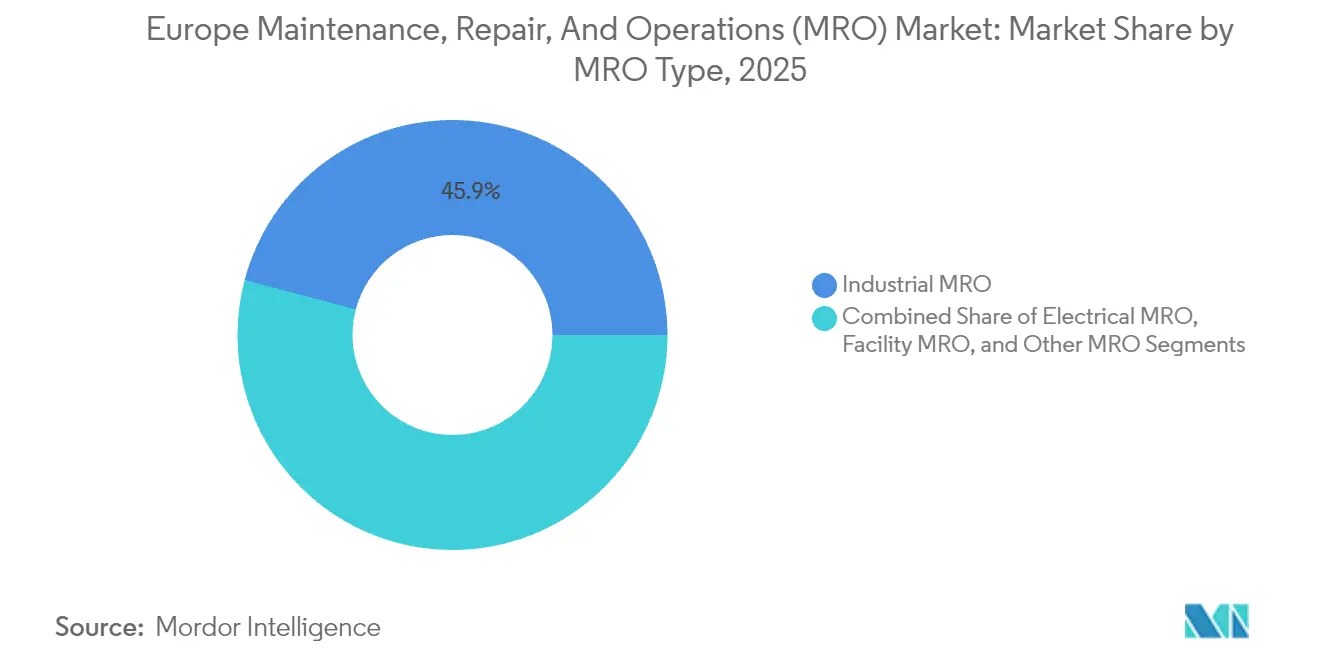
Industrial MRO retained 45.88% of 2025 revenue owing to Europe’s vast manufacturing ecosystem and the deep integration of automation technologies that demand regular servicing. The European MRO market size for industrial plants continues to grow modestly as facilities modernize; however, the electrical segment is growing faster, driven by renewable energy rollouts and smart factory retrofits. Germany’s ramp-up of electric-vehicle charging networks alone calls for thousands of high-voltage technicians trained to both mechanical and digital standards. Although facility services like HVAC and building automation offer steady returns, emerging niches—such as the maintenance of hydrogen electrolyzers—illustrate how environmental legislation constantly extends the market’s technical frontier.
Electrical MRO’s 2.69% CAGR springs from converging trends: wider sensor deployment, grid digitalization, and stricter uptime targets for renewable assets. As more solar parks and battery-storage arrays connect to the network, preventive testing of switchgear, cables, and inverters becomes mission-critical. Hybrid service contracts, which combine mechanical fixes with software upgrades, are gaining favor, further blurring traditional category boundaries. Those who master both domains are poised to capture above-average wallet share from asset owners seeking single-source accountability across a growing array of technologies.



By Maintenance Type: Predictive Routines Transform Cost Structures
Preventive programs accounted for 57.02% of 2025 spending and remain the backbone of European reliability culture; yet, predictive analytics is rewriting the rulebook by growing at a 6.82% CAGR. Real-time data enables operators to schedule work only when indicators cross risk thresholds, thereby reducing spare parts consumption and freeing labor for more strategic tasks. Early adopters such as BMW report 40% fewer unscheduled stops, which translates into direct margin gains and stronger supply-chain credibility. Consequently, the European MRO market size allocated to sensors, cloud platforms, and AI models climbs each year.
Corrective tasks still matter because no predictive model can foresee every failure. When turbines, engines, or robotic cells break unexpectedly, downtime losses can exceed EUR 100,000 (USD 108,000) per hour. Vendors now deploy augmented-reality headsets to accelerate complex repairs, while drone inspection shrinks outage windows for high-rise or offshore assets. As the service mix shifts, providers who can pivot between data-driven forecasting and responsive crisis management will protect their revenue streams, even as predictive penetration deepens.
By Sourcing Type: External Expertise Gains Momentum
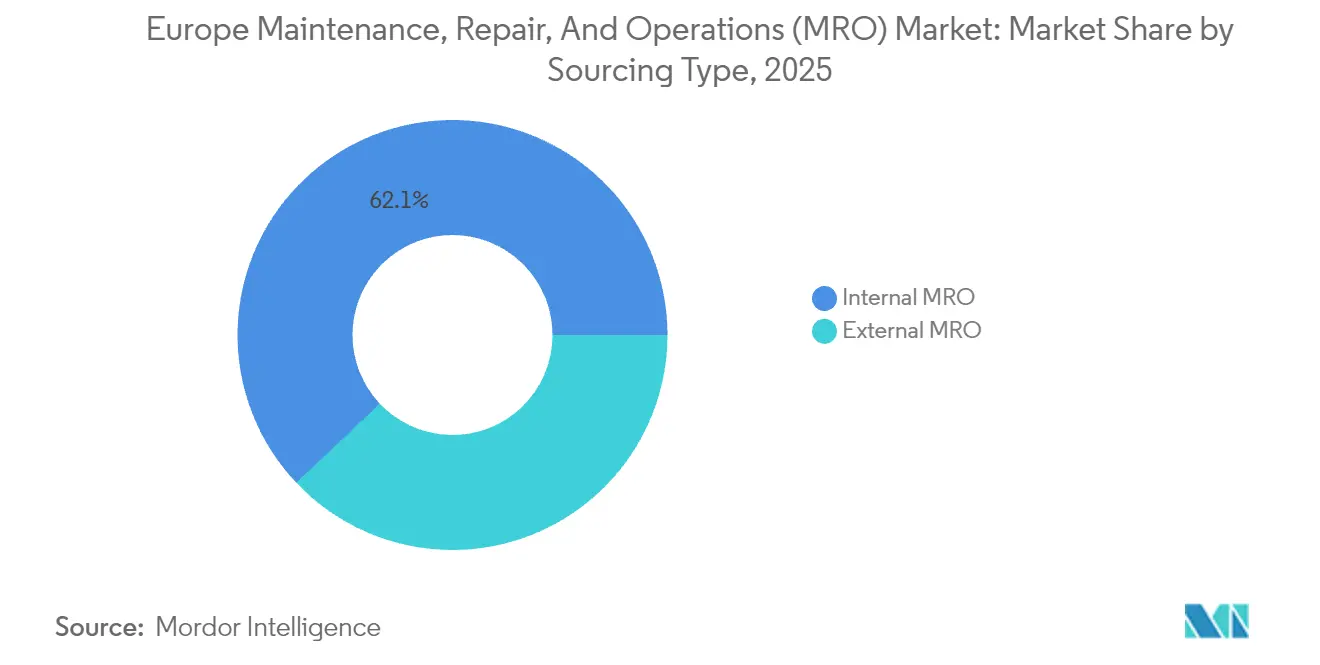
Internal teams controlled 62.05% of 2025 spend, underscoring Europe’s longstanding preference for in-house technical mastery. Nevertheless, the external portion is rising at a 6.15% CAGR, as equipment complexity outpaces corporate skill-development cycles. Asset-light, sustainability-oriented financial reporting under CSRD further nudges management toward outsourcing, particularly in high-cost Nordic economies.
External suppliers differentiate themselves by bundling uptime guarantees, inventory management, and compliance reporting into a single performance-based contract. Scale allows them to invest in niche skills, such as additive-manufactured spare production, that most plant operators cannot justify alone. Over time, partner ecosystems, rather than individual workshops, will dominate the European MRO market, mirroring trends seen earlier in IT and logistics outsourcing.
By End-User Industry: Energy Transition Sets the Pace
Manufacturing still contributed 31.55% of 2025 turnover, reflecting Europe’s dense network of automotive, chemical, and machinery plants that require constant upkeep. However, energy and utilities already post a market-leading 5.21% CAGR as the continent pours EUR 584 billion (USD 629 billion) into REPowerEU projects, which include wind, solar, and grid modernization. Turbines require gearbox checks every 6-12 months, and solar sites necessitate regular inverter calibration and cleaning to maintain optimal yield.
Aerospace remains a high-value sector due to its safety-critical processes, while the automotive industry's shift to electric drivetrains multiplies service tasks for battery handling, thermal management, and software updates. Meanwhile, nascent fields like hydrogen production and carbon capture create fresh blue-ocean prospects for agile maintenance players that can blend process, electrical, and digital know-how.
Geography Analysis
Germany’s large installed base, combined with high uptake of predictive maintenance, secures its leadership position. Widespread automation and Federal funding sustain a strong pipeline of retrofit projects that underpin the European MRO market. The United Kingdom follows, with diversified demand from aerospace engines, offshore wind farms, and rail overhauls, although post-Brexit customs formalities add cost friction to cross-border parts movements. France’s nuclear fleet and Airbus production lines ensure a steady flow of specialized maintenance requirements, while national decarbonization goals drive upgrades in HVAC and building management systems. Italy’s machinery and luxury automotive clusters prefer preventive disciplines rooted in lean manufacturing culture; yet, rising EV adoption is prompting new skills investments. Spain’s rapid growth stems from the deployment of solar and onshore wind energy across Andalusia and Castilla-La Mancha, creating an outsized demand for high-voltage electricians and blade technicians. The Rest of Europe captures Poland, the Czech Republic, and Hungary, where EU funds stimulate factory modernization and extend the European MRO market share into Central and Eastern corridors.
Supply-chain resiliency imperatives born out of the Russia-Ukraine conflict are propelling regional sourcing; many German and Austrian firms are relocating critical spare parts depots to Dutch ports and Polish free zones to cushion geopolitical shocks. Pan-European e-commerce platforms further shorten lead times, particularly for small and medium-sized enterprises. Overall, geography-specific policies, investment incentives, and changes in the energy mix produce a heterogeneous yet collectively expanding European service landscape.
Regulatory Landscape
EU regulation is tightening documentation, cybersecurity, and AI-governance requirements that affect maintenance workflows for connected industrial assets and safety-critical fleets. The EU AI Act (in force since August 2024) adds risk-management, transparency, and human-oversight duties for high-risk AI uses, including AI-driven fault prediction and predictive maintenance, while the Cyber Resilience Act raises security-by-design expectations for connected equipment and the software components maintained in the field.
Industrial and aerospace MRO providers are also preparing for Machinery Regulation (EU) 2023/1230, which replaces the Machinery Directive from January 20, 2027, and expands obligations around cybersecurity, AI-enabled safety components, and the treatment of substantial modifications during retrofits. In aviation, EASA updates continue to raise the bar for organizational controls and cyber assurance. By March 2026, Part-CAMO and Part-145 organizations completed the transition period tied to Regulation (EU) 2023/203, which includes Information Security Management Systems. In June 2026, EASA updated its Easy Access Rules for Continuing Airworthiness, incorporating Regulation (EU) 2025/111 for electric and hybrid-propulsion aircraft, affecting maintenance standards and evidence trails.
Value Chain Analysis
The European MRO value chain typically runs from OEMs and component manufacturers (mechanical, electrical, and automation parts) through authorized and independent service providers, then to distributors and digital procurement platforms that manage spares availability and fulfillment to end users in manufacturing, energy and utilities, aerospace, automotive, and facilities. A growing layer of software and data infrastructure (EAM/CMMS, condition monitoring, analytics, and cybersecurity tooling) now sits alongside traditional parts and labor, reflecting the shift toward predictive routines and compliance-grade maintenance records under EU sustainability and product rules.
Distribution and inventory orchestration is increasingly becoming a differentiator as customers seek uptime guarantees and shorter lead times amid supply-chain disruptions and raw-material volatility. Large distributors are expanding vendor-managed inventory and on-site replenishment models, supported by digital tools (for example, Rubix has promoted its Rubix INSITE approach for on-site replacement-part management to reduce downtime), while regionalization of critical spare depots (including movement toward logistics hubs in Dutch ports and Polish free zones) is used to buffer cross-border friction and geopolitical shocks. Certified labor availability and access to OEM data for troubleshooting remain key bottlenecks, pushing service models toward bundled mechanical-electrical-software support and stronger documentation and traceability across the chain.
Competitive Landscape
The European maintenance arena is moderately fragmented, with large aerospace specialists coexisting alongside thousands of local industrial workshops. Lufthansa Technik, Safran, and MTU Aero Engines dominate aviation engine and APU workscopes, leveraging scale and OEM alliances to secure double-digit operating margins. Industrial segments remain more fragmented but are progressing toward consolidation as vendors aggregate predictive analytics capabilities to secure global framework deals.
Technology adoption shapes competitive advantage. Service providers deploying digital twins, machine-learning prognostics, and augmented-reality repair guidance report 20-30% higher productivity compared to their peers.[4]Lufthansa Technik, “Press Releases,” lufthansa-technik.com Many independent companies lack the capital to keep pace and are therefore targets for acquisition. EasyJet’s purchase of SR Technics Malta and Sonaca’s tie-up with Aciturri illustrate the momentum toward vertical integration, ensuring aircraft operators and airframe suppliers control critical capacity.
White-space opportunities emerge in green-energy and hydrogen-infrastructure maintenance, areas where few incumbents possess deep domain knowledge. Vendors able to staff composite-blade repair teams or electrolyzer stack specialists will capture a disproportionate share as Europe scales its renewable capacity. Simultaneously, the skilled labor deficit elevates talent management to a strategic priority, prompting leaders to launch in-house academies and cross-training programs that not only lock in expertise but also enhance the employer brand.
Europe Maintenance, Repair, And Operations (MRO) Industry Leaders
Wurth Group GmbH
W.W. Grainger Inc.
Sonepar SA
Rexel SA
WESCO International Inc.
- *Disclaimer: Major Players sorted in no particular order

Market Opportunities and Future Outlook
Compliance-driven digital maintenance is creating whitespace for providers that can bundle condition monitoring, cybersecurity controls, and audit-ready documentation into ongoing service contracts. The EU AI Act (in force since August 2024) and the runway to Machinery Regulation (EU) 2023/1230 (effective January 2027) increase the need for governed AI models, change-control, and traceable evidence in maintenance decisions. This creates room for MRO vendors that integrate AI governance, cyber hygiene, and EAM data management as part of delivery rather than as add-ons.
Industrial connectivity and sovereign-cloud adoption are also reshaping how European asset owners operate and outsource maintenance activities. In April 2026, Deutsche Telekom highlighted EDAG Group migrating its industrial metaverse platform (metys) to T-Systems sovereign cloud infrastructure, indicating continued investment in Europe-based compute and data control for industrial AI and simulation. Parallel deployments of private 5G in industrial sites (including collaborations referenced in Europe around industrial digitalization) support real-time inspection, remote assistance, and sensor-driven workflows, which increases demand for service partners that can maintain both the physical asset and its connected stack across mechanical, electrical, and software layers.
Recent Industry Developments
- June 2026: Sonepar acquired the LCI Group in Portugal, including Tanqueluz, Futurluz, and Vedrel, adding a 17-branch footprint. The move improves last-mile availability for electrical and automation-related MRO categories and supports faster fulfillment for industrial and contractor customers. It also strengthens Sonepar’s position in a country highlighted for faster regional growth dynamics within Europe.
- March 2026: Wurth Elektronik ICS signed an agreement to acquire 100% of MRS Holding GmbH, expanding capabilities in electronic control, communication, and connectivity solutions. The deal aligns MRO distribution and service portfolios with increasingly software-defined assets that require hybrid electrical and digital support. It also broadens the in-house expertise needed for connected-equipment troubleshooting and lifecycle service offerings.
- February 2024: Wurth Electrical Wholesale Group acquired TIM S.A. in Poland. The acquisition expanded local scale in Central and Eastern Europe, improving coverage and responsiveness for MRO electrical supplies and related services. It also supports supply-chain resilience strategies that emphasize regional availability of critical spares and technical support.


Research Methodology Framework and Report Scope
Market Definition and Coverage
We size the Europe maintenance, repair, and operations (MRO) market as the value of goods and services purchased to keep plants, facilities, and equipment running, including routine maintenance and repair activity that supports day to day operations.
Scope exclusions: We exclude items that are directly consumed in the core manufacturing process as production inputs.
Segmentation Overview
- By MRO Type
- Industrial MRO
- Electrical MRO
- Facility MRO
- Other MRO Types
- By Maintenance Type
- Preventive
- Predictive
- Corrective
- By Sourcing Type
- Internal MRO
- External MRO
- By End-user Industry
- Manufacturing
- Aerospace
- Automotive
- Energy and Utilities
- Others
- By Country
- Germany
- United Kingdom
- France
- Italy
- Spain
- Rest of Europe
Data Sources, Market Sizing, and Validation
Desk Research
Desk research built the initial market frame and helped us anchor Europe level demand signals to repeatable public data. We relied on sources such as Eurostat for industrial output and price series, the European Commission for policy and energy transition updates, and the European Environment Agency for compliance signals that affect maintenance intensity.
To keep the model grounded, we also reviewed country level statistical offices and procurement disclosures where available, along with association and standards bodies that touch maintenance practices (for example, ISO maintenance related standards references and national engineering bodies). Company annual reports, investor presentations, and reputable press were used to understand sourcing patterns between internal teams and outsourced maintenance. Select paid subscriptions were used only to speed up company financial extraction, patent lookups, and shipment level trade checks where MRO spare parts flows were relevant. The desk sources listed here are illustrative, and many other public references were used for collection, cross checks, and clarification.
Primary Interviews and Surveys
Primary work was used to confirm what is actually bought under MRO budgets in Europe, and to sanity check the split between industrial, electrical, and facility related spend as equipment ages and compliance needs rise. We spoke with a mix of distributors, service providers, maintenance managers, and procurement leaders across key European economies so that replacement cycle assumptions, outsourcing intensity, and typical pricing moves could be corrected where needed.
Distribution of primary research fieldwork respondents
| Company type | Respondent position |
|---|---|
| Top tier: 30% | CXOs: 14% |
| Mid tier: 56% | Functional/Unit leaders: 28% |
| Smaller Players: 14% | Managers: 58% |
Market-Sizing & Forecasting
The core model starts with a top down build where Europe industrial activity and asset base signals are translated into an addressable maintenance spend pool, and then adjusted to reflect what is typically categorized as MRO purchasing. To keep the totals realistic, we corroborate the outcome with selective bottom up approximations, such as rolling up sampled distributor revenues, channel checks on spare parts versus service mixes, and typical spend per site benchmarks where interviews confirmed ranges.
A few practical inputs are used to keep the math traceable, including industrial production trends, energy and utilities operating intensity, maintenance type mix shifts (preventive, predictive, corrective), outsourcing penetration by end user, and observed pricing movement for common consumables and spares. Where company disclosures are incomplete, gaps are handled through peer based ratios and country weighting, followed by a second pass with interview feedback to avoid over extrapolation. For forecasting, we ran scenario analysis because maintenance budgets tend to respond to both macro output cycles and compliance driven programs, and the scenarios were aligned to what practitioners expect for plant utilization and replacement timing over the forecast window.
Data Validation & Update Cycle
Outputs are checked against independent signals, including industrial output direction, visible maintenance outsourcing trends, and trade movement for major spare parts categories where it helps explain inflections. Variances that fall outside expected ranges are reviewed, assumptions are re checked, and follow up calls are triggered when a single input is driving too much of the change.
Before sign off, a multi step internal review is completed so unit logic, currency handling, and country totals reconcile cleanly. Reports refresh annually, and interim updates are made when material events occur, such as large regulatory changes or sharp energy price shifts that affect maintenance schedules. Right before delivery, a final pass is run so clients receive the latest updated view.
Mordor Intelligence's Europe Maintenance Repair and Operations Market Sizing Compared With Other Published Estimates
Published market numbers for Europe MRO can vary because the spending boundary is not always treated the same way, and because some estimates mix goods and services differently across industrial, electrical, and facility upkeep. Timing also matters, since MRO is sensitive to industrial output cycles and price changes in spares, which can shift totals even when volumes look steady.
By tracking replacement cycles, outsourcing penetration, and USD conversion timing, Mordor Intelligence keeps the Europe MRO total tied to operational spend that supports running assets, rather than counting production inputs or adjacent capex programs. Differences also show up when a model relies on broad multipliers without checking how preventive and predictive maintenance adoption changes the service mix, and when refresh cadence lags fast moving input costs for common consumables and parts.
Benchmark comparison
| Source | Market Size | Gaps in Research Methodology |
|---|---|---|
| Mordor Intelligence | USD 132.52 B (2025) | |
| Industry Portal A | USD 31.71 B (2025) | This estimate appears to narrow the scope to a smaller MRO slice, likely closer to a specific service category or subset of end users, which would leave out broad facility and industrial consumables spending. |
| Sector Brief B | USD 158.90 B (2024) | This figure likely uses an earlier base year with a wider definition that can fold in adjacent operational spend beyond core MRO, and it may apply higher price or inflation pass through without the same maintenance type mix checks. |
The comparison suggests the spread is mainly explained by what is counted as MRO, along with base year timing and how prices are carried forward. Our approach stays easy to audit because each adjustment is linked to a small set of measurable drivers, and the final total is re checked with on the ground feedback before it is finalized.


Key Questions Answered in the Report
What is the size of the European MRO market in 2026?
The market is valued at USD 134.72 billion in 2026 and is projected to reach USD 146.3 billion by 2031.
What is the expected CAGR for Europe’s MRO services between 2026 and 2031?
The market is forecast to grow at a 1.66% CAGR over the period.
Which segment is expanding fastest within Europe’s maintenance landscape?
The Electrical MRO segment is the fastest-growing, projected to grow at a 2.69% CAGR through 2031.
Why is predictive maintenance gaining traction in Europe?
EU cybersecurity and right-to-repair mandates necessitate continuous monitoring, enabling up to 50% cost savings in unplanned downtime.
What factor most constrains market growth?
Acute shortages of certified technicians—estimated at up to 145,000 by 2030—pose the primary growth bottleneck.
Which country is expected to deliver the strongest growth rate by 2031?
Spain is forecast to post the highest national CAGR at 4.32%, driven by large-scale renewable-energy investments.
Page last updated on:




