
Market Overview
| Study Period | 2020 - 2031 |
|---|---|
| Forecast Data Period | 2026 - 2031 |
| Base Year Market Size (2025) | USD 8.59 Billion |
| Market Size (2026) | USD 8.87 Billion |
| Market Size (2031) | USD 10.44 Billion |
| Growth Rate (2026 - 2031) | 3.31 % |
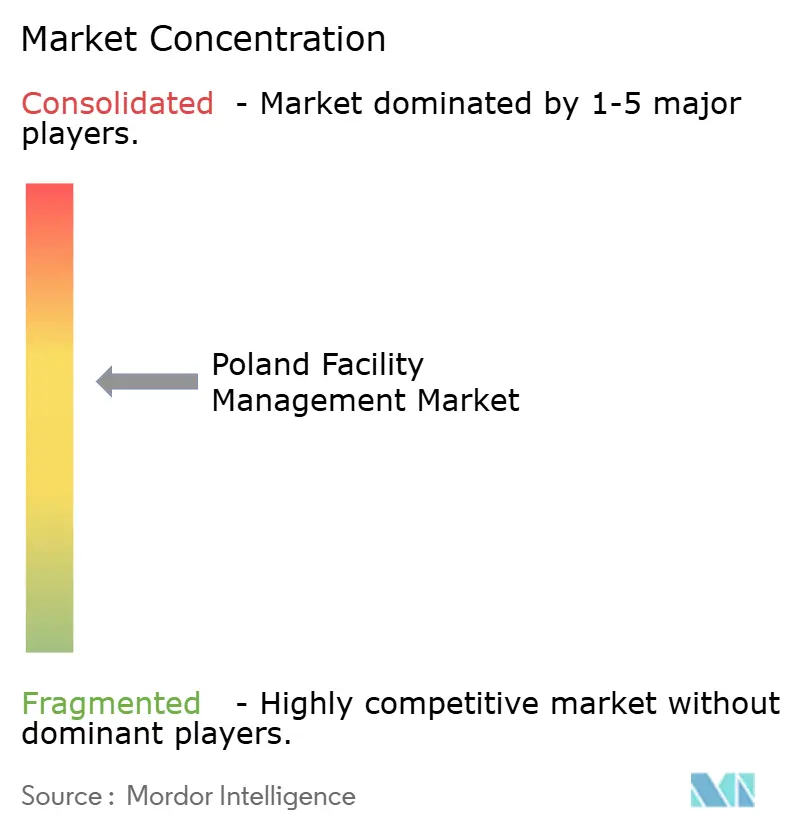
| Market Concentration | Medium |
Major Players *Disclaimer: Major Players sorted in no particular order Image © Mordor Intelligence. Reuse requires attribution under CC BY 4.0. | |
Poland Facility Management Market Analysis by Mordor Intelligence
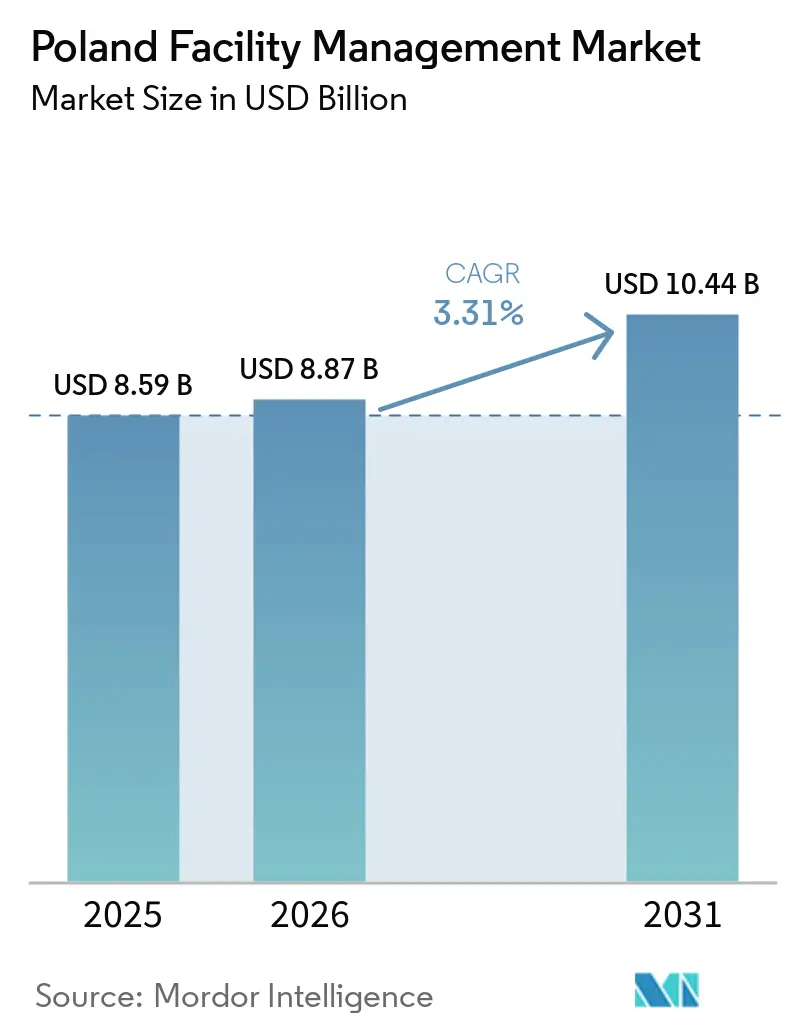
Poland facility management market size in 2026 is estimated at USD 8.87 billion, growing from 2025 value of USD 8.59 billion with 2031 projections showing USD 10.44 billion, growing at 3.31% CAGR over 2026-2031. This expansion has been anchored by a PLN 700 billion (USD 179.83 billion) national investment pipeline, a decisive corporate pivot toward outsourcing, and persistent infrastructure modernization. Outsourced services commanded 63.7% of the Poland facility management market in 2024, indicating a structurally entrenched client preference for professional operators that can navigate tightening labor and safety rules. Commercial real estate demand, particularly for Grade-A offices in Warsaw, Kraków, and Wrocław, bolstered service volume, while the institutional and public infrastructure segment emerged as the fastest-growing end user on the back of EU-funded energy retrofit programs. Provider margins, however, continued to compress as wage inflation outpaced contract indexation, prompting accelerated technology investment in IoT-enabled monitoring and digital-twin solutions.
Key Report Takeaways
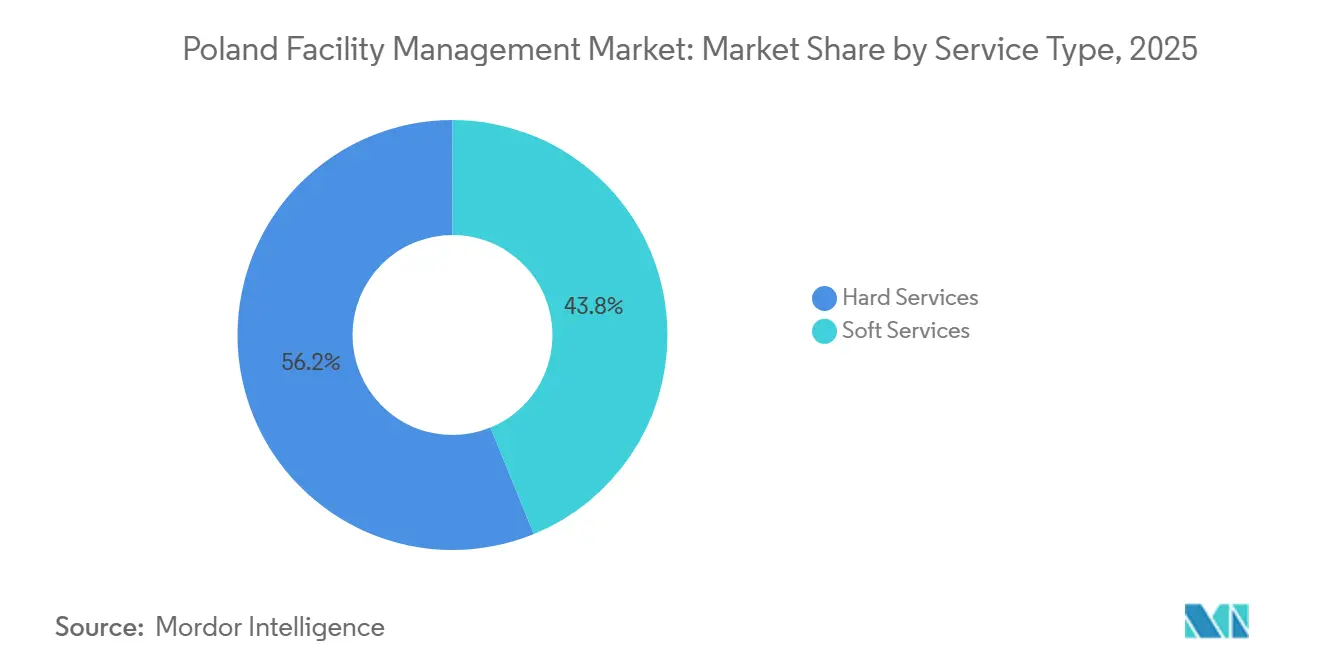
- By service type, hard services held 56.18% of the Poland facility management market share in 2025, whereas soft services are projected to grow at a 4.72% CAGR through 2031.
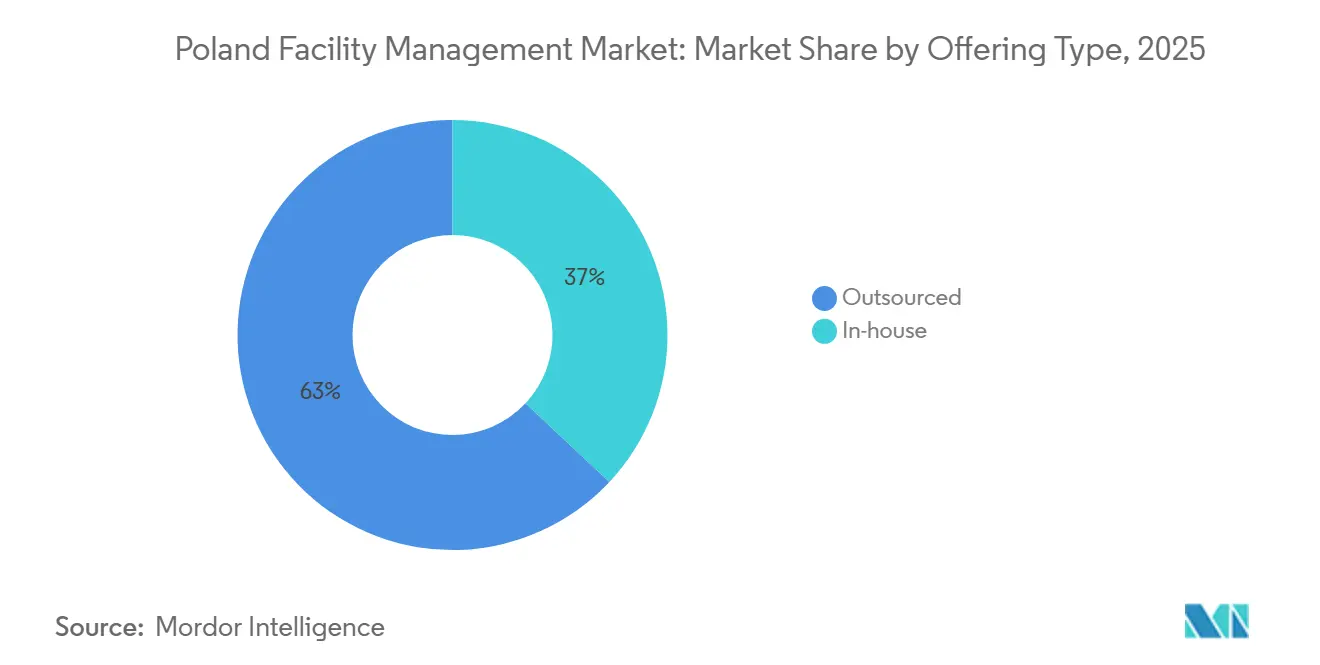
- By offering type, outsourced models accounted for 63.02% of the Poland facility management market size in 2025 and are forecast to expand at a 4.32% CAGR to 2031.
- By end-user industry, the commercial segment led with 37.34% revenue share in 2025, while institutional and public infrastructure are advancing at a 4.74% CAGR over 2026-2031.
Note: Market size and forecast figures in this report are generated using Mordor Intelligence’s proprietary estimation framework, updated with the latest available data and insights as of 2026.
Poland Facility Management Market Trends and Insights
Drivers Impact Analysis*
| Driver | (~) % Impact on CAGR Forecast | Geographic Relevance | Impact Timeline |
|---|---|---|---|
| Corporate shift toward outsourcing non-core building operations | +1.2% | Global, with early gains in Warsaw, Kraków, Wrocław | Medium term (2-4 years) |
| Expansion of Grade-A commercial real estate stock and occupancy in major Polish metros | +0.8% | Warsaw, Kraków, Łódź, Wrocław, Poznań | Short term (≤ 2 years) |
| National infrastructure pipeline boosting long-term O&M requirements | +1.0% | National, with a concentration in transport corridors | Long term (≥ 4 years) |
| Tightening labour and safety-standard regulations mandating professional FM compliance | +0.6% | National, with stricter enforcement in major metros | Medium term (2-4 years) |
| EU-funded public-building energy-retrofit programs driving integrated FM demand | +0.9% | National, with priority in public sector facilities | Medium term (2-4 years) |
| Investor pushes for ESG-aligned FM services linked to EU Taxonomy disclosure | +0.7% | APAC core, spill-over to major commercial hubs | Long term (≥ 4 years) |
| Source: Mordor Intelligence | |||
Corporate shift toward outsourcing non-core building operations
By 2025, many large enterprises had bundled cleaning, security, and maintenance into integrated contracts that delivered 15-20% cost savings versus in-house teams.[1] Outsourcing proved particularly attractive to shared-services centres employing more than 400,000 professionals, where salary inflation of 7-8% per year forced executives to contain non-personnel spending. Certified FM partners also mitigated compliance risk under Poland’s occupational health regime, which mandates periodic safety training for every job class. As hybrid work patterns stabilised, demand rose for flexible service scopes that could scale with fluctuating occupancy.
Expansion of Grade-A commercial real-estate stock and occupancy in major Polish metros
Warsaw alone recorded 286,700 sqm of net absorption in 2022, almost triple the 2021 levels. A 140% rebound in commercial-property investments to EUR 5 billion (USD 5.81 billion) in 2024 signalled renewed landlord confidence. Developers prioritised energy-efficient buildings to satisfy tenant ESG mandates, prompting FM providers to deploy sensor-driven HVAC optimisation that cut energy bills by up to 35%. Higher specification assets require continuous MEP oversight, reinforcing hard-services demand across the Poland facility management market.
National infrastructure pipeline boosting long-term O&M requirements
The PLN 700 billion (USD 190.84 billion) public-investment agenda unveiled for 2025 earmarked PLN 180 billion for railway upgrades and PLN 65 billion (USD 17.72 billion) for energy-grid modernisation. The Central Communication Port project alone involves PLN 44.7 billion (USD 12.19 billion) for Europe’s largest intermodal hub, slated to handle 34 million passengers annually by 2032. These assets demand multi-decade O&M contracts that favour FM firms with nationwide technical capacity and transport-sector know-how.
Tightening labour- and safety-standard regulations mandating professional FM compliance
Minimum-wage rises to PLN 4,242 gross in January 2024, and stricter building-code updates in August 2024 elevated compliance complexity for owners. State Labour Inspection spot-checks expanded, exposing companies without certified FM support to penalties. Consequently, organisations increasingly relied on external providers accredited in OHS, fire safety, and accessibility standards.
Restraints Impact Analysis*
| Restraint | (~) % Impact on CAGR Forecast | Geographic Relevance | Impact Timeline |
|---|---|---|---|
| Rapid wage inflation is eroding FM provider profit margins | -0.9% | National, with acute pressure in major metros | Short term (≤ 2 years) |
| Highly fragmented subcontractor base causing service-quality variability | -0.6% | National, with a concentration in construction-heavy regions | Medium term (2-4 years) |
| Slow digital-tool adoption among legacy public-sector facilities | -0.4% | National, with particular challenges in smaller municipalities | Long term (≥ 4 years) |
| Out-migration of certified technical staff, creating hard-services skill gaps | -0.8% | National, with a severe impact in border regions | Medium term (2-4 years) |
| Source: Mordor Intelligence | |||
Rapid wage inflation eroding FM provider profit margins
Construction firms offered 20% pay hikes and referral bonuses in 2024 to fill a 100,000-worker gap, pushing labour costs well above contract indexation. Labour typically forms 60-70% of service expenditure in the Poland facility management market, so providers faced sharp margin compression when annual price escalators remained tied to headline inflation rather than wage trends. In metropolitan areas, intense competition for licensed technicians further lifted salaries, compelling FM firms to accelerate automation and renegotiate multi-year agreements.
Highly fragmented subcontractor base causing service-quality variability
The European Labour Authority flagged Poland’s construction sector for widespread use of small subcontractors and inconsistent labour standards that complicated oversight.[2] FM primes spent more on vetting and training to assure uniform quality across mechanical, electrical, and fire-safety works. Fragmentation also limited scalability, hampering consistent delivery for clients with nationwide footprints and tempering growth potential in the Poland facility management market.
*Our forecasts treat driver/restraint impacts as directional, not additive. The impact forecasts reflect baseline growth, mix effects, and variable interactions.
Segment Analysis
By Offering Type: outsourced leadership, integrated FM acceleration
Outsourcing captured 63.02% revenue share in 2025 and is on track for a 4.32% CAGR through 2031 as corporates shifted non-core functions to external specialists. Shared-services centres reported cost efficiencies of up to 20% after transitioning to multi-service contracts. In-house delivery persisted in high-security environments such as defence plants and select public assets but remained cost-intensive. Within outsourcing, integrated FM rose fastest; single-provider models reduced interface risk and enabled consistent ESG reporting, a key investor demand under the EU taxonomy. Bundled FM solutions appealed to mid-sized firms seeking economies of scope without full contract complexity, while single-service deals continued where niche expertise or liability concerns prevailed.
Providers scaled through technology: IoT tags tracked asset utilisation, and digital twins simulated building behaviour to optimise preventive schedules. Kraków-based Kontakt.io secured EUR 12 million (USD 13.92 million) from the European Investment Bank in 2024 to deploy such solutions, delivering up to 35% power savings in pilot facilities. Automation’s promise to ease labour pressure further entrenched the outsourced share in the Poland facility management market.

By End-user Industry: commercial scale, public-sector velocity
Commercial real estate, led by offices, retail, and logistics, contributed 37.34% of 2025 revenue. Warsaw’s Grade-A absorption and EUR 5 billion (USD 5.81 billion) investment turnaround in 2024 underpinned FM volumes, while warehouse stock surpassed 31.5 million m² as e-commerce matured. Corporate occupiers demanded sophisticated energy dashboards and occupancy analytics, elevating the technical content of service contracts. Hotels and mixed-use complexes emphasised brand-consistent guest experiences, blending hard and soft services in outcome-based frameworks.
Institutional and public-infrastructure facilities are projected to grow 4.74% CAGR, lifted by EUR 15.51 billion (USD 18.03 billion) for green-energy projects under Poland’s Recovery and Resilience. Energy-retrofit grants spurred demand for integrated FM that could document carbon reductions. Healthcare settings require infection-control protocols and medical-equipment maintenance, commanding premium pricing for certified operators. Industrial and process plants invested in Industry 4.0 and required continuous uptime support, maintaining stable demand for hard-skills capacity in the Poland facility management industry.
By Service Type: hard-services dominance, soft-services momentum
Hard services accounted for 56.18% of revenue in 2025, underpinned by large-scale rail and energy projects that required specialised MEP maintenance, asset management, and fire-protection systems. The segment’s scale places it at the core of the Poland facility management market, especially as infrastructure assets age and require lifecycle support. Soft services grew faster, at a 4.72% CAGR by 2031, thanks to employers' focus on health, cleanliness, and occupant experience in flexible office environments. Integrated workplace programmes bundled cleaning, reception, catering, and minor technical tasks into single-invoice solutions, supporting user experience while managing cost volatility. As environmental standards tightened, cleaning protocols increasingly specified microfibre technologies and eco-label chemicals, elevating skill levels and documentation requirements.
A growing share of hard-services contracts incorporated performance-based clauses that tied provider remuneration to energy-consumption targets. Case studies in public-school retrofits recorded 35-46% utility savings after HVAC and envelope upgrades. These outcomes validated data-driven maintenance strategies and strengthened demand for predictive analytics platforms across the Poland facility management market at the sub-segment level. Soft-services providers likewise adopted real-time occupancy sensors to align cleaning frequency with actual footfall, securing labour savings that partly offset wage inflation.
Geography Analysis
Warsaw generated a significant share of national revenue in 2025, drawing on its 400,000-strong business-services workforce and high-grade office stock. Net absorption growth and sustained occupancy above 90% in prime zones underpinned service volumes, while major multinationals signed long-term integrated FM contracts covering multi-tower campuses. Wrocław, Gdańsk, and Poznań collectively accounted for roughly 40% of demand, each supported by logistics corridors and university clusters that attracted foreign direct investments.
Łódź emerged as an investment alternative to capital-city costs, leveraging improved rail links and lower office rents. The Silesian region sustained steady contracts from heavy industry and mining, while coastal markets such as Gdańsk and Szczecin expanded through port modernization. Smaller municipalities faced legacy-building migration issues and slower digital adoption, inviting FM providers to roll out scalable, cloud-based platforms capable of remote diagnostics.
Inter-regional portfolios became more common as domestic investors entered multiple voivodeships. Clients demanded consistent service-level metrics, prompting FM companies to standardize procedures and centralize help desk operations across the Polish facility management market. Automated asset registers and mobile workflows supported field teams dispersed across wide territories, reducing travel time and ensuring uniform compliance.
Regulatory Landscape
Poland FM compliance requirements tightened through 2026, spanning labor and safety, digital governance, and formalized qualifications. Key anchors include the PLN 4,242 gross minimum wage (January 2024) and building-code updates (August 2024), which increased documentation and inspection readiness. In June 2026, the market-based qualification Realizowanie usług facility management (facility manager) was included in Poland's Integrated Qualifications System (ZSK) (Monitor Polski 2026, pos. 570), supporting standardized training and competency verification across outsourced and integrated FM contracts.
Digital and technology-facing obligations also became more material for FM providers serving regulated end users such as energy, transport, and digital infrastructure. In February 2026, Poland signed an amendment to the National Cybersecurity System Act implementing NIS2, extending governance and accountability expectations for essential and important entities and raising the bar for facility operators supporting ICT-heavy sites. Separately, the Sejm passed an Act on artificial intelligence systems on 11 June 2026, establishing the Commission for the Development and Safety of Artificial Intelligence (KRiBSI) as the market surveillance authority, adding governance considerations for FM use cases that include AI-enabled monitoring, analytics, and automation in building operations.
Value Chain Analysis
The Poland FM value chain begins with inputs such as labor (cleaning, security, technicians), equipment and consumables, spare parts for MEP/HVAC and fire systems, and increasingly software and connected devices (BMS, IoT sensors, analytics). Service delivery is carried out by FM primes (integrated or bundled providers) that design SLAs, mobilize multi-trade teams, run helpdesks, and maintain compliance records, while specialist subcontractors support regulated and niche scopes such as fire protection, elevators, refrigeration, and electrical works. In a market where subcontractor fragmentation can create variability and higher oversight costs, this split between prime delivery and subcontract execution becomes a recurring operational constraint.
Downstream, property owners, occupiers, and public and infrastructure operators procure services via single-service, bundled, or integrated FM contracts, with technology vendors and PropTech platforms taking a greater role in execution. In major hubs such as Warsaw and Wroclaw, energy monitoring, automated maintenance workflows, and ESG reporting are increasingly tied into day-to-day operations. Software platforms that support orchestration, asset registers, and automated communications are replacing more manual reporting across dispersed portfolios, adding an integration layer between FM providers and digital suppliers where data capture, cybersecurity alignment, and interoperability with client IT systems are part of service delivery rather than only a back-office function.
Competitive Landscape
The ten largest players controlled the majority of revenue in 2024, indicating moderate concentration. Global brands such as ISS Facility Services Polska, Sodexo Polska, and Compass Group Poland leveraged international best practices, technology suites, and multi-country client relationships to secure large contracts. Local champions Impel Group and OKIN Facility Poland competed on price flexibility and regional familiarity. All tiers invested in digital solutions: smart sensors, machine-learning-based maintenance scheduling, and centralised energy-management dashboards. The skilled-labour deficit intensified automation economics; contactless cleaning robots and AI-guided workforce-management tools entered pilot operations, trimming low-value manual tasks.
ESG capability became a key differentiator. Providers with demonstrable carbon-saving metrics won public-sector tenders tied to EU taxonomy disclosures. For instance, ISS appointed a Group Head of ESG in July 2024 to embed sustainability across service lines.[4] Meanwhile, Sescom attracted new investors in May 2024 to finance European expansion and strengthen energy-performance contracts abroad. M&A discussions intensified around specialist technical firms, as integrated FM suppliers sought to deepen hard-services competencies and reduce reliance on volatile subcontractors.
Pressure on margins steered the market toward outcome-based pricing. Contracts increasingly tie payments to uptime, energy, or satisfaction metrics instead of labour hours, aligning incentives and rewarding technology innovation. Investors valued providers capable of scaling these models, supporting continued consolidation and reinforcing the ascendancy of integrated solutions within the Poland facility management market.
Poland Facility Management Industry Leaders
-
ISS Facility Services Polska
-
Sodexo Polska Sp. z o.o.
-
Impel Group
-
Compass Group Poland
-
Engie Services FM Poland
- *Disclaimer: Major Players sorted in no particular order
Market Opportunities and Future Outlook
Whitespace is expanding around compliance-ready, technology-enabled integrated FM for clients with higher governance burdens and dispersed assets. The February 2026 amendment to the National Cybersecurity System Act (NIS2 implementation) creates practical demand for providers that can align site operations with tighter ICT and risk-management requirements, especially across essential and important entities in energy, transport, and digital infrastructure. At the same time, the June 2026 inclusion of the facility manager qualification in Poland's ZSK supports standardized capability signaling in tenders, giving large buyers a basis to differentiate providers on verified competencies rather than only price.
Operational digitization is also moving from pilots to scaled rollouts, which opens room for platforms that unify work orders, inspections, asset registers, and reporting across multi-site portfolios. An evidence point is the August 2025 digitization program covering 550 maintenance sites, replacing manual reporting with a single orchestration approach, alongside broader PropTech adoption (IoT sensors and AI-driven energy analytics) in commercial real estate for energy management and ESG disclosure. With outsourced models already dominant (63.02% share in 2025), opportunity is concentrated in upgrading contract content toward outcome-based performance (energy, uptime, user experience) and in strengthening hard-services capability for infrastructure modernization programs, where providers can reduce subcontractor volatility by building more in-house technical capacity and standardized QA across voivodeships.
Recent Industry Developments
- July 2026: Sodexo secured a global workplace food services contract with Meta Platforms covering more than 130 locations across over 30 countries. The win reinforces the shift toward multi-country contracting and standardized service models that global FM leaders can replicate in local markets such as Poland. For Polish delivery organizations, it raises the bar for data-led governance, consistency, and ESG-linked reporting in corporate catering and workplace services.
- June 2026: ISS extended and expanded a long-running partnership with a large defence organisation in Northern Europe, adding scope with the updated agreement commencing in Q3 2026. The expansion underscores buyer preference for integrated service bundles under long-tenure frameworks, a structure increasingly mirrored in large enterprise and public-sector FM contracting. It also signals continued investment in hard-services capability and assurance processes needed for critical environments.
- August 2025: A digitization program covering 550 maintenance sites advanced, replacing manual reporting with a single orchestration approach. The shift supports energy management and ESG disclosure, and is aligned with broader PropTech adoption in commercial real estate.
Research Methodology Framework and Report Scope
Market Definition and Coverage
For this report, the Poland facility management market is defined as the value of services used to operate, maintain, and support buildings and sites across Poland, covering both hard services and soft services delivered through in-house teams or outsourced contracts.
Scope exclusions: This sizing excludes pure construction and standalone equipment sales where an ongoing facility service is not contracted or budgeted.
Segmentation Overview
- By Offering Type
- In-house
- Outsourced
- Single FM
- Bundled FM
- Integrated FM
- By End-user Industry
- Commercial (IT and Telecom, Retail and Warehousing)
- Hospitality (Hotels, Eateries and Restaurants)
- Institutional and Public Infrastructure (Government, Education, Transport)
- Healthcare (Public and Private Facilities)
- Industrial and Process (Manufacturing, Energy, Mining)
- Other End-user Industries (Multi-housing, Entertainment, Sports and Leisure)
- By Service Type
- Hard Services
- Asset Management
- MEP and HVAC Services
- Fire Systems and Safety
- Other Hard FM Services
- Soft Services
- Office Support and Security
- Cleaning Services
- Catering Services
- Other Soft FM Services
- Hard Services
Data Sources, Market Sizing, and Validation
Desk Research
Desk research was used to set the demand context and to keep assumptions tied to real activity in Poland's building stock. We leaned on public sources such as Statistics Poland (GUS) for construction and building-use indicators, Eurostat for comparable business and price series, and the European Commission for public building programs and renovation signals.
To link the market to how FM is bought and delivered, we reviewed materials from Polish and EU procurement portals, labor and wage series, and open building energy performance and efficiency guidance used in retrofit projects. Company annual reports, investor presentations, and reputable business press were then used to validate service mix, outsourcing intent, and cost pass-through patterns. Where needed, paid subscriptions for company financials and shipment-level import export checks helped verify supplier scale and cross-check a few pricing inputs. The sources listed are illustrative only, and many other public documents and databases were also referenced for validation and clarification.
Primary Interviews and Surveys
We conduct interviews and surveys with facility managers, service buyers, operations leaders, and finance managers working in Poland. Their feedback is used to test outsourcing rates, service prices, labor pressure, contract renewal patterns, and gaps in public data before the model is finalized.
Distribution of primary research fieldwork respondents
| Company type | Respondent position |
|---|---|
| Top tier: 26% | CXOs: 15% |
| Mid tier: 49% | Functional/Unit leaders: 30% |
| Smaller Players: 25% | Managers: 55% |
Market-Sizing & Forecasting
Sizing starts with a top-down build that reconstructs Poland's FM demand pool from the active non-residential and institutional building base, and then applies service adoption and outsourcing rates by end-user setting. The output is corroborated with selective bottom-up checks, such as sampled contract values by facility type, provider revenue sanity checks, and volume times average price approximations for a few common services, which are then used to adjust totals when gaps appear.
Inputs used in the model include: estimated serviced floor area by major building types, outsourcing penetration for single, bundled, and integrated engagements, wage and labor availability trends for cleaning and technical roles, energy and utility cost direction that affects maintenance intensity, and typical contract indexation behavior. Where certain service lines are under-reported in public disclosures, we fill gaps using interview-led ranges and cross-check them against procurement award patterns and observed price bands.
For forecasting, we rely mainly on scenario analysis, because FM demand in Poland is shaped by a mix of office occupancy, public infrastructure upkeep, and renovation cycles that can shift quickly. The base case is anchored to expert consensus on outsourcing momentum, wage inflation expectations, and building retrofit activity, and then stress-tested with conservative and aggressive paths before the final forecast is locked.
Data Validation & Update Cycle
Results are validated through cross-checks against independent signals, including service employment movement, public procurement activity, and the implied spend per square meter for common facility types. When a segment shows a sharp jump, we recheck the driver assumptions, rerun the pricing logic, and re-contact a few interviewees to confirm whether the change is real or just a modeling artifact.
Before sign-off, the model and outputs go through multi-step analyst review, where outliers are challenged and the logic is made traceable back to clear inputs. The report is refreshed on an annual cycle, and interim updates are completed when material events change costs or demand patterns. Right before delivery, we perform a final pass to ensure the latest public indicators and news have been reflected.
Mordor Intelligence's Poland Facility Management Market Sizing Compared With Other Published Estimates
Published market sizes for facility management in Poland can look far apart, even when they appear to cover the same services. This usually comes down to what is counted as FM, whether in-house delivery is included, and how contract values are treated when services are bundled.
The table shows a wide spread largely because some estimates mix adjacent categories like building technology or narrow the scope to outsourced services only, which changes the total materially. It also highlights how currency timing and pricing progression can shift the value, since wage-linked contracts and energy-driven maintenance cycles do not inflate smoothly every year. Under Mordor Intelligence's scope, the 2025 value reflects FM service delivery across both in-house and outsourced models, rather than combining FM with broader building tech spending.
Benchmark comparison
| Source | Market Size | Gaps in Research Methodology |
|---|---|---|
| Mordor Intelligence | USD 8.59 B (2025) | |
| Industry Publisher A | USD 2.80 B (2024) | This figure blends facility management with a building-technology angle and is tied to a different base year, so service-only spend and in-house delivery are not consistently captured. |
| Industry Association B | USD 12.40 B (2019) | This estimate reflects an older year and is often framed around outsourced FM value in local currency, which can inflate totals when converted and when the outsourcing boundary is defined differently. |
Taken together, the comparison suggests the biggest differences come from scope boundaries and the year used, not from disagreement on the demand direction. By keeping the sizing tied to building activity, outsourcing behavior, and repeatable price and adoption inputs, we can explain the total and update it cleanly when the underlying signals shift.
Key Questions Answered in the Report
What is the current value of the Poland facility management market?
The market was valued at USD 8.87 billion in 2026 and is projected to reach USD 10.44 billion by 2031.
Which service type dominates Poland’s facility management contracts?
Hard services led with 56.18% revenue share in 2025, driven by intensive infrastructure and technical maintenance needs.
Why are outsourced models preferred in Poland?
Outsourced services delivered cost reductions of 15-20% versus in-house teams and simplified compliance with labour and safety regulations.
Which end-user segment is expanding fastest?
Institutional and public-infrastructure facilities are forecast to grow at a 4.74% CAGR on the back of EU-funded energy retrofits and green-building mandates.
How is technology altering service delivery?
IoT sensors, digital twins, and AI-driven maintenance have reduced energy bills by up to 35% and mitigated labour shortages.
What labour challenges affect FM providers?
Wage inflation of up to 20% and migration of certified technicians compress margins and spur automation investments.