
Market Overview
| Study Period | 2020 - 2031 |
|---|---|
| Forecast Data Period | 2026 - 2031 |
| Base Year Market Size (2025) | USD 1.07 Billion |
| Market Size (2026) | USD 1.14 Billion |
| Market Size (2031) | USD 1.59 Billion |
| Growth Rate (2026 - 2031) | 6.82 % |
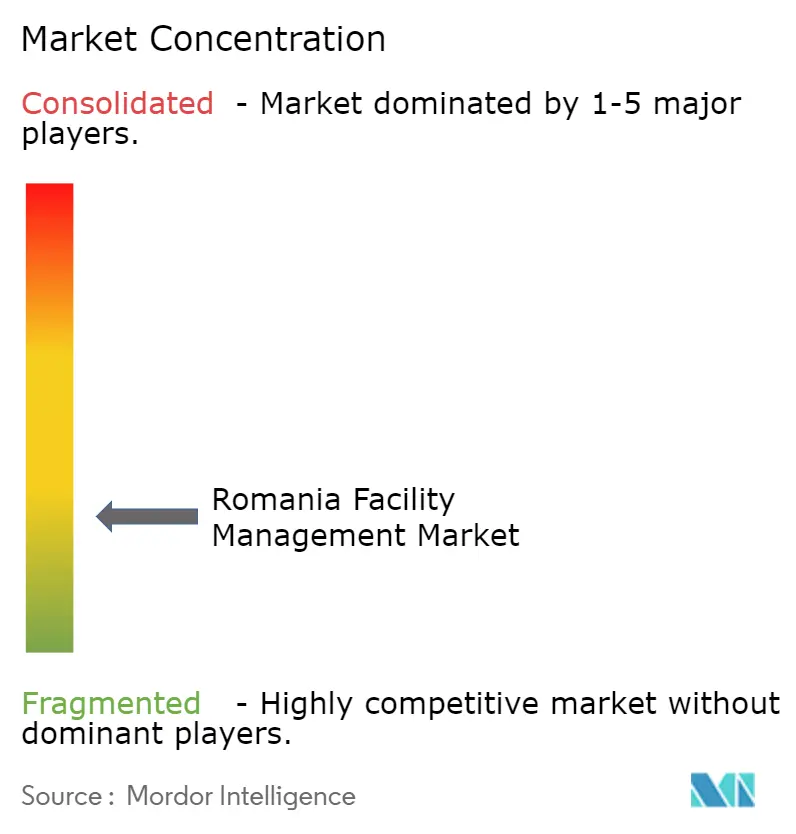
| Market Concentration | Low |
Major Players *Disclaimer: Major Players sorted in no particular order Image © Mordor Intelligence. Reuse requires attribution under CC BY 4.0. | |
Romania Facility Management Market Analysis by Mordor Intelligence
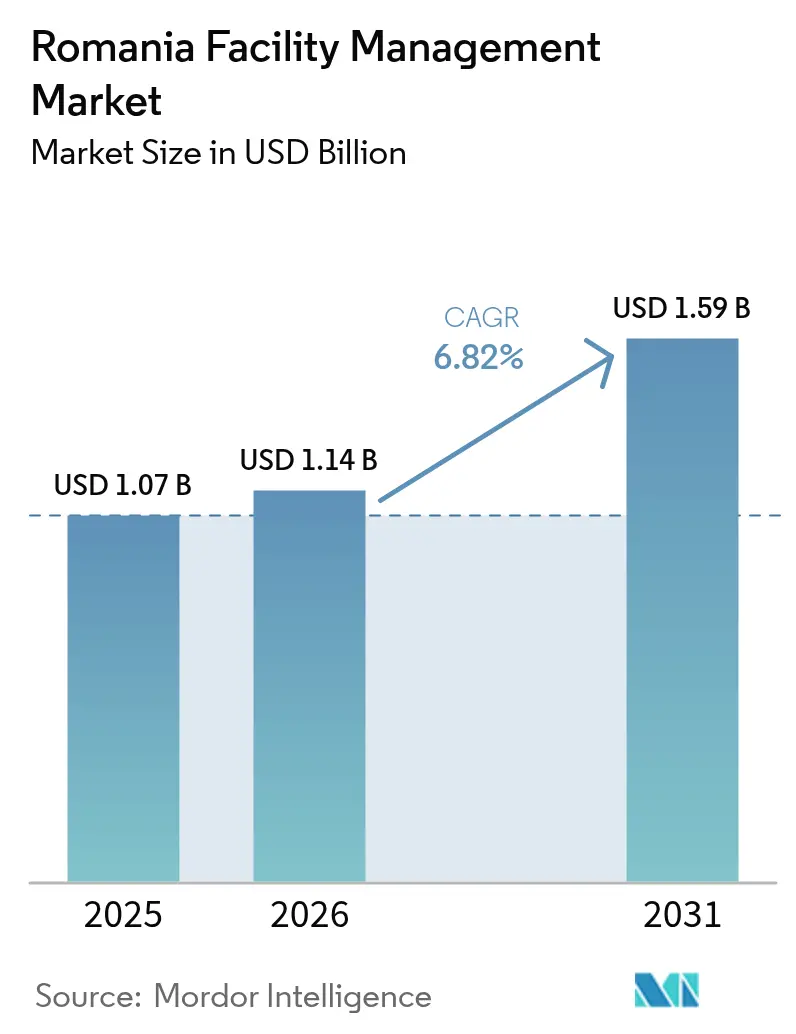
The Romania facility management market size is expected to grow from USD 1.07 billion in 2025 to USD 1.14 billion in 2026 and is forecast to reach USD 1.59 billion by 2031 at 6.82% CAGR over 2026-2031. The Romania facility management market is expanding as nearshoring inflows accelerate industrial construction, while EUR 29.2 billion in Recovery and Resilience Plan funding drives public-sector outsourcing. Energy-efficiency mandates, digital building technologies and outcome-based contracts are reshaping service scopes, prompting enterprises to seek integrated providers that manage both hard and soft tasks under a single agreement. The Romania facility management market also draws momentum from rising ESG commitments; developers are embedding IoT sensors, AI-enabled maintenance tools and green-building certifications to meet EU benchmarks. Competitive differentiation hinges on technology adoption, as volatile utility prices and looming inflation create cost-containment pressures that reward data-driven efficiency gains.
Key Report Takeaways
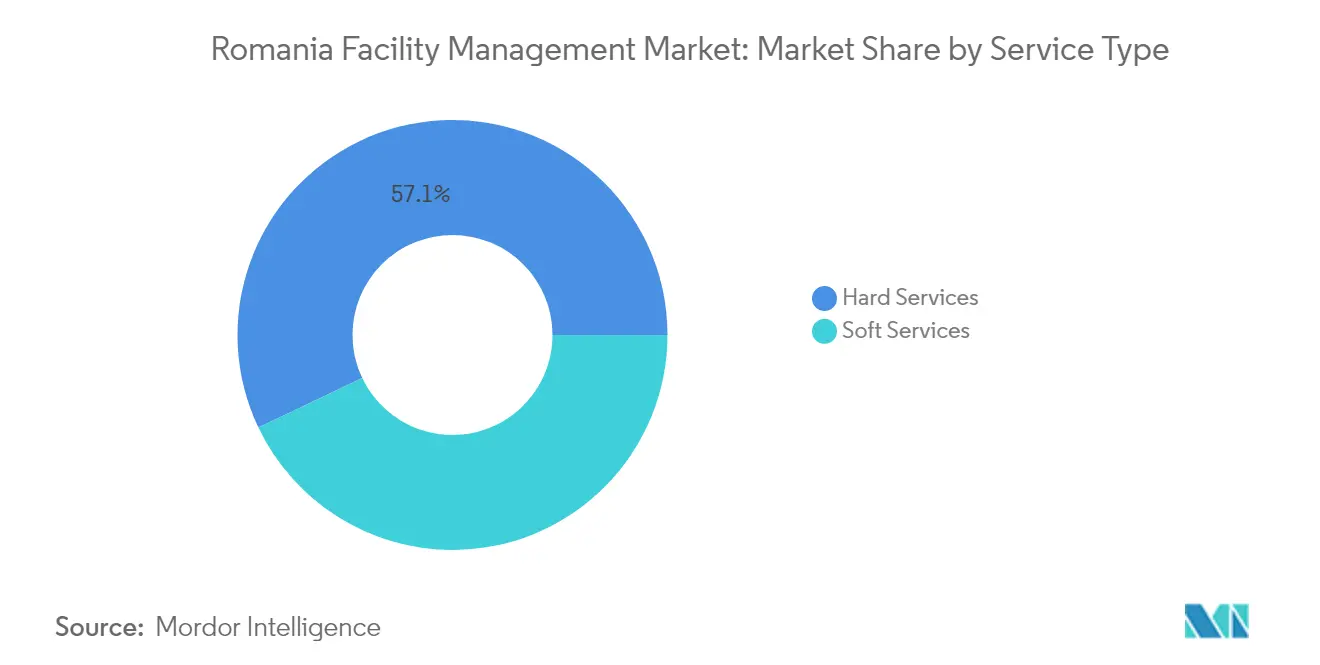
- By service type, hard services accounted for 57.08% of the Romania facility management market share in 2025, while soft services are forecast to grow at a 7.03% CAGR through 2031.
- By offering type, the outsourced segment commanded 62.85% of the Romania facility management market size in 2025 and is projected to expand at a 6.74% CAGR to 2031.
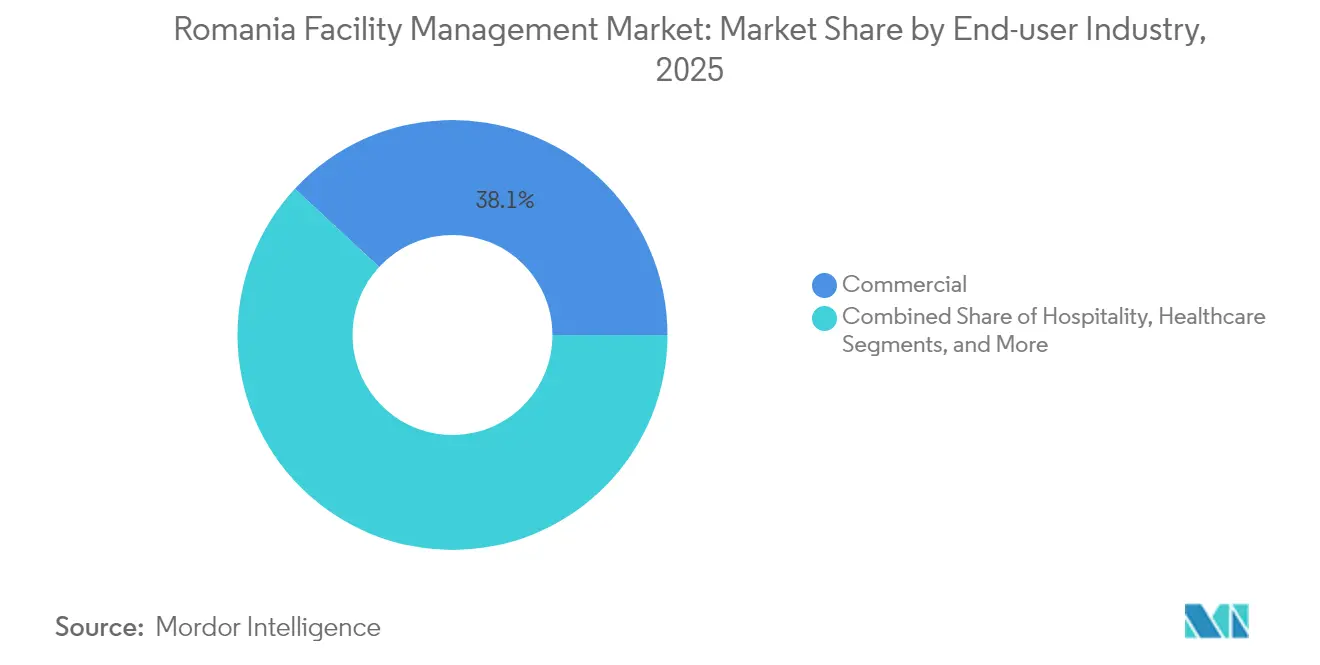
- By end-user industry, commercial facilities led with 38.10% share of the Romania facility management market size in 2025, whereas institutional and public infrastructure is advancing at an 8.63% CAGR through 2031.
Note: Market size and forecast figures in this report are generated using Mordor Intelligence’s proprietary estimation framework, updated with the latest available data and insights as of 2026.
Romania Facility Management Market Trends and Insights
Drivers Impact Analysis*
| Driver | (~) % Impact on CAGR Forecast | Geographic Relevance | Impact Timeline |
|---|---|---|---|
| Rising corporate outsourcing of non-core services | +1.8% | Bucharest, Cluj-Napoca, Timișoara | Medium term (2-4 years) |
| Growing adoption of integrated FM contracts | +1.5% | National, industrial corridors | Medium term (2-4 years) |
| Energy-efficiency and green-building mandates | +1.2% | National, EU-wide compliance | Long term (≥ 4 years) |
| EU RRF funding spurs public-sector outsourcing | +1.0% | Priority infrastructure regions | Short term (≤ 2 years) |
| Nearshoring-induced industrial expansion | +0.9% | Brașov, Timișoara, Constanța | Medium term (2-4 years) |
| Digitalization and IoT-enabled maintenance | +0.6% | Urban technology hubs | Long term (≥ 4 years) |
| Source: Mordor Intelligence | |||
Rising Corporate Outsourcing of Non-Core Services
Multinational manufacturers and technology firms increasingly relinquish in-house facilities teams to concentrate on core operations. Ford’s USD 300 million upgrade of its Craiova plant and Arctic’s EUR 37.8 million capacity expansion at Ulmi illustrate how production sites seek specialized MEP and fire-safety partners for compliance and uptime assurance. Outsourcing demand is most visible around Bucharest and Cluj-Napoca, where complex automated lines require predictive maintenance schedules aligned with ISO standards. Contract durations have lengthened beyond three years, reflecting client appetite for lifecycle cost certainty and service-level guarantees. Tier-one suppliers mirror this pattern, accelerating bundled hard-service deals that embed digital monitoring for energy, HVAC and critical utilities. The Romania facility management market benefits as global procurement teams recognise Romania’s engineering talent pool and competitive wage structure.
Growing Adoption of Integrated FM Contracts
Enterprises are consolidating disparate tasks-security, cleaning, catering, technical upkeep-into single multi-year frameworks. MKS Instruments’ 6,500 m² expansion in Bucharest deploys an integrated model so that cleanroom, utilities, and waste-handling teams share data flows and coordinated schedules.[1] Logistics developer CTP added almost 2 million m² of leases in 2024; most tenants requested bundled FM agreements covering energy optimisation, access control and landscaping. Integrated contracts cut transaction costs for clients while yielding continuous-improvement incentives for providers, who apply IoT platforms to predict faults, benchmark performance and issue consolidated KPI dashboards. The Romania facility management market thus sees a gradual shift from price-per-task quotes to outcome-based remuneration pegged to uptime, energy savings and occupant satisfaction indices.
Energy-Efficiency and Green-Building Certification Mandates
EU directives push facilities toward LEED and BREEAM labels, triggering demand for sensor-rich building-management systems. Genesis Property targets net-zero emissions by 2040, validating science-based targets and requesting suppliers to align on CO₂ reduction roadmaps. Romania’s Recovery Plan allocates EUR 1.2 billion for waste infrastructure and retrofits, propelling public authorities to embed energy audits and LED relighting into tenders. Facility managers now equip assets with sub-metering, air-quality probes and cloud analytics that fine-tune HVAC loads. Green mandates also influence material choices, requiring certified cleaning agents and recyclable consumables. Providers able to document carbon savings can charge premium rates, reinforcing a quality-over-price dynamic within the Romania facility management market.
EU RRF Funding Spurs Public-Sector Outsourcing
Recovery Facility grants accelerate healthcare and education projects that recruit private FM specialists. The European Investment Bank’s EUR 1 billion pipeline in 2024 underwrote hospital refurbishments and coastal-protection works that bundle maintenance, security and technical support in multi-year service contracts. Public buyers leverage outsourcing to access modern CAFM software without upfront capex and to comply with EU performance criteria. Outcome-linked payment schemes now reward providers for energy-intensity cuts, infection-control scores, and asset-availability thresholds. This mechanism shifts risk to contractors yet creates stable revenue streams, enhancing the attractiveness of the Romania facility management market for global vendors seeking predictable cash flows.
Restraints Impact Analysis*
| Restraint | (~) % Impact on CAGR Forecast | Geographic Relevance | Impact Timeline |
|---|---|---|---|
| Volatile utility costs increase contract risk | −1.2% | National, energy-intensive sites | Short term (≤ 2 years) |
| Highly fragmented supplier base | −0.8% | National, especially secondary cities | Medium term (2-4 years) |
| Lengthy digital permit approvals | −0.5% | National | Medium term (2-4 years) |
| Informal service providers intensify competition | −0.3% | Smaller municipalities | Short term (≤ 2 years) |
| Source: Mordor Intelligence | |||
Volatile Utility Costs Increase Contract Risk
The National Bank projects a 15% hike in power bills after price caps lapse, forcing providers to renegotiate tariff pass-through clauses. Data-center operator ClusterPower installs efficient cooling achieving a 1.1 PUE to shield clients from spikes.[2] Nonetheless, thin-margin FM firms face liquidity strain when electricity and gas exceed budgeted thresholds. Some clients switch from fixed-rate to indexed contracts, demanding transparent metering and mid-term price reviews. Providers capable of on-site renewables or demand-response programs mitigate exposure and bolster competitiveness inside the Romania facility management market.
Highly Fragmented Supplier Base Limits Scale Efficiencies
Thousands of small firms compete mostly on price, hampering investment in robotics, CAFM platforms and staff training. The dispute between Bucharest’s Sector 1 and Romprest over waste-collection fees underscores inconsistent service quality and legal risks in a fragmented setting. [3]Clients seeking nationwide coverage must orchestrate multiple micro-contracts, incurring coordination overheads. Fragmentation also delays technology diffusion, as smaller outfits cannot amortise AI or IoT deployments across sizeable portfolios. Consolidation opportunities remain substantial, especially for international groups with capital to acquire regional players and extend uniform standards within the Romania facility management market.
*Our forecasts treat driver/restraint impacts as directional, not additive. The impact forecasts reflect baseline growth, mix effects, and variable interactions.
Segment Analysis
By Service Type: Hard Services Drive Infrastructure Modernization
Hard services captured 57.08% of the Romania facility management market in 2025, mirroring modernization needs across aging industrial lines and commercial complexes. Asset-management, HVAC and electrical maintenance contribute most revenue as factories such as STIHL’s new plant and Petrofac’s USD 270 million upgrade of the Ticleni oilfield require continuous uptime monitoring. The Romania facility management market size attributed to hard services is projected to rise alongside stricter fire-safety codes that boost demand for alarm testing and sprinkler retrofits.
Soft services, though smaller today, post the fastest expansion at a 7.03% CAGR as hotels, offices and retail chains seek enhanced occupant experiences. Radisson’s new Bucharest and Brașov properties and Hyatt Regency Aro Palace require hospitality-grade cleaning, front-of-house and catering packages. Robotic scrubbers launched by Tennant via its Cluj center exemplify how automation lifts productivity and sanitisation consistency. This momentum lifts the Romania facility management market as employers prioritise wellness, ESG reporting and labour-efficient soft services.

By Offering Type: Outsourced Solutions Dominate Market Evolution
The outsourced model accounted for 62.85% of the Romania facility management market share in 2025, highlighting corporate preference for specialised expertise and scalable resources. International groups leverage global supply chains to introduce predictive analytics and CAFM dashboards that smaller in-house teams cannot match. The Romania facility management market size linked to outsourced contracts is set to climb at 6.74% CAGR as bundled agreements replace fragmented task orders.
In-house operations persist in sensitive sectors such as defence or data sovereignty, but rising complexity pushes many organisations toward external partners. Single-service contracts remain relevant for niche requirements like ISO-class cleanrooms, yet bundled FM commands premium demand due to one-stop accountability. Outcome-based models further tilt the scale, with providers staking remuneration on energy savings and asset availability-features most cost-effective under outsourced structures.
By End-user Industry: Commercial Sector Leads While Public Infrastructure Accelerates
Commercial facilities, including IT offices, retail hubs and logistics warehouses, held 38.10% of spending in 2025, driven by Romania’s role as a regional e-commerce and BPO hub. Major parks such as VGP Brașov lure brands that outsource security, cleaning and technical upkeep for 24/7 operations. This segment of the Romania facility management market benefits from tight delivery schedules and the prevalence of outcome-linked SLAs that reward throughput and inventory accuracy.
Institutional and public infrastructure grows fastest at 8.63% CAGR, fuelled by EU-backed modernisation of schools, hospitals and coastal defences. Regina Maria’s EUR 18 million storage overhaul confirms private healthcare’s push for lean operations and hygiene compliance. Government ministries adopt private FM expertise to meet digital-permit, energy-audit and ESG deadlines, unlocking sizeable multiyear contracts that expand the Romania facility management market.
Geography Analysis
Bucharest generates around 39.60% of national demand, reflecting its dense office skyline, government precincts and transport hubs. Developments such as One Cotroceni Park-900 apartments and 70,000 m² of offices-embed SMART lighting, access control and waste-recycling systems requiring continuous FM oversight. The new Henri Coandă Airport terminal likewise specifies AI-enabled building-management suites that lengthen scope for technical services.
Cluj-Napoca, Timișoara and Brașov anchor secondary growth, buoyed by nearshoring lines for automotive, electronics and aerospace. BEIA Consult deploys IoT platforms that let facility teams adjust ventilation and energy loads in real time, aligning with clients’ carbon targets. Brașov’s logistics parks need integrated FM that spans yard management, security and PV maintenance, while Timișoara’s assembly plants prioritise predictive maintenance to minimise downtimes.
Constanța and the Black Sea corridor emerge as energy and logistics gateways. Hydrogen pilot projects and wind-energy service bases demand niche FM skills, including hazardous-substance handling and turbine-blade storage. Rural districts, supported by EU cohesion funds, begin outsourcing maintenance for schools and clinics, giving providers with nationwide reach the chance to extend the Romania facility management market footprint beyond urban cores.
Regulatory Landscape
Romania facility management providers operate under tightening EU-aligned building and energy rules alongside a more digitized labor-compliance environment. The Energy Performance of Buildings Directive (EU) 2024/1275 set a national transposition deadline of May 29, 2026, pushing building owners and FM contractors toward verifiable energy performance actions such as audits, metering, and building-management upgrades. Romania also advanced related provisions through Ordinance 16/2025 and updated implementation norms via Order 1794/2025 for energy-performance improvements in housing blocks.
On labor and workforce administration, employers moved to mandatory digital reporting through REGES-ONLINE introduced via HG 295/2025, and OUG 32/2026 (in force from April 23, 2026) launched the WorkinRomania.gov.ro platform for employment authorization and employer registration, with a phased rollout. In public procurement, tender documentation for institutional maintenance services (including Ministry of Education procurements) emphasizes qualified technical staffing for day-to-day operation and upkeep of electrical installations, HVAC systems, and related building services, which raises compliance and documentation requirements for FM bidders.
Value Chain Analysis
Demand for Romania facility management originates from commercial offices, industrial parks, public institutions, and critical infrastructure operators, then flows into service design (SLA/KPI definition), mobilization (labor, tools, consumables, and MEP spares), delivery (hard and soft services), and performance reporting. Hard FM execution depends on local subcontractor ecosystems for specialized trades (electrical, HVAC, fire systems), while soft FM depends on labor availability and standardized consumable procurement. Buyers increasingly bundle scopes into integrated contracts that centralize scheduling, incident response, and compliance records.
Technology and energy-management vendors are moving into upstream enablers, connecting equipment OEMs, IoT/metering suppliers, CAFM platforms, and cloud hosting to day-to-day FM operations. Partnerships such as Schneider Electric and CTP, deploying EcoStruxure-enabled smart metering and energy management across industrial parks in Romania, and CTP partnering with Singu to standardize a cloud CAFM layer, show how property owners are embedding data platforms into the operating model. On the operator side, deployments such as Solida Capital integrating the workcloud24 platform at Victoria Center (Bucharest) and Electrica completing an AI-based active energy management project at its headquarters and the Dimitrie Leonida National Technical Museum illustrate measurement, automation, and analytics shifting from pilots into operational workflows. This changes the chain from reactive maintenance toward digitally governed delivery.
Competitive Landscape
The market remains highly fragmented; no single operator holds more than 10% revenue, and hundreds of regional firms compete on price for soft services. International players such as ISS, Sodexo and Dussmann differentiate via CAFM suites, global procurement and ESG reporting. ISS’s USD 937 million nuclear services contract showcases capability to manage mission-critical assets.
Domestic champions like Romprest sustain municipal waste deals but face scrutiny over tariff disparities, underscoring governance risks. Coral Companies leverage pest-control know-how to secure industrial and hospitality clients, while Facilitec focuses on technical maintenance packages for energy sites. Foreign entrants scout acquisitions to gain regional portfolios and skilled technicians quickly.
Technology investment is the prime battleground. Dussmann channels EUR 40 million annually into digitisation, rolling out sensor networks that feed central AI engines to predict HVAC faults and optimise staffing rosters. Smaller firms experiment with SaaS CAFM platforms to narrow the gap, though capital constraints slow adoption. Market consolidation is expected as integrated service demands grow and clients favour suppliers that can guarantee uniform standards across Romania’s dispersed geography.
Romania Facility Management Industry Leaders
-
Vinci Facilities
-
HGC Facility Management Services SRL
-
B+N Referencia ZRT.
-
P. Dussmann Serv Romania S.R.L.
-
Sodexo SA
- *Disclaimer: Major Players sorted in no particular order
Market Opportunities and Future Outlook
Technology-led integrated FM is a clear whitespace where owners and operators replace fragmented task contracting with platforms that connect dispatch, condition monitoring, and energy optimization across portfolios. Real deployments highlight this shift, including Europe House in Bucharest implementing the R8 Jenny AI Dispatcher for autonomous HVAC optimization (via EnergyPal) and Electrica completing an AI-based active energy management project across two sites. Both cases increase demand for FM partners that can run digital operations, maintain controls and sensors, and produce auditable performance reports.
Workforce standardization and ESG-linked service models are also expanding the addressable scope for professional FM providers. The Romanian Workplace and Facility Management Association (ROFMA) has emphasized AI agents in contract negotiation and workplace operations (June 2026), and the Romanian Classification of Occupations includes an official "manager of facilities" role (COR code 242117), which supports more standardized client requirements around competence, reporting, and governance. At the same time, EU-aligned energy-performance obligations tied to Directive (EU) 2024/1275 and Romania’s implementing measures increase the need for integrated hard services (BMS tuning, metering, HVAC efficiency, and compliance documentation), creating room for providers combining technical depth with digital tooling and outcome-based SLAs rather than labor-only delivery.
Recent Industry Developments
- May 2026: Vinci Energies reported a 5% increase in orders in Q1 2026, driven by electrification and digitalization, and highlighted continued activity across Romania in building solutions alongside energy, transport, industry, and ICT. This supports a larger pipeline of technically intensive work where Vinci Facilities and similar operators compete on integrated delivery, energy performance, and digital building capabilities.
- August 2025: CTP partnered with Singu to standardize facility management using a cloud-based CAFM platform across its portfolio, including operations in Romania, with rollout actions spanning into 2026. A common CAFM layer strengthens KPI-driven vendor governance and pushes service providers toward faster response times, consistent documentation, and portfolio-level benchmarking.
- December 2024: Romania signed a USD 2 billion deal to extend the life of the Cernavoda nuclear reactor, and AtkinsRealis secured a USD 937 million project management contract linked to the program. Long-duration modernization and lifecycle programs of this type elevate demand for high-compliance technical services and structured maintenance regimes aligned to mission-critical infrastructure.
Research Methodology Framework and Report Scope
Market Definition and Coverage
For this methodology, the Romania facility management market is defined as the value of contracted and in-house services used to run, maintain, and support buildings and sites, covering both hard and soft activities delivered under FM arrangements within Romania.
Scope exclusions: This sizing does not count standalone construction works, one-off equipment sales, or pure real estate leasing revenues unless they are part of an ongoing facility management service contract.
Segmentation Overview
- By Service Type
- Hard Services
- Asset Management
- MEP and HVAC Services
- Fire Systems and Safety
- Other Hard FM Services
- Soft Services
- Office Support and Security
- Cleaning Services
- Catering Services
- Other Soft FM Services
- Hard Services
- By Offering Type
- In-house
- Outsourced
- Single FM
- Bundled FM
- Integrated FM
- By End-user Industry
- Commercial (IT and Telecom, Retail and Warehouses, etc.)
- Hospitality (Hotels, Eateries, Large-scale Restaurants)
- Institutional and Public Infrastructure (Govt, Education, Transportation)
- Healthcare (Public and Private Facilities)
- Industrial and Process (Manufacturing, Energy, Mining)
- Other End-user Industries (Multi-housing, Entertainment, Sports and Leisure)
Data Sources, Market Sizing, and Validation
Desk Research
Desk research was used to map the size of the building and service demand pool that facility managers typically serve in Romania, and then to anchor assumptions that cannot be observed directly. We relied on public and official references such as the National Institute of Statistics in Romania for construction and building stock indicators, Eurostat for labor cost and sector activity series, and the European Commission for policy items tied to energy efficiency and public procurement.
We also reviewed sources such as the National Bank of Romania for inflation and exchange rate context, Romania procurement portals for large FM related tenders, and peer reviewed papers and standards bodies for definitions of hard and soft services and typical service frequency. Company annual reports, local press coverage, and investor presentations helped validate outsourcing appetite and contract structures. Paid subscriptions for company financials and news intelligence, plus patent databases for building technologies, were used only to cross-check individual assumptions. These examples are not exhaustive, and many other public documents and data points were also reviewed for collection, validation, and clarification.
Primary Interviews and Surveys
We use interviews and surveys with FM providers, property and operations leaders, procurement teams, and building managers in Romania. Their input checks outsourcing rates, service bundles, contract pricing, occupancy effects, and gaps in public records before final assumptions are triangulated.
Distribution of primary research fieldwork respondents
| Company type | Respondent position |
|---|---|
| Top tier: 30% | CXOs: 15% |
| Mid tier: 50% | Functional/Unit leaders: 30% |
| Smaller Players: 20% | Managers: 55% |
Market-Sizing & Forecasting
The core model uses top-down logic to reconstruct the addressable FM spend from Romania's active building base and activity levels, then applies service intensity and outsourcing shares by end-user setting. To keep the totals realistic, we corroborated results with selective bottom-up checks, including sampled contract value ranges, provider revenue patterns by service line, and channel checks on typical bundled scope.
Several Romania-specific inputs were tracked closely, including changes in commercial and industrial floor space additions, public infrastructure spending signals tied to outsourcing, labor cost inflation for cleaning and security, energy efficiency upgrade cycles that increase demand for MEP and HVAC maintenance, and the mix shift between single service and integrated FM contracts. Where bottom-up data was missing for smaller local providers, we filled gaps using conservative revenue banding and service mix ratios derived from interviews, then stress tested implied revenue per square meter against what procurement teams described. For forecasting, scenario analysis was used so pricing and outsourcing trajectories could be varied sensibly under different wage inflation and public tender cycles, and then the final path was aligned to the most consistent expert consensus we heard.
Data Validation & Update Cycle
Validation was handled through multiple checks so single-source bias did not drive the outputs. We compared modeled totals with independent signals such as employment trends in key service categories, public tender activity direction, and observed pricing movement from interview feedback, then investigated any sharp year-to-year jumps before analyst sign-off.
Each major assumption was reviewed in steps, first for logic and unit consistency, then for reasonableness against external indicators, and finally for alignment with primary inputs. If a large variance appeared, respondents were re-contacted to determine whether the issue came from scope, pricing timing, or an end-user mix change. The report is refreshed annually, with interim updates when material events occur, and a final pre-delivery pass is done so clients receive the latest view available.
Mordor Intelligence's Romania Facility Management Market Size Measured Against Other Published Estimates
Published market values for facility management in Romania often differ because the service basket is not identical across studies, and because the split between in-house work and outsourced contracts is treated differently. Variations also come from how pricing is updated, what year currency conversion is applied, and whether the model is checked against real procurement behavior.
Some estimates broaden the scope by adding adjacent items like construction refurbishment programs or pure energy supply bills that sit outside ongoing FM service delivery. In Mordor Intelligence's model, only hard and soft facility services delivered as in-house FM or outsourced single, bundled, and integrated contracts are counted, which keeps the value tied to recurring operational spend rather than project work.
Benchmark comparison
| Source | Market Size | Gaps in Research Methodology |
|---|---|---|
| Mordor Intelligence | USD 1.07 B (2025) | |
| Regional Consultancy A | USD 1.32 B (2025) | Uses a wider spend pool that appears to include some building upgrade projects and energy related costs, and it applies faster price pass-through without checking contract-level scope stability. |
| Industry Association B | USD 0.95 B (2025) | Focuses mainly on outsourced services reported by members, which can undercount in-house FM and smaller local providers, and it often assumes a slower shift toward integrated contracts. |
Overall, the spread is mainly explained by what gets counted as FM spend and how outsourcing and pricing are refreshed year to year. By keeping scope linked to recurring hard and soft services and then cross-checking those totals with contract and tender signals, our estimate stays easier to replicate and simpler to audit.
Key Questions Answered in the Report
What is the current value of the Romania facility management market?
The market is valued at USD 1.14 billion in 2026 and is expected to reach USD 1.59 billion by 2031.
Which segment dominates the Romania facility management market?
Hard services lead with 57.08% share in 2025, reflecting intensive demand for technical maintenance across industrial and commercial facilities.
How fast is the outsourced facility management segment growing?
Outsourced contracts are projected to expand at a 6.74% CAGR between 2026 and 2031 as organisations focus on core businesses.
Which end-user industry is growing quickest?
Institutional and public infrastructure shows the fastest rise, advancing at an 8.63% CAGR due to EU-funded modernisation projects.
Why are integrated facility management contracts gaining popularity?
They simplify vendor management, enable bundled service delivery and support data-driven performance optimisation through centralised platforms.
How do energy-efficiency mandates influence facility management?
EU-aligned green-building requirements drive adoption of IoT sensors, automation and predictive analytics to cut energy use and meet sustainability goals.