
Market Overview
| Study Period | 2020 - 2031 |
|---|---|
| Forecast Data Period | 2026 - 2031 |
| Base Year Market Size (2025) | USD 616.84 Million |
| Market Size (2026) | USD 651.46 Million |
| Market Size (2031) | USD 856.57 Million |
| Growth Rate (2026 - 2031) | 5.62 % |
| Market Concentration | Medium |
Major Players *Disclaimer: Major Players sorted in no particular order Image © Mordor Intelligence. Reuse requires attribution under CC BY 4.0. | |
Serbia Facility Management Market Analysis by Mordor Intelligence
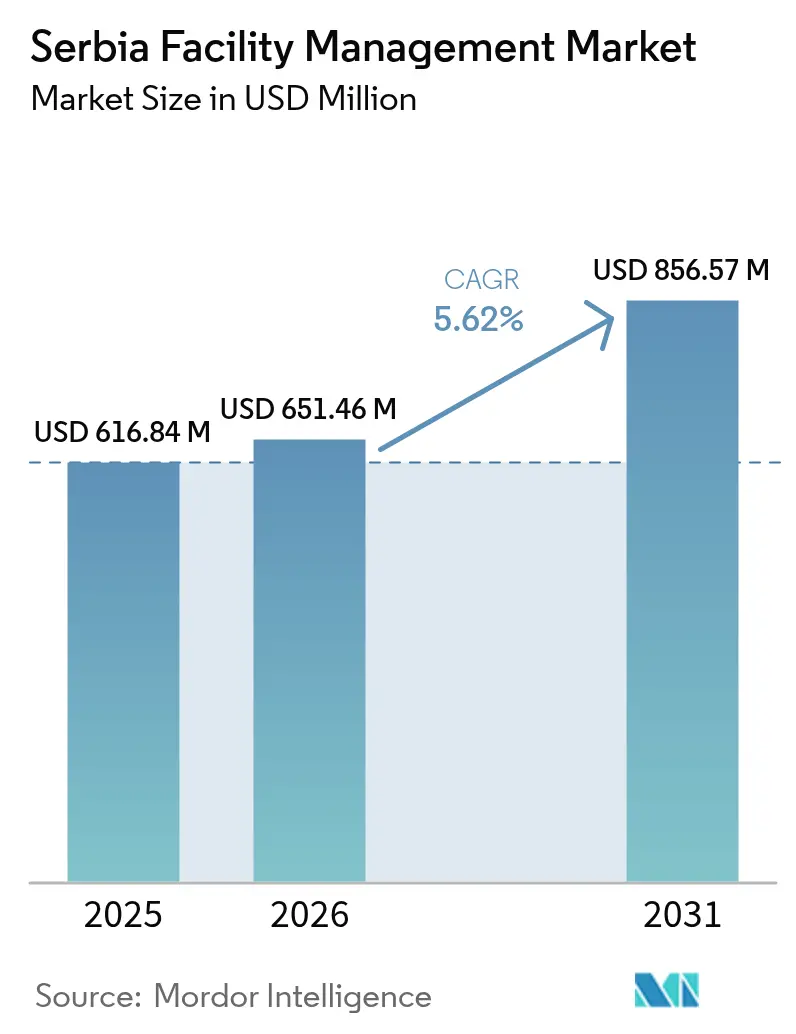
The Serbia facility management market size was valued at USD 616.84 million in 2025 and estimated to grow from USD 651.46 million in 2026 to reach USD 856.57 million by 2031, at a CAGR of 5.62% during the forecast period (2026-2031). Serbia’s investment-grade credit rating in late 2024 triggered EUR 5.2 billion in foreign direct investment that is feeding sustained demand for Grade A offices, logistics hubs and related integrated services.[1] The EU Economic and Investment Plan is channeling EUR 9 billion into transport, energy and environmental projects, anchoring a long pipeline of public-sector assets that now require professionally managed operations. Large multinationals nearshoring shared-service and IT centers to Belgrade and Novi Sad are deepening the shift from cost-based cleaning or security contracts to outcome-based, tech-enabled facility bundles. At the same time, Serbia’s Integrated National Energy and Climate Plan is accelerating retrofits toward nearly zero-energy buildings, forcing owners to embed energy-optimization clauses in new facility contracts.
Key Report Takeaways
- By service type, Hard Services captured 58.10% of Serbia facility management market share in 2025, while Soft Services are advancing at a 5.85% CAGR through 2031.
- By offering type, the Outsourced model accounted for 59.35% share of the Serbia facility management market size in 2025 and is expanding at a 6.05% CAGR over 2026-2031.
- By end-user industry, Commercial facilities led with 35.70% revenue share in 2025; Institutional & Public Infrastructure is forecast to post the fastest 6.02% CAGR to 2031.
Note: Market size and forecast figures in this report are generated using Mordor Intelligence’s proprietary estimation framework, updated with the latest available data and insights as of 2026.
Serbia Facility Management Market Trends and Insights
Drivers Impact Analysis*
| Driver | (~) % Impact on CAGR Forecast | Geographic Relevance | Impact Timeline |
|---|---|---|---|
| Outsourcing preference among corporates | +1.2% | National (Belgrade, Novi Sad) | Medium term (2-4 years) |
| Expansion of Grade-A office & logistics stock | +1.5% | Belgrade and secondary cities | Short term (≤2 years) |
| EU-backed infrastructure modernization | +1.0% | National urban centers | Long term (≥4 years) |
| Demand for certified green buildings | +0.8% | Belgrade, Novi Sad, Niš | Medium term (2-4 years) |
| Nearshoring influx of shared-service & IT hubs | +1.1% | Belgrade, Novi Sad, Kragujevac | Short term (≤2 years) |
| Government digitalization driving smart FM | +0.6% | National | Long term (≥4 years) |
| Source: Mordor Intelligence | |||
Growing outsourcing preference among Serbian corporates
Firms are reallocating scarce talent toward core, high-margin tasks and handing non-core activities to external specialists that can guarantee compliance with EU standards.[1]Foreign-owned plants inside free economic zones now insist on globally harmonized facility protocols, accelerating bundled contracts for cleaning, security and energy management. Rising administrative-burden reforms and a shortage of credentialed facility engineers further tilt the cost-benefit equation toward outsourcing.
Expansion of Grade-A office and logistics real estate stock
Belgrade exceeds 1.1 million m² of modern offices, with Airport City alone set to hit 230,000 m², each building demanding 24/7 MEP, HVAC and smart-system oversight. Active-office designs featuring flexible zones and 40% lower energy use make predictive maintenance and occupant-wellness metrics standard service-level items.
EU-backed public infrastructure modernization pipeline
Projects such as the EUR 730 million PPF8 transport and environment program expand the asset base needing lifecycle maintenance plans, asset-register digitization and warranty tracking. [3] Digital-governance reforms funded by a USD 50 million World Bank loan embed IoT devices in public buildings, compelling authorities to procure integrated facility platforms.
Rising demand for certified green & energy-efficient buildings
Serbia’s roadmap toward nearly zero-energy public buildings mandates real-time energy dashboards, fault detection and carbon reporting protocols that most owners source from specialist FM providers. [4]The Integrated National Energy and Climate Plan pushes 3.5 GW of renewables by 2030, sharpening scrutiny on building-level energy intensity.
Restraints Impact Analysis*
| Restraint | (~) % Impact on CAGR Forecast | Geographic Relevance | Impact Timeline |
|---|---|---|---|
| Price-based tendering squeezing margins | -0.9% | National public procurement | Short term (≤2 years) |
| Persistent informal labor | -0.7% | Smaller cities | Medium term (2-4 years) |
| Aging building stock outside Belgrade | -0.5% | Regional areas | Long term (≥4 years) |
| Volatile utility tariffs | -0.4% | National (industrial) | Medium term (2-4 years) |
| Source: Mordor Intelligence | |||
Price-based tendering squeezing provider margins
Lowest-bid public tenders still dominate, encouraging race-to-the-bottom pricing that dilutes investment in training and smart tools. Limited FM literacy among procurers further commoditizes complex, multiyear service packages, delaying Serbia’s convergence with EU value-based models.
Persistent informal labor limiting compliance
Shadow-economy labor, equal to 30.1% of GDP, enables unregistered contractors to undercut compliant firms but exposes owners to safety and tax liabilities. Inconsistent enforcement outside Belgrade restricts skills-development pipelines and undermines professionalization targets.
*Our forecasts treat driver/restraint impacts as directional, not additive. The impact forecasts reflect baseline growth, mix effects, and variable interactions.
Segment Analysis
By Service Type: Hard services underpin current revenue, soft services accelerate
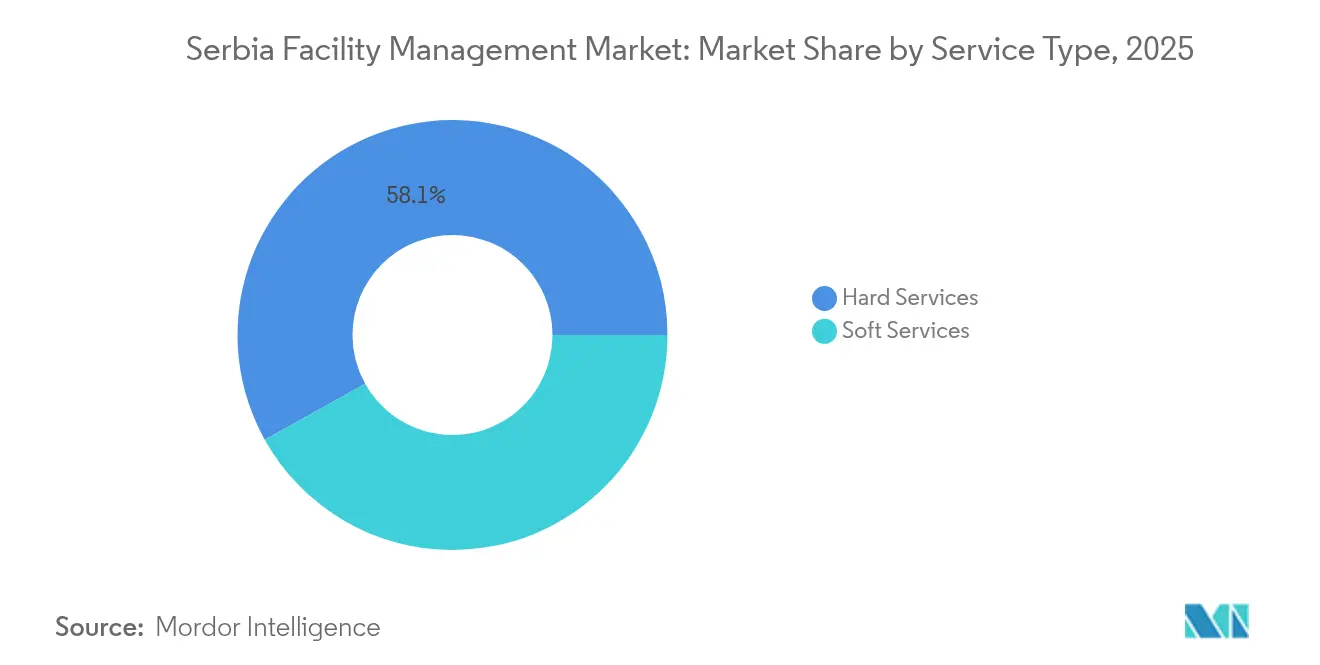
Hard Services generated 58.10% of 2025 revenue within the Serbia facility management market, led by MEP & HVAC packages needed to overhaul aging industrial stock to EU efficiency codes. Fire-safety upgrades are expanding fastest inside factories and logistics nodes aligning with harmonized EU directives, pushing asset-integrity contracts longer than five years.
Soft Services are projected to outpace at a 5.85% CAGR thanks to the rise of IT parks and shared-service centers that embed workplace-experience KPIs such as hygiene, catering variety and reception analytics. Cleaning contracts now bundle indoor-air-quality monitoring, a standard adopted in post-pandemic active-office formats.

By Offering Type: Outsourced partnerships dominate growth
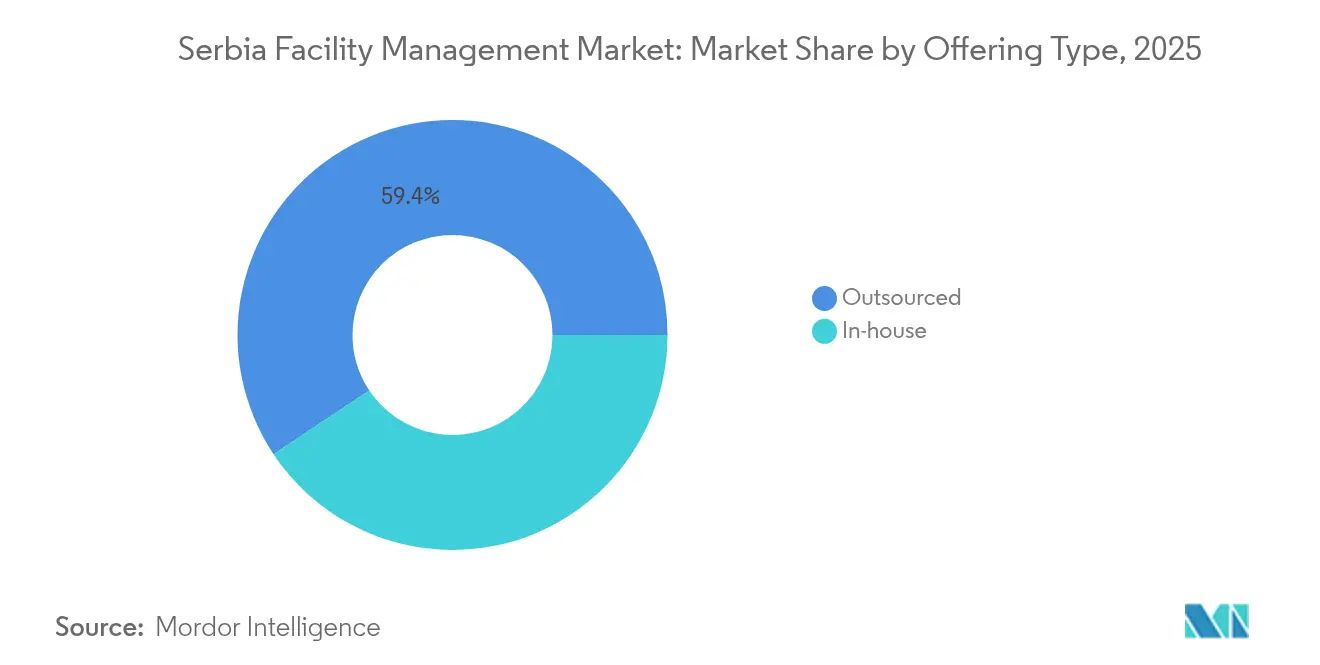
The Outsourced model commands 59.35% of 2025 spending and is widening through 2026-2031 at a 6.05% CAGR as foreign investors in free zones require single governance dashboards across multitenant sites. Single-service cleaning or security contracts remain the usual entry but quickly graduate to bundled or integrated FM arrangements once owners measure downtime savings.
Integrated FM is the fastest-growing slice, driven by flagship assets like the Smart Manufacturing Innovation Center in Novi Sad, where OT-IT convergence dictates 24/7 digital-infrastructure stewardship. In-house teams persist mainly in government bodies yet lose ground as institutional investment rules now score bidders on energy and ESG competencies.
By End-User Industry: Commercial leads today while institutional assets gain speed
Commercial portfolios—office, retail and warehousing—held 35.70% of 2025 demand, reflecting Belgrade’s technology-sector influx and EUR 125 million of retail-logistics spend by multinational brands. Data-center fit-outs linked to 5G deployment further enlarge requirement lists to include critical-environment maintenance and redundant power testing.
Institutional & Public Infrastructure is forecast to rise at a 6.02% CAGR to 2031, fueled by EU-funded rail, solid-waste and e-government undertakings that mandate performance-based FM contracts for new assets. Hospitals and schools pursuing NZEB targets create long-term energy-service agreements blending O&M with guaranteed consumption reductions
Geography Analysis
Belgrade dominates the Serbia facility management market with the bulk of Grade A offices, government ministries and cultural flagships such as the planned Philharmonic Concert Hall that will require acoustics-specific maintenance protocols. Competition is intense among ISS, Sodexo and CBRE alongside local Atrium Property Services, each layering IoT sensors and real-time dashboards into bids to win five-year integrated contracts.
Novi Sad is the second growth pole thanks to its Smart Manufacturing Innovation Center and thriving ag-tech cluster, prompting demand for facility partners skilled in OT network resilience and ISO 50001 energy-management routines. City authorities additionally deploy EU green-city funds to retrofit public buildings, raising outsourced opportunities for mid-cap providers.
Secondary cities—Niš, Kragujevac and Subotica—are emerging as nearshoring spillovers where data centers, logistics depots and Expo 2027 venues expand the outsourced serviceable area. Government balanced-development policy and World Bank resilient-cities grants are formalizing procurement frameworks that favor compliant FM vendors over informal crews.
Regulatory Landscape
Facility management in Serbia is anchored by the Law on Housing and Building Maintenance (Official Gazette RS, No. 104/16). The law defines routine, investment, and emergency maintenance obligations for buildings, which in turn shapes FM service scopes, documentation expectations, and how liability is allocated between FM providers and property managers. For public assets, the Ministry of Construction, Transport and Infrastructure oversees maintenance and operation through rules for buildings in public ownership, reinforcing O&M planning and clearer accountability for outsourced contractors.
Automation and digital-infrastructure-related compliance increasingly intersect with FM delivery. RATEL, the independent regulator for electronic communications and postal services, brought new rulebooks into force on 19 December 2024 that standardize contract summaries and termination rights for publicly available electronic communications services. For FM teams managing in-building telecom systems and vendor access, this raises the compliance baseline for telecom-related arrangements. In March 2026, a draft amendment track for the Law on Electronic Communications was reported, signaling tighter information and infrastructure reporting requirements for operators. Alongside Serbia's alignment work with the EU Gigabit Infrastructure Act via the Ministry of Information and Telecommunications, facility managers operating data-driven buildings and connected sites face higher governance and coordination needs. The Institute for Standardization of Serbia (ISS) supports harmonization through technical committees such as U247 (Building Automation, Controls, and Building Management) and U059 (Buildings and civil engineering works), which feed into technical specifications and procurement language used in FM tenders.
Value Chain Analysis
Serbia's facility management value chain begins with asset owners and occupiers, including commercial offices, logistics and industrial parks, and public institutions, which set performance requirements around uptime, safety, and energy outcomes. Upstream inputs cover MEP/HVAC equipment and controls, cleaning and hygiene consumables, security hardware, and digital layers such as BMS/CMMS, IoT sensors, and connectivity supplied through integrators and telecom operators. Midstream, FM providers and specialist subcontractors deliver hard services (MEP, HVAC, fire and safety, asset integrity) and soft services (cleaning, security, workplace support, catering), with delivery coordinated through SLAs and increasingly through integrated service bundles across multi-tenant portfolios.
Downstream, reporting and assurance return to clients through compliance documentation, energy dashboards, and audit trails. Industry bodies also play a role in strengthening standardization and capability building. The Serbia Green Building Council (Serbia GBC) has been advancing decarbonization capacity building through the BuildingLife initiative across 2025-2026, reinforcing demand for measurable, ESG-aligned FM practices. buildingSMART Serbia (established in 2017) supports BIM/VDC standardization, improving handover data quality and enabling model-based maintenance planning. Meanwhile, the Society of Construction Law Serbia (founded in 2024) expanded its international linkages in 2025, joining SCL International in April and ESCL in September, which helps address contractual clarity that affects lifecycle maintenance, warranties, and performance-based contracting.
Competitive Landscape
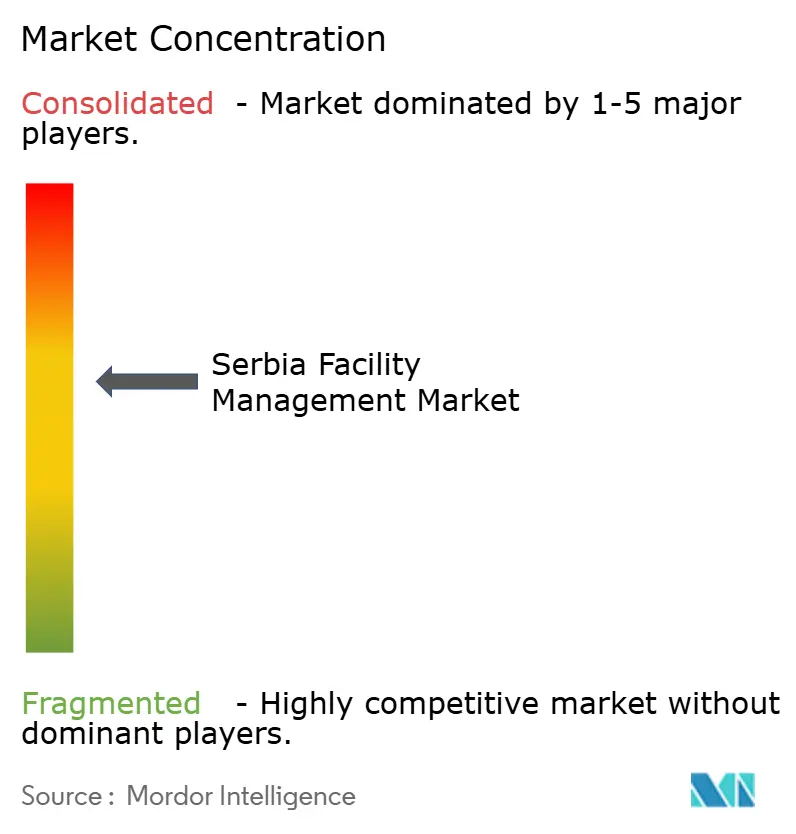
Serbia’s facility management arena is moderately fragmented: global incumbents such as ISS, Sodexo and Johnson Controls compete with regional names like Atrium Property Services and CBRE, while digital disruptors like Hauzmajstor leverage app-based booking and dynamic pricing. Multinationals rely on global frameworks to lock in energy-performance clauses and ESG reporting; regional firms counter with localized regulatory know-how and 24-hour dispatch hubs.
Consolidation prospects rise as Serbia tightens labor, VAT and waste-handling statutes, shrinking room for under-the-radar operators. Providers able to finance BMS upgrades and predictive-maintenance analytics will likely accumulate share when shadow-economy participants exit. Technology partnerships—e.g., HBIS and Siemens’ digital green-steel facility—signal a new frontier where FM contractors manage not only buildings but embedded production tech.
Outcome-based contracts are gaining currency in logistics and healthcare, rewarding vendors on uptime and energy-cost savings rather than fixed task lists. This model favors firms with balance-sheet strength to underwrite sensors, software platforms and staff reskilling, leaving niche cleaners or security-only players to either merge or focus on specialized segments like heritage-site conservation.
Serbia Facility Management Industry Leaders
-
Sauter AG
-
Atrium Property Services
-
Atalian Global Services
-
REIWAG Facility Services
-
Diversey Holdings Ltd.
- *Disclaimer: Major Players sorted in no particular order
Market Opportunities and Future Outlook
One clear whitespace in Serbia is earlier integration of facility management into design and delivery, so assets enter operation with structured data, maintainability-by-design, and automation-ready specifications. The Facility Management Business Association of Serbia (FMBAS) placed this theme at the center of its Seventh annual conference in Belgrade in May 2026, emphasizing FM involvement from the design phase for commercial and industrial buildings. This supports opportunities in BIM-enabled handover, commissioning-to-O&M workflows, and standardized asset data that can reduce reactive maintenance while strengthening SLA governance.
Technology-led integrated FM is also being pulled by national digital programs and private infrastructure builds that increase the share of connected, mission-critical facilities. Serbia's Strategy for the Development of Artificial Intelligence for 2025-2030 frames modernization across public services, energy, healthcare, and other sectors, aligning with FM offerings such as predictive maintenance, anomaly detection, and automated compliance reporting tied to building operations. Alongside digital infrastructure investment, including a national fiber backbone rollout scheduled across 2026-2027 and private initiatives such as Orion Telekom's approximately EUR 200 million AI computing infrastructure program, the installed base of high-availability sites expands. For FM providers, this environment supports differentiation through critical-environment maintenance, energy optimization, and operational data governance. As national AI governance discussions tighten, contractors that can document controls, map AI usage in building operations, and manage vendor access for connected systems have another route to shift beyond task-based service delivery into assurance-led managed operations.
Recent Industry Developments
- March 2026: A draft amendment track for the Law on Electronic Communications was reported, signaling tighter information and infrastructure reporting requirements for operators. This could influence how facility managers coordinate data governance and vendor access for connected sites across Serbia.
- April 2025: Eviden secured a EUR 50 million deal to build Serbia's National AI Factory, expanding the pipeline of high-spec digital infrastructure assets. The project elevates requirements for critical-environment operations, connected building systems, and measurable service levels that favor technology-enabled integrated FM delivery.
- December 2024: RATEL confirmed the entry into force of new rulebooks on 19 December 2024 covering contract summaries and termination rights for publicly available electronic communications services. This tightened the compliance baseline for in-building connectivity services and raises governance demands for facility teams coordinating telecom access, service continuity, and documentation in connected facilities.
Research Methodology Framework and Report Scope
Market Definition and Coverage
For this study, the market counts the total value of facility management services delivered for buildings and sites in Serbia, covering the recurring activities that keep facilities safe, functional, and compliant.
Scope exclusions: We exclude pure one-time construction and major renovation projects that are not managed as ongoing facility management services.
Segmentation Overview
- By Service Type
- Hard Services
- Asset Management
- MEP and HVAC Services
- Fire Systems and Safety
- Other Hard FM Services
- Soft Services
- Office Support and Security
- Cleaning Services
- Catering Services
- Other Soft FM Services
- Hard Services
- By Offering Type
- In-house
- Outsourced
- Single FM
- Bundled FM
- Integrated FM
- By End-user Industry
- Commercial (IT and Telecom, Retail and Warehousing)
- Hospitality (Hotels, Eateries and Restaurants)
- Institutional and Public Infrastructure (Government, Education, Transport)
- Healthcare (Public and Private Facilities)
- Industrial and Process (Manufacturing, Energy, Mining)
- Other End-user Industries (Multi-housing, Entertainment, Sports and Leisure)
Data Sources, Market Sizing, and Validation
Desk Research
Desk work starts with public data that helps us shape the demand pool for buildings and operations spend in Serbia. We typically review sources such as the Statistical Office of the Republic of Serbia (construction and business statistics), the National Bank of Serbia (inflation and exchange-rate series), and public procurement portals that show facility service tenders and contract patterns.
To ground the operating context, we also refer to documents from institutions such as Eurostat (for comparable building and services indicators), the European Investment Bank (infrastructure and public investment notes), and peer reviewed engineering and building operations journals that discuss MEP, HVAC upkeep, and safety compliance. Company annual reports, investor presentations, and reputable local business press are then used to understand outsourcing appetite, service bundling, and pricing direction, supported where needed by paid subscriptions for company financial intelligence, patent lookups, and shipment level import and export signals on equipment that influences maintenance activity. These examples are not exhaustive, and many other sources were also used to collect data, validate assumptions, and clarify open questions.
Primary Interviews and Surveys
We use interviews and surveys with facility managers, service providers, property operators, procurement teams, and building users in Serbia. Responses help test outsourcing rates, contract values, labor intensity, service mixes, and demand by end user, while also filling gaps in public turnover data and checking model assumptions. Re-contact is requested when a reported value differs materially from observed market signals.
Distribution of primary research fieldwork respondents
| Company type | Respondent position |
|---|---|
| Top tier: 28% | CXOs: 18% |
| Mid tier: 47% | Functional/Unit leaders: 32% |
| Smaller Players: 25% | Managers: 50% |
Market-Sizing & Forecasting
Sizing is built using top-down and bottom-up logic, but the main build begins from a top-down view where building stock, outsourcing penetration, and typical FM spend intensity are used to reconstruct the Serbia demand pool by major facility types. Only after that structure is in place do we corroborate totals with selective bottom-up checks, such as sampled contract values, observed price bands for bundled services, and limited supplier roll ups where coverage is clear.
A few practical variables guide the model inputs and keep it traceable, including commercial and institutional floor area additions, public infrastructure operating budgets, outsourcing share movements, wage and fuel inflation that affects labor-heavy soft services, and imported equipment activity that tends to pull periodic hard service work. Where direct data is patchy, gaps are handled through conservative ranges and then narrowed using interview-led validation on contract duration, service scope depth (hard versus soft), and the share of integrated packages.
For forecasting, scenario analysis is used, because near-term demand is sensitive to cost inflation, public spending cycles, and the pace of outsourcing migration. Each scenario is stress-tested against interview consensus and recent macro indicators, and the final forecast follows the most repeated expectations from respondents while staying consistent with observed price and volume signals.
Data Validation & Update Cycle
Outputs are checked through multiple steps before sign-off, starting with internal consistency tests across service types, delivery mode, and end-use patterns, and then followed by variance checks against external indicators like inflation, construction activity, and tender trends. If an assumption creates an unusual swing, we revisit the driver, rerun sensitivities, and re-contact relevant respondents when the gap cannot be explained through public data.
Reports are refreshed annually, and interim updates are triggered when a material event shifts costs or demand signals, such as sudden wage inflation, large public outsourcing programs, or new compliance requirements that change maintenance intensity. Before delivery, an analyst performs a fresh review pass so clients receive an updated view that aligns with the latest available indicators.
Mordor Intelligence's Serbia Facility Management Market Estimate Compared With Other Published Estimates
Published market sizes for Serbia facility management can differ even when the headline topic looks the same, because the counted services, delivery modes, and the timing of pricing updates are not always aligned. Differences also come from how much of the in-house spend is treated as part of the market versus being left as an operational cost outside the estimate.
The biggest gap drivers for this market usually show up in three places, which are service scope, outsourcing treatment, and how inflation and wage changes are applied to annual pricing. Some estimates mix adjacent items like one-off renovation work into hard services, and others apply aggressive ASP growth without checking it against tender rates and contract renewal patterns, which can push the number up quickly.
Benchmark comparison
| Source | Market Size | Gaps in Research Methodology |
|---|---|---|
| Mordor Intelligence | USD 651.46 M (2026) | |
| Regional Consultancy A | USD 720.00 M (2026) | Uses a broader hard-services bucket that appears to include more one-time upgrade and retrofit activity, and it applies faster price escalation without clear tender-backed checks. |
| Trade Journal B | USD 590.00 M (2026) | Focuses mainly on outsourced contracts and likely understates in-house delivery, and it relies on a narrower set of building types which reduces the addressed demand pool. |
The table shows a spread around the 2026 value, and in Mordor Intelligence's model the total includes both in-house and outsourced facility management value, while excluding pure construction and major one-time renovation work that is not managed as recurring FM. Once those scope choices are kept consistent and pricing is aligned to Serbia inflation and wage signals, the estimate stays easier to reproduce and compare year to year.
Key Questions Answered in the Report
What is the current value of the Serbia facility management market?
The Serbia facility management market size equals USD 651.46 million in 2026 and is projected to grow steadily through 2031.
Which service category generates the most revenue?
Hard Services—primarily MEP, HVAC, and fire-safety maintenance—held 58.10% market share in 2025, making it the dominant revenue engine.
Why is outsourcing gaining traction in Serbia?
Scarce technical labor, rising compliance complexity, and foreign investors’ demand for harmonized service standards are pushing Serbian occupiers toward outsourced facility-management partnerships.
Which end-user segment will expand fastest by 2031?
The Institutional & Public Infrastructure segment is expected to deliver a 6.02% CAGR, boosted by EU-funded modernization programs and smart-city investments.
How fragmented is market competition?
With the top five providers controlling slightly more than 60% of spending, the market is moderately concentrated; consolidation is anticipated as shadow-economy operators exit and digital-capable firms gain ground.
What technologies are shaping future contracts?
IoT sensors, AI-driven predictive maintenance, BIM-integrated CMMS platforms, and energy-analytics dashboards are becoming standard requirements in new integrated facility-management agreements.