
Market Overview
| Study Period | 2020 - 2031 |
|---|---|
| Forecast Data Period | 2026 - 2031 |
| Base Year Market Size (2025) | USD 3.34 Billion |
| Market Size (2026) | USD 3.46 Billion |
| Market Size (2031) | USD 4.11 Billion |
| Growth Rate (2026 - 2031) | 3.53 % |
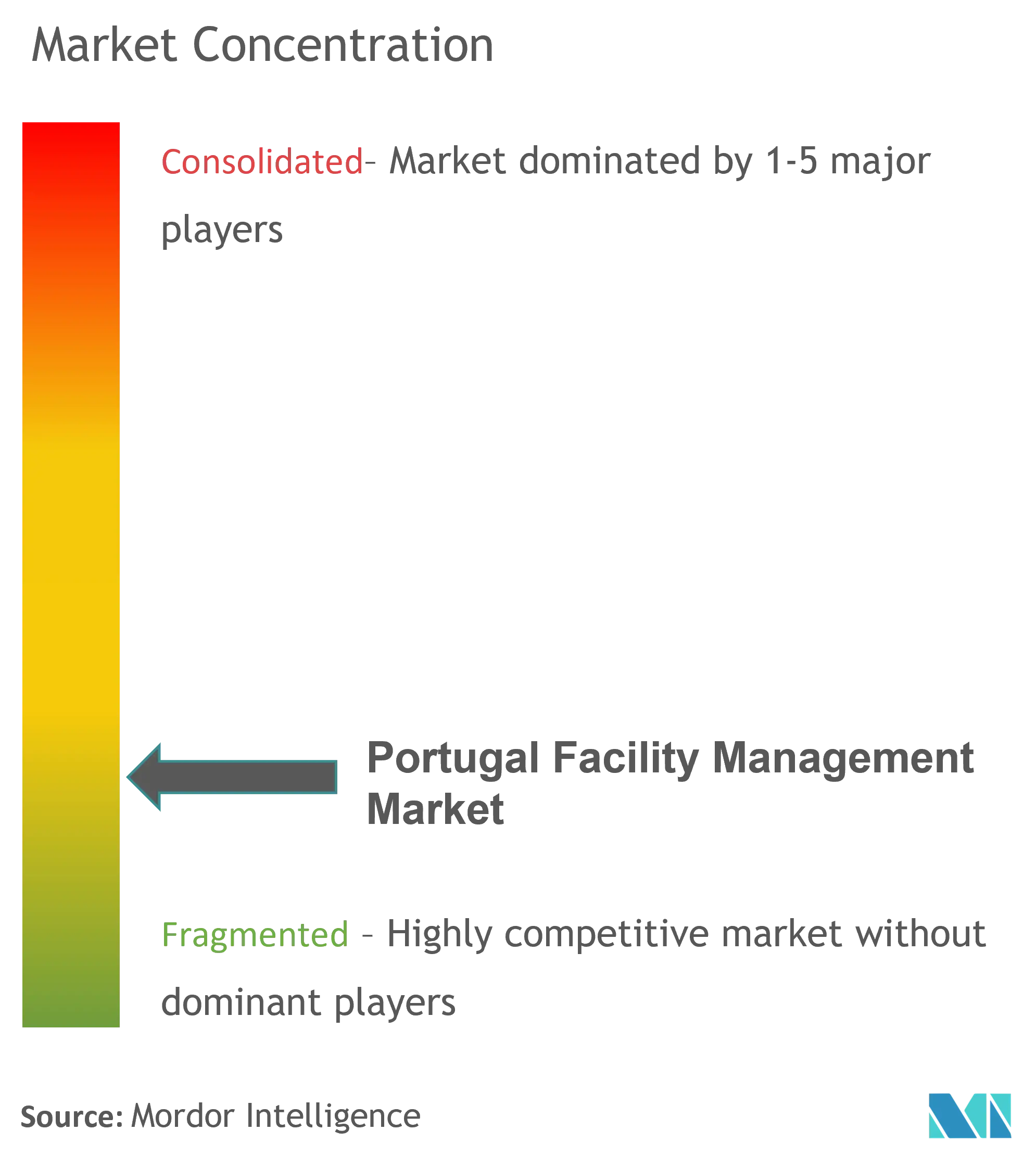
| Market Concentration | Medium |
Major Players *Disclaimer: Major Players sorted in no particular order Image © Mordor Intelligence. Reuse requires attribution under CC BY 4.0. | |
Portugal Facility Management Market Analysis by Mordor Intelligence
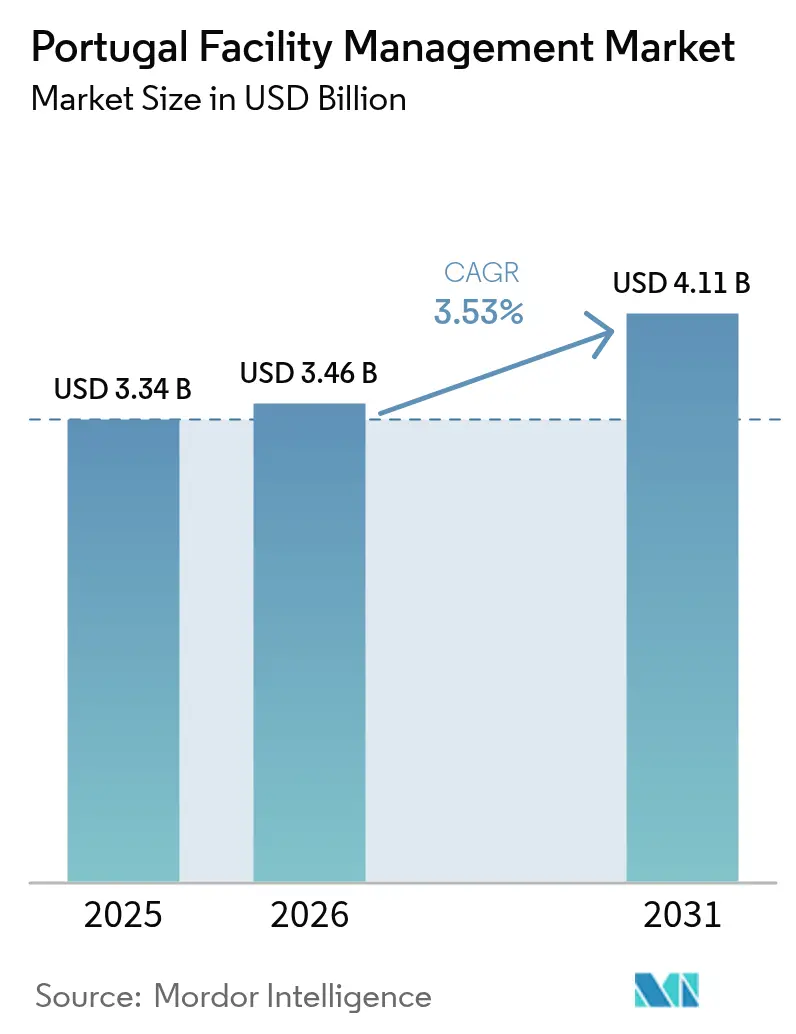
The Portugal facility management market size was valued at USD 3.34 billion in 2025 and estimated to grow from USD 3.46 billion in 2026 to reach USD 4.11 billion by 2031, at a CAGR of 3.53% during the forecast period (2026-2031). Growth has moderated as facility management services moved from an emerging offering to a standardized operational outlay for most organizations. Stricter energy-efficiency rules, a national building-renovation program targeting 69% of the stock by 2030, and steady infrastructure investment pipelines such as the EUR 1 billion (USD 1.16 billion) Porto Metro 3.0 expansion have generated predictable contract flows. At the same time, chronic labour shortages and persistent wage inflation in technical trades are pushing service providers toward efficiency-oriented technologies rather than rapid territorial expansion. Consolidation remains the dominant competitive theme, with international majors defending share while local technology specialists leverage IoT-driven systems to offer incremental performance gains.
Key Report Takeaways
- By service type, Hard Services led with 60.55% of the Portugal facility management market share in 2025.
- By offering type, the Outsourced model accounted for 67.05% of the Portugal facility management market size in 2025 and is advancing at a 4.66% CAGR through 2031.
- By end-user, the Commercial segment generated 40.25% revenue share of the Portugal facility management market in 2025, while Institutional and Public Infrastructure is projected to expand at a 4.74% CAGR to 2031.
Note: Market size and forecast figures in this report are generated using Mordor Intelligence’s proprietary estimation framework, updated with the latest available data and insights as of 2026.
Market Trends and Insights
Drivers Impact Analysis of Portugal Facility Management Market*
| Driver | (~) % Impact on CAGR Forecast | Geographic Relevance | Impact Timeline |
|---|---|---|---|
| Urbanization and population growth in key Portuguese metros | +0.8% | Lisbon, Porto, Amadora, Braga, Coimbra | Medium term (2-4 years) |
| National infrastructure-pipeline investment across transport, energy, and social assets | +1.1% | National, with a concentration in the Lisbon-Porto corridor | Long term (≥ 4 years) |
| Stricter labour and occupational-safety regulations are raising compliance-driven FM demand | +0.7% | National | Short term (≤ 2 years) |
| Technology-led adoption of integrated FM (IoT, BMS, predictive analytics) | +0.9% | Urban centers, industrial zones | Medium term (2-4 years) |
| EU Green Deal energy-efficiency mandates accelerating retrofit FM services | +0.6% | National, EU-wide alignment | Long term (≥ 4 years) |
| Surging demand for ESG-compliant, data-driven FM to achieve green-building certifications | +0.5% | Commercial districts, corporate headquarters | Medium term (2-4 years) |
| Source: Mordor Intelligence | |||
Urbanization and population growth in key Portuguese metros
Between 2025 and 2030, Lisbon and Porto continued to attract residents and corporate activity, together accounting for more than 40% of national GDP. New mixed-use projects clustered around transport corridors created a steady stream of mechanical, electrical, and plumbing (MEP) contracts rather than episodic spikes in demand. Occupiers increasingly favoured multi-year integrated agreements to maintain predictable cost structures, reinforcing the Portugal facility management market’s shift toward maturity. Dense metropolitan footprints also allowed providers to pool technicians and route service calls efficiently, partly offsetting skilled-labour scarcity. Service portfolios in these metros now standardize sustainability audits, reflecting tenant expectations for certified energy performance.
National infrastructure-pipeline investment across transport, energy, and social assets
Public-sector investment plans supplied the market’s longest visibility horizon. The Recovery and Resilience Plan earmarked EUR 143 million (USD 161 million) annually through 2050 for building upgrades, while flagship projects such as Porto Metro 3.0 and the Alcochete airport site embedded long-term facilities requirements into concession contracts.[1] High-speed rail electrification programs executed by Infraestruturas de Portugal further extended the pipeline of technical maintenance work. These undertakings strengthened the Portugal facility management market by locking in multi-year revenue rather than stimulating speculative supply.
Stricter labour and occupational-safety regulations raising compliance-driven FM demand
The Working Conditions Authority intensified inspections during 2024-2025, elevating non-compliance penalties for fire safety systems, indoor-air quality, and hazardous-material handling. The impending Construction Code, due in 2026, consolidated 100 separate statutes into a single framework that places clear accountability on facility owners for ongoing conformity. Clients, therefore, shifted from transactional fixes to preventative compliance programmes, favouring providers with integrated expertise across HVAC, fire systems, and workplace health. Consequently, contract renewal cycles lengthened, anchoring the Portugal facility management market around regulatory routine rather than discretionary spending.
Technology-led adoption of integrated FM (IoT, BMS, predictive analytics)
Measured digitization replaced the early-stage experimentation of the previous decade. IoT sensors embedded in building-management systems produced 20% energy savings in a Lisbon public-sector pilot, illustrating the incremental yet bankable returns that facility owners now expect. Predictive-maintenance trials at Renault Cacia’s plant trimmed maintenance costs by about 25%, encouraging industrial occupiers to negotiate outcome-based SLAs. Portuguese software vendors such as Infraspeak channelled their EUR 18 million (USD 20.88 million) Series B proceeds into collaboration features rather than expansionary marketing, underscoring the market’s operations-first mentality.
Restraints Impact Analysis of Portugal Facility Management Market*
| Restraint | (~) % Impact on CAGR Forecast | Geographic Relevance | Impact Timeline |
|---|---|---|---|
| Economic fluctuations and real estate market uncertainty | -0.6% | National, with higher impact in Lisbon and Porto | Short term (≤ 2 years) |
| Skilled labour shortages and wage inflation in technical trades | -0.9% | National, particularly acute in the construction and technical sectors | Medium term (2-4 years) |
| A highly fragmented vendor landscape is limiting standardisation and scale | -0.4% | National | Medium term (2-4 years) |
| Rising insurance and compliance costs for ageing building stock | -0.3% | Urban centers with older building stock | Long term (≥ 4 years) |
| Source: Mordor Intelligence | |||
Skilled labour shortages and wage inflation in technical trades
Portugal reported an 80,000-person shortfall in construction and allied technical roles during 2024-2025, lifting average janitorial and handyman rates to EUR 8-15 (USD 9-17) per hour in major cities.[2] Service providers responded by upskilling existing staff and adopting remote-monitoring tools to reduce truck rolls, but elevated wage bases eroded margins on lower-complexity contracts. Market-entry barriers rose, cushioning incumbent shares yet capping the Portugal facility management market’s headline expansion until the vocational-training pipeline recovers.
Economic fluctuations and real-estate market uncertainty
After rent caps expired, housing rents climbed 6.94% in 2024, while construction costs added 4.3% by December of the same year. Developers slowed speculative builds, dampening near-term demand for fit-out services. Although GDP is expected to grow 2.1-2.3% in 2025, interest-rate volatility keeps corporate real-estate decision-making conservative. Contract renewals continue, but portfolio expansions are modest, tempering growth in Portugal facility management market revenues over the next two years.
*Our forecasts treat driver/restraint impacts as directional, not additive. The impact forecasts reflect baseline growth, mix effects, and variable interactions.
Portugal Facility Management Market Segment Analysis
By Offering Type:
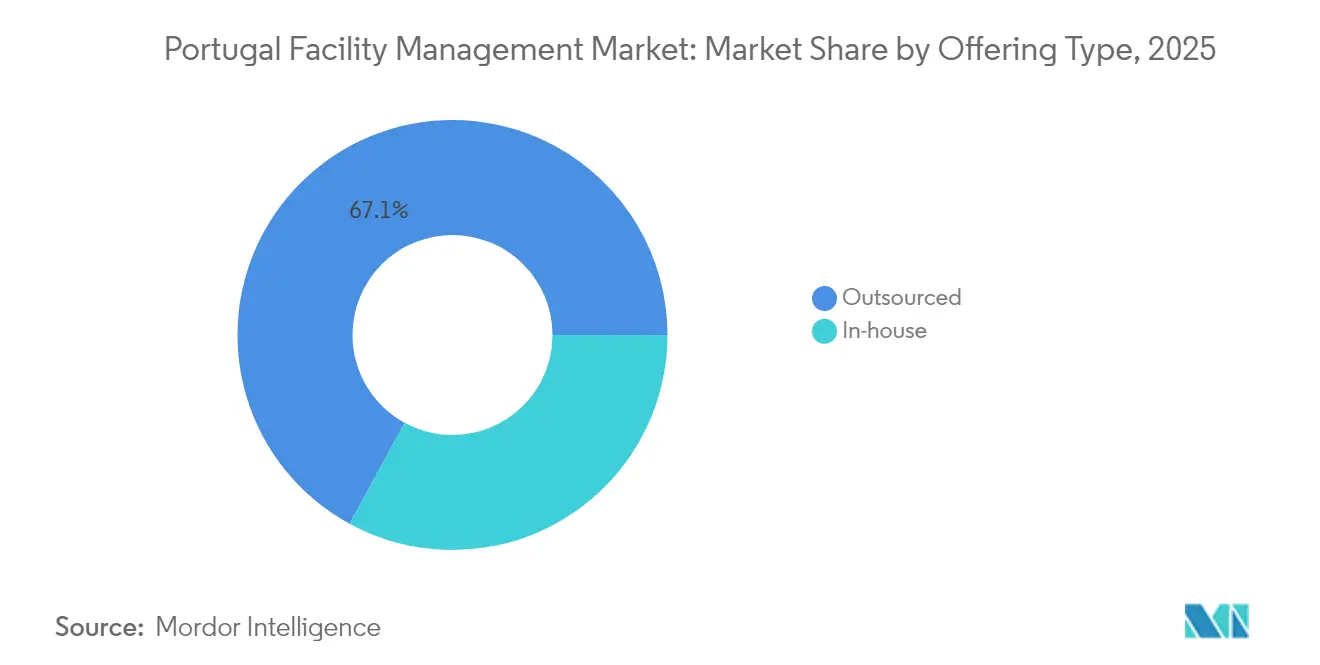
Outsourced Model Embeds Majority PreferenceOrganizations outsourced 67.05% of facility-management spend in 2025, a share projected to edge up as labour tightness persists. Owners perceived integrated-service bundles as the most reliable hedge against compliance risk, catalysing a 4.66% CAGR for outsourced agreements within the Portugal facility management market size through 2031. Banks, telecom operators, and energy utilities renewed five-year frameworks that couple technical upkeep with space-management analytics, expecting contractors to deliver energy-intensity improvements aligned with EU taxonomy disclosures.
In-house teams retained strategic control over corporate real estate portfolios but shed non-core chores such as boiler servicing and waste segregation. Rising insurance premiums for ageing stock incentivised boardrooms to transfer liability to specialist vendors with robust process certifications. Nevertheless, certain public-sector agencies preserved mixed models to protect local employment; such arrangements contribute to the remaining 32.95% share but seldom reverse the broader outsourcing trajectory in the Portugal facility management market.

By End-user Industry:
Commercial Core, Public Infrastructure UpsideThe Commercial arena delivered 40.25% of Portugal's facility management market revenue in 2025, reflecting a service-economy structure centred on offices, data centres, and retail hubs. Data-sovereignty legislation spurred domestic hosting demand, keeping facilities such as the 1.2 GW SINES campus under intensive 24/7 technical-maintenance regimes. ESG screening by multinational tenants ensured that green-building audits now stand as a contractual baseline, converting specialist certifications from differentiators into prerequisites.
Institutional and Public Infrastructure, covering hospitals, universities, and rail assets, is forecast to be the fastest riser at a 4.74% CAGR to 2031. Hospital de Lisboa Oriental and multiple PPP healthcare renewals feed multi-disciplinary contracts blending MEP, sterile-environment cleaning, and fleet management. Education campuses, meanwhile, repurpose pandemic ventilation upgrades into permanent energy-efficiency projects. The steady pipeline of EU-funded projects makes the Portugal facility management market particularly resilient within this end-user slice.
By Service Type:
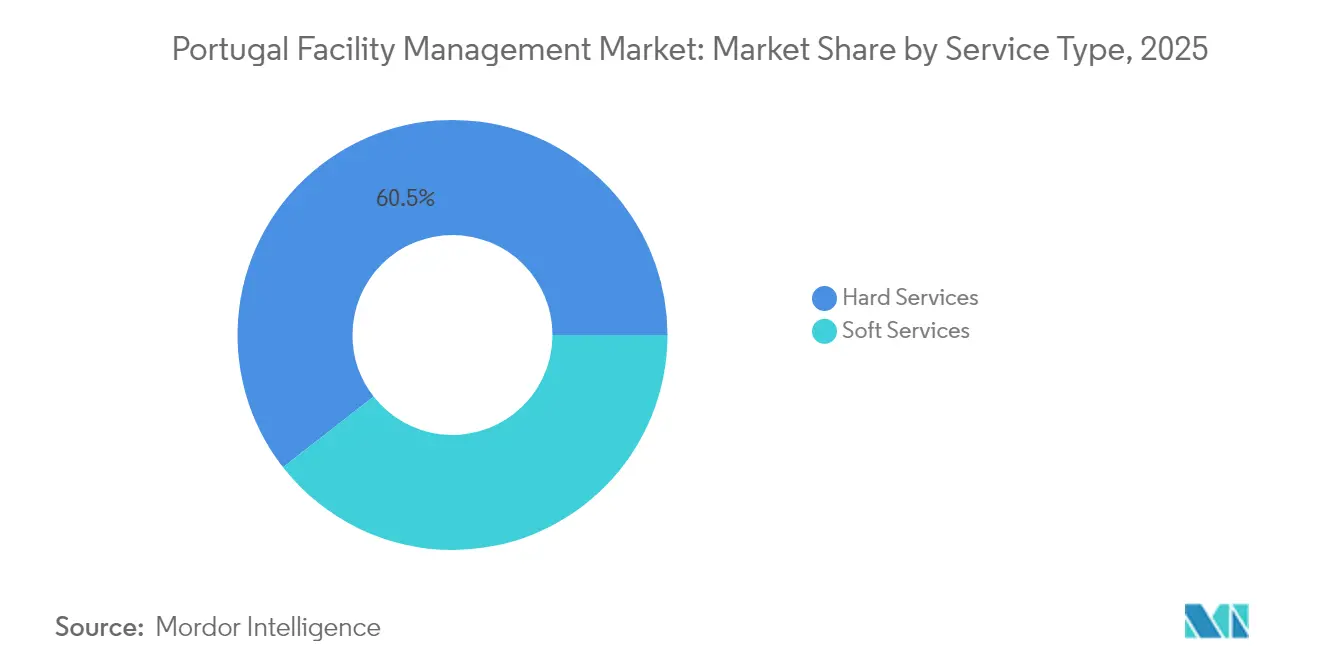
Hard Services Sustain Structural PrimacyHard Services held 60.55% of Portugal's facility management market share in 2025 and underpinned most mandatory compliance spending, while Soft Services advanced at a 4.92% CAGR to 2031 on hygiene and workspace-experience upgrades. The concentration of EU energy-efficiency mandates funnelled capital toward HVAC, MEP retrofits, and fire-system checks, embedding Hard-Service budgets into owner OPEX lines. Portugal's facility management market size associated with asset management surged alongside the EUR 1 billion (USD 1.16 billion) Porto Metro extension, which inserted multi-decade maintenance contracts into transit concessions.
Soft-Service providers leveraged regulatory requirements for formal employment contracts in cleaning and security to transition informal operators into professional networks. Technology infusion-such as robot scrubbers guided through Infraspeak’s maintenance platform-raised productivity per cleaner, partially offsetting higher wages. Hybrid working patterns sustained modest call-off demand for concierge and mailroom support, keeping segment revenues on a predictable ascent rather than the rapid spikes experienced in pandemic-era sanitization cycles.
Geography Analysis
Portugal's facility management market activity remained concentrated along the Lisbon-Porto axis, which absorbed roughly 59% of the national spend in 2025. Lisbon’s stock of government buildings, corporate HQs, and mixed-use developments cemented its lead; ESG compliance and ISO-41001 certification are now embedded in most renewal tenders, raising technical complexity and average contract values. Porto benefited from Metro 3.0 civil works and its software-startup ecosystem, which championed predictive-maintenance pilots to showcase exportable solutions.
Secondary urban clusters such as Braga, Coimbra, and Amadora drew university-linked R&D funding that flowed into smart-campus initiatives. Projects under the Aveiro Tech City Living Lab illustrated how mid-sized municipalities deployed AI for traffic-safety analytics and waste-collection routing, thereby opening niches for regional FM firms skilled in sensor integration. Along the Algarve coast, hospitality-driven seasonality sustained cyclical peaks for housekeeping and HVAC servicing. However, operators increasingly locked in 12-month retainers to guard against labour shortages during high season, smoothing revenue curves. Industrial zones such as Sines anchored specialized contracts on power-density management, water-treatment oversight, and substation maintenance. Rural regions, though fragmented, began to receive energy-retrofit grants that bundled FM clauses for long-term monitoring, broadening Portugal facility management market penetration outside metropolitan cores.
Regulatory Landscape
Portugal facility management demand is anchored by building energy-performance and safety compliance. The Energy Certification System for Buildings (SCE) under Decree-Law 101-D/2020 (overseen via DGEG) links ongoing operation and maintenance of technical building systems to documented energy-management practices, pushing owners toward structured maintenance planning and audit-ready records. Fire safety in buildings (SCIE), overseen by the National Emergency and Civil Protection Authority (ANEPC), with municipalities handling lower-risk categories, supports recurring inspection, testing, and corrective-work scopes across HVAC, alarms, suppression, and emergency systems.
Digital and construction compliance requirements are tightening the FM perimeter for telecom- and data-intensive sites. Decree-Law 125/2025 establishes a new cybersecurity legal regime transposing NIS 2, with entry into force on 3 April 2026, raising expectations for resilience, incident readiness, and supplier controls. For FM, this is translating into stricter SLAs and verification obligations in contracts for critical facilities. In parallel, the legal regime for construction activities (Law 41/2015, managed by IMPIC) and telecom infrastructure obligations such as ITED rules and ANACOMs Suitable Infrastructure Information System (SIIA) reinforce standardized technical execution and documentation when FM providers support building telecom rooms, structured cabling spaces, and shared passive infrastructure.
Value Chain Analysis
The Portugal facility management value chain starts with asset owners and occupiers (commercial offices, public infrastructure, healthcare, hospitality, and industrial sites) defining compliance and performance requirements, then moves into procurement of outsourced single, bundled, or integrated FM contracts. Inputs cover labor (MEP technicians, cleaners, security staff), specialist subcontractors (fire safety, lifts, water treatment), consumables and spare parts, and building-technology components such as BMS/IoT sensors that feed performance-based reporting. Industry bodies including the Associacao Portuguesa de Facility Management (APFM) and Portugal DC (data-center association) act as knowledge and standardization enablers, shaping training, service expectations, and resilience practices for critical digital infrastructure.
Service delivery is increasingly mediated by software platforms that connect work orders, asset registries, compliance documentation, and energy data, with a noted digital maturity gap as many organizations still operate at low BIM-FM maturity levels. Platform vendors and integrators, including Portuguese FM software specialists and solutions providers, support interoperability between BMS hardware and reporting layers, while larger FM operators and real-estate managers deploy integrated management platforms for real-time operational control, predictive maintenance, and automated reporting (for example, MVGM highlighted digitalization in Portugal during July 2025). Downstream, performance verification and client governance close the loop through KPIs, audits, and sustainability reporting, reinforcing demand for measurable service outcomes rather than labor-only contracting.
Competitive Landscape
Competitive dynamics reflected a mature, efficiency-oriented arena. ISS preserved its leading share through multi-country frameworks, including a 7-year, DKK 1.2 billion (USD 0.19 billion) annual deal with the UK Department for Work and Pensions, giving the group scale to leverage offshore procurement on Portuguese contracts.[4] Sodexo maintained a measured 2.1% organic growth in Europe, illustrating how incumbents prioritised contract optimization over aggressive rollout.
Local technology specialists intensified horizontal alliances rather than direct share grabs. Infraspeak channelled its EUR 18 million (USD 20.92 million) investment toward API integrations with BMS hardware, enabling incumbents to embed real-time telemetry into legacy work-order systems. NextBITT allocated EUR 5 million (USD 5.81 million) to carbon-footprint modules, positioning itself as a compliance engine amid growing CSRD reporting obligations.
M&A unfolded selectively: Samsic’s purchase of Pro Impec strengthened janitorial depth, while international energy-service conglomerates eyed data-centre cooling opportunities. Vendor selection criteria increasingly centred on ESG credentials—only 7% of Portuguese offices had third-party environmental labels in 2024, well below the 22% European norm, creating a value gap for certifications within the Portugal facility management market.
Portugal Facility Management Industry Leaders
-
Infraspeak
-
Apleona GmbH
-
TDGI SA
-
BMG-Services
-
NextBITT
- *Disclaimer: Major Players sorted in no particular order
Portugal Facility Management Market Companies Covered in this Report
- Infraspeak
- Apleona GmbH
- TDGI SA
- BMG-Services
- NextBITT
- Samsic Portugal
- Interlimpe Facility Services SA
- ISS Facility Services
- PLM Facility Management
- Openline
- Climex
- Cofely (Engie)
- Grupo Trivalor
- Dosapac
- Etermar
- Martifer
- SUMA
- Sodexo Portugal
- CBRE Global Workplace Solutions
- Sonae Sierra Services
- Johnson Controls FM
- Vinci Facilities
- Ferrovial Serviços (Serveo)
Market Opportunities and Future Outlook
A key whitespace is the convergence of physical FM with digital-infrastructure operations, especially as government and enterprise programs emphasize sovereign cloud, AI, and data-center capacity. In April 2026, the Government published the 2026-2027 Action Plan for the National Digital Strategy, which prioritizes a National Data Centres Plan and earmarks funding for digital infrastructure. This creates a pipeline of facilities that require 24/7 hard-services coverage (power, cooling, safety systems), along with structured reporting and resilience practices. The opportunity is shifting toward integrated FM packages that combine energy optimization, critical-environment maintenance, and governance-ready documentation aligned to customer requirements.
Technology-led service models are gaining concrete reference points across telecom and industrial environments. In April 2026, MEO deployed an AI factory architecture on Microsoft Azure to automate operational intelligence for field activities and troubleshooting, reinforcing demand for FM partners that can integrate telemetry, automate workflows, and support outcome-based SLAs. In industrial sites, CIMPOR completed private 5G deployments across multiple plants in partnership with Vodafone Portugal and Ericsson (January 2026), supporting more sensorized maintenance and safer remote operations, which expands the addressable scope for predictive maintenance, condition monitoring, and energy-consumption analytics. At the same time, the entry into force of Portugals NIS 2-based cybersecurity regime on 3 April 2026 raises the bar for auditability and supplier controls at critical sites, increasing the value of FM providers that can operationalize compliance across both physical and digitally dependent building systems.
Recent Industry Developments in Portugal Facility Management Market
- April 2026: Infraspeak held the Infraspeak FM Awards 2026, recognizing organizations for FM operations, including wins linked to intelligent operations and integrated FM. The program reinforced the visibility of data-driven, standardized operating models, supporting wider adoption of collaborative CMMS and integrated service workflows in Portugal.
- March 2026: Apleona acquired Morrison Facilities Services Limited in the UK to expand its self-delivery capability and public-sector footprint. The deal strengthened Apleonas technical services platform and decarbonization delivery depth, which can be leveraged across multinational accounts that include Portuguese FM scopes.
- October 2024: Infraspeak raised a growth round (reported as EUR 18 million in Europe-focused coverage and USD 19.5 million in US coverage) to expand collaboration capabilities for facilities management. The funding supported product investment in connected workflows and integrations, helping accelerate platform-led delivery for outsourced and integrated FM contracts.
Portugal Facility Management Market Report Scope and Research Methodology
Market Definition and Coverage
For this study, the Portugal facility management market covers the value of services used to operate, maintain, and support buildings and sites across the country, including day to day soft services and technical hard services delivered through in house teams or outsourced contracts.
Scope exclusions: We exclude one time new-build construction works and pure equipment sales when they are not part of an ongoing facility management service agreement.
Segments Covered in This Report
- By Offering Type
- In-house
- Outsourced
- Single FM
- Bundled FM
- Integrated FM
- By End-user Industry
- Commercial (IT and Telecom, Retail and Warehousing)
- Hospitality (Hotels, Eateries and Restaurants)
- Institutional and Public Infrastructure (Government, Education, Transport)
- Healthcare (Public and Private Facilities)
- Industrial and Process (Manufacturing, Energy, Mining)
- Other End-user Industries (Multi-housing, Entertainment, Sports and Leisure)
- By Service Type
- Hard Services
- Asset Management
- MEP and HVAC Services
- Fire Systems and Safety
- Other Hard FM Services
- Soft Services
- Office Support and Security
- Cleaning Services
- Catering Services
- Other Soft FM Services
- Hard Services
Data Sources, Market Sizing, and Validation
Desk Research
Desk work starts by mapping what is being managed in Portugal and how spending typically shows up in public records. We referenced sources such as INE (Statistics Portugal) for building stock and sector activity signals, the European Commission and Eurostat for macro and construction related series, and labor market statistics from OECD and ILO to understand wage pressure in service delivery.
To keep the model grounded, we also used public procurement portals and government notices to observe contracting patterns in institutional sites, followed by company annual reports and investor presentations to sense-check service mix and client concentration. Patent databases were selectively reviewed to understand where automation and energy management tools could shift service intensity over time. In addition, we used a paid subscription for company financials and news to validate operating footprints, contract wins, and headline events. The sources listed here are illustrative only, and many other public documents were also used for data collection, validation, and clarification.
Primary Interviews and Surveys
Primary work was used to check how services are priced and bundled in Portugal, and where in house delivery is still preferred versus outsourcing. We spoke with a mix of facility managers, procurement leads, service providers, and subject experts across commercial sites, healthcare, hospitality, industrial locations, and public infrastructure, which helped us confirm assumptions and close gaps that desk sources do not explain well.
Distribution of primary research fieldwork respondents
| Company type | Respondent position |
|---|---|
| Top tier: 27% | CXOs: 17% |
| Mid tier: 56% | Functional/Unit leaders: 34% |
| Smaller Players: 17% | Managers: 49% |
Market-Sizing & Forecasting
Sizing was built using both top-down and bottom-up logic, with the top-down view starting from the national demand pool for managed buildings and then translating it into service spend. For Portugal, demand was reconstructed by combining the building base and activity by end user (commercial offices and retail, hospitality sites, hospitals and clinics, industrial and process facilities, and public infrastructure) with typical outsourcing penetration and service intensity.
Once the demand pool was set, we applied market fingerprints that practitioners consistently referenced, such as hard versus soft service split, typical contract lengths, the share of integrated or bundled contracts, wage inflation for frontline roles, and energy efficiency compliance related maintenance cycles. Forecasts were built using scenario analysis so that different paths for outsourcing adoption, labor cost pressure, and renovation activity could be reflected without forcing one straight-line trend. Bottom-up checks were then used to corroborate totals, including sampled price per square meter and service frequency assumptions, plus limited roll-ups from public disclosures where available, and then gaps were handled with conservative ranges that were re-tested through follow-up calls.
Data Validation & Update Cycle
Outputs were cross-checked against independent signals, including employment trends in services, public contract flow, and the direction of costs that affect FM delivery. When a segment result looked out of line, the assumptions were re-opened, the calculation trail was reviewed by another analyst, and targeted re-contacts were triggered to confirm whether the variance came from pricing, scope, or penetration.
The report is refreshed annually, and interim updates are made when a material event changes demand or pricing assumptions, such as major policy shifts or outsized contract announcements. Before delivery, a final analyst pass is completed so the latest public releases and interview learnings are reflected in the numbers clients receive.
Mordor Intelligence's Portugal Facility Management Market Sizing Compared With Other Published Estimates
Market size values for facility management in Portugal often vary because sources do not always count the same service perimeter, and they also differ on whether they model in house delivery, bundled contracts, and public sector sites consistently. Timing also matters since price revisions in labor-heavy services can move the headline value even if volumes are stable.
The other common drivers are how hard and soft services are grouped, whether integrated contracts are counted as one package or split across lines, and how currency conversion is timed when local pricing is updated mid-year. The table helps make these differences visible so buyers can see what is being included before using the figure for planning.
Benchmark comparison
| Source | Market Size | Gaps in Research Methodology |
|---|---|---|
| Mordor Intelligence | USD 3.34 B (2025) | |
| Industry Association A | USD 2.95 B (2025) | Often leans toward outsourced contract value only, which can undercount in-house delivery still used in parts of public infrastructure and industrial sites. |
| Global Consultancy B | USD 3.78 B (2025) | Commonly broadens scope by folding adjacent building services and energy management spend into FM, and uses more aggressive price uplift assumptions for multi-year contracts. |
The table shows a tight spread around 2025, and the main differences come from what is counted as FM versus adjacent building services, plus how in house activity is treated. In Mordor Intelligence's model, the Portugal total is built around recurring hard and soft FM services across end users, and it only counts spend when it is tied to ongoing operation and maintenance delivery rather than one-off project work. That choice makes the estimate easier to reconcile back to service intensity, outsourcing mix, and wage-linked price movement, which we can explain and re-check as new signals appear.
Key Questions Answered in the Report
What is the current size of the Portugal facility management market?
The Portugal facility management market size reached USD 3.46 billion in 2026 and is projected to hit USD 4.11 billion by 2031.
Which service segment holds the largest share?
Hard Services dominated with 60.55% of Portugal facility management market share in 2025, thanks to mandatory MEP and fire-safety compliance.
Why is outsourcing preferred over in-house models?
A 67.05% share in 2025 reflected employers’ need for specialist skills amid labour shortages and rising regulatory complexity.
Which end-user sector will grow fastest by 2031?
Institutional and Public Infrastructure is expected to post a 4.74% CAGR as EU-funded modernization projects roll out.
How are technology trends shaping the market?
IoT-enabled BMS and predictive maintenance have delivered energy savings of around 20% in pilot sites, making data-driven FM a procurement staple.
What is the main barrier to faster market growth?
An 80,000-person deficit in technical trades is inflating wages and constraining capacity expansion across service providers.