
Market Overview
| Study Period | 2020 - 2031 |
|---|---|
| Forecast Data Period | 2026 - 2031 |
| Historical Data Period | 2020 - 2024 |
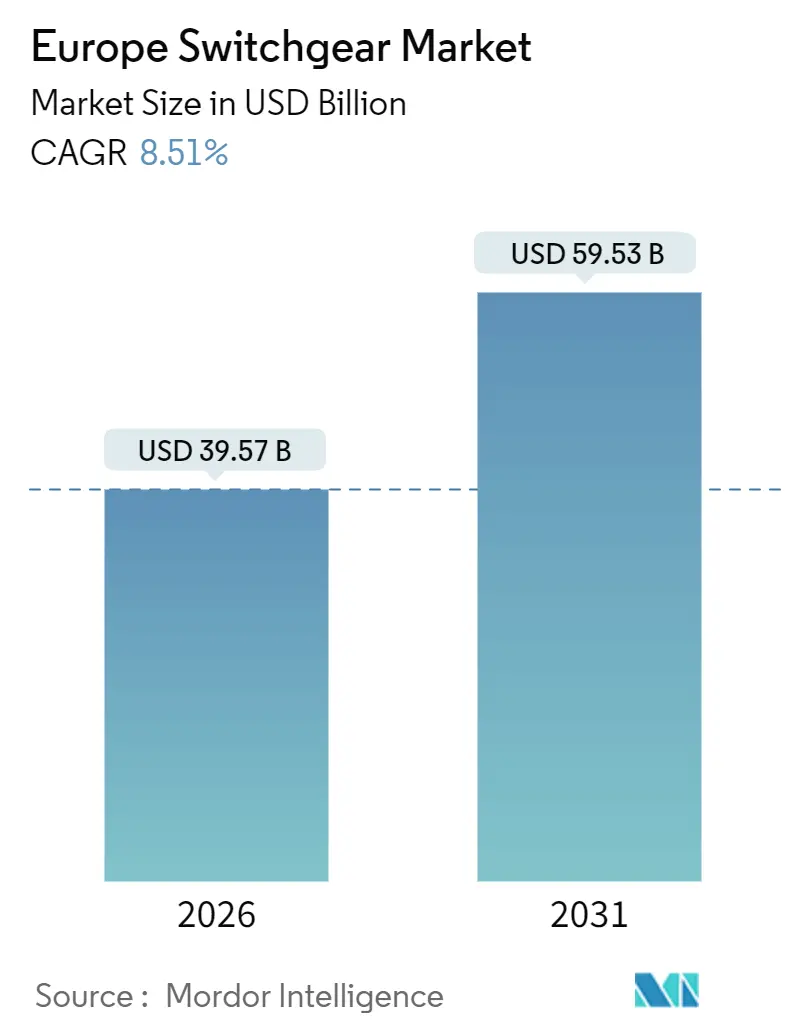
| Market Size (2026) | USD 39.57 Billion |
| Market Size (2031) | USD 59.53 Billion |
| Growth Rate (2026 - 2031) | 8.51 % |
| Market Concentration | Medium |
Major Players *Disclaimer: Major Players sorted in no particular order Image © Mordor Intelligence. Reuse requires attribution under CC BY 4.0. | |
Europe Switchgear Market Analysis by Mordor Intelligence
The Europe switchgear market size reached USD 39.57 billion in 2026 and is projected to climb to USD 59.53 billion by 2031, advancing at an 8.51% CAGR. Continued policy pressure to replace SF₆-filled equipment, fast-tracking of renewable interconnections, and the embedding of IoT sensors inside medium- and high-voltage assemblies are the dominant growth catalysts. Investment momentum is reinforced by the European Commission’s REPowerEU schedule, which compresses grid connection lead times and accelerates the procurement of compact gas-insulated units for offshore wind platforms. Data-center build-outs across Ireland, the Netherlands, and Germany are simultaneously lifting demand for redundant N+1 switchgear architectures that guarantee 99.999% uptime. Meanwhile, utilities are piloting switchgear-as-a-service contracts to convert capital outlay into predictable operating fees, creating a parallel revenue stream for manufacturers.
Key Report Takeaways
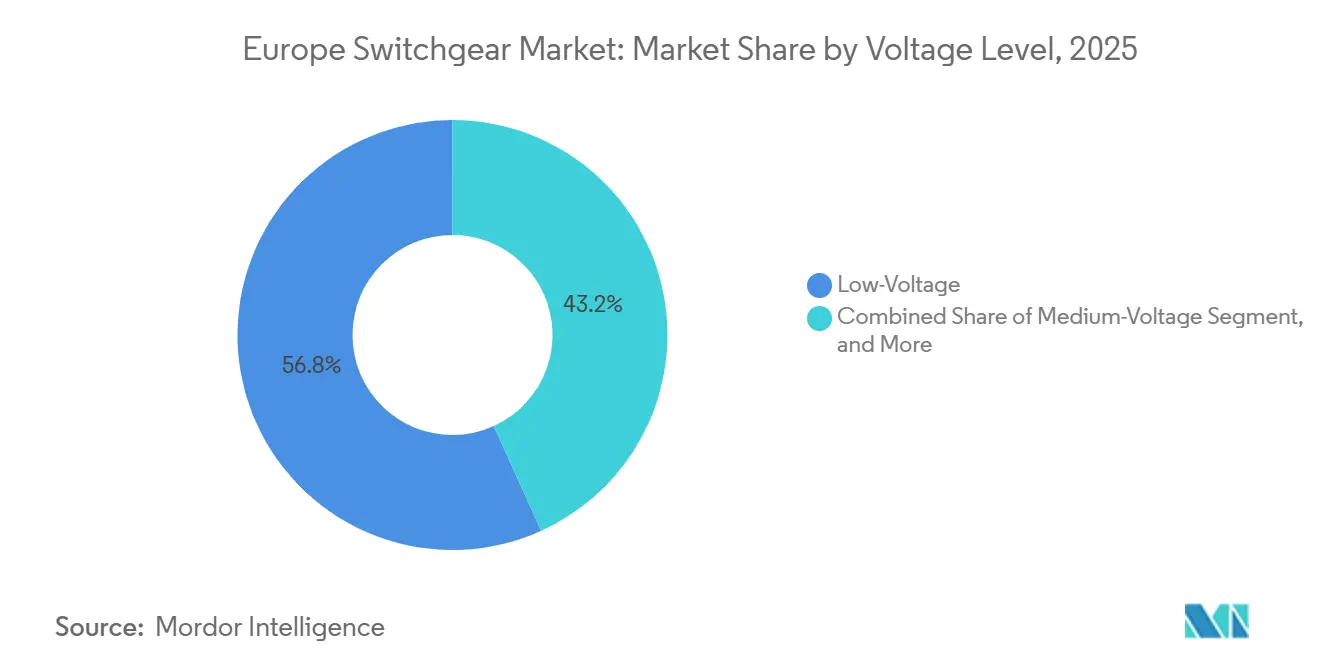
- By voltage level, low-voltage equipment accounted for 56.78% of 2025 revenue, while medium-voltage equipment is poised to expand at a 9.11% CAGR through 2031.
- By insulation type, air-insulated gear accounted for 42.39% of the Europe switchgear market share in 2025, but gas-insulated variants are forecast to grow at a 9.57% CAGR.
- By installation, indoor systems accounted for 63.91% of deployments in 2025, whereas outdoor assemblies are projected to grow at an 8.92% CAGR.
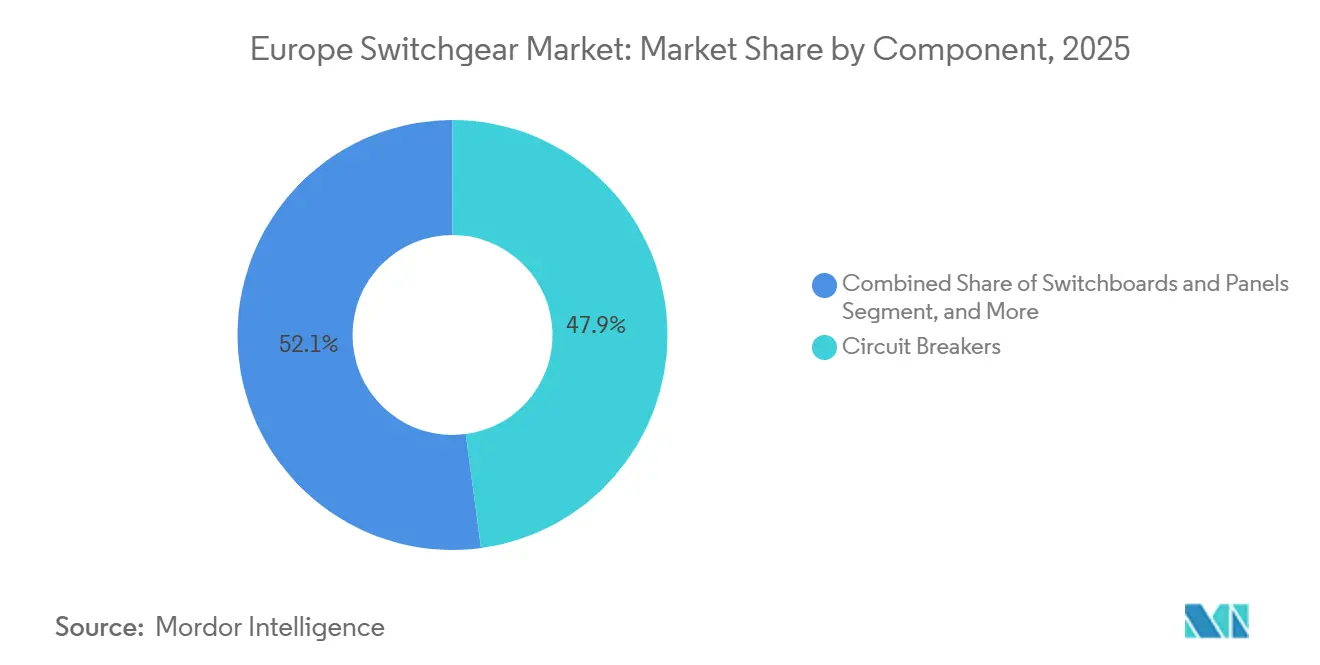
- By component, circuit breakers accounted for 47.88% of 2025 revenue, yet switchboards and panels posted the fastest 9.34% CAGR.
- By end-user, utilities led with a 36.21% share in 2025; transportation and infrastructure is the fastest-rising segment at a 9.51% CAGR.
- By geography, Germany contributed 29.19% of the 2025 value, while the United Kingdom is slated for a 9.77% CAGR through 2031.
Note: Market size and forecast figures in this report are generated using Mordor Intelligence’s proprietary estimation framework, updated with the latest available data and insights as of January 2026.
Europe Switchgear Market Trends and Insights
Drivers Impact Analysis*
| Driver | (~) % Impact on CAGR Forecast | Geographic Relevance | Impact Timeline |
|---|---|---|---|
| Grid-Edge Digitalization Push | +1.8% | Germany, United Kingdom, France, Nordic countries | Medium term (2-4 years) |
| Fast-Track Renewable Grid Connections | +2.1% | Germany, Spain, United Kingdom, Denmark | Short term (≤ 2 years) |
| Surge in Data-Center Switchgear Demand | +1.5% | Ireland, Netherlands, Germany, France | Short term (≤ 2 years) |
| Accelerated Rail Electrification Projects | +1.3% | France, Italy, Spain, Poland | Medium term (2-4 years) |
| SF₆-Free Technology Mandates | +1.6% | European Union-wide, early adoption in Germany and Nordics | Long term (≥ 4 years) |
| Rise of Micro-Utility Community Grids | +0.8% | Germany, Netherlands, Belgium, Austria | Long term (≥ 4 years) |
| Source: Mordor Intelligence | |||
Grid-Edge Digitalization Push
Real-time monitoring modules embedded in switchgear allow utilities to detect partial-discharge spikes and temperature anomalies before a fault escalates, cutting outage duration by as much as 40%.[1] National Grid ESO has required IEC 61850-compliant panels for every new connection above 11 kV since 2025, accelerating retrofit demand in aging U.K. substations. The convergence of edge computing with breaker intelligence enables dynamic load balancing without operator intervention, easing congestion at urban feeders. Cyber-security standards under the NIS-2 Directive, however, lengthen procurement by an extra 12-18 months because penetration tests and secure firmware protocols must be demonstrated before commissioning.
Fast-Track Renewable Grid Connections
The European Commission’s REPowerEU plan targets 320 GW of new solar and wind capacity by 2030, forcing network operators to halve grid connection lead times.[2] Spain approved 15 GW of projects in 2025 and specifies medium-voltage switchgear with fault-ride-through logic to handle intermittent output. Germany booked a 31% rise in coastal gas-insulated orders to serve 8.2 GW of offshore wind awaiting hookup. Denmark’s Energinet invested EUR 1.2 billion (USD 1.28 billion) in 2025 to upgrade transmission gear with vacuum interrupters that eliminate SF₆ use. Integrated reactive-power compensation built into modern panels lifts unit cost 15-20%, but it avoids separate capacitor banks, trimming project footprints.
Surge in Data-Center Switchgear Demand
Hyperscale builds added 1.8 GW of IT load across Europe in 2025, with Ireland, the Netherlands, and Germany accounting for 62% of capacity.[3] Schneider Electric saw European data-center orders jump 28% in 2025, particularly for compact gas-insulated lines that fit tight server-hall footprints. Liquid-cooled racks are raising inrush currents sixfold, compelling operators to specify higher short-circuit ratings. AWS pledged EUR 7.8 billion (USD 8.3 billion) to expand its regional footprint and mandates IEC 62271-certified equipment with 99.999% uptime guarantees. Persistent 40- to 52-week lead times for gas-insulated units are nudging some developers toward modular air-insulated designs that ship in 24 weeks at the expense of larger footprints.
SF₆-Free Technology Mandates
The 2025 F-gas revision bans most new SF₆-filled switchgear above 24 kV, driving a 34% jump in European vacuum-interrupter orders at ABB. Eaton’s solid-dielectric line, launched in March 2025, replaces both SF₆ and vacuum chambers, appealing to urban sites with limited maintenance access. The newly published IEC 62271-203 benchmarks accelerate type tests and cut certification costs by up to 22%. Vacuum assemblies cost 25-30% more than legacy gas units at 36 kV, straining budgets in Southern and Eastern Europe. Clean-air switchgear using fluoronitrile-CO₂ blends balances cost and performance, with Siemens pilots in Italy and Spain showing dielectric strengths within 5% of those of SF₆ units.
Restraints Impact Analysis*
| Restraint | (~) % Impact on CAGR Forecast | Geographic Relevance | Impact Timeline |
|---|---|---|---|
| High Capex versus Opex Savings Debate | -1.2% | Southern and Eastern Europe | Short term (≤ 2 years) |
| Lengthy Type-Testing Lead Times | -0.9% | European Union-wide, acute in Germany and France | Medium term (2-4 years) |
| Raw-Material Price Volatility | -1.4% | European Union-wide, supply-chain exposure in Germany, Italy, Poland | Short term (≤ 2 years) |
| Cyber-Security Compliance Burden | -0.7% | Germany, France, Netherlands, Nordics | Medium term (2-4 years) |
| Source: Mordor Intelligence | |||
High Capex versus Opex Savings Debate
Digitalized, SF₆-free panels cost 30-45% more upfront than legacy alternatives, leading Terna to retrofit only 12% of planned distribution substations in its 2025 budget. Iberdrola procurement committees now insist on five-year payback thresholds that many vacuum units cannot satisfy without factoring carbon-credit gains. Pilot switchgear-as-a-service contracts in the United Kingdom convert capex to opex, but regulators are undecided on whether leased assets earn a rate-based return, delaying widespread adoption. Utilities in Greece and Poland continue to favor cheaper SF₆ designs, slowing overall replacement velocity. As incentive schemes expand, however, performance-based contracts could bridge the value-perception gap.
Lengthy Type-Testing Lead Times
Copper traded between USD 8,200 and USD 10,400 per metric ton in 2025, while aluminum traded between USD 2,300 and USD 2,850, swelling medium-voltage production costs by up to 35%. Schneider Electric raised list prices by 6-8% in October 2025 to offset 180 basis points of margin erosion. Small regional suppliers lack hedging muscle and face cash-flow strain, prompting acquisitions by Tier-1 players securing raw-material pipelines. Steel enclosure prices rose 14% after carbon-border tariffs, adding EUR 800-1,200 (USD 850-1,280) per panel. Persistent volatility encourages design shifts toward aluminum-bus or composite-bus layouts, reducing copper mass by 20-25%.
*Our forecasts treat driver/restraint impacts as directional, not additive. The impact forecasts reflect baseline growth, mix effects, and variable interactions.
Segment Analysis
By Voltage Level: Medium-Voltage Gains on Industrial Electrification
Medium-voltage assemblies are tracking a 9.11% CAGR, outpacing low-voltage growth, as factory electrification and data center campuses demand higher fault-clearing ratings. ABB reported a 26% jump in European medium-voltage orders from automotive and chemical plants converting to electric furnaces. High-voltage equipment continues to serve cross-border interconnections such as the North Sea Wind Power Hub, which deploys 400 kV gas-insulated bays to conserve offshore platform real estate. Regulatory clauses in Germany’s VDE-AR-N 4110 compel assets above 1 MW to install programmable protection, nudging industrial loads from low- to medium-voltage boards.
Low-voltage frameworks still dominate residential and commercial projects where plug-and-play modules slash commissioning to 48 hours. Yet electric-vehicle hubs rated at 350 kW blur the voltage boundary, prompting some operators to choose compact 24 kV panels to curb feeder voltage drop. Hybrid medium-voltage designs that mix air busbars and vacuum interrupters trim footprint by 35%, reinforcing adoption on space-restricted brownfield sites. TenneT earmarked EUR 2.1 billion (USD 2.24 billion) for 2025 for upgrades to 72.5–245 kV lines along the Dutch-German corridor, prioritizing SF₆-free equipment. The Europe switchgear market, therefore, sees voltage-level convergence, where application rather than nominal voltage dictates equipment choice.

By Insulation Type: Gas-Insulated Captures Urban and Offshore Niches
Air-insulated gear maintained a 42.39% share in 2025 on cost advantage and ease of servicing, but gas-insulated alternatives are growing at a 9.57% CAGR because their compact footprints address premium land costs in London, Paris, and Frankfurt. Schneider Electric logged a 31% leap in gas-insulated data-center orders after launching fluoronitrile-CO₂ mixtures with a global warming potential below 1. Vacuum-insulated varieties respond directly to SF₆ bans, with German utilities replacing 1,200 panels under a federal subsidy covering 40% of incremental expense. Solid-dielectric technology, though 15-20% pricier, is more resistant to humidity and pollution on Mediterranean coasts and is therefore favored in Sicily and Cyprus.
Hybrid configurations pairing air busbars with gas breakers now account for roughly 9% of new procurements, balancing cost and density. Hitachi Energy’s 2025 hybrid launch shrank enclosure volume by half, targeting retrofits beneath city-center plazas where excavation permits are scarce. In rural Spain, utilities still prefer air-insulated bays for solar farms where land is abundant, and salt spray is minimal. The Europe switchgear market consequently maintains a mixed insulation portfolio, reflecting divergent spatial and regulatory pressures.
By Installation Type: Outdoor Gear Rides Renewable Expansion
Outdoor assemblies are expected to grow at an 8.92% CAGR, supported by wind and solar sites in remote or coastal terrain. United Kingdom offshore developers ordered 29% more outdoor 66 kV gas-insulated panels in 2025 to lighten turbine-platform loads. Natural ventilation reduces cooling costs by up to 25%, yet IP65 coatings and UV-resistant gaskets increase initial pricing. France’s RTE spent EUR 890 million (USD 950 million) on 47 outdoor substations engineered with surge arresters to counter lightning risk.
Indoor systems still account for 63.91% of volumes because urban density and fire codes demand enclosed solutions. Eaton’s 2025 arc-resistant indoor design vents pressure and limits incident energy by 85%, improving safety in hospitals and airports. Polymer-insulated busbars are shrinking indoor footprints by 30%, widening applicability to retrofits beneath office towers. Germany and the Netherlands, with substation densities above 12 units per 100 km², remain the strongholds of the Europe switchgear market.
By Component: Switchboards and Panels Lead Modular Shift
Switchboards and panels are forecast to grow at a 9.34% CAGR as modular architectures ease factory acceptance testing and enable field reconfiguration without downtime. Siemens recorded a 19% increase in European switchboard bookings after customers migrated from fixed to withdrawable designs, which expedited breaker swaps. Prefabricated skids now shorten on-site installation time from 2 months to under 3 weeks, cutting labor and lost-production costs.
Circuit breakers, still accounting for 47.88% of 2025 revenue, are evolving toward electronic trip units with Bluetooth diagnostics that feed building-management dashboards. Contactors and relays gain relevance in vehicle-charging depots where fast-cycling duty profiles prevail, while fuse switches retain cost appeal in apartments below 100 A. Legrand’s modular platform captured 62% of new panel bids in 2025, confirming a lasting tilt toward plug-and-play assemblies. The modular trend keeps the Europe switchgear market in rapid-deployment mode, favoring suppliers with flexible manufacturing lines.
By End-User: Transportation Electrification Accelerates Demand
Transportation and infrastructure applications will grow at a 9.51% CAGR as high-speed rail and metro extensions proliferate. SNCF budgeted EUR 4.2 billion (USD 4.48 billion) to electrify 1,800 km of regional rail, specifying 25 kV vacuum gear with pantograph protection. Spain’s Adif awarded contracts for 320 traction substations along the Madrid-Galicia corridor, mandating SF₆-free 36 kV units for environmental compliance.
Utilities remain the largest buyers at 36.21% share, but stretched capex forces prioritization of transmission-level upgrades over distribution replacements. Industrial plants are pursuing predictive maintenance to avert costly outages, investing EUR 1.6 billion (USD 1.71 billion) in German chemical complexes in 2025. Commercial buildings must meet near-zero-emission standards, hence specify switchgear with embedded energy meters. Residential uptake follows heat-pump adoption, up 34% in 2025, necessitating uprated service equipment. Performance-based contracts piloted by National Grid illustrate how service models can reshape the procurement landscape for the Europe switchgear market.
Geography Analysis
Germany accounted for 29.19% of the Europe switchgear market in 2025, backed by its industrial base and expanding offshore wind corridors. The Federal Network Agency approved EUR 3.8 billion (USD 4.05 billion) for 2026 transmission upgrades, 42% of which targets switchgear replacements along the North-South spine. Digital-ready panels installed by Enedis in France’s urban grids reduced outage response by 35%, illustrating tangible operational gains.
The United Kingdom will pace growth at a 9.77% CAGR through 2031, propelled by its offshore wind build-out and the requirement for smart-ready switchgear for any connection above 11 kV. Italy earmarked EUR 1.1 billion (USD 1.17 billion) for medium-voltage refresh in Sicily and Sardinia in 2025, while Spain’s 12 GW renewable surge mandates IP54 outdoor enclosures to withstand dust and heat. Nordic utilities have already replaced 840 SF₆ units through voluntary programs, accelerating the migration to vacuum and clean-air solutions.
Central and Eastern European nations such as Poland, the Czech Republic, and Romania are retiring coal plants, requiring bidirectional switchgear to accommodate distributed solar exports.
Regulatory Landscape
EU climate and grid-security rules are tightening design and procurement requirements for switchgear placed on the European market. Regulation (EU) 2024/573 (F-gas) restricts SF6 in electrical switchgear with staged prohibitions, including a ban on putting into operation new switchgear up to 24 kV from January 1, 2026 and further restrictions for 24 kV to 52 kV from January 1, 2030. This accelerates utility and industrial migrations to vacuum, solid-dielectric, and clean-air insulation. Personnel certification requirements for working with switchgear containing SF6 and alternative fluorinated gases are reinforced through Commission Implementing Regulation (EU) 2025/627, raising the bar for handling, servicing, and decommissioning practices across OEMs, EPCs, and utility service partners.
Market access and conformity remain tied to IEC/CENELEC standards used to demonstrate compliance with EU product directives and CE-marking requirements. Technical anchors include DIN EN IEC 62271-200:2025-06 (published June 2025) for metal-enclosed switchgear above 1 kV up to 52 kV, and IEC 60947-6-1:2026 (published April 2, 2026) for low-voltage multi-function equipment; prEN IEC 60947-1:2026 is progressing through the 2026 voting cycle (close-of-voting April 17, 2026). Commission Delegated Regulation (EU) 2024/1366 also adds cybersecurity governance for cross-border electricity flows, and the Net-Zero Industry Act (Regulation (EU) 2024/1735) links grid build-out and clean-tech manufacturing scale-up to EU industrial policy, pushing compliance-by-design and European production capacity into tendering criteria.
Value Chain Analysis
The value chain runs from raw materials (copper, aluminum, electrical steel, insulation materials) to key components (vacuum interrupters, circuit breakers, protection relays, sensors, control electronics), then through engineering and assembly, type testing and certification. Distribution follows multiple channels, including OEM direct sales, EPCs, and utility framework agreements. Europe is broadly self-sufficient for many standard low- and medium-voltage assemblies, but it remains exposed to global supply chains for critical subcomponents such as vacuum interrupters and control electronics. That exposure can affect lead times and pricing when electrification demand concentrates across projects. Since switchgear is typically configured to site-specific protection, footprint, and interoperability requirements, early-stage engineering collaboration between manufacturers, utilities, and EPCs regularly shapes delivery schedules.
Downstream, utilities and large C&I customers increasingly request factory-assembled, tested, and digital-ready lineups to reduce on-site labor and commissioning risk. This raises the role of pre-engineered modules and standardized interfaces. The shift is visible in European supplier activity that combines compact mechanical design with broadened nominal ratings, such as Greiner Schaltanlagen GmbH product updates in 2025 for its medium-voltage switchgear series. Bottlenecks tend to cluster in specialized components, testing slots, and compliance documentation, including cybersecurity and SF6-alternative handling, pushing manufacturers to localize sub-assembly capacity and strengthen supplier qualification programs to stabilize throughput.
Competitive Landscape
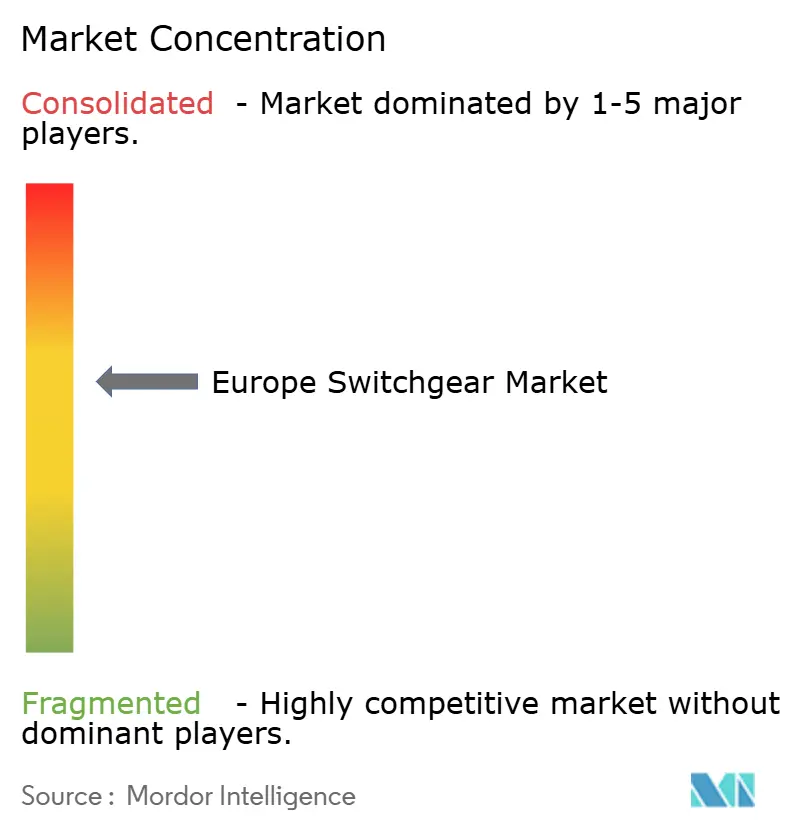
The market shows moderate concentration: ABB, Siemens, and Schneider Electric together hold roughly half of regional revenue. By end-2025, ABB’s Ability platform linked 14,000 live panels, providing customers with six- to nine-month failure forecasts. Siemens deepened vertical integration by acquiring a German sensor firm in October 2025, guaranteeing the supply of embedded partial-discharge monitors. Schneider Electric pilots switchgear-as-a-service deals, shifting revenue toward annuity streams and boosting retention in the Europe switchgear market.
Regional specialists such as Ormazabal and Lucy Electric win on localized assembly and sub-40-week delivery schedules, expanding share in Spain, Portugal, and the United Kingdom. CG Power exploits lower Indian production costs to price 18-22% below Western competitors, though service coverage remains thin. Eaton entered the SF₆-free retrofit niche with modular vacuum inserts compatible with legacy frames, tapping utilities unwilling to replace entire panels.
Innovation intensity is rising: Hitachi Energy now embeds AI algorithms that optimize breaker timing, cutting switching losses by 12-15%. Rockwell Automation targets industrial end-users with gear natively integrated into FactoryTalk analytics, enabling plant-wide predictive maintenance. Patent activity jumped 27% in 2025, spotlighting polymer-insulated busbar technology from Mitsubishi Electric that reduces partial-discharge risk by 40%.
Europe Switchgear Industry Leaders
-
ABB Ltd.
-
Honeywell International Inc.
-
Rockwell Automation Inc.
-
Schneider Electric SE
-
Siemens AG
- *Disclaimer: Major Players sorted in no particular order
Market Opportunities and Future Outlook
A key opportunity is expanding replacement and new-build demand for SF6-free medium-voltage switchgear driven by the EU F-gas regime, especially the prohibition on new switchgear up to 24 kV being put into operation from January 1, 2026 under Regulation (EU) 2024/573. OEMs that offer certified alternatives (vacuum, solid-dielectric, or clean-air solutions) with competitive footprints and predictable delivery can win in utility and data-center procurement cycles where compliance and installation speed are weighed alongside lifetime serviceability. Tightening grid cybersecurity governance, including Commission Delegated Regulation (EU) 2024/1366 for cross-border electricity flows, also creates room for switchgear offerings that embed security-by-design across protection, communication, and remote monitoring architectures.
Manufacturing and supply capacity expansion is becoming a more visible competitive lever, supported by named investments and financing programs. In 2025, the European Investment Bank committed EUR 11 billion in new financing for energy grids and also put forward a EUR 1.5 billion package for guarantees to European grid component manufacturers, reinforcing investment readiness across the supply base. Company actions in 2026 reflect the shift, including ABB’s announced USD 200 million investment across Europe to expand medium-voltage switchgear and grid automation capacity (including a new facility in Dalmine, Italy and expansions in several European countries), and Siemens’ announced EUR 300 million investment to expand power distribution manufacturing in Germany, including actions around its Frankfurt switchgear factory and a new supplier facility in Offenbach. On the demand side, the European Commission published an EU Grids Package in December 2025 to streamline permitting and related rules, complementing REPowerEU-driven interconnection urgency and supporting a sustained pipeline of substation and distribution upgrade projects that pull through switchgear, protection, and digital retrofit content.
Recent Industry Developments
- July 2026: Siemens launched ultra-fast SENTRON ECPD circuit protection technology in the UK. The electronic protection device reacts far faster than conventional electromechanical devices, cutting energy release during short-circuit events and widening the performance envelope for critical loads. It strengthens Siemens positioning in applications where downtime and arc-flash risk drive premium specifications, including data centers and transport infrastructure.
- December 2025: Siemens announced a EUR 180 million expansion of its Erlangen plant to scale SF6-free medium-voltage switchgear production. The added manufacturing capacity supports the shift to alternative insulation technologies as EU restrictions tighten on SF6-filled equipment. It also shortens supply risk for utilities and EPCs facing long lead times on compliant medium-voltage panels.
- October 2024: Schneider Electric launched the next generation Ringmaster AirSeT switchgear. The product targets SF6-free operation while maintaining compact ring-main-unit form factors suited to urban distribution networks. It broadens Schneider Electric's addressable retrofit and new-build opportunities where footprint, safety, and environmental compliance are procurement gatekeepers.
Research Methodology Framework and Report Scope
Market Definition and Coverage
This market covers revenue generated from switchgear equipment used to control, protect, and isolate electrical circuits across Europe, counted at the point of sale into utility, industrial, commercial, residential, and infrastructure end users.
Scope exclusions: We exclude standalone grid software and pure monitoring services that do not include switchgear hardware.
Segmentation Overview
- By Voltage Level
- Low-Voltage
- Medium-Voltage
- High-Voltage
- By Insulation Type
- Air-Insulated
- Gas-Insulated
- Vacuum-Insulated
- Solid-Insulated
- Hybrid
- By Installation Type
- Indoor
- Outdoor
- By Component
- Circuit Breakers
- Contactors and Relays
- Fuse Switches
- Switchboards and Panels
- By End-User
- Utilities
- Industrial
- Commercial Buildings
- Residential
- Transportation and Infrastructure
- By Country
- Germany
- United Kingdom
- France
- Italy
- Spain
- Rest of Europe
Data Sources, Market Sizing, and Validation
Desk Research
Desk research starts with building a clean picture of demand drivers across European power and construction activity, and then mapping where switchgear spending usually follows. For this, we refer to public sources such as Eurostat energy and construction statistics, ENTSO-E power system data, European Commission energy policy and grid plans, and national transmission and distribution operator publications.
We also review import and export series, customs and trade headlines, and public procurement signals (where available) to understand directionally where equipment ordering is rising or slowing. Company annual reports, investor presentations, and press releases help confirm product mix shifts such as indoor versus outdoor installations and insulation trends. In a few places, paid subscriptions that consolidate company financials, patent activity, and shipment level trade data are used to cross-check totals and remove obvious gaps. These examples are not exhaustive, and we reviewed many other public sources to collect data, validate assumptions, and clarify scope.
Primary Interviews and Surveys
Primary work is used to pressure test the model inputs that are hardest to see from public data, especially pricing movement, typical replacement cycles, and how utilities and large facilities sequence switchgear upgrades. We speak with a mix of manufacturers, distributors, EPC and panel builders, utility and industrial buyers, and service partners across major European economies so that country-level differences do not get averaged out too early.
Distribution of primary research fieldwork respondents
| Company type | Respondent position |
|---|---|
| Top tier: 25% | CXOs: 17% |
| Mid tier: 58% | Functional/Unit leaders: 25% |
| Smaller Players: 17% | Managers: 58% |
Market-Sizing & Forecasting
Sizing starts from a top-down build where electricity network expansion and refurbishment spending, grid connection activity, and building and industrial capex are used to reconstruct the likely switchgear demand pool across Europe. Those totals are then corroborated using selective bottom-up approximations like sampled average selling price ranges by voltage class, distributor channel checks, and supplier revenue roll ups for switchgear heavy portfolios, followed by adjustments when the two views do not align.
Key inputs used in the model include stated grid modernization plans and substation programs, renewable capacity additions and connection queues, data center and commercial building construction momentum, the indoor versus outdoor installation split, and insulation substitution trends driven by SF6 reduction efforts. Forecasts are built using scenario analysis around grid investment pacing and equipment price progression, and then aligned to what interviewees expect for project lead times and tender timing. Where coverage is thin for smaller countries, we fill gaps using proxy indicators such as electricity consumption, network length, and construction output, and then validate the implied per unit spend with expert feedback.
Data Validation & Update Cycle
Outputs are checked against independent signals such as regional power investment trends, trade flows, and the implied spend per substation and per connection, and then variances are investigated before finalizing the dataset. If a country shows an unusual jump, we re-check pricing, timing of large utility projects, and whether one-off infrastructure awards are being double counted.
A multi-step analyst review is followed so assumptions, formulas, and scope are consistently applied across voltage levels and end users. The report is refreshed annually, and interim updates are made when material events occur, such as major regulatory shifts or a clear change in grid spending plans. Before delivery, a final analyst pass is completed so clients receive the most current view available.
Mordor Intelligence's Europe Switchgear Market Size Compared Against Other Published Estimates
Published values for Europe switchgear can look far apart because firms do not always count the same equipment, the same buyer groups, or the same timing for project driven orders. Differences in currency conversion timing and how price inflation is treated can also move a USD total by several billion.
Digital substations and protection relays are a common source of confusion because some estimates bundle these adjacent electrical items inside the switchgear total, but Mordor Intelligence keeps them outside the market unless they are sold as part of switchgear assemblies captured under the covered components and installations.
Benchmark comparison
| Source | Market Size | Gaps in Research Methodology |
|---|---|---|
| Mordor Intelligence | USD 39.57 B (2026) | |
| Industry Publisher A | USD 20.39 B (2022) | Uses a regional share-of-global snapshot and does not clearly state component coverage or whether value is ex-factory versus installed, which can understate totals when multi-year utility programs are ramping. |
| Sector Research Portal B | USD 48.32 B (2023) | Provides limited clarity on whether low, medium, and high voltage are all included and whether panels, switchboards, and related assemblies are counted consistently, which can inflate totals when broader electrical distribution gear is grouped together. |
The spread in the table mainly comes from how adjacent electrical equipment is grouped, the year chosen, and whether a share-based shortcut is used versus a demand build tied to grid and construction activity. By keeping the scope aligned to defined components, installations, and end users, the final number stays traceable to practical drivers that can be rechecked as new projects and pricing updates emerge.
Key Questions Answered in the Report
What is the projected value of the Europe switchgear market by 2031?
The market is expected to reach USD 59.53 billion by 2031.
Which insulation technology is growing fastest in Europe?
Gas-insulated switchgear is forecast to expand at a 9.57% CAGR as urban and offshore installations seek compact, fire-safe solutions.
Why are utilities piloting switchgear-as-a-service contracts?
These contracts shift large upfront purchases to monthly operating fees, improving cash flow while guaranteeing performance and maintenance.
How do SF₆-free mandates affect equipment selection?
The 2025 F-gas rules virtually ban new SF₆ units above 24 kV, pushing utilities toward vacuum, solid-dielectric, or clean-air alternatives despite higher capex.
Which country is likely to post the fastest growth in switchgear demand?
The United Kingdom is projected to advance at a 9.77% CAGR through 2031, driven by offshore wind interconnections and smart-grid retrofits.
What material prices most influence switchgear costs?
Copper and aluminum together account for up to 35% of medium-voltage unit costs, and price swings have forced suppliers to raise list prices and redesign busbars.