
Europe Employer Of Record Market Size and Share
Market Overview
| Study Period | 2020 - 2031 |
|---|---|
| Forecast Data Period | 2026 - 2031 |
| Base Year Market Size (2025) | USD 1.78 Billion |
| Market Size (2026) | USD 1.95 Billion |
| Market Size (2031) | USD 3.33 Billion |
| Growth Rate (2026 - 2031) | 11.30 % |
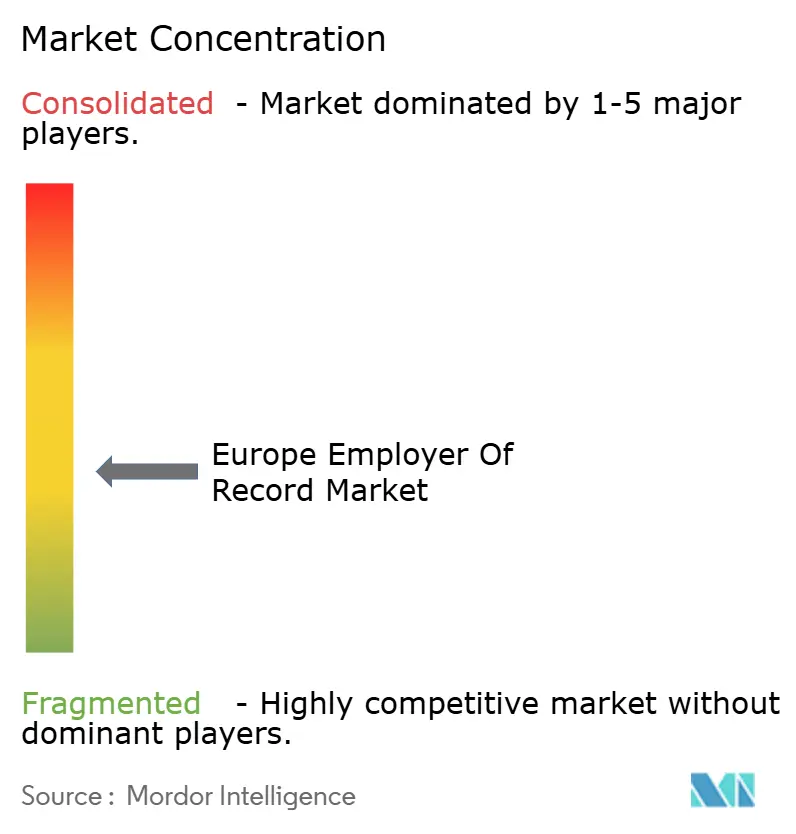
| Market Concentration | Medium |
Major Players *Disclaimer: Major Players sorted in no particular order Image © Mordor Intelligence. Reuse requires attribution under CC BY 4.0. | |
Europe Employer Of Record Market Analysis by Mordor Intelligence
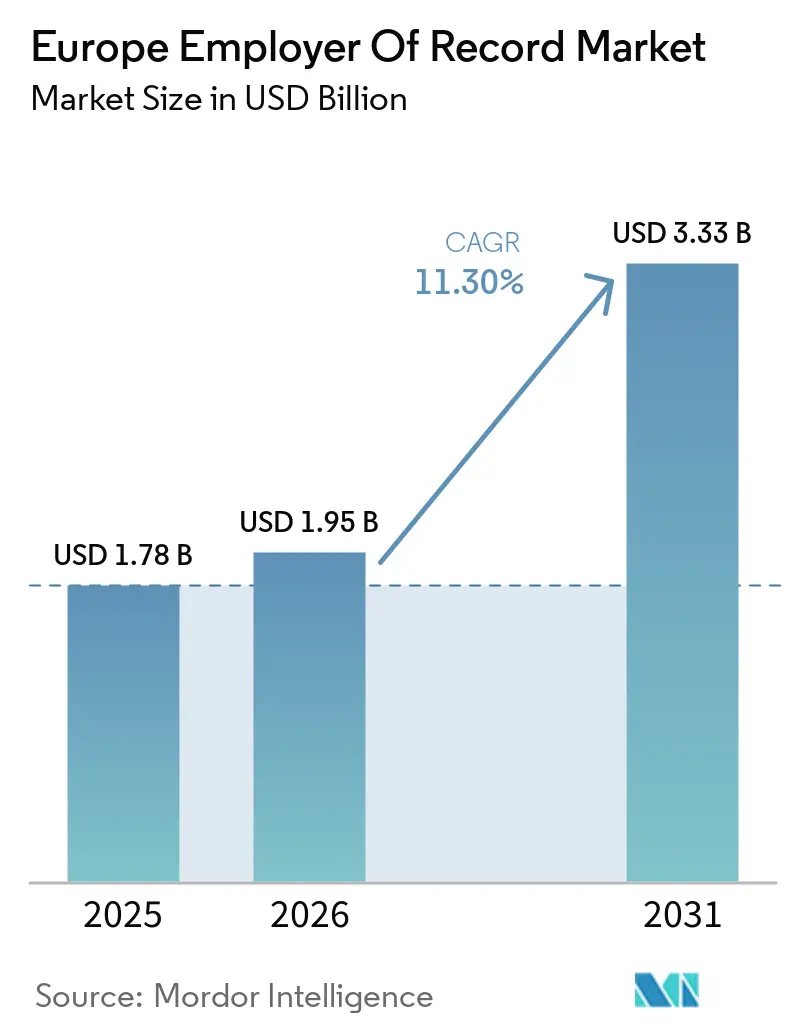
The Europe employer of record market size is projected to be USD 1.78 billion in 2025, USD 1.95 billion in 2026, and reach USD 3.33 billion by 2031, growing at a CAGR of 11.30% from 2026 to 2031. The Europe employer of record market is being supported by a lasting shift toward cross-border hiring, as companies now recruit talent where skills are available rather than where legal entities already exist. The region’s 27 separate labor, payroll, tax, and termination regimes continue to make direct entity setup inefficient for many low-headcount expansions, which keeps outsourced employment models relevant even when hiring volumes are small. The operating backdrop has also become more compliance-heavy because multiple regulatory changes are moving through Europe at the same time, which raises the cost of contractor misclassification, pay reporting failures, and payroll errors. Competitive pressure is increasing as global platforms, regional specialists, and technology-led entrants compete more directly for enterprise contracts and for mid-market customers that expect fast onboarding and transparent pricing. The Europe employer of record market also has room to deepen as companies convert contractors into employees, enter Central and Eastern Europe more selectively, and place more value on integrated payroll, benefits, tax, and compliance support.
Key Report Takeaways
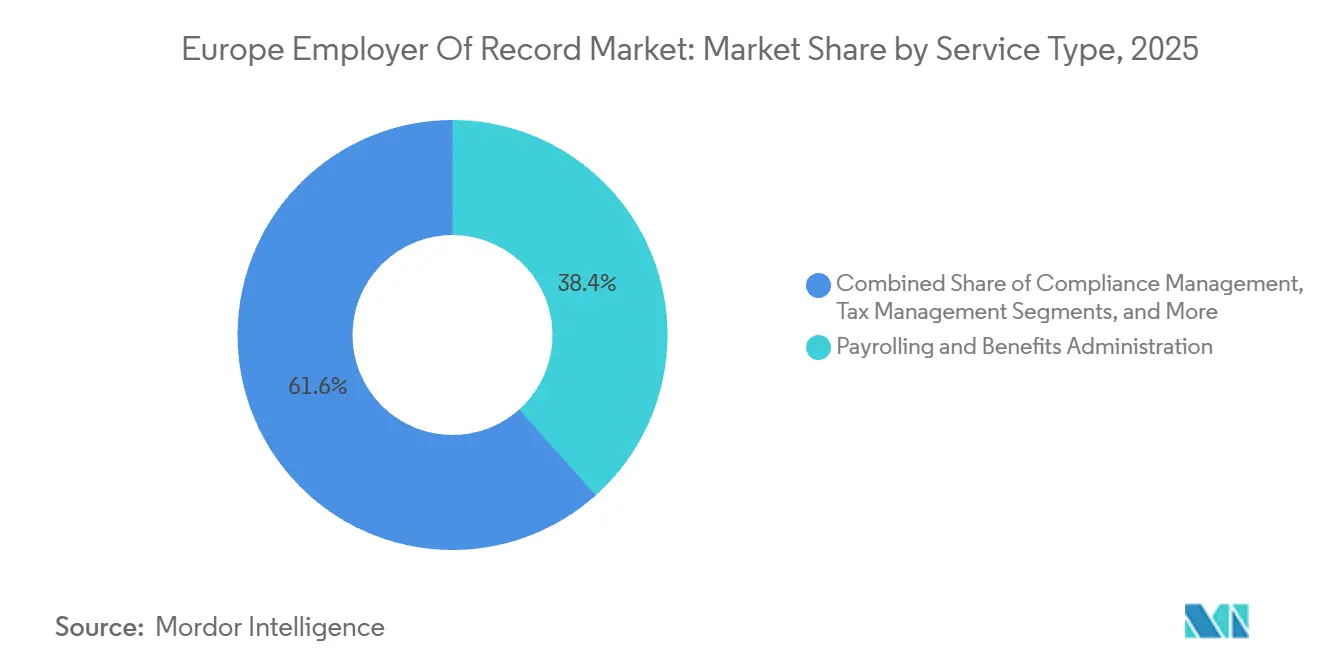
- By service type, payrolling and benefits administration held 38.40% of the Europe employee of record market share in 2025, while compliance management is projected to expand at a 13.20% CAGR through 2031.
- By organization size, large enterprises held 67.80% share in 2025, while SMEs are projected to expand at a 13.80% CAGR through 2031.
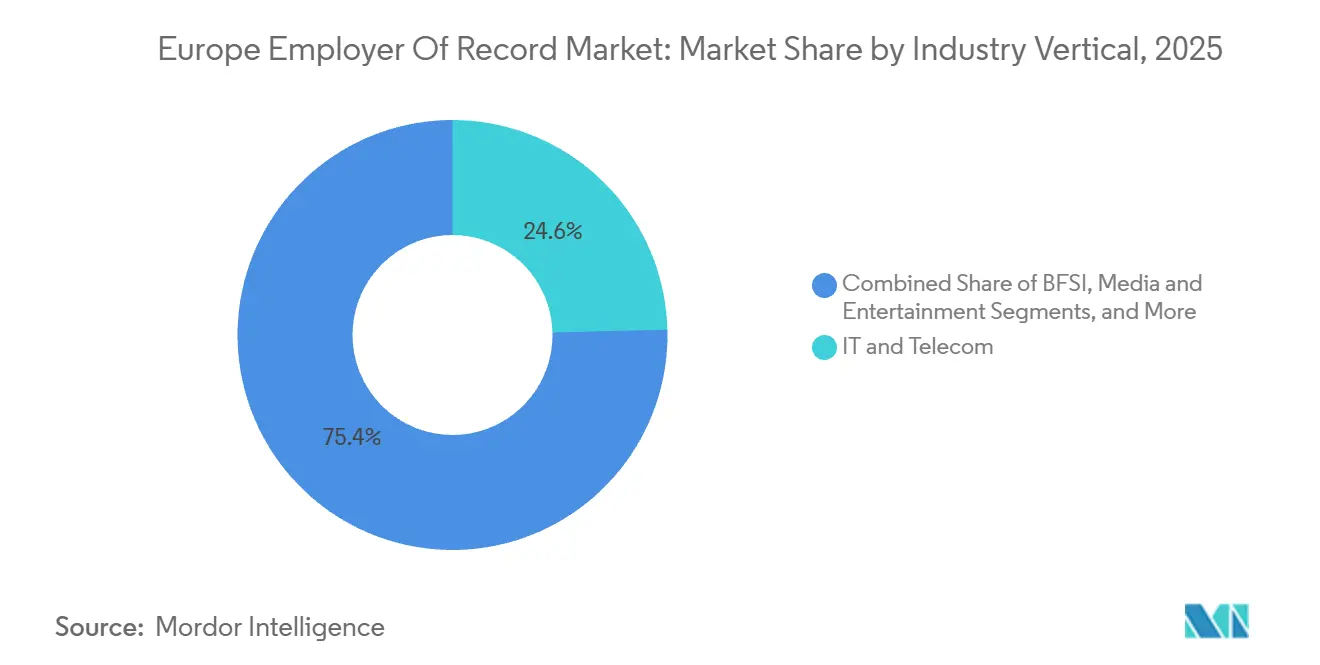
- By industry vertical, IT and telecom held 24.60% share in 2025, while healthcare and lifesciences is projected to grow at a 14.10% CAGR through 2031.
- By business model, the aggregator model held 61.70% share in 2025, while the wholly-owned infrastructure model is projected to expand at a 14.40% CAGR through 2031.
- By geography, the United Kingdom held 22.90% of the Europe employer of record market share in 2025, while Germany is projected to grow at a 13.50% CAGR through 2031.
Note: Market size and forecast figures in this report are generated using Mordor Intelligence’s proprietary estimation framework, updated with the latest available data and insights as of January 2026.
Market Trends and Insights
Drivers Impact Analysis of Europe Employer Of Record Market*
| Driver | (~) % Impact on CAGR Forecast | Geographic Relevance | Impact Timeline |
|---|---|---|---|
| Cross-Border Remote Hiring Expansion | +3.5% | Global, with concentrated gains in UK, Germany, Netherlands, and Nordics | Short term (≤ 2 years) |
| Complex European Labor Law Compliance | +2.8% | EU-wide, particularly France, Germany, Italy, and Spain | Medium term (2-4 years) |
| Rising Demand for Payroll, Benefits, and Tax Administration | +2.2% | Global, concentrated in UK, Germany, and France | Short term (≤ 2 years) |
| EU Pay Transparency Directive Readiness | +1.8% | EU 27 member states, early movers in Belgium, Czech Republic, Poland, and Finland | Short term (≤ 2 years) |
| Entity-Light Market Entry for Low-Headcount Expansion | +1.2% | Global, with focus on CEE emerging tech markets, Spain, and Netherlands | Medium term (2-4 years) |
| Contractor-to-Employee Conversion After Reclassification Tightening | +0.8% | EU-wide, Netherlands, Germany, Spain | Medium term (2-4 years) |
| Source: Mordor Intelligence | |||
Cross-Border Remote Hiring Expansion
Cross-border hiring remains one of the clearest growth engines for the Europe employer of record market because talent demand and legal entity footprints no longer line up in a practical way. Europe captured 43% of all new hires processed on major EOR platforms in 2024, which made it the most-sourced region for cross-border placement activity.[1] The United Kingdom led destination demand in 2025 with 12.2% of new international hires tracked among funded startups, while Germany followed with 8.8%. The Europe employer of record market is also benefiting from a change in hiring intent, because more companies now use cross-border employment to secure scarce talent in AI, fintech, and life sciences rather than to chase lower labor costs. Startups that raise at least USD 100 million are more likely to begin international hiring within 18 months of their first overseas hire, which supports premium demand for providers with deeper compliance infrastructure across major European labor markets.
Complex European Labor Law Compliance
The Europe employer of record market continues to draw support from the region’s unusually fragmented labor law structure, where hiring, dismissal, payroll, and social security obligations still follow national rules rather than a unified framework. The European Round Table for Industry identified labor and posting-of-workers rules as a persistent cross-border obstacle in its 2025 Single Market Compendium, which reinforces the cost of navigating Europe country by country. In practical terms, employers still face different contract forms, collective agreement obligations, and worker protection rules in France, Germany, Italy, Spain, and other major markets, which limit the value of a single standardized employment setup. Germany illustrated this volatility in October 2025 when revised Federal Employment Agency guidance clarified that employees working exclusively outside Germany without physical travel into the country are not subject to AÜG licensing requirements. The Europe employer of record market benefits from this kind of regulatory movement because many multinational HR teams cannot monitor shifting interpretations across all jurisdictions in real time, which turns outsourced compliance from a convenience into an operating necessity.
Rising Demand for Payroll, Benefits, and Tax Administration
The Europe employer of record market is also expanding because payroll administration has become harder to manage across multiple countries during the same regulatory cycle. Germany’s statutory minimum wage rose to EUR 13.90/hr (USD 15.70/hr) from January 1, 2026, while Ireland launched auto-enrollment pension and the Netherlands moved forward with a new collective labor agreement for temporary agency workers. These overlapping changes matter because payroll accuracy now depends on ongoing local updates rather than on a fixed annual rule set. EOR providers take over tax withholding, employer contribution calculations, statutory benefits administration, and country-specific payroll execution, which reduces fiduciary risk for finance and HR teams managing dispersed headcount. The Europe employer of record market is moving closer to a platform model as payroll services become more tightly linked with system-of-record data, workflow automation, and compliance monitoring. That direction was reinforced in 2026 when Deel advanced its payroll ecosystem positioning through Workday Global Payroll Cloud certification, which points to higher switching costs for enterprise buyers using integrated stacks.
EU Pay Transparency Directive Readiness
The Europe employer of record market is seeing near-term compliance demand from the rollout of the EU Pay Transparency Directive, which changed how employers must prepare for disclosure, reporting, and pay discrimination scrutiny. EU member states were required to transpose the Directive by June 7, 2026, while employers with 250 or more employees must begin annual reporting from 2027 using 2026 baseline data, and employers with 100-149 employees will follow from 2031. France showed how uneven that process can be when the Ministry of Labor submitted a draft transposition bill to social partners on March 6, 2026, and signaled that parliamentary adoption would likely move to autumn 2026.[2] For organizations using EOR structures in the EU, the main challenge is not only wage disclosure but also uncertainty around which obligations sit with the client and which sit with the EOR in each jurisdiction. That ambiguity makes compliance management a more visible part of the service offer and strengthens demand for providers that can operationalize legal changes rather than only describe them. The Europe employer of record market, therefore, benefits when regulatory deadlines compress buyer decision-making and push employers toward partners that can document compliant pay practices early.
Restraints Impact Analysis of Europe Employer Of Record Market*
| Restraint | (~) % Impact on CAGR Forecast | Geographic Relevance | Impact Timeline |
|---|---|---|---|
| High Statutory Employment Cost Burden | -1.6% | France, Italy, Belgium (employer add-on 35%-47% of gross salary), broad EU exposure | Short term (≤ 2 years) |
| Regulatory Fragmentation Across European Jurisdictions | -1.2% | EU-wide, intensified in Germany, France, Netherlands, and regulated Nordics | Medium term (2-4 years) |
| Labor Leasing Limits in Highly Regulated Markets | -0.5% | Germany, Netherlands, Sweden, Austria | Medium term (2-4 years) |
| Customer Migration to Own-Entity Models at Scale | -0.4% | Global, concentrated among large enterprises with 100+ employees per European country | Long term (≥ 4 years) |
| Source: Mordor Intelligence | |||
High Statutory Employment Cost Burden
The Europe employer of record market still faces friction from the high cost of formal employment in several Western European countries. In France, Italy, and Belgium, employer-side statutory costs can add 35%-47% to gross payroll, while many other European countries fall in the 25%-35% range, and Denmark, Romania, and Hungary sit lower at 5%-20%. Those charges are passed through directly in EOR pricing, which means client budgets can rise sharply once social contributions, pension obligations, unemployment insurance, and health coverage are fully loaded into total employment cost. The result is that some buyers delay permanent employee conversion or narrow hiring plans in high-cost countries even when talent demand is real. At the same time, those same countries often impose stricter termination frameworks and more formal worker protections, so the Europe employer of record market still retains relevance because employers value operational flexibility even when the employment cost burden weighs on overall volume growth.
Regulatory Fragmentation Across European Jurisdictions
The Europe employer of record market also faces a structural limit because service delivery still has to be rebuilt jurisdiction by jurisdiction rather than deployed under a single labor model. The European Round Table for Industry highlighted persistent differences in labor and posting rules across member states, which continue to create friction for cross-border employers. France, Poland, and the Netherlands remain examples of how materially different contract terms, payroll registration rules, and worker protection requirements can be, which prevents full product standardization across Europe. The EU Platform Work Directive adds another layer because it leaves the operational form of the employment presumption to each member state, which means harmonization in principle still produces country-specific compliance work in practice. This keeps legal monitoring, local advisory capacity, and implementation cost high for providers, and it favors larger operators while also limiting margin expansion across the Europe employer of record market.
*Our forecasts treat driver/restraint impacts as directional, not additive. The impact forecasts reflect baseline growth, mix effects, and variable interactions.
Europe Employer Of Record Market Segment Analysis
By Service Type:
Compliance Demands are Reshaping the Revenue MixPayrolling and benefits administration held 38.40% of the Europe employer of record market size in 2025, which kept it as the largest service type. This position reflects the practical reality that every EOR engagement still depends on local payroll execution, statutory benefits enrollment, and accurate tax withholding. Compliance management, while smaller in current revenue share, is projected to expand at a 13.20% CAGR from 2026 to 2031, which makes it the fastest-growing service type in the Europe employer of record market. That acceleration is tied to the combined effect of the Pay Transparency Directive, the Platform Work Directive, and frequent national labor law updates that are moving through the region at the same time. Tax Management and HR Outsourcing remain important parts of the service mix, and HR Outsourcing is gaining ground among buyers who want employment compliance and people operations handled on a single platform.
The service mix is shifting from transaction execution toward proactive monitoring, which changes how buyers assess value in the Europe employer of record market. Providers that combine automated compliance alerts with payroll processing are increasingly being evaluated as compliance infrastructure partners rather than as staffing intermediaries. G-P’s launch of G-P Gia in 2025 reflected that direction because the platform was built to monitor employment law changes, create documentation, and guide compliance responses across more than 180 countries.[3] Other service types, including onboarding support and immigration assistance, are also picking up relevance as companies expand into Central and Eastern Europe where talent supply is improving faster than internal HR coverage. Enterprise due diligence is now also placing more weight on ISO 27001 certification and broader data security controls, which gives established providers another basis for differentiation in the Europe employer of record industry.

By Organization Size:
Large Enterprises Still Anchor Revenue While SMEs Grow FasterLarge enterprises accounted for 67.80% of the Europe employer of record market in 2025, which made them the core revenue base for the category. Their lead comes from scale, because enterprise clients often need payroll and employment support across 5 or more European countries under a single contractual framework. The Europe employer of record market remains attractive to this group because it reduces the burden of managing works council terms, statutory benefit audits, and GDPR-sensitive employee data across multiple jurisdictions. It also gives procurement teams a cleaner way to consolidate compliance ownership when expansion is spread across several smaller labor markets. That combination keeps enterprise demand relatively durable even when expansion timing changes.
SMEs are projected to expand at a 13.80% CAGR from 2026 to 2031, making them the fastest-growing organizational cohort. This growth has been helped by technology-first providers such as Deel, Remote, and RemoFirst, which lowered commitment thresholds, simplified onboarding, and made pricing more transparent for smaller buyers. Deel’s 2026 global hiring data also showed that startups raising at least USD 100 million were more likely to hire across borders within 18 months of their first international hire, which links part of SME demand to funding cycles rather than only to organic growth. Another pattern in the Europe employer of record market is hybrid procurement, where companies with 80-200 international employees use one global EOR for lower-volume countries and specialist providers for high-complexity markets such as Germany and France.
By Industry Vertical:
Technology Leads Adoption While Healthcare and Lifesciences AccelerateIT and telecom held 24.60% share in 2025, which made it the largest vertical in the Europe employer of record market. The technology sector has been using distributed hiring models for longer than most sectors, so EOR adoption is already embedded in how many firms recruit AI, cloud, and cybersecurity talent across London, Berlin, Amsterdam, and Stockholm. Healthcare and lifesciences is projected to expand at a 14.10% CAGR from 2026 to 2031, which makes it the fastest-growing vertical. That pace is tied to the spread of clinical trial networks, medical device commercialization teams, and regulatory affairs roles that require in-country employment without immediate entity setup. The model is especially useful when sponsors need to onboard researchers and specialists in Poland, Spain, the Czech Republic, and Germany within short operating windows.
BFSI and manufacturing remain meaningful but more constrained parts of the Europe employer of record market. In BFSI, supervisory oversight at licensed entities can limit how far EOR structures can be used for regulated roles, which reduces addressable demand compared with other white-collar functions. Manufacturing has a narrower use case because physical-site operations reduce the number of roles that can be filled through cross-border remote hiring. Media and Entertainment, Retail and E-commerce, and other verticals are building steady momentum as streaming firms and cross-border merchants expand content, sales, and support teams without setting up entities in every country. Professional services firms are also using EOR arrangements to test new European markets before deciding whether permanent establishment is justified.
By Business Model:
Owned Infrastructure is Gaining Ground Against Aggregator BreadthThe aggregator model held 61.70% of the Europe employer of record market in 2025, which kept it as the leading business model by revenue. It achieved that scale by allowing providers to enter countries quickly through local partner networks rather than through fully owned legal entities in every market. The wholly-owned Infrastructure Model is projected to expand at a 14.40% CAGR from 2026 to 2031, which makes it the fastest-growing approach as enterprise buyers demand more direct control and clearer compliance accountability. The Europe employer of record market is therefore moving from a breadth-first phase toward a depth-and-assurance phase in its largest accounts. Globalization Partners has continued to position wholly owned coverage and compliance-as-code architecture as its core differentiator across more than 180 countries.
This divergence is reshaping competitive behavior across the Europe employer of record market. Aggregator-led providers still compete effectively on speed, lighter pricing, and wide coverage in the SME and mid-market segments. Wholly owned models now have a stronger appeal in large enterprise deals where procurement teams scrutinize entity ownership, local execution, and legal accountability more closely. Remote’s expansion supports that shift, with the company reporting more than 100 owned legal entities globally and surpassing USD 300 million in ARR in May 2026 while payroll growth exceeded 300% year over year. A middle path is also emerging as aggregator-model providers selectively acquire entities in the United Kingdom, Germany, and France so they can narrow the compliance gap without fully replicating a global owned-entity structure.
Geography Analysis
United Kingdom and France Employer of Record Market
The United Kingdom held 22.90% of the Europe employer of record market share in 2025, which made it the largest country market in the region. Its lead reflects a strong mix of technology, business services, and financial services hiring, along with its position as the most frequent destination for cross-border hires among funded startups. The Employment Rights Act 2025 added to this importance because its phased rollout from February 2026, combined with day-one statutory sick pay and parental leave changes from April 2026 and the launch of the Fair Work Agency on April 7, 2026, increased direct-hire compliance complexity for employers. France remained one of the most important Western European markets because high employer contribution rates, legally binding sectoral collective agreements, and shifting pay transparency implementation rules make local employment administration demanding. France’s transposition process stayed unsettled in early 2026, with the Ministry of Labor indicating that full adoption of the Pay Transparency Directive would likely move to autumn 2026.
Northern and Western Europe Employer of Record Market
Germany is projected to expand at a 13.50% CAGR from 2026 to 2031, which makes it the fastest-growing geography in the Europe employer of record market. Its growth is tied to heavy inbound hiring demand and to the complexity of the AÜG regime, which includes an 18-month assignment cap and licensing requirements for labor leasing in many circumstances. The October 2025 guidance revision that exempted employees working exclusively outside Germany without physical entry removed one important barrier for remote hiring models.[4] The Netherlands also stands out because enforcement of the DBA Act from January 2025 increased pressure on companies to convert contractors into compliant employees, while the Nordics continue to attract technology-driven demand because high digital maturity sits alongside strong collective agreement structures and high wage levels.
Southern and Eastern Europe Employer of Record Market
Spain and Italy remain important but structurally different parts of the Europe employer of record market. Spain has moved early on consultation around the EU Platform Work Directive, which matters for businesses that still depend on platform-style contractor structures and may need employee conversion paths. Italy’s 35%-40% employer contribution burden can limit volume growth, but transparent pricing and formal compliance support still preserve provider relevance in that market. Russia has become a minimal residual opportunity for most global providers because geopolitical constraints since 2022 pushed many operators to scale back or exit, while Central and Eastern European countries such as Poland, the Czech Republic, Romania, Hungary, and Bulgaria have become more active talent-source locations for technology and professional services hiring.
Competitive Landscape
The Europe employer of record market has a semi-consolidated top tier above a fragmented mid-market and long tail. Globalization Partners, Deel, and Remote sit at the front of that upper layer because they combine wider legal coverage, stronger product investment, and more visible enterprise relationships than most smaller rivals. G-P reported record 2025 revenue, customer growth of around 30%, and continued expansion of integrations with SAP, Workday, ADP, and UKG, which helped strengthen its position in enterprise buying cycles. It also secured the top position in the 2026 IEC Group Global EOR Study and was recognized as the leader in the 2026 QKS SPARK Matrix for EOR solutions. Deel and Remote have pushed the category forward as well, with Deel surpassing USD 1.4 billion in ARR and unveiling its AI Workforce suite in 2026, while Remote crossed USD 300 million in ARR and reported payroll growth above 300% year over year.
The next layer of competition is centered on niche coverage and specific buyer pain points in the Europe employer of record market. White space remains strongest in Central and Eastern Europe, in healthcare and life sciences hiring, and in modular solutions for SMEs that want lower fixed commitments. Providers such as WorkMotion, Boundless, Native Teams, and Playroll are using regional specialization, simpler onboarding, and targeted service models to compete where the largest global platforms do not always offer the most tailored fit. Vistra’s April 2026 partnership with Oyster showed how the market is also moving toward hybrid operating models that help clients shift from EOR use into entity management and broader payroll support as their European headcount grows.[5]
Competitive strategy in the Europe employer of record market is increasingly shaped by compliance depth rather than by geographic count alone. Buyers are asking harder questions about owned entities, payroll accuracy, data governance, local advisory support, and the ability to absorb regulatory change without disrupting employee experience. That is why AI-enabled compliance monitoring, HCM integrations, and stronger country-level infrastructure are becoming more important in renewals and in large enterprise procurements. GDPR also remains a meaningful operating filter because any provider handling EU employee data must align platform architecture, security controls, and data location practices with strict regional requirements.
Europe Employer Of Record Industry Leaders
-
Globalization Partners LLC
-
Deel Inc.
-
Remote Technology, Inc.
-
Velocity Global, LLC
-
Papaya Global Ltd.
- *Disclaimer: Major Players sorted in no particular order
Europe Employer Of Record Market Companies Covered in this Report
- Globalization Partners LLC
- Deel Inc.
- Remote Technology, Inc.
- Velocity Global, LLC
- Papaya Global Ltd.
- Oyster HR, Inc.
- Multiplier Technologies Pte. Ltd.
- Atlas Technology Solutions, Inc.
- WorkMotion Software GmbH
- RemoFirst Inc.
- Safeguard Global
- Playroll Limited
- Native Teams Limited
- Boundless Technologies
- Lano Software GmbH
- Omnipresent
- Remote People
- Mauve Group
- Mercans
- Acumen International
- Skuad
- Horizons
- New Horizons Global Partners
Recent Industry Developments in Europe Employer Of Record Market
- May 2026: RemotePass raised USD 17.4 million in a Series B funding round led by EBRD Venture Capital, with participation from 500 Global and existing investors, to fund expansion across Europe and the United States, deepen localized compliance coverage, and build AI-driven automation capabilities. The company reached net profitability in early 2025, a notable distinction in a sector dominated by venture-scale platforms operating on negative unit economics.
- May 2026: Remote Technology, Inc. announced that its payroll business surpassed 300% year-over-year growth, with the company crossing USD 300 million in ARR and achieving a cash-flow positive status. Simultaneously, the company launched Remote MCP, an infrastructure layer enabling AI agents to access Remote's live payroll, compliance data, and organizational structure for automated workflow execution.
- April 2026: Vistra and Oyster HR, Inc. announced a strategic EOR partnership enabling clients to transition seamlessly from Oyster's agile EOR platform to Vistra's full suite of entity management, global payroll, and advisory services as their international footprint matures, the solution was made available immediately to enterprises worldwide.
- February 2026: Oyster HR, Inc. launched People Partner Services, an advisory offering extending senior multi-country HR expert guidance to customers' entire global workforce, including employees hired through clients' own legal entities. The launch was supported by Everest Group research indicating that automation alone cannot address the complexity of global employment compliance.
Europe Employer Of Record Market Report Scope
The Europe employer of record market refers to the market for employment solutions and platforms that enable companies to legally hire, onboard, manage, pay, and administer employees across European countries without establishing a local legal entity. Employer of Record providers act as the official legal employer on behalf of client organizations while managing employment contracts, payroll processing, tax filings, statutory benefits, social security contributions, labor law compliance, immigration support, and workforce administration in accordance with country-specific employment regulations across Europe.
The Europe Employer of Record Market Report is Segmented by Service Type (Payrolling and Benefits Administration, Compliance Management, Tax Management, HR Outsourcing, and Other Service Types), Organization Size (SMEs, and Large Enterprises), Industry Vertical (IT and Telecom, BFSI, Media and Entertainment, Healthcare and Lifesciences, Manufacturing, Retail and E-commerce, Other Industry Verticals), Business Model (Aggregator Model, and Wholly-Owned Model), and Geography (United Kingdom, Germany, France, Netherlands, Nordics, Spain, Italy, Russia, and Rest of Europe). The Market Forecasts are Provided in Terms of Value (USD).
Segmentation Overview
| Payrolling and Benefits Administration |
| Compliance Management |
| Tax Management |
| HR Outsourcing |
| Other Service Types |
| SMEs |
| Large Enterprises |
| IT and Telecom |
| BFSI |
| Media and Entertainment |
| Healthcare and Lifesciences |
| Manufacturing |
| Retail and E-commerce |
| Other Industry Verticals |
| Aggregator Model |
| Wholly-Owned Model |
| United Kingdom |
| Germany |
| France |
| Netherlands |
| Nordics |
| Spain |
| Italy |
| Russia |
| Rest of Europe |
| By Service Type | Payrolling and Benefits Administration |
| Compliance Management | |
| Tax Management | |
| HR Outsourcing | |
| Other Service Types | |
| By Organization Size | SMEs |
| Large Enterprises | |
| By Industry Vertical | IT and Telecom |
| BFSI | |
| Media and Entertainment | |
| Healthcare and Lifesciences | |
| Manufacturing | |
| Retail and E-commerce | |
| Other Industry Verticals | |
| By Business Model | Aggregator Model |
| Wholly-Owned Model | |
| By Geography | United Kingdom |
| Germany | |
| France | |
| Netherlands | |
| Nordics | |
| Spain | |
| Italy | |
| Russia | |
| Rest of Europe |
Key Questions Answered in the Report
What is the size of the Europe employer of record market?
The Europe employer of record market was valued at USD 1.78 billion in 2025, stood at USD 1.95 billion in 2026, and is forecast to reach USD 3.33 billion by 2031 at an 11.30% CAGR.
Which service category generates the most revenue in Europe employer of record services?
Payrolling and Benefits Administration led with a 38.40% share in 2025, showing that payroll execution, tax withholding, and statutory benefits remain the core service base.
Which customer group is expanding fastest across Europe?
SMEs are projected to grow at a 13.80% CAGR through 2031, supported by lower onboarding friction, clearer pricing, and easier access to technology-first platforms.
Which industry vertical is growing the fastest for employer of record adoption in Europe?
Healthcare and Lifesciences is forecast to expand at a 14.10% CAGR, driven by cross-border specialist hiring, clinical trial expansion, and the need for compliant in-country employment.
Which country leads demand in the region?
The United Kingdom held the largest share at 22.90% in 2025, helped by strong technology and financial services hiring and rising compliance complexity in direct employment.
What is changing competition among employer of record providers in Europe?
Competition is shifting from simple country coverage toward owned-entity depth, payroll integration, AI-enabled compliance support, and stronger legal execution in high-complexity markets such as Germany and France.