
Europe Digital Workplace Market Size and Share
Market Overview
| Study Period | 2020 - 2031 |
|---|---|
| Forecast Data Period | 2026 - 2031 |
| Base Year Market Size (2025) | USD 22.14 Billion |
| Market Size (2026) | USD 25.74 Billion |
| Market Size (2031) | USD 57.21 Billion |
| Growth Rate (2026 - 2031) | 17.32 % |
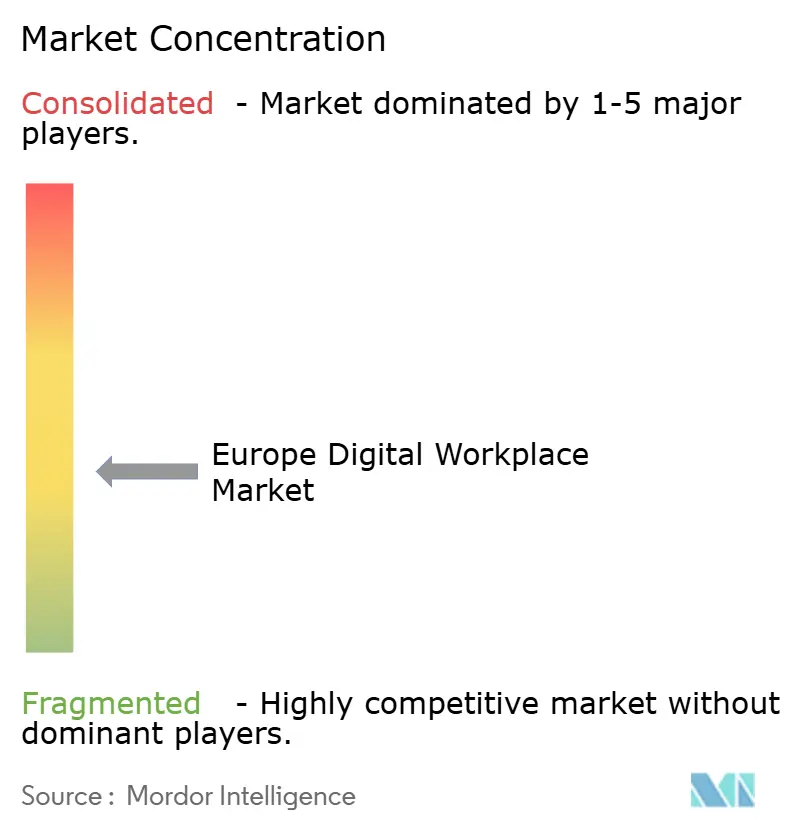
| Market Concentration | Medium |
Major Players *Disclaimer: Major Players sorted in no particular order Image © Mordor Intelligence. Reuse requires attribution under CC BY 4.0. | |
Europe Digital Workplace Market Analysis by Mordor Intelligence
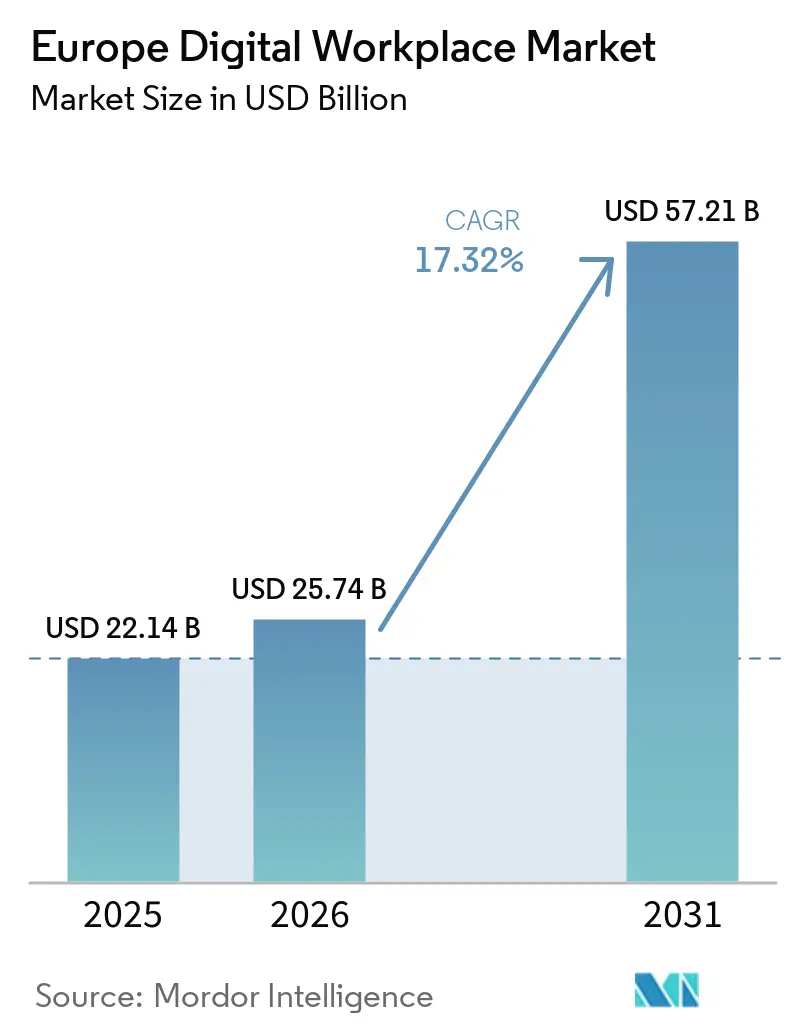
The Europe digital workplace market size is projected to be USD 22.14 billion in 2025, USD 25.74 billion in 2026, and reach USD 57.21 billion by 2031, growing at a CAGR of 17.32% from 2026 to 2031. The Europe digital workplace market is moving on the back of hybrid work becoming a permanent operating model across enterprises rather than a temporary workplace arrangement. Compliance requirements tied to GDPR, the EU AI Act, and NIS2 are also changing how employers select collaboration, workflow, endpoint, and employee-facing systems, because governance and data control now sit closer to the center of procurement decisions. At the same time, digital employee experience measurement is becoming a regular management metric, pushing buyers to look beyond simple communication tools toward platforms that demonstrate clear effects on productivity, support quality, and enhance day-to-day user experience. The Europe digital workplace market is also benefiting from cloud migration, sovereign hosting requirements, and growing interest in AI-enabled workflow orchestration, especially as companies seek to reduce tool sprawl and bring disparate workplace functions under a single platform contract.
Key Report Takeaways
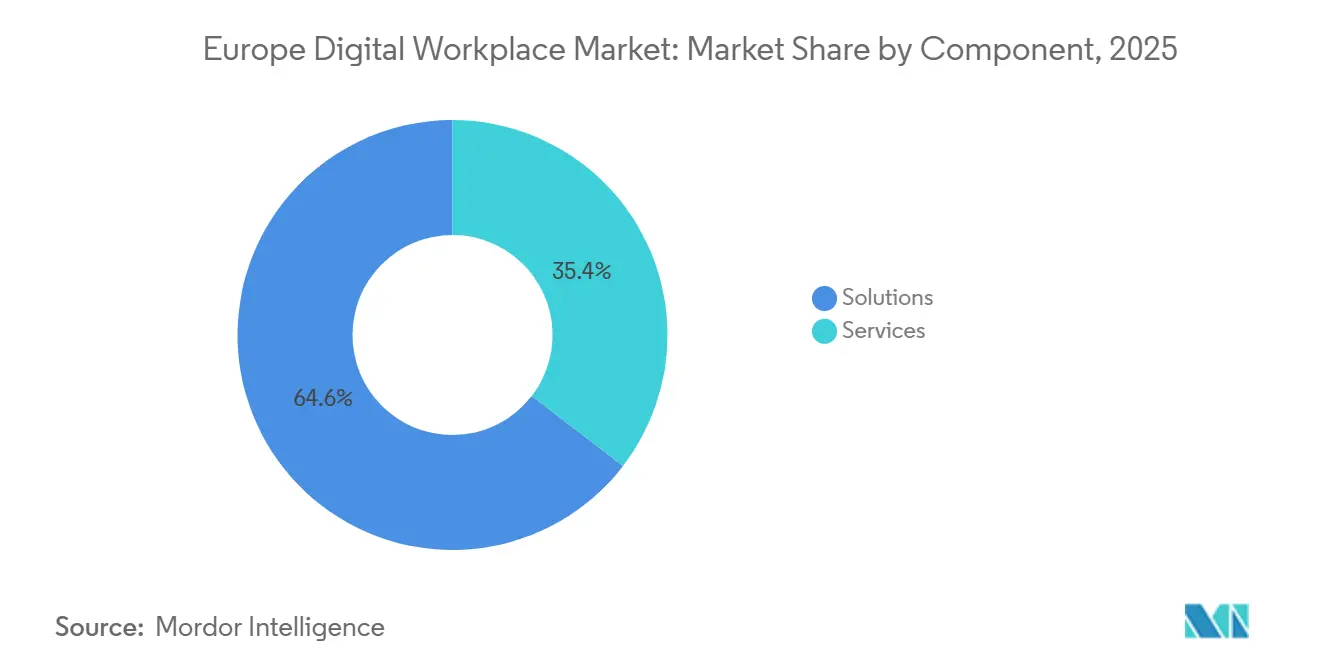
- By component, solutions accounted for 64.58% of the Europe digital workplace market in 2025, while it is projected to advance at a 18.64% CAGR through 2031.
- By deployment mode, cloud held 62.91% of the Europe digital workplace market in 2025, and is projected to expand at a 19.78% CAGR through 2031.
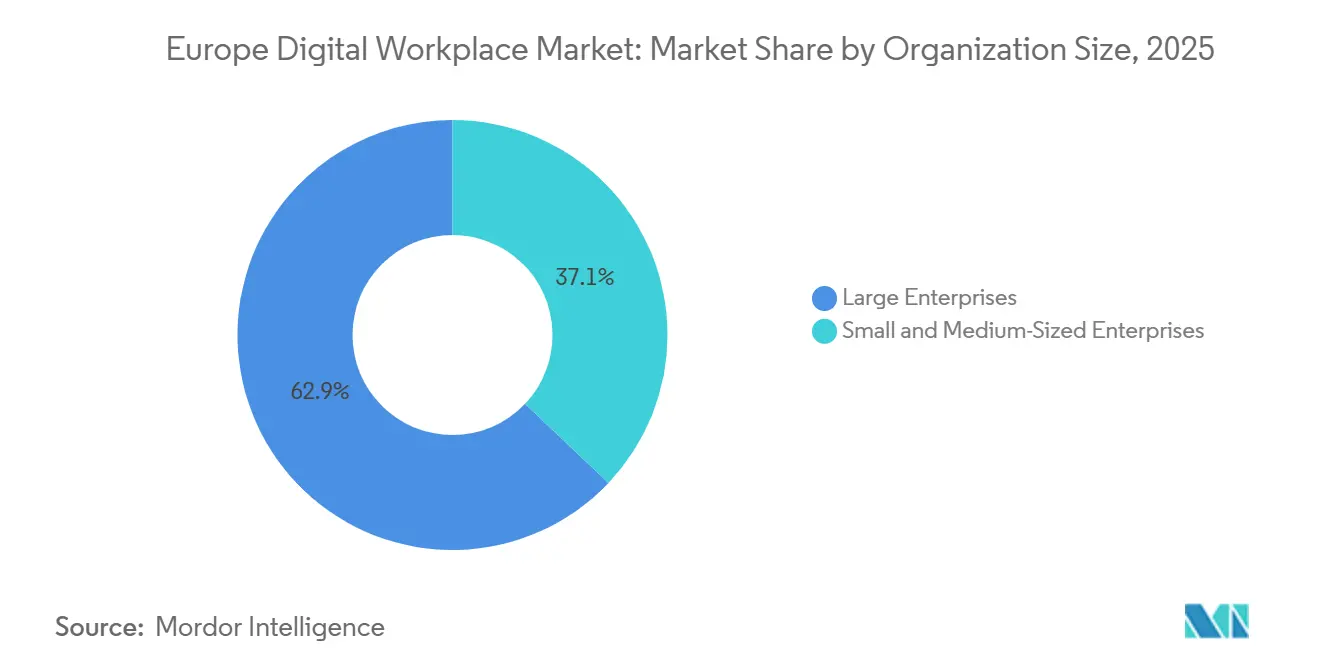
- By organization size, large enterprises held 62.91% of the market in 2025, while Small and Medium-Sized Enterprises are projected to expand at a 19.31% CAGR through 2031.
- By end-user industry, IT and telecommunications accounted for 25.46% of the market in 2025, while healthcare is projected to grow at a 19.86% CAGR through 2031.
- By country, Germany held 22.53% of the Europe digital workplace market share in 2025, while the Netherlands is projected to advance at an 18.93% CAGR through 2031.
Note: Market size and forecast figures in this report are generated using Mordor Intelligence’s proprietary estimation framework, updated with the latest available data and insights as of January 2026.
Market Trends and Insights
Drivers Impact Analysis of Europe Digital Workplace Market*
| Driver | (~) % Impact on CAGR Forecast | Geographic Relevance | Impact Timeline |
|---|---|---|---|
| Sustained Adoption of Hybrid and Remote Work Models | +4.8% | Global, concentrated in Western Europe, including the UK, Germany, the Netherlands, and the Nordics | Short term (≤ 2 years) |
| Enterprise Shift to Employee Experience Platforms and DEX Analytics | +3.2% | Global, particularly in IT-mature markets, including the UK, Germany, and the Nordics | Medium term (2-4 years) |
| Cloud Migration of Workplace Applications and End-User Computing | +3.0% | Global, with EU leadership in governance-driven and sovereign cloud deployments | Medium term (2-4 years) |
| GDPR, Data Sovereignty, and Security by Design Requirements | +2.2% | EU-wide, with early leadership in Germany and the Netherlands | Long term (≥ 4 years) |
| EU AI Act and Governance-Ready Workplace Automation | +1.6% | EU-wide, with high-risk deployments concentrated in DACH, the Nordics, and Benelux | Medium term (2-4 years) |
| Demand for Measurable Productivity, Sentiment, and Experience Telemetry | +1.2% | Global, concentrated in large enterprises in the UK, France, and Germany | Medium term (2-4 years) |
| Source: Mordor Intelligence | |||
Sustained Adoption of Hybrid and Remote Work Models
Hybrid work is now embedded in how many European employers organize operations, team collaboration, and talent management, so the Europe digital workplace market is increasingly tied to long-term workplace redesign rather than short-term continuity spending. That shift is expanding demand for cloud collaboration, virtual desktop access, endpoint control, and workflow tools that keep employee experience consistent across home, office, and mobile environments. It also changes buying behavior, because companies no longer look only for communication features and now place greater weight on access governance, device visibility, and support quality across distributed teams. As hybrid work matures, many organizations are discovering that a patchwork of tools creates operational friction, weakens policy enforcement, and raises support costs, which is pushing fresh demand for platform consolidation. This pattern helps explain why spending is moving toward broader workplace suites instead of isolated point products in the Europe digital workplace market. The longer hybrid work remains part of normal operating practice, the stronger the case becomes for integrated digital workplace platforms that can support flexibility without losing security, oversight, or usability.
Enterprise Shift to Employee Experience Platforms and DEX Analytics
The Europe digital workplace market is also being driven by a stronger enterprise focus on employee experience platforms and digital employee experience measurement, as employers seek to make workplace technology easier to manage and use. Organizations are moving away from reactive service models in which IT teams respond only after issues arise and instead building environments where endpoints, workflows, and support signals are monitored continuously. That shift matters because poor user experience now affects not only IT satisfaction but also productivity, retention, and tool adoption across departments. DEX platforms are gaining relevance because they help companies identify workflow bottlenecks, application fatigue, poor endpoint performance, and support gaps before those issues grow into larger operational problems. The commercial impact is equally important because buyers who can see underused licenses or overlapping tools are more likely to consolidate vendors and reinvest budgets into broader suites with measurable results. This is pushing the European digital workplace market toward platforms that combine analytics, automation, and service visibility rather than offering those functions as separate layers.
Cloud Migration of Workplace Applications and End-User Computing
Cloud has become the primary delivery model for new workplace environments in the European digital workplace market, as enterprises seek scalable access, centralized updates, and easier management across distributed user groups. The move is not based solely on efficiency, since European employers also want clearer audit trails, stronger workload portability, and infrastructure choices that support location-sensitive data handling. Microsoft completed its EU Data Boundary for the Microsoft Cloud in February 2025, ensuring that customer data and pseudonymized personal data for Microsoft 365, Dynamics 365, Power Platform, and most Azure services are stored and processed within the EU and EFTA regions, while also confirming cumulative investment of more than USD 20 billion in European AI and cloud infrastructure in the prior 16 months.[1] This kind of infrastructure commitment gives large employers a clearer path to migrate productivity, desktop, and workflow applications without moving outside regional control expectations. It also creates a sharper split between vendors that can support sovereign cloud requirements and vendors that still depend on more centralized or cross-border operating models. As a result, cloud adoption in the European digital workplace market is increasingly shaped by compliance readiness and architectural trust, rather than just by hosting economics.
GDPR, Data Sovereignty, and Security by Design Requirements
Regulation is shaping the Europe digital workplace market at the architecture level, because compliance obligations now influence where workplace data sits, how it moves, and which vendors remain acceptable for regulated deployments. The EU Data Act and the EU AI Act have set new operational expectations for switching, governance, transparency, and the handling of sensitive or high-risk AI use cases. NIS2 is also reinforcing pressure on organizations to strengthen digital resilience and security controls in systems that support daily operations and collaboration. These rules are making security and sovereignty by design more than just procurement preferences, because enterprises increasingly need contractual clarity, regional processing options, and stronger documentation before workplace tools are approved. This also raises barriers for vendors that cannot demonstrate mature European hosting, governance, and audit structures. In practical terms, regulation is steering the Europe digital workplace market toward fewer experimental deployments and more carefully governed platform rollouts that can withstand legal, operational, and procurement scrutiny.
Restraints Impact Analysis of Europe Digital Workplace Market*
| Restraint | (~) % Impact on CAGR Forecast | Geographic Relevance | Impact Timeline |
|---|---|---|---|
| Legacy Application Sprawl and Integration Complexity | -2.8% | Global, acute in manufacturing and financial services in Germany and Italy | Long term (≥ 4 years) |
| Data Residency Constraints Across Cross-Border Workflows | -1.8% | EU-wide, pronounced in multi-jurisdiction operations in France and Eastern Europe | Long term (≥ 4 years) |
| High Total Cost of Transformation for Mid-Market Firms | -1.4% | Global, most acute in Southern and Eastern Europe | Medium term (2-4 years) |
| User Fatigue From Tool Proliferation and Change Resistance | -0.9% | Global, concentrated in large enterprises and public sector segments | Short term (≤ 2 years) |
| Source: Mordor Intelligence | |||
Legacy Application Sprawl and Integration Complexity
Legacy application sprawl remains the most persistent operating barrier in the Europe digital workplace market, because many enterprises still manage large, uneven software estates that were not built to work as one modern employee environment. The problem runs beyond old software alone, since it also includes disconnected data models, duplicated collaboration layers, and fragmented identity structures that slow transformation after contracts are signed. When organizations try to modernize these environments, integration timelines often stretch, delaying user rollouts, increasing service costs, and weakening support consistency across locations and departments. That delay also creates a second problem: business units often adopt unofficial tools while formal migration work is still underway, adding more complexity to the next phase of consolidation. As a result, the true cost of workplace transformation is often shaped less by the target platform itself and more by the effort required to connect legacy workflows, applications, and data structures into a usable whole. This restraint is especially important in the European digital workplace market, where enterprise buyers want modernization without disrupting tightly regulated, high-volume operations.
Data Residency Constraints Across Cross-Border Workflows
Cross-border data residency rules create a second major restraint for the European digital workplace market, especially for enterprises that operate across multiple jurisdictions and want a single, common workplace layer. The challenge is not limited to storage location, because employee analytics, support logs, collaboration data, and workflow telemetry may all face different handling requirements when they cross borders. That makes it harder to build unified dashboards, shared service models, and centralized automation without creating separate tenants, duplicated controls, or additional legal review. The result is higher architecture complexity and a slower path to standardization, even when the underlying workplace platform is technically capable of broader deployment. GDPR rules on international transfers and related guidance continue to shape how multinational employers design and govern these environments. Until more vendors can support federated models that preserve local control while still enabling cross-border visibility, this issue will continue to limit operating simplicity in the Europe digital workplace market.
*Our forecasts treat driver/restraint impacts as directional, not additive. The impact forecasts reflect baseline growth, mix effects, and variable interactions.
Europe Digital Workplace Market Segment Analysis
By Component:
Solutions Lead the Revenue MixSolutions retained 64.58% of the component segment in 2025, which shows that software platforms remained the main spending center across the Europe digital workplace market. This weight reflects continued demand for unified communication and collaboration, unified endpoint management, workflow automation, knowledge management, virtual desktop infrastructure, and digital employee experience tools. Buyers are still building out the functional layer of the workplace stack, so software receives more direct investment than delivery support in many contracts. That pattern also suggests that many enterprises are still defining which workplace capabilities they want to standardize at the platform level before long-term service structures fully settle. In the near term, the solutions side of the Europe digital workplace market should continue to benefit from employers seeking broader orchestration across communication, workflow, support, and compliance.
Services remain important even though they sit behind solutions in terms of direct revenue share, because many workplace programs depend on integration, migration, managed operations, and governance support to turn software into operational business environments. As estates grow more complex, service providers are increasingly asked to connect workplace suites with security controls, identity systems, and legacy applications rather than simply deploy licenses. This gives the services layer a more strategic role, especially where clients need sector-specific implementation, sovereign hosting design, or steady operational support after rollout. The Europe digital workplace industry is therefore not moving toward a simple product-only model, because software strength and service depth increasingly reinforce each other. Over time, the most resilient vendors in the Europe digital workplace market are likely to be those that can package core workplace software with implementation skill, governance support, and lifecycle management under one coordinated offer.
By Deployment Mode:
Cloud Deployments Drive Architecture ChangeCloud is projected to grow at a 19.78% CAGR through 2031, making it the fastest-moving deployment mode within the Europe digital workplace market. This reflects a broad shift away from capital-intensive on-premises environments toward platforms that can be updated more quickly and managed more consistently across dispersed workforces. Enterprises are also using cloud to shorten deployment cycles, improve endpoint visibility, and simplify policy delivery across office, home, and mobile work settings. For many buyers, cloud adoption now sits alongside regulatory planning, because data location, auditability, and service resilience matter as much as infrastructure flexibility. These factors have made the cloud the leading path for new workplace builds and for major refresh cycles in the Europe digital workplace market.
Microsoft’s completion of the EU Data Boundary in February 2025 strengthened the migration case for regulated employers that rely on Microsoft productivity and cloud environments, because those customers gained a clearer regional processing path for core workplace workloads. On-premises deployments still hold value in tightly controlled settings such as defense, critical infrastructure, and some financial services operations, where isolation remains a procurement requirement. Even so, the middle ground is increasingly shifting toward hybrid structures that combine local control for selected workloads with cloud elasticity for collaboration, analytics, and service management. This makes deployment choice less of a binary decision and more of a compliance-informed architecture exercise. As that dynamic plays out, providers that can support sovereign hybrid models are likely to capture a larger share of incremental contract value across the Europe digital workplace market.
By Organization Size:
SMEs Gain Momentum as Barriers EaseLarge enterprises held 62.91% of the organization size segment in 2025, reflecting their long-standing role as the earliest and largest buyers in the Europe digital workplace market. They have wider IT budgets, more complex employee estates, and stronger internal demand for managed workplace operations, which helps explain their current lead. Large organizations also tend to face more formal compliance, service, and reporting requirements, so the value of integrated workplace platforms is easier to justify at scale. Their procurement behavior still shapes product direction across the Europe digital workplace market, especially in endpoint governance, service management, and AI-enabled operations. At the same time, their dominance does not remove the growing commercial importance of smaller employers.
Small and Medium-Sized Enterprises are projected to expand at a 19.31% CAGR through 2031, supported by subscription pricing, modular deployment models, and stronger partner channels that reduce the barriers that once limited adoption. In the Netherlands, 84% of Small and Medium-Sized Enterprises planned to increase AI investment over the next 3 years as of March 2026, and 81% were already operating in cloud environments, suggesting a stronger digital foundation for workplace modernization than many smaller firms had in earlier cycles. Germany’s Digital Jetzt program also broadened the buyer base by offering SME digitalization grants of up to EUR 50,000 (USD 56,500) to support technology consulting and deployment costs.[2] The Europe digital workplace industry is therefore seeing a wider spread of demand, where smaller firms no longer need enterprise-sized budgets to adopt more advanced collaboration, cloud, and governance capabilities. Vendors that can package strong compliance controls and manageable deployment models for this segment stand to gain as SME demand matures across the Europe digital workplace market.
By End-User Industry:
Healthcare Builds Faster Than the Broader MixIT and telecommunications held 25.46% of the end-user segment in 2025, making it the largest vertical in the Europe digital workplace market. That position reflects the operational profile of technology-native firms, which usually adopt new collaboration, endpoint, and workflow capabilities earlier than other sectors and can absorb platform changes with less disruption. These buyers also test tools such as digital employee experience analytics, AI-supported support workflows, and broader service automation ahead of slower-moving industries. Their early adoption helps define commercial expectations across the Europe digital workplace market, especially around integration depth, user visibility, and platform extensibility. Even with that lead, the most rapid growth is coming from sectors where workforce pressure and data exchange needs are becoming harder to manage through older systems.
Healthcare is projected to expand at a 19.86% CAGR through 2031, supported by interoperability requirements, growing use of AI-assisted clinical workforce tools, and stronger recognition that better digital systems can ease pressure on overstretched staff. The WHO Regional Office for Europe reported in 2025 that digital health adoption across the workforce still faces infrastructure gaps, training needs, workload pressure, and ethical uncertainty, yet it also pointed to a broadening evidence base for workforce-enabling digital tools across the region. This combination means healthcare demand is not being driven by enthusiasm alone and is instead tied to practical service delivery needs and policy-backed modernization. BFSI, manufacturing, and government remain important mid-range users, with BFSI favoring secure collaboration and compliance-ready workflows, while public sector buyers place more weight on sovereign design and policy alignment. Education, energy, utilities, and legal services still sit at earlier stages in some countries, but their need for secure document handling, workflow coordination, and remote support continues to widen the addressable base for the Europe digital workplace market.
Geography Analysis
Western Europe Digital Workplace Market
Germany accounted for 22.53% of the Europe digital workplace market size in 2025, and that position keeps Western Europe at the center of regional spending. Germany’s lead rests on enterprise scale, a large installed base of regulated and complex industries, and procurement preferences that favor secure and well-documented workplace architectures. The United Kingdom also remains a major demand center, even outside the EU regulatory framework, because large employers continue to invest in managed workplace services, cloud-based productivity environments, and employee support tools. France stays important to the Europe digital workplace market as well, although buyers there remain more selective where modernization costs and integration complexity are high. Across these Western European markets, spending is increasingly directed toward platforms that combine flexibility, security, and measurable workforce support within a single operating model.
Netherlands and Nordics Digital Workplace Market
The Netherlands is expected to expand at a 18.93% CAGR through 2031, making it the fastest-growing national market in the region. That pace is supported by strong cloud intensity and a business base already comfortable with digital tools and AI-related investments. Dutch cloud business spending reached EUR 2.9 billion (USD 3.28 billion) in 2025, with growth tied to AI-integrated IaaS workloads. Dutch SMEs also showed unusually strong digital momentum, with 84% planning to increase AI investment over the next 3 years and 81% already operating in cloud environments as of March 2026.[3] The Nordics continue to matter as advanced test beds for the Europe digital workplace market because buyers there tend to adopt higher-trust digital operating models earlier than the regional average.
Southern and Eastern Europe Digital Workplace Market
Southern and Eastern Europe offer a different profile, where opportunity is real but transformation capacity is more uneven across company size and sector. Italy and Spain are progressing, yet mid-market adoption still faces pressure from implementation cost, integration demands, and the need for stronger internal digital governance. Central and Eastern European countries present earlier-stage room for expansion as broadband, cloud readiness, and public digitalization programs continue to improve. The NIS2 Directive and related European digital governance rules are gradually pushing more organizations in these markets toward stronger workplace resilience and security planning. Russia now contributes less to the Europe digital workplace market for many Western-headquartered vendors, while the rest of Europe offers a longer runway where local language support, partner depth, and data localization capability can determine first-mover success.
Competitive Landscape
The Europe digital workplace market shows a moderately fragmented structure at the top, where large global service and platform providers compete for enterprise-scale contracts, while a much broader group of regional specialists, resellers, and sovereign-cloud-focused vendors compete below that level. This split means the largest deals tend to cluster around a familiar set of suppliers, but the wider market remains open in areas where integration, localization, and sector fit matter more than brand size alone. Buyers are increasingly looking for vendors that can manage workflow orchestration, endpoint operations, employee experience monitoring, and governance requirements within one coordinated environment. That favors providers with a broad product and service footprint, yet it also leaves room for smaller European players that can better meet sovereignty and compliance expectations. As a result, competition in the Europe digital workplace market is defined by both scale and specialization rather than by a single dominant model.
Strategic moves in 2026 showed how quickly vendor positioning is shifting toward AI-enabled and governance-aware workplace operations. IBM and ServiceNow expanded their collaboration in June 2026 to combine IBM’s AI, data, and automation capabilities with the ServiceNow AI Platform for legacy modernization, enterprise data governance, and autonomous IT operations.[4] Kyndryl launched an AI-powered Digital Twin for the Workplace in April 2026 on Microsoft Azure, using agentic AI to analyze signals from employee devices, applications, and locations and to predict disruptions before they affect productivity. LumApps also entered a definitive agreement in April 2026 to acquire Comeen, extending its employee hub into space management, digital signage, and visitor services and linking digital and physical workplace experience more closely.
The white space in the Europe digital workplace market is strongest where large vendors do not fully solve sovereign design, mid-market delivery, or workflow-level AI governance. Regional challengers can compete well in public sector and regulated accounts if they offer strong data control, local hosting alignment, and easier deployment paths for customers with limited internal transformation capacity. Nextcloud’s official updates underline this direction, with the company reporting more than 50% bookings growth in 2025 and launching Euro-Office in June 2026 with European partners including Deutsche Telekom and IONOS. These developments show that the Europe digital workplace market is not moving only toward bigger platforms, because sovereignty, open-source positioning, and regional trust can still reshape competitive outcomes. Over the next few years, vendors that combine compliance credibility, platform depth, and integration discipline are likely to hold the strongest position in the Europe digital workplace market.
Europe Digital Workplace Industry Leaders
-
Accenture plc
-
Atos SE
-
Capgemini SE
-
Cisco Systems, Inc.
-
Cognizant Technology Solutions Corporation
- *Disclaimer: Major Players sorted in no particular order
Europe Digital Workplace Market Companies Covered in this Report
- Accenture plc
- Atos SE
- Capgemini SE
- Cisco Systems, Inc.
- Cognizant Technology Solutions Corporation
- Computacenter plc
- DXC Technology Company
- Fujitsu Limited
- Getronics Holding B.V.
- HCL Technologies Limited
- Hewlett Packard Enterprise Company
- IBM Corporation
- Infosys Limited
- Kyndryl Holdings, Inc.
- NTT DATA Group Corporation
- SAP SE
- ServiceNow, Inc.
- SoftwareOne Holding AG
- Tata Consultancy Services Limited
- Telefónica, S.A.
- Wipro Limited
- Zensar Technologies Limited
Recent Industry Developments in Europe Digital Workplace Market
- June 2026: IBM and ServiceNow announced an expanded multi-year collaboration on June 11, 2026, combining IBM's AI, data, and automation capabilities with the ServiceNow AI Platform to jointly modernize legacy applications, extend ServiceNow Workflow Data Fabric with IBM watsonx X Data for enterprise data governance, and enable autonomous IT operations. Joint solutions are expected to be available in the second half of 2026, directly targeting the AI-ready data and legacy application gaps that constrain enterprise AI deployment at scale.
- June 2026: Nextcloud released the first stable version of Euro-Office on June 9, 2026, a fully European open-source office suite developed in collaboration with European partners including Deutsche Telekom and IONOS Cloud. The release, bundled with Nextcloud Hub 26 Spring, was positioned as a sovereign alternative to US-origin productivity suites for public sector and regulated enterprise deployment.
- April 2026: LumApps, the connected AI employee hub provider, entered a definitive agreement on April 21, 2026 to acquire Paris-based Comeen, the workplace experience platform specializing in space management, digital signage, and visitor services. The transaction extended LumApps' platform into a physical workplace experience, bridging digital and in-person collaboration environments for enterprise clients.
- April 2026: Kyndryl launched an AI-powered Digital Twin for the Workplace on April 9, 2026, built on Microsoft Foundry and running on Microsoft Azure. The solution uses agentic AI to analyze signals from employee devices, applications, and locations to predict and resolve technology disruptions before they affect productivity, simulating user personas to maintain privacy compliance.
Europe Digital Workplace Market Report Scope
The digital workplace is a comprehensive virtual environment that integrates advanced digital tools, platforms, and technologies to facilitate seamless collaboration, communication, and productivity among employees. This report focuses on the European digital workplace market, analyzing trends, growth drivers, challenges, and opportunities. It examines the adoption of technologies such as cloud computing, artificial intelligence, and unified communication platforms across various industries. The study also evaluates the impact of remote and hybrid work models on market dynamics, providing insights into key players, competitive strategies, and market forecasts.
The Europe Digital Workplace Market is Segmented by Component [Solutions (Unified Communication and Collaboration, Unified Endpoint Management, Enterprise Mobility Management, Employee Experience Platforms and Intranet, Workflow Automation and Knowledge Management, and Virtual Desktop Infrastructure and Cloud PC), and Services], Deployment Mode (Cloud, On-Premises, and Hybrid), Organization Size (Large Enterprises, and Small and Medium-Sized Enterprises), End-User Industry (IT and Telecommunications, BFSI, Healthcare, Manufacturing, Retail, Government and Public Sector, Education, Energy and Utilities, Legal and Professional Services, and Other End-User Industries), and Geography (Germany, United Kingdom, France, Italy, Spain, Nordics, Russia, Netherlands, and Rest of Europe). The Market Sizes and Forecasts are Provided in Terms of Value (USD).
Segmentation Overview
| Solutions | Unified Communication and Collaboration |
| Unified Endpoint Management | |
| Enterprise Mobility Management | |
| Employee Experience Platforms and Intranet | |
| Workflow Automation and Knowledge Management | |
| Virtual Desktop Infrastructure and Cloud PC | |
| Services |
| Cloud |
| On-Premises |
| Hybrid |
| Large Enterprises |
| Small and Medium-Sized Enterprises |
| IT and Telecommunications |
| BFSI |
| Healthcare |
| Manufacturing |
| Retail |
| Government and Public Sector |
| Education |
| Energy and Utilities |
| Legal and Professional Services |
| Other End-User Industries |
| Germany |
| United Kingdom |
| France |
| Italy |
| Spain |
| Netherlands |
| Nordics |
| Russia |
| Rest of Europe |
| By Component | Solutions | Unified Communication and Collaboration |
| Unified Endpoint Management | ||
| Enterprise Mobility Management | ||
| Employee Experience Platforms and Intranet | ||
| Workflow Automation and Knowledge Management | ||
| Virtual Desktop Infrastructure and Cloud PC | ||
| Services | ||
| By Deployment Mode | Cloud | |
| On-Premises | ||
| Hybrid | ||
| By Organization Size | Large Enterprises | |
| Small and Medium-Sized Enterprises | ||
| By End-User Industry | IT and Telecommunications | |
| BFSI | ||
| Healthcare | ||
| Manufacturing | ||
| Retail | ||
| Government and Public Sector | ||
| Education | ||
| Energy and Utilities | ||
| Legal and Professional Services | ||
| Other End-User Industries | ||
| By Geography | Germany | |
| United Kingdom | ||
| France | ||
| Italy | ||
| Spain | ||
| Netherlands | ||
| Nordics | ||
| Russia | ||
| Rest of Europe |
Key Questions Answered in the Report
What is the current and forecast value of the Europe digital workplace market?
The Europe digital workplace market size was USD 22.14 billion in 2025, is projected at USD 25.74 billion in 2026, and is expected to reach USD 57.21 billion by 2031 at a 17.32% CAGR.
Which deployment model is growing fastest across Europe?
Cloud is the fastest-growing deployment mode, with a projected 19.78% CAGR through 2031, supported by sovereign cloud demand and broader migration of workplace applications.
Which end-user sector is expanding fastest in Europe digital workplace adoption?
Healthcare is projected to grow at a 19.86% CAGR through 2031, driven by interoperability needs, workforce pressure, and greater use of AI-assisted clinical tools.
Which business size segment offers the strongest growth opportunity?
SMEs are projected to expand at a 19.31% CAGR through 2031, as subscription pricing, modular delivery, and grant support lower historical adoption barriers.
Which country leads the regional revenue base?
Germany led with a 22.53% share in 2025, reflecting the scale of its enterprise ICT base and strong demand for compliant, secure workplace modernization.
What is shaping vendor competition most strongly in this space?
Competition is increasingly shaped by AI-enabled workflow automation, sovereign cloud readiness, and the ability to integrate collaboration, endpoint management, and governance into one platform environment.