
Europe Benefits Administration Market Size and Share
Market Overview
| Study Period | 2020 - 2031 |
|---|---|
| Forecast Data Period | 2026 - 2031 |
| Base Year Market Size (2025) | USD 517.61 Million |
| Market Size (2026) | USD 575.84 Million |
| Market Size (2031) | USD 981.51 Million |
| Growth Rate (2026 - 2031) | 11.25 % |
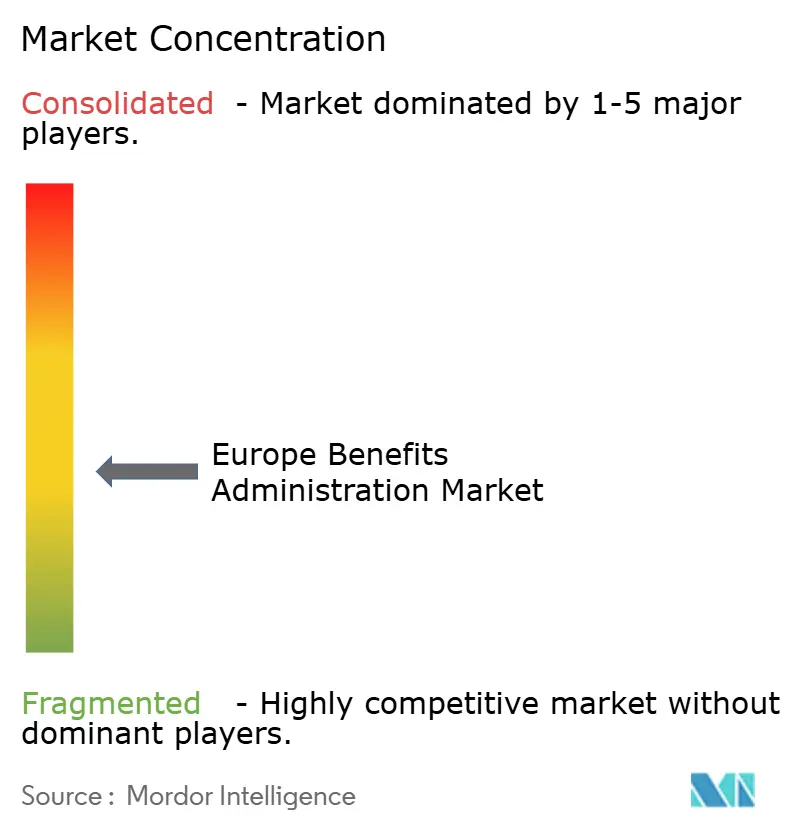
| Market Concentration | Medium |
Major Players *Disclaimer: Major Players sorted in no particular order Image © Mordor Intelligence. Reuse requires attribution under CC BY 4.0. | |
Europe Benefits Administration Market Analysis by Mordor Intelligence
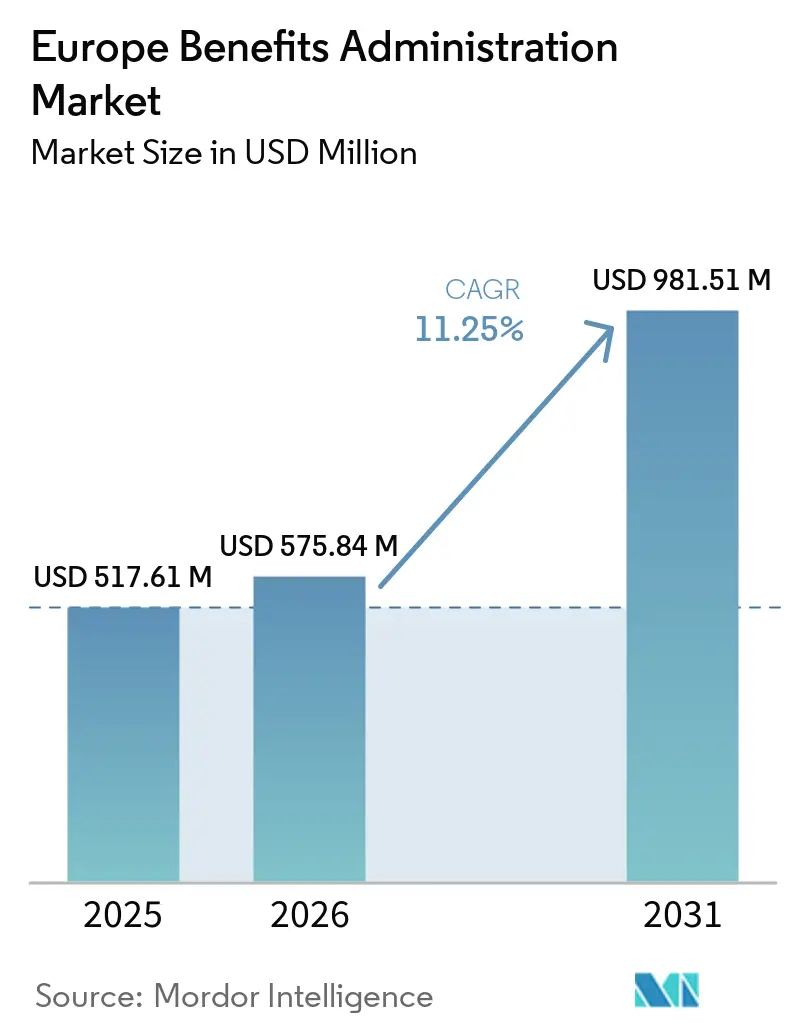
The Europe benefits administration market size is projected to be USD 517.61 million in 2025, USD 575.84 million in 2026, and reach USD 981.51 million by 2031, growing at a CAGR of 11.25% from 2026 to 2031. Growth is being driven by tighter pay transparency rules, broader digital HR modernization, and rising demand for systems that can manage benefits data across multiple countries in a single environment. Employers are moving spending away from manual administration and disconnected local tools toward platforms that can manage eligibility, enrollment, reporting, and compliance more consistently. Demand is also rising for implementation and managed support because complex payroll links, carrier connectivity, and data privacy obligations still require specialist delivery capabilities. The market is becoming more competitive as regional platform providers expand through acquisitions and brand consolidation to build wider pan-European coverage. Compliance overhead, data residency concerns, and long deployment cycles in regulated countries still slow adoption, but they also support continued demand for specialist services across the forecast period.
Key Report Takeaways
- By component, software held 68.12% of the Europe benefits administration market share in 2025, while services is forecast to expand at a 14.02% CAGR through 2031.
- By solution type, core administration platforms accounted for 41.16% of the market in 2025, while worksite benefits administration is projected to grow at a 13.14% CAGR through 2031.
- By deployment mode, cloud-based deployment represented 65.19% of the market in 2025, while hybrid deployment is expected to record a 13.67% CAGR through 2031.
- By organization size, large enterprises held 66.21% of the market in 2025, while SMEs are expected to grow at a 14.31% CAGR through 2031.
- By end-user industry, IT and telecom accounted for 34.41% of demand in 2025, while BFSI is projected to expand at a 12.81% CAGR through 2031.
- By geography, the United Kingdom held 21.53% of the market in 2025, while Poland is forecast to grow at a 12.44% CAGR through 2031.
Note: Market size and forecast figures in this report are generated using Mordor Intelligence’s proprietary estimation framework, updated with the latest available data and insights as of January 2026.
Market Trends and Insights
Drivers Impact Analysis of Europe Benefits Administration Market*
| Driver | (~) % Impact on CAGR Forecast | Geographic Relevance | Impact Timeline |
|---|---|---|---|
| EU Pay Transparency Directive Elevates Total Reward Data Requirements | +2.4% | EU27, with early compliance pressure in France, Poland, Netherlands, and Nordics | Short term (≤ 2 years) |
| Rising Need for Multi-Country Compliance Automation | +1.8% | Pan-European core, with strongest pull in UK, Germany, France, and Netherlands | Medium term (2-4 years) |
| Cloud Migration Across European HR Stacks | +1.6% | Europe-wide, with strongest conversion activity in DACH and Nordics | Medium term (2-4 years) |
| Cross-Border Remote Work Expands A1 and Social Security Administration Complexity | +1.2% | EU Framework Agreement signatories, including Austria, Belgium, Germany, France, Netherlands, and 17 others | Short term (≤ 2 years) |
| Growing SME Adoption of Configurable SaaS Platforms | +0.9% | Germany, France, Poland, and Spain SME clusters | Medium term (2-4 years) |
| Demand for Personalized and Mobile-First Benefits Experiences | +0.7% | UK, Nordics, and France as primary early adopter markets | Long term (≥ 4 years) |
| Source: Mordor Intelligence | |||
EU Pay Transparency Directive Elevates Total Reward Data Requirements
The EU Pay Transparency Directive is the clearest near-term driver for the Europe benefits administration market because it moves benefits data from a supporting HR record into a formal compliance requirement. Member states must apply the directive by June 7, 2026, which is forcing employers to prepare their reporting structures before the first full reporting cycle begins. Employers with 250 or more employees in the EU must file gender pay gap reports that include variable pay and benefits components from the 2026 calendar year onward, with reporting beginning in 2027. This pushes organizations to standardize how they value and classify rewards data across payroll, benefits, and HR systems, which increases the appeal of unified administration platforms. The directive also creates an ongoing compliance loop, as employers with an unjustified pay gap above 5% must complete a joint pay assessment with employee representatives, underscoring the need for always-available analytics rather than one-time audits. As national governments add their own requirements and timelines, the Europe benefits administration market is benefiting from demand for systems that can handle country variation without separate local builds.
Rising Need for Multi-Country Compliance Automation
The Europe benefits administration market is also being boosted by the growing complexity of running benefit programs across multiple European jurisdictions with different tax, payroll, pension, and reporting rules. Employers operating across the region are finding that manual coordination among local payroll teams, brokers, and administrators consumes too much HR time and leads to avoidable errors. HR implementation specialists reported in 2026 that administration can take up to 57% of HR working time in multi-country environments when automation is limited, which makes the return on platform investment easier to justify. This demand is strengthening providers that can combine benefits workflows with payroll connectivity and local compliance logic, rather than offering a simple enrollment front end. SD Worx’s scale across 27 European countries and its 2025 revenue base of EUR 1.307 billion (USD 1.41 billion) show the commercial value of solving compliance across borders as a built-in capability. As reporting obligations expand, procurement criteria are shifting toward integration quality, auditability, and support for local rules, raising the technical standard for the Europe benefits administration market.
Cloud Migration Across European HR Stacks
Cloud migration remains a major growth engine because it better aligns with how employers now want to update policies, connect vendors, and manage benefits data at scale. Cloud-based deployment held 65.2% of the Europe benefits administration market in 2025, while hybrid deployment is projected to grow faster at 13.7% through 2031, indicating that migration is progressing even if full replacement of legacy architecture remains uneven. The value case is no longer limited to lower setup costs, because employers also want centrally updated compliance rules and faster rollout of new benefit categories. In Germany, Roland Berger’s 2025 analysis found that 85% of HR managers found the provider landscape confusing and 82% struggled to navigate it, underscoring demand for more configurable, cloud-led systems. At the same time, the strongest cloud conversion is happening through hybrid architectures that connect modern benefit tools with existing payroll engines and local databases through API layers. The Europe benefits administration market is therefore expanding through a staged modernization path rather than through a clean break from on-premises systems.
Cross-Border Remote Work Expands A1 and Social Security Administration Complexity
Cross-border telework rules are adding a separate compliance workload, driving demand for platforms that can track employee location, social security status, and A1 certificate workflows. The EU Framework Agreement on cross-border telework has been in force since July 2023 across participating countries and allows employees to remain in their employer’s social security system under a defined telework threshold. Since July 1, 2024, retroactive A1 certificate requests can be filed only for up to 3 months in arrears, making current work-location records much more important for employers managing hybrid and mobile workforces. The compliance burden increased again in January 2025, when the CJEU ruled that social security authorities must engage in dialogue when responsibility shifts between member states, thereby adding documentation and coordination requirements. These changes are pulling the Europe benefits administration market beyond traditional enrollment use cases and into continuous compliance monitoring for distributed workforces. Employers that once accepted local manual handling now need systems that can surface exceptions quickly and support a documented workflow when social security treatment changes across borders.
Restraints Impact Analysis of Europe Benefits Administration Market*
| Restraint | (~) % Impact on CAGR Forecast | Geographic Relevance | Impact Timeline |
|---|---|---|---|
| Data Privacy and Cross-Border Data Transfer Burdens | -0.9% | EU27, particularly Germany, Netherlands, and France where national DPA enforcement is strict | Short term (≤ 2 years) |
| Integration Complexity With Legacy Payroll, Carrier, and Pension Systems | -0.8% | UK, Germany, and France with fragmented carrier ecosystems | Medium term (2-4 years) |
| Works Council and Co-Determination Delays in DACH Rollouts | -0.5% | Germany, Austria, and Netherlands, with spillover into French CSE consultation processes | Medium term (2-4 years) |
| Carrier and Benefits Provider Connectivity Fragmentation Across Europe | -0.4% | Pan-European, most acute in fragmented CEE and Southern European markets | Long term (≥ 4 years) |
| Source: Mordor Intelligence | |||
Data Privacy and Cross-Border Data Transfer Burdens
Data privacy remains one of the strongest brakes on the Europe benefits administration market because benefit platforms process sensitive personal, salary, and health-related data across multiple legal jurisdictions. GDPR creates ongoing documentation, governance, and risk assessment requirements, and those obligations fall more heavily on mid-sized employers that lack large internal compliance teams. Post-Schrems II, employers transferring HR data to U.S.-based cloud environments have had to complete transfer impact assessments and implement technical safeguards, such as encryption using EU-controlled keys. The EU-U.S. Data Privacy Framework reduced some friction for certified transfers, but the possibility of future legal challenges remains a concern for many employers, making them cautious about long-term architecture choices outside the EU. German employment law adds another layer because centralized HR data processing must meet a strict necessity test, which limits how easily multinational groups can centralize benefits data for operational efficiency alone. This leaves the Europe benefits administration market with a clear preference for EU-hosted infrastructure, but that preference can raise vendor costs, slow procurement, and stretch implementation timelines.
Integration Complexity with Legacy Payroll, Carrier, and Pension Systems
Integration difficulty is a persistent operational restraint because European employers still depend on payroll systems, pension records, and carrier interfaces that were not designed for seamless real-time administration. Many projects must connect modern benefits tools to legacy payroll engines and HR modules that have been in place for 10 to 15 years, turning even standard deployments into multi-month programs. Aptia noted in 2026 that pension administration is already under pressure from dashboard connectivity, consumer duty obligations, and data quality preparation for buyouts, all of which depend on clean and accessible records that legacy systems often cannot provide.[1]Carrier connectivity adds a second layer of complexity because insurers, pension providers, and occupational health partners often use their own data formats and file structures, requiring custom work for each new connection. In Germany, governance can further delay projects, as the Cologne Regional Labor Court's January 2025 ruling showed that some cloud HR system rollouts may require dual conciliation committees before broader deployment. These issues slow the Europe benefits administration market, but they also help sustain managed implementation demand because employers still need specialist partners to complete complex deployments.
*Our forecasts treat driver/restraint impacts as directional, not additive. The impact forecasts reflect baseline growth, mix effects, and variable interactions.
Europe Benefits Administration Market Segment Analysis
By Component:
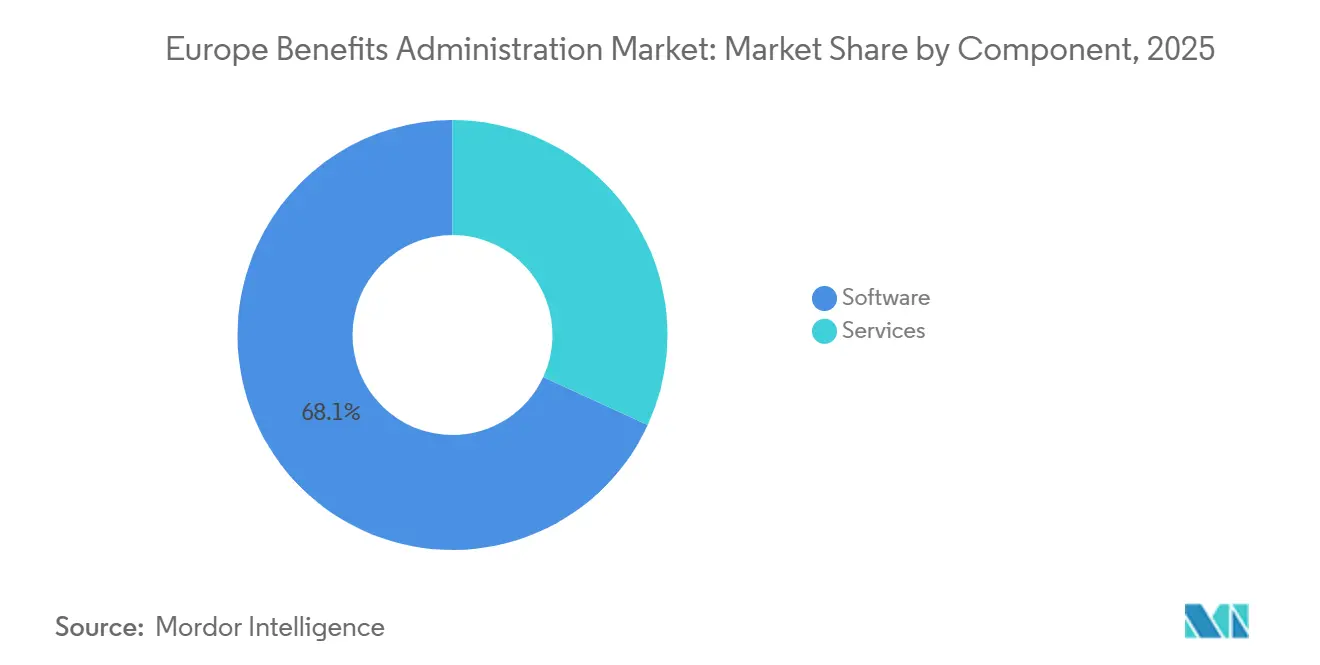
Services Growth Reshapes the Revenue MixSoftware held 68.12% of the Europe benefits administration market in 2025, which kept it as the clear revenue base for the category. Employers continued to prioritize core engines for eligibility, enrollment, employee self-service, and reporting because those functions are the first step away from manual administration. Software also fits the budget priorities of organizations that want a common operating layer across countries without immediately outsourcing every process. Even so, the revenue mix is changing because services are projected to grow at a 14.02% CAGR through 2031, which is faster than the overall Europe benefits administration market.
That faster services growth reflects the fact that software alone does not solve deployment complexity in a region shaped by works councils, GDPR controls, payroll mapping, and carrier coordination. Employers expanding across several EU countries still need outside support for implementation, rule configuration, compliance interpretation, and change management. Benifex reported in January 2026 that 32% of employers globally already use a single, unified benefits management platform, while 14% use multiple platforms across regions, indicating that platform adoption is advancing but still often requires advisory support.[2] The same research found that 51% of global employers prioritize integrating HR systems with benefits platforms, which naturally increases the demand for services-led delivery. In the Europe benefits administration industry, software remains the core spend category, while services are the stronger growth lever over the forecast period.
By Solution Type:
Worksite Administration Expands Employer Value PropositionCore administration platforms accounted for 41.16% of the Europe benefits administration market in 2025, reflecting their role as the main system of record for enrollment, eligibility, and billing reconciliation. These tools remain the usual starting point for employers moving away from spreadsheets or fragmented local workflows. Their lead position also shows that many organizations are still focused on replacing legacy administration rather than building advanced experience layers first. At the same time, worksite benefits administration is expected to grow at a 13.14% CAGR through 2031, making it the fastest-moving solution area in the Europe benefits administration market.
This growth reflects a clear shift toward employer-funded but employee-directed spending categories such as mobility, wellbeing, vouchers, and flexible lifestyle budgets. Worksite tools are becoming more relevant as employers seek benefit programs that are easier to personalize and communicate through a single digital experience. Single-card and app-based structures also reduce administrative effort by consolidating several discretionary benefits into a single interface. Retirement and pension administration remains an important adjacent category, especially in the United Kingdom, where dashboard readiness and data cleanup are raising the value of modern administration layers. The Europe benefits administration industry is therefore broadening from basic benefit processing into a wider platform model that supports both statutory administration and employee-facing choice.
By Deployment Mode:
Hybrid Architectures Bridge Compliance and FlexibilityCloud-based deployment held 65.19% of the Europe benefits administration market in 2025, which confirms that SaaS remains the dominant delivery model. Employers continue to favor cloud systems because they support faster updates, lower upfront infrastructure costs, and easier rollout of new reporting or benefit rules. The hybrid model is still growing faster, at 13.67% through 2031, indicating that many organizations are modernizing their legacy payroll estate rather than replacing it all at once. This means the Europe benefits administration market for hybrid deployments is being driven by companies that want modern user interfaces and centralized updates while retaining sensitive records in existing local systems.
Hybrid growth is strongest in environments where employers must connect cloud-based administration to on-premises payroll engines such as DATEV or long-standing SAP HR installations. Implementation guidance published in 2026 points to API-ready architecture as the practical standard for multi-country employers that need to connect global HR tools with local payroll and benefits systems. Data sovereignty concerns in Germany and France also support hybrid demand because employers remain cautious about moving all sensitive HR data into fully multi-tenant environments. On-premises deployments are losing share, but they remain prevalent in public administration, pensions, and tightly regulated financial institutions. In the Europe benefits administration market, hybrid is acting as the bridge between legacy compliance requirements and the flexibility employers now expect from modern software.
By Organization Size:
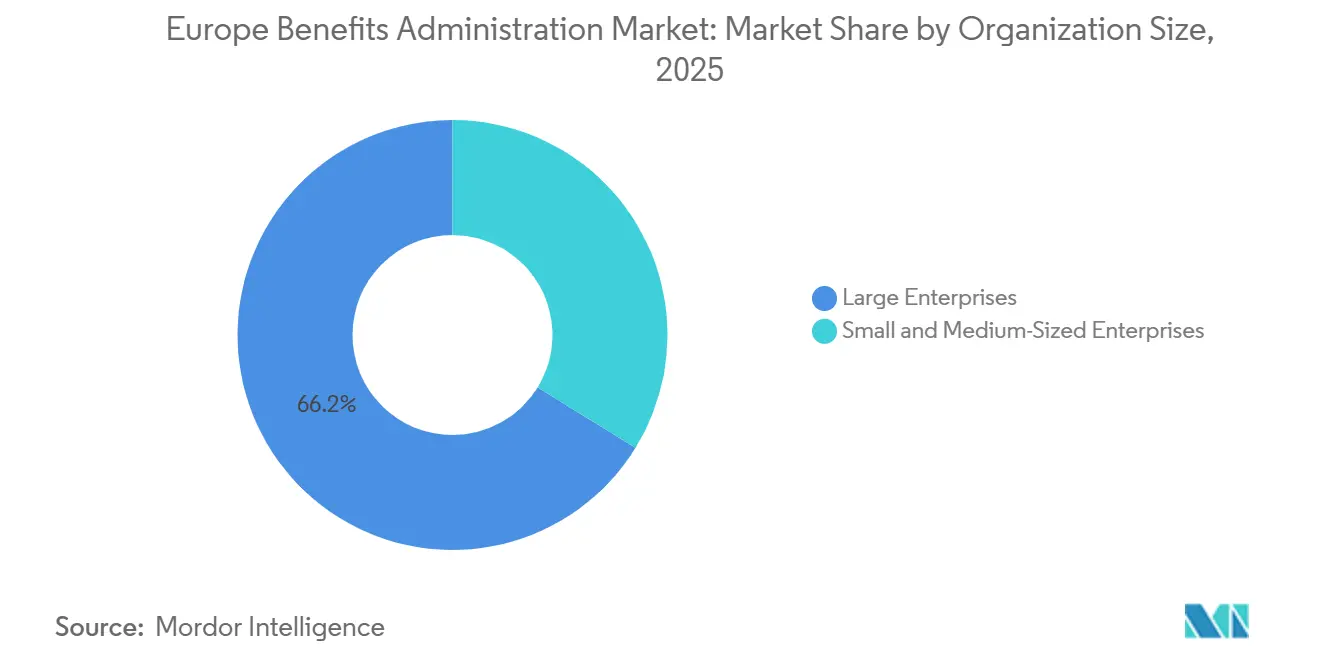
SMEs Drive Volume While Large Enterprises Drive ValueLarge enterprises held 66.21% of the Europe benefits administration market in 2025, which reflected their larger seat counts, broader country footprints, and heavier integration requirements. They continue to generate higher contract values because deployments often involve bespoke workflows, deeper reporting requirements, and links to multiple payroll and carrier systems. Large employers also face more immediate exposure to pay transparency, auditability, and employee representation obligations, which support earlier investment in structured administration platforms. Even so, SMEs are projected to grow at a 14.31% CAGR through 2031, making them the fastest-expanding size segment in the Europe benefits administration market.
This acceleration is being driven by simpler cloud deployment, lower implementation burden, and a broader understanding that benefits communication and compliance now matter even for employers without dedicated benefits teams. Many smaller companies are entering the category for the first time because off-the-shelf platforms now offer enrollment, communication, and reporting tools that no longer require enterprise-scale project resources. The EU Pay Transparency Directive adds another reason for adoption, as employers with 150 to 249 employees will also face reporting obligations under the staged framework, bringing more mid-sized organizations into formal reward data management. That regulatory pressure is especially relevant in countries where national transposition is advancing rapidly, and international employers are expanding local hiring. The Europe benefits administration market should therefore continue to see large enterprises lead on value while SMEs drive a larger share of new customer additions.
By End-User Industry:
BFSI Compliance Pressure Accelerates Digital AdoptionIT and telecom accounted for 34.41% of end-user demand in 2025, giving the sector the largest position in the Europe benefits administration market. This lead is supported by strong digital maturity, established use of employee self-service tools, and an ongoing need to compete for skilled talent with flexible reward packages. Technology employers were also early adopters of cloud HR systems, which made the move into structured benefits administration more straightforward than in slower-moving sectors. BFSI is projected to expand at a 12.81% CAGR through 2031, making it the fastest-growing vertical in the Europe benefits administration market.
Financial institutions are adopting more quickly because they face tighter scrutiny of total compensation, audit trails, and the disclosure of pay-related components. Benefits platforms address this need by centralizing records for salary-linked and non-salary-linked reward elements, making reporting and review easier. Healthcare, manufacturing, retail, and professional services are also moving forward as labor competition pushes employers to offer broader and more visible benefit packages. Benifex reported in January 2026 that 50% of international employers use a dedicated benefits platform, signaling that structured administration is becoming common across sectors with distributed, multi-country workforces. In the Europe benefits administration market, IT and telecom still lead due to digital readiness, but BFSI is closing the gap faster because compliance pressure is more intense.
Geography Analysis
United Kingdom Benefits Administration Market
The United Kingdom held 21.53% of the Europe benefits administration market share in 2025, which made it the largest country market in the region. Its lead position reflects a mature, flexible benefits environment, broad SaaS adoption among HR teams, and prior regulatory experience with gender pay gap reporting. The UK also remains central to modernizing pension administration, where benefits data quality is becoming increasingly important as schemes prepare for dashboard connectivity, consolidation activity, and member-facing digital services. Aptia highlighted this shift in 2026 and linked it to the need for cleaner and more accessible pension and benefits records. WTW’s completion of the Cushon acquisition in May 2026 added another sign of scale-building in UK workplace savings and benefits administration, creating a GBP 30 billion (USD 38.4 billion) master trust with 1.2 million members.
Germany and France Benefits Administration Market
Germany and France are the next major demand centers, but they do so under different regulatory and operating conditions. Germany’s market remains attractive because benefit offerings are expanding, yet deployment is often slowed by co-determination requirements that give works councils a strong role in HR technology decisions. The Federal Labour Court’s December 2023 position expanded that role further by recognizing a works council right of initiative in relation to HR IT systems, which adds preparation time for employers planning large rollouts. France is shaped more by a mature digital voucher ecosystem and strong demand for employee engagement tools, which have helped national and regional providers scale more quickly. Epassi’s broader European expansion and brand unification across 9 markets underscore how France, Germany, and nearby countries are increasingly treated as part of a single cross-border growth plan rather than as isolated local opportunities.
Broader European Markets
Poland is projected to grow at a 12.44% CAGR through 2031, making it the fastest-growing geography in the Europe benefits administration market size. This momentum is supported by faster adoption of pay transparency, growing international employer activity, and ongoing HR digitalization in large urban labor markets. The Netherlands is also drawing attention because Epassi’s acquisition of Alleo in November 2025 created a broader Dutch platform that combined fitness, bike leasing, mental wellness, and savings capabilities for more than 400 organizations and 200,000 employees.[3] In Southern Europe, platform capability is being reinforced by insurance-backed and engagement-led expansion, including Generali’s February 2026 acquisition of the Swiss Life Network, which established an employee benefits network managing more than EUR 3 billion (USD 3.24 billion) in premiums across over 130 countries.
Competitive Landscape
The Europe benefits administration market remains moderately concentrated, with a layer of regional scale players operating above a long tail of national specialists. Large multi-country providers are expanding as employers increasingly seek a single operating model across benefits, engagement, mobility, and reporting, rather than a separate vendor in every country. Epassi has been one of the clearest examples of this strategy, with the acquisition of Belonio in Germany in September 2025, the acquisition of Alleo in the Netherlands in November 2025, and a unified pan-European brand launch in March 2026.
Another important shift is that competition is moving away from simple voucher or enrollment breadth and toward platform depth, workflow intelligence, and ecosystem integration. Benifex was created in February 2025 through the combination of Benefex and Benify, forming a business that serves more than 3,000 organizations across over 100 countries. Origin Benefits added a new form of competitive pressure in May 2026 when it partnered with ServiceNow to embed benefits intelligence directly into employee service workflows, targeting a high-volume HR query category that still has low self-service resolution.[4]Generali’s acquisition of the Swiss Life Network in February 2026 shows that insurance-backed networks are also becoming increasingly relevant to platform competition, as carrier relationships and distribution access still matter across many benefit categories. These moves suggest that the Europe benefits administration market is consolidating in layers, with technology platforms, engagement specialists, and insurance-backed networks all seeking to expand their share of benefits workflows.
Even with that consolidation, the field is not closed. EDENRED SE and Pluxee N.V. remain important scale competitors because both have wide employer relationships and strong positions in benefit delivery and engagement, even as national pension administrators and local HR software firms continue to hold specific niches. The market still leaves room for specialists in pension administration, SME-focused compliance tooling, and country-specific carrier connectivity where pan-European platforms do not yet offer a complete answer. This is why competitive intensity feels stronger than the concentration level alone would suggest: buyers can choose from several credible regional platforms while still relying on local expertise in difficult markets. The Europe benefits administration market is therefore becoming more consolidated at the top, but it still operates with enough local variation to prevent a tightly controlled vendor structure.
Europe Benefits Administration Industry Leaders
-
EDENRED SE
-
Pluxee N.V.
-
Epassi Group Oy
-
BetterBenefit GmbH
-
Trianon SA
- *Disclaimer: Major Players sorted in no particular order
Europe Benefits Administration Market Companies Covered in this Report
- Benefex Limited
- EDENRED SE
- Pluxee N.V.
- Epassi Group Oy
- Reward Gateway (UK) Ltd
- SME HCI Limited
- Universal Cover, SA
- SPENDIT AG
- Thanks Ben Ltd
- Yonder Technology Limited
- Zest Technology Ltd.
- BetterBenefit GmbH
- Swile, société par actions simplifiée
- Trianon SA
- Aptia UK Limited
- PlanSource Benefits Administration, Inc.
- Benefitfocus.com, Inc.
- Businessolver.com Inc.
- bswift LLC
- Empower Benefits, Inc. dba Corestream
Recent Industry Developments in Europe Benefits Administration Market
- May 2026: WTW completed its acquisition of Cushon, a UK workplace pension and savings provider, following Financial Conduct Authority (FCA) regulatory approval. The deal created the fourth-largest UK master trust, with over GBP 30 billion (USD 38.4 billion) in assets under management, serving 1.2 million members, extending WTW's LifeSight master trust into the middle market, and establishing a referral agreement with NatWest Group.
- May 2026: Origin Benefits Ltd and ServiceNow announced a partnership embedding Origin's AI engine, Cuido, into the ServiceNow Employee Center, enabling self-service resolution of employee benefits queries for multinational employers. The integration targets the largest global HR service request category, where self-service resolution rates currently stand below 20% due to cross-country fragmentation of benefits data.
- April 2026: Pluxee UK launched a Financial Wellbeing Hub through a partnership with Attivo, a chartered independent financial planner. The hub integrates life-stage financial planning tools, retirement and mortgage calculators, and one-to-one regulated financial planning consultations into the Pluxee Employee Experience Platform at no additional employer cost.
- March 2026: Epassi Group Oy unveiled a refreshed pan-European brand identity, unifying its presence across 9 markets: France, Germany, Italy, Ireland, the Netherlands, the Nordics, the United Kingdom, Portugal, and Spain, serving over 50,000 employers and 36 million employees and signalling the final phase of post-acquisition brand consolidation.
Europe Benefits Administration Market Report Scope
The Europe Benefits Administration market encompasses software platforms and outsourced services that manage employee perks, from health insurance and pensions to compensation. These platforms, whether cloud-based or on-premise, simplify processes like enrollment, compliance, payroll integration, and benefits communication. Serving enterprises, HR departments, and third-party administrators, the market navigates Europe's intricate regulatory landscape. Growth is spurred by a digital transformation wave in HR, a heightened demand for centralized benefits management, and shifting labor laws.
The Europe Benefits Administration Market Report is Segmented by Component (Software, and Services), Solution Type (Core Administration Platforms, Voluntary Benefits Administration, Retirement and Pension Administration, Worksite Benefits Administration, Employee Decision Support and Self-Service, and Other Solution Types), Deployment Mode (Cloud-Based, On-Premises, and Hybrid), Organization Size (Large Enterprises, and Small and Medium-Sized Enterprises), End-user Industry (Information Technology and Telecommunications, Banking, Financial Services, and Insurance, Healthcare and Life Sciences, Manufacturing, Retail and E-Commerce, and Other End-user Industries), and Geography (Germany, United Kingdom, France, Italy, Spain, Netherlands, Nordics, Poland, and Rest of Europe). The Market Forecasts are Provided in Terms of Value (USD).
Segmentation Overview
| Software |
| Services |
| Core Administration Platforms |
| Voluntary Benefits Administration |
| Retirement and Pension Administration |
| Worksite Benefits Administration |
| Employee Decision Support and Self-Service |
| Other Solution Types |
| Cloud-Based |
| On-Premises |
| Hybrid |
| Large Enterprises |
| Small and Medium-Sized Enterprises |
| Information Technology and Telecommunications |
| Banking, Financial Services, and Insurance |
| Healthcare and Life Sciences |
| Manufacturing |
| Retail and E-Commerce |
| Other End-user Industries |
| Germany |
| United Kingdom |
| France |
| Italy |
| Spain |
| Netherlands |
| Nordics |
| Poland |
| Rest of Europe |
| By Component | Software |
| Services | |
| By Solution Type | Core Administration Platforms |
| Voluntary Benefits Administration | |
| Retirement and Pension Administration | |
| Worksite Benefits Administration | |
| Employee Decision Support and Self-Service | |
| Other Solution Types | |
| By Deployment Mode | Cloud-Based |
| On-Premises | |
| Hybrid | |
| By Organization Size | Large Enterprises |
| Small and Medium-Sized Enterprises | |
| By End-user Industry | Information Technology and Telecommunications |
| Banking, Financial Services, and Insurance | |
| Healthcare and Life Sciences | |
| Manufacturing | |
| Retail and E-Commerce | |
| Other End-user Industries | |
| By Geography | Germany |
| United Kingdom | |
| France | |
| Italy | |
| Spain | |
| Netherlands | |
| Nordics | |
| Poland | |
| Rest of Europe |
Key Questions Answered in the Report
What is the current and forecast size of the Europe benefits administration market?
The Europe benefits administration market reached USD 517.61 million in 2025, is expected to reach USD 575.84 million in 2026, and is forecast to reach USD 981.51 million by 2031 at an 11.25% CAGR.
What is driving growth in benefits administration across Europe?
The strongest growth factors are the EU Pay Transparency Directive, broader HR cloud migration, multi-country compliance needs, and rising complexity in cross-border remote work administration.
Which component is growing faster, software or services?
Software remained larger with a 68.12% share in 2025, but services is growing faster at a 14.02% CAGR because employers still need implementation, compliance, and integration support.
Why is hybrid deployment growing faster than pure cloud in Europe?
Hybrid is growing faster at 13.67% CAGR because many employers want cloud-based benefits tools while keeping legacy payroll engines and sensitive HR records in existing local systems.
Which countries offer the strongest opportunities through 2031?
The United Kingdom remains the largest country market with 21.53% share in 2025, while Poland offers the fastest growth at a 12.44% CAGR as compliance requirements and HR digitalization accelerate.
Which customer groups are creating the next wave of demand?
Large enterprises still account for the biggest spend with 66.21% share, but SMEs are growing fastest at 14.3% CAGR as cloud platforms become easier to adopt and compliance expectations spread to mid-sized employers.