
Employer Of Record (EOR) Market Size and Share
Market Overview
| Study Period | 2020 - 2031 |
|---|---|
| Market Size (2026) | USD 6.24 Billion |
| Market Size (2031) | USD 10.33 Billion |
| Growth Rate (2026 - 2031) | 10.55 % |
| Fastest Growing Market | Asia-Pacific |
| Largest Market | North America |
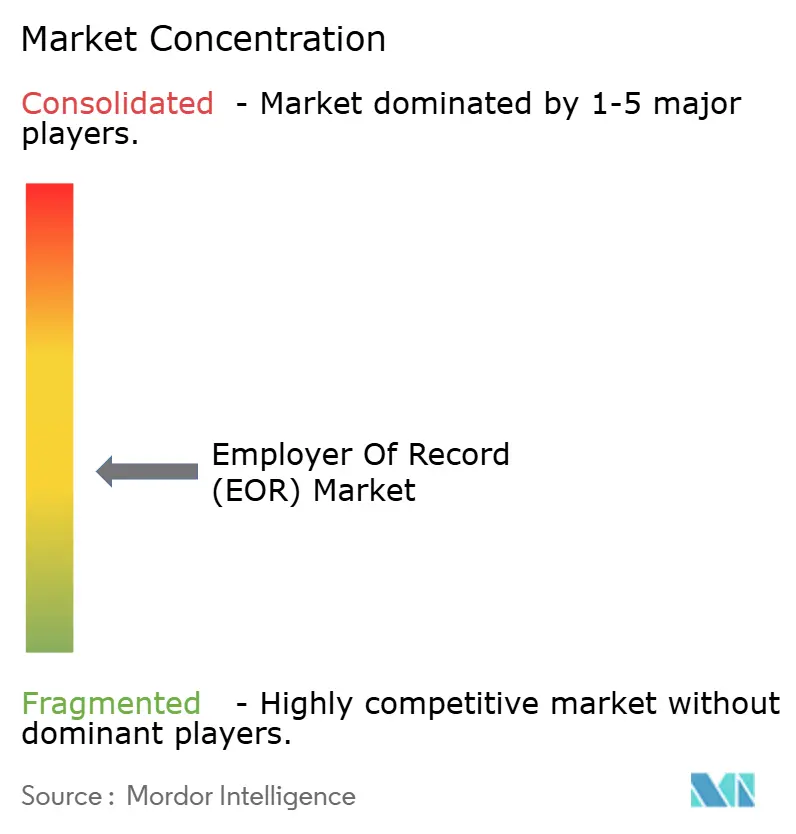
| Market Concentration | Medium |
Major Players *Disclaimer: Major Players sorted in no particular order Image © Mordor Intelligence. Reuse requires attribution under CC BY 4.0. | |
Employer Of Record (EOR) Market Analysis by Mordor Intelligence
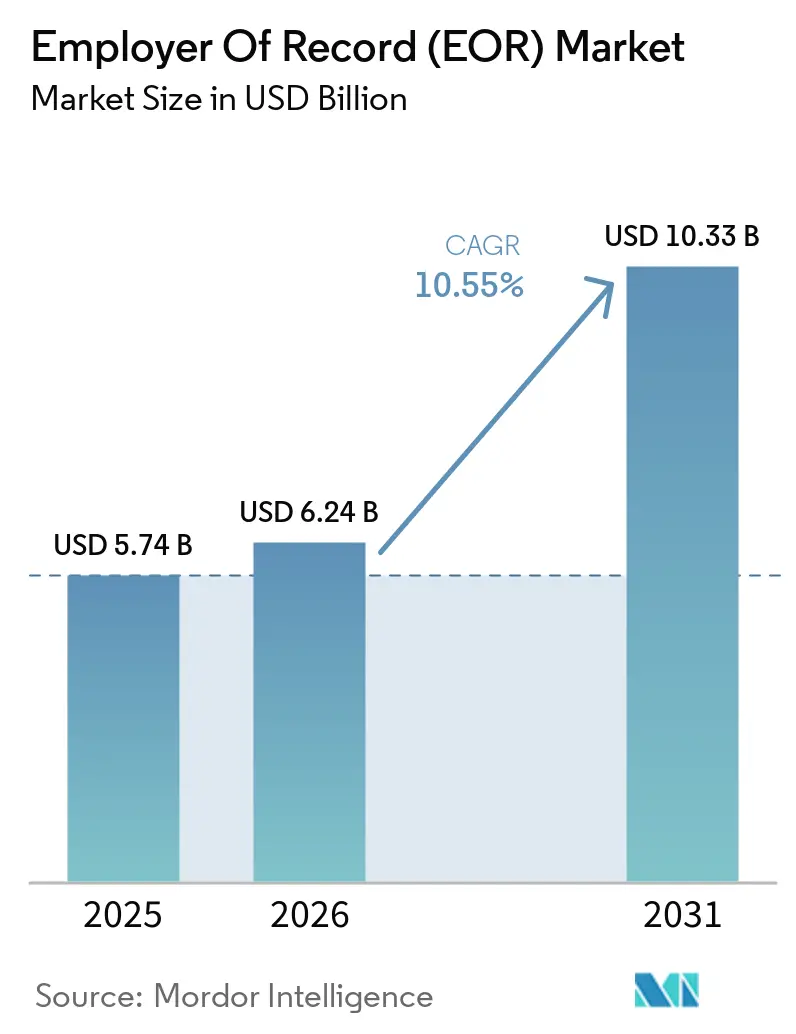
The employer of record (EOR) market size is projected to expand from USD 5.74 billion in 2025 and USD 6.24 billion in 2026 to USD 10.33 billion by 2031, registering a CAGR of 10.55% between 2026 and 2031. Organizations are embedding global hiring into core workforce strategies, replacing legal-entity roll-outs with asset-light EOR contracts. Demand is sustained by technology platforms that deliver instant country coverage and by investors that keep funding acquisition-led scale-ups. Venture-backed providers continue to build native payroll engines across more than 100 countries, shrinking onboarding cycles to days while raising industry switching costs. Intensifying worker-classification enforcement in the United States and the United Kingdom further tilts buyer criteria toward compliance depth and audit readiness, supporting premium pricing for vendors with wholly-owned footprints.
Key Report Takeaways
- By service type, payroll and benefits administration captured 39.84% revenue share of the employer of record (EOR) market in 2025, while compliance management is advancing at a 12.74% CAGR through 2031.
- By business model, the aggregator model held 57.21% of the employer-of-record market share in 2025, whereas wholly owned platforms are set to expand at a 11.43% CAGR over 2026-2031.
- By organization size, large enterprises accounted for 52.64% share of the 2025, employer of record (EOR) market size, yet small and medium enterprises are forecast to grow at a 11.92% CAGR through 2031.
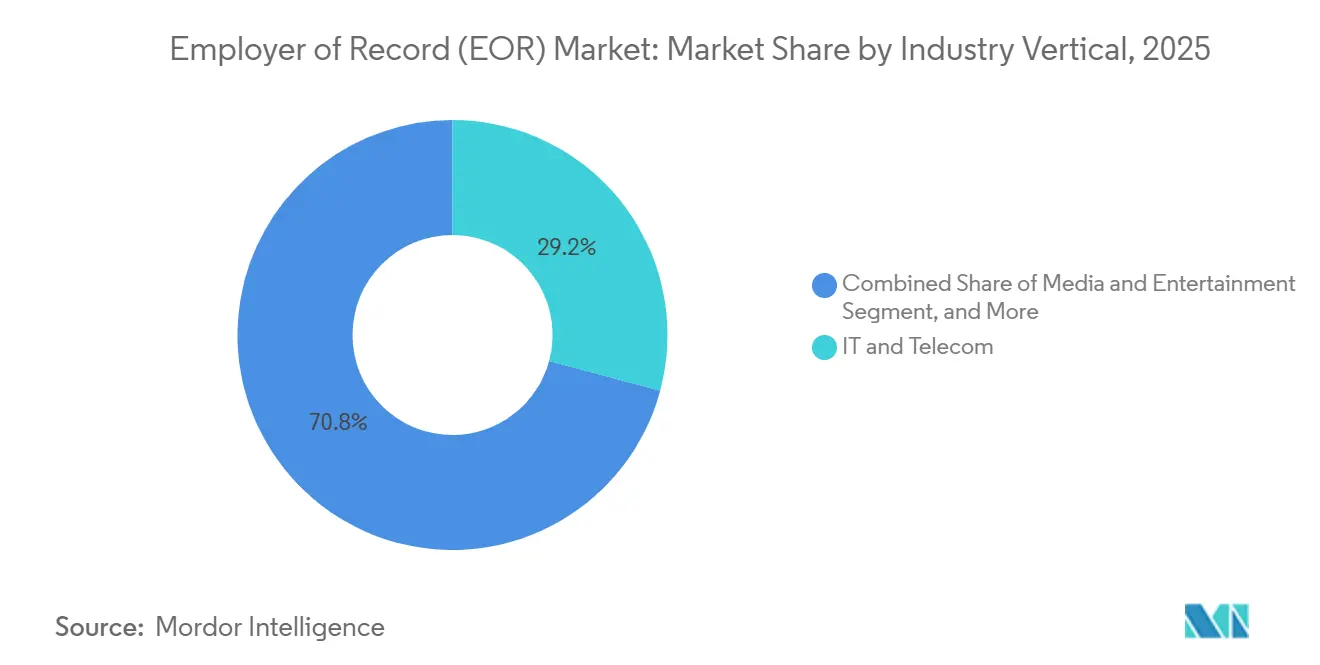
- By industry vertical, the healthcare and life sciences segment is expected to record a 12.66% CAGR to 2031, outpacing information technology and telecom, which led with 29.18% share in 2025.
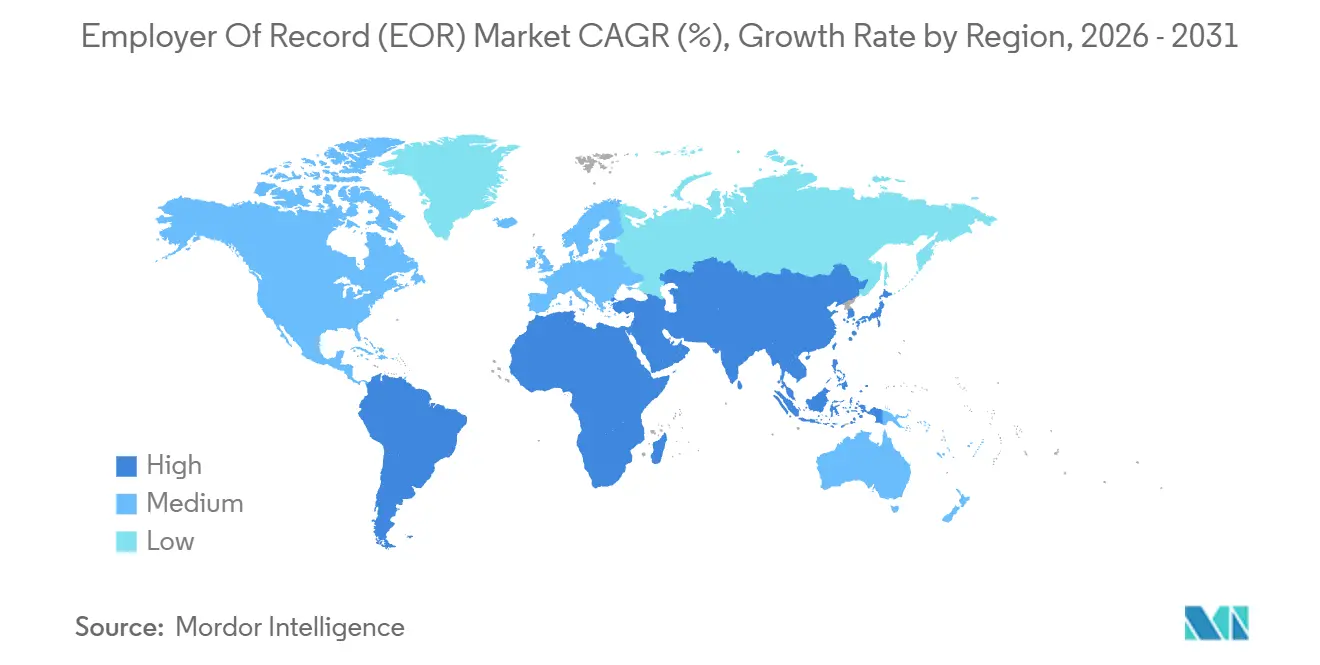
- By Geography, North America dominated with 37.86% share in 2025, while Asia-Pacific is projected to achieve a 12.81% CAGR during 2026-2031.
Note: Market size and forecast figures in this report are generated using Mordor Intelligence’s proprietary estimation framework, updated with the latest available data and insights as of January 2026.
Market Trends and Insights
Drivers Impact Analysis of Employer Of Record (EOR) Market*
| Driver | (~) % Impact on CAGR Forecast | Geographic Relevance | Impact Timeline |
|---|---|---|---|
| Rising Cross-Border Hiring in the Post-Pandemic Digital Economy | +2.8% | Global, with concentration in North America, Europe, Asia-Pacific | Medium term (2-4 years) |
| Surge in Venture Capital Funding for HR Tech and EOR Start-Ups | +1.9% | North America and Europe, spillover to Asia-Pacific | Short term (≤ 2 years) |
| Accelerating Remote-First Policies Among Fortune 500 Enterprises | +1.6% | North America, Europe, select Asia-Pacific markets | Medium term (2-4 years) |
| Growing Preference for Asset-Light Expansion by SMEs in Emerging Markets | +1.4% | Asia-Pacific, South America, Middle East and Africa | Long term (≥ 4 years) |
| Tightening Worker-Classification Enforcement in OECD Countries | +1.2% | North America, Europe | Short term (≤ 2 years) |
| Expansion of Digital Nomad Visa Programs Across 40-Plus Jurisdictions | +0.9% | Europe, South America, Southeast Asia, Middle East | Medium term (2-4 years) |
| Source: Mordor Intelligence | |||
Rising Cross-Border Hiring In The Post-Pandemic Digital Economy
Companies now embed international recruiting into annual manpower plans, treating it as a standard track rather than an experiment. A 2025 Remote.com survey showed that 73% of senior leaders expect more than half of next year's hires to sit outside headquarters countries.[1] Vistra’s 2026 payroll poll reported that 32% of workforces are already paid across borders and 76% of United States respondents intend to increase cross-border headcount within 12 months. Deel processed USD 22 billion in payroll during 2025, showing that distributed pay runs are now executed at scale. With time-zone coverage and wage arbitrage now board-level priorities, the employer of record market continues to convert new enterprise programs into multi-country contracts that lock in multiyear revenues.
Surge In Venture Capital Funding For HR Tech And EOR Start-Ups
Fresh capital accelerates product cycles and funds the conversion of aggregator footprints into wholly-owned entities. Deel’s USD 300 million Series E in October 2025 lifted its valuation to USD 17.3 billion and finances the roll-out of native payroll engines to 100-plus nations by 2029. Papaya Global and other peers have collectively attracted more than USD 3.5 billion since 2019, allowing platforms to negotiate lower transaction fees, expand compliance teams, and sequence acquisitions of regional specialists. Access to scale funding lowers unit costs, boosts gross margins, and raises the entry barrier for smaller rivals, sustaining double-digit expansion for the employer of record industry.
Accelerating Remote-First Policies Among Fortune 500 Enterprises
Large multinationals are codifying work-from-anywhere frameworks, often letting staff reside in countries where the firm lacks a legal entity. Globalization Partners’ 2025 World at Work survey stated that 62% of employees would relocate internationally within a year if career progression is guaranteed.[2] Integrations with Workday and SAP reduce procurement friction, as seen when Neeyamo secured Workday-certified integration in December 2025. As Fortune 500 governance teams demand payroll accuracy, tax withholding, and statutory benefits in every destination, the employer of record market captures recurring compliance fees while becoming an embedded module in enterprise HR stacks.
Growing Preference For Asset-Light Expansion By SMEs In Emerging Markets
Budget-constrained businesses in Asia-Pacific and Latin America favor two-week onboarding and flat per-employee fees over the cost and delay of entity creation. Safeguard Global positions EOR as costing hundreds of dollars less per worker than self-employment, citing onboarding timelines as short as 14 days. RemotePass pushes a super-app strategy, adding SpendCards in February 2026 to bundle payroll, expenses, and corporate cards in 150-plus countries. The aggregator model’s 57.21% 2025 share illustrates how speed and cash-flow visibility outweigh absolute fee levels for many SMEs, reinforcing strong growth prospects for the employer of record (EOR) market across developing economies.
Restraints Impact Analysis of Employer Of Record (EOR) Market*
| Restraint | (~) % Impact on CAGR Forecast | Geographic Relevance | Impact Timeline |
|---|---|---|---|
| Divergent Social Security Regimes Increasing Compliance Complexity | -1.8% | Global, acute in Europe and Asia-Pacific | Long term (≥ 4 years) |
| Rising Cyber-Security Risks on Cloud HR Platforms | -1.3% | Global, higher exposure in North America and Europe | Short term (≤ 2 years) |
| High Switching Costs Once an In-Country Legal Entity Is Incorporated | -0.9% | North America, Europe, select Asia-Pacific markets | Medium term (2-4 years) |
| Limited Awareness of EOR Model in Fragmented Developing Economies | -0.7% | Africa, parts of South America, Southeast Asia | Long term (≥ 4 years) |
| Source: Mordor Intelligence | |||
Divergent Social Security Regimes Increasing Compliance Complexity
Cross-border employment triggers overlapping contribution rules that differ by treaty coverage, residency duration, and telework thresholds. Two 2025 European Court of Justice decisions forced member states to coordinate assessments and to review worldwide activity when allocating liability, increasing the documentation burden on providers. Employees surpassing 183-day tax-residence triggers can generate dual social-security claims, while the EU telework exemption covers only assignments below 50% remote time. EOR platforms must maintain real-time geolocation logs and generate instant certificate requests, elevating technology spend and squeezing smaller vendors. Higher audit frequency and potential double payments temper demand growth, especially in heavily regulated European labor markets.
Rising Cyber-Security Risks On Cloud HR Platforms
Payroll systems store bank data, social security numbers, and health information, making them prime ransomware targets. The February 2026 PrismHR incident cut off salary runs for thousands of clients, echoing earlier breaches at Starbucks and VeriSource. Even vendors with SOC 2 Type II badges have been compromised, proving certification is a hygiene factor rather than a shield. Regulatory fines under GDPR or CCPA, together with remediation costs, weigh on provider profitability and can erode client trust. To sustain momentum, the employer of record market must continue over-investing in zero-trust architecture, multifactor authentication, and real-time anomaly detection.
*Our forecasts treat driver/restraint impacts as directional, not additive. The impact forecasts reflect baseline growth, mix effects, and variable interactions.
Employer Of Record (EOR) Market Segment Analysis
By Service Type:
Compliance Depth Becomes A Purchase TriggerCompliance management is projected to expand at a 12.74% CAGR, outstripping the overall employer of record market. Employers increasingly rank statutory accuracy above payroll cost, shifting spend from basic calculations toward automated regulation monitoring. Payroll and benefits administration retained a 39.84% 2025 share of the employer of record (EOR) market size, highlighting its foundational role, yet price compression is beginning as scale efficiencies feed through vendor P&Ls. Tax management and HR outsourcing gain from bundled purchasing, with customers preferring single-contract visibility for end-to-end workforce data.
Demand for compliance tools is encouraged by sharper penalties and public-sector scrutiny. Deel Shield, Remote.com’s Compliance Hub, and Globalization Partners’ AI-driven G-P Gia frame competitive positioning around real-time policy updates and suggested contract edits. Neeyamo’s Workday connector locks enterprise data directly into a cloud workflow, reducing errors that historically surfaced during file transfers.[3] As audit frequencies rise, service lines that absorb employer liability enjoy premium renewal rates, preserving dollar retention well above 100% and supporting profitable expansion for the employer of record industry.


By Organization Size:
SMEs Drive Volume, Enterprises Drive ValueLarge corporations held 52.64% of the employer of record market share in 2025, but SMEs are forecast to post an 11.92% CAGR, ahead of the total employer of record market. Smaller firms select aggregators for two-week go-live targets and transparent per-seat pricing, often starting with fewer than five workers in a test jurisdiction. RemotePass and Safeguard Global court this cohort with pre-configured contracts and in-app spend controls, displacing legacy contractor arrangements that expose firms to misclassification fines.
Enterprises, by contrast, prize integration, bespoke benefits, and on-site country advisors. Deel highlighted a 480% year-over-year jump in clients using three or more products, implying deepening wallet share once pilots succeed. Hybrid deployment models are gaining currency: owned entities cover strategic markets while aggregator partners service low-volume geographies. This duality keeps both sub-segments expanding and underpins the enduring double-digit trajectory of the employer of record (EOR) market.
By Industry Vertical:
Healthcare Leads Future UpsideThe healthcare and life sciences segment is on track for a 12.66% CAGR, the fastest among verticals, as decentralized trials and telehealth boom. The vertical often requires physicians, clinical researchers, and regulatory specialists to be hired compliantly in multiple regions, accelerating the adoption of employer of record solutions. Information technology and telecom still commanded 29.18% of the employer of record market size in 2025 and remain critical, but growth moderates as penetration deepens.
Banking and financial services, manufacturing, and retail employ EOR models to manage fintech licensing roll-outs, supply-chain diversification, and seasonal customer-service surges, respectively. As telemedicine platforms expand country panels and pharmaceutical sponsors chase diverse trial cohorts, healthcare’s demand intensity will keep reshaping product roadmaps, thrusting data-privacy guarantees and medical malpractice coverage into core offering checklists.
By Business Model:
Aggregator Reach Versus Wholly-Owned ControlAggregator networks maintained a 57.21% slice of the employer of record (EOR) market share in 2025 and are anticipated to log an 11.43% CAGR to 2031, driven by clients that value breadth and speed. Third-party legal entities allow 150-plus country coverage without heavy capital outlay, an advantage for quick-turn pilot projects. Wholly-owned models, representing 42.79%, are gaining ground as venture rounds bankroll entity builds and proprietary payroll engines.
Deel’s USD 100 million PaySpace deal expanded native engines across 44 African and Middle Eastern jurisdictions, shrinking processing latency and raising gross margin per worker. Remote.com stays 100% owned in 85-plus nations, positioning compliance certainty as a premium differentiator. Hybrid structures are proliferating, exemplified by the April 2026 Vistra-Oyster alliance that channels clients from EOR to entity incorporation without re-papering staff files. This fluidity underscores how business model innovation will continue shaping the EOR market.
Geography Analysis
The Americas Employer of Record (EOR) Market
North America generated 37.86% of 2025 revenues, anchored by United States technology hubs and by Canadian nearshore appeal. Software-as-a-service vendors, consulting firms, and digital agencies pioneered early adoption, using EOR contracts to tap engineering talent in Mexico, Colombia, and Canada while bypassing costly subsidiaries. The 2026 Vistra payroll survey revealed that 76% of United States payroll heads intend to boost international headcount within a year, reinforcing sustained regional momentum. Investor-backed providers layer in localized benefits and SOC-2 certifications to satisfy stringent procurement scorecards, sustaining premium per-seat pricing in the region.
APAC Employer of Record (EOR) Market
Asia-Pacific is forecast to deliver the highest regional CAGR at 12.81% through 2031 in the employer of record (EOR) market. India and the Philippines anchor volume, supplying engineering and customer-support labor at material cost advantages. Vietnam and Indonesia benefit from manufacturing nearshoring, while regulatory liberalization in Japan and South Korea nudges conservative employers toward limited-risk EOR pilots. Australia and New Zealand exemplify mature fee environments, where multinationals pay higher unit prices for stringent labor protections and English language alignment. Hybrid roll-outs are common: entities cover Australia and India, aggregators supply smaller teams across Southeast Asia, collectively sustaining robust employer of record market growth.
EMEA and South America Employer of Record (EOR) Market
Europe posts steady demand across the United Kingdom, Germany, France, Spain, and Italy. Revised IR35 thresholds effective April 2026 shrink exemptions, raising misclassification risk and steering medium-sized firms toward EOR solutions. Germany’s labor-leasing licenses and France’s co-employment restrictions elevate compliance complexity, encouraging clients to outsource liability. South America attracts North American and European firms chasing currency arbitrage in Brazil and Argentina. Hightekers’ Serviap Global acquisition highlights consolidation designed to extend compliant coverage across the continent. Middle Eastern demand centers on the United Arab Emirates and Saudi Arabia, where diversification programs and free-zone incentives drive pilot hiring. Africa remains early-stage, yet Deel’s PaySpace acquisition signals confidence in long-term potential, adding native engines across 44 countries and laying groundwork for future employer of record market penetration.
Competitive Landscape
The market shows moderate concentration, yielding a market concentration score of 4 on a ten-point scale. Competitive intensity is elevated as scale-ups, regional specialists, and full-stack HR platforms vie for share. M&A remains strategy one: Deel purchased PaySpace, adding 45 payroll engines and enlarging its owned-entity map to 70-plus countries.[4] Strategy two is AI-enabled compliance. Globalization Partners launched G-P Gia in 2025, claiming to reduce workload by up to 95% by drafting policy documents and parsing legislation in real time. Strategy three is partnership ecosystems; Vistra and Globalization Partners stitched a March 2026 pact that walks clients from contractor management to entity formation under a single contract, minimizing payroll disruption.
Vertical specialization is an emerging moat. Providers are tailoring offerings for pharmaceuticals, financial services, and healthcare, embedding sector-specific compliance such as HIPAA or clinical-trial credential checks. Regional boutiques trade on local expertise and language support, positioning as plug-ins for global aggregators that lack in-house knowledge. Security posture is now table stakes after high-profile breaches, pushing vendors to chase SOC 2 Type II and ISO 27001 as procurement prerequisites. Venture funding continues to fuel land-grab tactics, but profitability benchmarks are tightening, nudging late-stage platforms to pivot from growth-at-all-costs toward sustainable EBITDA.
As consolidation accelerates, smaller aggregators with narrow footprints face buy-out, vertical-niche repositioning, or retreat. Large enterprises increasingly demand dual-vendor strategies to hedge single-provider risk, sustaining room for challengers offering deep domain know-how or superior customer experience. Overall, technology investment, regulatory acumen, and integration breadth will dictate share capture across the employer of record market over the next five years.
Employer Of Record (EOR) Industry Leaders
-
Deel Inc.
-
Remote Technology Inc.
-
Safeguard Global LLC
-
Velocity Global LLC
-
Papaya Global Ltd.
- *Disclaimer: Major Players sorted in no particular order
Employer Of Record (EOR) Market Companies Covered in this Report
- Deel Inc.
- Remote Technology Inc.
- Safeguard Global LLC
- Velocity Global LLC
- Papaya Global Ltd.
- Globalization Partners LLC
- Atlas Technology Solutions Inc.
- Oyster HR Inc.
- Elements Global Services Inc.
- Omnipresent Group Ltd.
- WorkMotion GmbH
- Skuad Pte. Ltd.
- Panther Global Inc.
- Neeyamo Enterprise Solutions Pvt. Ltd.
- RemotePass FZ-LLC
- Global Expansion Group Limited
- Horizons Solutions Pte. Ltd.
- Boundless Technologies Ireland Ltd.
- INS Global Consulting SAS
- Agility EOR Holdings Inc.
- WeHireGlobally Ltd.
- Eres Relocation Services SL
- iWorkGlobal Holdings LLC
Recent Industry Developments in Employer Of Record (EOR) Market
- April 2026: Vistra and Oyster formed a strategic partnership to help clients migrate from EOR coverage to local entity formation without payroll interruption.
- March 2026: Vistra and Globalization Partners unveiled a unified pathway that allows mid-sized firms to shift from contractor hiring to entity incorporation under one contract.
- February 2026: RemotePass introduced SpendCards, a corporate-card module integrated into its EOR platform and available in more than 150 countries.
- January 2026: Globalization Partners reported record 2025 revenue growth, citing accelerated uptake of its AI-powered compliance tool G-P Gia.
Global Employer Of Record (EOR) Market Report Scope
The Employer of Record (EOR) market refers to the revenue generated from services that enable organizations to legally employ workers in foreign or domestic jurisdictions without establishing a local legal entity. Under this model, the EOR provider acts as the official employer on record for compliance purposes, while the client organization retains control over day-to-day work management. These services are primarily used to support cross-border hiring, remote workforce management, and market expansion strategies.
The Employer of Record (EOR) Market Report is Segmented by Service Type (Payrolling and Benefits Administration, Compliance Management, Tax Management, HR Outsourcing, and Other Service Types), Organization Size (Small and Medium Enterprises, aand Large Enterprises), Industry Vertical (IT and Telecom, BFSI, Media and Entertainment, Healthcare and Lifesciences, Manufacturing, Retail and E-commerce, and Other Industry Verticals), Business Model (Aggregator Mode, and Wholly-Owned Model), and Geography (North America, South America, Europe, Asia-Pacific, Middle East, and Africa). The Market Forecasts are Provided in Terms of Value (USD).
Segmentation Overview
| Payrolling and Benefits Administration |
| Compliance Management |
| Tax Management |
| HR Outsourcing |
| Other Service Types |
| Small and Medium Enterprises |
| Large Enterprises |
| IT and Telecom |
| BFSI |
| Media and Entertainment |
| Healthcare and Lifesciences |
| Manufacturing |
| Retail and E-commerce |
| Other Industry Verticals |
| Aggregator Mode |
| Wholly-Owned Model |
| North America | United States |
| Canada | |
| Mexico | |
| South America | Brazil |
| Argentina | |
| Rest of South America | |
| Europe | Germany |
| United Kingdom | |
| France | |
| Spain | |
| Italy | |
| Russia | |
| Rest of Europe | |
| Asia-Pacific | China |
| India | |
| Japan | |
| South Korea | |
| Australia and New Zealand | |
| Rest of Asia-Pacific | |
| Middle East | Saudi Arabia |
| United Arab Emirates | |
| Turkey | |
| Rest of Middle East | |
| Africa | South Africa |
| Nigeria | |
| Egypt | |
| Rest of Africa |
| By Service Type | Payrolling and Benefits Administration | |
| Compliance Management | ||
| Tax Management | ||
| HR Outsourcing | ||
| Other Service Types | ||
| By Organization Size | Small and Medium Enterprises | |
| Large Enterprises | ||
| By Industry Vertical | IT and Telecom | |
| BFSI | ||
| Media and Entertainment | ||
| Healthcare and Lifesciences | ||
| Manufacturing | ||
| Retail and E-commerce | ||
| Other Industry Verticals | ||
| By Business Model | Aggregator Mode | |
| Wholly-Owned Model | ||
| By Geography | North America | United States |
| Canada | ||
| Mexico | ||
| South America | Brazil | |
| Argentina | ||
| Rest of South America | ||
| Europe | Germany | |
| United Kingdom | ||
| France | ||
| Spain | ||
| Italy | ||
| Russia | ||
| Rest of Europe | ||
| Asia-Pacific | China | |
| India | ||
| Japan | ||
| South Korea | ||
| Australia and New Zealand | ||
| Rest of Asia-Pacific | ||
| Middle East | Saudi Arabia | |
| United Arab Emirates | ||
| Turkey | ||
| Rest of Middle East | ||
| Africa | South Africa | |
| Nigeria | ||
| Egypt | ||
| Rest of Africa | ||
Key Questions Answered in the Report
How large is the Employer of Record (EOR) market today and what growth is expected?
According to Mordor Intelligence, the Employer of Record (EOR) market is valued at USD 6.24 billion in 2026 and is forecast to reach USD 10.33 billion by 2031, reflecting a 10.55% CAGR over 2026-2031.
Which service line is expanding fastest within the employer of record space?
Mordor Intelligence identifies compliance management as the fastest-growing segment, advancing at a 12.74% CAGR through 2031 as buyers prioritize regulatory assurance.
What region will deliver the strongest revenue expansion through 2031?
Asia-Pacific is projected by Mordor Intelligence to post a 12.81% CAGR, outpacing North America and Europe due to talent arbitrage in India and the Philippines and ongoing nearshoring in Southeast Asia.
How are small and medium enterprises using employer of record platforms differently from large corporations?
Mordor Intelligence notes SMEs favor aggregator models for two-week onboarding and flat per-head pricing, while large enterprises lean toward wholly-owned frameworks that integrate with Workday and SAP for deeper compliance control.
Which vertical is projected to add the most incremental spending?
Healthcare and life sciences is expected by Mordor Intelligence to grow at 12.66% CAGR, driven by decentralized clinical trials and telehealth staffing needs across multiple jurisdictions.