
Europe Talent Management Software Market Size and Share
Market Overview
| Study Period | 2020 - 2031 |
|---|---|
| Forecast Data Period | 2026 - 2031 |
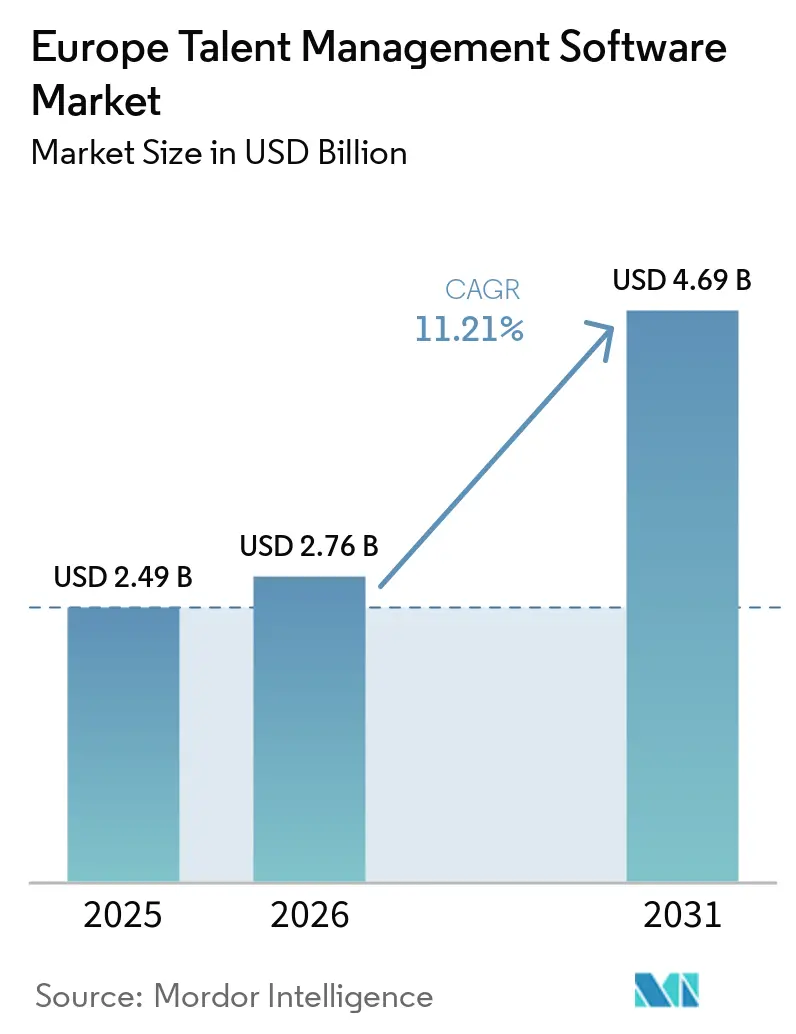
| Base Year Market Size (2025) | USD 2.49 Billion |
| Market Size (2026) | USD 2.76 Billion |
| Market Size (2031) | USD 4.69 Billion |
| Growth Rate (2026 - 2031) | 11.21 % |
| Market Concentration | Medium |
Major Players *Disclaimer: Major Players sorted in no particular order Image © Mordor Intelligence. Reuse requires attribution under CC BY 4.0. | |
Europe Talent Management Software Market Analysis by Mordor Intelligence
The Europe talent management software market size stood at USD 2.49 billion in 2025 and is forecast to reach USD 4.69 billion by 2031, growing at a CAGR of 11.21% from 2026 to 2031. Growth is being shaped by persistent skills shortages, faster workplace automation, and a heavier regulatory load around pay transparency, AI governance, and ESG disclosures. These pressures are pushing employers to connect recruiting, learning, performance, succession, and compensation workflows inside unified systems that can produce auditable records at scale. Compliance deadlines are also speeding up software purchases, especially where manual pay and reporting processes no longer support June 2026 obligations under the EU Pay Transparency Directive. Cloud adoption is rising as vendors pair AI-enabled functionality with stronger data residency options, while SMEs are entering the category more quickly as pricing models become easier to absorb. Competition remains centered on a small group of global HCM providers, but regional platforms still have room to compete where local regulation, language support, and sovereignty requirements matter more in buying decisions.
Key Report Takeaways
- By component, software accounted for 77.19% of the Europe Talent Management Software Market revenue in 2025, while services are projected to expand at a 13.71% CAGR through 2031.
- By application, performance management accounted for 23.01% in 2025, while learning and development is forecast to grow at 12.68% CAGR through 2031.
- By deployment, on-premise represented 65.21% of the Europe Talent Management Software Market in 2025, while cloud is expected to advance at 14.46% CAGR through 2031.
- By enterprise size, large enterprises accounted for 64.15% in 2025, while SMEs are set to grow at a 14.12% CAGR through 2031.
- By end-use industry, IT and telecommunications led with 24.55% in 2025, while healthcare and life sciences are projected to rise at 13.05% CAGR through 2031.
- By region, the United Kingdom held 25.89% of the Europe Talent Management Software Market in 2025, while Italy is forecast to expand at 13.33% CAGR through 2031.
Note: Market size and forecast figures in this report are generated using Mordor Intelligence’s proprietary estimation framework, updated with the latest available data and insights as of January 2026.
Market Trends and Insights
Drivers Impact Analysis of Europe Talent Management Software Market*
| Driver | (~) % Impact on CAGR Forecast | Geographic Relevance | Impact Timeline |
|---|---|---|---|
| AI-Driven Internal Talent Marketplaces | +2.5% | Global, concentrated in UK, Germany, and Nordics | Medium term (2-4 years) |
| Shift toward Skills-Based Hiring Models | +2.2% | Global, with early adoption in UK, Nordics, and Benelux | Short term (≤ 2 years) |
| Adoption of Cloud-Native HR Architectures | +1.8% | UK, Germany, France, Benelux, and Nordic markets | Medium term (2-4 years) |
| Compliance Pressure from EU Equal Pay and ESG Rules | +1.5% | EU-wide, with early implementation gains in Germany, France, and Italy | Short term (≤ 2 years) |
| Learning Experience Platforms Expanding into Talent Suites | +1.2% | UK, Germany, and Nordics, with spill-over to Southern Europe | Medium term (2-4 years) |
| Vendor-Led Consumption-Based Pricing Innovation | +0.9% | Western Europe, with growing relevance in Central-Eastern Europe | Long term (≥ 4 years) |
| Source: Mordor Intelligence | |||
Emergence of AI-Driven Internal Talent Marketplaces
In the Europe talent management software market, internal talent marketplaces are becoming one of the clearest paths to higher platform value. These tools help employers match employees to open roles, projects, mentorships, and stretch assignments by using verified skill profiles and career histories. Their appeal goes beyond recruiting efficiency because they lower dependence on external hiring, reduce time-to-fill, and make career paths easier for employees to see. Workday’s 2025 Spring Release added intelligent job recommendations inside Career Hub and Opportunity Marketplace, which showed how internal mobility functions are moving closer to daily employee workflows.[1] As organizations use these systems more often, they also build richer skills data that can support workforce planning, succession, and personalized learning. That makes the internal marketplace less of a stand-alone feature and more of a central operating layer in the Europe talent management software market.
Accelerating Shift toward Skills-Based Hiring Models
In the Europe talent management software market, skills-based hiring is moving from selective use into standard recruiting practice. LinkedIn reported in 2024 that 73% of recruiting professionals prioritized skills over credentials, which supports stronger demand for software that can assess, store, and match detailed skill profiles. Once employers create structured skill inventories, they can identify capability gaps earlier and shift from reactive hiring toward planned development. This matters for pay transparency as well because objective skill and competency frameworks make compensation decisions easier to explain and defend across roles. The European Commission’s skills agenda and ESCO framework are also helping multinational employers use more consistent terminology across borders, which improves cross-country talent matching and internal mobility. As a result, skills architecture is becoming a core requirement rather than an optional add-on in the Europe talent management software market.
Growing Adoption of Cloud-Native HR Architectures
In the Europe talent management software market, cloud-native HR architecture is gaining ground because it has become the main channel for faster AI delivery. SAP’s First Half 2026 SuccessFactors release introduced more than 400 updates, including AI agents for succession planning, goal creation, and learning compliance, which underlined how quickly cloud platforms can ship new functionality. The buying discussion is no longer centered only on cost and scalability, because employers also want a platform that can keep pace with new governance and automation requirements. GDPR continues to make data residency, lawful processing, and transfer controls central issues for HR systems that hold sensitive employee information. That is why sovereign cloud positioning, regional hosting, and auditable AI controls have become more important in procurement. The result is that cloud migration in the Europe talent management software market is being driven as much by compliance-ready innovation as by technical modernization.
Rising Compliance Pressure from EU Equal Pay and ESG Rules
In the Europe talent management software market, compliance pressure is now a direct demand driver instead of only a purchasing hurdle. The EU Pay Transparency Directive requires member states to transpose the rules by June 2026, which is pushing employers to strengthen compensation records, job architecture, and reporting readiness. The directive matters because employers need to justify pay differences with objective evidence, and fragmented HR systems rarely hold that information in one auditable structure. SAP’s First Half 2026 release responded to this need by embedding pay transparency compliance tooling into its People Intelligence capabilities. The same pressure is pulling compensation, performance, and skills records closer together, since each one contributes to defensible workforce reporting. That is making integrated compliance support a stronger purchase trigger across the Europe talent management software market.
Restraints Impact Analysis of Europe Talent Management Software Market*
| Restraint | (~) % Impact on CAGR Forecast | Geographic Relevance | Impact Timeline |
|---|---|---|---|
| Integrating Legacy HR Systems | -1.8% | Global, particularly pronounced in manufacturing and government sectors across Germany, France, and Italy | Long term (≥ 4 years) |
| Data Privacy Concerns Under GDPR | -1.4% | EU-wide | Medium term (2-4 years) |
| Limited Analytics Skills in Mid-Market Enterprises | -1.0% | Southern Europe and Central-Eastern Europe | Medium term (2-4 years) |
| Macroeconomic Hiring Freezes in Key Industries | -0.8% | UK, Germany, and France | Short term (≤ 2 years) |
| Source: Mordor Intelligence | |||
Complexity in Integrating Legacy HR Systems
Legacy fragmentation remains one of the hardest brakes on the Europe talent management software market. Many large employers still keep authoritative employee data inside older ERP environments that were not designed for modern API-based talent tools, which makes migration and synchronization slower than buyers expect. The problem is most visible in manufacturing and public-sector settings, where governance procedures, works council consultation, and long approval cycles add another layer of delay. Vendors are trying to reduce the burden through tighter integrations and broader platform releases, but the gap between old data structures and new workflows still creates custom work during every major project. That means implementation time often stretches well beyond software selection, which delays module adoption and slows follow-on revenue. Even as cloud penetration rises, legacy architecture continues to weigh on growth in the Europe talent management software market because integration risk is still one of the first issues buyers test during procurement.
Persistent Data Privacy Concerns under GDPR
Data privacy remains a meaningful restraint in the Europe talent management software market because AI-enabled HR features raise legal questions that are harder to resolve than standard software deployment issues. GDPR Article 22 limits decisions based solely on automated processing, which directly affects recruiting, screening, and predictive employee scoring use cases. The EU AI Act adds another layer by classifying recruitment AI systems as high-risk, with obligations beginning in August 2026. Employers therefore need human review checkpoints, audit trails, and explainable outputs before they can scale these tools with confidence. Those requirements are easier for top-tier platforms to absorb than for mid-market vendors with smaller compliance teams. The result is that privacy and governance are slowing adoption in parts of the Europe talent management software market even while they create an opening for vendors with stronger compliance design.
*Our forecasts treat driver/restraint impacts as directional, not additive. The impact forecasts reflect baseline growth, mix effects, and variable interactions.
Europe Talent Management Software Market Segment Analysis
By Component:
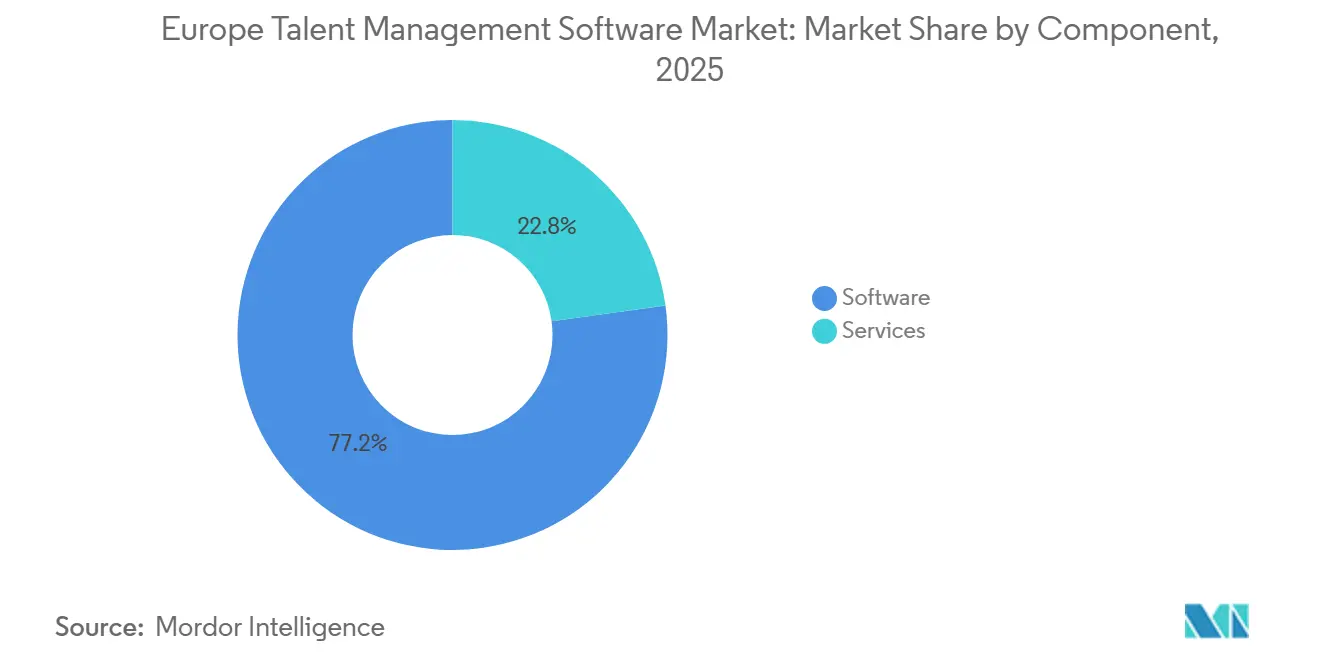
Software Sustains Dominance as Services Revenue AcceleratesSoftware accounted for 77.19% of Europe talent management software market share in 2025 and remained the main revenue base of the Europe talent management software market. That lead reflected the preference for integrated suites that connect performance, succession, compensation, and recruiting records in one system. Once a suite is embedded in core HR workflows, replacing single modules becomes less attractive because continuity in data and permissions matters as much as new functionality. This has helped major vendors expand contract value inside existing accounts instead of depending only on new customer wins. It has also kept the software layer at the center of procurement discussions even when service intensity rises during implementation.
Services are projected to grow at 13.71% CAGR through 2031, making them the fastest-moving component in the Europe talent management software market. The pace of AI feature releases is creating more demand for configuration, governance design, training, and adoption support after go-live. Enterprises are finding that new tools only deliver value when skills taxonomies, review cycles, and compensation rules are set up correctly across business units. Ongoing support is also gaining importance because vendors continue to release updates that affect workflows, permissions, and reporting logic.[2] As a result, services are rising not because software is losing relevance, but because buyers need more help turning software features into repeatable operating practice across the Europe talent management software market.
By Application:
Performance Management Leads while Learning and Development Gains SpeedPerformance management held the largest application share at 23.01% in 2025 and remained one of the most established use cases in the Europe talent management software market. Employers usually implement this area early because goal setting, review cycles, manager feedback, and compensation links are already embedded in annual HR operations. That gives the segment a durable installed base, especially in larger enterprises that want standardized review structures across countries and business units. It also means performance data often becomes the anchor for broader talent workflows, including succession and pay decisions. This installed role helps explain why performance management stayed the largest application even as buying priorities began to shift.
Learning and development is projected to grow at 12.68% CAGR through 2031, which makes it the fastest-rising application in the Europe talent management software market. Cornerstone’s Sapient Insights survey showed that skills management software budget commitments nearly doubled among enterprise respondents from 6% in 2024 to 11% in 2025, which points to a clear move from evaluation to spending. AI-native learning platforms are gaining traction because they personalize content, track skill development, and connect more directly to internal mobility and succession plans. Recruitment, engagement, and career development modules are also benefiting because skills-based hiring requires platforms that can carry the same skill data from candidate matching into employee growth paths. This is gradually changing the Europe talent management software market from a process-first category into one that places more weight on capability development and internal mobility.
By Deployment:
On-Premise Holds the Base While Cloud Shapes New DemandOn-premise deployment retained a 65.21% share in 2025 and reflected the weight of large installed systems in manufacturing, banking, and government across the Europe talent management software market. This position may seem counterintuitive against current cloud momentum, but many large employers are still moving through longer ERP transition programs that delay full platform replacement. Data sovereignty concerns, works council processes, and legacy customization all continue to protect older deployments, especially in Germany and France. In many cases, organizations keep core employee records in place while adding newer talent modules around them in stages. That creates a transition pattern where on-premise remains large even while future spending tilts toward newer delivery models.
The Europe talent management software market size for cloud deployment is projected to grow at 14.46% CAGR through 2031. Cloud demand is accelerating because buyers want faster AI feature delivery, easier updates, and stronger support for regional compliance controls. Workday’s Agent System of Record became generally available in February 2026, which showed how cloud-native environments are becoming the base for centralized AI oversight and auditability. GDPR remains a structural reason for this shift because personal HR data requires tighter governance on location, access, and lawful processing. As a result, future growth in the Europe talent management software market is likely to come more from cloud expansion than from new on-premise buildouts.
By End-Use Enterprise Size:
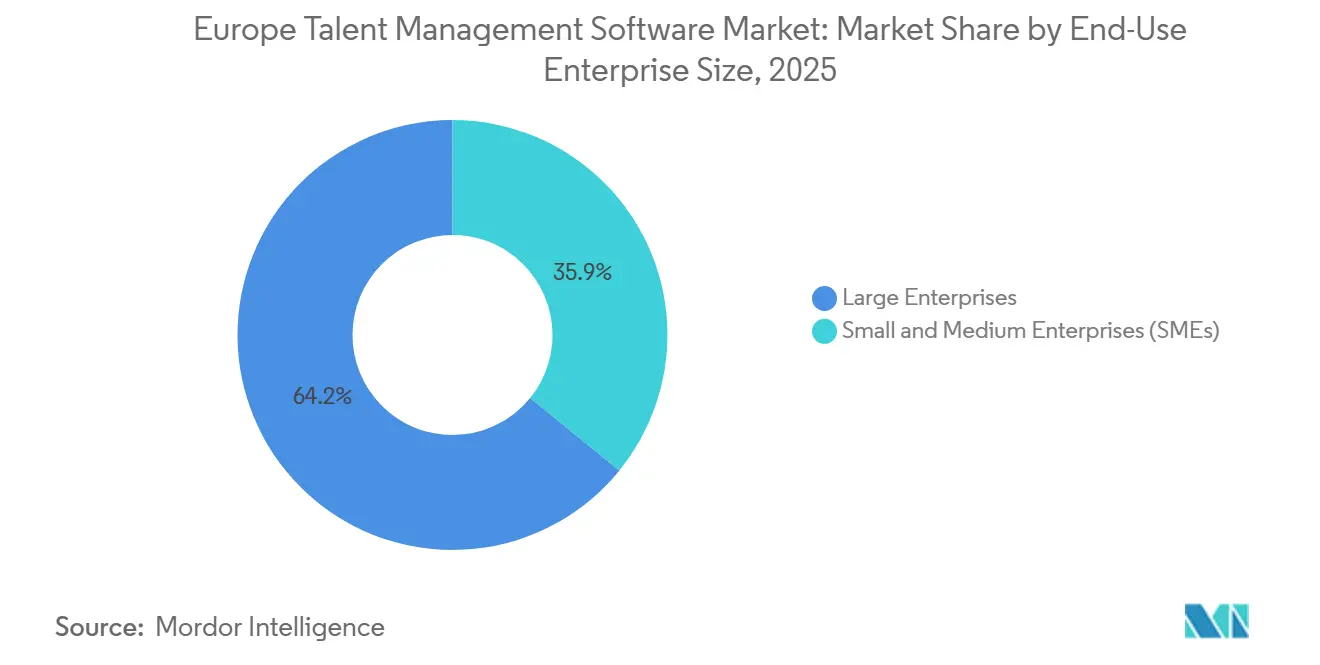
Large Enterprises Hold Value while SMEs Expand FasterLarge enterprises captured 64.15% in 2025 and remained the biggest spending cohort in the Europe talent management software market. Their lead reflects the fact that multinational employers need sophisticated planning, multi-country compliance support, and deep integration with payroll and enterprise systems. These requirements create larger contract values and favor a small group of providers that can manage scale across multiple jurisdictions. SAP stated that SuccessFactors supports 104 country localizations and more than 2,000 legislative updates each year, which illustrates the complexity level that matters to this customer group. In practice, large enterprise demand stays concentrated because few platforms can meet this level of localization and process depth at scale.
The Europe talent management software market size for SMEs is projected to grow at 14.12% CAGR through 2031. This faster growth reflects simpler pricing, shorter deployment cycles, and growing demand from companies that previously relied on spreadsheets or basic HR tools. Vendors are increasingly packaging talent functions in ways that let mid-sized firms adopt performance, recruiting, and learning modules without taking on the full complexity of enterprise suites. That matters most in Southern Europe and Central-Eastern Europe, where underpenetration remains higher and first-time formal adoption has more room to expand. Over time, this broadening buyer base should make the Europe talent management software market less dependent on a small set of very large accounts.
By End-Use Industry:
IT and Telecom Lead While Healthcare Gains UrgencyIT and telecommunications held the largest share at 24.55% in 2025 and remained the most active end-use vertical in the Europe talent management software market. This sector has high workforce mobility, intense hiring pressure for specialized roles, and a strong need to map skills more precisely than broad job titles allow. It was also among the earlier adopters of AI-enabled recruiting and skills tools, which helped sustain its leadership position. In these organizations, talent software is closely tied to speed in hiring, internal mobility, and retention of scarce technical talent. That gives the vertical a clear reason to invest even when other sectors move more slowly.
Healthcare and life sciences are projected to grow at 13.05% CAGR through 2031, making them the fastest-growing vertical in the Europe talent management software market. Staffing shortages, credential tracking, and workforce planning pressures are pushing this sector toward more structured talent systems. The need is especially strong where employers must link learning, certification, scheduling readiness, and retention in one operating view. Manufacturing is also advancing as automation changes plant-level skill requirements, while BFSI continues to deepen usage around workforce conduct, planning, and pay governance. Government adoption is rising more gradually because procurement rules and change governance remain heavier, but the direction still supports wider use of the Europe talent management software market over the forecast period.
Geography Analysis
United Kingdom and Continental Europe Talent Management Software Market
The United Kingdom held 25.89% of Europe talent management software market share in 2025, while Italy is forecast to expand at 13.33% CAGR through 2031. The UK kept that lead because large multinationals and relatively mature cloud HCM adoption supported higher-value software decisions. Cross-border employers based in the UK also face dual governance demands as they manage local rules alongside EU obligations. Germany and France formed the next major demand centers, supported by large enterprise bases, complex labor governance, and strong demand for auditable HR data. The Nordic markets added a smaller but digitally advanced buyer group that often adopts AI-enabled talent tools earlier than the continental average.
Southern Europe Talent Management Software Market
France has developed one of the clearest local ecosystems in the Europe talent management software market, with providers such as Cegid competing on regulatory fit, French-language workflows, and sovereignty commitments.[3] Cegid stated that its human capital management operations served more than 1,500 clients across 25 countries, which shows the scale that regional specialists can reach from a France-based platform. Spain moved more slowly through 2025 because its business base remained weighted toward smaller employers with tighter HR software budgets. Italy is growing faster because digital transformation funding and a lower historical software base are pulling more mid-market buyers into formal talent systems. This catch-up pattern gives Southern Europe a larger runway for first-time adoption than more mature Western European countries.
Broader European Markets
The Rest of Europe group combines highly mature buyers in Benelux, Switzerland, and the Nordics with faster-developing demand across Central and Eastern Europe. In those eastern markets, adoption is often linked to cross-border workforce mobility, multilingual operations, and the need to standardize talent data across subsidiaries. Russia followed a different path because disconnection from major global cloud ecosystems limited access to many leading platforms and increased reliance on domestic alternatives. The EU AI Act is likely to widen product and compliance differences between EU and non-EU European markets, which will make regional product planning more complex for vendors in the Europe talent management software market.
Competitive Landscape
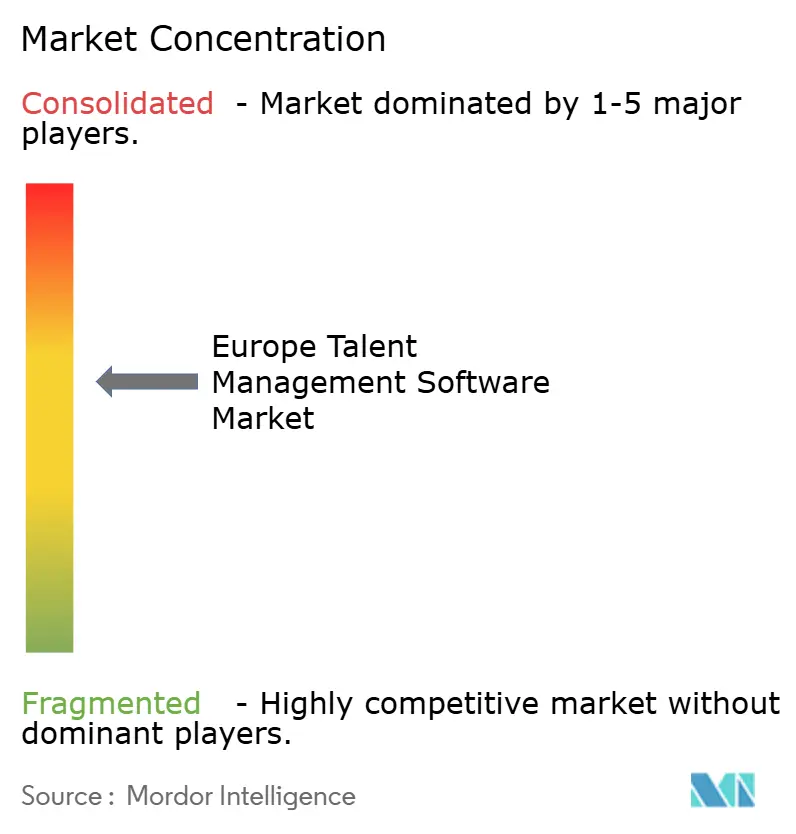
The Europe talent management software market shows moderate-to-high concentration in large-enterprise accounts, where SAP, Oracle, and Workday shape many strategic buying decisions. SAP has leaned on process depth, using SuccessFactors to connect core HR, talent, and compliance workflows for customers that already run SAP environments. Its First Half 2026 release added AI agents for career development, goal progress, and succession planning, which strengthened the value of staying inside one suite. Workday has taken a different route by combining product expansion with acquisitions and new governance layers for AI-enabled work. Oracle remains strong where buyers want talent software closely linked to finance, ERP, and enterprise data architecture.
Workday completed its acquisition of Sana in November 2025 and then launched the Agent System of Record in February 2026, which broadened its position in learning, knowledge access, and AI oversight. These moves matter because buyers are no longer selecting talent tools only for forms and workflows, they are also choosing the system that can govern skills data and AI outputs. The Europe talent management software market is therefore shifting from module breadth alone toward control of the skills layer and the intelligence built on top of it. European specialists such as Cegid, Talentia, and other national-language providers remain relevant where local reporting, labor rules, and in-country data handling carry more weight than global scale.[4] This keeps the mid-market more open than the enterprise tier, even as global vendors try to simplify deployment and broaden coverage.
White space is strongest in mid-market AI adoption and in workforce analytics that can support pay equity and broader ESG disclosures without heavy customization. Providers that can combine learning, internal mobility, compensation evidence, and explainable AI controls will have a better chance of expanding share in the Europe talent management software market. Platform stickiness is also rising because proprietary skills taxonomies and usage data become more valuable as customers train managers and employees on one system. Even with active local competition, the leading vendors still hold the strategic edge because they can fund faster product releases, larger partner ecosystems, and compliance investments across multiple European jurisdictions.
Europe Talent Management Software Industry Leaders
-
SAP SE
-
Oracle Corporation
-
Workday Inc.
-
ADP Inc.
-
UKG Inc.
- *Disclaimer: Major Players sorted in no particular order
Europe Talent Management Software Market Companies Covered in this Report
- SAP SE
- Oracle Corporation
- Workday Inc.
- Cornerstone OnDemand Inc.
- ADP Inc.
- UKG Inc.
- Ceridian HCM Holding Inc.
- Cegid SAS
- Talentsoft S.A.S.
- PeopleFluent Holdings Corp.
- Saba Software Inc.
- IBM Corporation
- Infor Inc.
- Zoho Corporation Pvt. Ltd.
- BambooHR LLC
- Bullhorn Inc.
- Learning Technologies Group plc
- SumTotal Systems LLC
- Paycom Software Inc.
- ClearCompany Inc.
Recent Industry Developments in Europe Talent Management Software Market
- May 2026: SAP SE released the First Half 2026 SuccessFactors HCM update, introducing over 400 innovations including AI-powered Career Development, Goal Progress, and Succession Planning agents. The release also embedded EU Pay Transparency Directive compliance tooling, covering pay-gap analysis, gender equity reporting, and auditable compensation-band disclosure, directly into SAP Business Data Cloud's People Intelligence module, accelerating enterprise readiness for the June 2026 national transposition deadlines.
- March 2026: Workday Inc. launched "Sana from Workday," an AI-native agent and learning platform integrated with Gmail, Salesforce, Slack, and ServiceNow, providing over 300 automated HR and finance task skills. The Sana Self-Service Agent, already adopted by over 400 enterprise customers, represented Workday's broadest deployment of autonomous AI workflows in its talent management suite to date.
- March 2026: SAP SE completed Phase 1 of its SmartRecruiters integration with SAP SuccessFactors Employee Central and Onboarding, enabling live bidirectional data sync for users, organizational structure, cost centers, and job requisitions. Phase 2, targeted for June 2026, is expected to automate "Hire Sync" flows that eliminate manual data entry for new-hire records and connect SAP's Joule AI assistant with SmartRecruiters' Winston agent.
- February 2026: Workday Inc. launched the Agent System of Record as generally available, providing enterprises with a unified governance layer for all AI agents, including those built by Workday, customers, and third-party partners. The system manages agent access using Workday's security model and aligns with EU AI Act governance requirements, recording and tracking all AI agent interactions for audit purposes.
Europe Talent Management Software Market Report Scope
The Europe talent management software market plays a pivotal role in attracting, developing, assessing, and retaining talent across both EU and non-EU member states. Adoption trends are heavily influenced by compliance mandates like GDPR, specific labor regulations of individual countries, and expansive digital initiatives in the public sector. The market covers a broad spectrum, including recruitment, learning, performance, career mobility, and analytics systems. Growth is fueled by the rise of hybrid work models, initiatives promoting digital skills, and a push towards modernizing the workforce.
The Europe Talent Management Software Market Report is Segmented by Component (Software, and Services [Professional Services, and Support and Maintenance Services]), Application (Performance Management, Learning and Development, Succession Planning, Compensation Management, Recruitment and Talent Acquisition, Workforce Planning, Employee Engagement and Career Development, and Other Talent Management Applications), Deployment (On-Premise, and Cloud), End-Use Enterprise Size (Large Enterprises, and Small and Medium Enterprises [SMEs]), End-Use Industry (IT and Telecommunications, Banking, Financial Services and Insurance, Healthcare and Life Sciences, Retail and E-Commerce, Manufacturing, Government and Public Sector, and Other End-Use Industries), and Region (United Kingdom, Germany, France, Italy, Spain, Russia, and Rest of Europe). The Market Forecasts are Provided in Terms of Value (USD).
Segmentation Overview
| Software | |
| Services | Professional Services |
| Support and Maintenance Services |
| Performance Management |
| Learning and Development |
| Succession Planning |
| Compensation Management |
| Recruitment and Talent Acquisition |
| Workforce Planning |
| Employee Engagement and Career Development |
| Other Talent Management Applications |
| On-Premise |
| Cloud |
| Large Enterprises |
| Small and Medium Enterprises (SMEs) |
| IT and Telecommunications |
| Banking, Financial Services and Insurance |
| Healthcare and Life Sciences |
| Retail and E-Commerce |
| Manufacturing |
| Government and Public Sector |
| Other End-Use Industries |
| United Kingdom |
| Germany |
| France |
| Italy |
| Spain |
| Russia |
| Rest of Europe |
| By Component | Software | |
| Services | Professional Services | |
| Support and Maintenance Services | ||
| By Application | Performance Management | |
| Learning and Development | ||
| Succession Planning | ||
| Compensation Management | ||
| Recruitment and Talent Acquisition | ||
| Workforce Planning | ||
| Employee Engagement and Career Development | ||
| Other Talent Management Applications | ||
| By Deployment | On-Premise | |
| Cloud | ||
| By End-Use Enterprise Size | Large Enterprises | |
| Small and Medium Enterprises (SMEs) | ||
| By End-Use Industry | IT and Telecommunications | |
| Banking, Financial Services and Insurance | ||
| Healthcare and Life Sciences | ||
| Retail and E-Commerce | ||
| Manufacturing | ||
| Government and Public Sector | ||
| Other End-Use Industries | ||
| By Region | United Kingdom | |
| Germany | ||
| France | ||
| Italy | ||
| Spain | ||
| Russia | ||
| Rest of Europe | ||
Key Questions Answered in the Report
What is the size of the Europe talent management software market?
The Europe talent management software market stood at USD 2.49 billion in 2025 and is forecast to reach USD 4.69 billion by 2031, growing at 11.21% CAGR from 2026 to 2031.
Which application area is growing the fastest across Europe?
Learning and development is the fastest-growing application, with projected growth of 12.68% CAGR through 2031, supported by stronger spending on skills and internal mobility.
Why are cloud deployments gaining momentum in Europe?
Cloud is projected to grow at 14.46% CAGR because buyers want faster AI updates, easier compliance controls, and stronger support for data residency and governance.
Which customer group is creating the strongest new demand?
SMEs are the fastest-growing enterprise-size segment at 14.12% CAGR through 2031, helped by easier pricing, shorter deployment timelines, and first-time adoption opportunities.
Which end-use sector currently leads spending on talent management software in Europe?
IT and telecommunications held the largest industry share at 24.55% in 2025 because the sector faces constant competition for scarce digital talent and needs better skills visibility.
Which countries are most important to future growth in Europe?
The United Kingdom remained the largest country market at 25.89% share in 2025, while Italy is forecast to grow the fastest at 13.33% CAGR through 2031.