
Switzerland Renewable Gas Waste Feedstock Management Market Size and Share
Market Overview
| Study Period | 2020 - 2031 |
|---|---|
| Forecast Data Period | 2026 - 2031 |
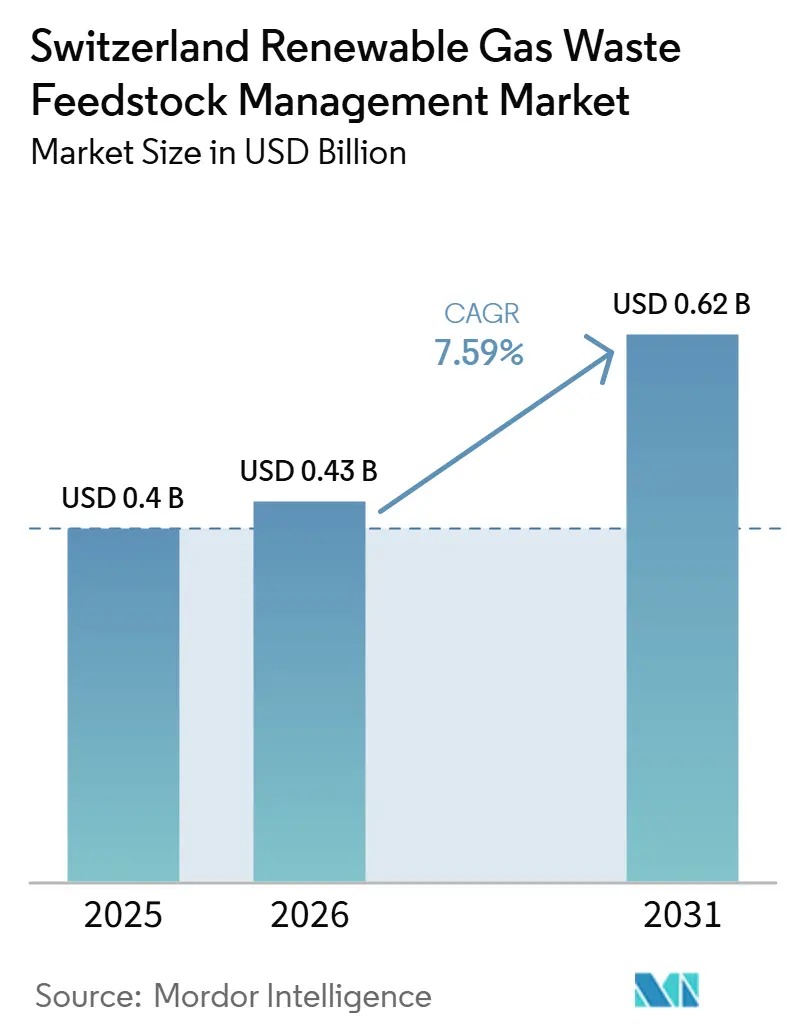
| Base Year Market Size (2025) | USD 0.4 Billion |
| Market Size (2026) | USD 0.43 Billion |
| Market Size (2031) | USD 0.62 Billion |
| Growth Rate (2026 - 2031) | 7.59 % |
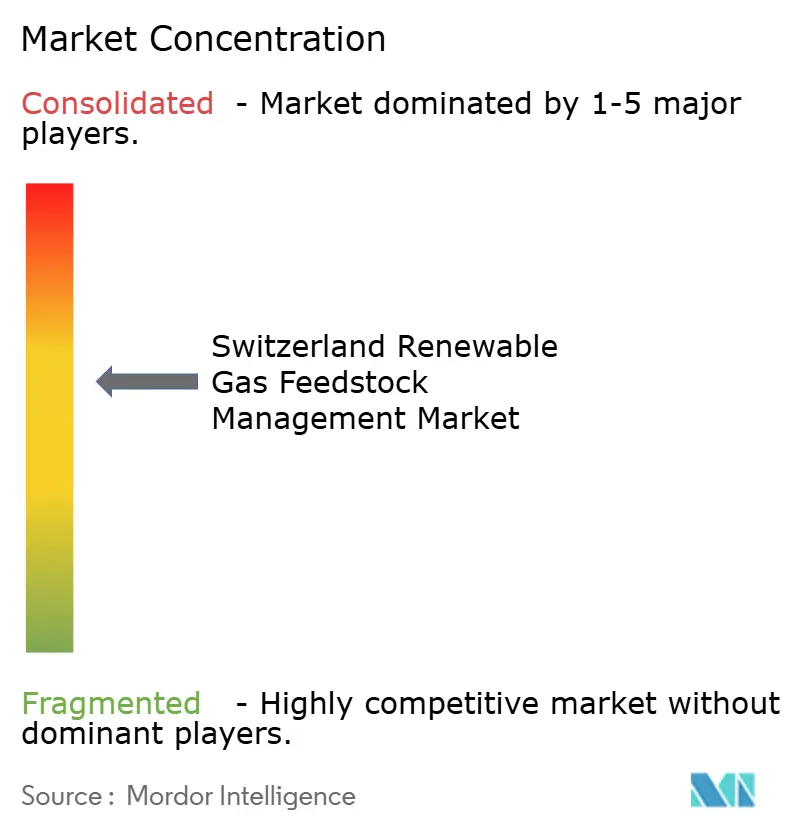
| Market Concentration | Medium |
Major Players *Disclaimer: Major Players sorted in no particular order Image © Mordor Intelligence. Reuse requires attribution under CC BY 4.0. | |
Switzerland Renewable Gas Waste Feedstock Management Market Analysis by Mordor Intelligence
The Switzerland Renewable Gas Waste Feedstock Management Market size is expected to grow from USD 0.4 billion in 2025 to USD 0.43 billion in 2026 and is forecast to reach USD 0.62 billion by 2031 at 7.59% CAGR over 2026-2031.
The revised Energy Act and the revised CO₂ Act made biomethane plants eligible for federal investment contributions from 2025, thereby improving the business case for feedstock preparation and upgrading projects. In 2025, developers continued to expand grid-connected biomethane projects, supported by investment incentives and growing demand for renewable gas. Plant owners are increasingly shifting from combined heat and power generation to grid injection, which raises the value of clean, traceable organic feedstocks. This policy support for grid-connected biomethane projects is increasing demand for reliable feedstock aggregation, quality assurance, and sustainability verification services. As domestic biomass availability remains constrained, long-term procurement agreements and efficient logistics networks are becoming key competitive differentiators for feedstock management providers. The Switzerland renewable gas waste feedstock management market therefore rewards operators that combine collection, conditioning, certification, and gas offtake relationships. Domestic resource limits and food waste prevention measures will keep supply contracting important even as new conversion capacity is developed.
Key Report Takeaways
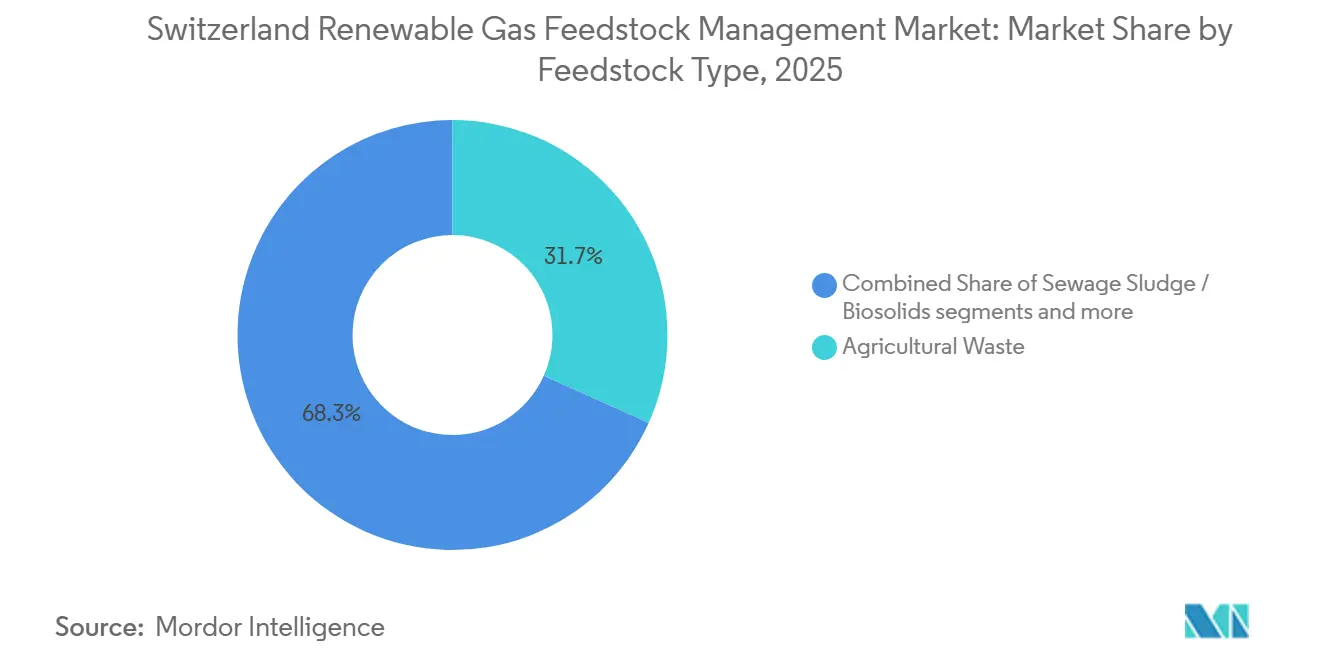
- By feedstock type, municipal solid waste organic fraction held 31.7% of the Switzerland renewable gas waste feedstock management market share in 2025, while food and beverage processing waste is forecast to grow at an 8.8% CAGR through 2031.
- By end-use facility type, anaerobic digestion plants held 44.4% of Switzerland renewable gas waste feedstock management market size in 2025, while wastewater treatment plant co-digestion is forecast to grow at a 9.4% CAGR through 2031.
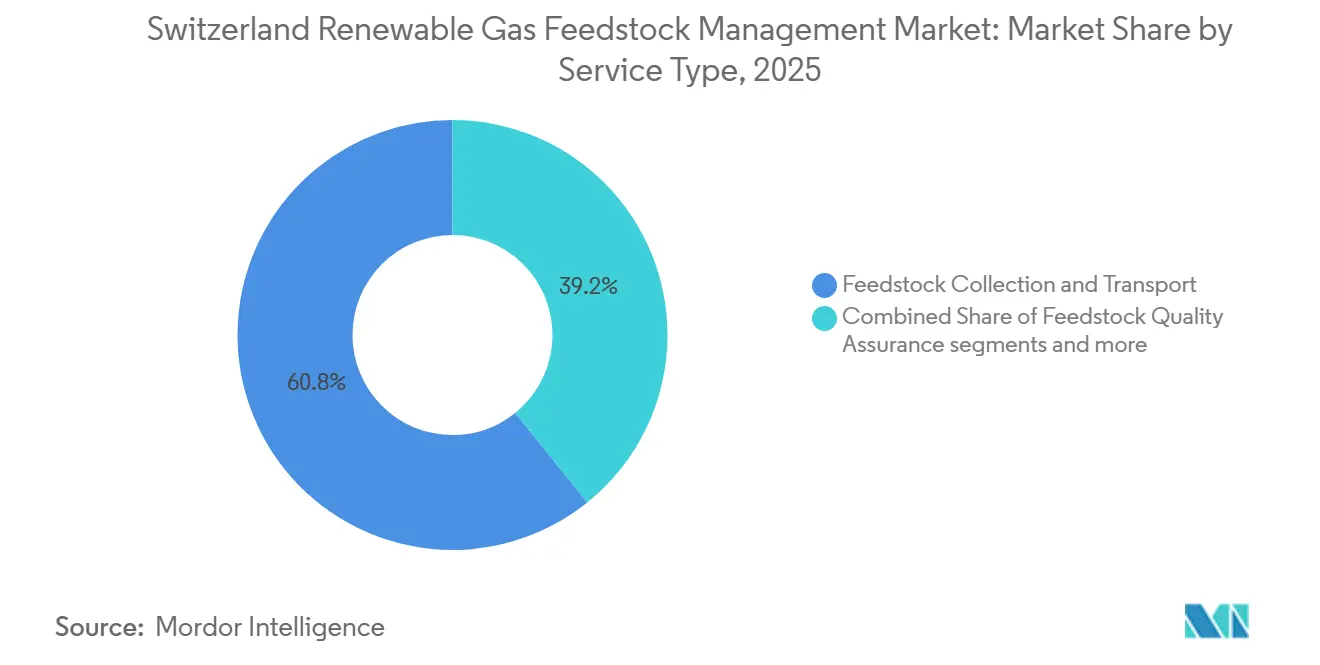
- By service type, feedstock collection and transport held 27.6% of demand in 2025, while digital feedstock monitoring platforms are forecast to grow at a 13.1% CAGR through 2031.
Note: Market size and forecast figures in this report are generated using Mordor Intelligence’s proprietary estimation framework, updated with the latest available data and insights as of January 2026.
Switzerland Renewable Gas Waste Feedstock Management Market Trends and Insights
Drivers Impact Analysis*
| Driver | (~) % Impact on CAGR Forecast | Geographic Relevance | Impact Timeline |
|---|---|---|---|
| Mandatory Separate Bio-Waste Collection Enhancing Organic Feedstock Availability | +1.8% | Switzerland-wide, with early gains in Zürich, Bern, and Basel | Short term (≤ 2 years) |
| Swiss Net Zero 2050 Strategy Accelerating Biomethane Feedstock Utilization | +1.5% | Switzerland-wide, with stronger activity in industrial cantons | Medium term (2-4 years) |
| Expansion of Renewable Gas Injection into Switzerland's Gas Distribution Network | +1.3% | Switzerland-wide, led by Mittelland and Romandy corridors | Medium term (2-4 years) |
| Strong Agricultural Manure-to-Biogas Initiatives Supporting Rural Feedstock Supply | +1.2% | Rural cantons, including Jura, Bern, Lucerne, and Aargau | Medium term (2-4 years) |
| Growing Decarbonization Demand from Industrial and Commercial Gas Consumers | +1.0% | Zürich, Basel-Stadt, and Aargau | Medium term (2-4 years) |
| Food Waste Reduction Programs Redirecting Organic Residues toward Biogas Production | +0.7% | Switzerland-wide, including food processing, hospitality, and retail | Medium term (2-4 years) |
| Source: Mordor Intelligence | |||
Mandatory Separate Bio-Waste Collection Enhancing Organic Feedstock Availability
Article 14 of Switzerland’s Waste Ordinance requires separately collected biogenic waste suitable for recycling to undergo material recovery or fermentation.[1] The rule provides the Switzerland renewable gas waste feedstock management market with a steady supply of organic materials for anaerobic digestion. A 2025 ZHAW interim report estimated avoidable food losses at 2.8 million tonnes across the national value chain. The report indicated that 435,000 tonnes were delivered to anaerobic digestion and composting facilities each year, while 51,000 tonnes were delivered to co-digestion facilities. Expanding source-separated collection improves feedstock consistency and increases the availability of higher-quality organic waste for biomethane production. This trend is encouraging investment in collection logistics, contamination monitoring, and decentralized transfer infrastructure to improve recovery rates while reducing processing costs. Separate collection reduces contamination compared with mixed waste and can lower sorting and pre-treatment needs. Municipalities have expanded collection from household bring systems to commercial generators, increasing the certified supply base.
Swiss Net Zero 2050 Strategy Accelerating Biomethane Feedstock Utilization
Switzerland’s Climate and Innovation Act established a net-zero greenhouse gas target for 2050, with milestones for buildings, transport, and industry.[2] The revised CO2 Act made biomethane plants eligible for federal investment contributions from 2025. Switzerland’s 2031 to 2035 Nationally Determined Contribution identifies biomass-derived energy as part of decarbonization for waste use and industry.[3] Pronovo launched the national biogas guarantee-of-origin system in January 2025 and linked it to the European registry. This system allows companies to document biomethane use under the applicable net-zero roadmap rules. The combination of financial incentives and digital certification is accelerating demand for feedstock traceability, sustainability verification, and greenhouse gas accounting services. As renewable gas trading becomes more certificate-driven, feedstock suppliers with robust documentation and compliance capabilities are gaining a stronger competitive position in long-term biomethane supply chains. Certified feedstock is consequently more valuable to buyers who need traceable emissions documentation.
Expansion of Renewable Gas Injection into Switzerland’s Gas Distribution Network
The Swiss gas sector has set a target of 30% renewable gas content by 2030. This target supports investment in feedstock sourcing, collection, logistics, pre-treatment, and grid-connected biomethane infrastructure across the Switzerland renewable gas waste feedstock management market. Axpo Biomasse's Aarberg facility began operating in February 2026 and processes approximately 20,000 tonnes of regional green waste into grid-quality biomethane annually. The facility replaced its previous combined heat and power unit and supplies biomethane under a long-term offtake agreement with Energie Wasser Bern. Gaznat also extended a CHF 5 million (USD 6.02 million) investment program with EPFL through 2031 to support power-to-gas and methanation research. The increasing deployment of grid-quality biomethane projects is strengthening demand for consistent feedstock quality, contamination control, traceability, and standardized pre-treatment across the supply chain. As additional upgrading facilities enter operation, operators with established regional feedstock collection networks and long-term supply agreements are expected to strengthen feedstock security and supply reliability. These developments reinforce the importance of reliable feedstock sourcing, quality assurance, and traceability to meet commercial and regulatory requirements for renewable gas production.
Strong Agricultural Manure-to-Biogas Initiatives Supporting Rural Feedstock Supply
ETH Zürich research estimated the sustainable primary bioenergy potential from exploitable manure and slurry at 27 PJ per year. Historically, less than 5% of generated manure has been used for biogas production, leaving substantial untapped feedstock potential. In 2025, agricultural biomethane projects continued to benefit from policy support, cooperative financing, and investments in farm-based anaerobic digestion infrastructure. The cooperative and the KliK Foundation have supported projects across 9 organic farms, with a combined annual digester output of 21.88 TJ. EcoBioVal at Courtemelon continues to supply biomethane to the Romandy gas network, while EDJ's gas-carried model enables compressed farm-gate biomethane to be transported to a central injection point, improving access for smaller and remote farms. The large gap between sustainable manure potential and current utilization represents a significant opportunity for feedstock aggregation, farm-level logistics, and decentralized collection services. Innovations such as mobile compression and shared injection infrastructure are improving the commercial viability of smaller farms, expanding the addressable feedstock base for renewable gas producers.
Restraints Impact Analysis*
| Restraint | (~) % Impact on CAGR Forecast | Geographic Relevance | Impact Timeline |
|---|---|---|---|
| Limited Domestic Organic Waste Volumes Restricting Large-Scale Feedstock Availability | -1.0% | Switzerland-wide, linked to population size and waste prevention | Long term (≥ 4 years) |
| High Capital Requirements for Advanced Feedstock Pre-Treatment Infrastructure | -0.8% | Switzerland-wide, particularly rural cantons without existing assets | Medium term (2-4 years) |
| Competition for Organic Waste from Composting and District Heating Projects | -0.5% | Urban and peri-urban cantons | Short term (≤ 2 years) |
| Stringent Environmental Permitting Increasing Project Development Timelines | -0.4% | Switzerland-wide, varying by canton and land-use conditions | Medium term (2-4 years) |
| Source: Mordor Intelligence | |||
Limited Domestic Organic Waste Volumes Restricting Large-Scale Feedstock Availability
Switzerland has limited agricultural land and a dense population relative to the scale of gas demand. A PSI study published in April 2026 found that domestic biomass could meet 25% to 50% of future gas demand, even as electrification reduces overall consumption. The finding includes organic waste, wood residues, sewage sludge, and agricultural residues. Energie 360° reported that customer demand for domestic biogas exceeded domestic production in its 2025 results. The Federal Council’s food waste plan aims to reduce avoidable food losses by 50% by 2030 relative to a 2017 baseline. This objective supports sustainability goals but can reduce residues available for biogas plants, which keeps long-term supply contracts and alternative inputs important in the Switzerland renewable gas waste feedstock management market.
High Capital Requirements for Advanced Feedstock Pre-Treatment Infrastructure
Advanced pre-treatment equipment requires significant capital investment and therefore favors large municipal utilities and integrated renewable gas operators. The Limeco Dietikon project combined sewage sludge treatment, biological methanation, and grid-connected renewable gas infrastructure through a CHF 14.5 million (USD 17.4 million) investment, illustrating the scale of investment required for integrated feedstock management facilities. Agriteos received a permit in early 2026 for a CHF 13 million (USD 15.6 million) facility designed to process up to 50,000 tonnes of organic feedstocks annually, with commissioning expected in 2028. High capital requirements are accelerating market consolidation by favoring operators that can spread pre-treatment, quality assurance, and regulatory compliance costs across larger feedstock volumes. This creates opportunities for third-party providers offering pre-treatment, laboratory testing, contamination analysis, and feedstock quality assurance services to smaller biogas operators that lack dedicated infrastructure. Smaller operators also face recurring costs for feedstock characterization, contamination testing, quality assurance, and regulatory documentation, which place additional pressure on operating margins and limit their ability to compete with larger integrated providers.
*Our forecasts treat driver/restraint impacts as directional, not additive. The impact forecasts reflect baseline growth, mix effects, and variable interactions.
Segment Analysis
By Feedstock Type: Urban Organic Streams Anchor the Market While Food-Processing Residues Accelerate
Municipal solid waste organic fraction accounted for 31.7% of the Switzerland renewable gas waste feedstock management market share in 2025, making it the largest feedstock category. Separate collection systems in urban cantons supply green and kitchen waste to anaerobic digestion facilities through well-established municipal collection networks. Switzerland first injected biomethane into its gas network at Samstagern in 1997, and urban feedstock aggregation systems have continued to expand since then. Green Power Aarau began operations in May 2025 and processes more than 25,000 tonnes of biogenic waste annually from 15 municipalities, demonstrating the importance of coordinated municipal collection and regional feedstock aggregation. Sewage sludge and biosolids also provide wastewater treatment plants with an established feedstock base while supporting the acceptance and management of additional organic waste streams.
Food and beverage processing waste is forecast to expand at an 8.8% CAGR through 2031, the fastest rate among feedstock types. Spent grains, whey permeate, fats, oils, grease, and off-specification food products are commercially attractive because of their relatively consistent quality, lower contamination levels, and established collection streams. Federal food waste policy encourages businesses to reduce waste generation and divert unavoidable organic materials into resource recovery pathways. Agricultural waste and industrial organic waste further diversify the feedstock base by providing reliable sources with predictable quality and volume. The Kompogas Winterthur facility sources green waste from Frauenfeld and sugar beet residues from Schweizer Zucker AG, illustrating how long-term supply agreements and diversified feedstock sourcing strengthen feedstock availability and supply security for renewable gas projects.

By End-Use Facility Type: AD Plants Lead While WWTP Co-Digestion Posts the Sharpest Uptake
Anaerobic digestion plants accounted for 44.4% of end-use demand in 2025. Their leading position reflects flexible feedstock intake, established offtake systems, and extensive operating experience among Swiss technology providers. Axpo's Kompogas dry-fermentation process is widely used for high-solids organic waste that is difficult to process in conventional wet digestion systems. Gasification and thermal treatment facilities remain a smaller part of the Switzerland renewable gas waste feedstock management market. Older waste processing assets are being retrofitted or repurposed, while improved source separation is directing higher-energy organic fractions toward anaerobic digestion. Landfill gas recovery continues to provide a supplementary renewable gas stream but is expected to decline over the long term as landfill organic content decreases.
Wastewater treatment plant co-digestion is projected to grow at a 9.4% CAGR from 2026 to 2031. Accepting external organic waste generates gate-fee revenue while improving plant energy self-sufficiency. The upgraded membrane-based biomethane upgrading system at the Zuchwil wastewater treatment plant is increasing renewable gas output by optimizing processing capacity to accommodate additional municipal feedstock. The Werdhölzli wastewater treatment plant in Zürich continues to host a long-term power-to-gas demonstration project involving Energie 360° and PSI, supporting the integration of renewable hydrogen with biomethane production. Pyrolysis and hydrothermal treatment remain pre-commercial options for lower-degradability feedstocks, and their wider adoption will depend on continued technical advances and integration with sustainability certification systems.
By Service Type: Collection Underpins Revenue While Digital Platforms Transform the Value Proposition
Feedstock collection and transport represented 27.6% of service demand in 2025. It forms the operational foundation of the Switzerland renewable gas waste feedstock management market because source-separated collection is a regulatory requirement. Service providers compete on route efficiency, collection coverage, vehicle utilization, and the ability to handle multiple organic waste streams through integrated logistics networks. ERZ Entsorgung + Recycling Zürich and REAL Recycling Entsorgung Abwasser Luzern demonstrate the integrated utility model, with long-term municipal collection and processing mandates that create high entry barriers for collection-only providers. Testing, laboratory services, and quality assurance support feedstock characterization, contamination detection, and traceability to meet the documentation requirements of renewable gas producers and certification frameworks.
Digital feedstock monitoring platforms are forecast to grow at a 13.1% CAGR through 2031. Operators are increasingly adopting digital monitoring systems to strengthen feedstock quality assessment, traceability, contamination detection, and inventory management across collection and pre-treatment activities. These systems provide real-time visibility into feedstock characteristics, enabling more informed procurement and quality assurance decisions. The Pronovo guarantee-of-origin system is also increasing demand for digital traceability throughout feedstock collection and processing. Supply chain management and advisory services are expanding as specialized offerings for smaller anaerobic digestion operators, which often require support with feedstock sourcing, documentation, regulatory compliance, and multi-source supply coordination.
Geography Analysis
The Switzerland renewable gas waste feedstock management market is concentrated within Switzerland, where domestic biomass is estimated to cover 25% to 50% of the country's future gas demand. In 2025, around 50 biomethane plants inject renewable gas into the national gas network, providing a growing base for feedstock collection and upgrading services. Agriteos at La Chaux-de-Fonds is expected to produce 14 GWh following its planned 2028 commissioning. Axpo Kompogas Wauwil targets 11.4 GWh from its planned mid-2027 start-up, while EDJ is advancing its gas-carried biomethane model in the Canton of Jura. The national objective of achieving 30% renewable gas by 2030 continues to support feedstock investment across Swiss cantons.
The Mittelland arc through Bern, Aargau, Lucerne, and Zürich contains the highest concentration of biogas infrastructure. Aarberg in Bern, Wauwil in Lucerne, Green Power Aarau in Aargau, and Werdhölzli in Zürich form the country's principal operating corridor. Romandy is expanding renewable gas capacity through Holdinova's five biomethane injection sites, strengthening regional feedstock demand and grid-connected biomethane production. EcoBioVal in Jura has demonstrated the viability of decentralized agricultural biomethane injection in French-speaking cantons, while Vaud and Neuchâtel continue to evaluate similar models. Eastern Switzerland and the Alpine cantons remain comparatively underserved because dispersed farms, mountainous terrain, and high gas grid extension costs limit project economics.
European integration continues to support biomethane imports while increasing the value of certified domestic supply. The Pronovo registry is linked to the European certification system, enabling eligible Swiss companies to document Scope 1 emissions reductions for biomethane produced or imported into Switzerland. This integration favors traceable domestic feedstocks and robust sustainability documentation. Switzerland does not yet have a federal Gas Market Act, and grid connection cost sharing remains largely industry-managed, which can disadvantage rural projects relative to urban utility-backed facilities.
Competitive Landscape
The Switzerland renewable gas waste feedstock management market exhibits a medium level of market concentration, with integrated operators holding strong regional positions while feedstock collection and aggregation remain more fragmented. Energie 360°, Axpo Kompogas, and Limeco have established competitive positions through long-term municipal collection agreements, feedstock pre-treatment capabilities, and relationships with gas distributors. Energie 360° reported 819 GWh of direct biogas sales in fiscal 2025 and increased the biogas content of its standard product to 45% from April 2026, reflecting continued investment in renewable gas supply. Long-term feedstock contracts, established collection networks, and integrated processing infrastructure remain the primary competitive differentiators among market operators.
Integrated operators are increasingly investing in grid-connected biomethane infrastructure and feedstock pre-treatment facilities to strengthen feedstock quality management and regulatory compliance. Axpo Biomasse commissioned its Aarberg upgrade in February 2026, replacing the former combined heat and power unit with grid-connected biomethane production. The Dietikon project further demonstrates investment in integrated renewable gas infrastructure combining sewage sludge treatment, biological methanation, and power-to-gas technologies. These developments are increasing demand for standardized feedstock quality, contamination control, and traceability throughout the supply chain.
Technology providers compete by supplying engineering, pre-treatment, gas conditioning, and digital monitoring solutions rather than directly participating in feedstock collection or aggregation. Hitachi Zosen Inova, WELTEC BIOPOWER, EnviTec Biogas, and DGE Green Gas Engineering support Swiss renewable gas projects through biological methanation systems, feedstock pre-treatment technologies, gas-quality conditioning equipment, and engineering expertise. Their role is to enable operators to strengthen feedstock handling, quality assurance, and compliance with technical and regulatory requirements.
Switzerland Renewable Gas Waste Feedstock Management Industry Leaders
-
Axpo Holding AG
-
Kanadevia Inova AG
-
Energie 360° AG
-
AVAG Umwelt AG
-
Limeco
- *Disclaimer: Major Players sorted in no particular order
Recent Industry Developments
- April 2026: A study led by the Paul Scherrer Institute (PSI) and commissioned by the SFOE found that domestic biomass encompassing waste streams, wood residues, and sewage sludge can meet 25–50% of Switzerland's future gas demand as a biomethane substitute for fossil natural gas, establishing a quantified policy foundation for long-term feedstock mobilisation strategies at a national level.
- February 2026: Axpo Biomasse AG commissioned a modern biogas processing plant at its Aarberg (BE) fermentation facility, replacing the prior CHP unit; the upgraded plant converts approximately 20,000 tonnes of regional green waste annually into grid-quality biomethane, with Energie Wasser Bern holding a full offtake contract; gas feeds into the Seelandgas AG pipeline and, via a new GVM pressure boosting station, into the high-pressure national network.
- December 2025: Axpo Kompogas Wauwil AG submitted a planning application for a new CHF 3 million (USD 3.6 million) biogas processing plant at its Wauwil (LU) fermentation site, with projected annual biomethane output of 11.4 GWh; the facility processes approximately 20,000 tonnes of organic waste annually from households, municipalities, restaurants, and commercial operators.
Switzerland Renewable Gas Waste Feedstock Management Market Report Scope
The Switzerland Renewable Gas Waste Feedstock Management Market is Segmented by Feedstock Type (Municipal Solid Waste, Agricultural Waste, Sewage Sludge / Biosolids and More), by End-Use Facility Type (Anaerobic Digestion (AD) Plants, Landfill Gas Recovery Sites, and More), and Service Type (Feedstock Collection & Transport, Feedstock Testing & Laboratory Services, and More). The Market Forecasts are Provided in Terms of Value (USD).
| Municipal Solid Waste (Organic Fraction / Source-Separated) |
| Agricultural Waste (Manure, Slurry, Crop Residues) |
| Sewage Sludge / Biosolids |
| Food & Beverage Processing Waste (FOG, Spent Grains, Off-Spec Product) |
| Industrial Organic Waste (Breweries, Paper Mills, Pharma Effluent) |
| Others |
| Anaerobic Digestion (AD) Plants |
| Landfill Gas Recovery Sites |
| Gasification / Thermal Treatment Facilities |
| Wastewater Treatment Plants (Co-Digestion) |
| Others (Pyrolysis, Hydrothermal) |
| Feedstock Collection & Transport |
| Feedstock Testing & Laboratory Services |
| Feedstock Quality Assurance |
| Digital Feedstock Monitoring Platforms |
| Feedstock Supply Chain Management & Consultancy |
| By Feedstock Type | Municipal Solid Waste (Organic Fraction / Source-Separated) |
| Agricultural Waste (Manure, Slurry, Crop Residues) | |
| Sewage Sludge / Biosolids | |
| Food & Beverage Processing Waste (FOG, Spent Grains, Off-Spec Product) | |
| Industrial Organic Waste (Breweries, Paper Mills, Pharma Effluent) | |
| Others | |
| By End-Use Facility Type | Anaerobic Digestion (AD) Plants |
| Landfill Gas Recovery Sites | |
| Gasification / Thermal Treatment Facilities | |
| Wastewater Treatment Plants (Co-Digestion) | |
| Others (Pyrolysis, Hydrothermal) | |
| By Service Type | Feedstock Collection & Transport |
| Feedstock Testing & Laboratory Services | |
| Feedstock Quality Assurance | |
| Digital Feedstock Monitoring Platforms | |
| Feedstock Supply Chain Management & Consultancy |
Key Questions Answered in the Report
What is the projected growth rate for renewable gas feedstock management in Switzerland?
The Switzerland renewable gas waste feedstock management market is forecast to grow at a 7.6% CAGR from 2026 to 2031, reaching USD 0.6 billion by 2031.
Which feedstock leads renewable gas production in Switzerland?
The municipal solid waste organic fraction accounted for 31.7% in 2025, as separate collection systems provide a regular urban supply.
Which facility type is growing fastest in Switzerland?
Wastewater treatment plant co-digestion is expected to expand at a 9.4% CAGR through 2031.
Why are digital feedstock platforms becoming important?
Digital monitoring is forecast to grow at a 13.1% CAGR, driven by operators' need for real-time quality control and traceability.
What limits domestic biomethane output in Switzerland?
PSI found that domestic biomass can meet 25% to 50% of expected future gas demand, which limits available local feedstock.
How are companies improving access to the gas network?
Utilities are funding grid connections, including EWL’s CHF 2.7 million (USD 3.0 million) for the Wauwil pipeline project.