
Finland Renewable Gas Waste Feedstock Management Market Size and Share
Market Overview
| Study Period | 2020 - 2031 |
|---|---|
| Forecast Data Period | 2026 - 2031 |
| Base Year Market Size (2025) | USD 0.32 Billion |
| Market Size (2026) | USD 0.34 Billion |
| Market Size (2031) | USD 0.51 Billion |
| Growth Rate (2026 - 2031) | 8.45 % |
| Market Concentration | Medium |
Major Players *Disclaimer: Major Players sorted in no particular order Image © Mordor Intelligence. Reuse requires attribution under CC BY 4.0. | |
Finland Renewable Gas Waste Feedstock Management Market Analysis by Mordor Intelligence
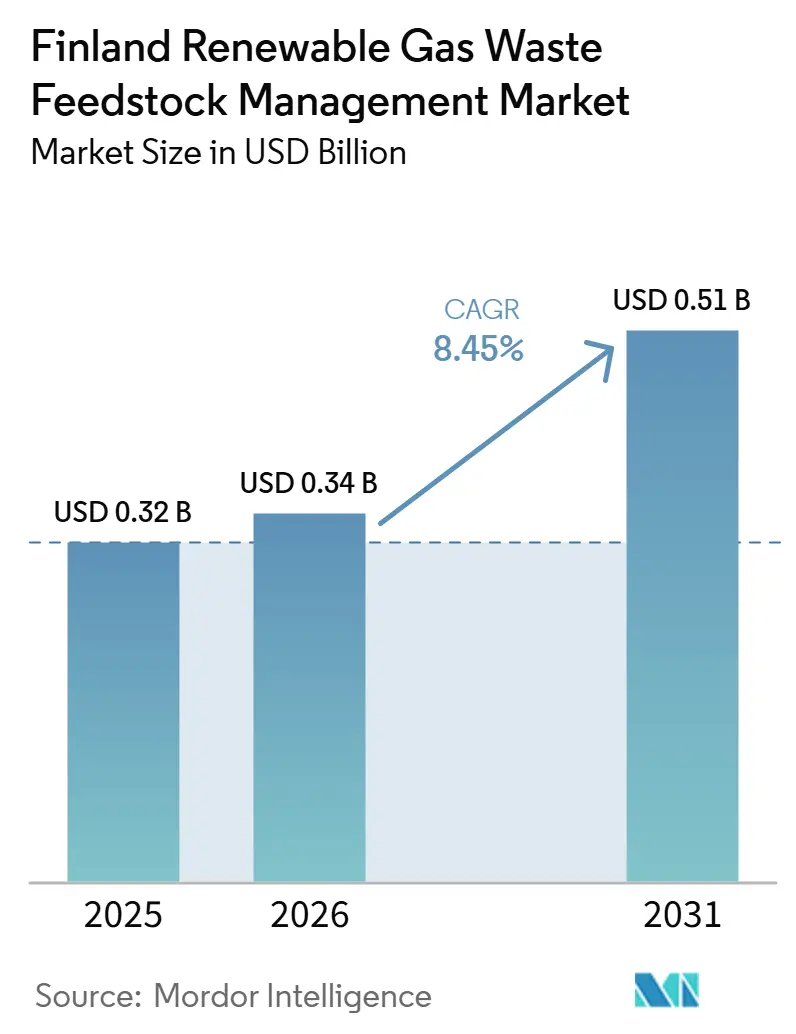
The Finland Renewable Gas Waste Feedstock Management Market size is projected to expand from USD 0.32 billion in 2025 and USD 0.34 billion in 2026 to USD 0.51 billion by 2031, registering a CAGR of 8.45% between 2026 to 2031.
The Finland renewable gas waste feedstock management market is supported by the country's transition toward diverting organic waste into renewable gas production and nutrient recycling. Finland's Bioeconomy Strategy 2022–2035 promotes investment in biogas plants, biomethane upgrading, farm-based digestion systems, gas transport infrastructure, and recycled fertilizer production, strengthening demand for organized feedstock management. In 2025, Finland maintained a robust pipeline of biomethane projects, with much of the planned capacity focused on liquefied biomethane (LBG), increasing the need for reliable feedstock collection, pre-treatment, contamination control, and quality assurance. Gasgrid Finland's guarantees-of-origin system and expanding grid-connected biomethane production have made feedstock traceability increasingly important for both domestic consumption and cross-border renewable gas trade. As larger biomethane projects progress toward commercialization, operators that integrate long-term feedstock supply agreements, quality testing, traceability, and pre-processing services are better positioned than logistics-only providers, as project developers require secure feedstock volumes and verified quality before committing capital to new processing capacity.
Key Report Takeaways
- By feedstock type, agricultural waste held 33.1% of the Finland renewable gas waste feedstock management market share in 2025, while food waste is forecast to grow at a 9.4% CAGR through 2031.
- By end-use facility type, anaerobic digestion plants accounted for 41.7% of the Finland renewable gas waste feedstock management market size in 2025, while gasification and thermal treatment facilities are forecast to grow at an 11.5% CAGR through 2031.
- By service type, collection and transport held 29.4% of the service market in 2025, while digital feedstock monitoring platforms are forecast to grow at a 13.5% CAGR through 2031.
Note: Market size and forecast figures in this report are generated using Mordor Intelligence’s proprietary estimation framework, updated with the latest available data and insights as of January 2026.
Finland Renewable Gas Waste Feedstock Management Market Trends and Insights
Drivers Impact Analysis*
| Driver | (~) % Impact on CAGR Forecast | Geographic Relevance | Impact Timeline |
|---|---|---|---|
| National Bioeconomy Strategy Accelerating Organic Waste Valorization | +2.5% | Finland nationally | Long term (≥ 4 years) |
| Rapid Expansion of Liquefied Biomethane (LBG) Demand in Heavy Transport | +2.2% | Finland nationally, with early gains in Tampere, Helsinki, and Oulu transport corridors | Medium term (2-4 years) |
| Large Untapped Potential of Livestock Manure and Agricultural Residues | +1.8% | Northern Ostrobothnia, Northern Savonia, and Eastern Finland | Long term (≥ 4 years) |
| Municipal Bio-Waste Collection Reforms Improving Feedstock Availability | +1.5% | Helsinki, Turku, Tampere, and Oulu | Short term (≤ 2 years) |
| Rising Investments in Biomethane Upgrading and Gas Grid Integration | +1.2% | Finland nationally, with spillover to the EU biomethane trade corridors | Medium term (2-4 years) |
| Industrial Decarbonization Driving Long-Term Biomethane Consumption | +0.9% | Finland nationally, with industrial centers in Tampere, Pori, and Oulu | Long term (≥ 4 years) |
| Source: Mordor Intelligence | |||
National Bioeconomy Strategy Accelerating Organic Waste Valorization
Finland's Bioeconomy Strategy 2022–2035 supports the expansion of biogas value chains through plant construction, gas cleaning, transport, and farm-based systems.[1] The strategy places feedstock collection, pre-treatment, and quality assurance within the country's broader bioeconomy agenda. It also recognizes digestate as a fertilizer product, providing project developers with an additional revenue stream alongside biogas production. This integrated approach encourages feedstock agreements that support both renewable energy generation and nutrient recycling. In 2025, public funding mechanisms and investment support continue to reduce project risks and encourage expansion of renewable gas processing capacity across Finland. Growing investment in biogas infrastructure is increasing demand for reliable feedstock collection, aggregation, and quality assurance services in the Finland renewable gas waste feedstock management market.[2]
Rapid Expansion of Liquefied Biomethane (LBG) Demand in Heavy Transport
Heavy transport is increasing the demand for liquefied biomethane (LBG) across Finland's renewable gas system. In 2025, LBG production capacity continues to expand as new projects advance toward commissioning, supported by growing demand from the heavy-duty transport sector. The Finnish Biocycle and Biogas Association estimates that biomethane production capacity under development could double by 2028 compared with current levels. LBG projects require feedstocks that meet consistent quality, contamination, and traceability specifications to support biomethane certification and commercial supply agreements. As a result, laboratory testing, feedstock quality assurance, and digital monitoring systems are becoming increasingly important. The Finland renewable gas waste feedstock management market therefore benefits as project developers incorporate stricter feedstock quality and traceability requirements into long-term supply agreements.
Large Untapped Potential of Livestock Manure and Agricultural Residues
Agricultural side streams offer a large potential feedstock base for biogas production in Finland. Research from the University of Oulu identified accessible slurry, straw, grass silage, and surplus biomass in Northern Ostrobothnia that could support additional production.[3] The Finland Biocycle and Biogas Association states that the country has a realistic annual biogas potential exceeding 10 TWh, mainly through wider recovery of agricultural residues. This indicates that feedstock collection, aggregation, and access to processing facilities remain the primary constraints rather than the physical availability of biomass. A 2024 research study highlighted that combining anaerobic digestion and pyrolysis provides complementary treatment pathways for agricultural side streams, improving the utilization of agricultural residues that differ in composition and handling requirements. Research from LUT University also found that field biomass could provide feedstock volumes equivalent to Finland's current biogas production under realistic collection scenarios. This substantial resource base supports the long-term expansion of the Finland renewable gas waste feedstock management market by diversifying feedstock sources beyond municipal organic waste and strengthening the supply of agricultural biomass.
Municipal Bio-Waste Collection Reforms Improving Feedstock Availability
Finland's revised Waste Act has improved the availability and reliability of municipal biowaste by expanding mandatory source separation across urban areas. Since summer 2024, separate biowaste collection has been required in urban areas with more than 10,000 residents and in qualifying residential properties with at least five apartments. Finland also maintains a landfill ban on biodegradable and organic waste, limiting disposal options for these materials and directing larger volumes toward biological treatment. In 2025, municipalities continue to strengthen compliance monitoring and enforcement of organic waste collection requirements, improving confidence in feedstock availability for renewable gas projects. These regulatory changes provide the Finland renewable gas waste feedstock management market with a broader, more predictable urban feedstock base, supporting longer-term supply agreements and investment in new processing capacity.
Restraints Impact Analysis*
| Restraint | (~) % Impact on CAGR Forecast | Geographic Relevance | Impact Timeline |
|---|---|---|---|
| High Feedstock Aggregation Costs Across Sparsely Populated Regions | -1.3% | Northern, Eastern, and rural Finland | Long term (≥ 4 years) |
| Seasonal Variability in Agricultural and Forestry Waste Generation | -0.7% | Northern Ostrobothnia, Lapland, and Häme | Medium term (2-4 years) |
| Limited Scale of Commercial Feedstock Processing Infrastructure | -0.5% | Rural Finland and areas outside major biogas plant clusters | Medium term (2-4 years) |
| Competition for Organic Waste from Composting and Bioenergy Facilities | -0.3% | Finland nationally | Short term (≤ 2 years) |
| Source: Mordor Intelligence | |||
High Feedstock Aggregation Costs Across Sparsely Populated Regions
Finland's low population density of approximately 18 people per square kilometer creates a high cost base for collecting and transporting organic waste over long distances. A 2025 study identified logistics costs as a major constraint on rural biogas projects, particularly as feedstock portfolios expand from sewage sludge and municipal biowaste to agricultural residues. Large collection areas increase transport requirements and reduce the delivered value of each tonne of feedstock, challenging the economics of decentralized projects. Smaller operators may struggle to compete with the hub-and-spoke collection networks and integrated logistics systems used by larger providers. The study also highlighted policy uncertainty and evolving subsidy frameworks as factors that can delay investment decisions and long-term project planning. These conditions favor larger processing hubs with established supply networks and may increase entry barriers in the Finland renewable gas waste feedstock management market.
Seasonal Variability in Agricultural and Forestry Waste Generation
Finland's climate creates seasonal variation in the availability and quality of agricultural feedstocks. While manure slurry is available throughout the year, straw, silage, and crop residues are generated primarily during the late summer and autumn harvest season. The IEA Bioenergy country report continues to identify the predictable availability of domestic biomass resources as a key challenge for expanding biogas production. To maintain stable renewable gas output throughout the year, plant operators rely on feedstock storage systems and staggered supply agreements that balance seasonal fluctuations. Storage lagoons, covered silos, and other preservation infrastructure increase capital and operating costs while helping to ensure continuous feedstock availability. Seasonal variation in feedstock characteristics and availability complicates storage planning, supply scheduling, and feedstock quality management, increasing the importance of reliable feedstock management for operators supplying grid-injected biomethane or liquefied biomethane (LBG).
*Our forecasts treat driver/restraint impacts as directional, not additive. The impact forecasts reflect baseline growth, mix effects, and variable interactions.
Segment Analysis
By Feedstock Type: Agricultural Streams Anchor Supply, Food Waste Accelerates
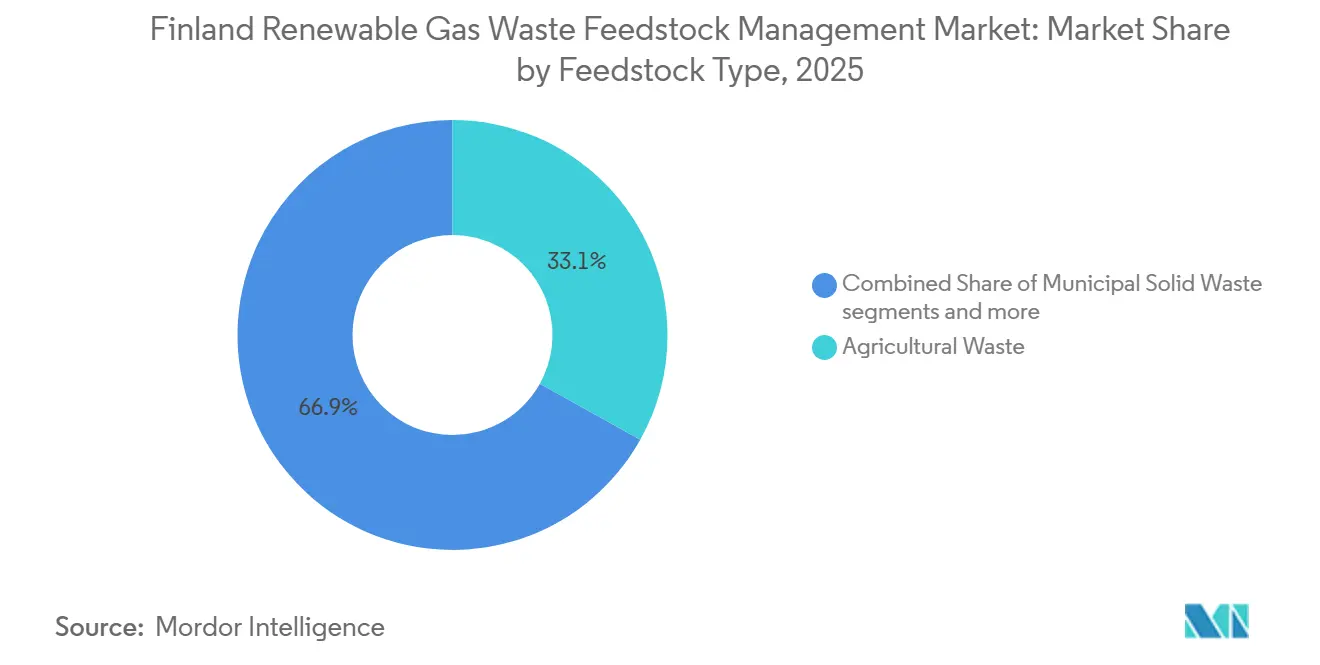
Agricultural waste accounted for 33.1% of the Finland renewable gas waste feedstock management market share in 2025. Livestock manure and slurry underpin this leading position, particularly in Northern Ostrobothnia and Northern Savonia, where intensive livestock production provides a stable feedstock base. The Finnish Biocycle and Biogas Association has outlined a pathway to 4 TWh of annual biogas production by 2030 through greater utilization of manure and field biomass, which will require more organized feedstock aggregation, efficient farm logistics, and long-term supply agreements. Research by LUT University also indicates that recovering nutrients from field biomass could reduce Finland's dependence on imported mineral fertilizers while improving the overall value of agricultural feedstock.
Food waste is projected to grow at a CAGR of 9.4% from 2026 to 2031, making it the fastest-growing feedstock segment. Expanded source-separated collection requirements continue to increase the availability of urban organic waste for anaerobic digestion. BioKymppi processes more than 16,000 tonnes of biowaste, food industry side streams, and agricultural residues annually at its Kitee facility, producing both organically certified and conventional fertilizers from digestate. Municipal biowaste, sewage sludge, and industrial residues from breweries, paper mills, and pharmaceutical manufacturers continue to support regional biogas plants. In addition, fats, oils, grease (FOG), spent grains, and off-specification food products are increasingly incorporated into quality-controlled co-digestion systems to improve feedstock quality, substrate consistency, and supply reliability.

By End-Use Facility Type: AD Plants Hold Ground, Gasification Scales Rapidly
Anaerobic digestion plants accounted for 41.7% of the Finland renewable gas waste feedstock management market by end-use facility type in 2025. Their leading position reflects well-established infrastructure and the ability to process a wide range of organic waste streams. Gasum operates nine biogas plants in Finland using feedstocks that include sewage sludge, municipal biowaste, and food industry residues. Farm-scale digesters and municipal co-digestion facilities also contribute to nationwide operating experience and feedstock utilization. Wastewater treatment plant digesters, landfill gas recovery sites, pyrolysis facilities, and hydrothermal treatment systems continue to serve more specialized roles within the renewable gas value chain.
Gasification and thermal treatment facilities are projected to grow at a CAGR of 11.5% from 2026 to 2031. As larger industrial renewable gas projects move toward commercialization, they require integrated feedstock supply arrangements covering collection, pre-treatment, laboratory testing, and transport. IEA Bioenergy continues to identify thermochemical conversion as an important component of Finland's renewable gas development, supported by the country's strong industrial demand for biogas. The Nivalan Biokaasu project remains on track to process more than 600,000 tonnes of agricultural and industrial organic waste annually and produce approximately 200 GWh of liquefied biomethane (LBG) following its planned commissioning in the second half of 2027. Projects of this scale increase demand for coordinated feedstock management services, including intake scheduling, contamination control, quality assurance, and logistics planning.
By Service Type: Collection Dominates Volume, Digital Platforms Define Value
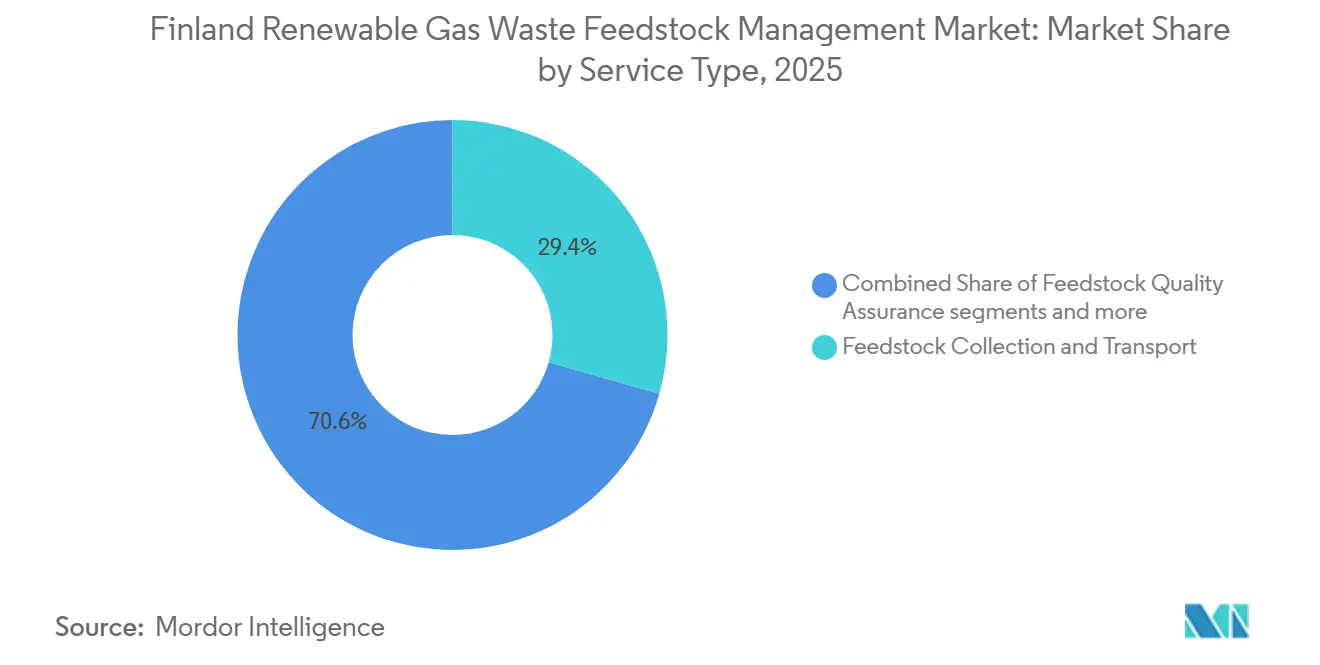
Collection and transport accounted for 29.4% of the Finland renewable gas waste feedstock management market in 2025. This service remains essential because feedstock sources are widely dispersed across farms, municipalities, and industrial facilities. Doranova has identified an industry shift toward fewer, larger biogas plants with capacities of 100–200 GWh per year, increasing the need for centralized feedstock collection and coordinated logistics across multiple supply sources. Quality assurance and laboratory testing represent the next key service layer, as grid-injected biomethane and liquefied biomethane (LBG) projects require verification of methane potential, dry matter content, and contaminant levels before processing.
Digital feedstock monitoring platforms are projected to grow at a CAGR of 13.5% from 2026 to 2031. Operators are increasingly adopting digital monitoring, feedstock characterization, and traceability systems to strengthen feedstock quality management, improve contamination detection, and support more informed procurement decisions. Biovoima's BIOliquefier technology captures and liquefies biogenic carbon dioxide recovered during biomethane upgrading, reflecting the growing integration of carbon recovery technologies within the renewable gas value chain. In 2026, Valmet delivered a DNAe automation system for carbon dioxide liquefaction at Auris Energia's Mäntsälä biogas facility, highlighting continued investment in automation and digital process management. Separately, operators across Finland are increasingly adopting digital monitoring, traceability, and feedstock quality assurance systems to strengthen feedstock characterization, contamination detection, and procurement decisions. These developments are expanding the role of digital solutions in the Finland renewable gas waste feedstock management market and increasing competitive differentiation among providers that combine collection and transport services with integrated monitoring, traceability, and quality assurance capabilities.
Geography Analysis
Northern Ostrobothnia and Northern Savonia are key areas for manure-based renewable gas projects due to their livestock bases. The University of Oulu identified significant volumes of slurry, straw, grass silage, and spoiled biomass that are accessible in municipalities including Nivala, Haapajärvi, Kärsämäki, Pyhäjärvi, Reisjärvi, Sievi, and Ylivieska. Suomen Lantakaasu’s Kiuruvesi development and the Nivala project show the importance of organized supply systems in this region. Southern Finland has more municipal biowaste volumes and mature upgrading infrastructure around Helsinki, Tampere, and Turku. Gasum sites in Riihimäki, Kouvola, and Turku serve these southern feedstock and grid connections.
The Vesilahti-Lempäälä Biopower project is located between southern feedstock clusters and the Tampere distribution area. Construction commenced in January 2026, with completion scheduled for summer 2026. Eastern Finland provides a mid-scale model through BioKymppi's Kitee operation. RED III requirements increasingly influence regional feedstock sourcing because sustainable fuel eligibility depends on lifecycle emissions, feedstock traceability, and supply chain documentation. Consequently, the Finland renewable gas waste feedstock management market operates within both domestic collection networks and European sustainability requirements, linking local feedstock sourcing with compliance for renewable fuel certification.
Finland had committed EUR 1.02 billion (USD 1.15 billion) to biomethane investments as of June 2025, supporting the development of approximately 2.0 TWh of new annual production capacity. As a result, the Finland renewable gas waste feedstock management market is being shaped by both the expansion of new biomethane plants and the increasing requirements of existing operating facilities. The European Commission's REPowerEU plan targets 35 billion cubic meters of annual biomethane production by 2030, reinforcing demand for reliable, traceable, and sustainably sourced biomass across Europe. Gasgrid Finland administers guarantees of origin under the European Energy Certificate System (EECS) framework, enabling renewable gas trading with Association of Issuing Bodies member states and increasing the commercial importance of feedstock traceability and sustainability verification.
Competitive Landscape
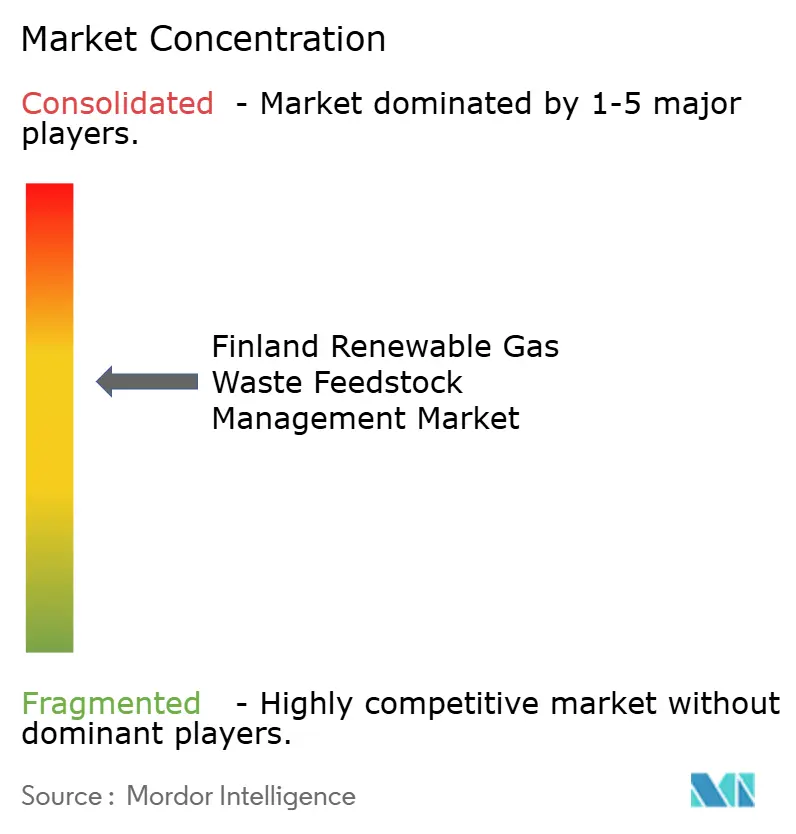
The Finland renewable gas waste feedstock management market exhibits a medium level of market concentration, with integrated renewable gas developers competing alongside specialized feedstock service providers. Gasum Oy, Suomen Lantakaasu Oy, and Nevel Oy have established positions by integrating feedstock aggregation, pre-treatment, renewable gas production, and commercialization within their operating models. Long-term feedstock supply agreements remain a key competitive factor because large biomethane projects require secure and traceable feedstock volumes before financing and construction can proceed. Gasum's ongoing environmental impact assessment for its proposed Kouvola expansion highlights the project development capabilities and feedstock sourcing strategies required to support large-scale renewable gas investments.
Technology providers compete by supplying feedstock pre-treatment, automation, digital monitoring, traceability, and carbon recovery solutions that support renewable gas operations. Doranova continues construction of the Vesilahti–Lempäälä Biopower plant as the engineering, procurement, and construction (EPC) contractor, while Valmet has supplied automation systems for Auris Energia's Mäntsälä biogas facility. Biovoima's BIOliquefier technology further demonstrates ongoing investment in biogenic carbon dioxide recovery within the renewable gas value chain. These companies compete by providing technology and engineering solutions that strengthen feedstock handling, quality assurance, monitoring, and operational efficiency rather than directly competing in feedstock collection or aggregation.
Looking ahead, RED III sustainability requirements and mass-balance rules are increasing the importance of feedstock traceability, chain-of-custody documentation, and quality assurance throughout the supply chain. Competition is expected to increasingly favor companies that combine reliable feedstock sourcing, collection, pre-treatment, quality testing, and digital traceability capabilities within integrated service offerings. As renewable gas capacity expands across Finland, these integrated feedstock management capabilities are expected to become an increasingly important source of competitive differentiation.
Finland Renewable Gas Waste Feedstock Management Industry Leaders
-
Gasum Oy
-
Suomen Lantakaasu Oy
-
Nevel Oy
-
Lassila & Tikanoja Oyj (L&T)
-
Nordic Ren-Gas Oy
- *Disclaimer: Major Players sorted in no particular order
Recent Industry Developments
- July 2026: Valmet delivered a DNAe distributed control system to Suomen Biovoima Oy for the carbon dioxide liquefaction plant at Auris Energia’s Mäntsälä biogas facility. The system enables captured biogenic carbon dioxide to be used in concrete and other industrial materials rather than being vented.
- January 2026: Doranova began construction of the Vesilahti-Lempäälä Biopower Oy biogas plant as engineering, procurement, and construction contractor. The facility was scheduled for completion in summer 2026 and is intended to be Finland’s first plant to capture and liquefy biogenic carbon dioxide from biogas upgrading for industrial applications.
Finland Renewable Gas Waste Feedstock Management Market Report Scope
The Finland Renewable Gas Waste Feedstock Management Market Report is Segmented by Feedstock Type (Municipal Solid Waste, Agricultural Waste, and More), by End-Use Facility Type (Anaerobic Digestion (AD) Plants, Landfill Gas Recovery Sites, and More), and Service Type (Feedstock Collection & Transport, Feedstock Testing & Laboratory Services, and More). The Market Forecasts are Provided in Terms of Value (USD).
| Municipal Solid Waste (Organic Fraction / Source-Separated) |
| Agricultural Waste (Manure, Slurry, Crop Residues) |
| Sewage Sludge / Biosolids |
| Food & Beverage Processing Waste (FOG, Spent Grains, Off-Spec Product) |
| Industrial Organic Waste (Breweries, Paper Mills, Pharma Effluent) |
| Others |
| Anaerobic Digestion (AD) Plants |
| Landfill Gas Recovery Sites |
| Gasification / Thermal Treatment Facilities |
| Wastewater Treatment Plants (Co-Digestion) |
| Others (Pyrolysis, Hydrothermal) |
| Feedstock Collection & Transport |
| Feedstock Testing & Laboratory Services |
| Feedstock Quality Assurance |
| Digital Feedstock Monitoring Platforms |
| Feedstock Supply Chain Management & Consultancy |
| By Feedstock Type | Municipal Solid Waste (Organic Fraction / Source-Separated) |
| Agricultural Waste (Manure, Slurry, Crop Residues) | |
| Sewage Sludge / Biosolids | |
| Food & Beverage Processing Waste (FOG, Spent Grains, Off-Spec Product) | |
| Industrial Organic Waste (Breweries, Paper Mills, Pharma Effluent) | |
| Others | |
| By End-Use Facility Type | Anaerobic Digestion (AD) Plants |
| Landfill Gas Recovery Sites | |
| Gasification / Thermal Treatment Facilities | |
| Wastewater Treatment Plants (Co-Digestion) | |
| Others (Pyrolysis, Hydrothermal) | |
| By Service Type | Feedstock Collection & Transport |
| Feedstock Testing & Laboratory Services | |
| Feedstock Quality Assurance | |
| Digital Feedstock Monitoring Platforms | |
| Feedstock Supply Chain Management & Consultancy |
Key Questions Answered in the Report
How large is Finland renewable gas waste feedstock management market?
Finland renewable gas waste feedstock management market was valued at USD 0.32 billion in 2025 and is forecast to reach USD 0.51 billion by 2031 at an 8.4% CAGR.
What is driving renewable gas waste feedstock management in Finland?
Biowaste collection rules, the potential of agricultural residues, LBG demand, and public support for biogas value chains are driving activity. The combination increases the need for reliable collection, pre-treatment, and quality assurance.
Which feedstock type held the largest share in 2025?
Agricultural waste led with a 33.1% value share, supported by manure and slurry resources in major livestock regions. Field biomass and nutrient recovery also strengthen its role in long-term feedstock supply.
Which service is projected to grow fastest through 2031?
Digital feedstock monitoring platforms are projected to grow at a 13.5% CAGR through 2031. Their use helps operators manage input quality, blending, and gas-yield consistency.
Why is quality assurance important for Finland biogas projects?
LBG, grid injection, and cross-border trade require consistent methane yields, lower contamination, and supply-chain documentation. This makes laboratory testing and traceability part of commercial project requirements.
What is the main operating challenge for rural projects?
Long collection distances increase logistics costs, making storage and coordinated supply contracts important for stable operations.