
Biodefense Market Size and Share
Market Overview
| Study Period | 2020 - 2031 |
|---|---|
| Market Size (2026) | USD 20.81 Billion |
| Market Size (2031) | USD 30.75 Billion |
| Growth Rate (2026 - 2031) | 8.12 % |
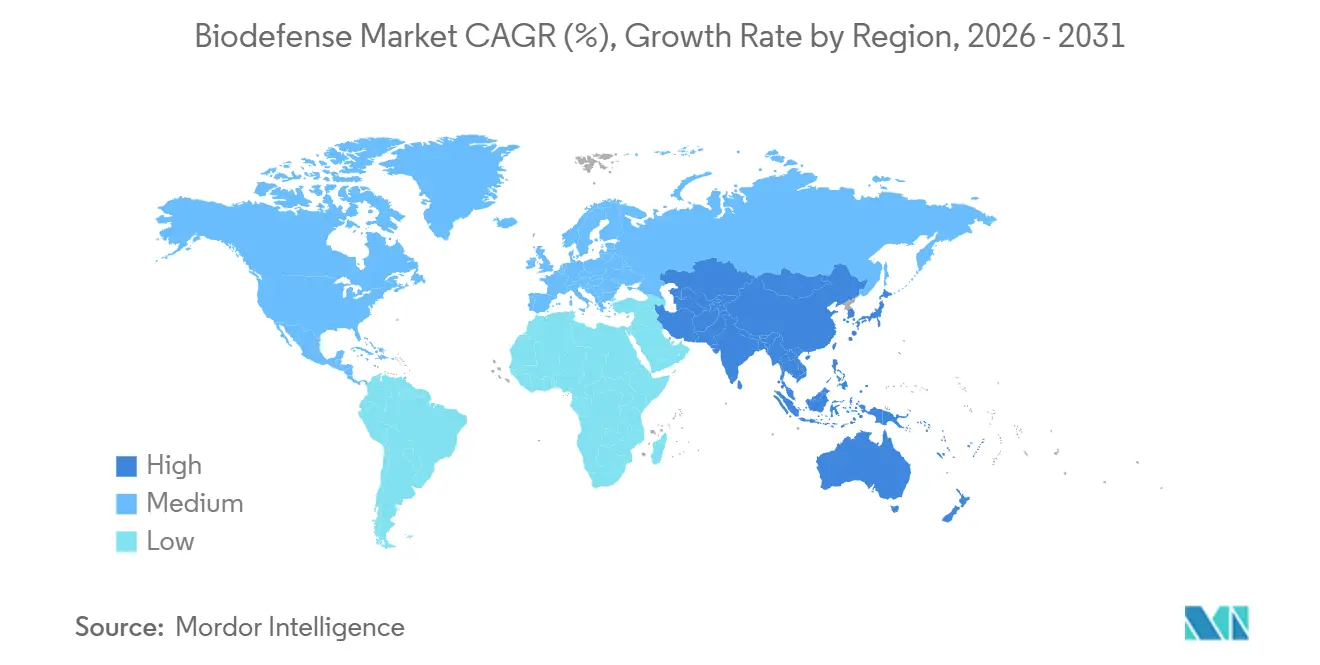
| Fastest Growing Market | Asia Pacific |
| Largest Market | North America |
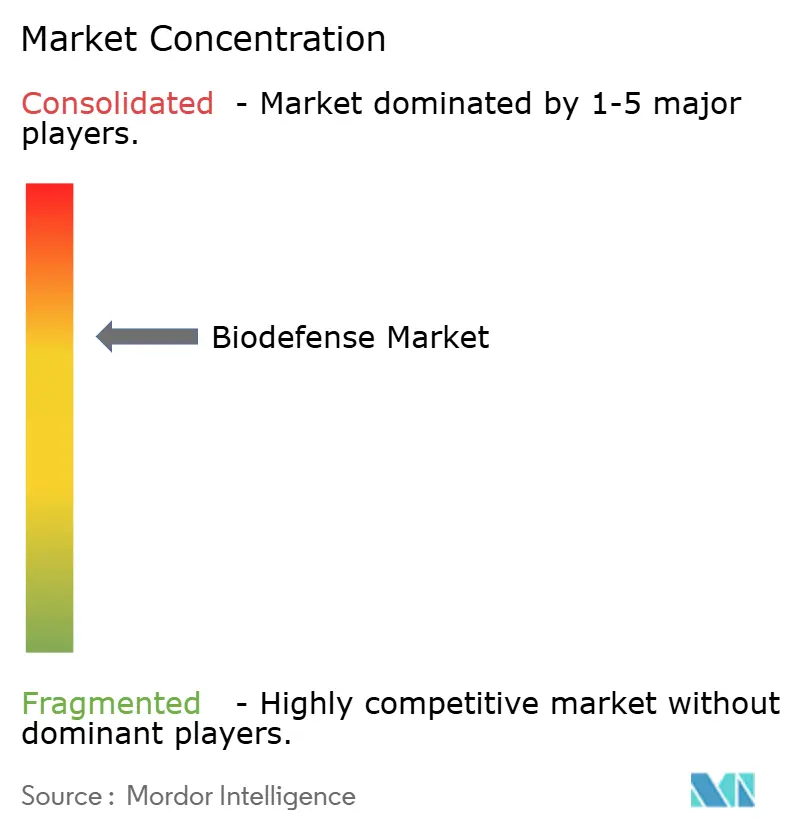
| Market Concentration | Medium |
Major Players *Disclaimer: Major Players sorted in no particular order Image © Mordor Intelligence. Reuse requires attribution under CC BY 4.0. | |
Biodefense Market Analysis by Mordor Intelligence
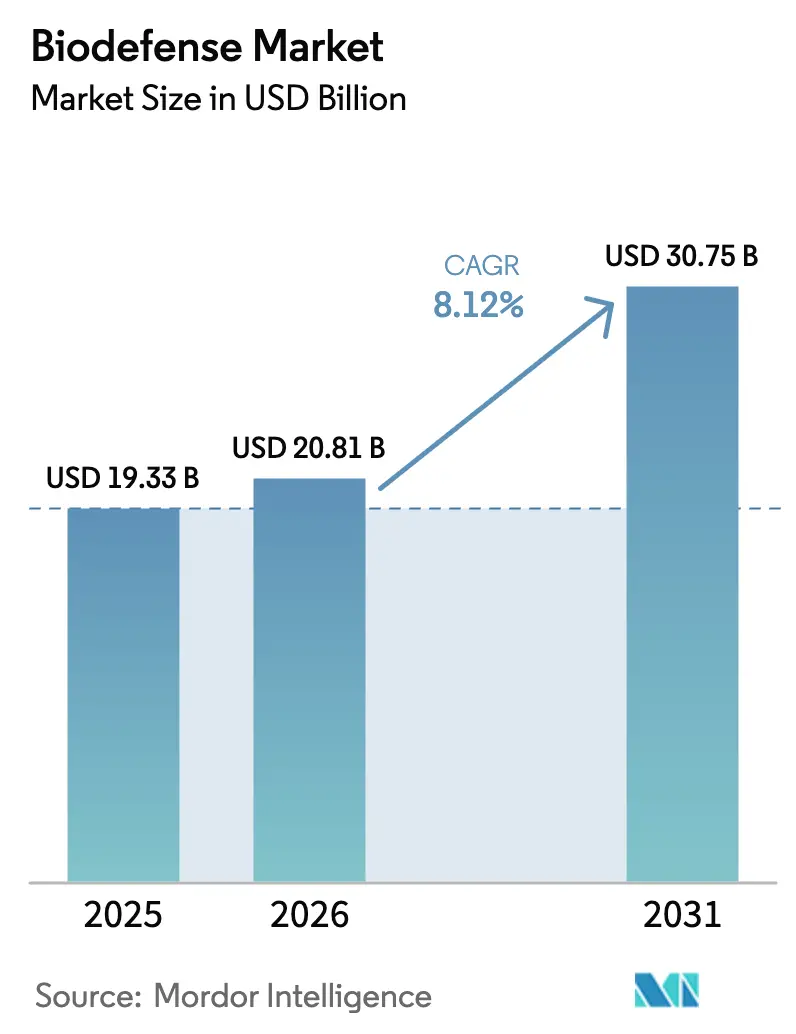
The Biodefense Market size is projected to expand from USD 19.33 billion in 2025 and USD 20.81 billion in 2026 to USD 30.75 billion by 2031, registering a CAGR of 8.12% between 2026 to 2031.
Sustained government appropriations for medical countermeasure stockpiling, rapid adoption of platform technology, and the integration of biosurveillance into national security planning underpin this expansion. In 2025, the U.S. Department of Health and Human Services (HHS) allocated USD 1.5 billion through the Biomedical Advanced Research and Development Authority to accelerate the development of next-generation vaccines and therapeutics[1]U.S. Department of Health and Human Services, “Budget in Brief FY 2025,” hhs.gov. Modular mRNA and monoclonal-antibody platforms now compress development timelines, enabling faster pivots when threat profiles change. At the same time, national biosecurity frameworks are increasingly treating genomic-surveillance systems as critical infrastructure, driving contracts for real-time sequencing and environmental monitoring networks. Competitive dynamics remain moderate, yet the entrance of firms with thermostable or plug-and-play platforms is intensifying innovation and reshaping procurement priorities.
Key Report Takeaways
- By product, anthrax countermeasures held 28.43% of 2025 revenue, while smallpox and broader orthopox solutions are forecast to expand at a 10.34% CAGR through 2031, making orthopox the fastest-growing product segment.
- By countermeasure type, vaccines accounted for 25.67% of the 2025 countermeasure-type revenue; detection and surveillance systems are advancing at a 10.21% CAGR to 2031 and represent the fastest-rising countermeasure category.
- By end user, hospitals and clinics contributed 27.65% of 2025 end-user revenue, yet military forces are predicted to grow most quickly at an 11.34% CAGR through 2031.
- By geography, North America commanded 42.45% of the global 2025 revenue, while the Asia-Pacific region is projected to post the fastest regional expansion at a 9.54% CAGR through 2031.
Note: Market size and forecast figures in this report are generated using Mordor Intelligence’s proprietary estimation framework, updated with the latest available data and insights as of January 2026.
Market Trends and Insights
Drivers Impact Analysis of Biodefense Market*
| Driver | (~) % Impact on CAGR Forecast | Geographic Relevance | Impact Timeline |
|---|---|---|---|
| Government Funding and Strategic Stockpiling Programs | +2.1% | North America, Europe, Asia-Pacific | Long term (≥ 4 years) |
| Advancements in Biothreat Detection and Biosurveillance | +1.8% | North America, European Union, expanding Asia-Pacific | Medium term (2-4 years) |
| Regulatory Approvals and Stockpile Readiness Initiatives | +1.3% | Global, led by U.S. FDA and EMA | Short term (≤ 2 years) |
| Public Health Emergency Preparedness and Response Frameworks | +1.0% | G7 and ASEAN nations | Medium term (2-4 years) |
| Platform-Based Medical Countermeasure Strategies | +1.5% | North America, Europe, select Asia-Pacific hubs | Long term (≥ 4 years) |
| Shelf-Life Extension and Cold-Chain Optimization Programs | +0.6% | Global, critical in resource-constrained regions | Short term (≤ 2 years) |
| Source: Mordor Intelligence | |||
Government Funding and Strategic Stockpiling Programs
Record-level appropriations continue to anchor biodefense growth. In 2025 the U.S. Congress authorized USD 4.2 billion for the Public Health Emergency Medical Countermeasures Enterprise, representing a 12% increase over the prior year[2]ASPR, “Public Health Emergency Medical Countermeasures Enterprise Annual Report 2025,” aspr.hhs.gov. The Strategic National Stockpile purchased 10 million doses of Bavarian Nordic’s Jynneos vaccine at a contract value of USD 300 million to bolster orthopox readiness. The European Union mirrored this approach by committing EUR 1.3 billion in 2025 to build continental stockpiles under the Health Emergency Preparedness and Response Authority. Japan increased its biodefense budget by 18%, allocating JPY 45 billion (approximately USD 300 million) for countermeasures against anthrax and plague. These multi-year funding streams provide manufacturers with visibility into demand and support long-term capacity planning.
Advancements in Biothreat Detection and Biosurveillance
Field-deployable detection technologies are reshaping response timelines. The U.S. Department of Homeland Security completed a BioWatch Generation-3 upgrade in early 2025, deploying 500 autonomous aerosol samplers across 30 cities[3]Department of Homeland Security, “BioWatch Generation-3 Deployment Fact Sheet,” dhs.gov. Each unit integrates next-generation sequencing with cloud-hosted threat libraries to deliver actionable data within four hours. Teledyne FLIR won a USD 85 million contract to supply handheld mass-spectrometers capable of identifying 20 priority agents in under ten minutes. BioFire Defense launched a multiplexed PCR panel that reduces diagnostic turnaround to 45 minutes for anthrax, plague, and tularemia. The World Health Organization added these data feeds to its Early Warning, Alert and Response System, enabling cross-border genomic sharing.
Regulatory Approvals and Stockpile Readiness Initiatives
Favorable regulatory pathways shorten commercialization cycles. The U.S. Food and Drug Administration approved three countermeasures under the Animal Rule in 2025, including SIGA Technologies’ intravenous tecovirimat for severe orthopox infections. The European Medicines Agency harmonized its review criteria with the FDA, cutting duplicative testing and accelerating joint European stockpile orders. Shelf-life-extension programs also ease budget pressure; the U.S. Department of Defense extended the labeled life of 12 vaccines and therapeutics by an average of 3.2 years, deferring USD 180 million in replacement costs. Australia adopted similar protocols, allowing key antibiotic inventories to remain in reserve beyond original expiry dates.
Public Health Emergency Preparedness and Response Frameworks
Governments are codifying lessons from recent outbreaks into durable preparedness plans. The U.S. Next Generation Medical Countermeasure Initiative earmarks USD 500 million over five years for broad-spectrum antivirals and pan-coronavirus vaccines with dual biodefense utility. The United Kingdom revived its Vaccine Taskforce with a GBP 200 million fund targeting Category A agents. ASEAN adopted a Biodefense Cooperation Framework to pool vaccine procurement and establish cross-border laboratory networks. The Africa Centres for Disease Control and Prevention secured USD 120 million in donor commitments to expand biosurveillance across 15 member states. These initiatives create a clearer route for multinational stockpile alignment and technology transfer.
Restraints Impact Analysis of Biodefense Market*
| Restraint | (~) % Impact on CAGR Forecast | Geographic Relevance | Impact Timeline |
|---|---|---|---|
| Budget Constraints and Uneven Global Preparedness | -1.4% | Low- and middle-income countries, global | Long term (≥ 4 years) |
| Animal Rule Evidence Requirements and Liability Complexities | -0.9% | North America, European Union | Medium term (2-4 years) |
| Procurement Cyclicality and Demand Volatility | -0.7% | Government-dependent markets | Short term (≤ 2 years) |
| Biomanufacturing Capacity and Critical Supply-Chain Constraints | -1.2% | North America, Europe | Medium term (2-4 years) |
| Source: Mordor Intelligence | |||
Budget Constraints and Uneven Global Preparedness
Fiscal limitations hamper countermeasure acquisition in resource-constrained settings. The World Bank estimated that low- and middle-income countries spent less than 0.5% of health budgets on preparedness in 2025, versus 3–5% in high-income economies. Sub-Saharan Africa’s aggregate biodefense outlay totaled only USD 180 million, well below recommended benchmarks. Even advanced markets encounter volatility; U.S. lawmakers debated a 7% cut to BARDA funding in mid-2025, delaying contract awards. The United Kingdom’s National Audit Office flagged a USD 100 million shortfall in its 2025 stockpile budget, forcing product prioritization.
Animal Rule Evidence Requirements and Liability Complexities
Approval based on animal efficacy data accelerates access yet raises evidentiary and indemnity hurdles. Manufacturers must conduct costly non-human-primate studies, and the Public Readiness and Emergency Preparedness Act affects liability coverage, complicating insurance negotiations. These factors prolong time-to-market for smaller firms despite the theoretical regulatory flexibility.
*Our forecasts treat driver/restraint impacts as directional, not additive. The impact forecasts reflect baseline growth, mix effects, and variable interactions.
Biodefense Market Segment Analysis
By Product:
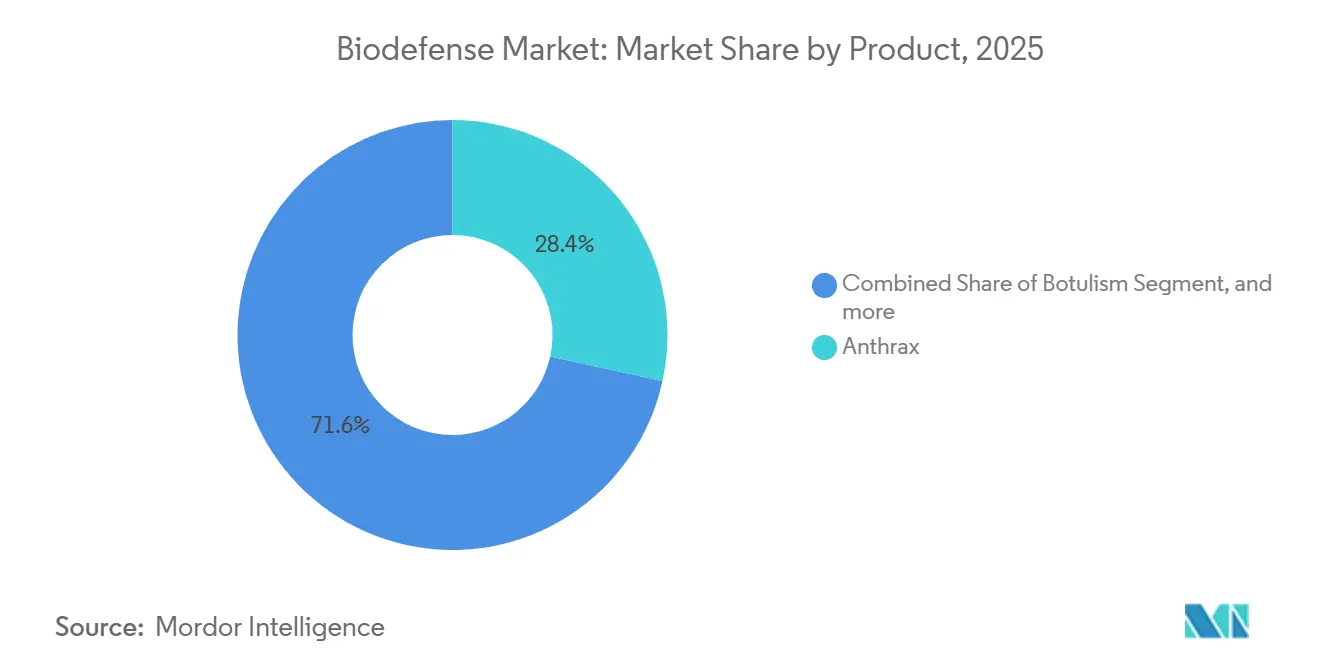
Orthopox Countermeasures Gain TractionAnthrax products commanded 28.43% of 2025 revenue, supported by decades-long procurement programs within the biodefense market. Smallpox and broader orthopox solutions are forecast to rise at a 10.34% CAGR, reflecting mpox-driven diversification and Strategic National Stockpile expansion. Bavarian Nordic’s Jynneos generated USD 520 million in 2024–2025 government sales across the United States, Canada, and Japan. SIGA Technologies secured a USD 113 million BARDA contract extension for oral and intravenous tecovirimat. Botulism products remain niche, yet Emergent BioSolutions’ BAT antitoxin enjoys a sole-source contract valued at USD 85 million annually.
Future growth will hinge on platform adaptability. The biodefense market size for orthopox countermeasures is expected to widen as mRNA architectures cut development lead times, and thermostable formulations improve logistical reach. Ricin and staphylococcal enterotoxin B candidates in Phase II trials indicate a pipeline that could shift revenue distribution once approved.



By Countermeasure Type:
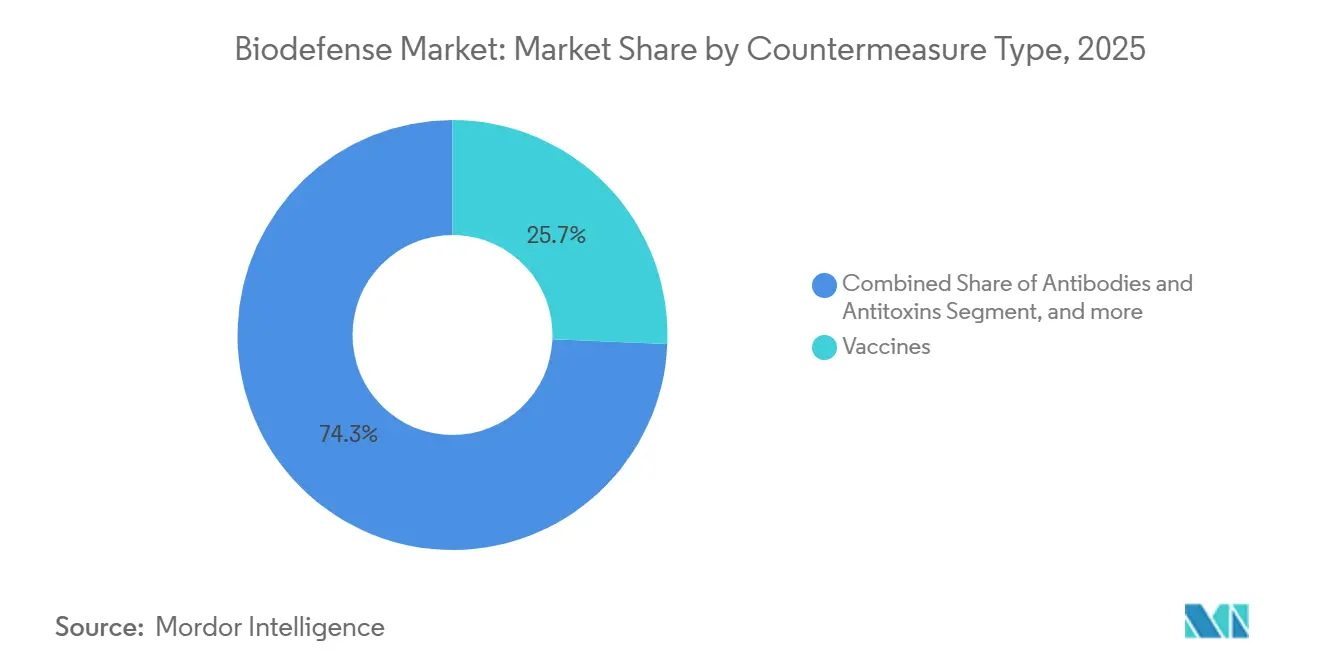
Detection Systems AccelerateVaccines delivered 25.67% of 2025 countermeasure-type revenue, but detection and surveillance systems are growing at a 10.21% CAGR, underscoring the pivot toward continuous situational awareness. The biodefense market share tied to advanced detectors climbed in 2025 as the BioWatch upgrade received USD 180 million in new funding. Smiths Detection reported a 34% surge in biodefense sales on the back of NATO contracts.
Antibodies and antitoxins held 18% of revenue, benefitting from monoclonal-antibody scalability. Elusys Therapeutics’ obiltoxaximab gained pediatric approval in 2025. Antibiotics and antivirals continue to anchor post-exposure strategies, with the Strategic National Stockpile stocking 50 million courses of ciprofloxacin and doxycycline.
By End User:
Military Forces Drive Fastest GrowthHospitals and clinics accounted for 27.65% of 2025 revenue as primary dispensing points during emergencies. The U.S. Cities Readiness Initiative moved 12 million antibiotic courses to hospital networks during drills. Military organizations represent the fastest-growing end user at an 11.34% CAGR. The U.S. Joint Program Executive Office for Chemical, Biological, Radiological and Nuclear Defense awarded USD 420 million in contracts in 2025, emphasizing forward-deployed personnel protection.
Homeland-security agencies captured 22% of revenue, focused on detection, decontamination, and personal protective equipment. Pharmaceutical contract-manufacturing partners such as National Resilience expanded Baltimore fill-finish capacity by 40,000 square feet in late 2025 to meet surge demand.
Geography Analysis
North America Biodefense Market
North America delivered 42.45% of 2025 biodefense revenue, driven by the Biomedical Advanced Research and Development Authority’s USD 1.8 billion in fiscal-year contracts. Canada committed USD 135 million to refresh its National Emergency Strategic Stockpile in 2025. Regulatory mechanisms, including the Animal Rule and Emergency Use Authorization, shorten approval timelines and sustain demand predictability. The biodefense market size in North America benefits from concentrated manufacturing nodes operated by Emergent BioSolutions, Grand River Aseptic Manufacturing, and National Resilience.
APAC Biodefense Market
Asia-Pacific is forecast to grow at a 9.54% CAGR through 2031, reflecting sovereign biosecurity mandates. Japan allocated JPY 38 billion (USD 255 million) in its 2025 defense budget for vaccines and detection equipment. South Korea’s Agency for Defense Development initiated a USD 90 million domestic-vaccine program. Australia partnered with CSL Limited to establish a regional manufacturing hub supported by AUD 150 million (USD 100 million). India’s Biotechnology Industry Research Assistance Council funded three vaccine developers with INR 1.2 billion (USD 14 million) in grants.
EMEA and South America Biodefense Market
Europe generated 23% of global revenue in 2025. The Health Emergency Preparedness and Response Authority earmarked EUR 800 million for stockpile creation across Poland, Spain, and Italy. The United Kingdom’s Vaccine Manufacturing and Innovation Centre secured GBP 120 million in contracts for biodefense vaccines. Middle East and Africa combined produced 8% of revenue, led by Gulf Cooperation Council purchases; the United Arab Emirates committed USD 45 million in 2025 under its National Resilience Strategy. South America remains embryonic but Brazil allocated BRL 220 million (USD 44 million) for antibiotic and vaccine reserves.

Regulatory Landscape
Regulatory access in biodefense is shaped by emergency and non-traditional evidentiary pathways alongside heightened biosecurity oversight. In the United States, the FDA Animal Rule remains a core route for medical countermeasures when human efficacy studies are not feasible, and regulatory expectations around animal data continue to influence approvals for vaccines, therapeutics, and diagnostics.
Policy direction is tightening governance and procurement. The U.S. Select Agent Program finalized updates effective January 16, 2025, affecting select agent lists and Tier 1 designations, while the May 6, 2025 policy governing Dual Use Research of Concern and Pathogens with Enhanced Pandemic Potential resets expectations for research governance tied to high-consequence pathogens. In Europe, the Health Emergency Preparedness and Response Authority anchors medical countermeasure procurement and portfolio planning, reinforced by the European Commission's Comprehensive 2026 Health Threat Prioritisation Assessment (January 2026) that guides investment choices across vaccines, therapeutics, and preparedness assets.
Value Chain Analysis
The biodefense value chain runs from threat assessment and R&D (platform vaccines, antivirals, antibodies, diagnostics) through regulated biomanufacturing (drug substance, fill-finish, quality release), then government-led procurement, stockpiling, and distribution to military forces, emergency agencies, and hospitals. Demand is strongly influenced by public-sector contracts and readiness frameworks such as the U.S. Strategic National Stockpile and DoD programs, which in turn shape supplier qualification, lot-release timelines, and surge-capacity planning. Contract development and manufacturing organizations (CDMOs) and federally aligned facilities play an outsized role in converting development programs into stockpile-ready supply, consistent with late-2025 fill-finish expansions and BARDA-supported manufacturing lines referenced in the report context.
Inputs and geography dependencies remain a key constraint, particularly for active pharmaceutical ingredients, specialty reagents, and single-source components used in diagnostics and biologics. The August 2025 White House action establishing the Strategic Active Pharmaceutical Ingredients Reserve (SAPIR) underscores how API availability has become a resilience lever, targeting expanded supply assurance for critical medicines. On the defense side, the FY 2026 CBDP budget request provides a funding anchor for development and production readiness efforts, while legislative activity such as H.R. 7777 (Protecting Americas Medical Supply Chains Act of 2026) highlights ongoing efforts to diversify sourcing and reduce dependence on foreign-controlled supply chains.
Competitive Landscape
The biodefense market shows moderate concentration, with incumbents leveraging entrenched government contracts. Emergent BioSolutions derived USD 680 million in 2024 revenue from biodefense products, equal to 58% of corporate sales. Bavarian Nordic’s Jynneos vaccine held 85% of global orthopox countermeasure volume in 2025, driven by sole-source contracts in the United States, Canada, and Japan. SIGA Technologies expanded its portfolio with an intravenous tecovirimat formulation approved in 2025.
New entrants target white-space opportunities in thermostable and broad-spectrum platforms. Tonix Pharmaceuticals reported promising Phase II data for its horsepox-based TNX-801 vaccine, noting improved thermostability over traditional smallpox vaccines. Soligenix advanced a recombinant ricin vaccine, winning Fast Track designation in October 2025. Detection-system vendors compete on portability and analytics speed; Teledyne FLIR’s handheld mass-spectrometer and BioFire Defense’s multiplex PCR panel both saw accelerated procurement in 2025. Patent grants for autonomous sampling and machine-learning threat classification climbed 19% year on year, indicating an innovation surge.
Integration of fill-finish capacity into contract-manufacturing organizations remains a priority. National Resilience’s USD 200 million Baltimore expansion achieved FDA readiness in late 2025, adding 40,000 square feet dedicated to BARDA programs. Grand River Aseptic Manufacturing initiated a USD 60 million line for anthrax and smallpox vaccines supported by BARDA cost-sharing. Such moves address supply-chain pinch points while creating geographically diversified surge capability.
Biodefense Industry Leaders
Emergent BioSolutions Inc.
Nighthawk Biosciences, Inc. (Elusys Therapeutics Inc.)
Dynavax Technologies
SIGA Technologies Inc.
Agilent Technologies, Inc.
- *Disclaimer: Major Players sorted in no particular order
Biodefense Market Companies Covered in this Report
- Agilent Technologies
- Battelle
- Bavarian Nordic
- BioFire Defense, LLC
- Bruker
- Cepheid (Danaher)
- Dynavax Technologies
- Elusys Therapeutics Inc. (NightHawk Biosciences)
- Emergent Bio Solutions
- Grand River Aseptic Manufacturing (GRAM)
- Jubilant HollisterStier LLC
- Leidos Biomedical Research, Inc. (Leidos)
- National Resilience, Inc. (Ology Bioservices)
- QIAGEN
- SIGA Technologies Inc.
- Smiths Detection (Smiths Group plc)
- Soligenix, Inc.
- Teledyne FLIR Detection, Inc.
- Tetracore, Inc.
- Tonix Pharmaceuticals

Market Opportunities and Future Outlook
Opportunities are rooted in domestically controlled biomanufacturing capacity, rapid-response platform countermeasures, and scalable detection and biosurveillance programs tied to national security funding. Evidence of investment activity includes Valion Bio opening Velocity Bioworks in San Antonio in May 2026 to anchor domestic production of Entolimod, and AeroVironment's July 2026 investment of 15 million USD in a 46,000-square-foot biomanufacturing facility in Xenia, Ohio aimed at military-relevant production volumes. In parallel, the FY 2026 CBDP budget request continues funding for biodefense RDT&E and capability development, supporting pathways for vendors that can transition programs from development into stockpile procurement.
White-space is visible where policy and procurement tighten around supply assurance and biosafety-by-design. US DURC/PEPP policy became effective May 6, 2025, creating a clearer compliance-driven procurement environment for upstream suppliers and research partners, while EU threat prioritization work (January 2026) supports more standardized portfolio decisions for medical countermeasures. For solution providers, the shift raises opportunities in verifiable supply-chain controls and in products that reduce deployment friction, including thermostable formulations and modular platforms that fit multi-agent stockpiles without requiring single-purpose manufacturing lines.
Recent Industry Developments in Biodefense Market
- June 2026: Emergent BioSolutions secured a contract modification from the Administration for Strategic Preparedness and Response (ASPR) to supply ACAM2000 (Smallpox and Mpox Vaccine, Live) to the U.S. government. The action supports stockpile sustainment for legacy vaccines and manufacturing utilization.
- January 2025: Emergent BioSolutions announced the exercise of a USD 20 million option to supply the U.S. Department of Defense with BioThrax (Anthrax Vaccine Adsorbed). The action extends procurement continuity for an established countermeasure and strengthens visibility for suppliers tied to DoD readiness requirements.
- July 2024: Emergent BioSolutions reported more than USD 250 million in contract modifications from ASPR to supply four critical medical countermeasure products spanning anthrax, smallpox, and botulism. The scale and multi-product nature of the modifications highlighted how government contracting can shift near-term production priorities and reinforce incumbent positioning across threat categories.


Biodefense Market Report Scope and Research Methodology
Market Definition and Coverage
This market covers spending on biodefense countermeasures and systems that prevent, detect, and respond to biological threats, including preparedness and response purchasing by defense, public health, and emergency agencies.
Scope exclusions: We exclude routine, non-threat driven infectious disease care and general hospital consumables that are not procured for biodefense readiness.
Segments Covered in This Report
- By Product
- Anthrax
- Smallpox / Orthopox (Smallpox & Mpox)
- Botulism
- Plague
- Tularemia
- Other Products
- By Countermeasure Type
- Vaccines
- Antibodies & Antitoxins
- Antivirals & Antibiotics
- Detection & Surveillance Systems
- Decontamination Systems & PPE
- Biodosimetry & Radiological Agents
- By End User
- Military Forces
- Homeland Security & Emergency Agencies
- Hospitals & Clinics
- Pharmaceutical & Biotech Companies
- Virological Research Institutes
- Geography
- North America
- United States
- Canada
- Mexico
- Europe
- Germany
- United Kingdom
- France
- Italy
- Spain
- Rest of Europe
- Asia-Pacific
- China
- Japan
- India
- Australia
- South Korea
- Rest of Asia-Pacific
- Middle East & Africa
- GCC
- South Africa
- Rest of Middle East & Africa
- South America
- Brazil
- Argentina
- Rest of South America
- North America
Data Sources, Market Sizing, and Validation
Desk Research
Desk research sets the starting structure for the model by mapping public budgets, procurement signals, and health security priorities to the demand pool. We leaned on public sources such as US HHS and CDC materials (including preparedness programs), US Government Accountability Office reports, WHO health emergency guidance, and World Bank population and health spending indicators to understand scale and timing.
We also used national budget documents and defense procurement releases, UN Comtrade trade statistics for select product classes, and peer reviewed journals that cover countermeasure stockpiling and readiness planning. Company annual reports, investor decks, and reputable press were then used to cross check revenue exposure and product focus. Where helpful, a paid subscription for company financials and news, plus a patent database, were used to confirm ownership changes and pipeline direction. These examples are not exhaustive, and many other public sources were reviewed for data collection, validation, and research clarification.
Primary Interviews and Surveys
Primary work was used to confirm what is actually being bought for biodefense, how procurement cycles behave, and how pricing moves when multi year contracts or replenishment orders are involved. We spoke with program and procurement stakeholders, solution providers, and domain experts across key regions, so assumptions on stockpile turnover, award timing, and demand triggers could be stress tested before finalizing the model.
Distribution of primary research fieldwork respondents
| Company type | Respondent position | Region |
|---|---|---|
| Top tier: 32% | CXOs: 19% | APAC: 51% |
| Mid tier: 49% | Functional/Unit leaders: 31% | EMEA: 29% |
| Smaller Players: 19% | Managers: 50% | Americas: 20% |
Market-Sizing & Forecasting
Sizing started with a top-down build where government biodefense preparedness and response spending signals were reconstructed into an addressable pool, and then allocated across countermeasure and system categories using observed program mixes. To keep the totals realistic, we corroborated results with selective bottom-up approximations, such as sampled contract values, typical unit pricing ranges, and limited supplier revenue exposure checks, and then adjusted for outliers.
Key model inputs included biodefense budget direction and award cadence, stockpile replenishment and shelf life driven replacement patterns, incidence of declared health emergencies and readiness drills, procurement mix between vaccines, therapeutics, detection and surveillance, and decontamination and PPE, plus region level readiness priorities. Pricing assumptions were treated carefully, since some items follow multi year price curves while others move mainly with production scale and regulatory changes.
For forecasting, scenario analysis was used, anchored to a base case that reflects the most likely procurement and replenishment cycle discussed in interviews, and then stressed for accelerated funding or delayed awards. Gaps in supplier level detail were handled by using category level allocation rules and cross checks against public procurement announcements, followed by a second pass review with experts to keep the trend line plausible.
Data Validation & Update Cycle
Outputs are validated through cross checks against independent signals such as major program funding shifts, visible contract awards, and region level preparedness priorities, and then compared for year to year continuity. When a category shows an unexpected jump, the assumptions behind volumes, price progression, and timing are reviewed, and follow up calls are triggered if the variance cannot be explained.
Before sign off, a separate analyst review is completed to catch scope leaks, double counting between adjacent categories, and inconsistent currency timing. Reports are refreshed annually, and interim updates are made when there is a material event such as a major award, a new emergency declaration, or a policy change that can move spending. Right before delivery, we run a final update sweep so the numbers reflect the latest available public signals.
Mordor Intelligence's Biodefense Market Sizing Compared With Other Published Estimates
Published biodefense market values can differ even for the same year because coverage choices vary, and the inputs used to translate programs into dollars are not always aligned. Differences usually come from what is counted as biodefense versus broader biosecurity activity, how stockpile replenishment timing is treated, and whether pricing is assumed to rise steadily or stay flat.
A second gap driver is geography and purchasing channels, since some estimates emphasize a few large national programs while others blend in wider public health spending without checking whether it is threat driven. Another recurring issue is currency timing and refresh cadence, because late year contract awards and emergency response buys can shift the current year total if updates are not made close to publication.
Benchmark comparison
| Source | Market Size | Gaps in Research Methodology |
|---|---|---|
| Mordor Intelligence | USD 19.33 B (2025) | |
| Global Consultancy A | USD 16.23 B (2025) | This estimate appears to lean more toward broad biosecurity framing and may keep procurement scope tighter on core countermeasures, which can undercount detection, surveillance, and decontamination related buys. |
| Industry Publisher B | USD 18.80 B (2025) | This estimate is close but may apply smoother growth and replacement timing assumptions, which can miss lumpiness from stockpile shelf life turnover and uneven contract award schedules. |
The spread is mainly explained by whether adjacent preparedness spending is folded in and by how replenishment cycles are timed, and this is why the model stays tied to observable award and replacement signals rather than only trend smoothing, a choice applied by Mordor Intelligence.


Key Questions Answered in the Report
What is the projected value of the global biodefense market by 2031?
Forecasts indicate the sector will reach USD 30.75 billion by 2031, rising at an 8.12% CAGR.
Which geographic region is expected to post the fastest growth through 2031?
Asia-Pacific is forecast to expand at a 9.54% CAGR, outpacing all other regions.
What share of 2025 revenue did anthrax countermeasures command?
Anthrax vaccines and therapeutics captured 28.43% of global revenue in 2025.
Why are detection and surveillance systems drawing increased investment?
Governments are integrating real-time genomic sequencing and autonomous aerosol sampling, pushing this segment to a projected 10.21% CAGR.
Which companies currently lead global orthopox countermeasure supply?
Bavarian Nordic's Jynneos vaccine and SIGA Technologies' tecovirimat therapy together dominate the orthopox segment.
How is the U.S. government addressing fill-finish capacity constraints?
A USD 200 million federal investment expanded National Resilience's Baltimore facility by 40,000 sq ft, adding dedicated aseptic lines for Strategic National Stockpile products.
Page last updated on:


 Your data is secure and never sold or shared.


