
Online Lottery Market Size and Share
Market Overview
| Study Period | 2021 - 2031 |
|---|---|
| Market Size (2026) | USD 13.22 Billion |
| Market Size (2031) | USD 19.65 Billion |
| Growth Rate (2026 - 2031) | 8.25 % |
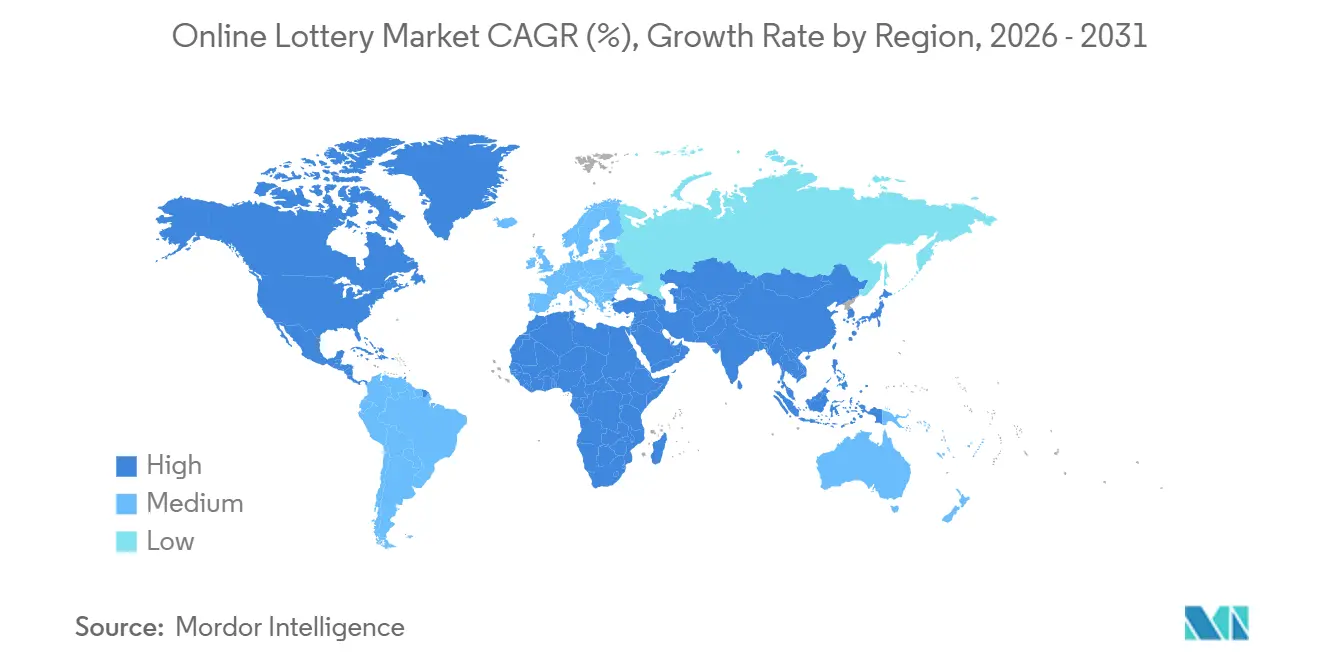
| Fastest Growing Market | North America |
| Largest Market | Europe |
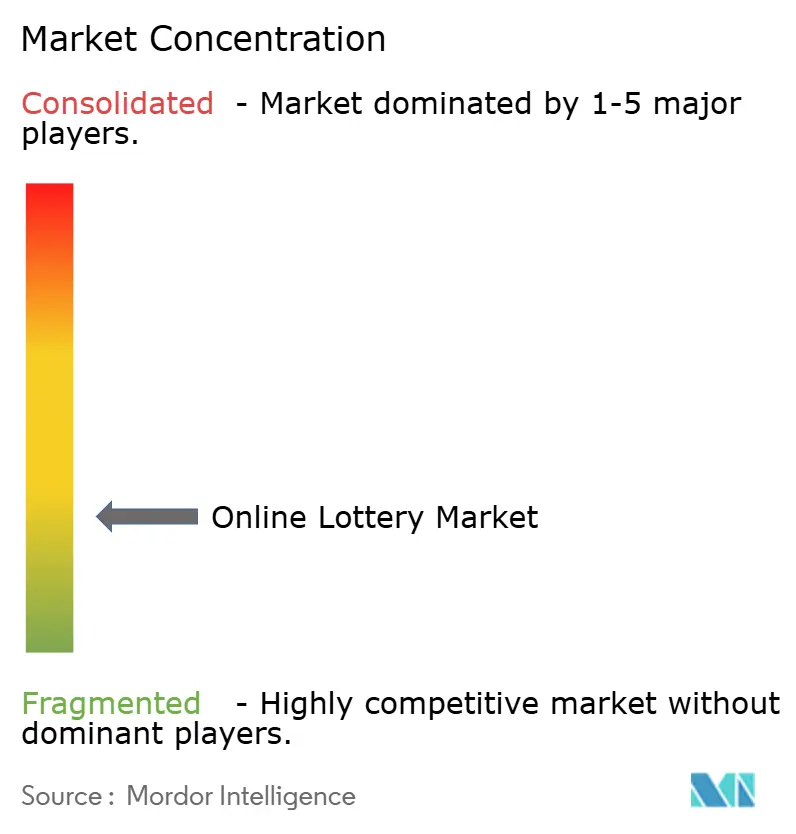
| Market Concentration | Low |
Major Players *Disclaimer: Major Players sorted in no particular order Image © Mordor Intelligence. Reuse requires attribution under CC BY 4.0. | |
Online Lottery Market Analysis by Mordor Intelligence
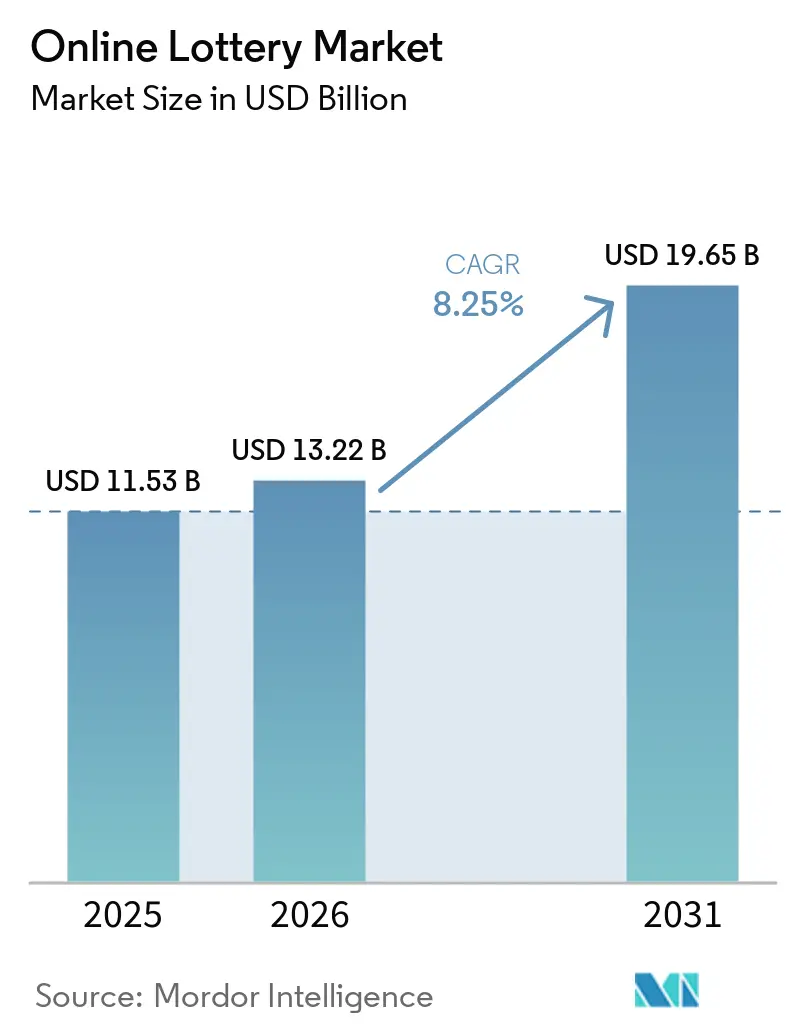
The online lottery market size is projected to expand from USD 11.53 billion in 2025 and USD 13.22 billion in 2026 to USD 19.65 billion by 2031, registering a CAGR of 8.25% between 2026 and 2031. Mobile access, friction-free digital wallets, and permissive legislation in North America are amplifying player acquisition, while cross-border jackpot pooling sustains headline prizes that exceed USD 1 billion and drive infrequent, value-seeking users back to the platform. Instant-win formats mimic casual mobile gaming and shorten the time from deposit to outcome, a dynamic that resonates with younger cohorts who favor micro-stakes and rapid feedback loops. Mature European frameworks keep revenue steady, yet incremental growth shifts to liberalizing U.S. states and Canadian provinces, where omnichannel cloud stacks streamline licensing compliance and marketing localization. Competitive intensity remains modest because state monopolies, private concessionaires, and cloud-based white-label vendors occupy distinct niches without dominating global share.
Key Report Takeaways
- By platform, mobile platforms captured 57.26% of the online lottery market share in 2025; they are on track for a 10.25% CAGR through 2031.
- By game type, draw-based games accounted for 34.21% of the online lottery market size in 2025, while instant games posted the fastest 10.11% CAGR to 2031.
- By age, the 25-40 years bracket held a 45.02% share in 2025; the below-25 cohort recorded the highest 9.78% CAGR.
- By end user, male participants represented 65.12% of 2025 revenue, whereas female engagement expanded at a 9.89% CAGR to 2031.
- By Geography, Europe led with a 46.72% share in 2025; North America shows the quickest 10.11% CAGR through 2031.
Note: Market size and forecast figures in this report are generated using Mordor Intelligence’s proprietary estimation framework, updated with the latest available data and insights as of 2026.
Global Online Lottery Market Trends and Insights
Drivers Impact Analysis*
| Drivers | (~) % Impact on CAGR Forecasts | Geographic Relevance | Impact Timeline |
|---|---|---|---|
| Rising Penetration of Digital Wallets and Mobile Payments Integration | +2.1% | Global, with accelerated adoption in Asia-Pacific and Sub-Saharan Africa | Medium term (2-4 years) |
| Legalization and Regulatory Liberalization | +2.5% | North America (U.S. state-by-state), Latin America, select Asia-Pacific markets | Short term (≤ 2 years) |
| Increasing Global Internet Penetration | +1.4% | Global, concentrated in emerging markets (India, Indonesia, Nigeria) | Long term (≥ 4 years) |
| Cross-Border Jackpot Pooling Boosting Prize Sizes | +1.8% | Europe (EuroMillions), North America (Powerball, Mega Millions), emerging multi-jurisdiction consortia | Medium term (2-4 years) |
| Micro-Influencer Affiliate Marketing Lowering Acquisition Costs | +1.2% | Global, particularly effective in Europe and North America | Short term (≤ 2 years) |
| Advancement of digital technologies | +1.5% | Global, led by developed markets | Medium term (2-4 years) |
| Source: Mordor Intelligence | |||
Rising Penetration of Digital Wallets and Mobile Payments Integration
Digital wallets and mobile payment systems now dominate online lottery transactions, reducing checkout abandonment and enabling instant deposits for impulse purchases. In 2025, the International Telecommunication Union reported over 1.6 billion mobile money accounts globally, with transaction values exceeding USD 1.2 trillion, easing access for lottery operators in regions with limited banking infrastructure[1]. IGT's platform integrates Apple Pay, Google Pay, and regional wallets like M-Pesa in Kenya and Paytm in India, allowing quick account funding without card details and speeding up betting. In 2024, Allwyn Entertainment added PayPal and Klarna to its UK National Lottery app, boosting mobile conversion rates by 23% among users aged 18-34. Latin America is leading in embedded finance, with Banco Central do Brasil's PIX system processing 42 billion transactions in 2025, and Caixa Econômica Federal piloting PIX-enabled ticket purchases. In the European Union, the revised Payment Services Directive (PSD2) enforces strong customer authentication while enabling open banking APIs, allowing lottery platforms to initiate payments directly from bank accounts, bypassing card networks and reducing fees.
Legalization and Regulatory Liberalization
Jurisdictional expansion of legal online lottery frameworks serves as a significant near-term growth driver, opening previously restricted markets and transitioning informal lottery activities into regulated systems. In the U.S., Michigan's iLottery platform achieved USD 1 billion in annual sales in 2025, highlighting the compatibility of digital channels with retail operations without eroding brick-and-mortar revenue. The National Council of Legislators from Gaming States (NCLGS) introduced a Model iLottery Act in 2024, providing a legislative framework for states exploring authorization while addressing issues like age verification, geolocation, and responsible gaming[2]. In Europe, Germany's Interstate Treaty on Gambling allows online lottery sales under strict advertising and player-protection regulations. In 2025, the Gemeinsame Glücksspielbehörde der Länder (GGL) issued 12 new licenses, intensifying competition among established players such as Lotto24 and ZEAL Network. Similarly, Latin America is experiencing liberalization, with Argentina's Buenos Aires province legalizing online lotteries in 2024 and Brazil's federal government finalizing igaming regulations set to take effect in 2026, creating a combined addressable market of over 250 million adults.
Increasing Global Internet Penetration
Emerging markets are witnessing a surge in internet access, broadening the player base for lotteries. This is especially significant in areas where geographic isolation and limited retail outlets have historically hampered lottery participation. India's internet user count hit 900 million in 2025, buoyed by budget-friendly 4G data plans averaging just USD 2 monthly. Additionally, government initiatives like BharatNet are pivotal, extending fiber connectivity to rural locales, as highlighted by the Telecom Regulatory Authority of India[3]. In a notable shift, state-run lotteries in Kerala and Punjab introduced mobile apps facilitating UPI payments. This move effectively taps into a demand previously met by informal lottery agents. Meanwhile, in Sub-Saharan Africa, mobile broadband subscriptions surged by 18% year-over-year in 2025. Notably, the Uganda National Lotteries Board forged partnerships with telecom giants MTN and Airtel, rolling out USSD-based lottery services. These services are accessible on feature phones, eliminating the need for smartphones, as reported by GSMA's Mobile Economy Sub-Saharan Africa 2025. In Indonesia, while 77% of the populace was online in 2025, the Ministry of Communication and Informatics underscored a critical point: the country's gambling laws still prohibit online lotteries. This highlights a crucial reality: mere connectivity doesn't guarantee participation without the backing of regulatory frameworks.
Cross-Border Jackpot Pooling Boosting Prize Sizes
Multi-jurisdiction lottery consortia pool players across borders, creating jackpots exceeding USD 1 billion and attracting casual participants seeking high returns. In December 2024, EuroMillions, operated by nine European national lotteries, hit a record EUR 240 million (USD 260 million) jackpot, boosting ticket sales by 34% during the rollover period. In the U.S., Powerball and Mega Millions expanded to 48 and 47 jurisdictions, respectively, by 2025. Powerball set a global record in November 2024 with a USD 2.04 billion jackpot, generating USD 120 million in California ticket sales during the final draw week. Emerging markets are adopting this model. The Caribbean Lottery Consortium launched a regional draw in 2025, spanning Jamaica, Trinidad and Tobago, and Barbados, with a starting jackpot of USD 5 million and shared marketing budgets to compete globally. However, cross-border pooling introduces challenges like currency conversion, tax withholding differences, and resolving disputes when winners face conflicting prize-claim regulations.
Restraints Impact Analysis*
| Restraints | (~) % Impact on CAGR Forecasts | Geographic Relevance | Impact Timeline |
|---|---|---|---|
| Regulatory and Legal Challenges | -1.6% | Global, acute in Asia-Pacific (China, India, Indonesia) and Middle East | Long term (≥ 4 years) |
| App-Store Policy Tightening on Real-Money Gambling | -1.3% | Global, particularly impactful in North America and Europe | Short term (≤ 2 years) |
| Cybersecurity Threats and Fraud Risks | -1.1% | Global, with elevated exposure in emerging markets lacking robust KYC infrastructure | Medium term (2-4 years) |
| Negative Public Perception and Stigma | -0.8% | North America, Europe, select Asia-Pacific markets | Long term (≥ 4 years) |
| Source: Mordor Intelligence | |||
Regulatory and Legal Challenges
Fragmented and contradictory regulatory regimes across jurisdictions increase compliance costs, delay market entry, and create legal uncertainties that hinder product innovation. In the U.S., as of 2025, only 11 states allow iLottery sales, while 39 states either prohibit or lack legislation, requiring operators to manage separate technology and marketing efforts for each state. In Asia-Pacific, China's Ministry of Public Security classifies online lotteries as illegal gambling, prosecuting operators and payment processors, effectively closing the market to legitimate providers. In India, the 1867 Public Gambling Act delegates lottery regulation to states, resulting in 13 states running lotteries, with only Sikkim permitting online sales. Additionally, the Goods and Services Tax Council imposes a 28% tax on lottery tickets, the highest for any consumer product. In the European Union, the principle of subsidiarity allows member states to restrict gambling services for public-policy reasons. Countries like Poland and the Netherlands require local licenses, even for operators authorized elsewhere in the EU, further fragmenting the single market.
App-Store Policy Tightening on Real-Money Gambling
Apple and Google have increasingly enforced stricter policies on real-money gambling apps, limiting distribution channels and pushing operators to adopt progressive web apps (PWAs). While PWAs bypass app stores, they compromise on discoverability and push-notification capabilities. Apple's App Store Review Guidelines, revised in June 2024, prohibit lottery apps in regions where online lotteries are not explicitly authorized by law. Additionally, developers must provide proof of licensing for app approval, a process that takes 8 to 12 weeks and often delays product launches. Similarly, Google's Play Developer Policy, updated in September 2024, requires gambling apps to implement age verification at download and restrict in-app advertising to users aged 21 and above. This added friction is estimated to reduce conversion rates by 15%. In response, operators like Lottoland and theLotter have shifted focus to PWAs. These platforms utilize HTML5 and service workers to deliver app-like experiences via mobile browsers, enabling offline functionality and home-screen installation without app-store approval. However, PWAs face limitations, such as the inability to access iOS push notifications and Android's full range of device APIs, which restricts engagement tools essential for driving repeat usage. Moreover, while app-store platforms offer advanced attribution and cohort analysis, PWAs must rely on third-party tools like Google Analytics and Adjust to replicate these analytics capabilities.
*Our forecasts treat driver/restraint impacts as directional, not additive. The impact forecasts reflect baseline growth, mix effects, and variable interactions.
Segment Analysis
By Platform Type: Mobile Dominance Accelerates
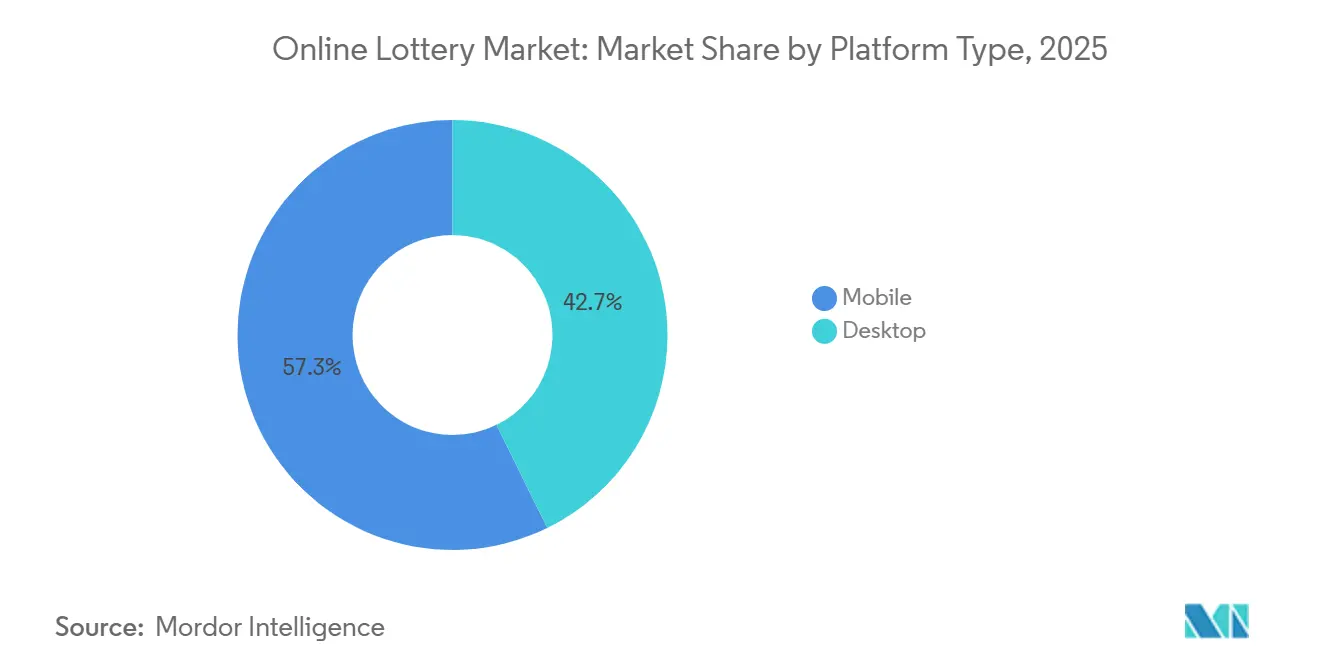
Mobile captured 57.26% of the online lottery market share in 2025 and is expanding at a 10.25% CAGR, while desktop erodes as smartphone penetration deepens. The online lottery market size for mobile transactions is predicted to grow in parallel to rising 5G coverage that supports richer media such as live draws and AR scratch cards. IGT’s biometric-enabled Missouri app lifted monthly active users by 38% within six months, illustrating that single-tap authentication sparks repeat play. Desktop remains relevant for high-value syndicates that require multi-ticket management and larger screens, but cedes share each year. Emerging markets, including India, exhibit virtually mobile-only usage patterns because 89% of users never touch a desktop browser, pushing operators toward Android-first builds.
Mobile provides geofencing, push alerts, and gamification loops that accelerate engagement, yet operators grapple with app-store restrictions, rising acquisition costs, and limited screen real estate for complex bets. Progressive Web Apps bypass store rules but sacrifice native notifications, forcing heavier CRM reliance through SMS and email. As 5G reduces latency and elevates graphics, operators expect to roll out immersive lobbies and livestreamed prize reveals that differentiate mobile from legacy web channels.
By Game Type: Instant Formats Gain Share
Draw-based games retained 34.21% of 2025 revenue, anchored by brands such as Powerball and EuroMillions that deliver ritualized weekly play and viral jackpots. However, instant-win titles record the fastest 10.11% CAGR, shifting the online lottery market size toward on-demand entertainment that mirrors casual mobile gaming. Licensed IP, such as Monopoly, lifts repeat purchase rates and average spending because recognizable themes reduce perceived risk. Instant products demand aggressive content pipelines; NeoGames released 120 unique eInstant titles in 2025 to sustain novelty.
Sports lottery and ancillary games like keno or raffles fill niche appetites and diversify risk but struggle to capture mainstream attention unless jackpots swell well beyond local averages. Draw games still boast lower cost per ticket and bigger average order values, yet limited draw frequency caps engagement versus always-on instant catalogs. Operators now hedge by cross-selling draw subscriptions to instant-first users and vice versa, lowering churn across both verticals.
By Age Group: Youth Adoption Drives Growth
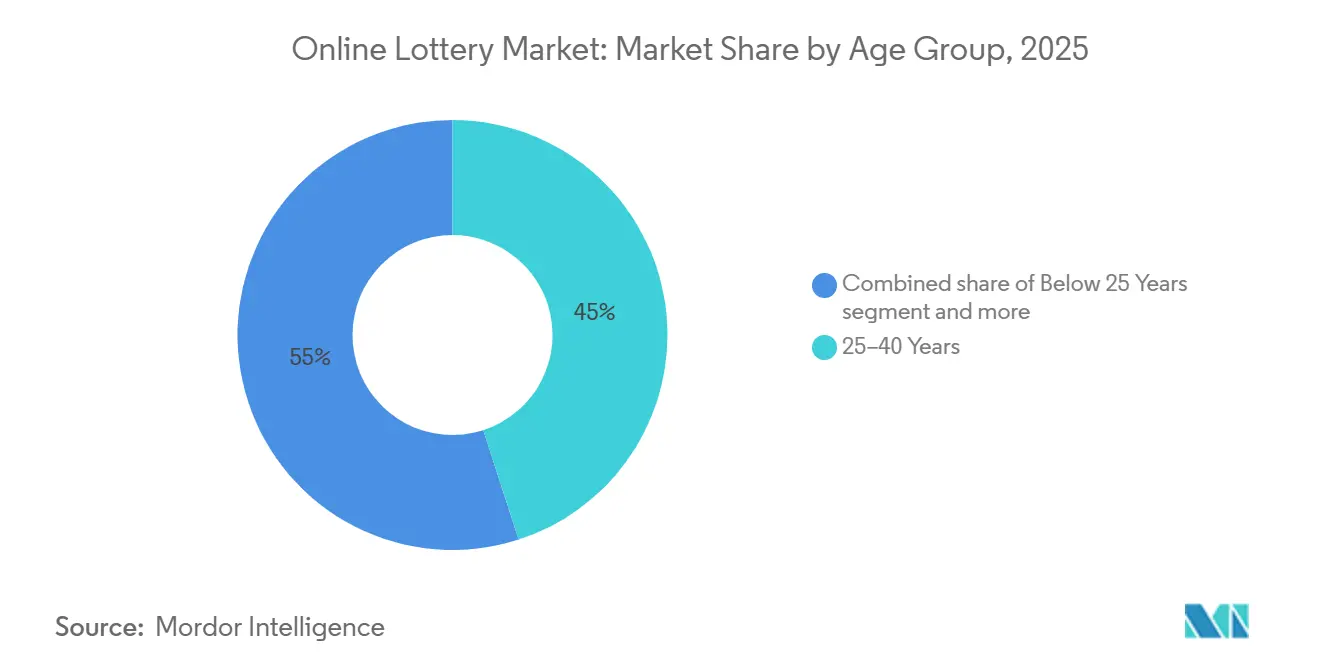
Individuals aged 25-40 provided 45.02% of 2025 participation, blending discretionary income with digital fluency. The online lottery market size attributable to players under 25 is projected to rise fastest at 9.78% CAGR, spurred by mobile-only apps that fuse social chat, micro-stakes, and push-notification reminders. Operators embed subscription auto-buy features that reduce decision fatigue and emulate fintech habits.
The 40-55 band contributes roughly 30% of revenue due to larger baskets and long-term loyalty, though growth flattens as this cohort ages. The 55+ group is digitizing gradually; Allwyn’s large-text mode lifted over-60 registrations by 19%. Younger players demand transparency: 68% of 18-34-year-olds say prize-fund breakdowns and responsible-gaming tools influence brand choice. Operators now publish real-time payout percentages and integrate self-exclusion toggles in dashboards to satisfy that expectation.

By End User: Female Participation Rises
In 2025, male users accounted for 65.12% of the total user base. On the other hand, female participation is witnessing significant growth, expanding at a compound annual growth rate (CAGR) of 9.89%. This increase is primarily driven by the growing appeal of lifestyle-themed events, charitable initiatives, and social playgroups, which resonate more strongly with women. Europe is leading the way in narrowing the gender gap, with the female share rising to 42%. This progress is supported by inclusive marketing campaigns and stringent advertising regulations that actively discourage gender stereotypes.
Women generally place smaller bets but exhibit higher engagement levels, particularly with responsible gaming measures. They are 2.3 times more likely to set deposit limits and 1.8 times more likely to opt for self-exclusion during cooling-off periods. Acquisition strategies also vary significantly, as women respond more positively to social media discoveries and influencer recommendations compared to paid search campaigns. This trend has prompted a reallocation of marketing budgets toward platforms such as Instagram and TikTok to better target female users. Additionally, loyalty programs are undergoing a transformation. Instead of focusing solely on cash-based rewards, these programs now emphasize community badges that recognize consistent, low-stakes participation. This shift aligns more closely with the risk preferences observed among female users.
Geography Analysis
In 2025, Europe contributed 46.72% of global lottery revenues, supported by over 90% internet penetration and the seamless online transition of established national lotteries, which successfully avoided cannibalizing retail sales. The UK's National Lottery reported GBP 1.8 billion (USD 2.3 billion) in digital revenues for the fiscal year ending March 2025. In Germany, a new licensing wave intensified competition between Lotto24 and ZEAL Network. France's FDJ leveraged mobile optimizations and branded instant releases to generate EUR 3.2 billion (USD 3.5 billion) online. In Italy, a nine-year Lotto concession was awarded in 2025 to a consortium comprising Allwyn, Sisal, and IGT, highlighting the preference for omnichannel joint ventures in high-value Southern European markets.
North America recorded the highest growth, with a 10.11% CAGR, driven by the expansion of iLottery legalization across U.S. states and the integration of retail and online play in Canadian provinces. Michigan surpassed USD 1 billion in digital sales in 2025 while maintaining retail revenue. New York's iLottery launch in November 2024 exceeded expectations, generating USD 180 million in its first six months, 22% above forecasts. Ontario's open gaming framework resulted in total igaming revenues of CAD 1 billion (USD 740 million) by 2025, with the lottery segment accounting for 15%. In Mexico, a newly introduced mobile app targeting 92 million internet users aimed to achieve USD 50 million in its first year.
The Asia-Pacific region experienced steady digital growth, though it was constrained by restrictions in China, several Indian states, and Indonesia. Australia's Lottery Corporation reported a 9% year-over-year increase, achieving AUD 3.9 billion (USD 2.6 billion) in online revenues for FY 2025. In New Zealand, Lotto NZ generated NZD 680 million (USD 420 million) in 2024, with mobile accounting for 72% of the total. Brazil finalized its federal igaming regulations in 2025, with implementation planned for 2026, potentially unlocking a market of over 150 million players. However, in the Philippines and across the Middle East and Africa, regulators are proceeding cautiously, weighing social costs against fiscal revenues, which has slowed the adoption of digital lotteries.
Regulatory Landscape
Regulation for online lottery remains jurisdiction-led, with licensing, geolocation, age verification, and responsible-gaming controls shaping go-to-market strategy. In Europe, national regulators continue to operate within localized frameworks, such as UK Gambling Commission oversight of the National Lottery and Germanys Gemeinsame Glücksspielbehörde der Länder (GGL) licensing approach. These arrangements reinforce strict advertising and player-protection requirements alongside digital sales growth. App distribution rules also act as a quasi-regulatory layer, with major app stores tightening requirements around proof of local authorization and age-gating, pushing some operators toward browser-led alternatives.
In 2026, several jurisdictions advanced more prescriptive, digital-first compliance regimes that affect platform design and vendor selection. Kenya issued the Gambling Control (National Lottery) Regulations, 2026 under the Gambling Control Act, 2025, adding technical system specifications and independent testing laboratory requirements for online lottery platforms. Italy brought into force rules governing instant lotteries with remote participation (effective January 11, 2026), reinforcing concession-based access for qualified operators and formalizing remote-channel obligations. India notified Online Gaming Rules effective May 1, 2026, establishing a structured registration framework and a national-level authority model for online gaming oversight, which raises compliance expectations around KYC, monitoring, and platform governance for money gaming categories used by lottery-adjacent operators.
Competitive Landscape
The online lottery market is moderately fragmented. Established technology providers secure multi-year contracts by leveraging their expertise in regulatory compliance and operational scale, thereby gaining competitive advantages. International Game Technology has strengthened its position by signing a 10-year contract extension with the North Carolina Education Lottery. This extension, effective from 2027 to 2037, includes upgrades to the Aurora central system and retail technology, supporting over USD 1 billion in annual education funding. Similarly, NeoPollard Interactive has reinforced its strategic presence by renewing contracts with the Virginia Lottery and entering Alberta's draw games market, seamlessly integrating its technology with existing lottery systems.
Emerging players are adopting artificial intelligence and blockchain technologies to differentiate their offerings and enhance operational efficiency. AI improves player experiences through data analysis and predictive modeling, while blockchain ensures transparent transaction records and automates smart contracts, reducing operational costs and minimizing fraud risks. Major market players include Allwyn Entertainment, Francaise des Jeux, Lotto Agent, ZEAL Network SE, and Lottoland. These companies focus on product innovation to expand their global reach and diversify their brand portfolios to meet varied consumer preferences.
Mobile-first lottery platforms offer significant opportunities, particularly in emerging markets with limited traditional retail infrastructure. This is especially relevant in regions experiencing rapid smartphone adoption and digital payment integration. Regulatory compliance requirements present challenges for new entrants but provide advantages to established players with proven track records and strong governmental relationships. The sector's technology-driven transformation benefits companies investing in digital capabilities, responsible gambling tools, and cross-platform integration to meet evolving consumer expectations and regulatory demands.
Online Lottery Industry Leaders
-
Francaise des Jeux
-
Allwyn Entertainment
-
ZEAL Network SE
-
Lottoland
-
Lotto Agent
- *Disclaimer: Major Players sorted in no particular order
Market Opportunities and Future Outlook
Regulatory openings and clearer rulebooks create whitespace for licensed iLottery expansion in markets that historically relied on retail-only sales or fragmented local permissions. In the United States, Massachusetts moved in 2026 to authorize regulatory amendments for iLottery, including virtual scratch tickets and digital versions of existing draw games. This offers a concrete template for product portfolios that blend draw-based games with higher-frequency instant formats. In parallel, formalization in large emerging markets supports demand for compliant platforms and local partnerships, including India implementing Online Gaming Rules effective May 1, 2026 and Kenya implementing a new licensing cycle and updated rules in 2026 that emphasize structured oversight.
Opportunities also cluster around compliance-led technology upgrades and channel strategy under tightening distribution and cross-border constraints. In April 2026 (Case C-440/23), the Court of Justice of the European Union clarified that member states can restrict cross-border online gambling services for public-interest and consumer-protection reasons. That ruling increases the value of localized licensing, geofenced product stacks, and country-specific payment and KYC flows, rather than a single pan-regional offer. This supports vendors and operators that can industrialize multi-jurisdiction compliance, including independent testing and technical certification (as reflected in Kenyas 2026 national lottery regulations), while using omnichannel architectures to protect retail economics and keep jackpot-led draw games and eInstants marketed within permitted boundaries.
Recent Industry Developments
- July 2026: ZEAL Network SE announced the acquisition of 96.5% of SevenCanyon Limited, a UK digital prize draw operator behind platforms such as 7days Performance, Redline Competitions, and UK Carp Competitions. The acquisition broadens ZEALs exposure to UK-facing digital draw formats adjacent to online lottery participation and adds new customer acquisition funnels outside its core German market.
- April 2026: FDJ UNITED consolidated its online sports betting and poker operations in France by merging ParionsSport en ligne and Unibet under the Unibet brand, following the earlier acquisition of Kindred Group. The integration simplifies brand architecture and concentrates digital product management, a pattern that supports cross-sell pathways between regulated gaming verticals and strengthens omnichannel scale in mature European markets.
- March 2026: Allwyn completed the business combination of Allwyn International AG and OPAP S.A., creating a larger listed lottery and gaming operator footprint. The combination increases operational scale across regulated lottery markets and supports investment capacity for digital platforms, compliance tooling, and content pipelines that underpin online lottery growth.
Research Methodology Framework and Report Scope
Market Definition and Coverage
This market covers lottery participation done through internet-enabled channels where ticket purchase, entry, and related account actions happen on websites or mobile apps, and winnings are tied to an authorized draw system. We size the market in USD based on the value of online lottery activity within regulated environments.
Scope exclusions: We exclude informal gambling, offline-only lottery sales, and purely social or free-to-play lottery style games that do not involve real money stakes.
Segmentation Overview
- By Platform Type
- Desktop
- Mobile
- By Game Type
- Draw-based Lottery
- Instant Lottery
- Spots Lottery
- Others
- By Age Group
- Below 25 Years
- 25–40 Years
- 40–55 Years
- 55+ Years
- By End User
- Male
- Female
- By Geography
- North America
- United States
- Canada
- Mexico
- Rest of North America
- Europe
- United Kingdom
- Germany
- Sweden
- France
- Spain
- Italy
- Rest of Europe
- Asia-Pacific
- Oceanic Countries
- Rest of Asia-Pacific
- Rest of the World
- South America
- Middle East and Africa
- North America
Data Sources, Market Sizing, and Validation
Desk Research
Desk research starts by mapping how regulated lottery sales are recorded and reported, because definitions can shift by country and by channel. We use public sources such as national or state lottery authority releases, gaming regulator publications, official statistics portals, and central bank or IMF exchange-rate series to anchor the year-by-year context.
From there, we review operator and platform disclosures in annual reports, investor decks, and press releases to understand channel mix changes and product rollouts. Supporting checks are taken from peer-reviewed journals on gambling behavior, patent databases for digital draw and ticketing flows, and trusted news and financials databases to track policy changes, jackpot events, and enforcement actions. These examples are not exhaustive, and many other public references were used for collection, cross-checking, and clarification during the work.
Primary Interviews and Surveys
Primary work was used to verify what gets counted as online lottery revenue in practice, and to pressure-test assumptions on payout ratios, bonus treatment, and mobile versus desktop purchasing patterns. We spoke with a mix of lottery ecosystem participants, including digital platform teams, channel partners, and market specialists, with coverage across APAC, EMEA, and the Americas so regional regulatory differences were properly reflected.
Distribution of primary research fieldwork respondents
| Company type | Respondent position | Region |
|---|---|---|
| Top tier: 30% | CXOs: 15% | APAC: 50% |
| Mid tier: 48% | Functional/Unit leaders: 42% | EMEA: 29% |
| Smaller Players: 22% | Managers: 43% | Americas: 21% |
Market-Sizing & Forecasting
Our main model uses a top-down build that reconstructs online lottery value from regulated lottery sales pools, the online share by channel, and country-level rules that shape what can be sold digitally. To keep the totals realistic, the results are corroborated with selective bottom-up approximations, where sampled operator disclosures, channel checks, and typical ticket value and transaction volume ranges are used to adjust outliers.
Key inputs for this market include internet and smartphone penetration, adoption of digital payments for gaming, changes in licensing and player verification rules, jackpot frequency and size, and shifts in payout and commission structures that affect net value. Where direct online share data is missing, proxy indicators are used, such as reported digital account growth, mobile channel share mentions, and regulator commentary, and then gaps are normalized to neighboring markets with similar regulatory setups.
Forecasts are produced using scenario analysis supported by trend smoothing on key drivers, since policy shifts and major jackpot cycles can temporarily distort short-term demand. Assumptions are reviewed with primary respondents so the final path reflects likely regulatory timing, expected payment friction, and realistic pricing and promo behavior.
Data Validation & Update Cycle
Validation is done by triangulating model outputs against independent signals such as reported lottery authority totals, public tax or duty indicators where available, and observed channel mix trends. Variance checks are run at country and regional levels so unusual jumps are investigated, and assumptions are revisited when the implied ticket value or online share moves outside normal ranges.
Before sign-off, the model goes through multi-step analyst review, and follow-up calls are triggered if a regulatory update or a major operator disclosure materially changes the demand pool. The report is refreshed annually, and interim updates are made when there are major licensing changes, enforcement actions, or meaningful shifts in payment or access rules. Right before delivery, a final pass is completed so clients receive the latest consistent view.
Mordor Intelligence's Online Lottery Market Size Compared With Other Published Estimates
Published market sizes for online lottery often do not match, even when they look like they cover the same years, because the counting rules are not identical. Differences usually come from what gets treated as online lottery value, how net versus gross amounts are handled, and whether forecasts assume steady regulation or include step-changes.
A common gap driver is refresh cadence and currency timing, where exchange rates and inflation assumptions are updated at different points, and that alone can move the USD total for the same local currency base. Another driver is ASP logic, since some studies effectively assume higher ticket values or heavier promo-driven spending, while others apply tighter checks using payout patterns, reported digital channel share, and regulator-reported totals, and these checks are refreshed in the model before publishing, which is the approach used in Mordor Intelligence.
Benchmark comparison
| Source | Market Size | Gaps in Research Methodology |
|---|---|---|
| Mordor Intelligence | USD 11.53 B (2025) | |
| Trade Journal A | USD 11.00 B (2023) | Uses an earlier base year and a longer horizon, and the definition reads closer to ticketing and draw enablement without clearly separating gross stakes from net value treatment, which can compress totals when compared in USD. |
| Global Publisher B | USD 12.10 B (2022) | Anchored to an older year and may include adjacent online lottery types more broadly, while the currency conversion timing and payout related adjustments are not transparent, creating differences when aligned to current-year regulated online activity. |
When the numbers are lined up, the spread is mostly explained by year alignment, what is counted as online lottery value, and how currency and pricing assumptions are refreshed. Using clear scope boundaries and repeatable checks tied to regulated sales and channel share makes the market size easier to track and update as conditions change.
Key Questions Answered in the Report
How large will the online lottery market be by 2031?
The online lottery market size is forecast to reach USD 19.65 billion by 2031, growing at an 8.25% CAGR over 2026-2031.
Which platform grows fastest in global online lottery sales?
Mobile is advancing at a 10.25% CAGR as smartphone adoption deepens and digital wallets trim payment friction.
Which region currently delivers the quickest revenue expansion?
North America leads with a 10.11% CAGR because additional U.S. states and Canadian provinces are legalizing iLottery.
What game format is gaining share most rapidly?
Instant-win digital scratch cards are outpacing draw games at a 10.11% CAGR owing to on-demand, mobile-friendly play.