
South Africa Cosmetics And Personal Care Products Market Size and Share
Market Overview
| Study Period | 2021 - 2031 |
|---|---|
| Forecast Data Period | 2026 - 2031 |
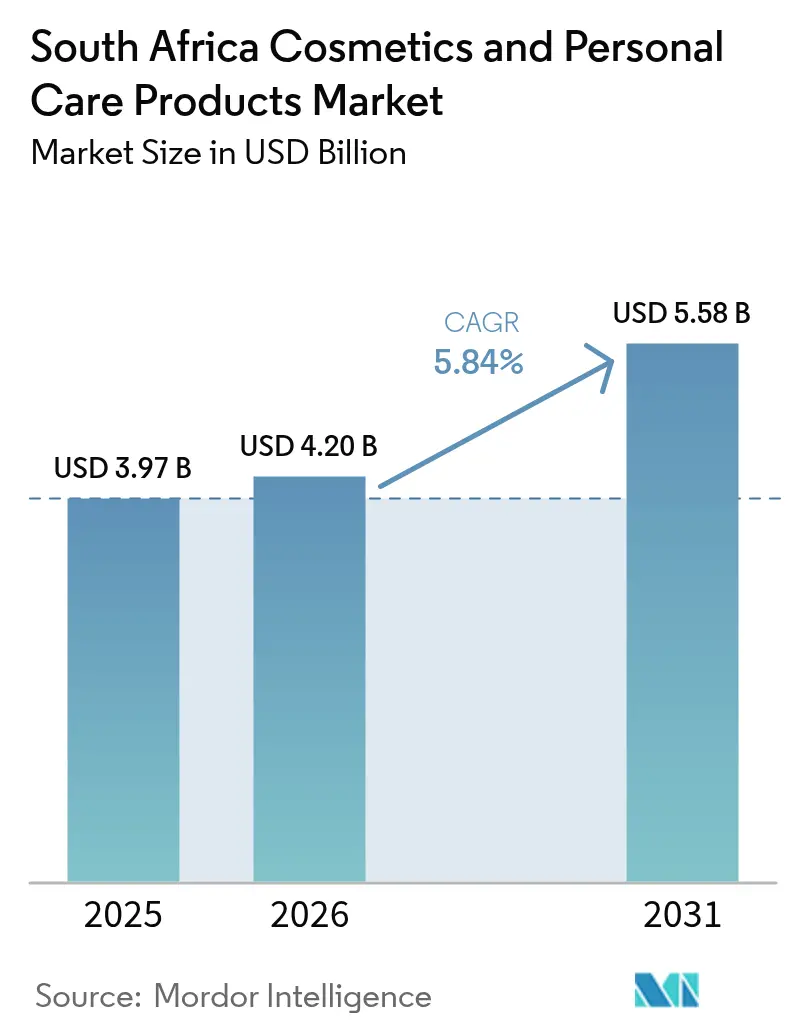
| Base Year Market Size (2025) | USD 3.97 Billion |
| Market Size (2026) | USD 4.2 Billion |
| Market Size (2031) | USD 5.58 Billion |
| Growth Rate (2026 - 2031) | 5.84 % |
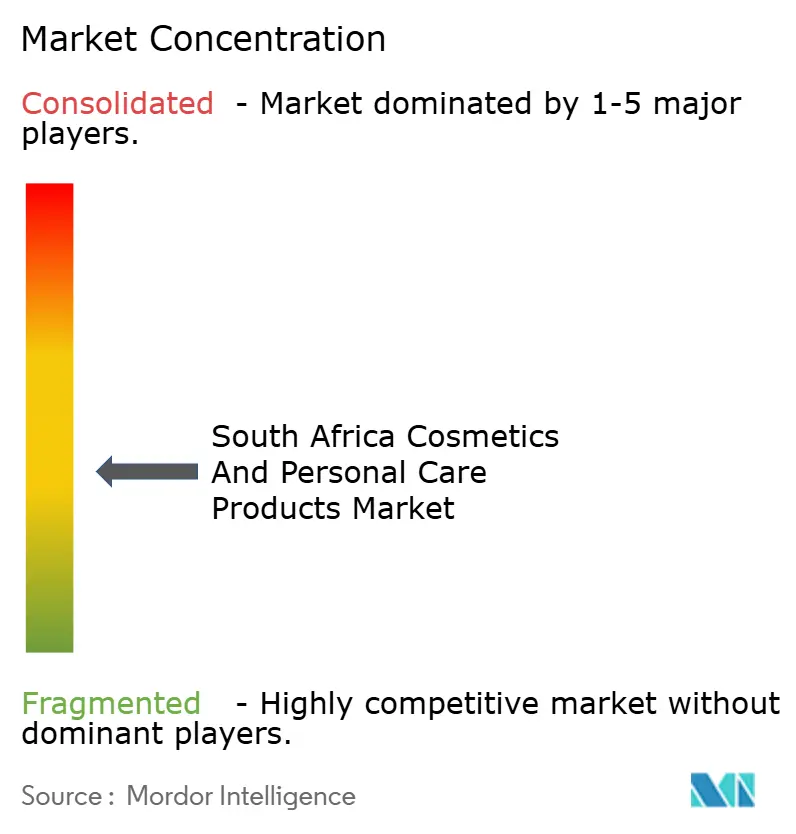
| Market Concentration | Medium |
Major Players
*Disclaimer: Major Players sorted in no particular order Image © Mordor Intelligence. Reuse requires attribution under CC BY 4.0. |
|
South Africa Cosmetics And Personal Care Products Market Analysis by Mordor Intelligence
The South Africa cosmetics and personal care products market size is expected to grow from USD 3.97 billion in 2025 to USD 4.2 billion in 2026 and is forecast to reach USD 5.58 billion by 2031 at 5.84% CAGR over 2026-2031. The growing middle-class population, coupled with increasing disposable incomes, has further fueled the adoption of premium and natural products, which are gaining popularity due to their perceived health and environmental benefits. Moreover, the influence of global beauty trends, including the demand for organic and cruelty-free products, is shaping consumer preferences in South Africa. The penetration of e-commerce platforms has also played a pivotal role in expanding market accessibility, enabling consumers to explore and purchase a variety of products conveniently. The market is witnessing continuous innovation in product formulations, such as the incorporation of natural ingredients and advanced technologies, to cater to the diverse needs of South African consumers. Packaging innovations, including eco-friendly and sustainable options, are also gaining traction as environmental concerns grow among consumers. Additionally, the increasing presence of international brands and the expansion of local manufacturers are contributing to the competitive landscape of the market.
Key Report Takeaways
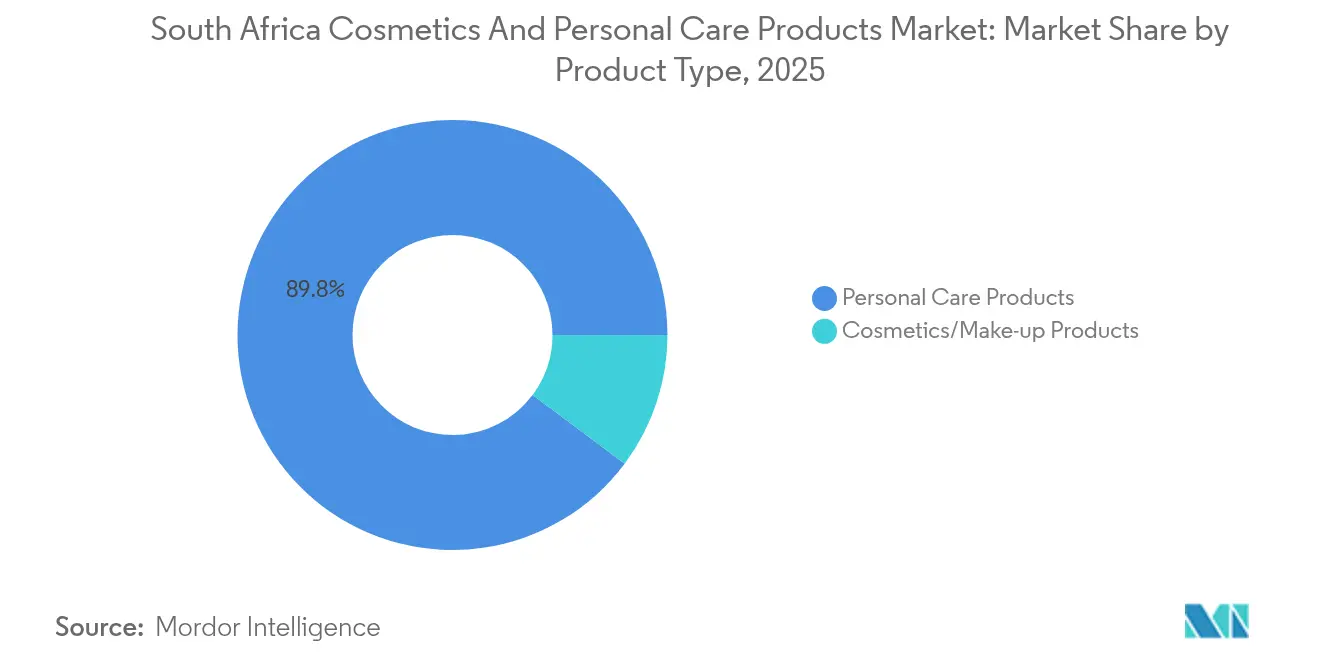
- By product type, personal care items held 89.78% of the South Africa cosmetics and personal care products market share in 2025; cosmetics and is projected to grow at the fastest 6.24% CAGR through 2031.
- By category, mass-market products commanded 85.62% share in 2025, while the premium segment is expanding at a 6.69% CAGR to 2031.
- By ingredient type, conventional/synthetic formulations accounted for 74.92% of the South Africa cosmetics and personal care products market size in 2025; natural and organic products are advancing at a 6.9% CAGR.
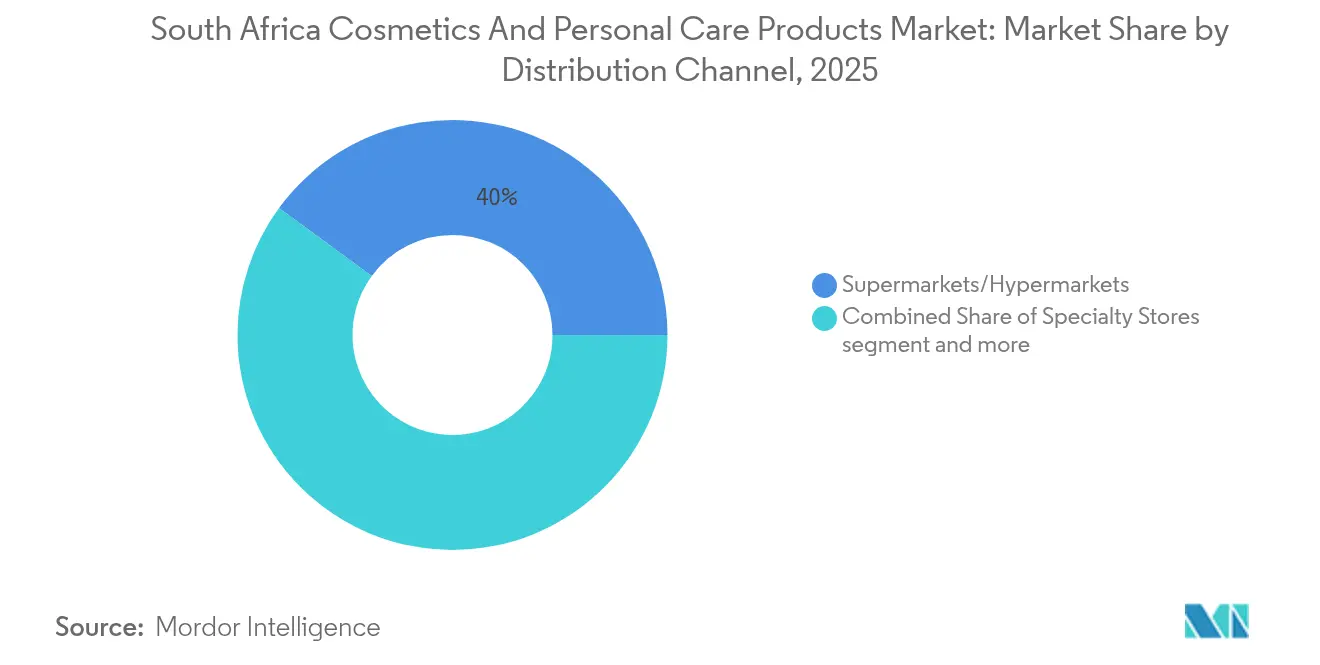
- By distribution channel, supermarkets and hypermarkets led with 39.95% revenue share in 2025, whereas online retail is accelerating at an 8.01% CAGR on the back of rising e-commerce adoption.
Note: Market size and forecast figures in this report are generated using Mordor Intelligence’s proprietary estimation framework, updated with the latest available data and insights as of 2026.
South Africa Cosmetics And Personal Care Products Market Trends and Insights
Drivers Impact Analysis*
| DRIVER | (~) % IMPACT ON CAGR FORECAST | GEOGRAPHIC RELEVANCE | IMPACT TIMELINE |
|---|---|---|---|
| Rising demand for natural and organic products | +1.2% | National, with early gains in Cape Town, Johannesburg, Durban | Medium term (2-4 years) |
| Increasing focus on men’s skincare products | +0.8% | Urban centers, expanding to townships | Long term (≥ 4 years) |
| Growing concern for oral hygiene | +0.6% | National, with higher penetration in middle-income segments | Short term (≤ 2 years) |
| Influence of social media and digital technology | +1.1% | National, youth-driven adoption | Short term (≤ 2 years) |
| Rapid urbanization and increasing disposable income | +0.9% | Major metropolitan areas, secondary cities | Long term (≥ 4 years) |
| Growth in e-commerce platforms | +1.0% | National, with concentration in urban areas | Medium term (2-4 years) |
| Source: Mordor Intelligence | |||
Rising demand for natural and organic products
The market is witnessing a significant rise in demand for natural and organic products. Consumers are increasingly prioritizing products made from natural ingredients, driven by growing awareness of the potential health and environmental impacts of synthetic chemicals. This shift is further fueled by a preference for sustainable and eco-friendly options, aligning with global trends toward greener lifestyles. Additionally, the rising disposable income among South African consumers has enabled them to invest in premium, organic personal care products. The market is also benefiting from the increasing availability of such products across various distribution channels, including online platforms, supermarkets, hypermarkets, and specialty stores. Furthermore, the influence of social media and digital marketing has amplified awareness about the benefits of organic and natural cosmetics, encouraging consumers to make informed purchasing decisions. Local and international manufacturers are actively expanding their product portfolios to include organic formulations, catering to the growing demand. This trend is expected to continue driving growth in the forecast period, as manufacturers innovate to meet the evolving preferences of health-conscious and environmentally aware consumers.
Increasing focus on men’s skincare products
In South Africa, the cosmetics and personal care market is witnessing a surge, largely driven by a heightened focus on men's skincare. As men become more aware of personal grooming and skincare, there's a noticeable uptick in demand for products tailored specifically to their skin. In response, companies are rolling out innovative offerings, from anti-aging creams to sunscreens, all crafted with men in mind. These products are formulated to address unique male skincare needs, such as thicker skin, higher collagen density, and increased exposure to environmental stressors. Moreover, marketing efforts, bolstered by endorsements from male influencers and celebrities, are amplifying the appeal of these products. Campaigns often emphasize the importance of skincare in enhancing confidence and overall appearance, resonating with the growing male consumer base. Data from ITC Trade Map highlights this trend: South Africa's import value for skincare makeup preparations jumped from USD 219.04 million in 2022 to USD 251.41 million in 2024 [1]Source: ITC Trade Map, "Import Value of Skincare Make-up Preparations (HS Code: 3304), trademap.org. This underscores the burgeoning demand, especially for products aimed at men. Given these dynamics, the trend is poised to play a pivotal role in the market's growth trajectory.
Rapid urbanization and increasing disposable income
In South Africa, rapid urbanization and rising disposable incomes are propelling the cosmetics and personal care products market. Data from the World Bank indicates that by 2024, 69% of South Africa's population had transitioned to urban living [2]Source: World Bank, “Urban population (% of total population)”, data.worldbank.org. This urban migration has spurred a heightened demand for personal care products tailored to an urban lifestyle, as urban consumers often seek convenient, high-quality, and innovative products to match their fast-paced routines. With increasing disposable incomes, consumers are also leaning towards premium and specialized cosmetic products, including organic, natural, and dermatologist-recommended options. This shift is especially pronounced among the youth, who find themselves swayed by global beauty benchmarks, celebrity endorsements, and the latest social media trends, such as tutorials and influencer recommendations. Additionally, the growing penetration of e-commerce platforms has made these products more accessible, further driving market growth. Given these dynamics, the South African cosmetics and personal care market is poised for significant growth in the coming years.
Growth in e-commerce platforms
In South Africa, the cosmetics and personal care products market is being significantly propelled by the rise of e-commerce platforms. As of January 2024, the International Trade Association reported that South Africa had 45.34 million active internet users, representing 74.7% of its population. Between January 2023 and January 2024, the nation saw an uptick of 409,000 internet users, translating to a 0.9% growth [3]Source: International Trade Administration, "South Africa Country Commercial Guide", trade.gov. This growth highlights the increasing accessibility of digital platforms across the country. With the deepening reach of the internet and the surging adoption of smartphones, online shopping has become increasingly accessible to a broader demographic, including urban and semi-urban areas. E-commerce platforms, with their convenience, vast product selections, and competitive pricing, are drawing in a larger customer base. Moreover, features like product comparisons, review readings, and exclusive online discounts amplify the allure of these platforms, making them a preferred choice for consumers. This momentum is poised to persist, further energizing the market in the coming years as digital infrastructure continues to improve and consumer preferences shift toward online channels.
Restraints Impact Analysis*
| RESTRAINT | (~) % IMPACT ON CAGR FORECAST | GEOGRAPHIC RELEVANCE | IMPACT TIMELINE |
|---|---|---|---|
| Consumer awareness of chemical ingredients | -0.7% | Urban areas, educated demographics | Medium term (2-4 years) |
| Presence of counterfeit products | -1.2% | National, concentrated in informal retail | Long term (≥ 4 years) |
| Price sensitivity among consumers | -0.9% | National, particularly township markets | Short term (≤ 2 years) |
| Concerns about harmful chemical ingredients | -0.5% | Health-conscious urban consumers | Medium term (2-4 years) |
| Source: Mordor Intelligence | |||
Consumer awareness of chemical ingredients
Increasing consumer awareness regarding the chemical ingredients used in products is acting as a significant market restraint in the market. Consumers are becoming more informed about the potential health and environmental impacts of certain chemicals commonly found in cosmetics and personal care items. This growing awareness is driving demand for transparency in ingredient labeling and pushing manufacturers to reformulate products to exclude harmful substances such as parabens, sulfates, and synthetic fragrances. Furthermore, the rise of social media and digital platforms has amplified consumer access to information, enabling them to research and scrutinize product formulations more effectively. Additionally, regulatory bodies are implementing stricter guidelines to ensure consumer safety, further influencing market dynamics. These regulations often require companies to conduct extensive testing and certification processes, which can be time-consuming and costly. As a result, companies are facing challenges in adapting to these evolving consumer preferences and regulatory requirements, which may increase production costs and impact profit margins.
Presence of counterfeit products
The presence of counterfeit products poses a major restraint restraint in the South Africa Cosmetics and Personal Care Products Market. These counterfeit goods, often sold at lower prices, undermine the sales of genuine products, impacting the revenue of established brands. Additionally, counterfeit cosmetics and personal care items may not adhere to safety and quality standards, leading to potential health risks for consumers. This situation erodes consumer trust in the market and creates challenges for manufacturers and retailers in maintaining brand reputation. The proliferation of counterfeit products is further fueled by inadequate regulatory enforcement and the rise of online marketplaces, where such items are more easily distributed. Counterfeit products also create an uneven playing field, as legitimate manufacturers must compete with lower-priced, substandard alternatives. This issue not only affects the profitability of established players but also discourages new entrants from investing in the market due to the risk of brand dilution.
*Our forecasts treat driver/restraint impacts as directional, not additive. The impact forecasts reflect baseline growth, mix effects, and variable interactions.
Segment Analysis
By Product Type: Personal Care Dominates Growth Trajectory
In 2025, the Personal Care Products segment dominated the market, claiming a substantial 89.78% share. Forecasts indicate this segment will outpace the overall market, growing at a CAGR of 6.05% from 2026 to 2031. Within this segment, Skin Care products are on the rise, fueled by heightened consumer awareness of preventative skincare and a surging demand for multifunctional formulations. These formulations address multiple concerns: hydration, anti-aging, and sun protection, all in one product. Social media and beauty influencers amplify this demand, as consumers chase solutions that resonate with global beauty trends. The increasing availability of premium skincare products and the expansion of e-commerce platforms are further driving the segment's growth, making these products more accessible to a broader audience. Meanwhile, the Hair Care segment thrives, bolstered by products tailored to South Africa's rich tapestry of hair textures: curly, coily, and wavy.
Consumers are increasingly gravitating towards natural and organic hair care, emphasizing sustainability and chemical-free choices. The segment's growth is also fueled by the rising trend of protective hairstyles and the specialized products needed to maintain them. Additionally, the influence of cultural pride and the promotion of local brands catering to diverse hair needs are contributing to the segment's expansion. On another front, the Oral Care segment is witnessing a wave of innovation. Manufacturers are rolling out advanced products, from toothpaste to mouthwash, targeting specific concerns like sensitivity, whitening, and gum health. This growth is further propelled by initiatives to tackle Africa's dental professional shortage, with some areas reporting a stark ratio of one dentist for every 10,000 residents. Efforts to improve oral health awareness through educational campaigns and collaborations with healthcare providers are also playing a significant role in driving demand for oral care products.



By Category: Mass Products Maintain Market Dominance
Mass products dominate South Africa's cosmetics and personal care market, claiming an 85.62% share. This stronghold underscores the value-driven choices of many South African consumers, who emphasize affordability and accessibility. Catering to a diverse demographic, mass products address essential cosmetic and personal care needs. Their dominance is bolstered by widespread distribution networks, with products readily available in supermarkets, hypermarkets, and convenience stores. These extensive networks ensure that mass products are accessible even in remote areas, further solidifying their market position. Moreover, a steady demand for budget-friendly solutions promises continued growth for this segment, as consumers consistently seek cost-effective options without compromising on basic quality.
On the other hand, the premium products segment, though smaller in market share, is on a significant upswing. Forecasted to grow at a CAGR of 6.69% from 2026 to 2031, this segment is buoyed by an expanding consumer base in pursuit of luxury and high-quality offerings. This growth is driven by factors like rising disposable incomes, heightened brand awareness, and a trend towards personalized, innovative products. Consumers are increasingly drawn to premium products that offer unique formulations, advanced benefits, and exclusivity. The segment's rise is further bolstered by the influx of international brands and the surge of e-commerce platforms, making premium products more accessible to South Africans. Additionally, the sway of social media and beauty influencers is markedly elevating the profile of premium products, especially among younger consumers, who are more inclined to explore and invest in high-end beauty and personal care solutions.
By Ingredient Type: Conventional Products Maintain Market Leadership
Conventional and synthetic ingredients currently dominate the South African cosmetics and personal care products market, holding a substantial 74.92% market share. These ingredients are widely used due to their cost-effectiveness, longer shelf life, and consistent performance in product formulations. Additionally, their availability in bulk and compatibility with various product types make them a preferred choice for manufacturers targeting mass-market consumers. However, growing consumer awareness regarding potential health and environmental concerns associated with synthetic ingredients is gradually impacting their dominance. Despite this, they remain a key component in the market, especially in mass-market products where affordability and accessibility are critical factors.
On the other hand, natural and organic alternatives are gaining significant traction, driven by increasing consumer preference for sustainable and eco-friendly products. These alternatives are supported by a strong projected CAGR of 6.9% for the period 2026 to 2031. Factors such as rising health consciousness, demand for clean-label products, and regulatory support for natural formulations are fueling this growth. Furthermore, the growing influence of social media and endorsements by beauty influencers advocating for natural and organic products are accelerating their adoption. As a result, manufacturers are increasingly investing in the development of innovative natural and organic product lines to cater to this growing demand.
By Distribution Channel: Digital Transformation Reshapes Traditional Retail
Supermarkets and hypermarkets hold a dominant 39.95% share of South Africa's cosmetics market, driven by their extensive geographic presence and the convenience they offer to consumers. These retail formats benefit from their ability to stock a wide range of cosmetics and personal care products, catering to diverse consumer preferences. Additionally, their established reputation and strong consumer trust have enabled them to maintain a leadership position in the market. Promotional strategies, such as discounts and loyalty programs, further enhance their appeal, attracting a steady flow of customers. The accessibility of these outlets in both urban and suburban areas ensures consistent consumer engagement, solidifying their market dominance.
Online retail channels, on the other hand, are experiencing significant growth, with a projected CAGR of 8.01% during the forecast period (2026-2031). This growth is fueled by increasing internet penetration, the rising adoption of smartphones, and the convenience of online shopping. E-commerce platforms offer a wide variety of cosmetics and personal care products, often accompanied by competitive pricing and doorstep delivery services, which appeal to tech-savvy and time-constrained consumers. Furthermore, the integration of advanced technologies, such as AI-driven product recommendations and virtual try-on features, is enhancing the online shopping experience. As a result, online retail is emerging as a key distribution channel in South Africa's cosmetics and personal care products market.
Geography Analysis
South Africa, recognized as the continent's most sophisticated retail landscape, serves as the primary entry point for global brands targeting the African market. The nation's cosmetics and personal care sector flourishes, fueled by a rising middle class with increasing disposable incomes and beauty preferences that seamlessly merge global influences with local nuances. Major urban hubs, Johannesburg, Cape Town, Durban, Pretoria, and Gqeberha, account for 90% of the nation's economically active populace, driving the country's cosmetics consumption. These metropolitan areas not only show a pronounced preference for premium offerings but also demonstrate a strong receptiveness to novel formulations and packaging. The urban population's inclination towards high-quality products and innovative solutions makes these cities critical for market penetration and growth strategies.
Regional variations in consumer preferences and product uptake reflect South Africa's diverse climate and rich multicultural tapestry. Coastal regions, for example, gravitate towards sun protection and moisture-retention products, driven by the area's exposure to higher humidity and sunlight. In contrast, inland regions exhibit distinct consumption patterns shaped by drier environmental conditions, leading to a demand for products that address hydration and skin nourishment. This regional diversity necessitates tailored product offerings to meet the specific needs of consumers across different parts of the country. Such variations also highlight the importance of localized marketing strategies for companies aiming to establish a strong foothold in the market.
As a pivotal economic center, South Africa has established itself as the manufacturing and distribution hub for cosmetics across Southern Africa. The domestic production landscape increasingly emphasizes the use of indigenous ingredients, aligning with both local consumer preferences and the growing demand for natural and sustainable products in export markets. This leadership position is further reinforced by South Africa's relatively advanced regulatory framework, which ensures heightened consumer protection and product standards, surpassing those of many neighboring countries. The combination of a robust regulatory environment, a skilled workforce, and well-developed infrastructure positions South Africa as a key player in the regional cosmetics and personal care products market.
Regulatory Landscape
Cosmetics and personal care products sold, manufactured, or imported in South Africa are primarily governed under the Foodstuffs, Cosmetics and Disinfectants Act, 1972 (Act 54 of 1972), administered by the National Department of Health. Technical compliance for certain product categories is also shaped by compulsory specifications administered by the National Regulator for Compulsory Specifications (NRCS), where in-scope products may require a Letter of Authority (LOA) for market access.
Standards and claims substantiation are influenced by the South African Bureau of Standards (SABS) through SANS standards referenced by industry and procurement requirements, including sunscreen performance and ingredient labelling standards (for example, SANS 1557 and SANS 98). While voluntary in many cases, these standards still operate as practical compliance anchors for manufacturers and retailers. NRCS reviews of compulsory specifications also continue to align with updated legislative requirements and international practices.
Competitive Landscape
South Africa's cosmetics and personal care products market showcases a moderate fragmentation. Established multinationals vie for dominance alongside emerging local entities and regional specialists. Key players, including Unilever, Procter & Gamble, L'Oréal, Henkel AG & Co. KGaA, and Estée Lauder, navigate this landscape. These industry giants harness their global resources, yet tailor their strategies to resonate with local consumer preferences and the nation's economic nuances. Such a balanced approach not only solidifies their market presence but also caters to the distinct needs of South African consumers. This competitive arena spurs innovation and strategic differentiation among its participants.
A significant trend shaping the market is digital transformation, with companies increasingly adopting advanced technologies to enhance consumer engagement. For instance, Unilever has implemented AI-driven solutions to improve customer connectivity and launched science-based skincare recommendation platforms. These initiatives aim to provide personalized experiences, thereby strengthening brand loyalty and consumer trust. The integration of digital tools not only enhances operational efficiency but also enables companies to respond swiftly to changing consumer behaviors and preferences. This focus on technology-driven strategies underscores the importance of staying relevant in a dynamic and competitive market.
Another notable trend is the growing emphasis on premiumization, driven by luxury retail expansion and innovative product offerings. Companies are investing in high-end product lines to cater to the rising demand for premium cosmetics and personal care products. At the same time, mass-market players are focusing on value positioning and accessibility to attract price-sensitive consumers. This dual approach ensures that the market caters to a diverse consumer base, ranging from those seeking affordable options to those willing to pay a premium for quality and exclusivity. The balance between premiumization and value-driven strategies highlights the adaptability of market players in addressing varied consumer needs and preferences.
South Africa Cosmetics And Personal Care Products Industry Leaders
-
Beiersdorf AG
-
The Estée Lauder Companies Inc.
-
The Procter & Gamble Company
-
Henkel AG & Co. KGaA
-
L'Oréal SA
- *Disclaimer: Major Players sorted in no particular order

Market Opportunities and Future Outlook
Retailers and brands increasingly use South Africa as a launch and scaling market for beauty, which creates room for differentiated portfolios across mass and premium tiers. Expansion activity shows up in omnichannel retail, including stand-alone beauty formats (for example, Woolworths beauty retail rollout) and broader shelf-space competition tied to sector coverage of the countrys multi-billion-dollar beauty market. This environment supports brands that can win distribution across supermarkets, pharmacies, and specialist chains.
Opportunity areas center on ingredient transparency, dermocosmetic proof points, and sustainability-linked packaging. Advertising Regulatory Board (ARB) actions related to dermatologist-recommended and recommended-brand claims have raised the bar for substantiation, reinforcing the value of evidence-backed positioning and compliant communications. On the supply side, local capability building can shorten iteration cycles and improve localization. Prime Product Manufacturings acquisition of L'Oreal South Africas Midrand facility, reported as a capacity step-up for contract manufacturing, and Unilevers Johannesburg automated refill store collaboration with Sonke point to two practical pathways, local production scale-up and circular retail models, for brands seeking to improve availability, reduce single-use packaging, and tailor products to local climate and skin and hair needs.
Recent Industry Developments
- June 2026: Masodi Beauty expanded its retail footprint by securing placement at Dis-Chem, moving the brand further into mainstream pharmacy-led distribution. The listing improves national visibility and creates a clearer route for scaling haircare and beauty assortments beyond informal and niche channels.
- May 2026: The Advertising Regulatory Board (ARB) ruled that L'Oreal could substantiate La Roche-Posays "No. 1 recommended brand" claim using independent research, following a challenge from Beiersdorf. The decision sharpened competitive dynamics in dermocosmetics by reinforcing that marketing claims must be supported by current, defensible evidence in the South African context.
- September 2024: Woolworths opened its first standalone beauty store at Waterstone Village in Somerset West, widening access to curated local and international beauty brands. The opening signaled continued retailer investment in dedicated beauty environments, supporting premiumization and higher-margin category focus within South African brick-and-mortar retail.


Research Methodology Framework and Report Scope
Market Definition and Coverage
This market covers the value of cosmetics and personal care products sold in South Africa across mass and premium offerings, counted at the product level and tracked through major retail and online channels.
Scope exclusions: Services such as salon treatments and aesthetic procedures are excluded, and illegal or unregistered trade is not explicitly sized.
Segmentation Overview
-
By Product Type
-
Personal Care Products
-
Hair Care
- Shampoo
- Conditioner
- Hair Colourant
- Hair Styling Products
- Others
-
Skin Care
- Facial Care Products
- Body Care Products
- Lip and Nail Care Products
-
Bath and Shower
- Shower Gels
- Soaps
- Others
-
Oral Care
- Toothbrush
- Toothpaste
- Mouthwashes and Rinses
- Others
- Men's Grooming Products
- Deodorants and Antiperspirants
- Perfumes and Fragrances
-
Hair Care
-
Cosmetics/Make-up Products
- Facial Cosmetics
- Eye Cosmetics
- Lip and Nail Make-up Products
-
Personal Care Products
-
By Category
- Premium Products
- Mass Products
-
By Ingredient Type
- Natural and Organic
- Conventional/Synthetic
-
By Distribution Channel
- Specialty Stores
- Supermarkets/Hypermarkets
- Online Retail Stores
- Other Channels
Data Sources, Market Sizing, and Validation
Desk Research
Desk work started by building a simple fact base on South Africa population, income trends, inflation, and household spend patterns that influence grooming and beauty purchases. We leaned on public and official sources such as Statistics South Africa releases, the South African Reserve Bank for macro indicators, SARS trade statistics for selected imports, and South African Bureau of Standards guidance for product and labeling context.
To make the market model more realistic, we also reviewed publicly available retailer updates, company annual reports, and reputed press coverage for category language and channel shifts (including the pace of online growth). In a few cases, paid subscriptions for company financials and intelligence, news and financials, shipment-level import and export data, and patent databases were used to cross-check directionally where public data was thin. The source examples listed here are illustrative and not exhaustive, and many other public documents and datasets were also reviewed for collection, validation, and clarification.
Primary Interviews and Surveys
Primary work was used to pressure-test category scope, price ladders, and distribution splits across grocery, pharmacy, specialist retail, and online. We spoke with a mix of brand owners, distributors, retailers, and packaging or ingredient-linked participants, then rechecked assumptions using independent experts who track consumer demand signals across South Africa.
Distribution of primary research fieldwork respondents
| Company type | Respondent position |
|---|---|
| Top tier: 36% | CXOs: 15% |
| Mid tier: 45% | Functional/Unit leaders: 33% |
| Smaller Players: 19% | Managers: 52% |
Market-Sizing & Forecasting
Sizing was built using top-down and bottom-up logic, where household spend signals and category participation rates were used to reconstruct the addressable demand pool in South Africa. Those totals were then allocated across product groups and channels. To keep it grounded, we corroborated results with selective bottom-up approximations, such as sampled price points across channels multiplied by volume proxies, followed by supplier and distributor roll-ups where disclosures were available.
Data Validation & Update Cycle
Model outputs were checked against independent signals such as category growth commentary from South African retailers, trade movement for relevant product groups, and consistency of implied per-capita spend. Large variances were flagged, reviewed in steps, and corrected only after assumptions were re-tested through follow-up outreach and internal analyst review.
The report is refreshed annually, and interim updates are made when major events materially change demand, pricing, or channel structure. Before delivery, a final pass is completed so clients receive the latest updated view.
Mordor Intelligence's South Africa Cosmetics and Personal Care Products Market Market Sizing Compared With Other Published Estimates
Published market sizes for South Africa often do not line up because each publisher mixes product categories differently, uses its own price basis, and may apply different inflation and currency timing for the same year. Differences also show up when one estimate leans more on retail sell-out logic versus another that leans on production or trade indicators.
Salon and aesthetic treatment services sit outside Mordor Intelligence's scope, and the table spread also reflects how some sources narrow the basket to cosmetics-only or apply smoother price and channel assumptions over longer horizons.
Benchmark comparison
| Source | Market Size | Gaps in Research Methodology |
|---|---|---|
| Mordor Intelligence | USD 3.97 B (2025) | |
| Industry Publisher A | USD 3.00 B (2025) | Uses a cosmetics-only definition that can exclude several personal care lines, and it typically applies a longer forecast window where near-term pricing and channel shifts are smoothed. |
| Industry Publisher B | USD 3.71 B (2025) | Often centers on cosmetic products with limited clarity on whether oral care, bath and shower, or similar personal care items are included, which can compress totals versus a broader basket. |
Overall, most of the difference comes from what is counted as the product basket, and then from how prices and channel mix are carried forward year to year. When inclusions are kept explicit and cross-checks are done with channel and pricing signals, the final number is easier to trace back to clear steps.


Key Questions Answered in the Report
How big is the South Africa cosmetics and personal care products market in 2026?
The market is valued at USD 4.2 billion in 2026 and is projected to reach USD 5.58 billion by 2031.
Which product category holds the largest share?
Personal-care essentials command 89.78% of sales, thanks to daily use items such as hair-care and skin-cleansing products.
What is driving the premium segment’s faster growth?
Rising disposable income, luxury mall expansion, and social-media influence encourage consumers to trade up to higher-quality formulations.
How significant is e-commerce for beauty sales?
Online retail, led by platforms like Takealot, is growing at an 8.01% CAGR and is expected to account for about 10% of national beauty retail turnover by 2025.
Page last updated on:


 Your data is secure and never sold or shared.


