
Cloud Endpoint Protection Market Size and Share
Market Overview
| Study Period | 2020 - 2031 |
|---|---|
| Market Size (2026) | USD 2.59 Billion |
| Market Size (2031) | USD 4.99 Billion |
| Growth Rate (2026 - 2031) | 14.04 % |
| Fastest Growing Market | Asia Pacific |
| Largest Market | North America |
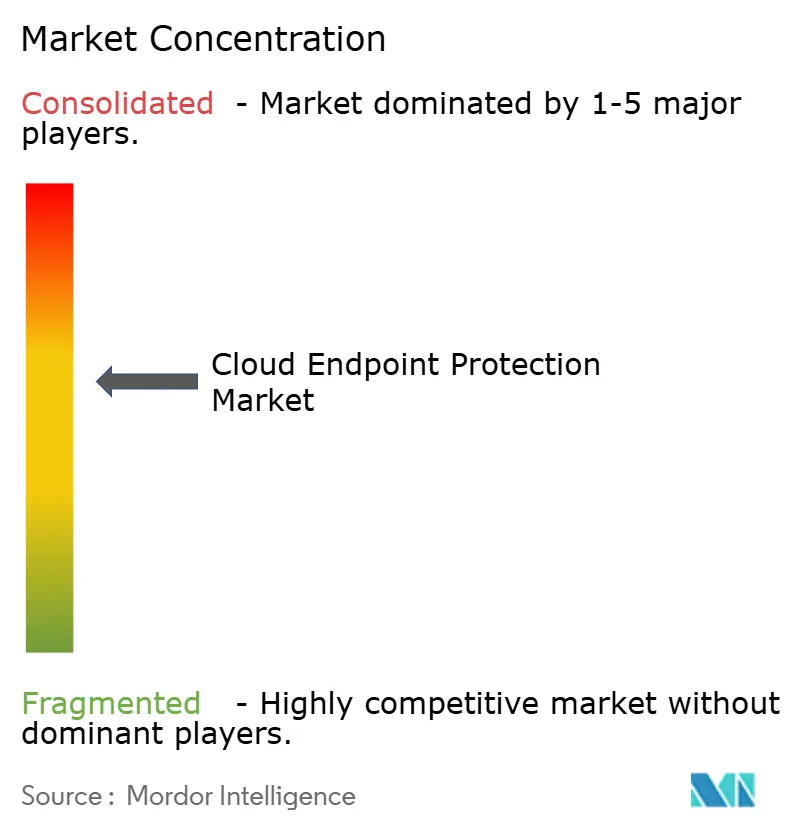
| Market Concentration | Medium |
Major Players *Disclaimer: Major Players sorted in no particular order Image © Mordor Intelligence. Reuse requires attribution under CC BY 4.0. | |
Cloud Endpoint Protection Market Analysis by Mordor Intelligence
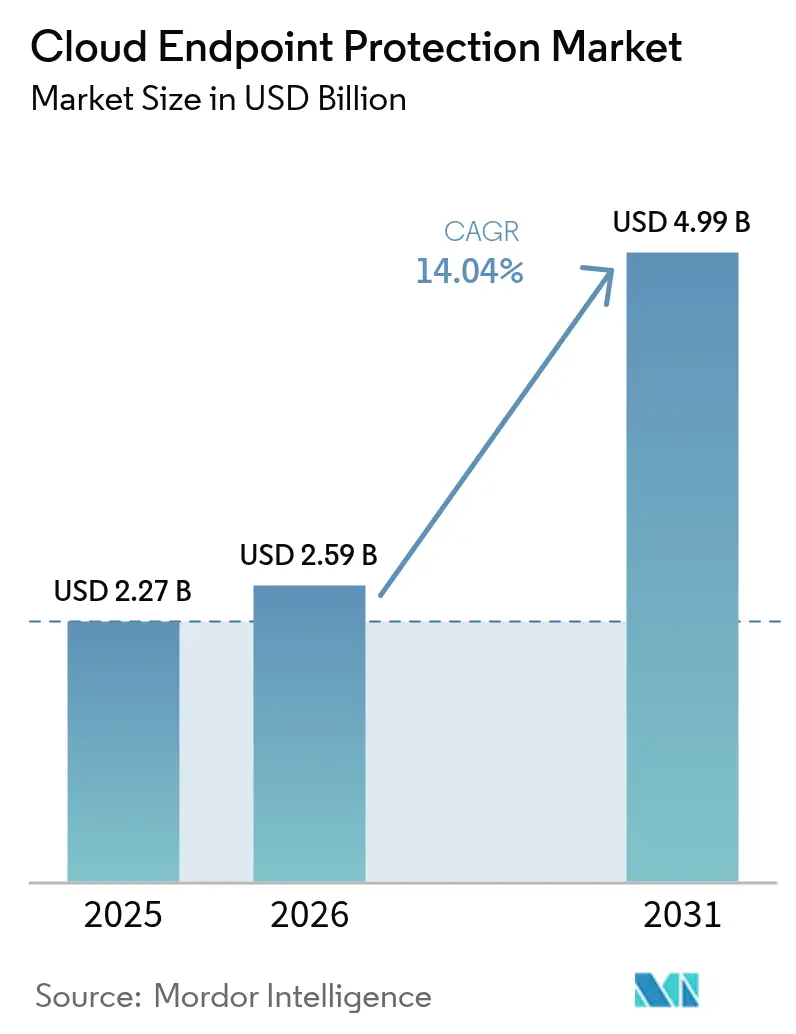
cloud endpoint protection market size in 2026 is estimated at USD 2.59 billion, growing from 2025 value of USD 2.27 billion with 2031 projections showing USD 4.99 billion, growing at 14.04% CAGR over 2026-2031. The surge is explained by the rapid expansion of distributed workforces, cloud-native workloads, and the board-level push toward Zero Trust architecture. Large public-sector investments reinforce demand; for example, the U.S. Department of the Interior raised its FY 2025 cybersecurity allocation to USD 67.8 million, up USD 23.4 million solely for Zero Trust implementation [1]. Intensifying regulatory pressure such as the EU NIS2 Directive plus the HIPAA Security Rule proposals is sustaining double-digit adoption curves [2]. At the same time, AI-enhanced threats and the global cyber-talent shortage are accelerating managed detection and response outsourcing—especially across small and medium enterprises—thus broadening the addressable cloud endpoint protection market. Competitive dynamics tightened after CrowdStrike’s July 2024 outage, which triggered vendor diversification and catalyzed investment in AI-driven Extended Detection and Response (XDR) platforms.
Key Report Takeaways
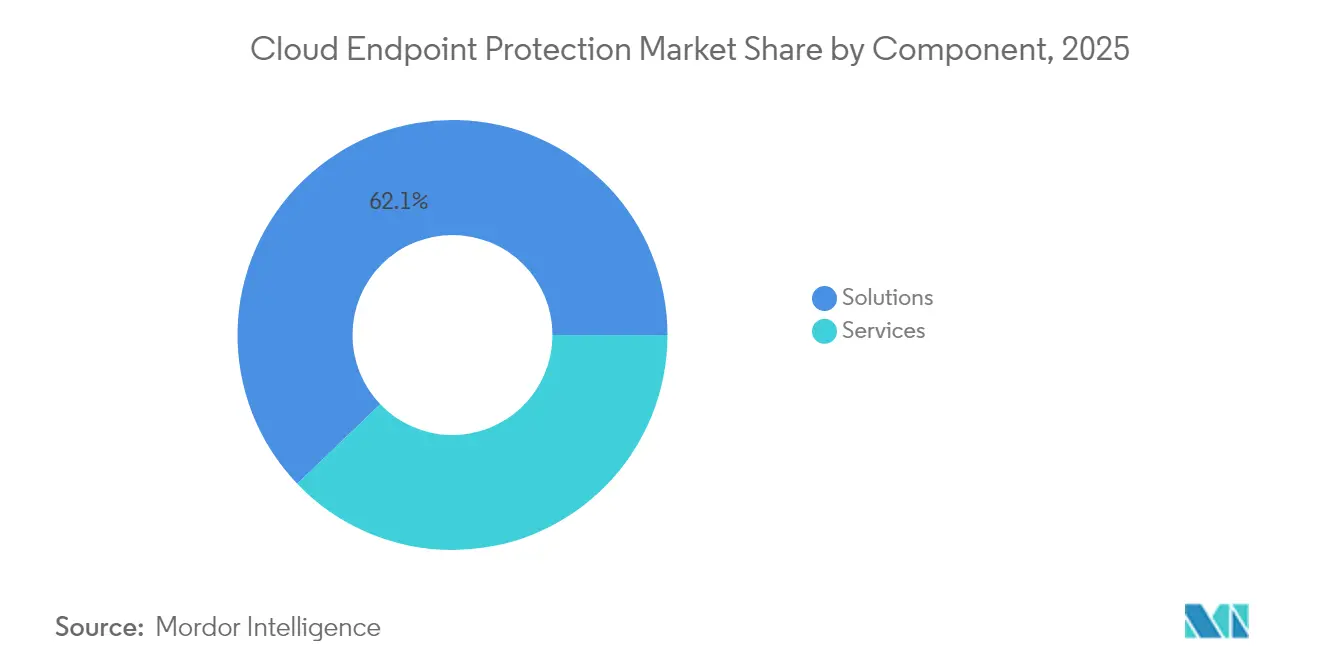
- By component, solutions held 62.15% of the cloud endpoint protection market share in 2025, whereas services are set to expand at a 14.72% CAGR to 2031.
- By enterprise size, large enterprises captured 57.45% of the cloud endpoint protection market share in 2025, while small and medium enterprises are forecast to grow at a 16.65% CAGR through 2031.
- By deployment model, public cloud led with 48.86% revenue share in 2025; hybrid cloud is projected to climb at an 17.35% CAGR through 2031.
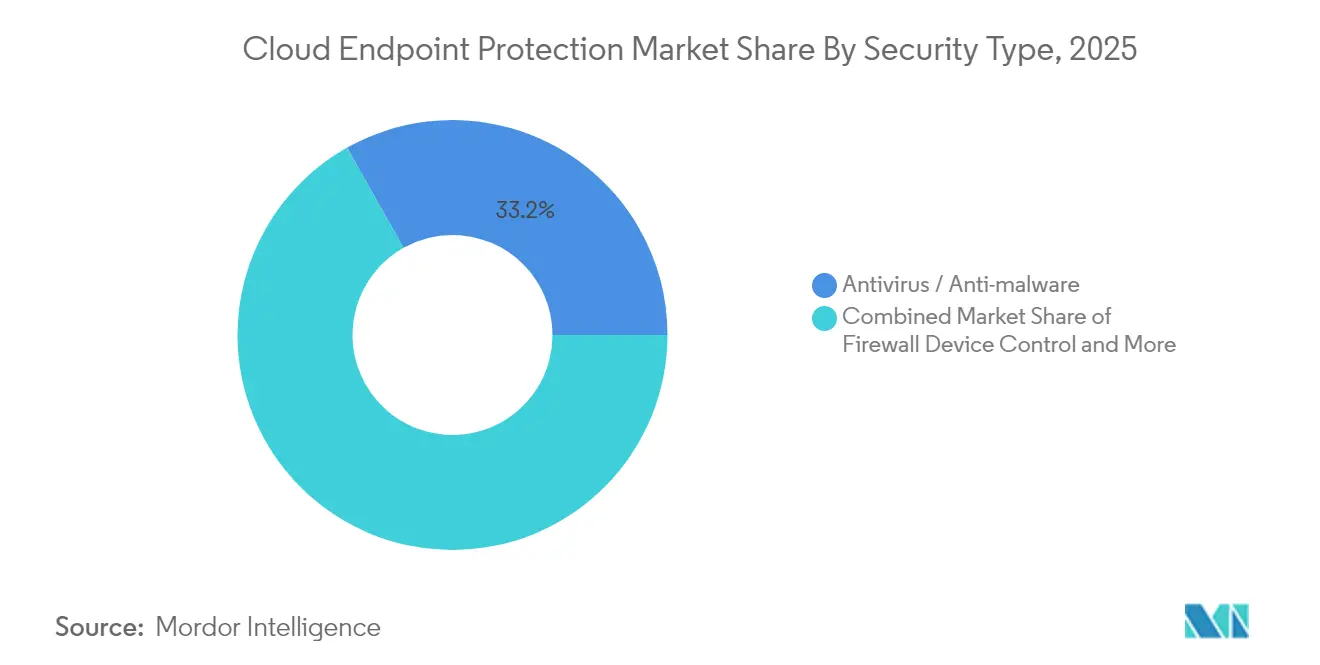
- By security type, antivirus and anti-malware still account for 33.15% of 2025 revenue, acting as baseline hygiene. However, EDR’s 20.95% CAGR signals a profound pivot to behavioral analytics and automated remediation. The cloud endpoint protection market size tied to EDR is projected to exceed USD 2.08 billion by 2031,
- By end-user industry, the BFSI sector accounted for a 24.95% slice of the cloud endpoint protection market size in 2025; healthcare is advancing at an 17.55% CAGR to 2031.
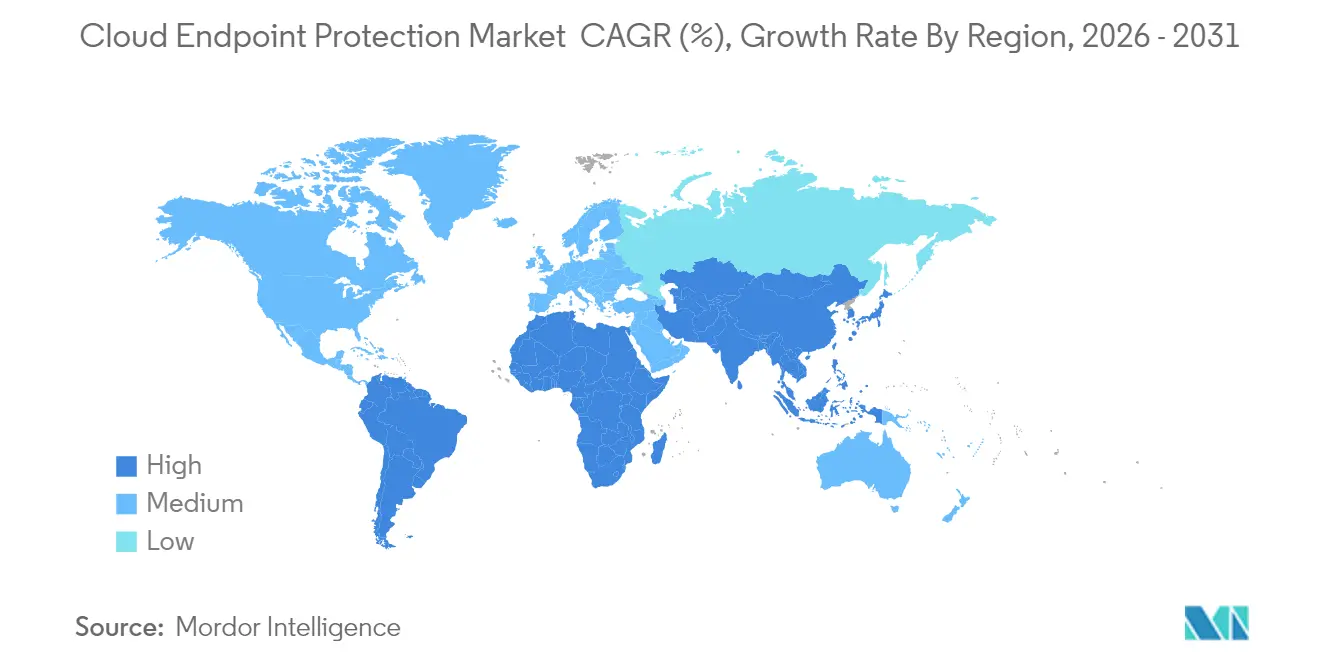
- By geography, North America delivered 40.35% of the cloud endpoint protection market size in 2025,
Note: Market size and forecast figures in this report are generated using Mordor Intelligence’s proprietary estimation framework, updated with the latest available data and insights as of 2026.
Market Trends and Insights
Drivers Impact Analysis of Cloud Endpoint Protection Market*
| Driver | (~) % Impact on CAGR Forecast | Geographic Relevance | Impact Timeline |
|---|---|---|---|
| Proliferation of remote work & BYOD | +2.8% | North America & Europe, global reach | Medium term (2-4 years) |
| Surge in sophisticated cyber-attacks & data breaches | +3.2% | APAC & North America | Short term (≤ 2 years) |
| Regulatory mandates for data protection & privacy | +2.1% | Europe & North America expanding to APAC | Long term (≥ 4 years) |
| Cost-saving scalability of SaaS security | +1.9% | SME-heavy regions worldwide | Medium term (2-4 years) |
| Integration of XDR & AI-driven automation | +2.4% | North America & Europe, emerging APAC | Medium term (2-4 years) |
| Zero Trust accelerates endpoint upgrades | +1.8% | Government & enterprise sectors worldwide | Long term (≥ 4 years) |
| Source: Mordor Intelligence | |||
Proliferation of remote work & BYOD
The normalization of hybrid schedules has erased the traditional network perimeter, forcing security teams to protect devices that rarely touch the corporate LAN. Microsoft’s Secure Future Initiative demonstrates how hyperscalers embed protection across cloud assets to secure any endpoint, anywhere [3]. Cisco’s Zero Trust Architecture Guide stresses device-level verification in Bring-Your-Own-Device environments. The outcome is a decisive shift toward unified platforms that merge endpoint protection, identity, and remote access functions, thereby enlarging the cloud endpoint protection market.
Surge in sophisticated cyber-attacks & data breaches
AI-enabled adversaries employ deep-fake lures, living-off-the-land payloads, and multistage ransomware. Proofpoint logged a 600% spike in deep-fake scam chatter in APAC during 2024. China-linked actors sustained five years of clandestine campaigns targeting unpatched edge devices. Vendors answer with AI-driven XDR that stitches telemetry across endpoints and cloud workloads to automate triage, cementing buyer preference for cloud-delivered endpoint security.
Regulatory mandates for data protection & privacy
The NIS2 Directive obliges European firms to institute “state-of-the-art” defenses or risk fines up to EUR 10 million (USD 11 million). In the United States, proposed HIPAA Security Rule changes impose first-year compliance costs of USD 9 billion, compelling health systems to upgrade endpoint defenses. Compliance deadlines therefore act as a predictable growth trigger for the cloud endpoint protection market.
Cost-saving scalability of SaaS-based security models
Subscription delivery lowers capital outlays and taps external expertise. LevelBlue’s partner program converts resellers into MSSPs offering 24×7 monitoring and response capabilities. SonicWall notes mounting SMB adoption of Managed Detection and Response as staffing constraints bite. SaaS scalability is therefore integral to the expansion of the cloud endpoint protection market.
Restraints Impact Analysis of Cloud Endpoint Protection Market*
| Restraint | (~) % Impact on CAGR Forecast | Geographic Relevance | Impact Timeline |
|---|---|---|---|
| Cyber-talent shortage inflates service costs | -2.40% | Global; acute in North America & Europe | Short to medium term (1–3 yrs) |
| Deployment complexity in multi-cloud estates | -1.90% | Global | Medium term (2–4 yrs) |
| Price sensitivity among SMEs | -1.50% | Global; strongest in emerging markets | Medium term (2–4 yrs) |
| Scrutiny of telemetry-data privacy in security tools | -1.30% | Europe, regulated sectors globally | Short to medium term (1–3 yrs) |
| Source: Mordor Intelligence | |||
Cyber-talent shortage inflates service costs
The worldwide shortfall of qualified defenders raises billable rates for incident response and managed services, squeezing budgets even as threat volumes climb. Microsoft pledged to train 250,000 U.S. practitioners by 2025 to alleviate the pinch. Elevated labor pricing curbs spending elasticity, moderating near-term growth within the cloud endpoint protection market.
Deployment complexity in multi-cloud estates
Enterprises juggling AWS, Azure, and private clouds struggle to unify policy, visibility, and incident response. Cisco’s IT/OT convergence study highlights the operational friction when security tooling varies by environment.. Integration overhead prolongs rollouts and defers value realization, restraining a portion of the cloud endpoint protection market’s upside.
*Our forecasts treat driver/restraint impacts as directional, not additive. The impact forecasts reflect baseline growth, mix effects, and variable interactions.
Cloud Endpoint Protection Market Segment Analysis
By Component:
Services Surge Despite Solutions DominanceSolutions generated the largest slice of the cloud endpoint protection market translating into 62.15% revenue share. Core detection, response, and anti-malware engines remain indispensable building blocks, yet buyers now evaluate them through an AI-first lens. Endpoint Detection and Response modules are evolving rapidly, with CrowdStrike patenting workflow automation that speeds analyst triage. Managed services, by contrast, posted the steepest 14.72% CAGR as organizations grapple with talent shortages and regulatory audits that demand 24×7 coverage.
The services boom is anchored by turnkey MDR, integration, and training offerings. LevelBlue’s MSSP transition blueprint exemplifies how channel partners monetize recurring revenue via remote SOC operations. Vendors are bundling advisory services—policy tuning, Zero Trust road-mapping, compliance reporting—to maximize lifetime value, thereby cementing services as a structural driver within the cloud endpoint protection market.

By Enterprise Size:
SME Acceleration Challenges Large-Enterprise DominanceLarge enterprises contributed 57.45% of the cloud endpoint protection market share in 2025, underpinned by multi-million-dollar security budgets and appetites for early-stage innovation. Their pilots often shape vendor product-roadmaps, especially around AI-assisted threat hunting. Yet SMEs scored a 16.65% CAGR, proving that SaaS pricing and outsourced SOCs democratize sophisticated defenses. SonicWall confirms heightened SMB uptake of EDR capabilities once considered “big-bank only”.
Cost predictability and rapid onboarding make subscription models appealing to finance-constrained firms. Meanwhile, compliance automation embedded in cloud consoles eases audit anxiety. Hence the SME segment is reshaping go-to-market tactics across the cloud endpoint protection market, prompting vendors to launch one-click packages with usage-based billing and curated playbooks.
By Deployment Model:
Hybrid Cloud Emerges as Strategic BridgePublic cloud retained 48.86% revenue share, but hybrid architectures are accelerating at an 17.35% CAGR as boards demand workload portability and regulatory alignment. The cloud endpoint protection market size linked to hybrid deployments is estimated to climb from USD 1.01 billion in 2025 to USD 2.64 billion by 2031. Microsoft’s USD 20 billion-plus security revenue underscores the economic might of hyperscale platforms that embed endpoint defense deep inside their fabrics.
Yet sensitive datasets in finance, healthcare, and government remain anchored on-premises, driving demand for unified consoles that span legacy data centers and SaaS estates. Fortinet’s Security Fabric meshes firewall, endpoint, and network analytics across campus, cloud, and edge topologies. Consequently, hybrid solutions form the linchpin of multi-cloud security orchestration within the cloud endpoint protection market.
By Security Type:
EDR Revolution Transforms Traditional AntivirusAntivirus and anti-malware still account for 33.15% of 2025 revenue, acting as baseline hygiene. However, EDR’s 20.95% CAGR signals a profound pivot to behavioral analytics and automated remediation. The cloud endpoint protection market size tied to EDR is projected to exceed USD 2.08 billion by 2031, reflecting deep buyer confidence in AI techniques that surface zero-day threats. Palo Alto Networks frames AI as indispensable for eliminating manual triage delays.
Complementary technologies—device control, anti-phishing, and next-gen firewall—are converging into unified agents that share telemetry with XDR back-ends. Fortinet’s workspace security suite extends protection to browsers and collaboration apps, underscoring the broadening remit of endpoint platforms. Consolidation simplifies procurement and elevates cross-control efficacy inside the cloud endpoint protection market.
By End-User Industry:
Healthcare Acceleration Challenges BFSI LeadershipBFSI held 24.95% share in 2025 due to strict governance and high-value digital assets. Yet healthcare’s 17.55% CAGR is outpacing all other verticals, propelled by HIPAA modernization that earmarks USD 9 billion in first-year security spend. Medical IoT devices introduce fresh attack vectors, turning endpoint controls into patient-safety imperatives.
Manufacturing, energy, and retail likewise expand deployments as IT/OT convergence and customer privacy mandates materialize. Government programs—from the U.S. Zero Trust memo to EU cyber-resilience acts—continue to establish baseline requirements that reinforce growth trajectories across every sector, bolstering the overall cloud endpoint protection market.
Geography Analysis
North America Cloud Endpoint Protection Market
North America generated 40.35% of 2025 revenue owing to mature regulatory regimes and long-standing investments in cloud security. Federal Zero Trust blueprints and large-scale SaaS adoption keep refresh cycles brisk. The region’s enterprises adopted AI-driven XDR platforms early, shaping feature roadmaps and anchoring spend on next-generation endpoint suites. Venture capital funding and cybersecurity start-up density further fertilize innovation, strengthening North America’s position within the cloud endpoint protection market.
APAC Cloud Endpoint Protection Market
Asia-Pacific is the fastest-growing theatre, expanding at a 14.88% CAGR. The region benefits from hyperscaler capital flows such as Microsoft’s USD 2.2 billion Malaysian AI hub, Amazon’s USD 12.7 billion India build-out, and Google’s USD 6.7 billion Singapore expansion. A pronounced spike in ransomware and deep-fake scams compels enterprises to adopt advanced EDR and XDR capabilities, making APAC the next frontier for the cloud endpoint protection market.
Europe Cloud Endpoint Protection Market
Europe commands steady growth underpinned by the NIS2 Directive’s stringent penalties. Germany, the United Kingdom, and France spearhead adoption of AI-centric endpoint technologies to meet “state-of-the-art” compliance thresholds. Data-sovereignty sensitivities drive demand for vendors that can localize telemetry and sustain residency assurances, ensuring the region remains strategically salient in the cloud endpoint protection market.
Regulatory Landscape
Compliance requirements for cloud-delivered endpoint security are tightening around continuous monitoring, incident reporting, and secure configuration baselines across major jurisdictions. In the United States, CISA Binding Operational Directive (BOD) 25-01 directs federal agencies to implement Secure Cloud Configuration Baselines with continuous monitoring for cloud tenants. NIST published SP 800-172 Rev. 3 (May 2026) to strengthen enhanced security requirements for protecting Controlled Unclassified Information (CUI) in nonfederal systems against advanced threats.
In Europe, NIS2 implementation is being operationalized through technical measures, including the EU implementing act specifying cybersecurity risk management requirements (October 2024), alongside guidance from ENISA (June 2025) on risk management measures. The EU Cyber Resilience Act (Regulation 2024/2847) introduces mandatory vulnerability and incident reporting obligations starting 11 September 2026. Germanys BSI C5:2026 catalog aligns cloud compliance controls with NIS2, ISO/IEC 27001:2022, and EUCS Substantial-level expectations, which is shaping procurement and audit criteria for endpoint security platforms supporting regulated cloud estates.
Value Chain Analysis
The value chain extends from endpoint agent and analytics software developers to threat intelligence and AI model suppliers, then to cloud service providers hosting control planes. Identity and access ecosystem partners, along with delivery channels such as cloud marketplaces, MSSPs, and global system integrators, complete the chain. Public-sector and regulated-industry buying criteria increasingly require upstream assurance artifacts (secure development, supplier risk controls, data residency) alongside downstream operational proof (continuous monitoring, audit reporting). This is pushing vendors to incorporate supply-chain risk management and compliance mappings into cloud consoles.
Go-to-market and delivery also depend on platform interoperability and managed services. Enterprise buyers increasingly procure through hyperscaler marketplaces and favor architectures that ingest telemetry from native controls (for example, Microsoft Defender for Endpoint) into broader XDR and SIEM pipelines. MSSPs operationalize MDR and threat hunting on top of multi-tenant cloud back ends. In 2026, major vendors are emphasizing AI-native endpoint security capabilities (shadow AI discovery, AI-agent runtime protection, and browser-layer controls), which adds integration points across browser extensions, collaboration apps, and AI gateways.
Competitive Landscape
The market is moderately consolidated yet fiercely innovative. CrowdStrike’s 2024 platform outage exposed systemic concentration risk and prompted many enterprises to diversify endpoint suppliers. Palo Alto Networks quickly capitalized, acquiring Protect AI for USD 700 million to infuse AI security into its Cortex stack. Check Point’s Veriti buy extends exposure-management across multi-vendor estates, signaling a pivot toward consolidation of control planes.
Microsoft wields ecosystem reach, bundling Defender for Endpoint with Office 365, Azure, and Entra to deliver cross-stack synergies that small competitors struggle to match. Fortinet differentiates through ASIC performance and an integrated fabric that spans firewall, LAN, and endpoint. Up-and-coming players such as Arctic Wolf and Mind capitalise on data-loss prevention and workflow patents, injecting fresh IP into the cloud endpoint protection industry.
Vendor roadmaps converge around AI orchestration, open APIs, and vertically-tuned analytics. Healthcare, industrial, and public-sector blue-ocean spaces invite specialized modules—HIPAA reporting dashboards, SCADA protocol inspection, or CJIS compliance—to erect moats and expand total addressable share. M&A activity is anticipated to remain brisk as larger suites absorb niche innovators to shorten time-to-capability and protect gross margins.
Cloud Endpoint Protection Industry Leaders
-
Microsoft Corporation
-
CrowdStrike Holdings, Inc.
-
Cisco
-
Palo Alto Networks
-
Trend Micro
- *Disclaimer: Major Players sorted in no particular order
Cloud Endpoint Protection Market Companies Covered in this Report
- Bitdefender
- CrowdStrike
- Microsoft
- SentinelOne
- Kaspersky
- Sophos
- VMware
- Cisco
- McAfee
- Trend Micro
- Fortinet
- Broadcom (Symantec)
- Avast
- Palo Alto Networks
- Check Point Software
- Carbon Black
- ESET
- Cybereason
- Malwarebytes
- Trellix
Market Opportunities and Future Outlook
A key whitespace is securing AI use at the endpoint, particularly browser-based AI interactions, local AI agents, and LLM-connected workflows that can bypass traditional network controls. Vendor activity in 2026 reinforces this direction, including Zscalers Endpoint AI Security additions (June 2026) and Palo Alto Networks Prisma AIRS AI Gateway reaching general availability (July 2026). These moves extend endpoint protection into AI governance and inline inspection, creating adjacent attach opportunities for endpoint agents, policy enforcement, and unified telemetry into XDR.
Another opportunity centers on compliance automation and continuous posture enforcement aligned to recognized frameworks and sector mandates. NIST SP 800-70 Rev. 5 (May 2026) updated checklist guidance for IT products across cloud, IoT, and AI systems, while government cloud programs are emphasizing persistent assessment and configuration baselines, including FedRAMPs 2026 direction and CISA cloud baseline mandates. This supports endpoint platforms and services that can continuously validate endpoint and cloud configuration state, produce audit-ready evidence for NIS2-linked controls, and integrate with marketplace procurement alongside MDR delivery models that address talent constraints.
Recent Industry Developments in Cloud Endpoint Protection Market
- July 2026: Palo Alto Networks announced general availability of Prisma AIRS AI Gateway to provide inline security inspection for AI interactions. The update expands enterprise security architectures to cover AI usage pathways that originate at endpoints and traverse SaaS and cloud services, increasing demand for unified policy and telemetry across endpoint and cloud control planes.
- June 2025: Fortinet rolled out its AI-powered Workspace Security suite, adding browser and collaboration protections for hybrid workers. The release broadens endpoint protection coverage into day-to-day productivity surfaces and supports consolidation toward single-agent, cloud-managed security for distributed workforces.
- July 2024: CrowdStrikes platform outage triggered many enterprises to reassess concentration risk in endpoint security and diversify suppliers. The incident accelerated interest in interoperable deployments and layered approaches that pair native endpoint tooling with MDR, XDR, and multi-vendor exposure management.
Cloud Endpoint Protection Market Report Scope and Research Methodology
Market Definition and Coverage
This market covers cloud-delivered endpoint protection used to prevent, detect, and respond to threats across endpoints such as laptops, desktops, mobile devices, and virtual machines. In this scope, endpoint management, updates, and policy distribution are run from a cloud control plane, and revenues are counted in the invoicing year.
Scope exclusions: Hardware appliances, purely on-premise endpoint security suites, and network-centric gateway security are excluded from this sizing.
Segments Covered in This Report
- By Component
- Solutions
- Antivirus / Anti-malware
- Endpoint Detection and Response (EDR)
- Firewall
- Application / Device Control
- Services
- Managed Services
- Consulting and Integration
- Training and Support
- Solutions
- By Enterprise Size
- Small and Medium Enterprises (SMEs)
- Large Enterprises
- By Deployment Model
- Public Cloud
- Private Cloud
- Hybrid Cloud
- By Security Type
- Antivirus / Anti-malware
- Endpoint Detection and Response
- Firewall
- Device Control
- Anti-phishing
- Application Control
- Others
- By End-user Industry
- Banking, Financial Services and Insurance (BFSI)
- Government
- Healthcare
- Energy and Power
- Retail and E-commerce
- IT and Telecom
- Manufacturing
- Education
- Media and Entertainment
- Others
- By Geography
- North America
- United States
- Canada
- Mexico
- South America
- Brazil
- Argentina
- Rest of South America
- Europe
- Germany
- United Kingdom
- France
- Italy
- Spain
- Russia
- Rest of Europe
- Asia
- China
- India
- Japan
- South Korea
- Southeast Asia
- Rest of Asia
- Middle East and Africa
- Middle East
- United Arab Emirates
- Saudi Arabia
- Turkey
- Rest of Middle East
- Africa
- South Africa
- Nigeria
- Rest of Africa
- Middle East
- North America
Data Sources, Market Sizing, and Validation
Desk Research
Desk research starts with mapping the demand pool and the buying triggers for cloud-based endpoint security, then matching those demand drivers to supply signals visible in public data. We lean on non-paywalled sources such as NIST guidance, CISA alerts, FCC breach reporting updates, and OECD digital security publications to track how endpoint risks and recommended controls are evolving.
For the market math, we use sources such as SEC filings and earnings decks, security incident disclosures in reputable press, and cybersecurity frameworks published by regulators that shape spending priorities. Where relevant, paid subscriptions are used only as supporting inputs, for example company financials and intelligence, news and financials screening, contract and tender visibility, and patent databases for feature direction checks. The desk sources listed here are illustrative, and many other references were used to collect data, validate assumptions, and clarify gaps.
Primary Interviews and Surveys
Primary work was used to pressure-test what buyers actually deploy in cloud endpoint protection, how pricing is structured (seat-based, device-based, or workload-based), and how renewal and expansion behavior changes by organization size and regulated industries. We spoke with a mix of vendors, channel partners, managed security providers, and enterprise security leaders across major regions, so model assumptions could be adjusted when desk signals looked optimistic or out of date.
Distribution of primary research fieldwork respondents
| Company type | Respondent position | Region |
|---|---|---|
| Top tier: 34% | CXOs: 22% | APAC: 48% |
| Mid tier: 44% | Functional/Unit leaders: 21% | EMEA: 30% |
| Smaller Players: 22% | Managers: 57% | Americas: 22% |
Market-Sizing & Forecasting
The sizing model uses a top-down approach. We translate endpoint device and cloud workload adoption trends into an addressable protected-endpoint pool, then convert that pool into spending using penetration and average annual spend per endpoint. To keep totals grounded, we cross-check the result with selective bottom-up approximations, mainly sampled seat volumes times observed price bands, plus a light roll-up of reported security revenue exposures where they clearly align to cloud endpoint protection.
Key inputs that shape the model include enterprise endpoint counts and remote work intensity, adoption of EDR-style monitoring, the shift from perpetual licenses to subscriptions, typical contract lengths and renewal rates, and the pace of cloud workload growth that increases coverage needs. Forecasting uses scenario analysis supported by expert consensus on a small set of variables, especially endpoint growth, attach rate of advanced detection, and expected pricing progression. When bottom-up checks have gaps, for example mixed product bundles or unclear service lines, the missing pieces are estimated using conservative attach-rate ranges and then revalidated through follow-up calls.
Data Validation & Update Cycle
Validation is done through multiple passes where outputs are compared against independent signals such as reported security spending trends, device growth ranges, and the implied spend per endpoint by region and organization size. Large swings are investigated, and assumptions are revisited when they conflict with what practitioners say about real deployment coverage and renewal behavior.
A structured review is then completed before sign-off, with variance checks across regions and time-series to catch timing or currency issues. The report is refreshed annually, and interim updates are made when material events occur, such as major regulatory shifts or demand shocks tied to high-impact incidents. Before delivery, a final update pass is performed so the latest view is still traceable to clear variables and repeatable steps.
Mordor Intelligence's Cloud Endpoint Protection Market Size Compared Against Other Published Estimates
Published values for cloud endpoint protection can look far apart because the underlying scope is often not aligned, even when titles sound similar. Differences usually come from what is counted as endpoint protection versus broader endpoint security, whether services are bundled, and how cloud-only delivery is separated from on-prem deployments.
By tracking protected endpoint coverage, pricing per seat, and renewal behavior, Mordor Intelligence ties the model to cloud-delivered endpoint protection revenues only. This often diverges from estimates that fold in wider endpoint platforms, hardware, or non-cloud security spend. Timing choices also matter because some sources apply older FX rates or use aggressive adoption assumptions without re-checking them against current buying patterns.
Benchmark comparison
| Source | Market Size | Gaps in Research Methodology |
|---|---|---|
| Mordor Intelligence | USD 2.59 B (2026) | |
| Industry Publisher A | USD 6.65 B (2025) | The scope is described as cloud endpoint protection services, which likely includes broader managed security work and bundled services that are not limited to cloud-delivered endpoint protection licenses and related support. |
| Industry Publisher B | USD 5.60 B (2024) | This estimate appears to mix cloud-based and on-premise deployment modes, which expands the counted revenue pool beyond cloud endpoint protection and can also shift the base year and growth math. |
The spread across sources is mainly explained by scope boundaries and the year used for the stated value, rather than a simple math difference. When the count is restricted to cloud-delivered endpoint protection revenue, and the assumptions are checked against adoption and pricing signals, the output becomes easier to reconcile with observable demand drivers.
Key Questions Answered in the Report
What impact did the 2024 CrowdStrike outage have on market dynamics?
The incident triggered vendor diversification, increased federal scrutiny, and accelerated investments in AI-driven XDR alternatives.
What is the projected size of the cloud endpoint protection market by 2031?
The cloud endpoint protection market size is forecast to reach USD 4.99 billion by 2031.
Which component is growing fastest within the cloud endpoint protection market?
Services, especially managed detection and response, are expanding at a 14.72% CAGR.
Why is healthcare the fastest-growing end-user segment?
New HIPAA Security Rule proposals require USD 9 billion in first-year cybersecurity investments, pushing 17.55% CAGR adoption.
How does hybrid cloud deployment influence endpoint security buying?
Hybrid environments demand unified consoles that span on-premises and public clouds, driving an 17.35% CAGR for hybrid solutions.