
Vietnam Green IT Software Market Size and Share
Market Overview
| Study Period | 2020 - 2031 |
|---|---|
| Forecast Data Period | 2026 - 2031 |
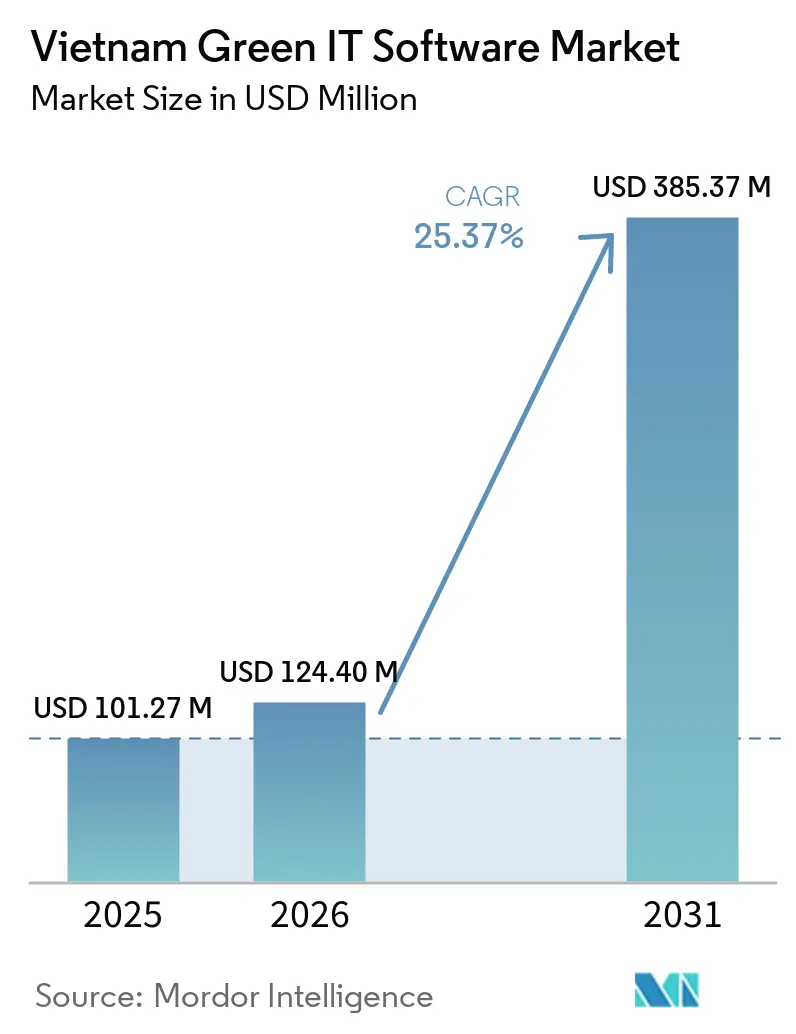
| Base Year Market Size (2025) | USD 101.27 Million |
| Market Size (2026) | USD 124.40 Million |
| Market Size (2031) | USD 385.37 Million |
| Growth Rate (2026 - 2031) | 25.37 % |
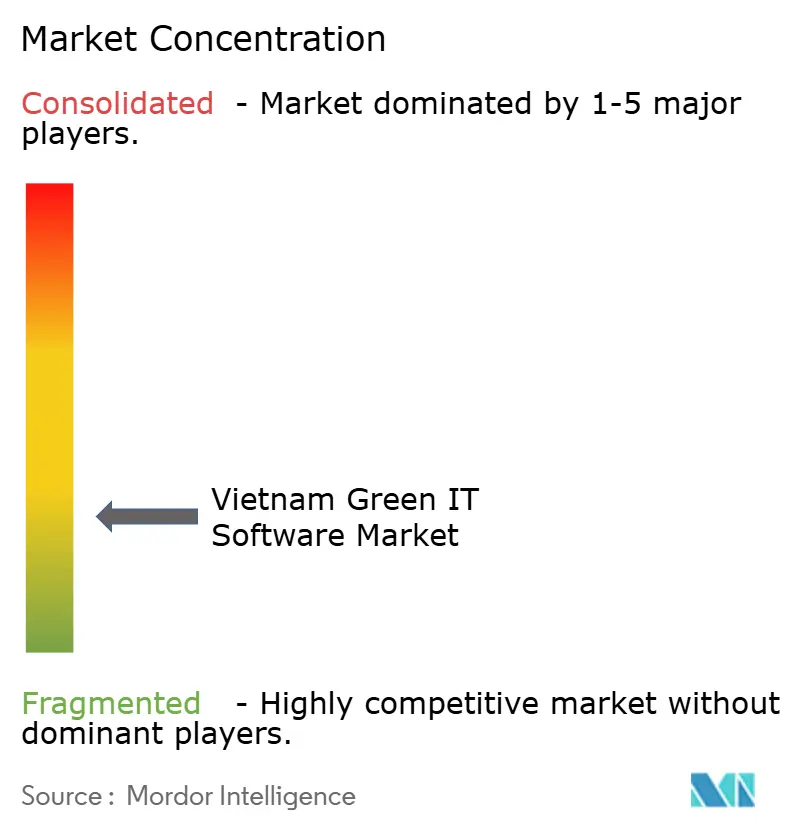
| Market Concentration | Low |
Major Players *Disclaimer: Major Players sorted in no particular order Image © Mordor Intelligence. Reuse requires attribution under CC BY 4.0. | |
Vietnam Green IT Software Market Analysis by Mordor Intelligence
The Vietnam Green IT Software Market size was valued at USD 101.27 million in 2025 and estimated to grow from USD 124.40 million in 2026 to reach USD 385.37 million by 2031, at a CAGR of 25.37% during the forecast period (2026-2031). Vietnam’s policy framework has shifted from planning to execution, turning carbon compliance, registry reporting, and quota management into direct software-buying activity across regulated industries. Export pressure is also raising urgency, as manufacturers serving the EU now need cleaner, more auditable emissions data across Scope 1, Scope 2, and Scope 3 to protect customer relationships and preserve access to overseas markets. The Vietnam Green IT Software Market is also supported by broader cloud modernization, as companies need systems that can gather data from multiple facilities, connect to enterprise platforms, and still comply with domestic data-handling rules. Expansion in AI data centers and tighter energy efficiency targets are widening the addressable demand base beyond emissions accounting into energy monitoring, optimization, and digital reporting tools. Competitive activity is rising across global software firms, carbon-focused providers, and local technology companies, while talent shortages and compliance complexity may slow implementation speed even as the long-term need for adoption remains firm.
Key Report Takeaways
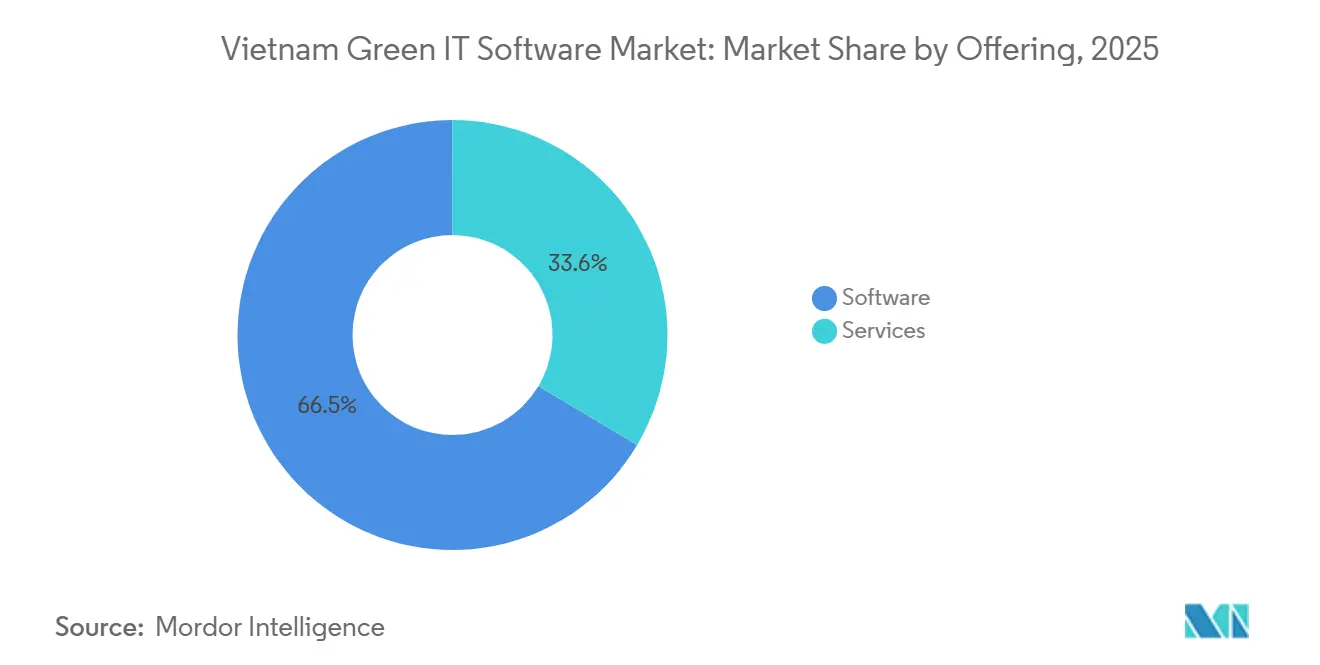
- By offering, software held 66.45% of the Vietnam Green IT Software Market share in 2025, while services are projected to expand at 26.88% CAGR through 2031.
- By deployment, cloud-based solutions accounted for 57.81% of the Vietnam Green IT Software Market in 2025, while hybrid deployment is projected to advance at 26.33% CAGR through 2031.
- By enterprise size, large enterprises accounted for 68.24% of the Vietnam Green Information Technology Software Market in 2025, while SMEs are expected to record the fastest growth at a 26.57% CAGR through 2031.
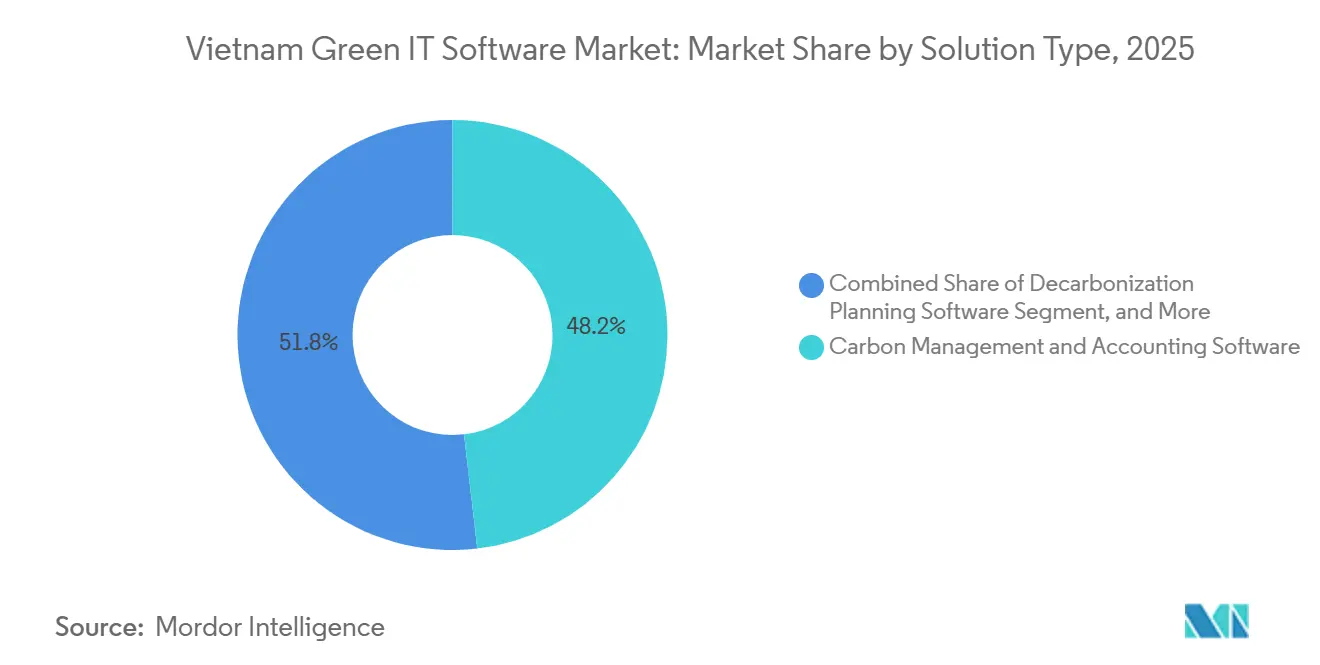
- By solution type, carbon management and accounting software accounted for 48.17% of the Vietnam Green IT Software Market in 2025, while ESG reporting and compliance software is projected to expand at a 25.91% CAGR through 2031.
- By end user, manufacturing accounted for 21.89% of the Vietnam Green Information Technology Software Market in 2025, while information technology and telecom are projected to grow at a 25.69% CAGR through 2031.
Note: Market size and forecast figures in this report are generated using Mordor Intelligence’s proprietary estimation framework, updated with the latest available data and insights as of January 2026.
Vietnam Green IT Software Market Trends and Insights
Drivers Impact Analysis*
| Driver | (~) % Impact on CAGR Forecast | Geographic Relevance | Impact Timeline |
|---|---|---|---|
| Regulatory Push for Carbon and Energy Traceability | +6.8% | National, with concentrated compliance activity in Hanoi and Ho Chi Minh City | Short term (≤ 2 years) |
| Cloud Migration and Hybrid Architecture Modernization | +5.2% | Ho Chi Minh City, Hanoi, and Da Nang tech clusters | Short term (≤ 2 years) |
| Green Data Center and Energy Efficiency Mandates | +3.9% | National, with early adoption in Ho Chi Minh City and Hanoi data center corridors | Medium term (2-4 years) |
| Export-Oriented Compliance Pressure From CBAM and ESG Rules | +3.4% | Northern and southern Vietnam export manufacturing belts, global spill-over | Short term (≤ 2 years) |
| Industrial Park Decarbonization and ESG Digitization | +2.6% | Northern Vietnam industrial corridors, including Hai Phong and Bac Ninh, and southern manufacturing zones | Medium term (2-4 years) |
| AI-Driven Energy Optimization in High-Density Digital Infrastructure | +2.1% | Ho Chi Minh City and Hanoi AI data center clusters | Long term (≥ 4 years) |
| Source: Mordor Intelligence | |||
Regulatory Push for Carbon and Energy Traceability
Vietnam’s domestic emissions trading system pilot started in August 2025, and the regulatory framework became much more concrete in January 2026 when Decree No. 29/2026/NĐ-CP established a domestic carbon exchange operated by the Hanoi Stock Exchange. Circular No. 11/2026/TT-BNNMT then established the national carbon registry and required electronic tracking for the issuance, transfer, and cancellation of quotas and credits, thereby making digital recordkeeping a functional requirement rather than an optional administrative tool. The Vietnam Green IT Software Market is responding to this shift because 110 covered installations now need auditable emissions inventories and traceable workflows that spreadsheets cannot easily support at scale. Full implementation is expected in 2029, so buyers are not only reacting to today’s filings but also preparing their systems for a tighter compliance cycle over the next few years. The registry structure also raises the cost of weak baseline data, because errors can become visible across a formal audit trail and create exposure tied to prior reporting periods. Climate governance requirements under the Corporate Governance Code 2026 further broaden the demand base, as listed companies now face stronger board accountability for environmental oversight and disclosure processes.
Cloud Migration and Hybrid Architecture Modernization
Enterprise cloud adoption in Vietnam has reached a point where it supports ESG data collection, workflow integration, and reporting across multiple sites, rather than simply lowering infrastructure costs. The practical architecture question in 2026 is not simply cloud versus on-premise, but how to combine multi-cloud flexibility, local hosting, data residency, and systems integration in a single operating model. That is why the Vietnam Green IT Software Market is seeing a stronger pull for platforms that can connect with ERP systems and separate regulated data storage from analytics workloads without breaking reporting continuity. Microsoft’s 2026 Sustainability Manager release shows how large enterprise vendors are building sustainability features directly into existing business software environments, raising the baseline for automation and integration across the category.[1] This matters for buyers in Vietnam because local cybersecurity obligations and global parent reporting requirements often coexist, and a hybrid model is the most workable path in that setting. As a result, deployment decisions are becoming more strategic, and software vendors that can support compliance, interoperability, and architecture flexibility are gaining an advantage in the Vietnam Green IT Software Market.
Green Data Center and Energy Efficiency Mandates
Vietnam’s green data center policy environment has become more demanding since Decision 36/QĐ-TTg required new data centers to achieve a PUE index not exceeding 1.4, while another government plan called for private investment to account for at least 50% of national data center capacity through internationally certified green facilities. Large investment commitments are reinforcing that policy direction, with more than USD 7 billion in AI data center investment announced across Vietnam, including a USD 2.1 billion project in Ho Chi Minh City and a USD 1 billion campus in Da Nang with a 60 MW on-site solar array. Schneider Electric Vietnam stated that AI workloads are projected to account for 15-20% of total data center energy consumption by 2028, up from 8% in 2023, underscoring the rising need for intelligent cooling and power management software. In this setting, energy and resource optimization tools are no longer side products, as operators need them to control power intensity, maintain performance, and meet reporting obligations simultaneously. The Vietnam Green IT Software Market benefits because data center operators need one digital layer for PUE monitoring and another for carbon and electricity reporting, and those needs increasingly overlap. Vendors that link utility-grade monitoring with sustainability reporting are therefore better placed to capture broader spending as Vietnam expands digital infrastructure.
Export-Oriented Compliance Pressure from CBAM and ESG Rules
The EU Carbon Border Adjustment Mechanism entered its financial liability phase in January 2026, making embedded emissions tracking more important for Vietnamese exporters of steel, aluminum, cement, and related products. The same source pointed to potential forgone revenue of USD 830 million annually for Vietnam in exposed export categories, while steel exports to the EU could decline by USD 1.1 billion by 2030 under full enforcement. The pressure does not end with CBAM, as wider European disclosure and supply-chain due diligence rules are pushing Vietnamese suppliers to provide primary Scope 3 data rather than broad estimates. PwC’s ESG Progress Tracker 2025 found that 57% of 174 prominent Vietnamese businesses had achieved external ESG reporting, but it also highlighted uneven data quality and limited technology adoption, which suggests that more companies still need better tools to meet buyer and investor demands. Export contracts are also embedding ISO 14064-1 and GHG Protocol expectations, which shift demand toward software that supports primary measurement and clearer audit trails rather than basic report formatting. That combination is strengthening the Vietnam Green IT Software Market because compliance is becoming part of sales continuity for export-facing manufacturers, not just part of corporate reporting.
Restraints Impact Analysis*
| Restraint | (~) % Impact on CAGR Forecast | Geographic Relevance | Impact Timeline |
|---|---|---|---|
| Talent Shortage in Cloud Security, Data Architecture, and Carbon Accounting | -3.2% | National, with acute gaps in tier-2 and tier-3 cities | Medium term (2-4 years) |
| Data Localization and Compliance Complexity for Foreign Vendors | -2.5% | National | Short term (≤ 2 years) |
| Power Grid and Infrastructure Constraints for Scalable Deployment | -1.4% | Central Vietnam and emerging data center markets | Medium term (2-4 years) |
| Budget Sensitivity Among SMEs and Mid-Market Buyers | -1.2% | National, with greater constraint in SME-dense provinces | Long term (≥ 4 years) |
| Source: Mordor Intelligence | |||
Talent Shortage in Cloud Security, Data Architecture, and Carbon Accounting
The main practical barrier for the Vietnam Green IT Software Market is not awareness, but the shortage of people who can configure systems, manage data quality, and translate reporting rules into usable workflows. Vietnam targeted 700,000 ICT professionals, but the workforce stood near 550,000 in 2025, and only 30% of graduates were considered immediately ready for enterprise roles. At the same time, green hiring is becoming more competitive, with ESG specialist roles commanding a 15-25% salary premium over similar IT positions. The labor challenge is broader than corporate sustainability teams, as Vietnam also needs around 150,000 specialized workers to support the carbon credit market, placing manufacturing, finance, and technology employers in direct competition for the same small talent pool. That shortage slows deployment after software is purchased, because companies still need staff who can build inventories, validate data, connect systems, and manage ongoing reporting cycles. The result is a drag on license utilization, project timelines, and expansion revenue, even when customer intent to adopt remains strong.
Data Localization and Compliance Complexity for Foreign Vendors
Vietnam’s Law on Cybersecurity No. 116/2025/QH15, effective July 1, 2026, reaffirmed local data storage requirements and the need for foreign digital service providers to establish a local branch or representative office in certain cases. For international software vendors, this creates additional work around local hosting, legal structures, security controls, and approval timelines before a product can scale in Vietnam. The Vietnam Green IT Software Market, therefore, favors firms that already have domestic infrastructure, strong local partners, or product designs that separate storage and analytics without violating compliance requirements. This also creates a cost and timing gap between new entrants and vendors already operating in the country, because the latter can move faster on delivery and customer assurance. Local cloud providers such as Viettel, VNPT IDC, and CMC Corporation are well-positioned to benefit as hosting and integration partners under these rules. Over time, this may not reduce demand, but it can reshape route-to-market models and slow foreign vendor expansion in the near term.
*Our forecasts treat driver/restraint impacts as directional, not additive. The impact forecasts reflect baseline growth, mix effects, and variable interactions.
Segment Analysis
By Offering: Software Dominates While Services Build Recurring Revenue
Software held 66.45% of the Vietnam Green IT Software Market share in 2025, which shows that the first wave of spending centered on platform ownership rather than outsourced delivery. Companies moved first toward carbon management tools, ESG reporting systems, and sustainability data platforms because these products are closest to immediate filing, audit, and customer reporting needs. This pattern was especially clear among regulated operators and export-facing enterprises that needed direct control over data inputs and approval steps. License-based software also fits the early buying cycle because many companies were still establishing their first formal greenhouse gas inventories and internal governance structures. In practice, buyers wanted tools that could capture source data, preserve audit trails, and support future integration with enterprise systems.
Services are projected to expand at a 26.88% CAGR through 2031, indicating a second phase in the Vietnam Green IT Software Market in which implementation support becomes more valuable after the initial purchase. The demand is driven by gaps in internal ESG analytics capacity, carbon accounting know-how, and technical integration skills, making outside help necessary for many companies. SAP’s sustainability AI agent rollout in 2026 also shows that software and advisory workflows are converging, especially for reporting preparation, simulation, and compliance documentation.[2] Local delivery partners are becoming increasingly important in this context, and ESEC’s IBM Envizi partnership is a strong example of how global platforms are packaged with local implementation capabilities in Vietnam. That means future revenue growth should come not only from setup projects, but also from managed reporting, audit support, platform tuning, and recurring integration work as compliance needs become more detailed.
By Deployment: Cloud-Based Leadership With Hybrid as the Strategic Pivot
Cloud-based deployment accounted for 57.81% of the Vietnam Green IT Software Market in 2025, supported by the need to collect data from multiple facilities and consolidate reporting across business units. Cloud models are well-suited to emissions and energy data because companies often need real-time or near-real-time visibility across sites, suppliers, and reporting teams. They also support faster updates, easier collaboration, and better integration with modern enterprise applications. This has made the cloud the default path for companies building sustainability systems from scratch rather than extending older local tools. The Vietnam Green IT Software Market has therefore leaned toward cloud-first designs where scalability and remote access are central to value creation.
Hybrid deployment is projected to expand at a 26.33% CAGR through 2031, making it the most strategic architecture choice for companies balancing global reporting standards with Vietnamese data-handling rules. A pure cloud model can raise concerns when local storage or data residency rules are strict, while a fully on-premises model can reduce flexibility for supplier collaboration and large-scale analytics. Hybrid architecture offers a middle path by keeping sensitive data onshore while still using broader cloud resources for analytics, automation, and workflow coordination. Microsoft’s sustainability product roadmap and Vietnam’s cybersecurity direction both support this pattern, as buyers increasingly want systems that meet both corporate and local compliance requirements. As a result, deployment choice in the Vietnam Green IT Software Market is no longer a narrow IT preference, but part of a broader risk and compliance strategy.
By Enterprise Size: Large Enterprise Anchors While SME Adoption Accelerates
Large enterprises represented 68.24% of the Vietnam Green IT Software Market in 2025, reflecting their concentration in ETS-covered operations, multinational supply chains, and listed company reporting structures. These buyers were the first to face formal pressure from parent-company ESG programs, export customer requests, and domestic climate compliance requirements. They also had the budgets and systems maturity needed to adopt tools with Scope 1, Scope 2, and Scope 3 coverage, ERP connectivity, and external audit compatibility. In many cases, adoption was driven less by voluntary sustainability goals and more by the need to coordinate finance, operations, procurement, and compliance teams around one data framework. That gave large organizations a clear lead in early spending and shaped the Vietnam Green IT Software Market's initial profile.
SMEs are projected to grow at a 26.57% CAGR through 2031, even though cost and capability constraints remain significant barriers. Vietnam’s SME base is large, with SMEs accounting for 97% of all businesses and more than 600,000 enterprises, so even a gradual rise in adoption creates a sizable future demand pool. The national SME Digital and Green Transformation Plan for 2026-2030 provides additional policy support in that direction, while larger exporters are also passing ESG data expectations down through their supplier networks. Cost still matters, and a survey cited in the input showed that 68% of SMEs named cost as the main barrier, with traditional management software priced at VND 50 million (approximately USD 2,050) to VND 200 million (approximately USD 8,200) per year. This is why the strongest fit in the Vietnam Green IT Software Market is likely to come from modular, subscription-led products that lower entry costs while covering basic inventory, reporting, and compliance workflows.
By Solution Type: Carbon Management Leads While ESG Reporting Gains Speed
Carbon Management and Accounting Software accounted for 48.17% share of the Vietnam Green IT Software Market size in 2025, making it the clear revenue leader among solution categories. That lead reflects the direct force of the emissions trading system, CBAM reporting, and export contract requirements linked to recognized greenhouse gas accounting methods. For many companies, carbon accounting is the starting point because it establishes the baseline data needed before wider decarbonization planning or optimization software can deliver useful results. This creates a natural sequence where organizations first invest in measurement, then move into planning, data orchestration, and energy performance tools. The Vietnam Green IT Software Market has therefore been shaped by the immediate need to quantify and defend emissions numbers before firms tackle broader transformation programs.
ESG Reporting and Compliance Software is projected to expand at 25.91% CAGR through 2031 as listed-company disclosure practices move closer to international standards and board oversight becomes more formal. The State Securities Commission’s expected shift toward an ISSB-aligned framework and the Corporate Governance Code 2026 are important here because they extend reporting discipline beyond purely industrial carbon management cases. FPT Software’s VertZéro adds another local dimension, because it became the first domestically developed carbon accounting platform certified by TÜV Rheinland Germany under ISO 14064-1:2018, which supports confidence in local regulatory alignment and technical credibility. This matters because buyers increasingly want software that aligns with international reporting standards and the practical requirements of Vietnamese enforcement. Over time, that should help the Vietnam Green IT Software Market broaden from pure accounting systems toward deeper governance, disclosure, and workflow platforms.

By End User: Manufacturing Leads While Information Technology and Telecom Builds Momentum
Manufacturing accounted for 21.89% of the Vietnam Green IT Software Market in 2025, reflecting its direct exposure to CBAM, export buyer scrutiny, and quota allocation under the domestic emissions trading system. Heavy industrial facilities in cement and steel faced immediate compliance triggers, while broader manufacturing supply chains faced growing requests for traceable primary emissions data. Industrial park activity strengthens this position, with projects in places such as Nam Cau Kien and KBC-linked zones showing that facility-level emissions monitoring is becoming part of industrial infrastructure planning. Foxconn Vietnam’s Bac Ninh example is also important because a 22% reduction in Scope 3 emissions, achieved using AI-driven design tools and a generative AI carbon platform across 128 supplier partners, shows how one large manufacturer can influence digital adoption across an entire supplier base. This multiplier effect keeps manufacturing at the center of software demand in the Vietnam Green IT Software Market.
Information technology and telecom are projected to expand at a 25.69% CAGR through 2031, supported by AI data center growth, concerns about power intensity, and the need for listed company disclosures. The vertical is moving quickly because data center operators must manage PUE performance, energy forecasting, cooling efficiency, and emissions reporting within a single operating stack. Banking, financial services, and insurance, along with energy and utilities and government entities, form the next layer of demand as green finance reporting and power-related disclosure needs become more structured. Healthcare and life sciences, retail and e-commerce, and construction and infrastructure are still early in the adoption cycle, but they are beginning to face similar investor and customer expectations. That means the Vietnam Green Information Technology Software Market is likely to remain manufacturing-led in the near term, while technology and telecom narrows the gap as digital infrastructure expands and energy management becomes more critical.
Geography Analysis
Ho Chi Minh City and the southern industrial corridor accounted for the largest demand center in the Vietnam Green IT Software Market in 2026, as they combine export manufacturing, foreign-invested operations, and large-scale digital infrastructure development. The city hosts Saigon Hi-Tech Park, where Sembcorp Development is building a 90 MW AI-ready data center through the StarMason JSC joint venture, and it also received an investment certificate for a USD 2.1 billion AI data center in Tan Phu Trung Industrial Park in late 2025.[3] This concentration matters because large data centers need energy monitoring and optimization systems, while export manufacturers in the same broader region need carbon accounting and supply-chain reporting tools. The southern belt also benefits from a higher concentration of multinational firms, which usually brings stronger parent-company ESG requirements and faster adoption of enterprise-grade software. That combination keeps the Vietnam Green IT Software Market closely tied to Ho Chi Minh City's economic weight and its surrounding manufacturing network.
Hanoi and the northern industrial belt constitute the second major cluster, as the capital anchors the country’s regulatory and market infrastructure for carbon compliance. National agencies located there shape reporting rules, registry operations, and listed-company governance expectations, which turn policy decisions into direct procurement activity for software users across sectors. Industrial parks in the north are also becoming active deployment zones, as shown by Glassdome’s June 2026 agreement with KinhBac City Development Holding Corporation and HOUSELINK to implement a carbon platform covering PCF under ISO 14067, CCF, CBAM, and Environmental Product Declaration compliance. Hanoi’s data center corridor is strengthening as well, and Viettel’s Hoa Lac 2 facility became the first in Asia-Pacific to integrate NVIDIA H200 AI computing infrastructure and receive Uptime Institute’s Tier III Certification of Constructed Facility in June 2026. These developments support software demand in the north across both industrial reporting and intelligent energy management.
Tier-2 cities and emerging locations such as Da Nang, Binh Duong, and Dong Nai are still earlier in the adoption cycle, but their momentum is improving as industrial park developers pursue eco-industrial positioning and foreign direct investment. Da Nang is becoming more visible because a USD 1 billion AI data center campus is under development, featuring a 60 MW on-site solar array, which requires advanced energy optimization and carbon-tracking layers from the start. These cities also benefit from the fact that CBAM reporting and domestic emissions obligations apply across provinces, thereby spreading demand for similar software capabilities even where adoption began later. As a result, the Vietnam Green IT Software Market is concentrated in 2 main hubs today, but the same compliance and infrastructure logic is gradually extending demand into secondary cities.
Competitive Landscape
The Vietnam Green IT Software Market is fragmented in 2026, with competition spread across global enterprise platforms, carbon-focused specialists, and local or regional technology providers. SAP SE, Microsoft Corporation, and IBM Corporation formed the first tier because each could extend sustainability functions through broader enterprise relationships in finance, procurement, supply chain, and operations. Their strength lies in integration and account access, as large Vietnamese buyers often prefer sustainability tools that integrate with existing ERP and reporting systems. SAP’s 2026 sustainability roadmap, including planned AI-enabled regulatory readiness support and multi-step reporting automation, shows how global vendors are trying to stay relevant as local compliance demands evolve. IBM’s channel partnership with ESEC is another useful example because it shows that route-to-market success in Vietnam often depends on local implementation and advisory capability, not only on software features.
A second group competes on technical depth in primary data collection, supplier engagement, and carbon-specific workflow design rather than on broad enterprise suite coverage. EcoVadis and Workiva formed a strategic partnership in May 2026 to connect supplier carbon data directly into Workiva Carbon’s reporting engine, reflecting a broader move toward networked data models for Scope 3 reporting. EcoVadis also partnered with Watershed in March 2026 to close Scope 3 data gaps by combining supplier data collection with sustainability analytics and decarbonization planning.[4] These moves are relevant in Vietnam because export-oriented manufacturers increasingly need more than basic emissions estimates and are looking for stronger supplier-level evidence. In the Vietnam Green IT Software Market, specialist firms have room to win where product depth and supply-chain attribution matter more than full-suite enterprise-standardization.
Local and regional vendors are gaining ground because regulatory familiarity and local delivery are becoming meaningful competitive advantages. FPT Software’s VertZéro, certified under ISO 14064-1:2018 by TÜV Rheinland Germany, gives Vietnam a domestic platform with recognized technical credibility and a local fit for carbon accounting use cases. TPIsoftware’s GreenSwift deployment at Nam Cau Kien Eco-Industrial Park shows how industrial park use cases can be served through localized combinations of greenhouse gas inventory, energy management, and AIoT monitoring. The open spaces in the Vietnam Green Information Technology Software Market remain affordable, including SME tools for anomaly detection in emissions and energy data quality, and supply-chain platforms that fit Vietnam’s industrial park tenant structure. That competitive shape supports continued fragmentation, because no single vendor appears positioned to control all of the local compliance, integration, pricing, and delivery needs across the full customer base.
Vietnam Green IT Software Industry Leaders
-
Schneider Electric SE
-
Microsoft Corporation
-
IBM Corporation
-
SAP SE
-
Siemens AG
- *Disclaimer: Major Players sorted in no particular order
Recent Industry Developments
- June 2026: Glassdome signed a 3-party MOU with KinhBac City Development Holding Corporation (KBC) consortium and HOUSELINK to deploy an integrated carbon management platform across KBC-operated industrial parks in northern Vietnam, covering Product Carbon Footprint (ISO 14067), Corporate Carbon Footprint, CBAM, and Environmental Product Declaration compliance via real-time primary data from manufacturing equipment and IT/OT systems. Glassdome announced plans to establish a local subsidiary in Vietnam within 2026, targeting Korean carbon management standards as a regional ASEAN benchmark.
- June 2026: Viettel's Hoa Lac 2 data center received Uptime Institute's Tier III Certification of Constructed Facility, becoming the first facility in the Asia-Pacific region to integrate NVIDIA H200 AI computing infrastructure and achieve Tier-3 certification, with capacity for 2,400 server racks supporting AI platforms and cloud computing. The certification validates Viettel's intelligent energy management and cooling investments, reinforcing demand for AI-driven energy optimization software across Vietnam's expanding data center ecosystem.
- May 2026: SAP announced that new sustainability AI agents, covering multi-step workflows for carbon footprint simulation, ESG reporting preparation, packaging compliance, and workplace safety documentation, will become generally available by end-2026, targeting finance, procurement, supply-chain, and operations teams with audit-ready automation.
- May 2026: EcoVadis and Workiva formed a strategic partnership to connect EcoVadis' Carbon Data Network directly into Workiva Carbon's reporting and calculation engine, enabling mutual customers to use primary Scope 3 supplier data instead of industry averages for audit-ready ESG disclosures.
Vietnam Green IT Software Market Report Scope
The Vietnam Green IT Software Market encompasses platforms that champion energy optimization, carbon tracking, and sustainable IT management. Widely adopted in manufacturing, construction, and the burgeoning digital sector, the market's momentum is driven by industrial growth, urbanization, and a heightened emphasis on energy efficiency and emissions reduction. These solutions seamlessly weave sustainability into daily operations, elevate environmental performance, and bolster long-term digital transformation efforts.
The Vietnam Green IT Software Market Report is Segmented by Offering (Software, and Services), Deployment (Cloud-Based, On-Premise, and Hybrid), Enterprise Size (Large Enterprises, and Small and Medium Enterprises), Solution Type (Carbon Management and Accounting Software, ESG Reporting and Compliance Software, Sustainability Data Management Platforms, Decarbonization Planning Software, and Energy and Resource Optimization Software), and End User (Information Technology and Telecom, Banking, Financial Services and Insurance, Manufacturing, Energy and Utilities, Retail and E-Commerce, Government, Healthcare and Life Sciences, Construction and Infrastructure, and Other End-User Industries). The Market Forecasts are Provided in Terms of Value (USD).
| Software |
| Services |
| Cloud-Based |
| On-Premise |
| Hybrid |
| Large Enterprises |
| Small and Medium Enterprises |
| Carbon Management and Accounting Software |
| ESG Reporting and Compliance Software |
| Sustainability Data Management Platforms |
| Decarbonization Planning Software |
| Energy and Resource Optimization Software |
| Information Technology and Telecom |
| Banking, Financial Services, and Insurance |
| Manufacturing |
| Energy and Utilities |
| Retail and E-Commerce |
| Government |
| Healthcare and Life Sciences |
| Construction and Infrastructure |
| Other End-User Industries |
| By Offering | Software |
| Services | |
| By Deployment | Cloud-Based |
| On-Premise | |
| Hybrid | |
| By Enterprise Size | Large Enterprises |
| Small and Medium Enterprises | |
| By Solution Type | Carbon Management and Accounting Software |
| ESG Reporting and Compliance Software | |
| Sustainability Data Management Platforms | |
| Decarbonization Planning Software | |
| Energy and Resource Optimization Software | |
| By End User | Information Technology and Telecom |
| Banking, Financial Services, and Insurance | |
| Manufacturing | |
| Energy and Utilities | |
| Retail and E-Commerce | |
| Government | |
| Healthcare and Life Sciences | |
| Construction and Infrastructure | |
| Other End-User Industries |
Key Questions Answered in the Report
What is the 2026 value and 2031 outlook for green IT software in Vietnam?
The Vietnam Green IT Software Market is valued at USD 124.40 million in 2026 and is forecast to reach USD 385.37 million by 2031 at a CAGR of 25.37%.
What is driving software demand the most in Vietnam right now?
The strongest demand driver is the move from climate policy to enforceable compliance, including the domestic carbon exchange, the national carbon registry, and formal emissions tracking obligations for covered facilities.
Which solution type leads spending in this space?
Carbon Management and Accounting Software led with 48.17% of revenue in 2025 because companies first need trusted emissions inventories before they can scale broader sustainability programs.
Why is hybrid deployment growing faster than other deployment models?
Hybrid deployment is projected to grow at 26.33% CAGR because companies need to balance cloud analytics and integration benefits with local data residency and cybersecurity requirements.
Which end-user group is adopting these platforms the fastest?
Information technology and telecom is the fastest-growing end-user segment at 25.69% CAGR, mainly because AI data centers need stronger energy monitoring, cooling management, and emissions reporting tools.
How are SMEs expected to participate over the next few years?
SMEs are projected to grow at 26.57% CAGR as supply-chain ESG requirements spread from large exporters, although price sensitivity and limited in-house expertise still constrain adoption.