
China Green IT Software Market Size and Share
Market Overview
| Study Period | 2020 - 2031 |
|---|---|
| Forecast Data Period | 2026 - 2031 |
| Base Year Market Size (2025) | USD 1.41 Billion |
| Market Size (2026) | USD 1.62 Billion |
| Market Size (2031) | USD 3.73 Billion |
| Growth Rate (2026 - 2031) | 18.15 % |
| Market Concentration | Medium |
Major Players *Disclaimer: Major Players sorted in no particular order Image © Mordor Intelligence. Reuse requires attribution under CC BY 4.0. | |
China Green IT Software Market Analysis by Mordor Intelligence
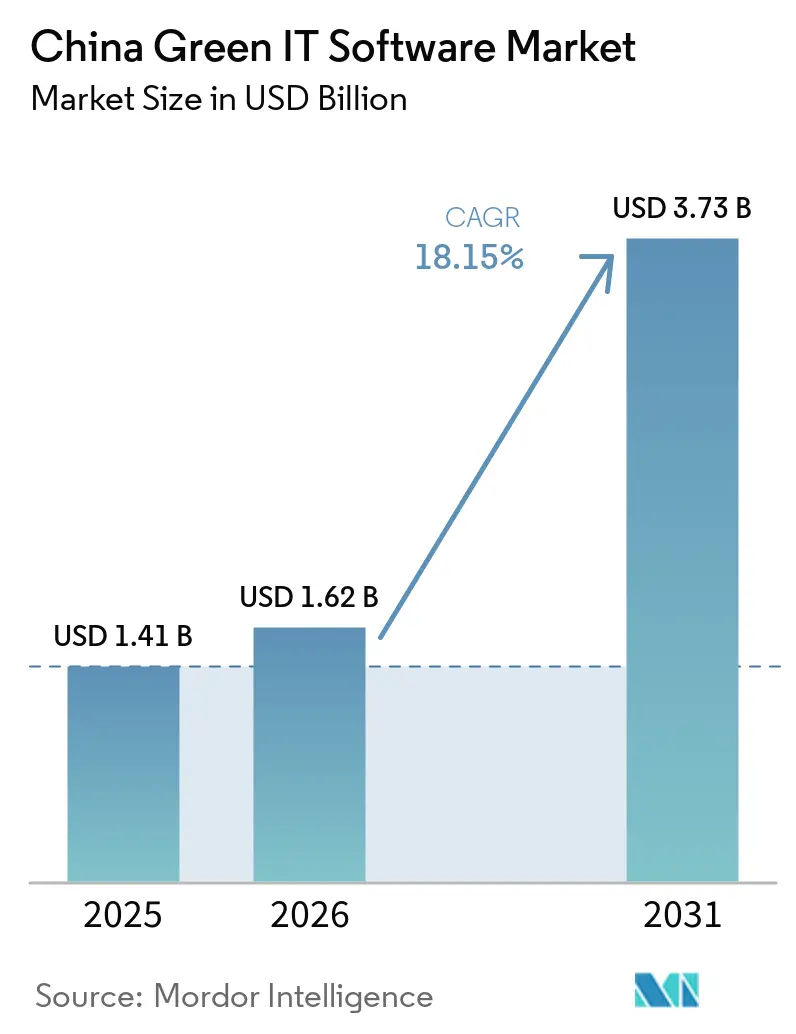
The China green IT software market size is projected to be USD 1.41 billion in 2025, USD 1.62 billion in 2026, and reach USD 3.73 billion by 2031, growing at a CAGR of 18.15% from 2026 to 2031. The China green IT software market is being shaped by a shift in spending priorities, because enterprises now treat carbon accounting, ESG reporting, energy management, and sustainability data handling as operating requirements rather than optional digital projects. Regulatory pressure is widening the addressable demand base, while exporter exposure to product-level carbon reporting is also pushing firms to replace isolated internal tools with platforms that can handle recurring disclosure work. Data center growth is adding another layer of demand, since operators need software that can track energy use, coordinate renewable power inputs, and support facility-level reporting with less manual work. Competition in the China green IT software market remains active across global and domestic vendors, and the main dividing line is no longer basic functionality, but the ability to combine localized compliance coverage, enterprise system integration, and lower-friction deployment models. The strongest commercial openings are now tied to interoperability, managed implementation support, and software architectures that can absorb new reporting rules without forcing enterprises into repeated system rebuilds.
Key Report Takeaways
- By offering, software held 67.41% of the China green IT software market in 2025, while services are projected to expand at an 19.63% CAGR through 2031.
- By solution type, carbon management and accounting software accounted for 32.41% share in 2025, while sustainability data management platforms are projected to grow at a 21.26% CAGR through 2031.
- By deployment mode, cloud-based solutions held 68.94% of the China green IT software market share in 2025, and this same segment is projected to expand at an 20.12% CAGR through 2031.
- By organization size, large enterprises captured 74.23% share in 2025, while small and medium enterprises are projected to record the fastest growth at a 22.84% CAGR through 2031.
- By end-user industry, manufacturing held 26.62% share in 2025, while IT and telecommunications are projected to advance at a 21.19% CAGR through 2031.
Note: Market size and forecast figures in this report are generated using Mordor Intelligence’s proprietary estimation framework, updated with the latest available data and insights as of January 2026.
China Green IT Software Market Trends and Insights
Drivers Impact Analysis*
| DRIVER | (~) % IMPACT ON CAGR FORECAST | GEOGRAPHIC RELEVANCE | IMPACT TIMELINE |
|---|---|---|---|
| Dual-Carbon Policy Momentum and Compliance Digitization | +4.2% | National, with intensified demand in industrial hubs of Jiangsu, Guangdong, and Shandong | Short term (≤ 2 years) |
| Rising Enterprise Demand for Automated Carbon Accounting | +3.5% | National, with early gains in SSE and SZSE-listed company clusters | Short term (≤ 2 years) |
| AI Enabled Energy Optimization Across Data Centers and Industrial IT | +2.8% | National, with concentration in eastern data center corridors and western computing hubs | Medium term (2-4 years) |
| Expanding ESG Disclosure Requirements Across Export-Oriented Firms | +2.1% | National, with disproportionate impact on coastal export zones including Guangdong, Zhejiang, and Jiangsu | Short term (≤ 2 years) |
| Growth of Cloud Native Sustainability Platforms for Multi-Site Operations | +1.6% | National | Medium term (2-4 years) |
| Integration of Green IT With Enterprise Resource Planning and Operations Systems | +1.2% | National, with early gains in large industrial enterprises and state-owned enterprises | Medium term (2-4 years) |
| Source: Mordor Intelligence | |||
Dual-Carbon Policy Momentum and Compliance Digitization
The China green IT software market is gaining direct support from policy measures that now specify how industrial firms should build energy and carbon data systems, rather than only stating long-term emissions goals. The March 2025 guidelines for digital energy-carbon management centers set a clearer architecture baseline for industrial enterprises and parks, which raises the minimum technical standard that software vendors must meet in procurement processes. The January 2025 product carbon footprint accounting guidelines added another layer of demand by pushing manufacturers toward standardized product-level carbon management across supply chains, which broadens the use case beyond facility reporting alone.[1] This policy pattern matters because it shifts software buying from one-time compliance projects toward recurring platform investment, especially where factories, parks, and enterprise groups need common data structures. In the China green IT software market, this change supports vendors that can align system design with national reporting logic while still fitting enterprise workflows. It also creates room for long-term account expansion, because once the first reporting layer is installed, enterprises usually need additional modules for product data, audit support, and supplier engagement.
Rising Enterprise Demand for Automated Carbon Accounting
The China green IT software market is also benefiting from the move away from spreadsheet-based carbon tracking toward automated and auditable reporting workflows. Enterprises now need stronger data traceability, cleaner approval chains, and more direct links between operational records and disclosure outputs, which favors platforms embedded in finance, ERP, and cloud environments. Kingdee’s FY2025 results showed that its cloud subscription revenue rose 20.9% year on year to RMB 3,556 million, or USD 488 million, while its Kingdee AI platform deployed nearly 20 AI agents across use cases that included ESG scenarios.[2] That result is commercially important because it shows that automated ESG and carbon reporting functions are moving into mainstream enterprise software spending rather than remaining niche sustainability tools. In the China green IT software market, this gives an advantage to vendors that can automate data collection and validation inside systems enterprises already use for financial and operating control. It also raises switching costs over time, since once carbon workflows are linked to core records and approvals, enterprises are less willing to return to manual reporting or disconnected specialist tools.
AI Enabled Energy Optimization Across Data Centers and Industrial IT
AI-led workload growth is changing the demand profile of the China green IT software market by making energy optimization a much larger operating issue for data center owners and industrial IT environments. A 2026 analysis published in Frontiers in Energy Research cited International Energy Agency expectations that Chinese data center electricity consumption will reach 277TWh by 2030, which implies a steep rise from 2024 levels and a broader need for software-led efficiency control. That growth makes real-time tracking of power, cooling, and facility performance more valuable, because energy variance now carries direct financial and capacity implications. Siemens launched Data Center Solution 5.0 in 2026 with integration across power supply, cooling, energy storage, and operations, which shows how vendors are packaging energy and carbon visibility as a single operating layer rather than separate tools. In the China green IT software market, this driver is especially important because AI infrastructure expansion is happening at the same time as tighter efficiency expectations, which means new facilities are more likely to adopt software from day 1. The result is a stronger market for platforms that can support automated optimization, verifiable reporting, and coordination between IT operations and power management.
Expanding ESG Disclosure Requirements Across Export-Oriented Firms
The China green IT software market is seeing additional momentum from exporters that now face more frequent requests for product-level carbon information from overseas customers and compliance channels. The product carbon footprint management push that appeared in January 2025 strengthened the expectation that manufacturers should build more consistent carbon records at the product and supply-chain level. That matters because export manufacturers do not only need plant emissions totals, but also component-level and shipment-level records that can be shared across customers, verifiers, and internal teams. In practice, this shifts demand toward platforms that can collect supplier inputs, standardize data structures, and keep evidence ready for recurring external review. The China green IT software market, therefore, gains from trade-linked reporting pressure even when the initial rule originates outside China, because Chinese suppliers still need domestic software capability to retain contracts. This is also one reason cloud-native vendors are gaining attention, since they can connect multi-site data and partner records faster than legacy point systems.
Restraints Impact Analysis*
| RESTRAINT | (~) % IMPACT ON CAGR FORECAST | GEOGRAPHIC RELEVANCE | IMPACT TIMELINE |
|---|---|---|---|
| Fragmented Emissions Data and Weak System Interoperability | -1.8% | National, most acute in multi-site industrial manufacturers and export-oriented supply chains | Medium term (2-4 years) |
| Limited In-House Sustainability Data Governance in Small and Medium Enterprises | -1.4% | National, disproportionately affecting non-coastal SME clusters | Long term (≥ 4 years) |
| High Implementation Friction for Legacy On-Premises Environments | -1.1% | National, concentrated in state-owned enterprises and traditional heavy industry | Medium term (2-4 years) |
| Shortage of Standardized Verification and Audit-Ready Data Workflows | -0.9% | National | Medium term (2-4 years) |
| Source: Mordor Intelligence | |||
Fragmented Emissions Data and Weak System Interoperability
Fragmented data remains one of the clearest operating limits on the China green IT software market, because many enterprises still manage production, procurement, facility, and logistics records across disconnected systems. A 2024 study published by the Strategic Study of the Chinese Academy of Engineering highlighted the lack of a credible and unified emissions factor database across industrial sectors, which makes it harder to produce comparable and auditable carbon inventories. This problem is larger than a basic software integration issue, because different source systems often define boundaries, units, and activity categories in ways that do not match regulatory reporting needs. Enterprises may therefore have the software budget and the reporting obligation, yet still struggle to generate records that external reviewers can reconcile without manual correction. In the China green IT software market, which slows implementation cycles and keeps service intensity high, because vendors often need to spend significant time on data mapping before customers see full platform value. It also protects incumbents once they solve the integration layer, since replacement becomes harder after custom data structures and workflows are in place.
Limited In-House Sustainability Data Governance in Small and Medium Enterprises
Limited sustainability data capability inside SMEs is another meaningful drag on the China green IT software market, even though this customer group is expected to grow quickly. The OECD noted in 2025 that many SMEs in emerging economies lack the internal resources, expertise, and tools needed to measure and report sustainability performance, and that pattern fits a large share of China’s supplier base. A 2025 study in Systems found that government pressure can stimulate green digital process innovation in Chinese SMEs, but it also showed that overlapping demands can create capability gaps that slow execution. This matters because many smaller firms are not entering software adoption from a neutral starting point, but from a position where management time, reporting skills, and system maturity are already limited. In the China green IT software market, which holds back demand conversion unless vendors simplify onboarding, reduce manual setup, and offer more guided workflows. It also means large enterprise customers may continue to face supplier data gaps, which delays the full buildout of value-chain reporting and weakens network effects at the lower end of the market.
*Our forecasts treat driver/restraint impacts as directional, not additive. The impact forecasts reflect baseline growth, mix effects, and variable interactions.
Segment Analysis
By Offering: Software Leads, While Services Gain Strategic Weight
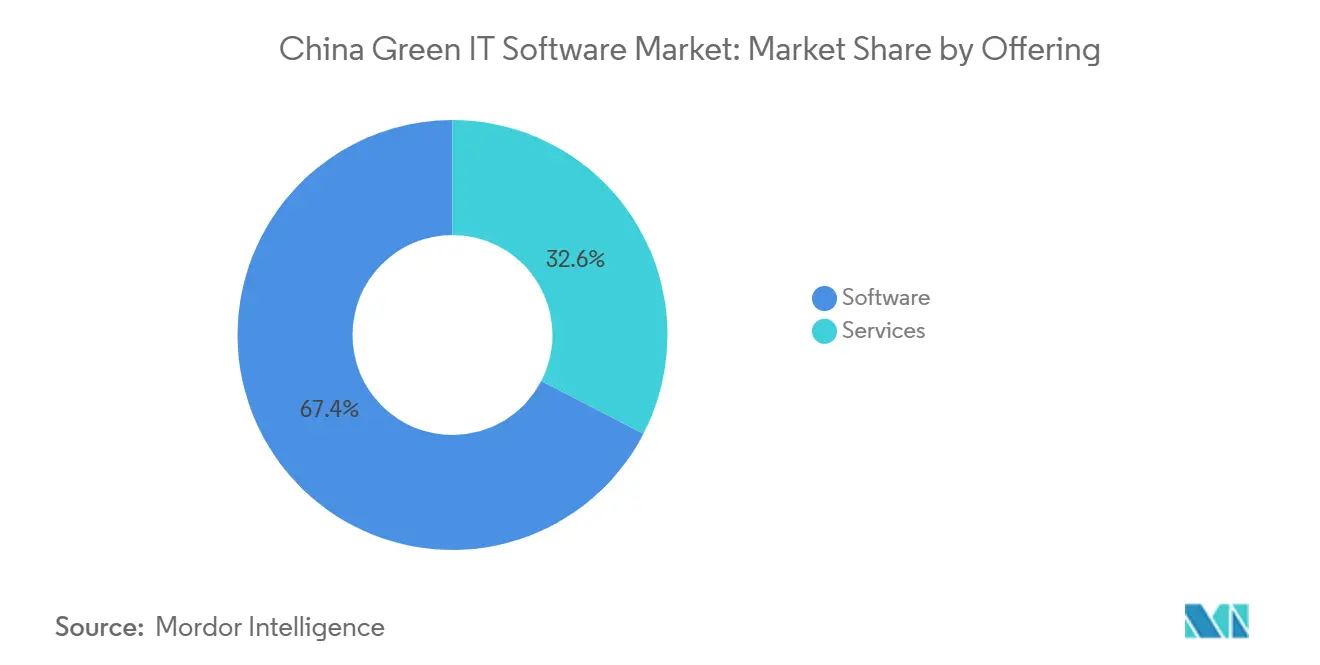
Software continues to dominate China green IT software market, holding a 67.41% share in 2025, driven by enterprise demand for integrated tools like carbon accounting and ESG disclosure systems within ERP and cloud environments. Businesses increasingly rely on software for centralized records, automated calculations, and reusable reporting structures, reducing manual interventions and enhancing governance and continuity. As procurement strategies evolve, buyers prioritize integration depth, scalability, and workflow traceability, favoring vendors offering comprehensive enterprise solutions over standalone dashboards. SAP's May 2026 launch of sustainability AI agents highlights the market's shift toward automation quality and operational compatibility, reinforcing software's central role despite more stringent buying criteria.[3]
Services are projected to grow at an 19.63% CAGR through 2031, reflecting their strategic importance in addressing the complexities of implementation. Enterprises require support in data preparation, workflow design, and compliance management to maximize platform value, especially when operating across multiple sites or reporting frameworks. This trend benefits vendors combining strong product offerings with effective implementation services, as managed validation, advisory support, and process redesigns enhance customer relationships and renewal rates. Consequently, the market is transitioning from a pure license model to a blended structure where software and services collectively drive value and operational integration.
By Solution Type: Carbon Accounting Remains the Core, While Data Platforms Expand Faster
Carbon accounting remains the backbone of China green IT software market, holding a 32.41% share in 2025. It serves as the foundational layer for emissions tracking, disclosure, and operational analysis, enabling enterprises to establish reliable records before advancing to broader sustainability initiatives. The growing need for consistent data collection, frequent reviews, and standardized reporting has driven vendors to integrate carbon accounting into finance and operations software, enhancing workflow efficiency. While energy management tools and sustainability performance solutions are gaining traction, enterprises often adopt these as complementary layers to carbon accounting, reflecting a modular growth approach. This layered adoption strategy underscores why carbon accounting remains central, even as other solution categories expand.
Sustainability data management platforms are emerging as the fastest-growing segment, with a projected CAGR of 21.26% through 2031. These platforms address the increasing demand for consolidating emissions, energy, water, and social data into a unified framework for enterprise-wide use. Basic carbon tools often fall short in managing complex data relationships required for comprehensive reporting and oversight. By transforming scattered records into a structured reporting backbone, data management platforms are becoming indispensable for enterprises seeking centralized governance of operational data. This trend highlights their critical role in supporting broader sustainability goals within China's green IT software market.
By Deployment Mode: Cloud Sets the Pace Across Adoption and Growth
Cloud-based deployments accounted for 68.94% of China green IT software market in 2025 and are projected to grow at an 20.12% CAGR through 2031, making them the leading and fastest-growing deployment mode. Enterprises prefer cloud solutions due to their ability to centralize data aggregation, streamline updates, and simplify the rollout of new reporting rules, addressing the challenges of managing carbon, energy, and ESG data across multiple locations. This deployment model aligns with the industry's shift toward subscription-based software, enabling businesses to better manage compliance and operational costs. Additionally, the cloud's execution speed allows organizations to quickly implement reporting structures, meeting urgent compliance needs while leaving room for future scalability.
While on-premises deployments remain relevant for specific use cases, such as data residency and legacy infrastructure requirements, and hybrid models act as transitional solutions, the market's growth trajectory clearly favors cloud architectures. Cloud solutions offer vendors the ability to update rule libraries and enhance reporting workflows with minimal friction, providing customers with faster improvements and consistent functionality. This adaptability is critical in a dynamic reporting environment, solidifying the cloud's position as the operational standard in China's green IT software market, while on-premises and hybrid formats address niche or transitional needs.
By Organization Size: Large Enterprises Drive Current Revenue, While SMEs Open the Next Growth Layer
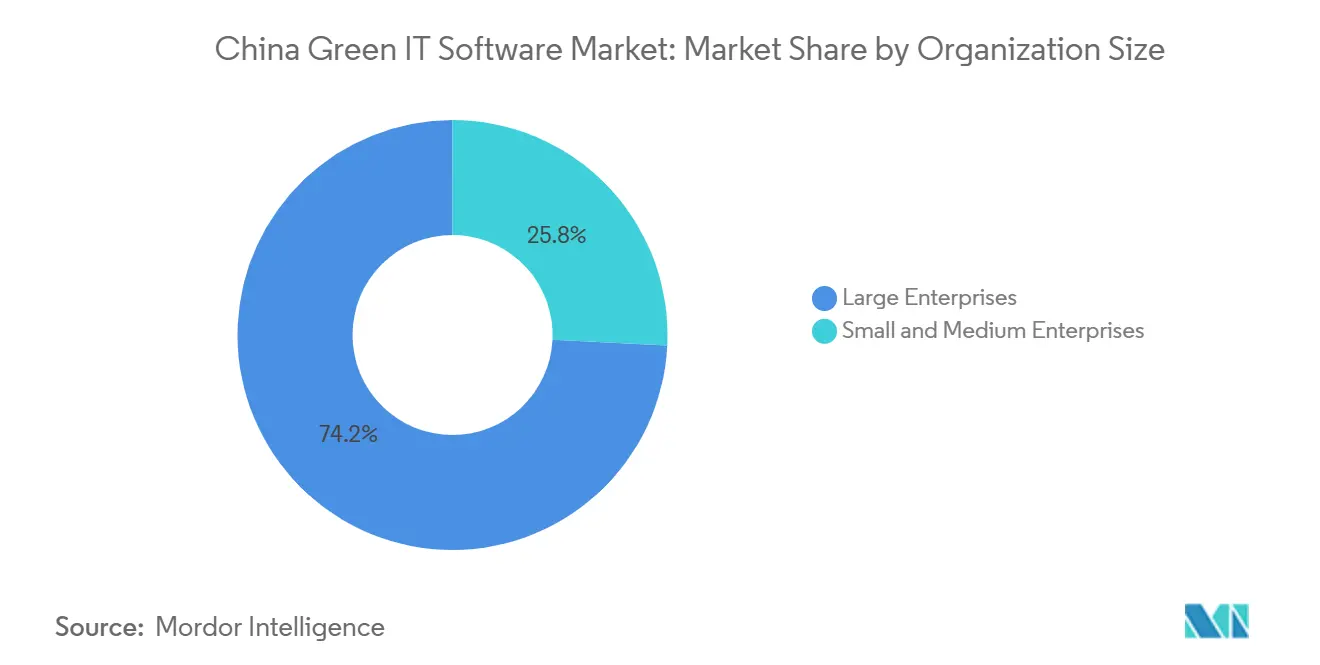
Large enterprises dominated the China green IT software market in 2025, accounting for 74.23% of the market share. Their leadership stems from broader reporting obligations, larger budgets, and the ability to manage integrated platforms. These organizations often influence product design by demanding advanced workflow controls, system compatibility, and robust reporting capabilities, shaping vendor strategies that later cater to smaller firms. For instance, IBM’s 2026 partnership with Oracle to deliver Envizi as a SaaS offering on Oracle Cloud highlights the trend of integrating sustainability management with modernization efforts, keeping large enterprises central to vendor competition.[4]
In contrast, small and medium enterprises (SMEs) are projected to grow at a 22.84% CAGR through 2031, driven by customer and supply-chain demands rather than internal sustainability goals. SMEs require simpler, cost-effective solutions with guided workflows, unlike the complex systems used by larger firms. Domestic vendors, such as Yonyou, are well-positioned to capture this growth by embedding carbon management into existing platforms, as seen with the YonBIP 5 release in 2025. This approach aligns with SME preferences for integrated solutions, signaling that the next growth wave in the market will likely focus on product simplification and embedded functionalities rather than standalone tools.
By End-User Industry: Manufacturing Holds the Base, While IT and Telecommunications Move Faster
In 2025, manufacturing accounted for 26.62% of the China green IT software market, making it the largest end-user segment. This leadership stems from the sector's focus on emissions management, energy efficiency, supply-chain transparency, and carbon tracking at the product level. Manufacturers face challenges in consolidating data from production, procurement, logistics, and utilities, which increases the demand for software that standardizes data management without disrupting operations. The sector's need for comprehensive solutions, such as plant-level energy monitoring and supplier data integration, makes it a lucrative market for vendors capable of supporting multi-site coordination and aligning data definitions across operations. Manufacturing remains central to the market, driving consistent demand and translating sustainability goals into actionable tasks.
IT and telecommunications are projected to grow at a 21.19% CAGR through 2031, the fastest among all end-user segments. This sector operates on both sides of the demand spectrum, consuming significant power through data centers while offering cloud services increasingly evaluated on energy efficiency and sustainability. A 2026 study from Frontiers in Energy Research estimates that Chinese data center electricity demand will reach 277TWh by 2030, highlighting the need for advanced software to optimize power usage and reporting. Other sectors, including banking, financial services, energy, government, healthcare, and retail, are gradually adopting green IT software, driven by the need for operational efficiency, compliance, and supply-chain carbon data. As software becomes more accessible and compatible with existing systems, the market is expanding beyond industrial early adopters to a broader range of industries.
Geography Analysis
Eastern China is the leading regional cluster in the country's Green IT Software market. This dominance is driven by a high concentration of publicly listed companies, advanced manufacturers, export-oriented suppliers, and finance-focused business hubs, all of which face complex disclosure requirements. Shanghai plays a central role, combining its relevance in carbon trading with the presence of major enterprise headquarters and a strong procurement network. Jiangsu and Zhejiang further enhance the region's position with their large-scale manufacturing and export activities, making them natural adopters of product-level carbon accounting and sustainability platforms. The region's advanced digital maturity accelerates the shift from compliance to software adoption, with enterprises often setting national implementation standards through complex, multi-site programs that serve as reference models.
Western China is emerging as a strategic growth area, driven by new computing infrastructure and energy-focused digital projects in provinces rich in renewable resources. Projects such as the Lianghekou hydropower mountain tunnel computing center in Sichuan highlight the need for software capable of real-time coordination of power and computing resources. The national “Eastern Data, Western Computing” initiative aims to significantly reduce data center emissions by 2030, reinforcing the long-term importance of Western provinces in green digital infrastructure. With many facilities newly constructed, Western China benefits from a clean-slate advantage, adopting cloud-native, energy-efficient platforms from the outset. This environment increases the value of platforms that can be quickly configured and scaled across new sites, while the direct connection between physical energy assets and digital infrastructure ensures software performance is highly visible in daily operations.
Northern China remains a stable demand center due to the presence of central agencies, research institutions, state-owned enterprises, and large corporate headquarters. Advanced sustainability practices in Beijing's development zones further strengthen the region's role in shaping national standards. Southern China, led by Guangdong, remains a key region due to its export-driven manufacturing base, which drives consistent demand for carbon data on products and suppliers.[5] Central and Northeastern China, while earlier in the adoption cycle, are expected to play a more significant role as compliance requirements expand and industrial users transition from basic reporting to comprehensive sustainability software platforms.
Competitive Landscape
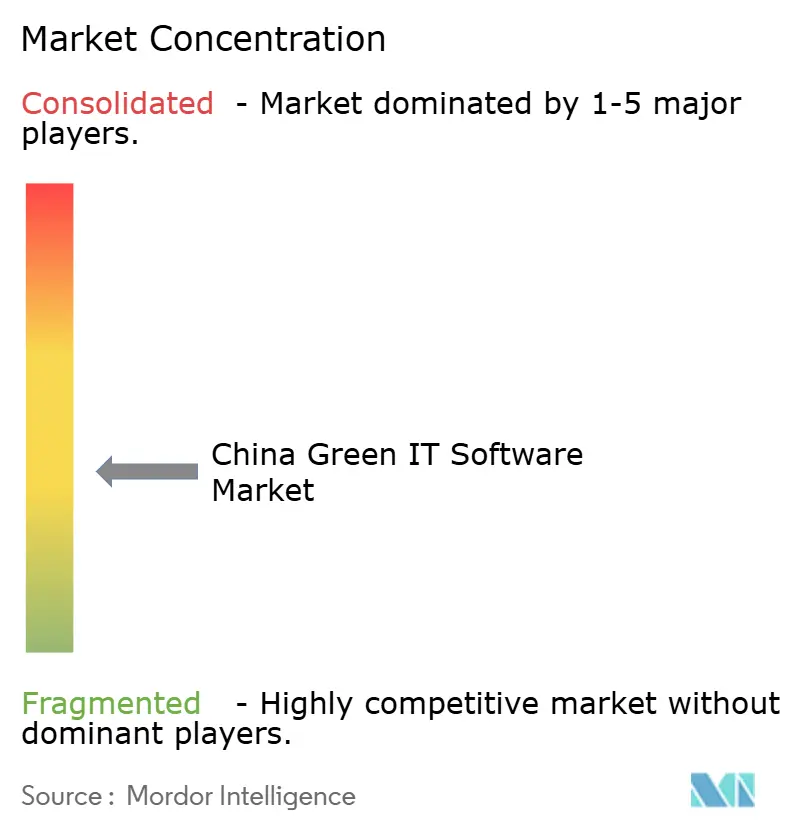
The China green IT software market remains moderately fragmented, with competition split between global enterprise software groups and domestic vendors that are closer to local operating realities. Global players like SAP, IBM, Microsoft, Salesforce, Oracle, and ServiceNow leverage their integrated architecture, enterprise credibility, and alignment with multinational reporting standards to attract large organizations. On the other hand, domestic companies such as Kingdee, Yonyou, Alibaba Cloud, and Huawei Digital Power focus on localization, deployment flexibility, and affordability, catering to mid-market and SME customers. This duality creates a market where purchasing decisions are influenced not only by software features but also by a vendor's ability to meet local standards, integrate with internal systems, and align with budgetary constraints.
Global vendors excel in serving large enterprises that require robust financial controls, enterprise integration, and compatibility with international reporting frameworks. For instance, IBM's April 2026 partnership expansion with Oracle, featuring Envizi on Oracle Cloud Infrastructure, and SAP's May 2026 launch of its sustainability AI agent, highlight efforts to integrate sustainability into broader enterprise transformation initiatives. These strategies make sustainability software more appealing by embedding it within larger digital transformation budgets, particularly for organizations seeking comprehensive vendor ecosystems.
Domestic vendors, meanwhile, capitalize on their understanding of local market needs. Kingdee's ESG automation within its enterprise cloud offerings, Yonyou's integration of dual-carbon functions in its YonBIP 5 platform, and Huawei Digital Power's AI-driven energy optimization solutions demonstrate their focus on localized compliance, energy efficiency, and accessible deployment. This approach aligns with the fastest-growing segments of the market. The competitive landscape remains open, as no single vendor dominates all customer tiers. Large enterprises often prefer global frameworks, while smaller firms prioritize simplicity and local adaptability. As a result, the market is expected to remain competitive throughout the forecast period, offering growth opportunities for both international and domestic players that adapt to evolving enterprise requirements.
China Green IT Software Industry Leaders
-
IBM Corporation
-
Microsoft Corporation
-
SAP SE
-
Oracle Corporation
-
Schneider Electric SE
- *Disclaimer: Major Players sorted in no particular order
Recent Industry Developments
- April 2026: IBM and Oracle expand their partnership, with IBM announcing plans to deliver Envizi as a SaaS offering on Oracle Cloud Infrastructure to enable enterprises to manage ESG data and sustainability reporting on the same cloud as operational and financial information.
- March 2026: Huawei Digital Power unveiled new-generation AI-powered green site and gigawatt-level AI data center solutions at MWC Barcelona 2026, targeting zero-carbon data networks and AI computing energy optimization for global operators.
- January 2026: Amendments to China's stock exchange Sustainability Report Compilation Guides took effect January 30, 2026, providing updated guidance on pollutant discharge, energy utilization, and water resources utilization, expanding the scope of environmental data that listed companies must collect and validate through digital sustainability platforms.
- March 2025: China's Ministry of Industry and Information Technology issued the Guidelines for the Construction of Digital Energy-Carbon Management Centers for Industrial Enterprises and Parks (MIIT No. 13, 2025), establishing a national architecture standard for enterprise energy-carbon management systems and raising the technical bar for green IT software certifications.
China Green IT Software Market Report Scope
The China Green IT Software Market refers to software solutions and digital infrastructure designed to enhance energy efficiency and reduce environmental impact, aligning with the country's sustainable development goals. This technology supports green data centers, enables renewable energy integration, and leverages AI-driven optimization. Consequently, it assists enterprises in meeting stringent Power Usage Effectiveness (PUE) benchmarks and complying with sustainability regulations.
The China Green IT Software Market Report is Segmented by Offering (Software, and Services), Solution Type (Carbon Accounting and Reporting Software, Energy Management and Optimization Software, ESG Data Management Software, Sustainability Performance Management Software, and Green Data Center Management Software), Deployment (Cloud-Based, On-Premises, and Hybrid), Organization Size (Large Enterprises, and Small and Medium Enterprises), End-User Industry (Information Technology and Telecommunications, Banking, Financial Services, and Insurance (BFSI), Manufacturing, Energy and Utilities, Retail and E-Commerce, Government, Healthcare, Construction and Infrastructure, and Other End-User Industries). The Market Forecasts are Provided in Terms of Value (USD).
| Software |
| Services |
| Carbon Accounting and Reporting Software |
| Energy Management and Optimization Software |
| ESG Data Management Software |
| Sustainability Performance Management Software |
| Green Data Center Management Software |
| Cloud-Based |
| On Premises |
| Hybrid |
| Large Enterprises |
| Small and Medium Enterprises |
| IT and Telecommunications |
| Manufacturing |
| Banking, Financial Services, and Insurance (BFSI) |
| Government and Public Sector |
| Energy and Utilities |
| Healthcare and Life Sciences |
| Retail and E-Commerce |
| Construction and Infrastructure |
| Other End-User Industries |
| By Offering | Software |
| Services | |
| By Solution Type | Carbon Accounting and Reporting Software |
| Energy Management and Optimization Software | |
| ESG Data Management Software | |
| Sustainability Performance Management Software | |
| Green Data Center Management Software | |
| By Deployment Mode | Cloud-Based |
| On Premises | |
| Hybrid | |
| By Organization Size | Large Enterprises |
| Small and Medium Enterprises | |
| By End-User Industry | IT and Telecommunications |
| Manufacturing | |
| Banking, Financial Services, and Insurance (BFSI) | |
| Government and Public Sector | |
| Energy and Utilities | |
| Healthcare and Life Sciences | |
| Retail and E-Commerce | |
| Construction and Infrastructure | |
| Other End-User Industries |
Key Questions Answered in the Report
What is the 2026 size and 2031 outlook for China green IT software?
The China green IT software market stood at USD 1.41 billion in 2025, reaches USD 1.62 billion in 2026 and is projected to reach USD 3.73 billion by 2031 at a CAGR of 18.15%.
Which deployment model leads adoption in China green IT software?
Cloud-based deployment leads with 68.94% share in 2025 and is also projected to grow the fastest at 20.12% through 2031.
Which customer group drives current spending the most?
Large enterprises account for 74.23% of 2025 demand, mainly because they face broader reporting obligations and can fund integrated software rollouts.
Which end-user segment is expanding the fastest?
IT and telecommunications are projected to grow at 21.19% through 2031, supported by rising data center energy intensity and stronger demand for facility-level optimization software.
Why does manufacturing remain the largest user base?
Manufacturing holds 26.62% share in 2025 because it combines emissions reporting, plant energy management, supplier data collection, and product-level carbon recordkeeping in one operating environment.
What is driving growth in China green IT software?
Growth is being supported by stricter carbon disclosure requirements, wider enterprise use of automated carbon accounting, rising demand for energy optimization in data centers, and stronger reporting pressure across export supply chains.