
Indonesia Green IT Software Market Size and Share
Market Overview
| Study Period | 2020 - 2031 |
|---|---|
| Forecast Data Period | 2026 - 2031 |
| Base Year Market Size (2025) | USD 192.5 Million |
| Market Size (2026) | USD 232.97 Million |
| Market Size (2031) | USD 669.68 Million |
| Growth Rate (2026 - 2031) | 23.51 % |
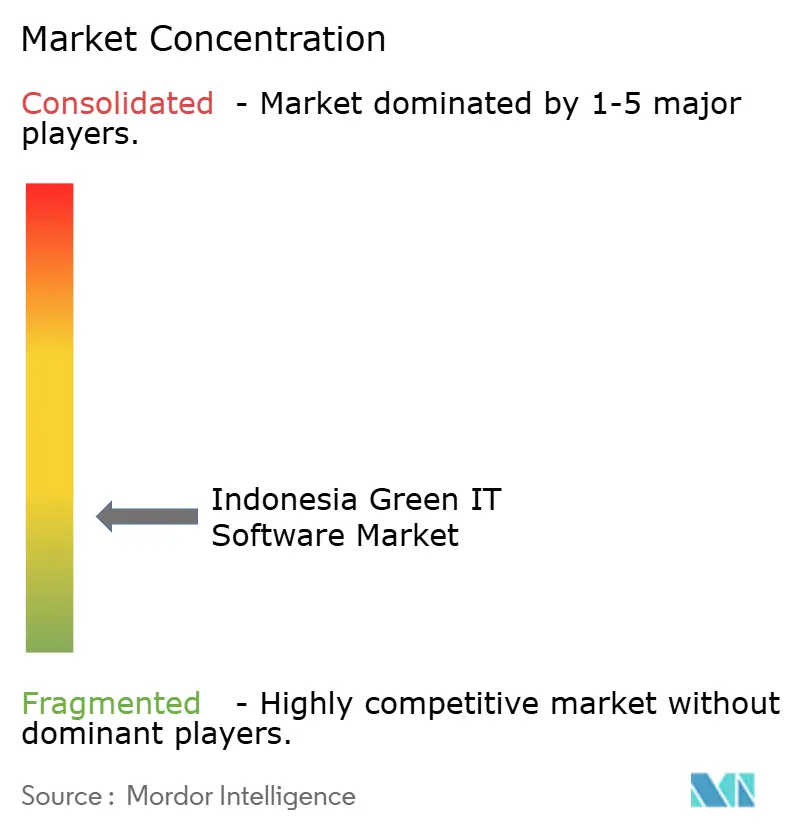
| Market Concentration | Low |
Major Players *Disclaimer: Major Players sorted in no particular order Image © Mordor Intelligence. Reuse requires attribution under CC BY 4.0. | |
Indonesia Green IT Software Market Analysis by Mordor Intelligence
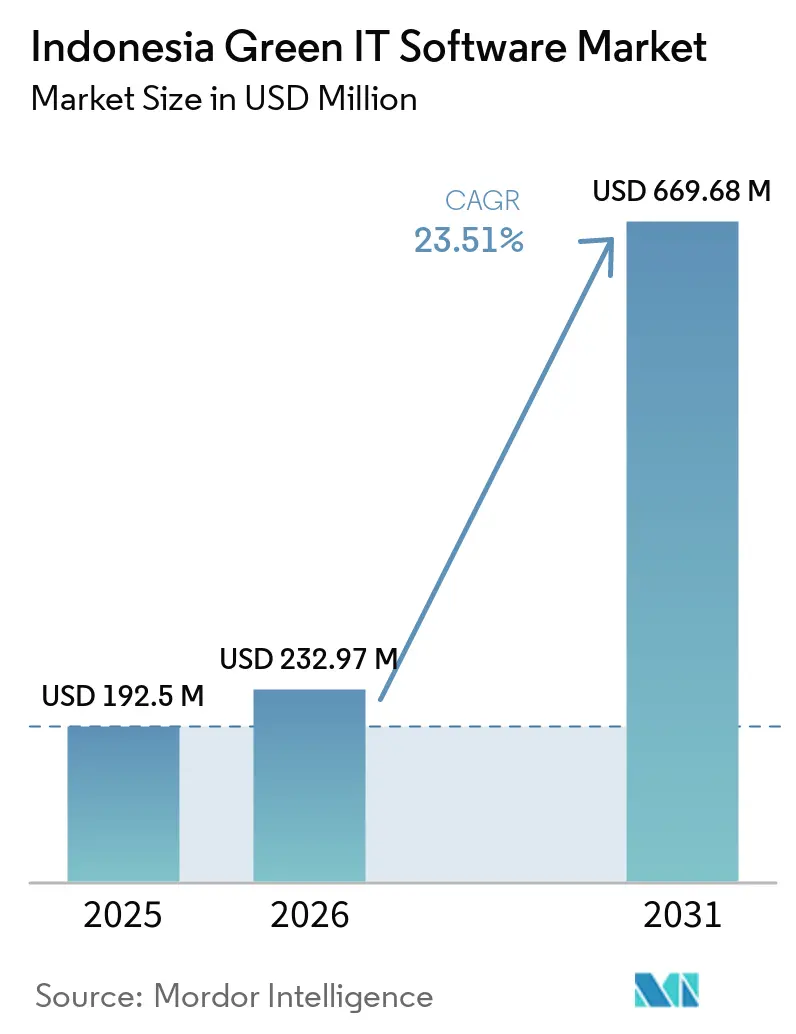
The Indonesia Green IT Software Market size is expected to increase from USD 192.50 million in 2025 to USD 232.97 million in 2026 and reach USD 669.68 million by 2031, growing at a CAGR of 23.51% over 2026-2031. The Indonesia Green IT Software Market is expanding because sustainability reporting in Indonesia is moving from periodic narrative disclosure toward a year-round data management process that needs formal software controls, governed records, and repeatable audit trails. A clearer compliance timetable for ISSB-aligned disclosures has made software purchases more time-bound for listed companies, large banks, and other regulated institutions, shifting buying decisions from exploration to execution. The market is also moving beyond basic emissions measurement, as enterprises now want systems that support implementation, internal approvals, disclosure preparation, and documented decarbonization planning within a single operating framework. Hybrid architecture, service-led deployment, and local workflow support are becoming increasingly important as buyers balance cloud convenience with data-handling requirements, integration work, and assurance readiness. These conditions are widening the opportunity set for the Indonesia Green IT Software Market, especially by enabling vendors to connect regulatory reporting, operational data, and enterprise governance without forcing companies to rely on manual spreadsheets for critical sustainability records.
Key Report Takeaways
- By offering, Software held 66.18% of the Indonesia Green IT Software Market in 2025, while Services is projected to expand at a 25.06% CAGR through 2031.
- By deployment, Cloud-Based held 57.23% of the Indonesia Green Information Technology Software Market in 2025, while Hybrid is projected to expand at a 24.38% CAGR through 2031.
- By enterprise size, Large Enterprises held 69.42% share in 2025, while SMEs are projected to expand at a 24.77% CAGR through 2031.
- By solution type, Carbon Management and Accounting Software commanded 45.18% revenue share in 2025, while Decarbonization Planning Software is projected to expand at a 24.09% CAGR through 2031.
- By end user, Manufacturing held 22.78% revenue share in 2025, while Government is projected to expand at a 23.81% CAGR through 2031.
Note: Market size and forecast figures in this report are generated using Mordor Intelligence’s proprietary estimation framework, updated with the latest available data and insights as of January 2026.
Indonesia Green IT Software Market Trends and Insights
Drivers Impact Analysis*
| Driver | (~) % Impact on CAGR Forecast | Geographic Relevance | Impact Timeline |
|---|---|---|---|
| Regulatory Push for Corporate Carbon Disclosure | +4.2% | National, with primary concentration in Jakarta and Surabaya financial districts | Short term (≤ 2 years) |
| Enterprise Shift From Spreadsheet-Based ESG Tracking to Audit-Ready Software | +3.8% | National, concentrated in Java manufacturing and financial clusters including Jakarta, Surabaya, and Bandung | Short term (≤ 2 years) |
| Rising Demand for Scope 3 Visibility Across Multi-Tier Manufacturing Supply Chains | +3.1% | Java industrial corridor, Batam export zone, and IMIP Morowali in Sulawesi | Medium term (2-4 years) |
| Green Financing Requirements Tied to Measurable Digital Reporting | +2.8% | National, with early adoption in banking clusters in Jakarta and Surabaya | Medium term (2-4 years) |
| Procurement Preference for Vendors With Localized Reporting Workflows | +2.4% | National, with strongest pull in Jakarta’s capital markets ecosystem | Medium term (2-4 years) |
| AI Assisted Emissions Factor Mapping and Data Cleansing | +1.9% | National, with early gains in technology-forward enterprises in Jakarta and Bali | Long term (≥ 4 years) |
| Source: Mordor Intelligence | |||
Regulatory Push for Corporate Carbon Disclosure in Indonesia
The Indonesia Green IT Software Market is moving faster because mandatory disclosure dates now fall within a defined corporate planning cycle, which shortens the time companies have to replace informal reporting routines with governed digital systems. In February 2026, OJK opened a consultation on amendments to POJK 51/2017, while IAI had already adopted PSPK 1 and PSPK 2 in July 2025 and formally launched on August 11, 2025, providing companies with a clearer transition path toward ISSB-aligned disclosure practices.[1] The staged rollout from January 2027 for main board issuers, large banks, and overseas bank branches turns sustainability software from a discretionary line item into a dated compliance purchase, especially for enterprises that still rely on fragmented records and manual consolidations. Bank Indonesia also noted that TKBI Version 3 classifies information and communication as an enabling sector within sustainable finance, thereby giving digital reporting tools a clearer place in green budgeting discussions and financing frameworks. This matters because procurement teams now have both a reporting deadline and a taxonomy signal when they justify software spending to management, finance teams, and audit committees. In practice, the Indonesia Green IT Software Market is benefiting from a regulatory cycle that rewards platforms with audit trails, multi-entity controls, scenario-ready data structures, and structured disclosure workflows that can be maintained every year rather than assembled only at filing time.
Enterprise Shift from Spreadsheet-Based ESG Tracking to Audit-Ready Software
The move away from spreadsheet-based ESG tracking is changing the Indonesia Green IT Software Market from a basic reporting niche into a broader systems category that must support data ownership, traceability, approvals, and repeatable disclosure preparation. Spreadsheet files remain familiar and easy to start with, but they are weak when companies need version control, data lineage, cross-entity consolidation, supporting evidence retention, and a clear record of who changed what and when. Once assurance expectations rise, those manual steps introduce delays and error risk because emissions information is scattered across finance, operations, procurement, facilities, and supplier records that were not designed to work together under a single reporting method. TruCarbon addressed this need in January 2026 with TruCount, a platform built for IDX-listed companies that supports Scope 1, Scope 2, and 15 Scope 3 categories within OJK-aligned reporting workflows and a defined reporting window for the 2025 financial year. Its alignment with GHG Protocol, ISO 14064, and GRI 305 shows that multi-standard compatibility has become a baseline expectation rather than a premium option reserved for the most advanced users. That shift favors vendors that can turn raw operational inputs into audit-ready outputs, while also reducing the need for sustainability teams to maintain parallel spreadsheet files outside the formal system.
Rising Demand for Scope 3 Visibility Across Multi-Tier Manufacturing Supply Chains
Scope 3 visibility is pushing the Indonesia Green IT Software Market deeper into manufacturing supply chains, as buyer scrutiny rarely stops at a company’s direct operations and often extends to purchased goods, logistics, contract production, and upstream material sources. Export-oriented producers need supplier data that is consistent enough to support emissions statements across materials, transport activities, conversion steps, and product-level documentation that can withstand commercial review and repeated reporting cycles. The challenge is harder in Indonesia because supplier networks are distributed across islands, reporting maturity differs sharply by firm size, and many smaller vendors still lack the routines needed to produce standardized emissions information on schedule. A 2024 study on carbon emission accounting in Indonesia’s manufacturing sector found that adoption varied sharply by company size and subsector, with larger firms moving earlier and SMEs facing stronger resource and skills constraints that slow formal reporting adoption. The same study highlighted limited data awareness, high collection costs, internal resistance to standardization, and weak interoperability across systems, all of which make supplier-level reporting programs harder to scale and validate. As those gaps narrow, demand moves beyond simple footprint calculation toward supplier portals, validation workflows, governed sustainability data repositories, and operating models that can support multi-tier disclosure over several reporting periods.
Green Financing Requirements Tied to Measurable Digital Reporting
Green financing requirements are also supporting the Indonesia Green IT Software Market, as lenders and internal capital committees increasingly expect measurable sustainability data rather than general narrative commitments that cannot be verified against a stable baseline. This changes software-buying behavior because carbon accounting tools are increasingly supporting treasury, investor relations, and covenant management functions, not just sustainability teams that prepare annual disclosures. Companies seeking sustainability-linked financing need records that can be reviewed across baseline definitions, reporting periods, data ownership points, and target progress, which makes documentation quality more important than a simple one-time emissions estimate. That requirement increases demand for centralized systems that store historical values, method notes, approval logs, review comments, and standard reporting templates in a single environment accessible by different functions. It also broadens the buyer group inside each enterprise, since finance teams, compliance teams, operating units, and sustainability leads all need to work from the same emissions record to avoid conflicting numbers. The result is a reinforcing cycle in which reporting software supports both external disclosure obligations and internal capital planning, thereby strengthening the commercial justification for the Indonesia Green IT Software Market even as procurement budgets face closer scrutiny.
Restraints Impact Analysis*
| Restraint | (~) % Impact on CAGR Forecast | Geographic Relevance | Impact Timeline |
|---|---|---|---|
| Fragmented Emissions Data Across Subsidiaries and Suppliers | -2.8% | National, most acute in multi-site conglomerates operating across Java, Kalimantan, and Sulawesi | Medium term (2-4 years) |
| Limited In-House Sustainability Analytics Talent Among Mid-Market Firms | -2.2% | National, most severe outside Java’s major urban centers | Long term (≥ 4 years) |
| Integration Burden With Legacy ERP and Procurement Systems | -1.8% | National, concentrated in established manufacturing firms in Java and Batam | Medium term (2-4 years) |
| Data Sovereignty and Confidentiality Concerns In Cloud Deployment | -1.4% | National, particularly in financial services and government sectors | Long term (≥ 4 years) |
| Source: Mordor Intelligence | |||
Fragmented Emissions Data Across Subsidiaries and Suppliers
Fragmented emissions data remains the main implementation barrier in the Indonesia Green IT Software Market because large Indonesian groups often operate through separate subsidiaries, plants, distribution entities, and supplier networks that do not share one reporting structure. Each operating unit may use a different ERP setup, approval routine, or level of data discipline, which slows consolidation even before companies begin supplier-facing Scope 3 collection. The problem becomes more apparent when enterprises try to align electricity use, fuel consumption, procurement records, logistics activities, and supporting documentation into a single auditable reporting file that management and external reviewers can both trust. The 2024 manufacturing study found that Indonesian firms faced limited data awareness, high collection costs, internal resistance to standardization, and insufficient interoperability across systems, which explains why first deployments often take longer than buyers initially expect. Those gaps increase service dependence, raise implementation effort, and force software vendors to spend more time on data mapping and validation than on higher-value planning or analytics functions. Until interoperability improves, vendors that simplify ingestion, exception handling, and validation will keep an advantage over tools that assume source systems are already clean, aligned, and centrally governed.
Limited In-House Sustainability Analytics Talent Among Mid-Market Firms
Limited in-house sustainability analytics talent continues to slow adoption in the Indonesia Green IT Software Market, especially outside the largest listed corporations and outside the most digitally mature business clusters on Java. Many mid-market firms still lack staff who can map activity data, apply reporting standards, maintain disclosure calendars, and keep supporting evidence organized without outside training or hands-on vendor support. That skills gap matters because even a simplified software platform still depends on clear data ownership, stable collection routines, internal review steps, and enough process discipline to keep results comparable from one period to the next. The APINDO, GRI, Ministry of SMEs, Ministry of Trade, and Life Cycle Indonesia program graduated 151 SMEs with their first published sustainability reports in February 2026, which showed that structured guidance remained necessary before many smaller firms could operate reporting tools independently. This explains why SMEs are growing quickly from a small base while large enterprises still account for most current spending in the Indonesia Green Information Technology Software Market, since the learning curve remains a real commercial constraint for smaller buyers. Vendors that combine guided workflows, local-language support, onboarding services, and simple reporting paths are better positioned to reduce this adoption gap than those that assume users already understand carbon accounting logic and disclosure practices.
*Our forecasts treat driver/restraint impacts as directional, not additive. The impact forecasts reflect baseline growth, mix effects, and variable interactions.
Segment Analysis
By Offering: Services Growth Narrows the Software Dominance Gap
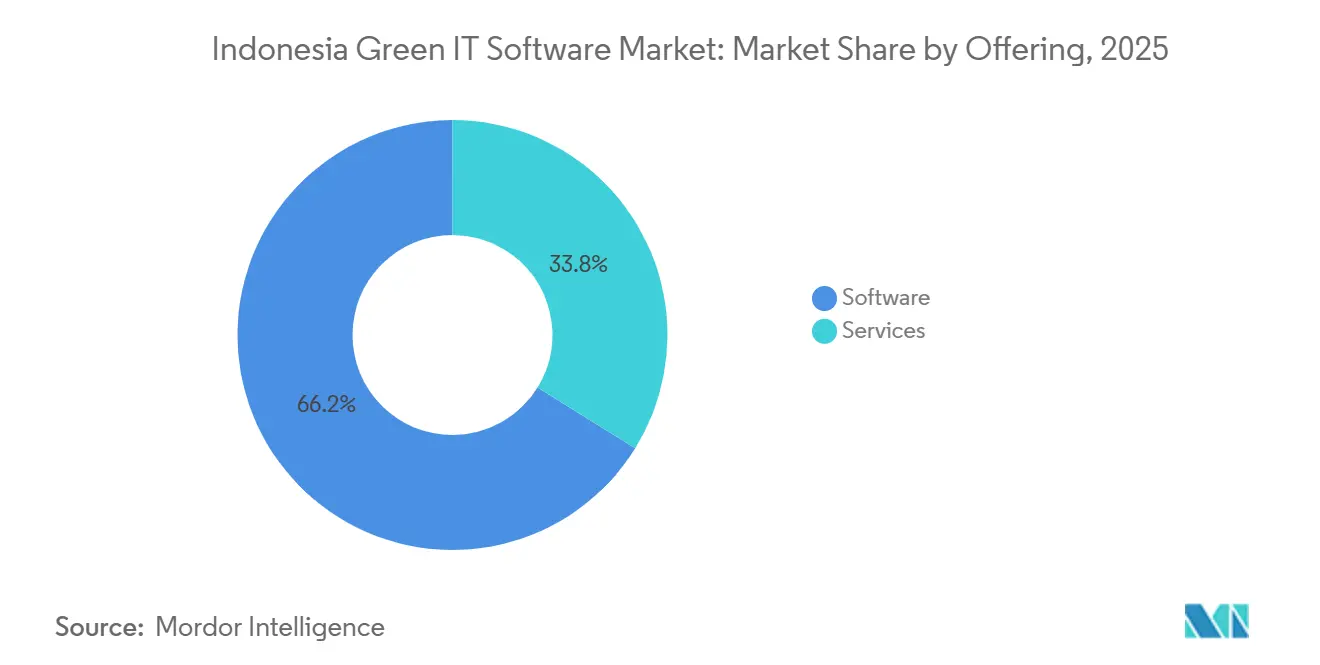
Software held 66.18% of the market in 2025, accounting for 66.18% of the Indonesia Green IT Software Market Size, because platform licenses were the first purchase for regulated enterprises that needed a structured control layer for sustainability data. Many buyers started with carbon accounting and reporting modules because those tools created a base record that later services, assurance preparation tasks, and adjacent applications could use without rebuilding the same dataset each year. This pattern fits the current stage of the Indonesia Green IT Software Market, where procurement is still led by the need to collect, classify, store, and retrieve emissions information in a formal system rather than in scattered internal files. Buyers also prefer software first because it creates a durable operating foundation that can remain in place across annual reporting cycles, internal governance reviews, and evolving disclosure standards that require repeatable methods. As a result, license-led deals still anchor budgets even as implementation work becomes more complex after the first deployment wave and as more teams begin using the same platform.
Services are projected to expand at a 25.06% CAGR through 2031, as enterprises now need migration support, organizational setup, assurance preparation, training, workflow design, and ongoing system refinement after the initial purchase. Companies that adopted platforms earlier are finding that sustainability reporting depends on data stewardship, approval routing, supporting documentation, and review readiness, which software alone cannot deliver unless a vendor or partner helps shape the operating process. This is why implementation, data mapping, evidence management, and disclosure support are becoming more commercially important inside the Indonesia Green IT Software Market, even though software remains the larger revenue pool. Workiva’s September 2025 platform expansion added agentic AI, unified data automation, and Intelligent Sustainability tools aimed at finance, governance, risk, compliance, and sustainability teams preparing for IFRS S1 and IFRS S2 reporting cycles.[2] That product direction matters because it shows how the line between software and services is narrowing, with vendors embedding guided analysis and workflow assistance into the platform itself instead of treating support as a fully separate offering.
By Deployment: Hybrid Architecture Addresses Data Residency Constraints
Cloud-based deployment accounted for 57.23% of the market in 2025, and it held 57.23% of the Indonesia Green IT Software Market Share because enterprises valued faster rollout, lower upfront infrastructure needs, easier remote access, and more efficient coordination across multiple business entities. For companies operating across Indonesia’s islands, cloud delivery also supports centralized data collection from plants, offices, branches, warehouses, and suppliers operating in different contexts and often reporting on different internal timetables. The model suits recurring rule updates because vendors can adjust templates, calculation logic, factor libraries, and reporting fields without requiring a large internal IT project each time a client needs a change. It also fits buyers who want sustainability teams, finance teams, internal auditors, and management users to work in the same system rather than exchanging multiple local files, which increases control risk. These advantages explain why cloud remains the default entry route for many first-time buyers in the Indonesia Green IT Software Market, especially where speed and ease of coordination matter more than full local infrastructure ownership.
Hybrid deployment is projected to expand at a 24.38% CAGR through 2031, as some companies still need tighter control over sensitive operational or financial data, even when they prefer cloud-based analytics and reporting outputs. Data residency requirements under Government Regulation No. 71/2019 and sector-specific oversight create a practical case for keeping some inputs on-premise or in locally hosted environments while using cloud tools for consolidation, workflow management, and final disclosure assembly. This architecture is especially relevant for regulated institutions, state-linked organizations, and large enterprises with internal security rules that require stronger separation between raw operational data and broader reporting access. On-premise systems, therefore, remain relevant where governance rules favor local infrastructure, even if their relative weight should narrow as hybrid models become more mature, easier to verify, and more acceptable to risk and compliance teams. The deployment mix shows that convenience alone does not shape buying decisions in the Indonesia Green IT Software industry, because enterprises also weigh sovereignty, audit readiness, integration effort, and control over sensitive source data.
By Enterprise Size: SME On-Ramps Begin to Scale From a Low Base
Large enterprises held 69.42% of the market in 2025 and continued to account for the majority of spending, as listed groups, large manufacturers, and major financial institutions faced the earliest pressure to formalize emissions reporting within governed digital environments. Their advantage comes from broader IT budgets, larger implementation teams, established finance controls, and existing ERP or CRM estates that can support integration work without forcing a complete redesign of internal processes. In the Indonesia Green IT Software Market, these firms also have stronger reasons to buy sooner, as they face investor scrutiny, export customer requirements, internal audit expectations, and multi-entity governance needs simultaneously. Existing enterprise software relationships further strengthen this position, since large buyers often prefer to extend a trusted platform before evaluating a full replacement or a narrow specialist tool. That dynamic keeps the revenue base tilted toward bigger accounts even as the customer pool widens and new mid-sized users begin to enter with lighter, more focused use cases.
SMEs are projected to expand at a 24.77% CAGR through 2031 because supply chain requests, buyer due diligence, simplified reporting frameworks, and financing-related screens are gradually reaching smaller businesses that were previously outside formal sustainability systems. Growth is starting from a lower base because many SMEs still need training, simpler data collection routines, basic process ownership, and lightweight implementation models before they can operate a reporting platform with consistency and confidence. The APINDO and GRI consortium program with Life Cycle Indonesia graduated 151 SMEs with their first published sustainability reports in February 2026, demonstrating that standardized guidance can move smaller firms from broad awareness to actual reporting practice and repeatable disclosure behavior. SME uptake should therefore rise where vendors offer local-language support, straightforward templates, lighter service packages, and product designs that reduce the need for dedicated in-house specialists or complex external consulting. The gap between large enterprises and SMEs will narrow over time, but the large-enterprise cohort should remain the main revenue center through the forecast period because it began from a far larger installed base and still faces the strongest near-term compliance pressure.
By Solution Type: Carbon Accounting Anchors the Market While Decarbonization Tools Accelerate
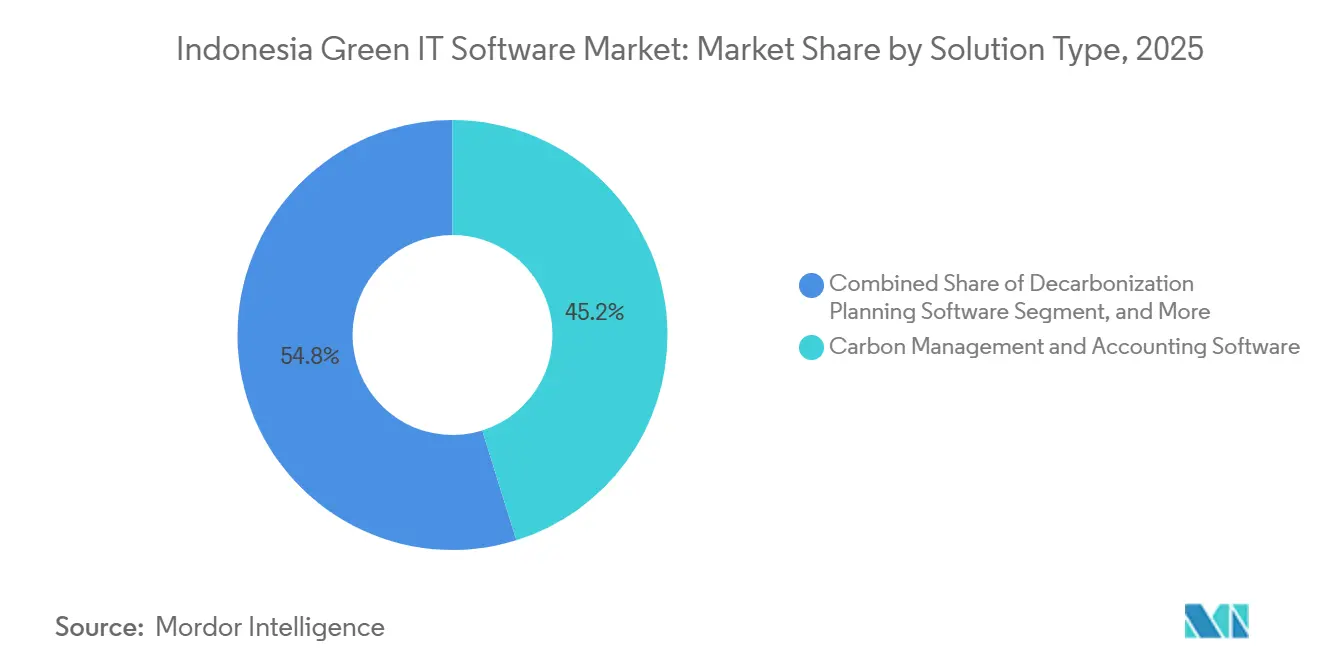
Carbon Management and Accounting Software accounted for 45.18% of solution-type revenue in 2025 because later workflows in the Indonesia Green IT Software Market depend on a credible, reusable, verifiable, and defensible base calculation of Scope 1 and Scope 2 emissions. It remains the entry point for most buyers because measurement must come before disclosure, planning, supplier engagement, operational optimization, or any other sustainability workflow that relies on a stable emissions baseline. These tools help enterprises structure activity data, apply factors, retain calculation logic, classify sources, and prepare a repeatable record that supports management review and external reporting. ESG Reporting and Compliance Software sits next to this layer by converting measured values into disclosure-ready outputs that align with OJK requirements, corporate reporting calendars, and broader framework expectations. Sustainability Data Management Platforms support both categories by gathering inputs from multiple functions and storing them in a governed repository that can answer future audit or assurance questions without forcing teams to reconstruct historical records.
Decarbonization Planning Software is projected to expand at a 24.09% CAGR through 2031 as companies move from initial measurement to formal transition roadmaps, internal target setting, and monitored execution against reduction pathways. Once an enterprise has a stable baseline, it needs scenario tools that can compare reduction options, connect targets to budgets, and show how operational changes may affect future emissions profiles across facilities, suppliers, and business units. This is where the Indonesia Green Information Technology Software Market begins to shift from pure compliance support toward management action, even though accounting remains the core revenue anchor for most new users. Energy and Resource Optimization Software also gains importance when manufacturers want emissions data to inform plant efficiency, utility use, and process improvement, rather than having it sit in a separate reporting file that management reviews only once a year. The solution mix, therefore, shows a clear sequence, with accounting first, reporting next, data governance underneath, and planning tools gaining speed as enterprises become more confident in the quality and continuity of their emissions information.

By End User: Manufacturing Leads While Government Digitizes at Pace
Manufacturing accounted for 22.78% of end-user revenue in 2025 because of export exposure, supply chain disclosure requests, process complexity, and multi-site operating structures, making this group one of the earliest adopters of sustainability data systems. Manufacturers often need to gather emissions information across plants, purchased materials, utilities, logistics, packaging, and contract suppliers, which creates a much broader software requirement than a single office-based disclosure exercise. In the Indonesia Green IT Software Market, the need is stronger for sectors tied to international customers, carbon-intensive activities, or production systems that require data to be assembled from multiple internal and external contributors simultaneously. These buyers also benefit from structured tools because the same emissions record can support customer questionnaires, internal performance reviews, supplier engagement, and formal sustainability disclosures without the need for repeated manual rework. As a result, manufacturing should remain a leading revenue anchor even as government and service-oriented sectors continue to widen their software use cases.
Government is projected to expand at a 23.81% CAGR through 2031, driven by public-sector digitalization and regulatory reporting programs that are expanding the use cases for centralized sustainability systems across institutions and supervised entities. Bank Indonesia’s APOLO initiative began digitalizing GHG and green portfolio reporting for commercial banks in 2026, supporting institutional demand for platforms with standardized submission fields, review workflows, and centralized recordkeeping. Indonesia’s Government Digital Master Plan 2025-2045 also embedded data-driven governance within the public sector, which strengthens the broader operating context for digital environmental reporting tools and wider process standardization. IT, telecom, and BFSI remain active adjacent adopters, while retail, healthcare, construction, and other service sectors are moving in as partners as partners due diligence and customer expectations become more difficult to manage through informal processes alone. This spread across end users shows that the Indonesia Green IT Software Market is broadening from a compliance-led core into a wider operational software category that can support reporting, governance, and day-to-day management across multiple sectors.
Geography Analysis
Java, especially Greater Jakarta, anchored the largest share of demand in 2026 because the country’s listed issuers, major banks, corporate headquarters, technology ecosystems, and central regulatory institutions are concentrated there. This concentration makes procurement more immediate in Jakarta than in most other regions, since disclosure readiness, internal governance expectations, and enterprise software budgets are strongest among large centralized organizations. Surabaya added an important demand through its manufacturing and logistics networks, which require more structured emissions records across production, warehousing, transport activities, and supplier coordination. Bandung also contributed through technology and industrial clusters, where enterprises can connect existing digital systems with sustainability reporting tools more quickly than in less connected business environments. Taken together, these urban centers form the commercial core of the Indonesia Green IT Software Market because they combine budget capacity, regulatory exposure, existing enterprise software estates, and greater internal data maturity.
East Java’s automotive, chemicals, and food processing zones create a second layer of opportunity as emissions data requests flow from anchor manufacturers to regional suppliers that must gradually formalize their reporting routines. Sumatra and Kalimantan contribute demand from plantation, natural resource, and processing businesses that need more consistent land-use, operational, energy, and supply chain reporting over time. These regions often face a more challenging implementation path because facilities are dispersed, operating structures are less centralized, and source data can remain spread across disconnected local systems for extended periods. Sulawesi is becoming more relevant as integrated industrial parks and mining-linked value chains face stronger expectations for auditable emissions records from customers, lenders, and large corporate counterparties. The Indonesia Green IT Software Market, therefore, does not spread evenly across the archipelago, and adoption still follows the geography of large enterprise operations, export-linked production, and data-intensive institutional oversight.
Eastern Indonesia, including Papua and the Nusa Tenggara islands, remained at an earlier adoption stage in 2026 because large enterprise density and digital infrastructure were still lower than in western Indonesia. That does not remove the opportunity, because national digital government planning is expanding the basic conditions for standardized reporting, secure digital workflows, and broader software adoption over time.[3] As connectivity and governance systems improve, smaller regional organizations should find it easier to move from manual recordkeeping toward structured carbon and ESG platforms that support routine data submission and review. Geography in this market is therefore shaped less by population size alone and more by the overlap between industrial concentration, regulatory urgency, digital readiness, and the presence of enterprises that already operate with formal reporting disciplines.
Competitive Landscape
The competitive environment remained fragmented in 2026, with large global enterprise vendors leading many top-tier accounts and specialized carbon platforms competing around specific use cases, service intensity, and local workflow adaptation. SAP SE, Microsoft Corporation, Oracle Corporation, and Salesforce Inc. benefit from installed enterprise relationships that reduce switching friction for large buyers already using their finance, cloud, data, or customer systems in daily operations. That installed base matters in the Indonesia Green IT Software Market because sustainability teams often need support from existing IT, finance, procurement, and governance environments rather than a completely separate tool stack that increases integration burden. Vendors that can connect emissions data with enterprise workflows, therefore, hold an advantage in large corporate accounts where integration discipline and internal control matter as much as front-end reporting design. This keeps the upper end of the market competitive, but it does not create a single dominant supplier because buyers still compare functionality, localization, implementation depth, and the ability to support changing reporting requirements.
SAP strengthened its position in May 2026 when it announced new sustainability AI agents, including a Sustainability Regulatory Readiness Agent and an agent that connects financial and sustainability data, extending its ERP-embedded approach into more automated workflows.[4] Workiva expanded its platform in September 2025 with agentic AI, unified data automation, and Intelligent Sustainability tools aimed at finance, governance, risk, compliance, and sustainability teams preparing for new disclosure cycles. Terrascope also became a notable strategic case in February 2026, when XeleratedFifty acquired the company and retained all customer contracts and service commitments, signaling continued confidence in APAC supply chain decarbonization software and cross-border growth potential. These moves show that competition is no longer limited to simple carbon accounting, as vendors race to add automation, workflow intelligence, and broader enterprise connections that support both compliance and operational follow-through. In the Indonesia Green IT Software Market, suppliers that can combine disclosure outputs with practical data management tools are favored, rather than treating reporting as a narrow annual exercise.
Local providers such as TruCarbon, Jejakin, and ESGTrack.AI remain relevant because they can build POJK 51-oriented workflows, local language support, and implementation models that reflect Indonesian reporting realities more closely than some international platforms. Smaller and regional vendors also compete by reducing onboarding friction for companies without large internal sustainability teams, mature global controls, or complex ERP estates that can support heavyweight deployments. The main open space remains supplier engagement and multi-tier Scope 3 tools that work well across fragmented Indonesian value chains, especially in manufacturing, resource-linked production, and land-connected sectors, where primary data collection remains difficult. Overall, the Indonesia Green Information Technology Software Market rewards both scale and specialization, which supports the view that concentration is limited even though global enterprise brands carry strong visibility and substantial account access at the top end.
Indonesia Green IT Software Industry Leaders
-
SAP SE
-
Salesforce, Inc.
-
Microsoft Corporation
-
Oracle Corporation
-
IBM Corporation
- *Disclaimer: Major Players sorted in no particular order
Recent Industry Developments
- June 2026: Sweep, in partnership with Amazon Web Services, launched a complete cloud emissions measurement solution using the AWS Sustainability service, enabling enterprise customers to automatically consolidate Scope 1, 2, and 3 cloud emissions data within Sweep's sustainability intelligence platform and produce audit-ready outputs under a single methodology traceable to source.
- May 2026: SAP announced at SAP Sapphire that new sustainability AI agents, including a Sustainability Regulatory Readiness Agent that automates reporting-scope assembly based on materiality assessments, and an autonomous agent that connects financial and sustainability data, will be generally available by the end of 2026, extending its ERP-embedded sustainability strategy into agentic AI workflows.
- February 2026: XeleratedFifty acquired Terrascope Pte. Ltd. from Olam Group Limited, maintaining all customer contracts and service-level commitments, with the transaction aimed at accelerating Terrascope's commercialization as a leading APAC supply chain decarbonization platform serving customers in over 50 countries.
- February 2026: The APINDO, GRI, Ministry of SMEs, Kementerian Perdagangan, and Life Cycle Indonesia consortium graduated 151 Indonesian SMEs with their first published sustainability reports under the Panduan Lestari framework, marking Indonesia's first structured initiative to deliver GRI-aligned sustainability reporting capability to micro and small businesses at scale.
Indonesia Green IT Software Market Report Scope
The Indonesia Green IT Software Market encompasses digital solutions that mitigate the environmental impact of IT operations in industrial and enterprise settings. Key offerings, such as energy monitoring systems and carbon management tools, cater specifically to the manufacturing and infrastructure sectors. The market's growth is fueled by rising industrialization, a regulatory push for emissions reduction, and the swift growth of cloud and data center ecosystems. These solutions empower organizations to boost efficiency, cut energy consumption, and meet evolving environmental standards.
The Indonesia Green IT Software Market Report is Segmented by Offering (Software, and Services), Deployment (Cloud-Based, On-Premise, and Hybrid), Enterprise Size (Large Enterprises, and Small and Medium Enterprises), Solution Type (Carbon Management and Accounting Software, ESG Reporting and Compliance Software, Sustainability Data Management Platforms, Decarbonization Planning Software, and Energy and Resource Optimization Software), and End User (Information Technology and Telecom, Banking, Financial Services and Insurance, Manufacturing, Energy and Utilities, Retail and E-Commerce, Government, Healthcare and Life Sciences, Construction and Infrastructure, and Other End-User Industries). The Market Forecasts are Provided in Terms of Value (USD).
| Software |
| Services |
| Cloud-Based |
| On-Premise |
| Hybrid |
| Large Enterprises |
| Small and Medium Enterprises |
| Carbon Management and Accounting Software |
| ESG Reporting and Compliance Software |
| Sustainability Data Management Platforms |
| Decarbonization Planning Software |
| Energy and Resource Optimization Software |
| Information Technology and Telecom |
| Banking, Financial Services, and Insurance |
| Manufacturing |
| Energy and Utilities |
| Retail and E-Commerce |
| Government |
| Healthcare and Life Sciences |
| Construction and Infrastructure |
| Other End-User Industries |
| By Offering | Software |
| Services | |
| By Deployment | Cloud-Based |
| On-Premise | |
| Hybrid | |
| By Enterprise Size | Large Enterprises |
| Small and Medium Enterprises | |
| By Solution Type | Carbon Management and Accounting Software |
| ESG Reporting and Compliance Software | |
| Sustainability Data Management Platforms | |
| Decarbonization Planning Software | |
| Energy and Resource Optimization Software | |
| By End User Industry | Information Technology and Telecom |
| Banking, Financial Services, and Insurance | |
| Manufacturing | |
| Energy and Utilities | |
| Retail and E-Commerce | |
| Government | |
| Healthcare and Life Sciences | |
| Construction and Infrastructure | |
| Other End-User Industries |
Key Questions Answered in the Report
What is the size outlook for Indonesia green IT software through 2031?
The Indonesia Green IT Software Market was valued at USD 192.50 million in 2025, reached USD 232.97 million in 2026, and is forecast to reach USD 669.68 million by 2031 at a 23.51% CAGR.
Which offering leads spending in Indonesia green IT software?
Software led with a 66.18% share in 2025 because enterprises first needed a stable platform for carbon accounting, reporting control, and governed sustainability data management.
Which deployment model is growing fastest in this space?
Hybrid deployment is projected to grow at a 24.38% CAGR through 2031, reflecting the need to balance cloud scale with data handling, control, and residency requirements.
Which enterprise segment is expanding the quickest?
SMEs are projected to grow at a 24.77% CAGR through 2031, but they are scaling from a smaller base because many still need onboarding, simpler workflows, and structured reporting support.
Which solution category currently holds the largest revenue share?
Carbon Management and Accounting Software led with 45.18% of solution-type revenue in 2025 because emissions measurement remains the starting point for reporting, planning, and governance workflows.
Which end-user group shows the strongest current and future demand pattern?
Manufacturing led with 22.78% share in 2025, while Government is projected to grow fastest at 23.81% CAGR through 2031 as public-sector digital reporting programs and supervised data workflows expand.