
Malaysia Green IT Software Market Size and Share
Market Overview
| Study Period | 2020 - 2031 |
|---|---|
| Forecast Data Period | 2026 - 2031 |
| Base Year Market Size (2025) | USD 143.09 Million |
| Market Size (2026) | USD 172.32 Million |
| Market Size (2031) | USD 483.29 Million |
| Growth Rate (2026 - 2031) | 22.91 % |
| Market Concentration | Low |
Major Players *Disclaimer: Major Players sorted in no particular order Image © Mordor Intelligence. Reuse requires attribution under CC BY 4.0. | |
Malaysia Green IT Software Market Analysis by Mordor Intelligence
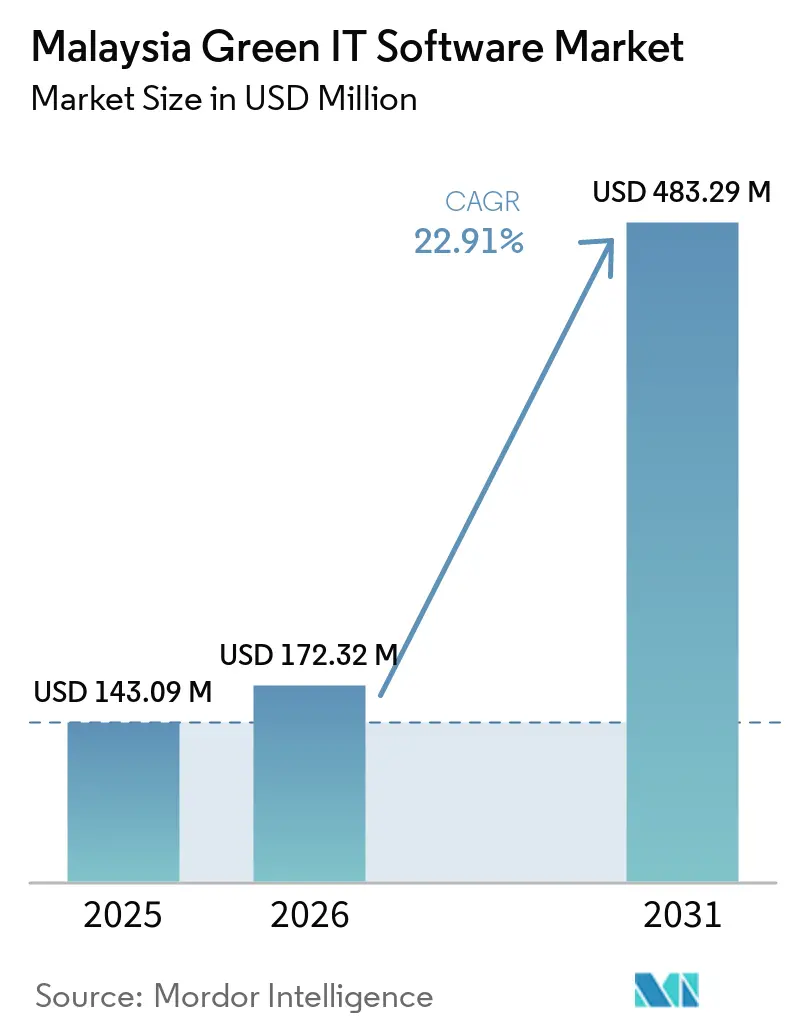
The Malaysia Green IT Software Market size is projected to expand from USD 143.09 million in 2025 and USD 172.32 million in 2026 to USD 483.29 million by 2031, registering a CAGR of 22.91% between 2026 to 2031. The growth path is being shaped by a compliance-led buying cycle, as sustainability disclosure rules have shifted software spending from a gradual IT decision to a near-term reporting requirement. Enterprises now need systems that can capture auditable climate and emissions data across business units, sites, and supplier networks, which is widening the role of dedicated sustainability platforms. Demand is also being supported by the need for faster deployment, stronger data controls, and better alignment between finance, risk, and reporting teams, which makes cloud delivery and traceable audit workflows more relevant. At the same time, local hosting preferences, supplier disclosure pressure, and rising scrutiny around carbon accounting are creating openings for vendors that can combine reporting depth with practical implementation support. Competitive conditions remain moderate, with global enterprise platforms and Malaysia-focused specialists both finding room to grow as buyers look for compliance fit, easier deployment, and sector-specific workflow support.
Key Report Takeaways
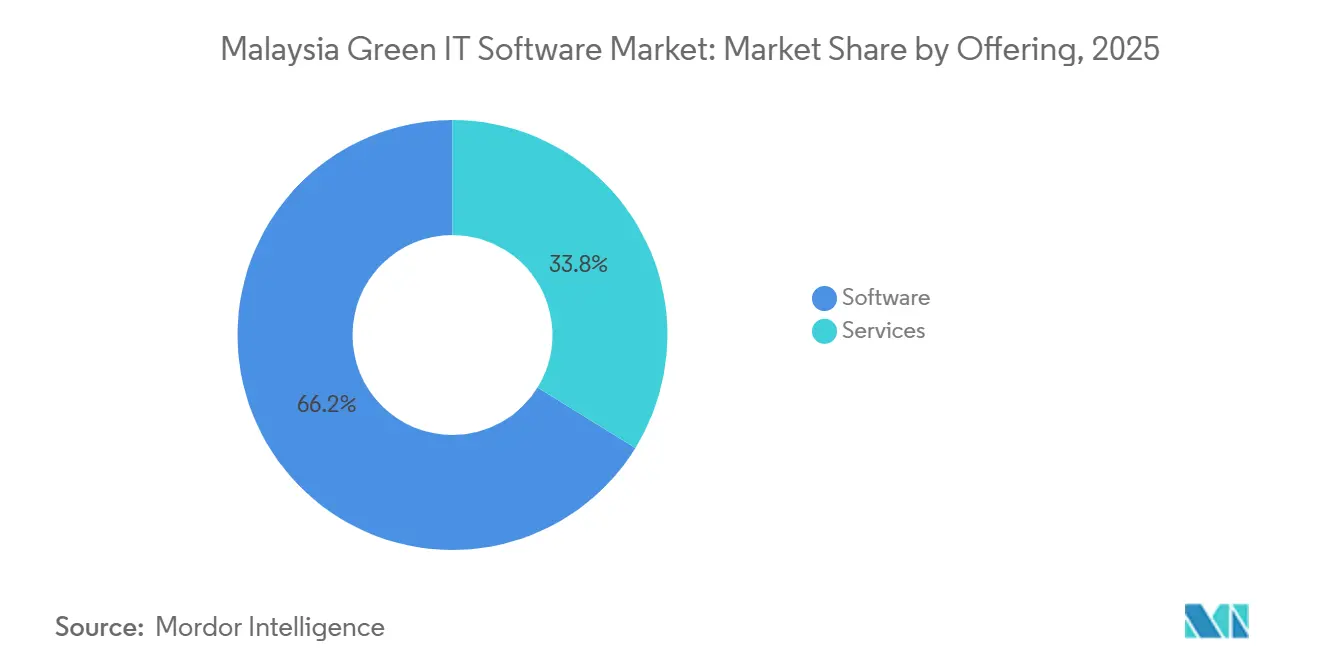
- By offering, software held 66.19% of revenue of the Malaysia Green IT Software Market in 2025, while services are projected to expand at a 24.71% CAGR through 2031.
- By deployment, cloud-based solutions held 57.11% of the Malaysia Green IT Software Market in 2025, while hybrid is projected to expand at a 23.97% CAGR through 2031.
- By enterprise size, large enterprises accounted for 69.44% of revenue in 2025, while SMEs are expected to record the highest CAGR at 24.35% through 2031.
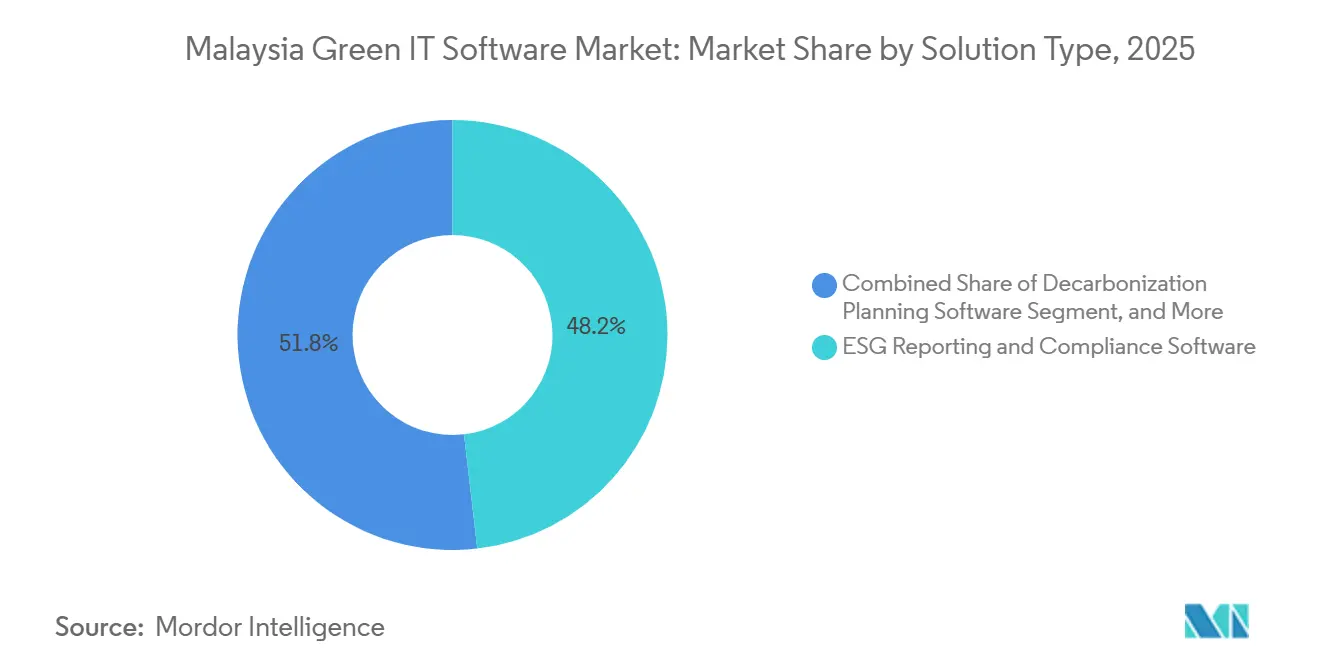
- By solution type, ESG Reporting and Compliance Software captured 48.16% of revenue in 2025, while Carbon Management and Accounting Software is projected to grow at a 23.68% CAGR through 2031.
- By end user, BFSI held 21.36% of revenue in 2025, while IT and telecom are projected to expand at a 23.31% CAGR through 2031.
Note: Market size and forecast figures in this report are generated using Mordor Intelligence’s proprietary estimation framework, updated with the latest available data and insights as of January 2026.
Malaysia Green IT Software Market Trends and Insights
Drivers Impact Analysis*
| Driver | (~) % Impact on CAGR Forecast | Geographic Relevance | Impact Timeline |
|---|---|---|---|
| Rising Bursa Malaysia Sustainability Disclosure Requirements | +6.5% | National, with concentrated demand in Klang Valley PLC and financial sector clusters | Short term (≤ 2 years) |
| Expansion of ESG Data Volumes Across Enterprises | +5.2% | National, with highest ESG data density in BFSI, manufacturing, and retail sectors | Medium term (2-4 years) |
| Cloud Migration for Scalable Sustainability Reporting | +4.8% | National, with strong uptake in Klang Valley, Penang, and Johor technology corridors | Medium term (2-4 years) |
| AI-Enabled Emissions Factor Mapping and Audit Trails | +4.1% | APAC core, with spill-over to global supply chain reporting requirements | Long term (≥ 4 years) |
| Data Sovereignty Preference for Local Hosting | +2.8% | National, reinforced by Malaysia's National Cloud Computing Policy and PDPA requirements | Medium term (2-4 years) |
| Carbon-Linked Procurement and Supplier Reporting Pressure | +2.2% | National, with strongest effect on export-oriented manufacturers facing EU CBAM alignment | Long term (≥ 4 years) |
| Source: Mordor Intelligence | |||
Rising Bursa Malaysia Sustainability Disclosure Requirements
Bursa Malaysia's tighter sustainability disclosure schedule is the strongest direct demand trigger in the Malaysia Green IT Software Market. The phased rollout created consecutive buying windows across major listed issuers, compressing decision timelines and reducing the scope for delayed adoption. Enterprises that once relied on qualitative reporting now need systems that can produce auditable, quantitative climate and emissions disclosures in a repeatable format. This changed approval behavior because finance and audit teams began treating sustainability software as a compliance requirement rather than a discretionary digital project. The unified direction under Malaysia's sustainability reporting framework also reduced room for interpretation and supported faster procurement decisions across the corporate base.
Expansion of ESG Data Volumes Across Enterprises
Rising ESG data volumes are making manual workflows less practical across the Malaysia Green IT Software Market. Listed companies now need more frequent data collection from sites, business units, and suppliers, which increases the reporting burden beyond a single central team. The pressure is even higher when value chain reporting reaches smaller suppliers that were not part of earlier reporting cycles. Capital Markets Malaysia expanded the data structure in July 2025 with SEDG Version 2 and the launch of a GHG emissions calculator for SMEs, thereby structuring upstream data collection for a larger user base. Vendors with ready connectors, guided data capture, and simpler validation routines are better placed when enterprises scale disclosure programs across wider operating networks.
Cloud Migration for Scalable Sustainability Reporting
Cloud delivery remains a strong growth driver because it supports faster deployment across reporting teams in the Malaysia Green IT Software Market. Enterprises facing near-term reporting deadlines often prefer subscription models that avoid upfront infrastructure spending and reduce internal setup time. Cloud platforms also allow quicker updates to templates, factors, and workflow controls when disclosure requirements change. Malaysia's 2025 cross-border personal data transfer guidelines provided enterprises with clearer rules for compliant cloud use and regulated data movement, reducing some uncertainty around hosted reporting systems. As a result, buyers are increasingly evaluating hosting location, access controls, and data residency together with reporting functionality.[1] Cloud delivery is expected to remain a critical enabler for enterprises navigating evolving reporting requirements.
AI-Enabled Emissions Factor Mapping and Audit Trails
AI-enabled emissions accounting is becoming increasingly relevant as reporting in the Malaysia Green Information Technology Software Market requires scale, consistency, and traceable calculations. Automated factor matching reduces the manual effort needed to classify Scope 1, Scope 2, and Scope 3 data across many sources. PANTAS built its position around emissions measurement and automated source mapping, while Karbon Hero launched Sustainability AI to extend AI-assisted reporting support to enterprises and SMEs. These moves show that buyers want systems that can explain how each result was created, not only display a final number. Platforms that preserve a clear data lineage from raw inputs to published outputs should gain an advantage as review expectations become stricter.
Restraints Impact Analysis*
| Restraint | (~) % Impact on CAGR Forecast | Geographic Relevance | Impact Timeline |
|---|---|---|---|
| High Integration Cost With Legacy ERP and Metering Systems | -3.8% | National, with highest exposure in manufacturing, energy, and utilities sectors | Short term (≤ 2 years) |
| Limited ESG Software Skills Among SME Buyers | -2.5% | National, particularly in East Malaysia and non-Klang Valley industrial zones | Medium term (2-4 years) |
| Fragmented Emissions Data Across Multi-Site Operations | -1.9% | National, with cross-border supply chain implications across ASEAN | Medium term (2-4 years) |
| Unclear Internal ROI Versus Compliance-Only Adoption | -1.4% | National, predominantly among mid-market enterprises outside Group 1 issuers | Long term (≥ 4 years) |
| Source: Mordor Intelligence | |||
High Integration Cost With Legacy ERP and Metering Systems
High integration cost is still the main near-term brake on the Malaysia Green IT Software Market. Many industrial buyers continue to rely on older ERP environments and site systems that were not designed for emissions reporting or sustainability workflows. Connecting bills, meters, procurement records, and plant data often requires custom middleware, manual mapping, and repeated validation. That can push early project costs above the annual software license and slow rollout in manufacturing, energy, and utilities. Vendors that can offer lighter connectors and reusable adapters are better positioned to reduce deployment friction and shorten time-to-value.
Limited ESG Software Skills Among SME Buyers
Limited ESG software skills among SME buyers continue to constrain adoption in the Malaysia Green Information Technology Software Market. Awareness has improved faster than technical readiness, so many smaller firms understand the reporting direction but still lack confidence in running dedicated platforms. This matters because supply chain requests are now reaching companies that were not part of the first wave of direct sustainability software buying. Capital Markets Malaysia addressed part of the challenge with a GHG calculator and practical guidance for SMEs, while local providers developed simpler setup paths to meet Bursa Malaysia reporting requirements. Even so, vendors still need onboarding support, training, and managed services to convert interest into durable platform usage.
*Our forecasts treat driver/restraint impacts as directional, not additive. The impact forecasts reflect baseline growth, mix effects, and variable interactions.
Segment Analysis
By Offering: Software Anchors Revenue, Services Gain Weight as Disclosure Work Expands
Software accounted for 66.19% of revenue in 2025 and remained the anchor of buyer spending in the Malaysia Green IT Software Market. This share reflects the fact that most enterprises first prioritized the core reporting platform needed to manage disclosure deadlines and climate data workflows. The compliance calendar reduced room to defer these purchases, especially for organizations with board-level sustainability accountability. This made the software layer the main spending item during the first stage of adoption. Services are projected to grow at a 24.71% CAGR through 2031, indicating that implementation support, validation, and managed reporting are rising alongside license demand.
Services are projected to grow at a 24.71% CAGR, and the Malaysia Green IT Software Market for this offering is expanding as enterprises seek audit support, control design, and managed disclosure workflows. Buyers increasingly want a single partner who can configure data flows, validate outputs, and prepare evidence for review. This is lifting demand for assurance-readiness support and workflow administration, not only basic technical setup. The Malaysian Institute of Accountants listed IBM Envizi and Workiva as comprehensive sustainability reporting tools that support the need for broad feature sets that meet both platform and control requirements. That structure favors providers that can keep assurance-oriented capabilities close to the same user workflow used for recurring reporting.[2] The services segment is poised to play a pivotal role in addressing the growing complexity of sustainability reporting needs.
By Deployment: Cloud Leads Adoption, Hybrid Advances With Data Control Needs
Cloud-based deployment accounted for 57.11% of the Malaysia Green IT Software Market in 2025 and remained the preferred model for rapid rollout. Subscription delivery helps teams add users, update templates, and centralize reporting without waiting for longer internal infrastructure cycles. It also reduces the burden on internal IT teams during the first phase of deployment. On-premise setups still matter in banking and utilities, where older governance practices shaped technology preferences. Hybrid is projected to grow at a 23.97% CAGR through 2031 as enterprises balance speed with tighter control over sensitive operating data.
Hybrid demand is rising because many firms want local processing for source data and cloud reporting for enterprise-wide visibility. Buyers are also weighing hosting rules more closely after the 2025 publication of cross-border transfer guidance. This helps enterprises separate source-system control from enterprise disclosure access. It also makes deployment architecture a governance choice, not only a technology choice. Vendors that support residency controls and phased cloud adoption should be better placed in complex accounts.
By Enterprise Size: Large Enterprises Lead First, SMEs Form the Next Growth Wave
Large enterprises accounted for 69.44% of revenue in 2025 and led initial buying because compliance pressure reached them first. These organizations usually had wider budgets, stronger audit oversight, and more formal ESG governance structures. Their broader reporting footprint also made spreadsheet-based methods less sustainable. Many also operated across multiple entities, which made manual consolidation more difficult and underscored the need for centralized platforms. SMEs are projected to grow at a 24.35% CAGR through 2031 as supply chain disclosure requests spread through listed-company ecosystems.
Large enterprises held 69.44% of the Malaysia Green IT Software Market share in 2025, but the next wave is coming from smaller suppliers that need simpler reporting tools. This shift is commercial as much as regulatory, because supplier status can increasingly depend on more reliable ESG data submission. Local products with guided configuration are better aligned to that need than generic platforms that assume stronger in-house capability. That localized support can matter more than feature breadth in first-time implementations. Capital Markets Malaysia, RAA Capital Partners, and PANTAS all reinforced the importance of simplified tools and Malaysia-specific workflows for the SME segment.
By Solution Type: Reporting Software Leads Today, Carbon Management Builds Momentum
ESG Reporting and Compliance Software held 48.16% of revenue in 2025 and remained the largest solution type in the Malaysia Green IT Software Market. Buyers first focused on mandatory disclosure needs, which made reporting tools the entry point for many early implementations. This sequencing is common in a market moving from rule-driven reporting to broader emissions management. Carbon Management and Accounting Software is projected to expand at a 23.68% CAGR through 2031 as emissions measurement becomes more operational across enterprise functions. That shift broadens demand from reporting teams to finance, risk, procurement, and site-level users.
Carbon Management and Accounting Software is projected to expand at a 23.68% CAGR, and the Malaysia Green IT Software Market size tied to this solution is benefiting from stronger measurement needs in export-facing and emissions-intensive operations. Sustainability data management and decarbonization planning tools are also gaining relevance once enterprises move beyond first-stage disclosure compliance. That supports higher-value deployments after the initial reporting phase has been addressed. Local platforms are adding AI-assisted accounting and calculator tools that lower the barrier for recurring emissions reporting across different buyer groups. Capital Markets Malaysia and Karbon Hero both point to rising demand for tools that connect calculation support with ongoing reporting workflows.

By End User: BFSI Leads Under Dual Oversight, IT and Telecom Expands on Internal and Client Demand
BFSI held 21.36% of revenue in 2025 and remained the largest end-user group in the Malaysia Green IT Software Market. Financial institutions faced pressure from both capital-market reporting requirements and banking-sector climate oversight, increasing the need for traceable software controls. That dual exposure shortened approval cycles for disclosure and control platforms. Financial institutions also need stronger traceability across financed and operational emissions records. IT and telecom are projected to grow at a 23.31% CAGR through 2031 because the sector manages its own energy footprint and also builds systems for other buyers.
Manufacturing, energy, retail, government, healthcare, and infrastructure buyers are broadening the addressable market for Malaysia Green IT Software. Public sector use is still smaller, but it gained visibility after the MBI Selangor group-wide deployment of an AI-enabled ESG platform in June 2026. Healthcare needs stronger control over sensitive data, while infrastructure projects need better monitoring of energy and resource use. That diversity supports a wider vendor mix across the overall market. These differences favor vendors that can adapt a single core platform across multiple reporting environments without making deployments overly complex.
Geography Analysis
The Malaysia Green IT Software Market is centered in Klang Valley, where listed companies, banks, and regional headquarters are most concentrated. Kuala Lumpur and Selangor have the highest density of likely early adopters because compliance teams, auditors, and enterprise technology buyers are clustered together. This concentration supports faster rollout cycles and stronger vendor access to decision makers. The June 2026 deployment of RANTAiX across MBI Selangor subsidiaries showed that group-level ESG software adoption is moving beyond private corporations. That step may encourage similar decisions across state-linked and large enterprise networks in the same corridor.
Penang and Johor form the second growth tier of the Malaysia Green Information Technology Software Market. Penang's electronics and semiconductor base supports demand for supplier data capture and carbon reporting across manufacturing chains. Johor adds a different demand pattern because digital infrastructure and data center expansion require tighter monitoring of energy use and reporting controls. These states give vendors access to buyers who care as much about operational data as they do about formal disclosure output. East Malaysia remains smaller, but Sarawak and Sabah can become more important as renewable energy availability and project financing standards strengthen, thereby increasing reporting needs.
Malaysia also benefits from a regional positioning advantage within ASEAN. The country's sustainability disclosure framework moved earlier than many peers, which gives local deployments reference value for regional sales conversations. Capital Markets Malaysia strengthened that role when it aligned SEDG Version 2 with the ASEAN Simplified ESG Disclosure Guide and launched a calculator that extends reporting practices into the SME base. That connection can help Malaysia-origin platforms pursue opportunities beyond the domestic market as neighboring disclosure regimes mature.
Competitive Landscape
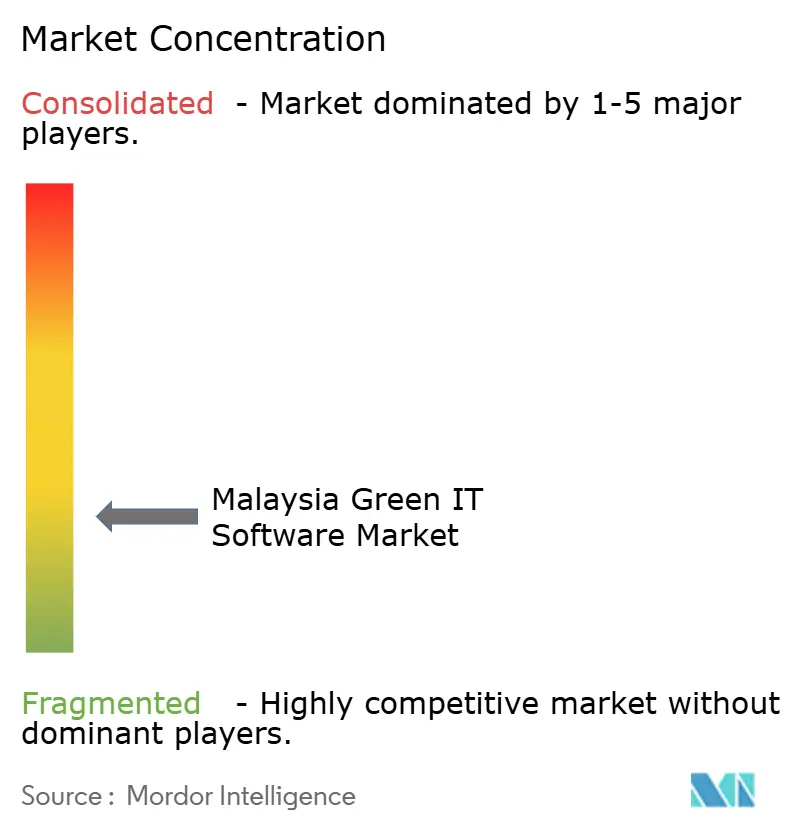
The Malaysia Green IT Software Market remains fragmented, with global enterprise vendors competing alongside Malaysia-focused specialists. SAP, IBM, Microsoft, Oracle, Workiva, Salesforce, and ServiceNow bring deep enterprise integration and broad multi-framework reporting features. These vendors are well-positioned with large accounts that already run global systems and want broader governance coverage. Local and regional providers compete more effectively where Malaysia-specific templates, local support, and simpler deployment matter most. This mix keeps pricing power balanced and prevents any single vendor group from defining the market on its own.
PANTAS Software built a clear niche around financed emissions measurement and local compliance relevance. RAA Capital Partners targeted SMEs and mid-sized buyers with the Saraa Suite and its Centre of Excellence for Sustainability Impact. These moves show that local firms are not competing only on price, but on workflow fit and regulatory familiarity. ASPL's facility-level monitoring position also matters because buyers often want operational data feeds, not only board-level reporting screens. The local value proposition becomes stronger when implementation speed and support quality matter more than global brand depth.[3] Local players are strengthening their market position by addressing specific operational and regulatory needs with tailored solutions.
Strategic activity since 2025 has reinforced this pattern. Karbon Hero launched Sustainability AI in March 2025 to expand AI-assisted GHG accounting for enterprises and SMEs. MBI Selangor adopted an AI-enabled ESG platform across its group in June 2026, demonstrating that large institutional users are willing to support locally relevant solutions. The competitive path in the Malaysia Green Information Technology Software Market, therefore, favors vendors that combine credible reporting controls, practical onboarding, and clear alignment with Malaysia-specific requirements.
Malaysia Green IT Software Industry Leaders
-
SAP SE
-
Oracle Corporation
-
Microsoft Corporation
-
Salesforce, Inc.
-
Schneider Electric SE
- *Disclaimer: Major Players sorted in no particular order
Recent Industry Developments
- June 2026: MBI Selangor and UNGCMBC launched a strategic partnership on June 12, 2026, to deploy RANTAiX, an AI-enabled ESG assessment and intelligence platform, across all MBI Selangor subsidiaries, making MBI Selangor the first state-owned investment conglomerate in Malaysia to implement a group-level AI-powered ESG diagnostic. The initiative expands RANTAiX's conventional supply chain use case into full, conglomerate-level ESG governance, establishing a new application model for public-sector ESG software procurement.
- March 2026: The Securities Commission Malaysia released the Capital Market Masterplan 4 for 2026-2030, announcing AI-based digital screening tools to enhance ESG alignment and improve cross-border investment product visibility. This regulatory mandate directly expands the addressable market for AI-powered ESG compliance software in Malaysia's capital markets sector.
- August 2025: Malaysia's Ministry of Digital launched the National Cloud Computing Policy on August 13, 2025, embedding environmental sustainability as one of 5 policy pillars and establishing data sovereignty and green data center standards as mandatory considerations for cloud-based digital infrastructure, including ESG software deployments.
- July 2025: Capital Markets Malaysia launched the SEDG GHG Emissions Calculator for SMEs on July 22, 2025, alongside SEDG Version 2, which includes 3 additional disclosures aligned with the ASEAN Simplified ESG Disclosure Guide. The tool, developed under the GHG Protocol methodology, directly expands the addressable SME buyer base for carbon accounting software in Malaysia.
Malaysia Green IT Software Market Report Scope
The Malaysia Green IT Software Market encompasses software that helps enterprises monitor, manage, and report carbon emissions while optimizing IT resources. Key offerings include platforms for Environmental, Social, and Governance (ESG) reporting, sustainability data management, and energy efficiency. The market thrives on government-led digital economy initiatives, a surge in ESG adoption, and the growth of the financial and tech sectors. These tools enhance organizational transparency in sustainability, boost operational performance, and ensure alignment with both local and global compliance standards.
The Malaysia Green IT Software Market Report is Segmented by Offering (Software, and Services), Deployment (Cloud-Based, On-Premise, and Hybrid), Enterprise Size (Large Enterprises, and Small and Medium Enterprises), Solution Type (Carbon Management and Accounting Software, ESG Reporting and Compliance Software, Sustainability Data Management Platforms, Decarbonization Planning Software, and Energy and Resource Optimization Software), and End User (Information Technology and Telecom, Banking, Financial Services and Insurance, Manufacturing, Energy and Utilities, Retail and E-Commerce, Government, Healthcare and Life Sciences, Construction and Infrastructure, and Other End-User Industries). The Market Forecasts are Provided in Terms of Value (USD).
| Software |
| Services |
| Cloud-Based |
| On-Premise |
| Hybrid |
| Large Enterprises |
| Small and Medium Enterprises |
| Carbon Management and Accounting Software |
| ESG Reporting and Compliance Software |
| Sustainability Data Management Platforms |
| Decarbonization Planning Software |
| Energy and Resource Optimization Software |
| Information Technology and Telecom |
| Banking, Financial Services, and Insurance |
| Manufacturing |
| Energy and Utilities |
| Retail and E-Commerce |
| Government |
| Healthcare and Life Sciences |
| Construction and Infrastructure |
| Other End-User Industries |
| By Offering | Software |
| Services | |
| By Deployment | Cloud-Based |
| On-Premise | |
| Hybrid | |
| By Enterprise Size | Large Enterprises |
| Small and Medium Enterprises | |
| By Solution Type | Carbon Management and Accounting Software |
| ESG Reporting and Compliance Software | |
| Sustainability Data Management Platforms | |
| Decarbonization Planning Software | |
| Energy and Resource Optimization Software | |
| By End User | Information Technology and Telecom |
| Banking, Financial Services, and Insurance | |
| Manufacturing | |
| Energy and Utilities | |
| Retail and E-Commerce | |
| Government | |
| Healthcare and Life Sciences | |
| Construction and Infrastructure | |
| Other End-User Industries |
Key Questions Answered in the Report
What is the current and forecast value of the Malaysia Green IT Software Market?
The Malaysia Green IT Software Market was valued at USD 143.09 million in 2025, is estimated at USD 172.32 million in 2026, and is forecast to reach USD 483.29 million by 2031 at a 22.91% CAGR.
What is driving software demand in Malaysia most strongly?
The strongest driver is the move to mandatory sustainability disclosures, which has made auditable ESG and climate reporting systems a near-term compliance priority for listed enterprises.
Which deployment model leads adoption in Malaysia?
Cloud-based deployment led with 57.11% of revenue in 2025 because it supports faster rollout, easier updates, and lower upfront infrastructure burden.
Which customer group is expanding the fastest?
SMEs are projected to grow at a 24.35% CAGR through 2031 as supplier disclosure requests spread from listed companies into wider corporate ecosystems.
Which software category is growing the fastest?
Carbon Management and Accounting Software is projected to grow at a 23.68% CAGR through 2031 as enterprises expand from disclosure reporting into repeat emissions measurement and control.
Which end-user segment is most important right now?
BFSI held the largest share at 21.36% in 2025 because it faces both capital-market and banking-sector sustainability oversight, which increases urgency for traceable reporting tools.