
United States Green IT Software Market Size and Share
Market Overview
| Study Period | 2020 - 2031 |
|---|---|
| Forecast Data Period | 2026 - 2031 |
| Base Year Market Size (2025) | USD 5.91 Billion |
| Market Size (2026) | USD 6.63 Billion |
| Market Size (2031) | USD 12.91 Billion |
| Growth Rate (2026 - 2031) | 14.26 % |
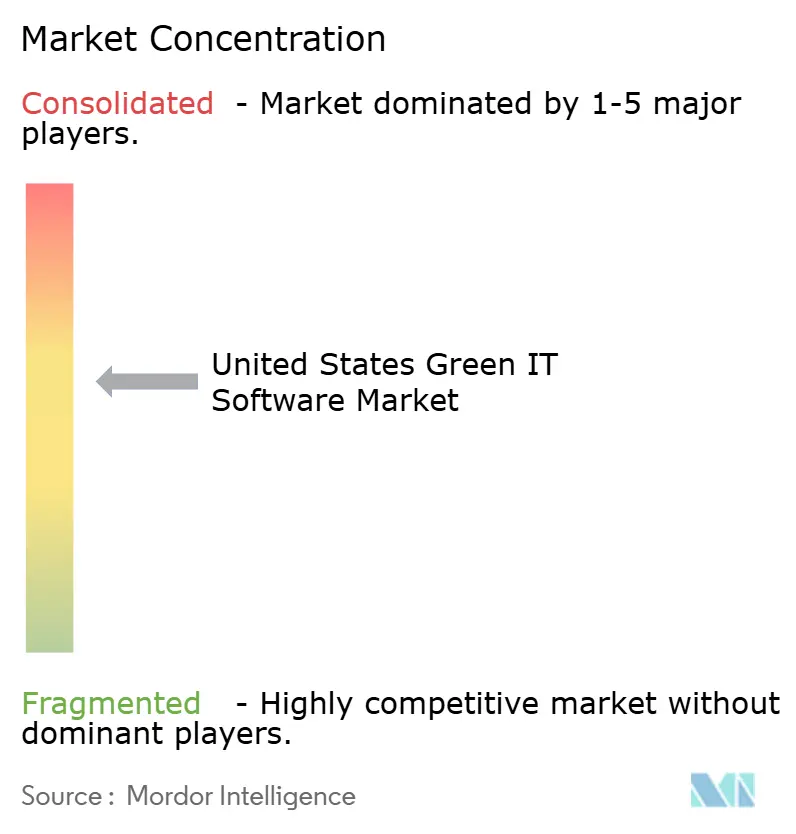
| Market Concentration | Medium |
Major Players *Disclaimer: Major Players sorted in no particular order Image © Mordor Intelligence. Reuse requires attribution under CC BY 4.0. | |
United States Green IT Software Market Analysis by Mordor Intelligence
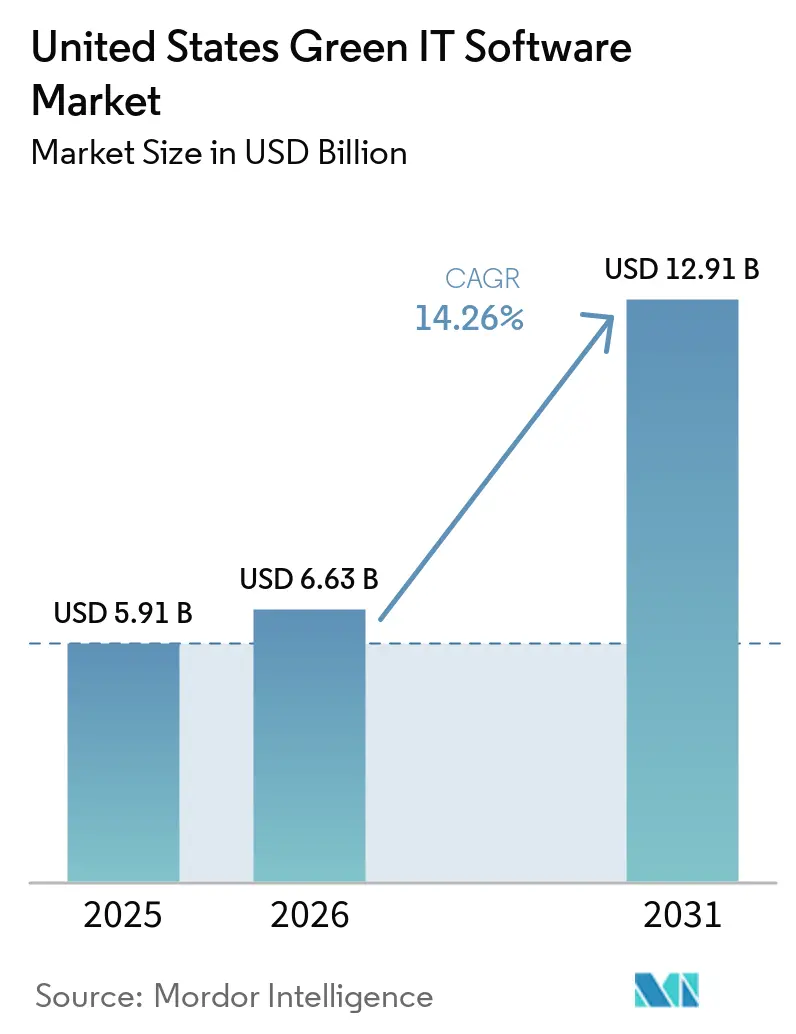
The United States green IT software market size is expected to increase from USD 5.91 billion in 2025 to USD 6.63 billion in 2026 and reach USD 12.91 billion by 2031, growing at a CAGR of 14.26% over 2026-2031. The market is moving from periodic and manually assembled sustainability reporting toward continuous, audit-ready software that sits inside core operating and reporting workflows. Demand is being sustained by the combined effect of state-level climate disclosure rules, investor reporting pressure, broader use of AI in enterprise software, and the need to connect sustainability data with procurement, finance, and operations. Buyers are making longer-term platform decisions because the software is now tied to governance, supplier data collection, and enterprise system integration rather than a narrow filing need. The United States green IT software market is also benefiting from the shift toward unified data platforms that can support carbon accounting, ESG reporting, decarbonization planning, and energy optimization in one architecture. Growth is still checked by legacy system integration costs, uneven supplier emissions data, budget sensitivity among smaller firms, and cybersecurity concerns around centralized ESG data environments.
Key Report Takeaways
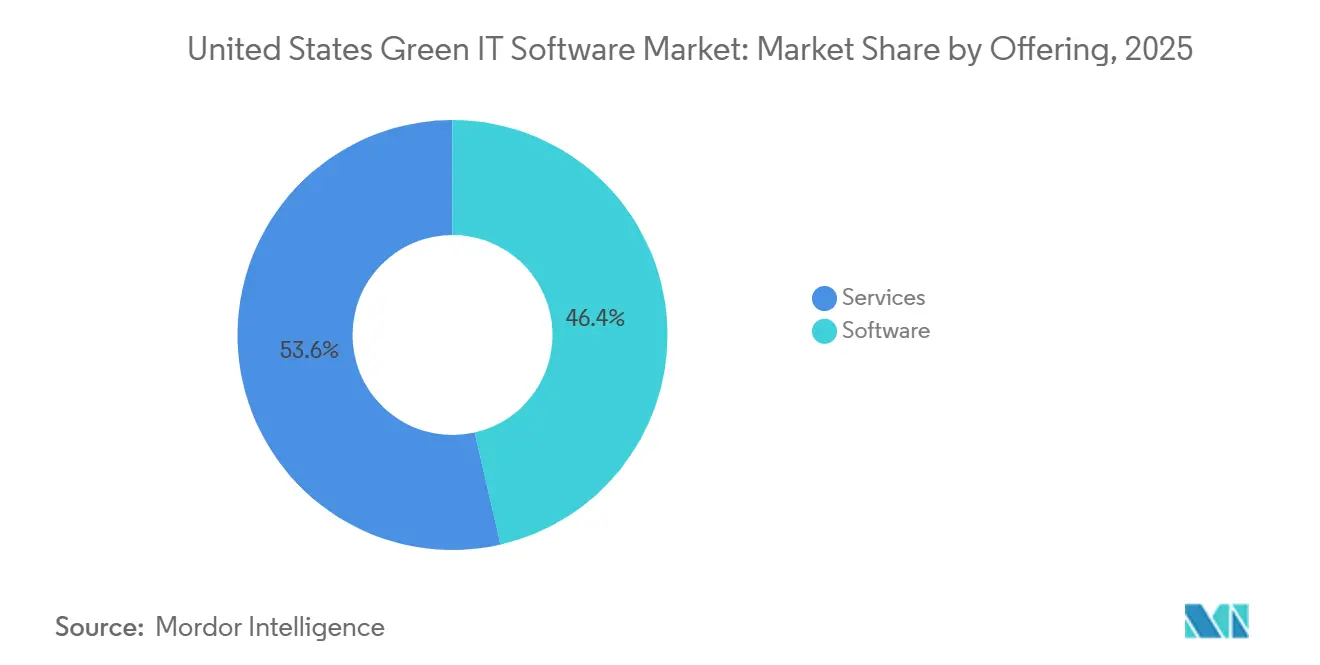
- By offering, software held 46.41% of revenue in 2025, while services are projected to expand at a 19.26% CAGR through 2031.
- By deployment, cloud-based deployment held 63.94% of the United States green IT software market share in 2025 and is projected to grow at a 16.12% CAGR through 2031.
- By solution type, carbon management and accounting software accounted for 31.23% of the United States green IT software market size in 2025, while sustainability data management platforms are projected to expand at a 19.57% CAGR through 2031.
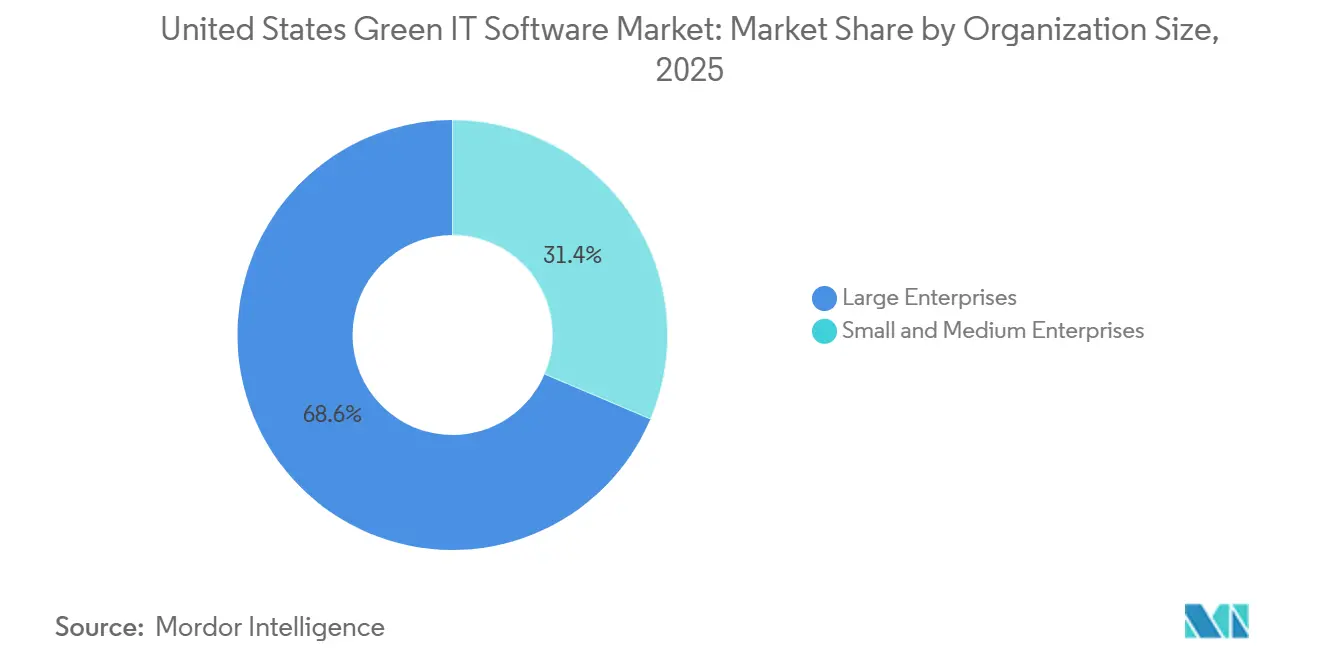
- By organization size, large enterprises held 68.62% of revenue in 2025, while small and medium enterprises are projected to grow at a 21.39% CAGR through 2031.
- By end-user industry, IT and telecommunications accounted for 29.31% of spending in 2025, while healthcare and life sciences is projected to grow at a 19.83% CAGR through 2031.
Note: Market size and forecast figures in this report are generated using Mordor Intelligence’s proprietary estimation framework, updated with the latest available data and insights as of January 2026.
United States Green IT Software Market Trends and Insights
Drivers Impact Analysis*
| DRIVER | (~) % IMPACT ON CAGR FORECAST | GEOGRAPHIC RELEVANCE | IMPACT TIMELINE |
|---|---|---|---|
| Regulatory Pressure for Scope 1 to Scope 3 Reporting Automation | +3.2% | Global, with concentrated near-term demand in the US, especially California | Short term (≤ 2 years) |
| Enterprise AI Shift Toward Continuous Sustainability Intelligence | +2.8% | North America and EU | Medium term (2-4 years) |
| Cloud Native Carbon and Energy Optimization Adoption in Data Center Workloads | +2.5% | North America and EU | Medium term (2-4 years) |
| Procurement Requirements Linking Software Selection to Verified ESG Data | +1.9% | Global | Medium term (2-4 years) |
| Utility Price Volatility Increasing Demand for Consumption Optimization | +1.2% | North America, with spillover to APAC | Short term (≤ 2 years) |
| Fragmented Multi-Framework Reporting Burden Across Public and Private Firms | +0.7% | Global | Long term (≥ 4 years) |
| Source: Mordor Intelligence | |||
Regulatory Pressure for Scope 1 To Scope 3 Reporting Automation
California has become the clearest near-term trigger for enterprise buying in the United States green IT software market because CARB adopted initial implementing regulations for SB 253 on February 26, 2026, and set August 10, 2026 as the first disclosure deadline for Scope 1 and Scope 2 emissions for covered companies doing business in the state. The law reaches beyond companies headquartered in California because the revenue threshold applies to firms that do business in the state, which widens the addressable buyer base across sectors and operating regions. Scope 3 obligations will activate from 2027, so many buyers are acting in 2026 because supplier data systems, controls, and internal review processes take time to build and test at audit-ready quality.[1] This timing is lifting demand for software that can manage emissions inventories, supplier submissions, evidence trails, and framework-ready outputs in one controlled environment. The SEC’s proposal to rescind its climate-related disclosure rules in May 2026 has not removed the underlying need for repeatable reporting systems among large enterprises that still face disclosure expectations from investors, lenders, customers, and boards. Vendors that align workflows with accepted emissions accounting practices and verification requirements are therefore gaining ground because buyers want tools that remain usable across both mandatory and voluntary reporting settings.
Enterprise AI Shift Toward Continuous Sustainability Intelligence
AI is shifting the value of the United States green IT software market from simple data collection toward software that can monitor, interpret, and organize sustainability information on a continuous basis. Salesforce launched Agentforce for Net Zero Cloud in June 2025 with AI agents that can draft disclosure content, monitor Scope 1, Scope 2, and Scope 3 inventories, and surface issues during the reporting cycle rather than after it closes.[2] SAP stated in May 2026 that its sustainability AI agents will reach general availability by the end of 2026 and will support side-by-side decarbonization scenario work while addressing the variability found in average emissions factors. This changes buyer expectations because sustainability teams no longer want software that only stores past-period data. They want systems that can flag data gaps, compare scenarios, compress reporting timelines, and support internal decision-making during the year. The advantage is moving toward vendors that can combine AI functions with governance controls, traceability, and integration into finance and operating systems, because those features reduce manual effort without weakening audit discipline.
Cloud Native Carbon and Energy Optimization Adoption in Data Center Workloads
Data center operations are becoming a larger demand center for the United States green IT software market because sustainability and IT operations teams now depend on many of the same power, asset, and supplier datasets. Schneider Electric launched Resource Advisor+ in January 2026 as an AI-native platform that brings together emissions management, energy procurement, supply chain sustainability, and climate risk reporting in one system. IBM also made Envizi Emissions Calculations for Excel available on Microsoft AppSource in January 2026, which places GHG Protocol-aligned calculation capability inside an operating tool that many finance and reporting teams already use. These launches matter because adoption rises faster when sustainability software fits into the systems that enterprise teams already trust for daily work. Large enterprises that need emissions visibility across cloud infrastructure, facilities, and procurement are also pushing verified data requirements into service providers and technology suppliers, which broadens the buyer base around digital infrastructure. The result is a stronger position for vendors that can manage both enterprise reporting and operational energy intelligence inside the same software environment.
Procurement Requirements Linking Software Selection to Verified ESG Data
Procurement is becoming an independent demand channel for the United States green IT software market because supplier qualification now depends more often on the ability to provide verified ESG and carbon data. EcoVadis and Workiva announced a strategic partnership in May 2026 to connect primary supplier carbon data from the EcoVadis Carbon Data Network into Workiva’s reporting platform, which supports a shift from average-based Scope 3 estimates toward auditable primary data. This matters because it creates a second wave of buyers that are not driven first by regulation, but by customer requirements inside enterprise supply chains. Mid-market firms and SMEs are entering the software category to respond to data requests from larger customers that must improve supplier-level reporting quality. Sage reported in December 2025 that SMEs using AI-powered accounting and carbon-tracking tools were twice as likely to secure green financing, which shows that software adoption can support capital access as well as disclosure response. Procurement-led adoption is often more durable than deadline-led adoption because qualification rules tend to stay inside sourcing programs over multiple contract cycles. That durability is reinforcing demand for platforms that can collect supplier data repeatedly, standardize submissions, and turn those submissions into usable reporting outputs.
Restraints Impact Analysis*
| RESTRAINT | (~) % IMPACT ON CAGR FORECAST | GEOGRAPHIC RELEVANCE | IMPACT TIMELINE |
|---|---|---|---|
| High Integration Complexity With Legacy ERP and Facility Systems | -1.8% | Global, with stronger effect in manufacturing and energy settings in North America | Medium term (2-4 years) |
| Weak Supplier Data Quality Slowing Scope 3 Automation | -1.2% | Global | Long term (≥ 4 years) |
| Cybersecurity and Data Residency Concerns for ESG Data Platforms | -0.9% | North America and EU | Medium term (2-4 years) |
| Budget Sensitivity Among Mid-Market Buyers Despite Compliance Need | -0.6% | North America, with spillover to APAC | Short term (≤ 2 years) |
| Source: Mordor Intelligence | |||
High Integration Complexity With Legacy ERP and Facility Systems
Integration remains the clearest operational barrier in the United States green IT software market because core sustainability data still originates inside older ERP, procurement, facility, and building systems that were not designed for emissions reporting. Many buyers must connect several transactional systems before they can produce usable carbon calculations or disclosure-ready records, and that work can stretch implementations and raise total cost. Oracle launched Oracle Fusion Cloud Sustainability in September 2024 inside its existing Fusion Cloud Applications Suite, which directly addresses this issue by embedding data capture and reporting functions within software environments that already hold enterprise transactions. IBM’s Envizi Supply Chain Intelligence also targets this problem by connecting ERP transactions to Scope 3 calculations and by prioritizing supplier-specific data over broad averages where better source data exists. Even with these improvements, data quality and system compatibility still vary widely across buyer environments, which means integration effort remains a real brake on adoption speed. This restraint gives a durable advantage to vendors that control the ERP layer or have strong pre-built connectors, because buyers want shorter implementation cycles and fewer external data handoffs.
Weak Supplier Data Quality Slowing Scope 3 Automation
Supplier data quality is the most durable technical challenge for the United States green IT software market because Scope 3 reporting depends on information that often sits outside the direct control of the reporting company. SAP said in May 2026 that industry-average emission factors can show 30-40% variability, which makes those averages less acceptable as buyers move toward audit-ready reporting and decision-grade emissions data. The problem becomes more serious as large enterprises prepare for 2027 Scope 3 requirements under California’s framework, because they must gather deeper supplier data across large and uneven partner networks. EcoVadis is responding through a network model that connects more than 150,000 organizations around primary supplier carbon data, which supports more repeatable data exchange across procurement relationships. IBM is addressing the same issue from the software workflow side by giving enterprises tools that can absorb better supplier-level data when it is available and structure reporting logic around it. Vendors that can combine network access, data controls, and calculation discipline will be better positioned as enterprises push past spend-based estimates and demand more supplier-specific reporting inputs.
*Our forecasts treat driver/restraint impacts as directional, not additive. The impact forecasts reflect baseline growth, mix effects, and variable interactions.
Segment Analysis
By Offering: Services Growth Challenges Software's Installed-Base Advantage
Services are projected to grow at a 19.26% CAGR through 2031, which makes them the fastest-expanding part of this segmentation in the United States green IT software market. That growth reflects the need for implementation support, data architecture work, reporting design, and change management as disclosure obligations become more detailed. Many large buyers still need outside help to connect emissions workflows with ERP, procurement, and facility data before the software can operate at scale. Services also remain relevant because supplier-data programs, assurance preparation, and internal governance processes often require sustained support after initial implementation. At the same time, software held 46.41% of revenue in 2025, which shows that licensed platforms still anchor how enterprises govern sustainability data and reporting programs.
Software remains the installed-base core because the control layer, workflow logic, and evidence management all sit inside the product rather than inside a consulting engagement. Workiva introduced Intelligent Finance, GRC, and Sustainability in September 2025 with AI-enabled automation for disclosure drafting, benchmarking, materiality work, peer comparison, and compliance workflows, which shows how vendors are expanding software value even as services demand stays strong.[3] As automation improves, service spend is likely to shift away from repetitive assembly work and toward higher-value areas such as governance setup, decarbonization planning, and assurance readiness. That pattern helps explain why services are growing quickly without displacing software as the larger revenue base. The United States green IT software industry is therefore evolving toward combined software and delivery models rather than a pure license-only structure.
By Deployment: Cloud Dominance Consolidates as Enterprise Scalability Demands Intensify
Cloud-based deployment accounted for 63.94% of revenue in 2025 and is projected to grow at a 16.12% CAGR through 2031, which leaves it as both the largest and fastest-growing deployment model in the United States green IT software market. This dual position shows that buyer preference is consolidating around cloud-native sustainability architecture rather than moving through an early transition stage. Large enterprises need continuous synchronization across business units, geographies, and reporting frameworks, and cloud environments make that easier than isolated on-premise systems. Cloud deployment also supports the always-on data feeds that AI-enabled sustainability functions require for anomaly detection, scenario work, and in-cycle review. For that reason, cloud adoption is now tied as much to workflow design and system interoperability as it is to hosting choice.
IBM’s January 2026 Excel add-in for Envizi Emissions Calculations shows how cloud-based sustainability tools can be inserted into established user workflows instead of forcing users into a separate operating environment. IBM also released ESRS Omnibus framework configurations in February 2026 inside Envizi Sustainability Reporting Manager, which reflects the advantage of managed cloud frameworks that can be updated as standards evolve. On-premise deployment still has a role in more regulated settings where data residency and infrastructure control remain important. Hybrid models are also relevant where companies want cloud analytics but need tighter control over selected employee, financial, or operational datasets. One sentence with direct scale relevance is that cloud-based deployment held 63.94% of the United States green IT software market size in 2025, which confirms that deployment leadership already sits with scalable hosted models.
By Solution Type: Carbon Accounting Anchors Market Share, Data Platforms Drive Expansion
Sustainability data management platforms are projected to grow at a 19.57% CAGR through 2031, which makes them the fastest-moving solution category in the United States green IT software market. Enterprises increasingly want a shared data layer that can serve carbon accounting, ESG reporting, energy optimization, and planning workflows from one controlled source. This is reducing the appeal of disconnected tools built for only one framework or one reporting output. At the same time, carbon management and accounting software held the largest solution-type share at 31.23% in 2025, because many enterprises first entered the category through emissions inventory and accounting needs. That installed base is still important because Scope 1 and Scope 2 reporting, assurance preparation, and internal target tracking continue to depend on strong carbon accounting capability.
Workiva launched Workiva Carbon in June 2024 to connect carbon management and climate compliance with wider governance and reporting activity, which signals the market’s move toward multi-module platforms rather than standalone emissions tools. SAP’s 2026 sustainability AI agents push the same direction because they connect reporting and scenario modeling inside one enterprise software stack. Buyers now expect accounting tools to feed planning functions and expect planning functions to sit close to disclosure workflows. That is why the United States green IT software market size for carbon management and accounting software remained the largest in 2025 even as data management platforms posted the strongest forward growth rate. The United States green IT software industry is therefore moving from single-purpose product buying toward platform buying centered on reusable emissions and sustainability data.
By Organization Size: SME Momentum Reshapes the Market's Growth Center of Gravity
Small and medium enterprises are projected to grow at a 21.39% CAGR through 2031, which makes them the fastest-growing organization-size segment in the United States green IT software market. This acceleration is tied to supply-chain pressure because larger companies need better supplier emissions data and are pushing those requirements down to vendors and contractors. Many SMEs are therefore entering the category not because they chose sustainability reporting as a near-term priority, but because customer expectations are becoming harder to ignore. Large enterprises still held 68.62% of revenue in 2025, which reflects bigger budgets, larger reporting scope, and more mature governance structures. They also remain the core installed base for deeply integrated, multi-year platform relationships that support stronger visibility for leading vendors.
Sage reported in December 2025 that 44% of SMEs now use digital accounting systems and that firms using AI-driven accounting and carbon-tracking tools were twice as likely to secure green financing.[4] That finding matters because it gives smaller firms a business case that goes beyond compliance and reaches into financing outcomes. The input also pointed to tiered pricing structures that lower entry costs for smaller organizations, which helps explain why adoption is widening beyond the large-enterprise tier. F1000Research’s 2025 systematic review on ESG reporting in SMEs also supports the case that proportionate frameworks and digitally enabled reporting solutions are key enablers for this segment. One direct market-position sentence is that large enterprises captured 68.62% of the United States green IT software market size in 2025, while SMEs remain the strongest growth engine for the forecast period.
By End-User Industry: Healthcare Leads Growth Amid Rising Governance Demands
Healthcare and life sciences is projected to grow at a 19.83% CAGR through 2031, which makes it the fastest-growing end-user segment in the United States green IT software market. The vertical is facing rising disclosure, procurement, and supply-chain pressure across hospitals, pharmaceutical manufacturers, and medical device firms. Multi-tier supplier networks, heavy documentation needs, and the need for reliable operating data make manual reporting harder to sustain in this segment. Those conditions strengthen demand for platforms that can unify data collection, evidence handling, and reporting output across many internal and external contributors. IT and telecommunications still held the largest vertical share at 29.31% in 2025 because the sector combines high energy exposure with stronger internal technology capacity and lower implementation friction.
Healthcare growth also fits the wider shift toward stronger Scope 3 governance because clinical and pharmaceutical supply chains depend on data from packaging, chemicals, logistics, equipment, and service providers. California’s reporting framework is reinforcing the importance of supplier-ready systems, which matters for industries with broad upstream networks and repeated procurement cycles. Data management platforms are therefore likely to remain relevant in healthcare because they can support both operational complexity and formal disclosure needs. IT and telecommunications, by contrast, already had a favorable adoption base because those firms operate large digital estates and usually have stronger internal capability to integrate software across business functions. A direct segment statement is that IT and telecommunications accounted for 29.31% of the United States green IT software market share in 2025, while healthcare and life sciences is the fastest-growing vertical for the years ahead.
Geography Analysis
California is spearheading demand in the U.S. Green IT Software market, particularly following the implementation of SB 253 in 2026. This regulation introduced the first disclosure deadlines for specific firms, accelerating the adoption of platforms for reporting, carbon accounting, and sustainability data management. The West Coast's leadership is further strengthened by its robust digital infrastructure, cloud operations, and large technology enterprises that integrate multi-module sustainability platforms into their broader operating systems. Oregon complements this position with its extensive infrastructure and technology-driven sustainability initiatives. For instance, Apple's Prineville facility consumed 255 million kWh of renewable electricity in 2024, highlighting the significant energy and reporting requirements associated with large-scale digital assets.
In contrast, the Midwest and Southeast are emerging as the fastest-growing regions for Green IT Software adoption. This growth is fueled by increasing data center activity, cross-state enterprise reporting requirements, and supplier-level sustainability mandates driven by large corporate buyers. Texas stands out due to substantial infrastructure investments and energy-intensive digital operations, which amplify the need for governance in emissions, energy, and procurement data across enterprise systems. Georgia is also contributing to this growth, as technology operators expand water and infrastructure sustainability programs across more facilities. For example, Amazon announced in 2025 its plans to extend water recycling at data centers to over 120 U.S. locations, including sites in Georgia, underscoring the demand for software capable of tracking resource and emissions data across distributed facilities.
The U.S. Green IT Software market is shaped by two distinct demand patterns. The West Coast dominates due to its regulatory environment, established digital infrastructure, and mature enterprise software ecosystem. Meanwhile, the Midwest and Southeast are experiencing rapid growth driven by greenfield infrastructure projects, evolving supplier requirements, and multi-state compliance needs, which are broadening the buyer base. These dynamics illustrate how regulatory frameworks and infrastructure expansion are influencing regional adoption trends across the country.
Competitive Landscape
The United States green IT software market is moderately concentrated in large enterprise accounts and more fragmented in the mid-market. Competition at the top end is shaped by vendors such as Workiva, Salesforce, SAP, Microsoft, Oracle, IBM, and Schneider Electric, which compete through integration depth, multi-framework support, and governance controls rather than through simple reporting templates alone. The strongest platforms are trying to sit close to finance, procurement, operations, and ERP data because that is where audit discipline and workflow durability are built. This is making the market harder for narrow point tools that do not connect well with enterprise systems or cannot support repeatable evidence management. The competitive center of gravity is therefore moving toward vendors that can combine calculation capability, reporting logic, AI functions, and system interoperability in one commercial offering.
AI is the clearest current battleground. Salesforce launched Agentforce for Net Zero Cloud in June 2025 to automate disclosure drafting, monitor emissions data in real time, and support multiple sustainability frameworks from the same platform. SAP followed with sustainability AI agents announced in May 2026, aimed at scenario simulation and workflow automation inside its enterprise software environment SAP. Schneider Electric’s Resource Advisor+ launch in January 2026 also shows that vendors are widening their pitch from reporting alone to a broader energy and sustainability intelligence proposition. These moves raise the barrier for smaller competitors because buyers can now compare software not only on framework coverage, but also on workflow automation, operational relevance, and the ability to reduce manual work.
The mid-market remains more open, with specialists such as Persefoni AI, Watershed Technologies, Intelex Technologies, Sphera Solutions, EnergyCAP, Cority Software, and FigBytes competing against lighter versions of enterprise platforms. Persefoni’s March 2025 Series C extension, which brought total capital raised to USD 179 million, suggests that specialist providers still see room to scale even as integrated suites gain ground. EcoVadis and Workiva’s May 2026 partnership also shows that alliances can be a competitive strategy when no single vendor owns every part of the supplier-data chain.[5] The market still has room for vendors that can connect live operational data, supplier inputs, and disclosure workflows more directly than periodic file-based processes allow.
United States Green IT Software Industry Leaders
-
Salesforce, Inc.
-
IBM Corporation
-
Microsoft Corporation
-
SAP SE
-
Schneider Electric SE
- *Disclaimer: Major Players sorted in no particular order
Recent Industry Developments
- May 2026: EcoVadis and Workiva announced a strategic partnership to connect EcoVadis' primary supplier carbon data directly into Workiva's reporting platform via the EcoVadis Carbon Data Network (CDN). The partnership enables mutual customers to transition from industry-average Scope 3 estimates to granular, audit-ready primary emissions data, with CDN built on a network of over 150,000 organizations. This move directly addresses the Scope 3 data quality gap that constrains automated carbon accounting for large enterprises.
- February 2026: Schneider Electric launched Resource Advisor+, an AI-native energy and sustainability intelligence platform, at Davos. The platform replaces fragmented point tools with a unified ecosystem spanning emissions management, energy procurement, supply chain sustainability, and climate risk reporting, serving enterprise customers managing multi-site energy and sustainability portfolios.
- February 2026: IBM released ESRS Omnibus framework configurations aligned with the EU's draft simplified ESRS standards within its Envizi Sustainability Reporting Manager (SRM), providing enterprises preparing for CSRD obligations with pre-configured compliance frameworks. The configurations are managed frameworks updated by IBM's ESG Suite team as final standards are adopted.
- January 2026: IBM made Envizi Emissions Calculations for Excel available on Microsoft AppSource, embedding GHG Protocol-aligned emissions calculations into Excel workflows via an API add-in. The tool enables sustainability teams to perform accurate emissions calculations with trusted global and regional emission factors without migrating to a standalone sustainability platform.
United States Green IT Software Market Report Scope
In the United States, Green IT Software refers to technology solutions designed to promote sustainable computing by minimizing energy consumption, enhancing the efficiency of IT resources, and ensuring adherence to federal and corporate climate objectives. This movement resonates with initiatives such as the U.S. EPA's Energy Star program, the SEC's climate disclosure mandates, and corporate pledges towards net-zero emissions.
The United States Green IT Software Market Report is Segmented by Offering (Software, and Services), Deployment (Cloud-Based, On-Premise, and Hybrid), Solution Type (Carbon Management and Accounting Software, ESG Reporting and Compliance Software, Sustainability Data Management Platforms, Decarbonization Planning Software, and Energy and Resource Optimization Software), Organization Size (Large Enterprises, and Small and Medium Enterprises), End-User Industry (Information Technology and Telecommunications, Banking, Financial Services, and Insurance (BFSI), Manufacturing, Energy and Utilities, Retail and E-Commerce, Government, Healthcare, Construction and Infrastructure, and Other End-User Industries). The Market Forecasts are Provided in Terms of Value (USD).
| Software |
| Services |
| Cloud-Based |
| On-Premise |
| Hybrid |
| Carbon Management and Accounting Software |
| ESG Reporting and Compliance Software |
| Sustainability Data Management Platforms |
| Decarbonization Planning Software |
| Energy and Resource Optimization Software |
| Large Enterprises |
| Small and Medium Enterprises |
| IT and Telecommunications |
| Manufacturing |
| Banking, Financial Services, and Insurance (BFSI) |
| Government and Public Sector |
| Energy and Utilities |
| Healthcare and Life Sciences |
| Retail and E-Commerce |
| Construction and Infrastructure |
| Other End-User Industries |
| By Offering | Software |
| Services | |
| By Deployment | Cloud-Based |
| On-Premise | |
| Hybrid | |
| By Solution Type | Carbon Management and Accounting Software |
| ESG Reporting and Compliance Software | |
| Sustainability Data Management Platforms | |
| Decarbonization Planning Software | |
| Energy and Resource Optimization Software | |
| By Organization Size | Large Enterprises |
| Small and Medium Enterprises | |
| By End-User Industry | IT and Telecommunications |
| Manufacturing | |
| Banking, Financial Services, and Insurance (BFSI) | |
| Government and Public Sector | |
| Energy and Utilities | |
| Healthcare and Life Sciences | |
| Retail and E-Commerce | |
| Construction and Infrastructure | |
| Other End-User Industries |
Key Questions Answered in the Report
How large is the United States green IT software market in 2026?
The United States green IT software market size stood at USD 5.91 billion in 2025, reaches at USD 6.63 billion in 2026 and is forecast to reach USD 12.91 billion by 2031 at a 14.26% CAGR.
What is driving software demand in this space?
The main drivers are California climate disclosure rules, rising supplier-data requirements, stronger investor and governance expectations, and growing use of AI in reporting and planning workflows.
Which deployment model leads adoption?
Cloud-based deployment led with 63.94% share in 2025 and is also the fastest-growing deployment model, supported by scalability, framework updates, and easier enterprise-wide data synchronization.
Which solution type is growing the fastest?
Sustainability data management platforms are projected to grow at a 19.57% CAGR through 2031 because enterprises want one verified data layer for reporting, accounting, and planning use cases.
Why are SMEs becoming more important in this category?
SMEs are projected to grow at a 21.39% CAGR because large buyers increasingly require supplier emissions data, and software can also improve financing access for smaller firms.
Which end-user vertical shows the strongest growth outlook?
Healthcare and life sciences is projected to grow at a 19.83% CAGR through 2031 due to rising governance demands and complex supplier networks that are difficult to manage through manual reporting.