
Vietnam Electronics Manufacturing Services Market Size and Share
Market Overview
| Study Period | 2020 - 2031 |
|---|---|
| Forecast Data Period | 2026 - 2031 |
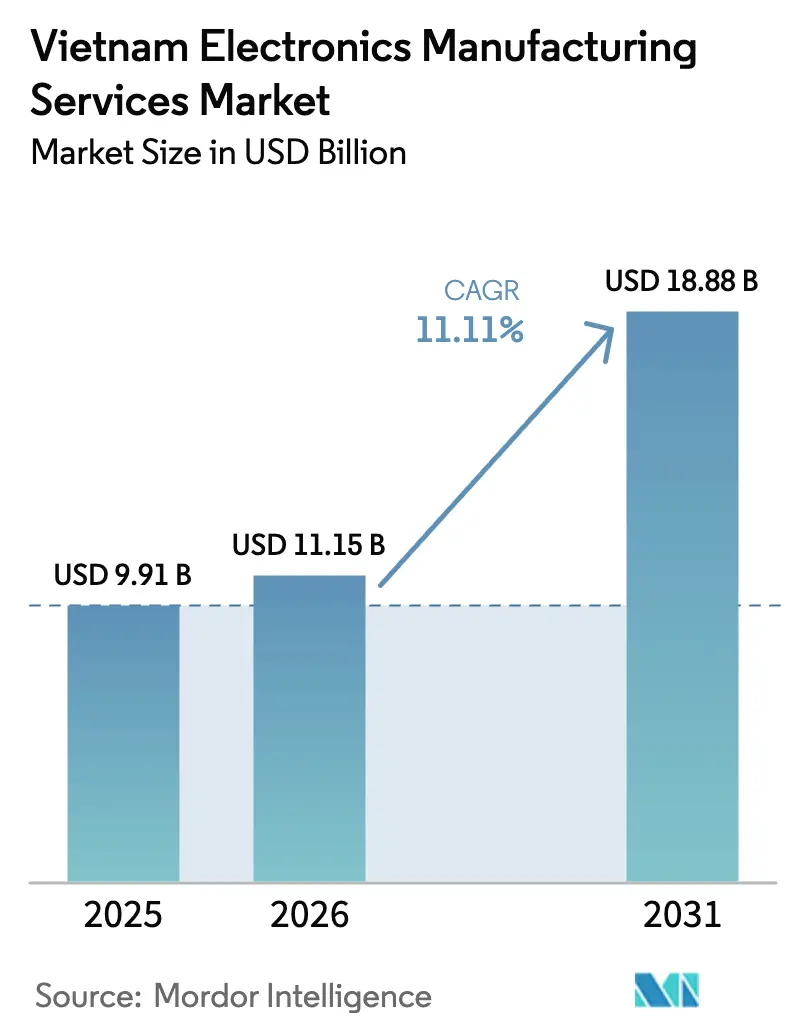
| Base Year Market Size (2025) | USD 9.91 Billion |
| Market Size (2026) | USD 11.15 Billion |
| Market Size (2031) | USD 18.88 Billion |
| Growth Rate (2026 - 2031) | 11.11 % |
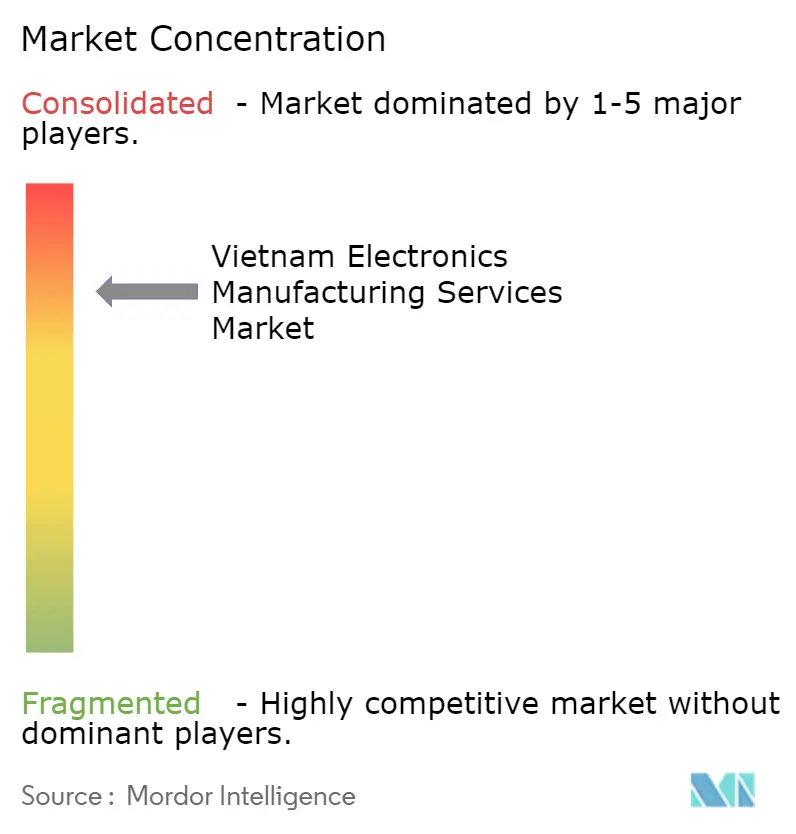
| Market Concentration | High |
Major Players *Disclaimer: Major Players sorted in no particular order Image © Mordor Intelligence. Reuse requires attribution under CC BY 4.0. | |
Vietnam Electronics Manufacturing Services Market Analysis by Mordor Intelligence
The Vietnam electronics manufacturing services market size is expected to grow from USD 9.91 billion in 2025 to USD 11.15 billion in 2026 and is forecasted to reach USD 18.88 billion by 2031 at 11.11% CAGR over 2026-2031. Continued foreign direct investment inflows sustain the upward curve, a widening local parts ecosystem, and government incentives that lower entry barriers for high-technology projects. Multinational contract manufacturers are consolidating assembly and test lines around Bac Ninh and Hai Phong to compress lead times, while mid-tier Vietnamese firms are positioning around prototyping and engineering services. Semiconductor back-end spending, the transition to turnkey box-build models, and growing orders for electric-vehicle electronics combine to lift average selling prices per unit, offsetting wage and energy inflation. At the same time, exposure to imported components and global handset demand cycles keeps capacity utilization planning a central management challenge in the Vietnam electronics manufacturing services market.
Key Report Takeaways
- By service type, printed circuit board assembly held 43.68% of the Vietnam electronics manufacturing services market share in 2025, while electromechanical and box-build services are forecast to post a 12.17% CAGR through 2031.
- By business model, contract manufacturing accounted for 62.47% of the revenue share of the Vietnam electronics manufacturing services market in 2025, whereas hybrid and turnkey arrangements are expected to expand at a 11.71% CAGR to 2031.
- By manufacturing process, surface-mount technology accounted for 51.39% of the Vietnam electronics manufacturing services market in 2025, and advanced packaging is projected to grow at a 11.78% CAGR between 2026-2031.
- By end-user, the consumer-electronics segment commanded 37.64% of the Vietnam EMS market, yet automotive electronics are advancing at a 12.93% CAGR through 2031.
Note: Market size and forecast figures in this report are generated using Mordor Intelligence’s proprietary estimation framework, updated with the latest available data and insights as of January 2026.
Global valuation is built by aggregating outputs from multiple countries and regions, with Vietnam being one of the contributors. Our global electronics manufacturing services market size represents that cumulative total.
Vietnam Electronics Manufacturing Services Market Trends and Insights
Drivers Impact Analysis*
| Driver | (~) % Impact on CAGR Forecast | Geographic Relevance | Impact Timeline |
|---|---|---|---|
| Growing Mobile Device Exports | +2.8% | National, concentrated in Bac Ninh, Bac Giang, Thai Nguyen | Medium term (2-4 years) |
| Rapid FDI-Led Capacity Expansion | +3.1% | National, with priority in northern industrial zones (Bac Ninh, Hai Phong, Quang Ninh) | Short term (≤ 2 years) |
| Semiconductor Assembly and Test Investments | +2.2% | National, early gains in Bac Ninh, Da Nang, Yen Phong | Long term (≥ 4 years) |
| Integrated Logistics Strategy Implementation | +1.4% | National, port-adjacent zones in Hai Phong, Ho Chi Minh City | Medium term (2-4 years) |
| Workforce Upskilling and STEM Talent Pipeline | +1.1% | National, university clusters in Hanoi, Ho Chi Minh City, Da Nang | Long term (≥ 4 years) |
| Government High-Tech Tax Incentives | +1.5% | National, enhanced benefits in high-tech zones and industrial parks | Short term (≤ 2 years) |
| Source: Mordor Intelligence | |||
Growing Mobile-Device Exports
Vietnam shipped 900 million smartphones from Samsung Electronics Vietnam lines in 2025, firmly establishing the country as the world’s second-largest handset exporter after China.[1]Samsung Electronics Vietnam, “2025 Export Milestones,” samsung.com.vn Tier-one brands are signing multi-year industrial-land leases and co-funding worker dormitories, locking in production continuity. Foxconn, Luxshare, and Pegatron have each scaled single-site capacities beyond 100 million units annually, creating volume platforms that attract ancillary component makers. Free-trade agreements eliminate tariffs across the Association of Southeast Asian Nations and the Regional Comprehensive Economic Partnership, widening duty-free access to 2.3 billion consumers. Concentration in smartphones and tablets, however, leaves the Vietnam electronics manufacturing services market vulnerable to lengthening replacement cycles.
Rapid FDI-Led Capacity Expansion
Ministry of Planning and Investment records show electronics-related commitments exceeding USD 18 billion during January-October 2025, with Bac Ninh alone receiving USD 4.2 billion across 89 projects.[2]Ministry of Planning and Investment, “FDI Performance Report 2025,” mpi.gov.vn Speed-to-production advantages stem from ready-built industrial parks that offer substations, wastewater treatment, and bonded warehouses. Samsung Display’s USD 1.8 billion organic light-emitting diode line and Lite-On’s USD 690 million power adapter plant illustrate the scale of recent greenfield projects. Although rapid buildup strains domestic connector and passive-component suppliers, contract manufacturers benefit from volume visibility that underpins further automation investment.
Semiconductor Assembly and Test Investments
Amkor Technology’s USD 1.6 billion expansion will triple Bac Ninh output to 3.6 billion packages by 2035.[3]Amkor Technology, “Bac Ninh Expansion Announcement,” amkor.com FPT Corporation broke ground on the country’s first local packaging facility in January 2026, scheduling six testing lines for commissioning by 2027. A VND 1.8 trillion FabLab in Da Nang targets fan-out wafer-level and 2.5-D integration, reflecting the national goal of capturing up to 9% of global assembly and test capacity by 2032. Advanced back-end processes lift average order value and diversify revenue beyond traditional phone assembly.
Government High-Tech Tax Incentives
Decree 182/2024 created a VND 12.8 trillion Investment Support Fund reimbursing up to 50% of semiconductor R&D spend. The Corporate Income Tax Law 2025 sets a 10% rate for 15 years in high-tech zones and grants a 4-year exemption for new projects. Circular 33/2025 accelerates depreciation on automated surface-mount lines to five years, improving cash flow for capital-intensive upgrades. Early adopters cite the incentives in site-selection filings, reinforcing Vietnam’s pull for high-complexity manufacturing.
Restraints Impact Analysis*
| Restraint | (~) % Impact on CAGR Forecast | Geographic Relevance | Impact Timeline |
|---|---|---|---|
| Supply-Chain Dependence on Imported Components | -1.8% | National, acute in smartphone and consumer-electronics clusters | Short term (≤ 2 years) |
| Rising Wage and Energy Costs | -1.3% | National, most pronounced in northern industrial zones | Medium term (2-4 years) |
| Intensifying US-China Trade-Policy Volatility | -0.9% | National, export-oriented facilities | Short term (≤ 2 years) |
| Skilled-Labour Shortage for Advanced Packaging | -0.7% | National, concentrated in Bac Ninh, Da Nang, Ho Chi Minh City | Long term (≥ 4 years) |
| Source: Mordor Intelligence | |||
Supply-Chain Dependence on Imported Components
Around 80% of the handset bill-of-materials value, covering displays, application processors, and camera sensors, originates outside Vietnam. Port congestion in southern China during the Lunar New Year 2025 highlighted the risk when flexible printed circuits arrived two weeks late, trimming Foxconn Fushan's daily output by 70,000 units. Domestic printed-circuit-board capacity stands at roughly 15 million m² annually, which is less than 5% of China’s total, limiting local value-add. Samsung Vietnam responded by co-investing in a Bac Ninh connector joint venture to shorten lead times, yet meaningful localization remains a multi-year endeavor.
Rising Wage and Energy Costs
Minimum wages rose 6% in July 2025, pushing skilled surface-mount operators toward a monthly pay of USD 400-600. Foxconn cited a 9% per-unit labor cost increase in 2025 and installed 120 collaborative robots to claw back margins. Electricity averages 8-10 cents per kilowatt-hour, with a 7% tariff increase in late-2025 adding USD 0.12 to the assembly cost of a mid-range smartphone. Pegatron’s 15-megawatt rooftop solar array now supplies 18% of its Hai Phong campus load, lowering the effective rate to 6.5 cents, yet broad-based relief remains elusive.
*Our forecasts treat driver/restraint impacts as directional, not additive. The impact forecasts reflect baseline growth, mix effects, and variable interactions.
Segment Analysis
By Service Type: Turnkey Integration Gains Traction
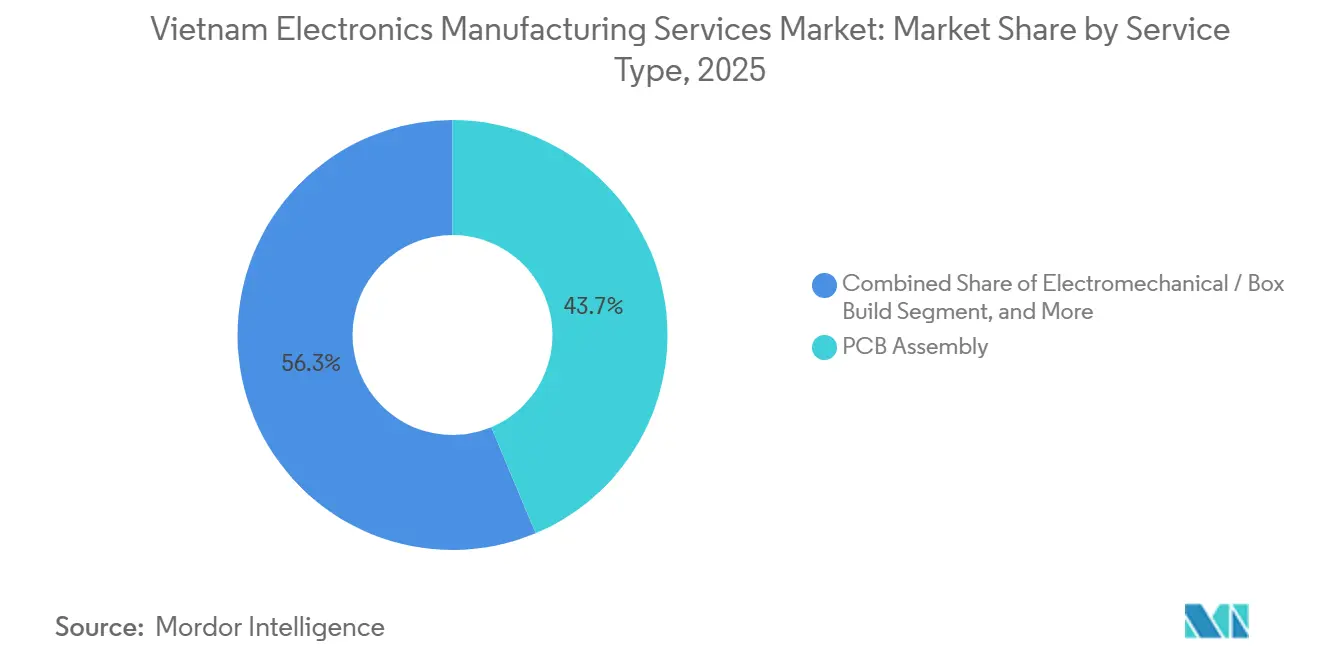
In 2025, printed circuit board assembly commanded a 43.68% share of Vietnam electronics manufacturing services market. Meanwhile, electromechanical and box-build services are projected to achieve a 12.17% CAGR through 2031, propelled by original-equipment manufacturers seeking single-invoice solutions covering chassis, power supplies, and firmware flashing. Wistron’s USD 134.8 million expansion of its networking-equipment business illustrates how turnkey capability shifts margin capture from labor to engineering.
The rising demand for engineering services and test-and-development is evident at FPT Industrial Manufacturing’s 12,000 m² Hanoi prototyping center. Logistics services, though smaller in revenue terms, underpin just-in-time sequencing; Samsung’s dedicated bonded hub in Bac Ninh feeds assembly lines every two hours, freeing working capital. Cable harnesses and conformal coating remain niche, but VinFast’s electric-vehicle ramp is catalyzing double-digit annual orders that reward domestic specialists.



By Business Model: Hybrid Arrangements Reshape Partnerships
Contract manufacturing generated 62.47% of 2025 revenue as brands retained component ownership and consigned kits to assemblers. Hybrid and turnkey models, however, are recording an 11.71% CAGR, reflecting the desire to offload procurement, inventory, and co-engineering risk. Luxshare-ICT’s evolution from board stuffing to joint development of acoustic modules for a global smartphone maker underscores the value shift within the Vietnam EMS market.
Original design manufacturing remains smaller, concentrated in tablets and wearables, where speed trumps deep IP. Yet Pegatron’s Hai Phong design center, with 200 radio-frequency and thermal-simulation engineers, signals rising interest from telecom operators seeking fifth-generation small-cell reference designs. As manufacturers accept inventory risk on behalf of customers, barriers to entry rise, protecting margins in an intensifying price-competition environment.
By Manufacturing Process: Advanced Packaging Captures Back-End Value
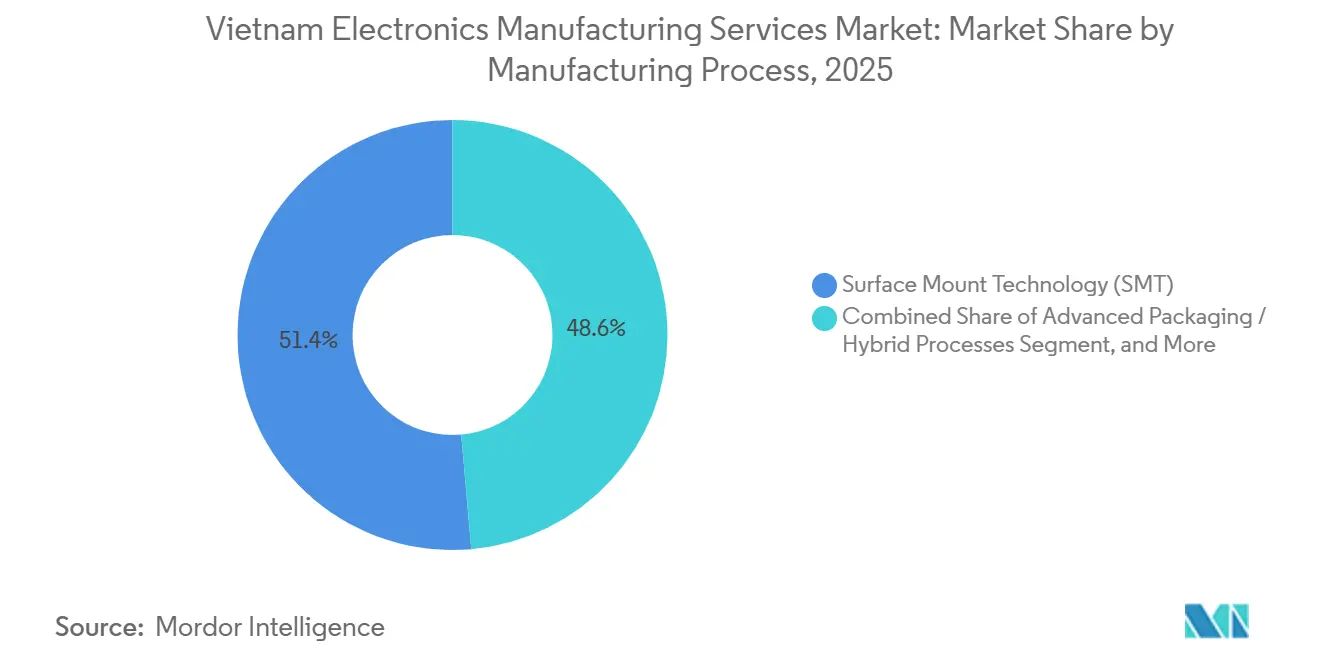
Surface-mount technology accounted for 51.39% of 2025 revenue but continues to cede share to hybrid and advanced-packaging flows, which posted an 11.78% CAGR. Da Nang’s FabLab aims at fan-out wafer-level volumes, while FPT Corporation’s Yen Phong site will ramp 18 testing lines by 2030. Together with Amkor’s focus on flip-chip ball-grid-array packaging, these projects anchor a domestic value proposition beyond low-mix phone boards, broadening the Vietnam EMS market.
Through-hole assembly persists in industrial controls and automotive inverters where physical robustness trumps miniaturization. Hybrid lines, blending surface-mount microcontrollers with through-hole power devices, dominate battery-management system boards supplied to VinFast. Capital spending on cleanrooms, die-attach, and wire-bond tools raises upfront costs but locks in clients that require tight tolerances and high first-pass yields.
By End-User: Automotive Electrification Drives Double-Digit Growth
Consumer electronics accounted for 37.64% of end-user demand in 2025, but electric-vehicle electronics is advancing at a 12.93% CAGR through 2031, shifting the revenue mix. VinFast’s target of 300,000 cars by 2027 draws contracts for on-board chargers and high-voltage cable harnesses, creating incremental orders for Viettronics and Elcom. Mobile devices still anchor unit volumes Samsung and Foxconn together assembled more than 1 billion smartphones and tablets in 2025 yet lengthening replacement cycles to 3.2 years put a natural ceiling on incremental growth in the Vietnam EMS market.
Computers benefit from enterprise and education refreshes, sustaining line utilization at Compal and Wistron plants. Industrial automation and telecom infrastructure, powered by Industry 4.0 and fifth-generation rollouts, are driving double-digit demand for printed circuit boards for programmable logic controllers and Open RAN radio units. Lighting and medical electronics remain nascent but are expanding, supported by smart-building retrofits and early success stories such as Spartronics’ diagnostic-equipment assembly.
Geography Analysis
Northern provinces Bac Ninh, Bac Giang, and Hai Phong account for more than 70% of Vietnam's current electronics manufacturing services market revenue, on the back of dense industrial park networks and proximity to Hai Phong port. Samsung, Foxconn, and Pegatron operate mega-campuses that bring in dozens of board fab and plastic molding suppliers. Local governments fast-track land-lease approvals and coordinate vocational-training programs, reinforcing the agglomeration effect.
Central Vietnam, notably Da Nang and Quang Nam, is emerging as a semiconductor and power-adapter hub. Da Nang’s FabLab and Lite-On’s 50-hectare charger campus are catalyzing a cluster centered on back-end packaging and high-density power electronics. Infrastructure upgrades, including the expansion of the Tien Sa container terminal, cut transit times to mainland China’s component suppliers by two days, bolstering the central region’s competitiveness in the Vietnam electronics manufacturing services market.
The southern region, anchored by Ho Chi Minh City and neighboring Dong Nai, focuses on prototyping, medical devices, and industrial electronics. Spartronics’ 270,000-square-foot plant and multiple surface-mount service bureaus serve diversified local demand. While land costs and wage rates are higher than in the north, access to engineering talent and international airports supports quick-turn engineering engagements that feed the national value chain.
Coverage of the electronics manufacturing services market by Mordor Intelligence spans a wide geographic footprint, with regional analysis available for Europe, Asia, and North America, alongside detailed country-level intelligence for Thailand, Singapore, United Kingdom, United States, South Korea, and Japan, each shaped by local operating conditions.
Competitive Landscape
Global leaders hold scale advantages, yet the combined top-five share of 65-70% signals room for mid-sized entrants in specialized niches. Samsung’s bonded-warehouse logistics system sequences components within two-hour windows, sustaining 98% line uptime. Foxconn’s collaborative-robot deployment lifted first-pass yields above 98% and trimmed per-device labor spend by 8-10%. Luxshare-ICT and Pegatron pursue vertical integration by adding acoustic-module and haptic-actuator lines, safeguarding margins amid wage inflation.
Domestic challengers such as FPT Industrial Manufacturing capture prototyping and engineering contracts at gross margins above 30%, double those of high-volume assembly. Viettel Manufacturing’s Qualcomm partnership to build Open RAN radio units demonstrates a path into export-oriented telecom infrastructure. Quality-management certifications ISO 9001, IATF 16949, and ISO 13485 remain key gatekeepers for automotive and medical accounts, limiting low-cost entrants without robust compliance systems.
Technology adoption is the new competitive fault line. Pegatron’s machine-learning-driven optical-inspection suite predicts solder defects 12 hours ahead, while Amkor’s Bac Ninh site integrates fully automated material handling from wafer singulation to final test. Capital-intensive advanced packaging will likely trigger consolidation, favoring Vietnam electronics manufacturing services market participants with access to patient capital and global purchasing leverage.
Vietnam Electronics Manufacturing Services Industry Leaders
Samsung Electronics Vietnam Co., Ltd.
Hon Hai Precision Industry Co., Ltd.
Luxshare-ICT (Vietnam) Co., Ltd.
Pegatron Vietnam Co., Ltd.
Compal Electronics (Vietnam) Co., Ltd.
- *Disclaimer: Major Players sorted in no particular order

Recent Industry Developments
- January 2026: FPT Corporation announced Vietnam’s first domestic semiconductor testing and packaging facility, scheduling six testing lines by 2027 and 18 lines plus full packaging by 2030.
- December 2025: Wistron approved USD 134.8 million to expand networking-equipment assembly and purchased 37 hectares in Kim Bang for a new campus.
- November 2025: Lite-On Technology completed its USD 690 million power-adapter plant in Quang Ninh with 40 million-unit initial capacity and a roadmap to 124 million units by 2030.
- October 2025: Viettel Group gained recognition in Gartner’s Magic Quadrant for Communications Service Provider Network Infrastructure after deploying 30,000 fifth-generation base stations.


Vietnam Electronics Manufacturing Services Market Report Scope
The Vietnam Electronics Manufacturing Services Market Report is Segmented by Service Type (Electronics Manufacturing Services, Engineering Services, Test and Development Implementation Services, Logistics Services, Other Service Types), Business Model (Contract Manufacturing (CM), Original Design Manufacturing (ODM), Hybrid / Turnkey / Other Business Models), Manufacturing Process (Surface Mount Technology (SMT), Through-Hole Technology (THT), Advanced Packaging / Hybrid Processes), End-user (Mobile Devices, Consumer Electronics, Computer, Industrial, Automotive, Communication, Lighting, Medical, Other End-users). The Market Forecasts are Provided in Terms of Value (USD).
| Electronics Manufacturing Services | PCB Assembly |
| Electromechanical Assembly/Box Build | |
| Prototyping | |
| Other Electronics Manufacturing Services | |
| Engineering Services | |
| Test and Development Implementation Services | |
| Logistics Services | |
| Other Service Types |
| Contract Manufacturing (CM) |
| Original Design Manufacturing (ODM) |
| Hybrid / Turnkey / Other Business Models |
| Surface Mount Technology (SMT) |
| Through-Hole Technology (THT) |
| Advanced Packaging / Hybrid Processes |
| Mobile Devices (Smartphones and Tablets) |
| Consumer Electronics |
| Computer (PCs/Desktop/Laptops) |
| Industrial |
| Automotive |
| Communication |
| Lighting |
| Medical |
| Other End-users |
| By Service Type | Electronics Manufacturing Services | PCB Assembly |
| Electromechanical Assembly/Box Build | ||
| Prototyping | ||
| Other Electronics Manufacturing Services | ||
| Engineering Services | ||
| Test and Development Implementation Services | ||
| Logistics Services | ||
| Other Service Types | ||
| By Business Model | Contract Manufacturing (CM) | |
| Original Design Manufacturing (ODM) | ||
| Hybrid / Turnkey / Other Business Models | ||
| By Manufacturing Process | Surface Mount Technology (SMT) | |
| Through-Hole Technology (THT) | ||
| Advanced Packaging / Hybrid Processes | ||
| By End-user | Mobile Devices (Smartphones and Tablets) | |
| Consumer Electronics | ||
| Computer (PCs/Desktop/Laptops) | ||
| Industrial | ||
| Automotive | ||
| Communication | ||
| Lighting | ||
| Medical | ||
| Other End-users |


Key Questions Answered in the Report
What was the value of the Vietnam electronics manufacturing services market in 2026?
It stood at USD 11.15 billion and is forecast to reach USD 18.88 billion by 2031.
Which segment is expanding fastest in service offerings?
Electromechanical and box-build services are growing at a 12.17% CAGR to 2031.
How much of the market do contract manufacturing models hold?
Contract manufacturing generated 62.47% of 2025 revenue but hybrid models are gaining ground.
Why are automotive electronics important for Vietnam?
Electric-vehicle programs led by VinFast are driving a 12.93% CAGR in automotive electronics demand, diversifying revenue beyond smartphones.
What government incentives support semiconductor projects?
Decree 182/2024 reimburses up to 50% of R&D costs and the Corporate Income Tax Law 2025 fixes a 10% rate for 15 years in high-tech zones.
How concentrated is industry leadership?
The top five companies hold an estimated 65-70% share, giving the market a moderate concentration score of 6.
Page last updated on:





