
UI/UX Market Size and Share
UI/UX Market Analysis by Mordor Intelligence
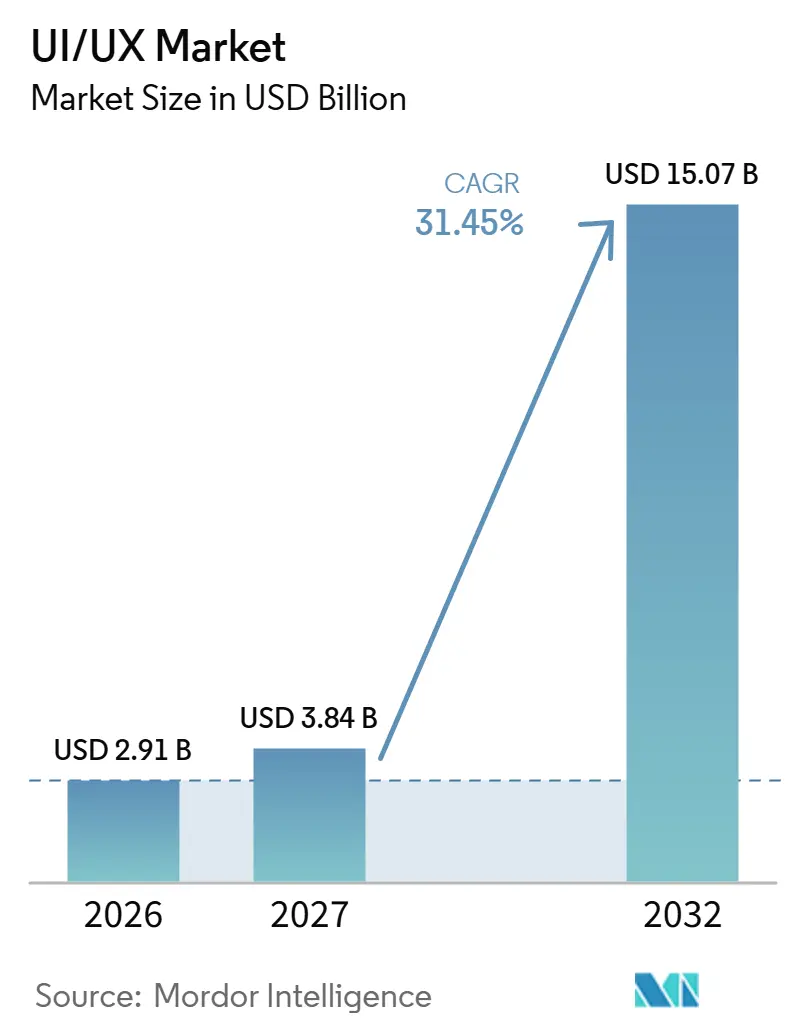
The UI/UX market size was valued at USD 2.91 billion in 2026 and estimated to grow from USD 3.84 billion in 2027 to reach USD 15.07 billion by 2032, at a CAGR of 31.45% during the forecast period (2027-2032).
Digital transformation and mobile retail activity make interface validation a recurring requirement for product teams. In the United States, public-sector accessibility requirements add a compliance reason to revisit web content and mobile-app interactions. Software providers can respond by connecting prototype creation, editable alternatives, and team review. Higher subscription costs and scarce design capacity can slow the conversion of that workload into paid seats. Suppliers that keep prototyping, review, and handoff inside one subscription can turn that validation workload into recurring revenue, but premium seat pricing and thin design staffing will set how fast it converts.
Key Report Takeaways
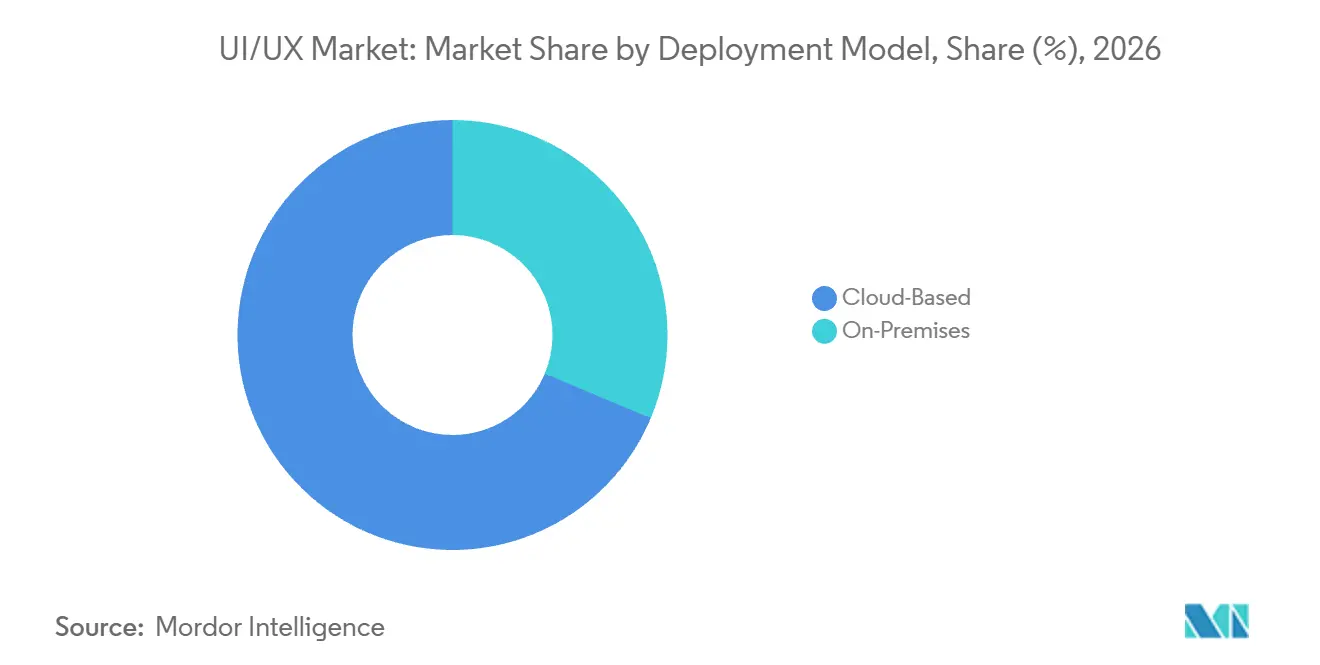
- By deployment model, cloud-based software led with a 68.68% UI/UX market share in 2026 and is forecast to grow fastest at a 32.35% CAGR during 2027-2032.
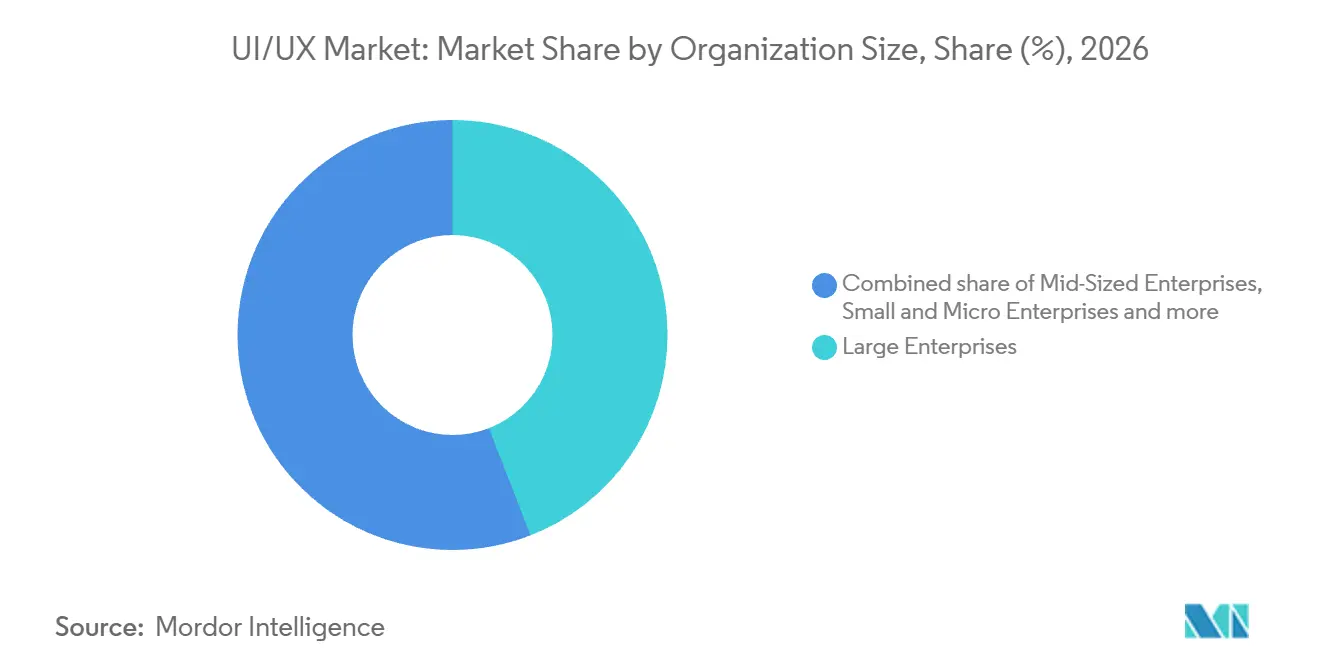
- Among organization sizes, large enterprises led with a 44.09% share of the UI/UX market size in 2026, while small and micro enterprises are forecast to grow fastest at a 32.1% CAGR during 2027-2032.
- Across end-use industries, e-commerce and retail led with a 23.54% share in 2026, while the healthcare and life sciences segment is forecast to grow fastest at a 32.2% CAGR during 2027-2032.
- By platform, mobile applications led with a 39.53% share in 2026, while AR/VR and spatial interfaces are forecast to grow fastest at a 33% CAGR during 2027-2032.
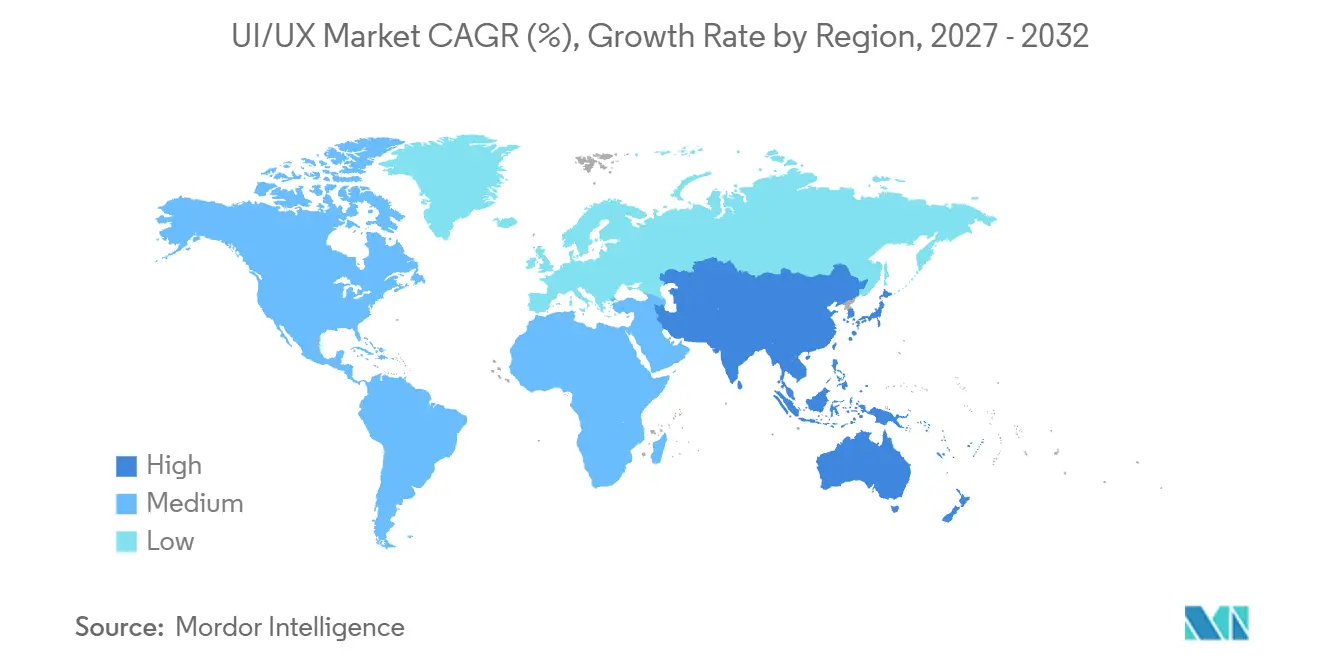
- Geographically, North America held the largest share at 38.84% in 2026, while Asia-Pacific is forecast to grow fastest at a 32.9% CAGR during 2027-2032.
Note: Market numbers in this report are based on Mordor Intelligence's proprietary estimation framework, which combines nine months of actuals with Q4 projections for base year 2026.
Market Trends and Insights
Drivers Impact Analysis of UI/UX Market*
| Driver | (~) % Impact on CAGR Forecast | Geographic Relevance | Impact Timeline |
|---|---|---|---|
| Proliferation of Digital-Transformation Programs | +18% | Locations within India | Medium term (2-4 years) |
| Surge in Mobile-Commerce Adoption | +10% | Within the United States | Short term (≤ 2 years) |
| Enterprise Focus on CX KPIs and NPS | +3% | Locations within Germany | Medium term (2-4 years) |
| Accessibility Legislation (WCAG 2.1) Redesign Mandates | +2.5% | Within the United States | Short term (≤ 2 years) |
| Design Tokens Standardization for Multi-Brand Scalability | +1.5% | Selected markets within Europe | Medium term (2-4 years) |
| Edge-Rendered UI for Low-Latency Devices | +1% | North America, Europe, Asia-Pacific | Long term (≥ 4 years) |
| Source: Mordor Intelligence | |||
Proliferation of Digital-Transformation Programs
Digital-transformation programs create a continuing interface-design requirement when organizations change multiple digital workflows. Deloitte surveyed 548 senior business and technology decision-makers across 5 industries in 2025, covering organizations with at least USD 500 million in annual revenue. Digital-initiative budgets among surveyed organizations rose from 7.5% of revenue in 2024 to 13.7% in 2025.[1] Separately, GSMA Intelligence's survey of 6,342 enterprises across 50 countries projects a spending level of 10% of revenue on digital transformation through 2032. For software suppliers, broader digital programs create demand for interface work across successive workflows, with reusable design assets reducing repeated setup. The commercial unit can consequently shift from one redesign project to a continuing design capability supported throughout a transformation program.
Surge in Mobile-Commerce Adoption
Mobile checkout has greater commercial importance when more online retail transactions pass through a smartphone interface. During the 2025 US holiday season from November 1 through December 31, mobile accounted for 56.4% of online retail transactions, up from 54.5% in 2024.[2] That shift places a larger portion of the measured transaction activity behind mobile interaction choices. For retail design teams, testing a purchase journey therefore has value beyond improving the appearance of individual screens. UI/UX software can help organize alternatives around completing that journey, with navigation and checkout evaluated as connected tasks. A mobile checkout defect can therefore affect a larger share of holiday orders, increasing the commercial weight of resolving it before release.
Enterprise Focus on CX KPIs and NPS
Customer-experience measurement creates a design problem when a summary score must inform changes to individual interactions. In a survey conducted in 2025, Net Promoter Score (NPS) was a focal point in CX operations at 38% of surveyed organizations, although that attention was retreating. Deloitte Digital's 2025 study describes customer insights from journey touchpoints as a prerequisite for designing customer-oriented products and services. In its April 2025 survey of 150 CX experts at large German companies, 96% said their firms systematically recorded customer satisfaction, with NPS among the most commonly used metrics. With satisfaction recording so prevalent in this sample, UI/UX suppliers can address the next design task of translating feedback into a specific interface change. Demand then rests on the persistence of satisfaction measurement, not on any single metric such as NPS.
Accessibility Legislation (WCAG 2.1) Redesign Mandates
US Department of Justice rules require covered state and local governments to make directly provided or contracted web content and mobile apps conform to Web Content Accessibility Guidelines (WCAG) 2.1 Level A and Level AA. Compliance begins April 26, 2027, for entities serving 50,000 or more people, excluding special districts, and April 26, 2028, for smaller entities and special districts. Exceptions apply when an entity can demonstrate a fundamental alteration to the nature of a service, program, or activity, or undue financial and administrative burdens. For public-sector design teams, the standard provides a release criterion around which future web and mobile changes can be validated. For software suppliers, compliance review links proposed web and mobile changes to a legally defined acceptance standard. The phased deadlines create 2 successive public-sector compliance windows, allowing suppliers to sequence work for larger entities before smaller entities and special districts.
Restraints Impact Analysis of UI/UX Market*
| Restraint | (~) % Impact on CAGR Forecast | Geographic Relevance | Impact Timeline |
|---|---|---|---|
| Shortage of Skilled UI/UX Talent | -1.8% | Within the United Kingdom | Medium term (2-4 years) |
| High Subscription Cost of Premium Tool Suites | -1.4% | United States and international markets | Short term (≤ 2 years) |
| Algorithmic Bias Risks in AI-Generated UX | -0.8% | North America, South America, Europe, Asia-Pacific | Medium term (2-4 years) |
| Interoperability Gaps Across AR/VR and Classic Tooling | -0.5% | North America, Europe, Asia-Pacific | Long term (≥ 4 years) |
| Source: Mordor Intelligence | |||
Shortage of Skilled UI/UX Talent
A shortage of designers can limit the productive capacity that supports additional paid software seats. In 2025, around one in 5 UK computer-games employers experiencing recruitment difficulties cited UI/UX designers and researchers among hard-to-fill occupations, on a low sample base of 16 employers. For these studios, another license cannot add research capacity unless a skilled practitioner can turn findings into interaction choices. Recruitment difficulties can therefore constrain seat expansion even when more interface work is available. UI/UX designers and researchers jointly topped the audit's hard-to-fill list with computer programmers, so studios adding seats before hiring can carry subscription costs without added design output.
High Subscription Cost of Premium Tool Suites
Premium suite pricing can make broad participation in interface design more expensive even before a team adds functionality. Figma raised prices for its bundled Full seat by 20% to 33% beginning March 11, 2025, with increases taking effect at annual or monthly renewal.[3] Its listed Enterprise Full-seat price is USD 90 per month, billed annually, for access to multiple Figma products. For a design organization adding contributors, each Full seat costs 20% to 33% more from its renewal, which raises the value required from every additional seat. Figma also required administrator approval from that date before paid seat upgrades that incur additional costs. Approval provides spending control, while the higher renewal price leaves the cost of authorized Full seats elevated.
*Our forecasts treat driver/restraint impacts as directional, not additive. The impact forecasts reflect baseline growth, mix effects, and variable interactions.
UI/UX Market Segment Analysis
By Deployment Model:
Cloud Delivery Supports Recurring Platform RelationshipsCloud-based software accounted for a 68.68% share of the UI/UX market size in 2026 and is the largest and fastest-growing segment, with a forecast CAGR of 32.35% during 2027-2032. Figma reported company-wide revenue of USD 370.1 million for the second quarter of 2026, up 48% from the second quarter of 2025. Its cloud-based design and product-development platform was expanding into additional products and AI features. For vendors, a broader platform creates opportunities to support connected work around interface creation through the same delivery environment. Extending the paid offer across those activities can create additional routes to subscription revenue within an established platform relationship.
Customer expansion provides a separate commercial mechanism for cloud providers after initial adoption. Figma reported 136% net dollar retention as of June 30, 2026, for paid customers with more than USD 10,000 in annual recurring revenue. The measure compares annual recurring revenue for the same qualifying customers 12 months apart and reflects expansion, contraction, and churn. It therefore captures the net development of existing relationships, giving suppliers a reason to consider the depth of platform use alongside customer acquisition. Commercial momentum can depend on how much continuing product work the platform supports within those relationships.

By Organization Size:
Account Scale and Product Priorities Separate Buyer NeedsLarge enterprises represented a 44.09% UI/UX market share in 2026, making them the largest segment. Figma reported 1,635 paid customer accounts with at least USD 100,000 in annual recurring revenue as of June 30, 2026. The company uses this cohort as an indicator of its ability to support larger organizations. Separately billed divisions, subsidiaries, or subscribing teams within one organization can count as multiple paid customers. Account coordination can consequently become part of the enterprise software proposition as adoption extends across distinct paying teams within the same organization, each with its own commercial relationship.
Small and micro enterprises are the fastest-growing segment, with a forecast CAGR of 32.1% during 2027-2032. In Figma's 2025 survey, 61% of users at companies with 1 to 10 employees said AI was very or critically important to their market-share goals. The finding points to product ambition among a tightly defined group of existing design-platform users. For a small team developing an AI-enabled product, prototyping can help expose whether proposed interactions communicate the intended action before development commits to implementation. Because the 61% reading came from Figma users, it describes existing design-platform users at the smallest firms, making AI capability inside their design platform a direct commercial link to that priority.
By End-Use Industry:
Transaction Scale and Care Access Shape Design PrioritiesE-commerce and retail was the largest segment, with a 23.54% share in 2026. Adobe estimated US online consumer spending at USD 257.8 billion from November 1 through December 31, 2025. Its Adobe Analytics analysis covered more than 1 trillion visits to US retail sites, 100 million stock-keeping units, and 18 product categories. That breadth gives retail teams a reason to evaluate proposed interaction changes against varied products and purchase journeys. For suppliers serving retail portfolios, reusable purchase patterns can spread the cost of interaction design across varied catalogs and storefronts.
Healthcare and life sciences is the fastest-growing segment, with a forecast CAGR of 32.2% during 2027-2032. In the Peterson Health Technology Institute's survey of 100 US health systems, fielded July 1-22, 2026, 76% of those willing to spend more on digital-health solutions cited improved access outcomes as a reason. This places access outcomes among the conditions behind additional digital-health investment, alongside engagement outcomes. For interface-software suppliers, a proposed service journey has a stronger sales case when its access objective can be evaluated alongside engagement. An access-led sales case therefore needs evidence of the redesigned care journey's benefits before stated interest can credibly become a software commitment.
By Platform:
Established App Workloads Meet Spatial Design NeedsMobile applications held the largest segment position, with a 39.53% share in 2026. Apple reported 892.7 million average weekly App Store visitors worldwide in its 2025 App Store Transparency Report. The 2025 Ofcom study, with May 2025 as its primary reference period, found that UK smartphone users averaged 41 apps per month, 3 more than in 2024. A single mobile app must make its navigation and interaction choices understandable within an environment of frequent app use and many other applications. That crowded usage pattern makes familiar navigation a way for mobile-app developers to reduce what users must learn before reaching an application's core task.
AR/VR and spatial interfaces form the fastest-growing segment, with a forecast CAGR of 33% during 2027-2032. For a team building an immersive application, interface choices include where controls appear and how they respond as the user changes position. In July 2025, ShapesXR released an animation feature for its XR design software that lets designers animate and prototype 3D scenes, including UI elements, in a browser before moving into VR. That sequence allows placement and motion to be reviewed together before a team commits to implementation. Separating these stages can concentrate headset work on spatial judgments while leaving scene construction and animation in the browser.
Geography Analysis
North America UI/UX Market
North America accounted for a 38.84% UI/UX market share in 2026, making it the largest regional market. Figma's broader collaborative design and product-development platform generated USD 491.5 million in 2025 revenue from customers with billing addresses in the United States. No single country outside the United States accounted for more than 10% of Figma's total revenue in 2025, so US-billed accounts were its largest single-country revenue base. That gives a concrete example of buyer spending behind North America's leading position.
Asia-Pacific UI/UX Market
Asia-Pacific is the fastest-growing region, with a forecast CAGR of 32.9% during 2027-2032. Hong Leong Finance officially launched HLF Digital in Singapore on September 15, 2025, reporting customer fixed-deposit placements through the financial-services mobile app since its August 2024 pilot. During 2025, the app recorded more than 11,000 sign-ups, bringing its cumulative total since 2024 above 18,000 by year-end. In Southeast Asia, Grab's Figma-based Duxton design system reached roughly 50% adoption across its passenger app by the second half of 2025. Together, financial-service delivery and shared design systems link regional interface work to both expanding customer journeys and standardization across established apps.
In South America, Brazil's Secretariat of Digital Government coordinates its 2024-2027 National Digital Government Strategy to simplify citizen access across federated entities, making cross-government consistency a design priority. An ordinance revised the strategy's recommendations on July 1, 2026. In Europe, the UK Government Digital Service calls for user research at each development phase and updated plans as teams learn, favoring iterative service-design work. In the Middle East, the UAE Telecommunications and Digital Government Regulatory Authority provides reusable components for usable, accessible federal websites, giving suppliers a shared design baseline. In Africa, Rwanda Information Society Authority and partners launched a Service Access Point in Muhura Sector, Gatsibo District, on October 2, 2025, to support online government-service access, making assisted use a relevant interface consideration.
Regulatory Framework and Outlook
The comparison of selected jurisdictions assesses clarity of interface requirements and implementation flexibility from the perspective of operators of covered digital services. Germany's Accessibility Strengthening Act (BFSG) requires accessibility for covered consumer e-commerce services provided after June 28, 2025, while US Title II duties cover state and local government web content and mobile apps. Products lawfully used for the same or similar services before June 28, 2025, may continue through June 27, 2030, alongside unchanged contracts predating the former date, limited to their original term and the latter deadline. Specified exclusions include third-party content not funded, developed, or controlled by the operator and archived content not updated after June 28, 2025.
Regulatory Table of UI/UX Market
| Decision factor | United States | Brazil | Germany | China | United Arab Emirates | South Africa |
|---|---|---|---|---|---|---|
| Primary authority | US Department of Justice | Public Prosecutor's Office and Public Defender's Office, general rights protection | Market-surveillance authorities designated under state law | Procuratorates where violations harm public interests | Dubai Digital Authority, for Dubai | Government Communication and Information System, government-web guidance |
| Key instruments or direction | ADA Title II web/mobile rule and WCAG 2.1 Level AA | Inclusion Law, Article 63, for covered websites | BFSG consumer-service duties and limited product/contract transitions | Accessible Environments Law and recommended miniapp standard GB/T 45395-2025 | Dubai Law No. 9 of 2022; up to 1 year from applicable phase commencement, extendable by 1 year; conditional exemptions | Recommendation of at least WCAG 2.2 Level A for government departments |
| Commercial effect | Web/mobile conformance for covered state/local entities under phased deadlines | Accessible websites for government and companies headquartered or commercially represented in Brazil | Accessibility for covered consumer e-commerce after June 28, 2025, subject to statutory scope and exclusions | Progressive conformity for government-funded platforms; listed private services encouraged | Dubai-only accessible channels and disability-access options without extra customer fees; exemptions require request and coordination with the General Secretariat and Dubai Electronic Security Centre | Basic accessibility guidance with departmental implementation flexibility |
| Current policy attractiveness | Medium | Medium | Medium | Medium | Medium | High |
| Future direction of policy attractiveness | Hardening | Hardening | Hardening | Hardening | No change | No change |
| Source: Mordor Intelligence | ||||||
US public-sector compliance in 2027-2028 and Brazil's preliminary 2026 federal-website order increase implementation pressure, with the latter requiring a transition plan within 180 days from the order. Germany's consumer-service duties and limited transitional permissions support a medium attractiveness rating, with hardening as those permissions expire. China's 2026-2030 plan calls for stronger public-interest enforcement, including apps and mini programs, supporting hardening under its differentiated duties. Dubai's conditional-exemption framework and South Africa's nonmandatory Level A recommendation support continuity, with the recommendation leaving government departments greater implementation flexibility.
Value Chain Stages
The value chain compares interface authoring, interactive prototyping, and developer handoff as stages supported by paid design software. Figma sells plans with per-seat pricing and annual billing options. Sketch offers subscriptions and a one-time Mac-only license. These commercial models place value capture around authoring access, while included collaboration can extend the software's role into delivery.
Value Chain Analysis Table of UI/UX Market
| Primary activity | Key participants | Value capture | Bottleneck | Resilience response |
|---|---|---|---|---|
| Interface authoring | Design-platform vendors such as Figma, Inc., Sketch B.V. | Design-seat subscriptions and Mac-only licenses | Inconsistent interface decisions across parallel work | Establish shared design decisions before parallel authoring |
| Interactive prototyping | Prototyping-software providers such as Figma, Inc. | Paid-plan seats including advanced prototyping | Interaction questions unresolved by static screens | Validate critical transitions before developer handoff |
| Developer handoff | Design-collaboration providers such as Figma, Inc., Sketch B.V. | Design subscriptions with included handoff capabilities | Ambiguity between design intent and implementation | Preserve revisions and agreed behavior during review |
| Source: Mordor Intelligence | ||||
Figma's separately priced seat categories and Sketch's included developer handoff illustrate different ways to charge for participation in the workflow. Preserving agreed revisions and interaction behavior across handoff can help implementation teams work from a shared design decision. The pricing model then determines whether downstream collaboration expands paid participation or adds value to access sold earlier in the sequence.
Competitive Landscape
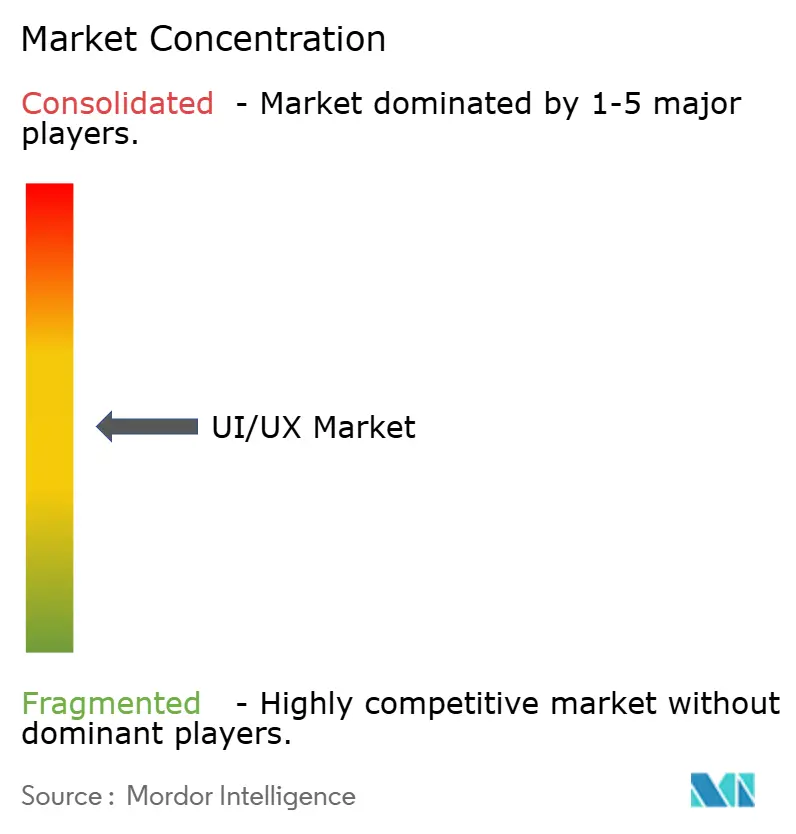
Competition is moderately concentrated around platform ecosystems, with specialist software providers maintaining distinct authoring environments. Adobe Inc., a creativity and productivity software provider, reported company-wide revenue of USD 6.76 billion for fiscal Q3 2026 ended August 28, up 13% year over year, or 12% in constant currency. Figma, Inc. supplies UI design and prototyping products within a broader collaborative design and product-development platform. The coexistence of a design-platform business and a much broader software supplier makes the scope of the paid workflow a central point of competition for focused software challengers.
Sketch B.V. supplies digital design software with a Mac application and cloud collaboration. In September 2025, Figma purchased technology behind the html.to.design plugin and enabled editable Figma Make previews in Figma Design. The plugin's developer retained independent responsibility for building and maintaining its plugins and tools. By purchasing a specific integration technology, a platform can deepen workflow coverage while an independent developer continues to supply specialized tooling for teams revising generated designs.
Across Figma's broader platform, over 80% of paid customer accounts with more than USD 10,000 in annual recurring revenue were consuming AI credits weekly as of June 30, 2026, measured in the quarter's peak week. Figma describes work toward WCAG 2.2 AA compliance and provides accessibility features across web, desktop, iOS, and Android. Sketch B.V. shipped 3 major releases in 2025, including Stacks and Frames for modern user-interface layouts. Those releases also redesigned Sketch's macOS interface. For a specialist seeking accounts that already use platform AI, layout improvements must justify adding another authoring tool.
UI/UX Industry Leaders
-
Adobe Inc.
-
Figma, Inc.
-
Sketch B.V.
- *Disclaimer: Major Players sorted in no particular order
UI/UX Market Companies Covered in this Report
- Adobe Inc.
- Figma, Inc.
- Sketch B.V.
- InVisionApp, Inc.
- Axure Software Solutions, Inc.
- Balsamiq Studios, LLC
- PROTOIO Inc.
- UXPin Inc.
- Justinmind Inc.
- International Business Machines Corporation
- Oracle Corporation
- SAP SE
- Microsoft Corporation
- Google LLC
- Apple Inc.
- Atlassian Corporation
- IDEO LP
- Ramotion LLC
- UX Studio Zrt.
- Nielsen Norman Group Inc.
- HCL Technologies Limited
- Cognizant Technology Solutions Corporation
- Zeplin, Inc.
- MAZE.DESIGN INC.
Key Opportunities for Market Participants
The opportunities compare accessibility-led interface validation with the coordination needs of teams using AI in product development. The European Accessibility Act requires selected EU services, including e-commerce and banking, to meet common accessibility requirements. In Figma's 2026 survey across 10 markets, 41% of respondents said AI meaningfully changes how teams work together, compared with 7% 2 years earlier. These conditions create openings for software that connects design changes with reviewable service requirements and team decisions.
Market Opportunities Table of UI/UX Market
| Opportunity | Why now | Buyer / lead segment | Recommended play | Main barrier | Likely beneficiaries |
|---|---|---|---|---|---|
| Accessible retail transaction design | Covered e-commerce services face accessibility duties | EU e-commerce and retail service teams | Link purchase-path prototypes with accessibility review | Demonstrating conformance through actual interactions | Design and prototyping software providers |
| Banking service-flow validation | Covered banking services face accessibility duties | EU banking product teams | Review connected service steps before implementation | Coordinating changes across a complete service journey | Interaction-design and testing software providers |
| AI collaboration context management | Surveyed product teams report changed teamwork in 2026 | Design, development, and product-management teams | Keep generated alternatives, decisions, and review context together | Assigning responsibility for accepted design changes | Collaborative design-platform providers |
| Source: Mordor Intelligence | |||||
The central opening is to make responsibility for interface changes explicit at the point of review. Accessibility supplies a service requirement to check, while changing teamwork makes ownership of design decisions a useful part of the software workflow. The commercial offer centers on a review record that connects an accepted design decision to the service requirement it is meant to satisfy.
Recent Industry Developments in UI/UX Market
- Oct 2026: Figma launched code layers for interactive, code-backed prototypes and Figma Specs for design context, both rolling out in open beta, with Specs on paid plans.
- Oct 2026: Figma made its design agent generally available for design work on its canvas.
UI/UX Market Report Scope and Research Methodology
Market Definition and Coverage
The UI/UX market measures annual spending on software used to design, prototype, test, and manage user interfaces and experiences for digital products in the Global market. It covers cloud subscriptions and on-premises licenses purchased by organizations of all sizes for applications and connected-device interfaces.
Scope exclusions: UI/UX consulting, design agency, and implementation services, in-house UI/UX employee wages and contractor labor, revenue from developing or selling finished websites, mobile apps, and other digital products, computers, phones, automotive systems, and other interface hardware, and separately sold cloud infrastructure, hosting, and general-purpose storage are excluded.
Segments Covered in This Report
- By Deployment Model
- Cloud-Based
- On-Premises
- By Organization Size
- Large Enterprises
- Mid-Sized Enterprises
- Small and Micro Enterprises
- By End-Use Industry
- E-Commerce and Retail
- Healthcare and Life Sciences
- Banking, Financial Services and Insurance
- Education and EdTech
- IT and Telecom
- Media and Entertainment
- Government and Public Sector
- Other End-Use Industries
- By Platform
- Mobile Applications
- Web Applications
- Desktop Software
- Voice and Conversational Interfaces
- AR/VR and Spatial Interfaces
- Automotive and IoT Displays
- By Geography
- North America
- United States
- Canada
- Mexico
- South America
- Brazil
- Argentina
- Chile
- Rest of South America
- Europe
- Germany
- France
- United Kingdom
- Russia
- Italy
- Spain
- Rest of Europe
- Asia-Pacific
- China
- Japan
- India
- South Korea
- Australia and New Zealand
- Rest of Asia-Pacific
- Middle East
- Saudi Arabia
- United Arab Emirates
- Turkey
- Rest of Middle East
- Africa
- South Africa
- Nigeria
- Kenya
- Rest of Africa
- North America
Data Sources, Market Sizing, and Validation
Desk Research
Sources such as the US Census Bureau's retail e-commerce series help track digital commerce conditions that influence interface-software demand. US Department of Justice and European Commission accessibility materials clarify requirements and timing for covered digital services, while Figma's published plans and seat details provide a company-level check on software packaging and recurring purchase terms.
Company filings and investor materials can help distinguish software subscription revenue from broader business revenue, and reputable reporting can cross-check product launches, pricing changes, and acquisitions. These sources are illustrative and not exhaustive, and further sources inform collection, validation, and clarification.
Primary Interviews and Surveys
Interviews and structured surveys should include software product and finance leaders, design-operations and UX research leaders, procurement managers, and software channel specialists across global regions and buyer sizes. Their evidence should test secondary-source interpretations of software revenue, paid seat use, deployment, and buyer segmentation, with conflicting definitions checked against each respondent's stated product and transaction scope. Where reported values or segment details are missing, analysts should record the gap, seek clarification from suitable respondents, and triangulate with vendor disclosures, published prices, and other independent market signals.
Distribution of primary research fieldwork respondents
| Company type | Respondent position | Region |
|---|---|---|
| Top tier: 35% | CXOs: 20% | APAC: 38% |
| Mid tier: 45% | Functional/Unit leaders: 35% | EMEA: 32% |
| Smaller Players: 20% | Managers: 45% | Americas: 30% |
Market-Sizing & Forecasting
A top-down model estimates global annual vendor revenue from UI/UX software subscriptions and licenses, then allocates value across deployment, organization size, end-use industry, platform, and geography using vendor reporting, product and pricing evidence, and documented buyer patterns. Key indicators include paid seat and subscription growth, published price and plan changes, adoption of cloud collaboration, digital-product investment and commerce activity, and accessibility requirements. Each informs addressable spending, revenue per account, or the pace of adoption. Selective bottom-up checks can multiply observed paid seats or customer accounts by published annual prices, then roll up sampled vendors and channels. Uncertain account counts, suite allocations, and price realization should be represented as ranges and reconciled to the top-down total. Forecasting can use a multivariate regression where these indicators have a consistent historical relationship with market revenue, with scenario analysis for adoption and pricing paths where evidence is less stable. Primary experts can check the assumptions and direction of variable-level forecasts, and material discrepancies should lead to revised inputs or documented gaps rather than unsupported precision.
Data Validation & Update Cycle
Analysts should triangulate vendor revenue disclosures, published plan prices, channel evidence, and independent demand signals, then check totals and segment movements for unusual changes against prior periods and related indicators. A multi-step review should verify source definitions, calculations, allocations, and narrative consistency, with anomalies resolved through source rechecks or respondent follow-up before sign-off. Re-contact is appropriate when a material definition, pricing, or adoption discrepancy remains. The model is refreshed annually, interim estimates are updated after material market events, and a fresh source and calculation pass is completed before delivery.
Mordor Intelligence's Ui Ux Market Size Measured Against Other Published Estimates
The UI/UX market measures annual spending on software used to design, prototype, test, and manage user interfaces and experiences for digital products in the Global market. A top-down model estimates global annual vendor revenue from UI/UX software subscriptions and licenses, then allocates value across deployment, organization size, end-use industry, platform, and geography using vendor reporting, product and pricing evidence, and documented buyer patterns.
Key Gap Drivers are addressed through a consistent transaction boundary, market-specific demand inputs and cross-checks across the study. Analysts should triangulate vendor revenue disclosures, published plan prices, channel evidence, and independent demand signals, then check totals and segment movements for unusual changes against prior periods and related indicators.
Benchmark comparison
| Source | Market Size | Gaps in Research Methodology |
|---|---|---|
| Mordor Intelligence | USD 3.84 B (2027) | |
| Global Consultancy A | USD 2.13 B (2025) | At its 2025 base, this estimate is 44.5% below this report's 2027 value of USD 3.84 B, 2 years later. Its 2025 design-software estimate covers interface creation, wireframes, mockups, and prototypes, before the report's 2027 measure and with less explicit coverage of testing and interface management. |
| Regional Consultancy B | USD 2.46 B (2025) | At its 2025 base, this estimate is 35.9% below this report's 2027 value of USD 3.84 B, 2 years later. Its published forecast uses a 29.16% growth rate from 2027 to 2033, below the report's growth path, contributing to a lower level against the 2027 comparison. |
Mordor Intelligence ties the estimate to the study’s defined coverage and demand model. Analysts should triangulate vendor revenue disclosures, published plan prices, channel evidence, and independent demand signals, then check totals and segment movements for unusual changes against prior periods and related indicators.
Key Questions Answered in the Report
What is the UI/UX market size and growth outlook?
The size was USD 2.91 billion in 2026 and is estimated to grow from USD 3.84 billion in 2027 to USD 15.07 billion by 2032, at a 31.45% CAGR during 2027-2032.
What drives demand for interface-design software?
Digital-transformation programs, mobile commerce, and accessibility requirements support demand. Covered US state and local entities face web/mobile accessibility compliance dates in 2027 and 2028.
Which deployment model leads UI/UX software demand?
Cloud-based software led the deployment models with a 68.68% share in 2026 and is forecast to grow fastest, at a 32.35% CAGR during 2027-2032.
Which companies feature in the competitive landscape for interface-design software?
Major interface-design software suppliers include Adobe Inc., Figma, Inc. and Sketch B.V.
What is a key cost challenge for UI/UX software buyers?
Figma's Enterprise Full seat bundles multiple products and is listed at USD 90 per month, billed annually. That cost can raise the value required from each added seat.
Which region leads UI/UX software spending, and which grows fastest?
North America held the largest share at 38.84% in 2026. Asia-Pacific is forecast to grow fastest at a 32.9% CAGR during 2027-2032.