
Marketing Technology Market Size and Share
Market Overview
| Study Period | 2020 - 2031 |
|---|---|
| Market Size (2026) | USD 0.66 Trillion |
| Market Size (2031) | USD 1.27 Trillion |
| Growth Rate (2026 - 2031) | 13.95 % |
| Fastest Growing Market | Asia Pacific |
| Largest Market | North America |
| Market Concentration | Low |
Major Players *Disclaimer: Major Players sorted in no particular order Image © Mordor Intelligence. Reuse requires attribution under CC BY 4.0. | |
Marketing Technology Market Analysis by Mordor Intelligence
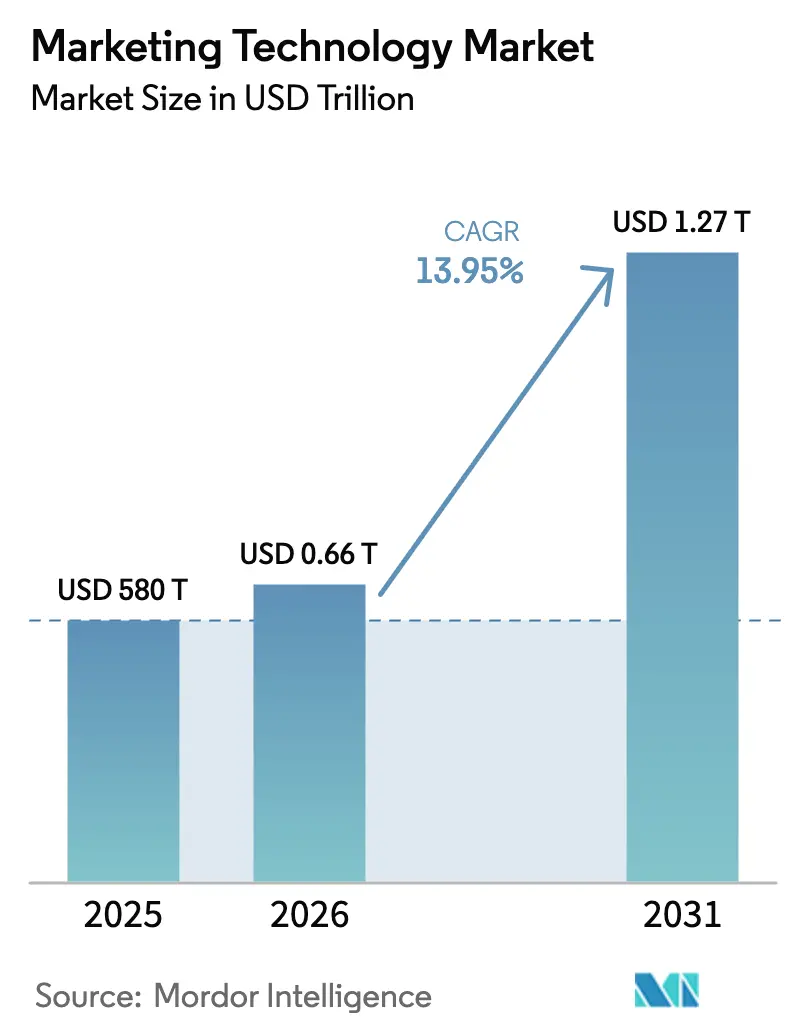
The Marketing Technology Market size was valued at USD 580 billion in 2025 and estimated to grow from USD 660.91 billion in 2026 to reach USD 1,270.82 billion by 2031, at a CAGR of 13.95% during the forecast period (2026-2031).
Enterprise demand for cloud-first, AI-embedded stacks is the primary accelerator, enabling real-time orchestration of campaigns, dynamic content generation, and cross-channel attribution at scale. Market leaders are embedding generative AI in core products, while regulatory pressure to transition toward privacy-first data strategies raises the value of first-party and zero-party data assets. Competitive dynamics favor vendors that can unify creative, data, and activation workflows inside a composable architecture, giving enterprises granular control over costs, latency, and compliance. Operational efficiency gains from automated content pipelines are already improving campaign ROI enough to offset rising AI compute expenditures.
Key Report Takeaways
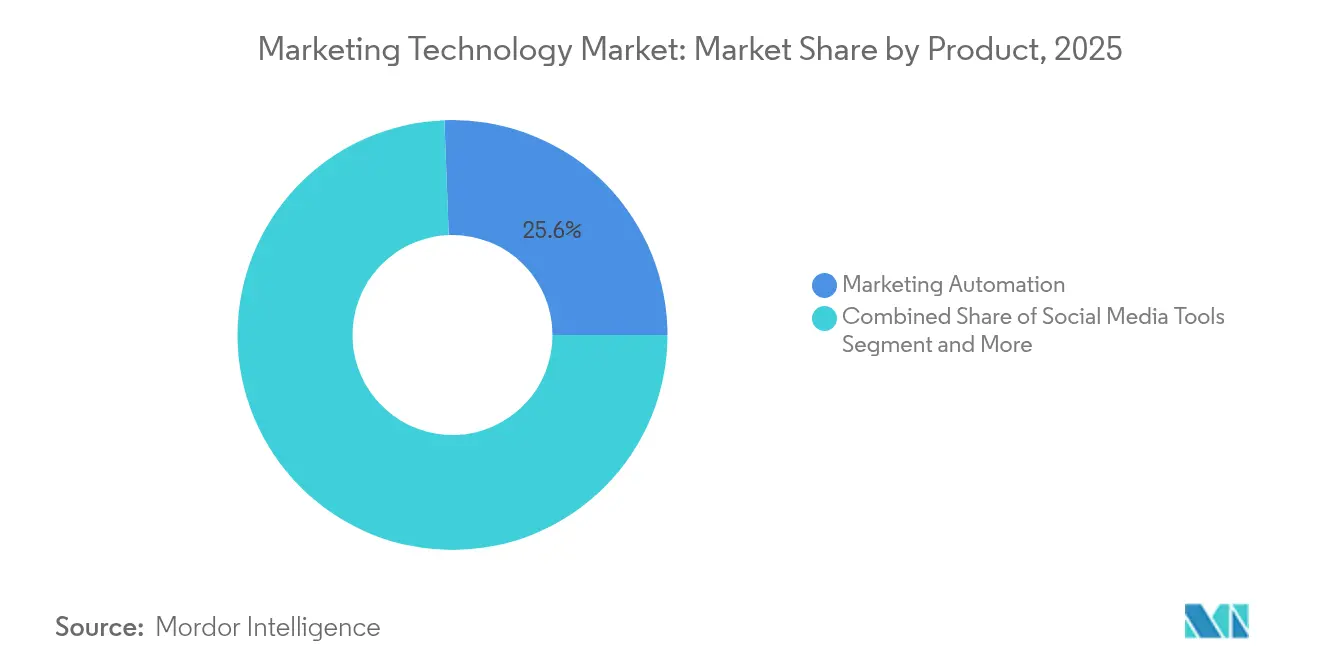
- By product category, Marketing Automation led with 25.60% of the marketing technology market share in 2025, while GenAI-Powered Content Tools are projected to expand at a 25.92% CAGR through 2031.
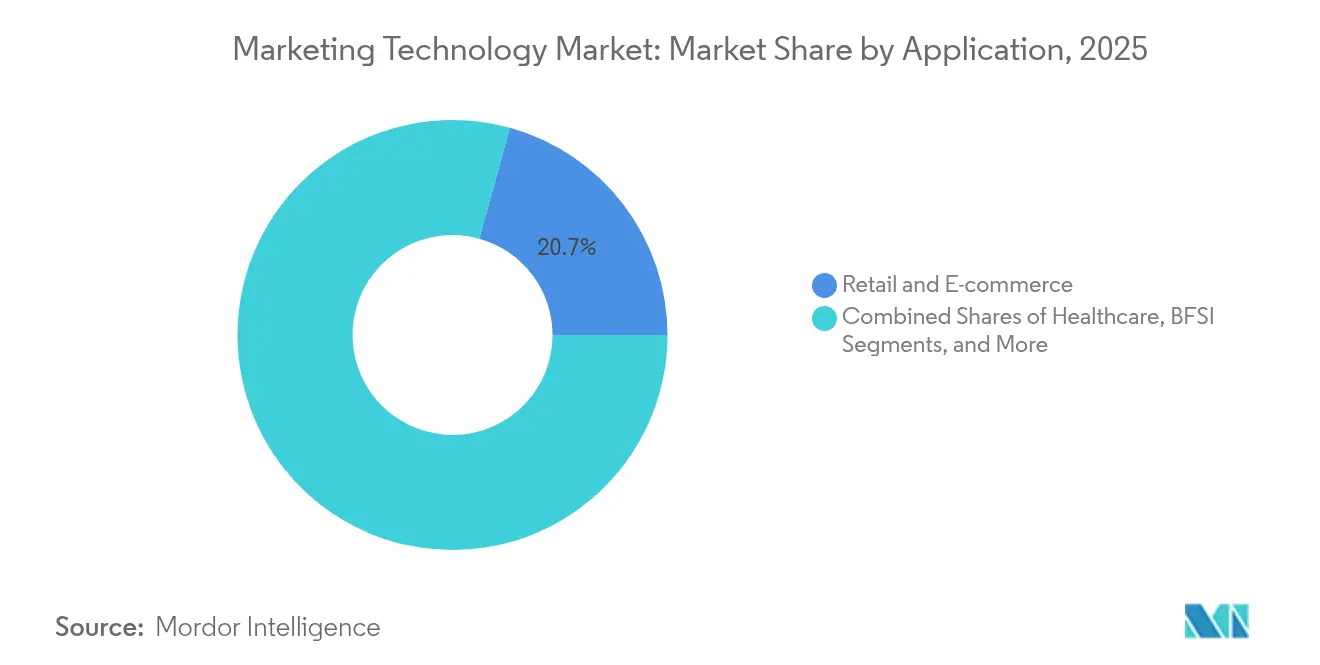
- By application, Retail and E-commerce held 20.70% revenue share of the marketing technology market in 2025; Healthcare is advancing at an 18.10% CAGR over 2026-2031.
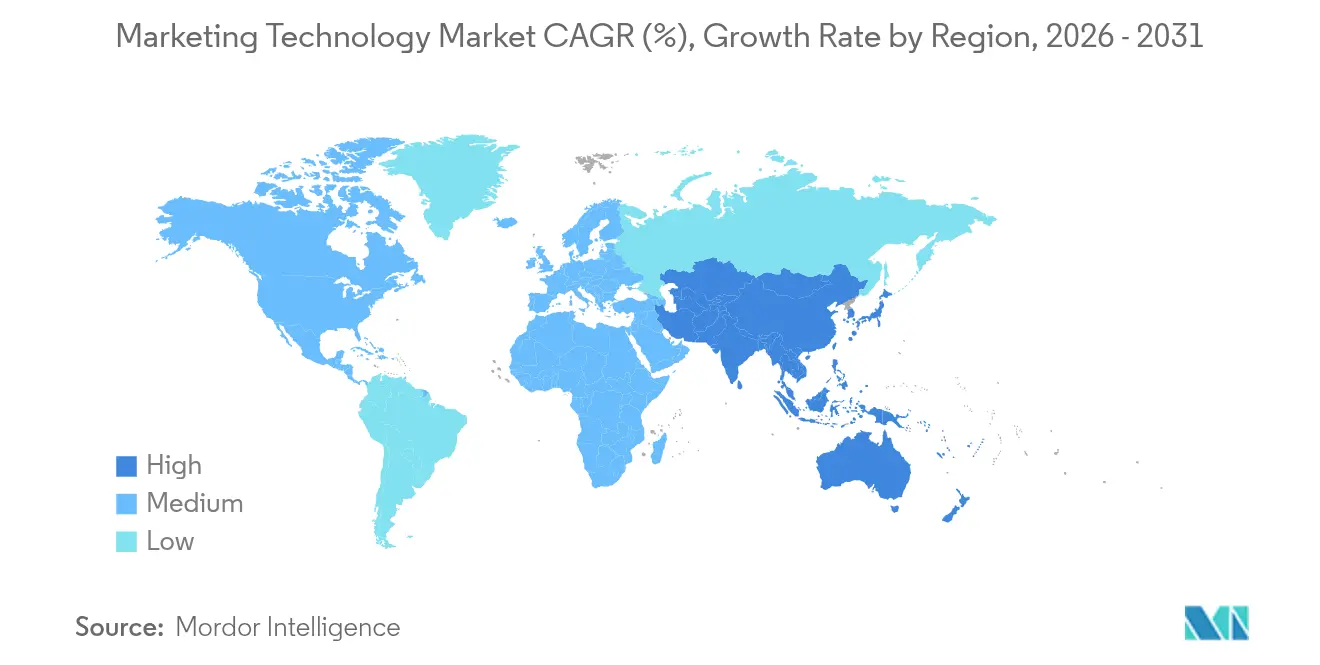
- By geography, North America commanded 37.60% share of the marketing technology market in 2025, whereas APAC is set to post the fastest 15.95% CAGR to 2031.
Note: Market size and forecast figures in this report are generated using Mordor Intelligence’s proprietary estimation framework, updated with the latest available data and insights as of 2026.
Market Trends and Insights
Drivers Impact Analysis of Marketing Technology Market*
| Driver | (~) % Impact on CAGR Forecast | Geographic Relevance | Impact Timeline |
|---|---|---|---|
| Cloud-first marketing stacks adoption surge | 4.20% | Global with APAC leadership | Medium term (2-4 years) |
| GenAI embedded across campaign orchestration | 3.80% | North America and EU early adopters | Short term (≤ 2 years) |
| Privacy-driven first-party data strategies | 2.10% | EU catalyst, global expansion | Long term (≥ 4 years) |
| Zero-party data micro-exchange programs | 1.40% | North America and APAC pilots | Long term (≥ 4 years) |
| Composable CDP architectures beating suite lock-in | 1.80% | Global enterprise tier | Medium term (2-4 years) |
| Operational efficiency gains offset AI compute outlays | 1.00% | Global cost-conscious adopters | Short term (≤ 2 years) |
| Source: Mordor Intelligence | |||
Cloud-First Marketing Stacks Adoption Surge
Enterprises continue an aggressive pivot toward cloud-native architectures to collapse data silos and enable real-time decisioning across every customer touchpoint. Microsoft’s USD 1.3 billion Mexico and USD 2.7 billion Brazil data-center commitments underscore the need for regional infrastructure that supports low-latency customer data processing.[1]Microsoft, “Mexico and Brazil Data-Center Investments,” microsoft.com IT teams report cycle-time reductions that let marketers shrink campaign rollouts from weeks to hours, boosting personalization accuracy and revenue velocity.
GenAI Embedded Across Campaign Orchestration
Generative AI is transforming what used to be manual, reactive workflows into proactive experience orchestration engines. Adobe’s Customer Experience Orchestration platform illustrates how AI unites creative and marketing functions under one roof, enabling continuous content optimization without relying on labor-intensive A/B testing. Enterprises highlight margin expansion as proprietary models deliver 50-60% gross margins versus legacy SaaS tools.
Privacy-Driven First-Party Data Strategies
GDPR 2025 enhancements force brands to prioritize first-party relationships over third-party cookies. Google’s updated consent framework now requires explicit opt-ins to sustain measurement fidelity, pushing marketers to invest in robust customer data platforms designed for compliance.[2]Google, “Updated Consent Mode for EEA,” google.com Firms that pivot early are capturing higher customer lifetime value as data quality improves trust-based personalization.
Zero-Party Data Micro-Exchange Programs
Leading brands are experimenting with micro-value exchanges in which customers willingly share preferences in return for tailored offers. Early adopters report 40% improvements in relevance scores and 25% jumps in retention when zero-party data fuels marketing automation. Gamified preference centers and progressive profiling are fast becoming standard features of modern engagement hubs.
Restraints Impact Analysis of Marketing Technology Market*
| Restraint | (~) % Impact on CAGR Forecast | Geographic Relevance | Impact Timeline |
|---|---|---|---|
| Rising total cost of ownership and integration debt | -2.80% | Global enterprise tier | Short term (≤ 2 years) |
| Skills gap for complex martech stacks | -1.90% | North America and EU acute | Medium term (2-4 years) |
| Regulatory compliance complexity | -1.50% | EU influence, global scope | Medium term (2-4 years) |
| Escalating AI compute and storage expenses | -1.20% | Global hyperscaler regions | Long term (≥ 4 years) |
| Source: Mordor Intelligence | |||
Rising Total Cost of Ownership and Integration Debt
Organizations layering AI tools onto legacy stacks face unplanned data-migration and maintenance bills that exceed initial budgets by 40-60%. Cloud storage alone surpassed USD 200 billion of IT spend in 2025, pressuring CFOs to reassess platform choices.
Skills Gap for Complex Martech Stacks
Eighty-seven percent of marketers fear technology displacement, yet 63% of leaders cite insufficient technical talent to run AI-heavy stacks effectively. This shortage inflates implementation timelines and compels vendors to ship low-code modules to accelerate value realization.
*Our forecasts treat driver/restraint impacts as directional, not additive. The impact forecasts reflect baseline growth, mix effects, and variable interactions.
Marketing Technology Market Segment Analysis
By Product:
Marketing Automation Retains the Lion’s ShareMarketing Automation captured 25.60% of the marketing technology market share in 2025, validating its role as the control center for omnichannel journey management. The marketing technology market size tied to Marketing Automation is projected to grow alongside enterprises’ pivot to unified orchestration engines that connect data, content, and activation workflows. GenAI-Powered Content Tools, while representing a smaller revenue base today, are forecast to post a 25.92% CAGR through 2031 as brands redistribute spend toward scalable, AI-driven content generation. Social media and content marketing suites post steady gains by enabling direct audience engagement, whereas rich-media creation tools benefit from rising video demand.
Enterprises view content velocity as a durable moat, directing budgets toward platforms that marry creative excellence with real-time performance insights. Adobe’s GenStudio Foundation exemplifies how vendors integrate automation into the content supply chain, allowing marketers to publish without sacrificing brand integrity. Sales-enablement suites now embed predictive lead scoring that draws on AI-trained historical win data to accelerate pipeline conversion.



By Application:
Healthcare Emerges as the Growth LeaderRetail and E-commerce held 20.70% of the marketing technology market in 2025, reflecting its historic leadership in digital engagement sophistication. The segment retains healthy growth as omnichannel brands double down on hyper-personalized promotions. Yet Healthcare is set to outpace every other vertical at an 18.10% CAGR between 2026-2031, pushing the marketing technology market size for patient engagement platforms sharply upward. Telehealth expansion and HIPAA-compliant automation are the main catalysts, enabling providers to match consumer-grade experience standards.
Healthcare organizations apply marketing automation beyond patient acquisition to drive adherence and outcome-focused communication. Kaiser Permanente’s community-centric campaigns showcase how purpose-driven marketing builds trust while delivering measurable health benefits. BFSI, IT and Telecom, and Media and Entertainment also step up investment to personalize services, manage churn, and maximize lifetime value.
Geography Analysis
North America Marketing Technology Market
North America controlled 37.60% of the marketing technology market in 2025 due to mature cloud adoption, venture funding, and advanced AI research capabilities. Regional leaders leverage deep ecosystem integrations to maintain competitive edge, even as state-level privacy statutes multiply compliance tasks. Canadian enterprises refine consent strategies in anticipation of Bill C-27, while US-based firms deploy privacy-preserving analytics to stay ahead of litigation exposure.
APAC Marketing Technology Market
APAC is the fastest-growing region, projected to log a 15.95% CAGR over 2026-2031. Governments support digital infrastructure build-outs, enabling widespread uptake of marketing tech among mobile-first consumers. India expects its digital marketing sector to reach INR 1.12 lakh crore (USD 13.4 billion) by 2025, powered by local-language content and AI-enabled ad-targeting innovations. Southeast Asian advertisers are directing larger shares of media spend toward social commerce, and Australian enterprises are expanding AI marketing budgets to capture incremental conversion gains.
EMEA and LATAM Marketing Technology Market
Europe’s outlook is colored by stringent regulations: GDPR 2025, the Digital Markets Act, and the Digital Services Act collectively redefine data stewardship obligations. Vendors serving the region must design default-privacy architectures that comply across all 27 member states, often rolling those standards global. In Latin America, Mexico welcomed both Netflix’s USD 1 billion production pledge and Alibaba’s first local cloud region, signals that international players foresee robust digital growth. Meanwhile, Middle East and Africa developers accelerate e-commerce stack adoption as payment rails mature and cross-border logistics improve.

Regulatory Landscape
The regulatory environment for marketing technology is increasingly shaped by overlapping privacy and AI rules that affect how platforms collect, process, and activate customer data. In the European Union, GDPR enforcement continues to anchor consent, purpose limitation, and data subject rights. The EU AI Act (Regulation (EU) 2024/1689) adds AI-specific obligations, including prohibitions that began applying from February 2025, and transparency obligations that apply from August 2, 2026, which impacts AI-enabled targeting, analytics, and content generation involving personal data. In parallel, the Digital Markets Act and Digital Services Act influence advertising and platform practices, which pushes vendors toward privacy-by-default architectures and auditable decisioning.
Outside the EU, compliance complexity is amplified by fragmented regimes and staged implementations. The UK Data (Use and Access) Act 2025 is being implemented in stages across 2026, requiring marketing stacks to adjust governance and data-sharing controls. In the United States, additional state-level privacy statutes and AI transparency initiatives, including California SB 53 and Maryland MODPA, add requirements around data minimization and disclosures. Together, these rules increase demand for first-party and zero-party data strategies, consent-modeled measurement, and vendor tooling that supports policy-based controls across regions.
Value Chain Analysis
The marketing technology value chain starts with the infrastructure and data foundation provided by hyperscalers and cloud platforms such as Microsoft Azure and Amazon Web Services. These platforms supply compute, storage, identity, and AI services used to run data-heavy orchestration and analytics. Above that, core martech vendors deliver the platform layer, including customer data platforms, campaign orchestration, content production, and measurement capabilities, such as Adobe Experience Platform and Microsoft-linked marketing and productivity environments. As stacks become more AI-embedded, model access and orchestration capabilities, including enterprise AI workspaces and agent frameworks, increasingly sit alongside traditional SaaS modules as upstream dependencies.
Value realization then depends on the integration and services layer, including APIs, connectors, and partner ecosystems that link data sources, creative systems, activation channels, and enterprise workflows. Partnerships that connect Adobe solutions with Microsoft 365 Copilot illustrate how orchestration and content workflows are moving into day-to-day productivity contexts. The downstream requirement for embedded consent management, security, and compliance workflows, particularly in regulated verticals, elevates the role of governance tooling and implementation partners across ingestion, segmentation, activation, and attribution.
Competitive Landscape
The market shows moderate concentration around full-suite incumbents Adobe, Salesforce, and Microsoft, which bundle creative, data, and activation layers into cohesive clouds. Salesforce’s USD 8 billion takeover of Informatica boosts its unified profile capability, aiming to cut data-latency bottlenecks in large enterprises. Adobe capitalizes on Creative Cloud synergies to cross-sell AI-enhanced marketing modules, while Microsoft activates Azure-based AI services to deepen engagement across Dynamics 365.
Competitive differentiation now pivots on AI maturity, latency, and trust. Meta’s multimodal patent filings point to smart assistant roadmaps that could radically reduce friction in customer interactions. Specialized vendors exploit composable architecture momentum, carving profitable niches around privacy-preserving analytics and sector-specific workflows such as HIPAA-aligned patient engagement.
Price pressure mounts as buyers benchmark the total cost of ownership across full-suite and best-of-breed alternatives. Vendors respond with usage-based billing and low-code accelerators to ease implementation. The rise of no-code orchestration appeals to mid-market firms starved for technical talent, while open APIs allow in-house teams to extend platform functions without incurring integration debt.
Marketing Technology Industry Leaders
Amazon Inc.
Acoustic L.P.
Active Campaign
Adobe Inc
Microsoft Corporation
- *Disclaimer: Major Players sorted in no particular order

Marketing Technology Market Companies Covered in this Report
- Adobe Inc.
- Alphabet Inc. (Google Marketing Platform)
- Amazon Web Services (AWS for Martech)
- Salesforce Inc.
- Microsoft Corp.
- Oracle Corp.
- HubSpot Inc.
- SAP SE
- Shopify Inc.
- Mailchimp (Intuit)
- Hootsuite Inc.
- Sprinklr Inc.
- Zoho Corp. (Zoho Marketing Plus)
- Optimizely
- Klaviyo
- Acoustic L.P.
- ActiveCampaign
- FullCircl Ltd.
- Buzzoole Holdings Ltd.
- Konnect Insights
- Iterable

Market Opportunities and Future Outlook
A key whitespace is the operational layer that turns generative and agentic AI into governed, cross-platform workflows within enterprise marketing teams. Adobe's moves to expand its partner ecosystem for customer experience orchestration and to place marketing agents into work surfaces such as Microsoft 365 Copilot indicate demand for agent-based execution that connects content, data, and activation without forcing teams to switch tools. With enterprises also weighing rising total cost of ownership and integration debt, there is an opportunity for composable architectures, interoperable agent frameworks, and prebuilt connectors that reduce deployment time while preserving policy controls.
A second opportunity centers on privacy-first measurement and consent-led personalization as rules tighten across regions. With EU AI Act transparency obligations applying from August 2, 2026, and ongoing GDPR-driven constraints, vendors offering auditable AI decisioning, consent-aware attribution, and first-party or zero-party data activation have clearer enterprise adoption paths than tools that depend on opaque third-party tracking. Buyer interest reflected in industry initiatives such as CMO Council and MartechTribe's Apex Martech Matrix supports a growing focus on benchmarking and performance governance, which creates room for analytics and optimization providers to quantify martech value, standardize KPIs, and support procurement and operating-model decisions.
Recent Industry Developments in Marketing Technology Market
- June 2026: Adobe Inc announces general availability of CX Enterprise Coworker for agentic marketing workflows. The GA strengthens AI-driven orchestration across marketing workflows and cross-platform integrations.
- April 2026: Adobe Inc announces general availability of Adobe Marketing Agent within Microsoft 365 Copilot and beta on AWS/Amazon Quick, Anthropic Claude, ChatGPT, Gemini, IBM watsonx. The integration embeds AI-assisted marketing decisions into daily work routines and expands cross-platform AI deployment.
- April 2026: CX Enterprise Coworker announced; strategic collaboration with AWS to integrate Agent Orchestrator with Amazon Bedrock AgentCore. The collaboration positions Adobe at the center of a cloud-enabled agentic marketing stack via AWS and Bedrock integration.


Marketing Technology Market Report Scope and Research Methodology
Market Definition and Coverage
For this study, the marketing technology market covers software and related platforms that help organizations plan, run, measure, and optimize marketing activities across digital and offline touchpoints, including data management, campaign execution, and performance analytics.
Scope exclusions: This sizing excludes pure creative agency labor and media buying as standalone services unless they are packaged as part of a technology platform fee.
Segments Covered in This Report
- By Product
- Social Media Tools
- Content Marketing Tools
- Rich-Media Creation Tools
- Marketing Automation Platforms
- Data and Analytics Tools
- Sales Enablement Tools
- By Application
- IT and Telecommunications
- Retail and E-commerce
- Healthcare
- Media and Entertainment
- Sports and Events
- BFSI
- By Geography
- North America
- South America
- Europe
- Asia-Pacific
- Middle East
- Africa
Data Sources, Market Sizing, and Validation
Desk Research
Desk research built the starting structure for the model, especially for defining what should be counted as marketing technology revenue versus adjacent marketing spend. We relied on public sources such as U.S. Bureau of Economic Analysis data for digital economy signals, U.S. Census Bureau and Eurostat business and ICT adoption statistics, OECD digital indicators, International Telecommunication Union connectivity series, and World Bank macro and sector indicators to anchor addressable demand and spending capacity.
To translate those signals into market sizing inputs, we also reviewed company filings, annual reports, investor presentations, reputable press coverage, and relevant association publications that discuss marketing operations, privacy changes, and software buying patterns. Where needed, paid subscriptions were used for company financials and intelligence, news and financials tracking, and patent databases to verify product direction and category mapping. The desk sources listed here are illustrative, and we used additional public references for data collection, validation, and clarification.
Primary Interviews and Surveys
Primary work was used to pressure test assumptions that cannot be read directly from public datasets, including how budgets are split across marketing data, automation, orchestration, and measurement tools, and how pricing moves with contract type. We spoke with practitioners from marketing leadership, marketing operations, IT, and procurement, plus solution implementers and channel partners, across the Americas, EMEA, and APAC to capture regional adoption patterns and buying cycle timing before the final numbers were locked.
Distribution of primary research fieldwork respondents
| Company type | Respondent position | Region |
|---|---|---|
| Top tier: 26% | CXOs: 14% | APAC: 44% |
| Mid tier: 60% | Functional/Unit leaders: 40% | EMEA: 37% |
| Smaller Players: 14% | Managers: 46% | Americas: 19% |
Market-Sizing & Forecasting
Sizing starts with a top-down reconstruction of marketing technology demand by linking enterprise marketing and digital transformation spend signals to software penetration and typical allocation shares across core tool families. Once the demand pool is shaped, it is translated into revenue using observed contract structures, cloud subscription pricing behavior, and deployment mix, and then adjusted for regional differences in adoption speed.
To keep the totals realistic, we corroborate results using selective bottom-up approximations, including sampling vendor revenue disclosures where available, channel checks on deal sizes, and volume times ASP logic for higher visibility categories such as marketing automation, customer data tooling, and analytics. Key inputs used in the model include enterprise marketing budget trends, cloud software adoption rates, number of active customer-facing digital channels supported, privacy and consent compliance effort, and the pace of AI feature rollout that changes willingness to pay.
Forecasts are built using scenario analysis, supported by expert views collected in interviews on budget cycles, renewal expectations, and where consolidation is most likely to reduce tool counts. When bottom-up signals are missing for smaller categories, gaps are handled by using proxy penetration rates from similar software categories and then cross-checking against region-level IT spend direction before finalizing.
Data Validation & Update Cycle
Outputs are checked against independent signals, such as software spend growth indicators, enterprise digital adoption surveys, and disclosed revenue direction from a sample of public companies that participate in the value chain. If a variance looks large, assumptions are revisited, and follow-up calls are triggered to confirm whether the difference is driven by definition, timing, or a real shift in buying behavior.
Before sign-off, the model goes through multi-step analyst review, which includes anomaly checks across regions and a consistency pass across the historical series and the forecast path. Reports are refreshed annually, and interim updates are made when material events occur that can move spending or pricing. Before delivery, a final review pass is completed so clients receive the most current view available at the time of purchase.
Mordor Intelligence's Marketing Technology Market Sizing Compared With Other Published Estimates
Published market sizes for marketing technology often do not match because sources are not counting the same thing, even when they use similar words like martech, marketing tech, or marketing software. Differences usually come from whether the estimate is tracking spend versus supplier revenue, whether services and media are included, and how currency timing and inflation are treated.
Some estimates lean toward software spend only and cap the scope to a narrower set of tools, while others expand into adjacent areas like sales technology or broader marketing communications. In Mordor Intelligence, the number is built as marketing technology platform revenue across core marketing functions, and it is kept separate from media spend and pure agency labor so the total stays tied to repeatable software and platform economics.
Benchmark comparison
| Source | Market Size | Gaps in Research Methodology |
|---|---|---|
| Mordor Intelligence | USD 0.66 T (2026) | |
| Trade Journal A | USD 0.22 T (2027) | Often cited as martech software spend, which can exclude broader platform categories and may reflect budget allocation reporting instead of supplier revenue conversion. |
| Industry Research Group B | USD 0.67 T (2023) | Presented as martech plus salestech combined, which can raise the total by adding sales enablement and related tools that are not consistently purchased under marketing technology budgets. |
The spread mainly comes from what is being counted and how the spending is translated into market revenue, not from a simple math difference. By keeping the scope tied to marketing technology platform revenue and then validating the implied spend levels through interviews and cross-check signals, the estimate stays easier to reproduce and compare across years.


Key Questions Answered in the Report
How big is the Marketing Technology Market?
The Marketing Technology Market size is expected to reach USD 0.66 trillion in 2026 and grow at a CAGR of 13.95% to reach USD 1.27 trillion by 2031.
What is the current size of the marketing technology market?
The market was valued at USD 660.91 billion in 2026.
How fast is the marketing technology market expected to grow?
It is forecast to register a 13.95% CAGR, reaching USD 1,270.82 billion by 2031.
Which product segment holds the largest market share?
Marketing Automation platforms led with 25.60% share in 2025.
Which application area is growing the fastest?
Digital infrastructure build-outs, rising mobile-first consumer bases, and supportive government policies are pushing APAC to a 15.95% CAGR.
What is the main restraint hindering market growth?
Rising total cost of ownership and integration debt is reducing expected ROI for enterprises deploying complex AI-driven stacks.
Page last updated on:


 Your data is secure and never sold or shared.


