
Head-Up Display Market Size and Share
Market Overview
| Study Period | 2020 - 2031 |
|---|---|
| Market Size (2026) | USD 3.83 Billion |
| Market Size (2031) | USD 10 Billion |
| Growth Rate (2026 - 2031) | 21.16 % |
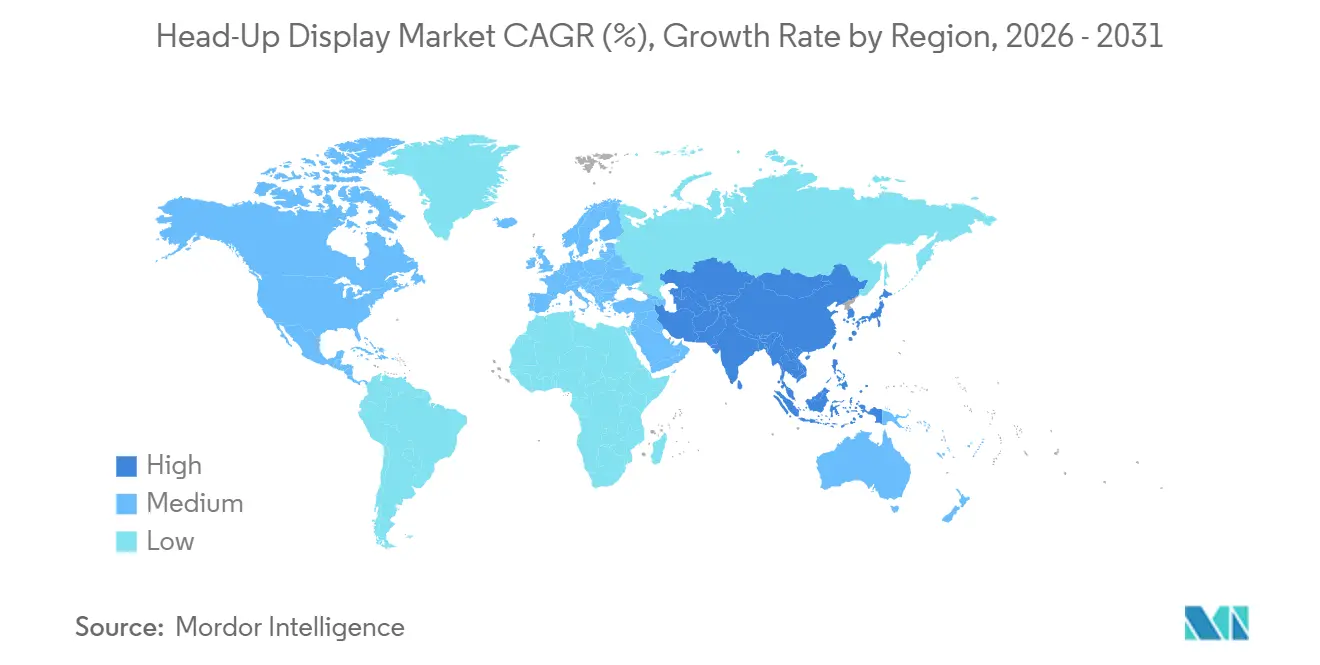
| Fastest Growing Market | Asia Pacific |
| Largest Market | Asia Pacific |
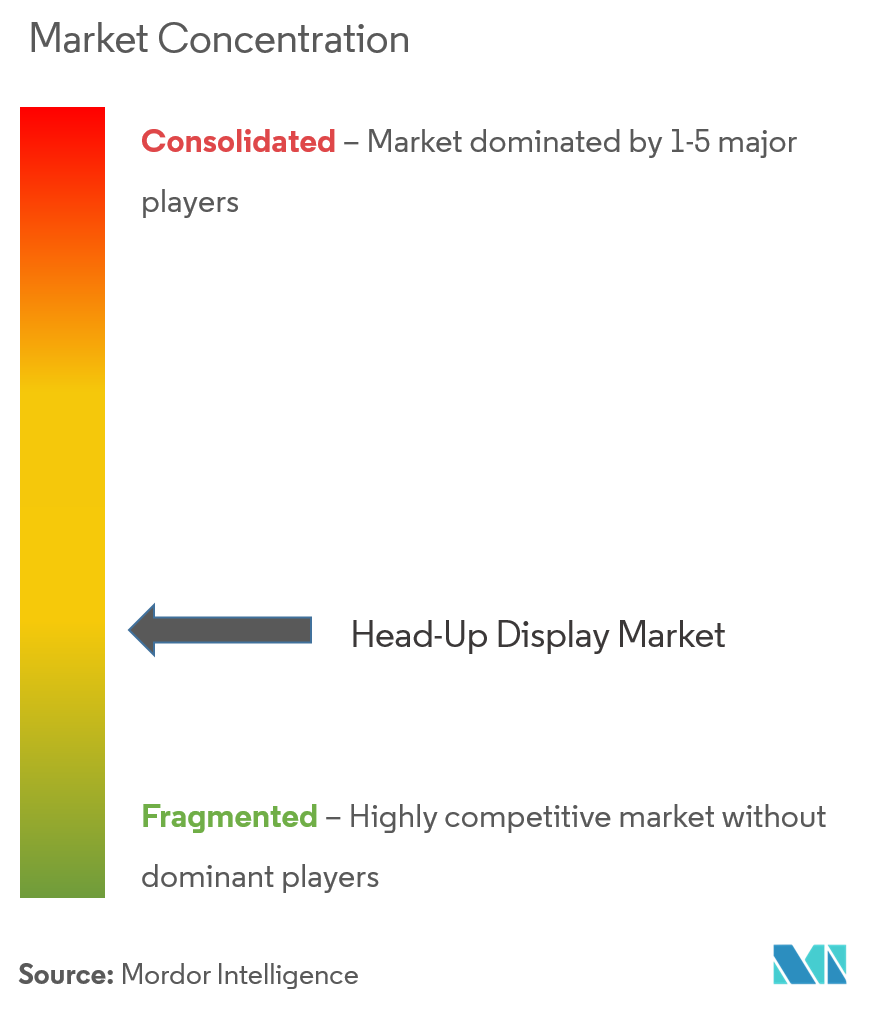
| Market Concentration | Low |
Major Players *Disclaimer: Major Players sorted in no particular order Image © Mordor Intelligence. Reuse requires attribution under CC BY 4.0. | |
Head-Up Display Market Analysis by Mordor Intelligence
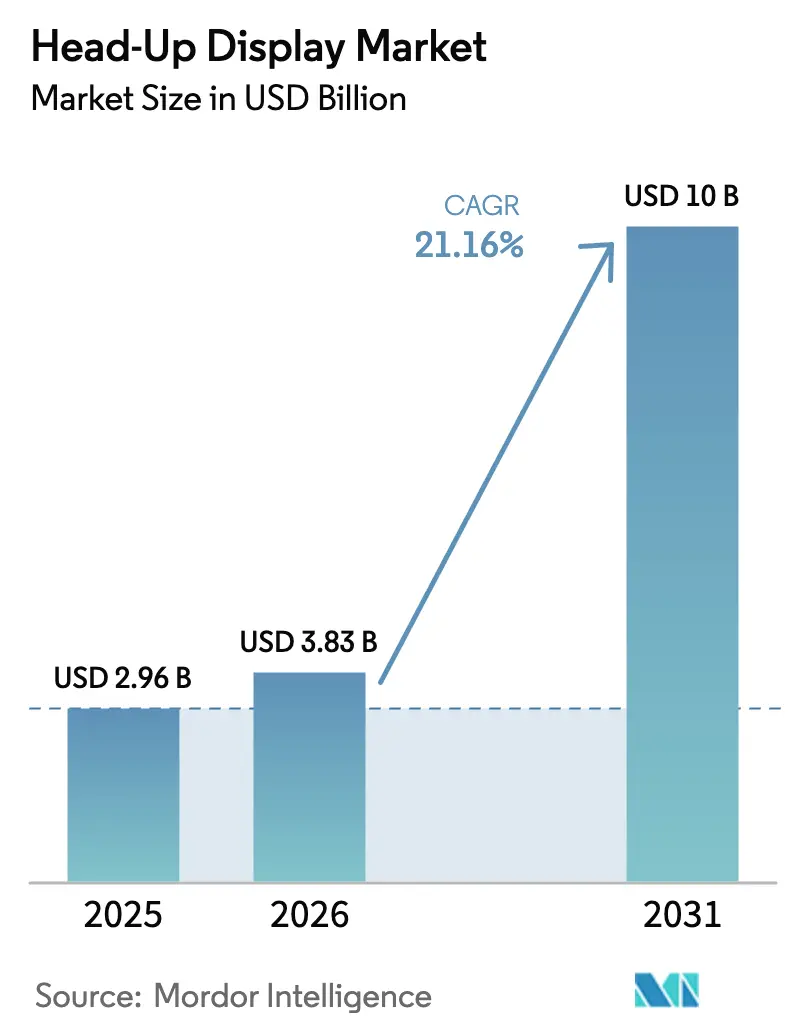
The Head-Up Display Market size is expected to grow from USD 2.96 billion in 2025 to USD 3.83 billion in 2026 and is forecast to reach USD 10 billion by 2031 at 21.16% CAGR over 2026-2031, underscoring a steep expansion curve for this cockpit technology. This momentum stems from tightening safety mandates, the spread of electric and software-defined vehicle platforms, and a sharp pivot toward subscription-based revenue streams that rely on in-car visualization. Automakers now view windshield-integrated projection as a competitive necessity rather than a luxury option, while tier-1 suppliers race to shorten development cycles through silicon co-design so that advanced displays can cascade from premium to mid-segment trims. Asia-Pacific leads unit volume on the back of China’s new-energy vehicle surge, but North America and Europe set the pace on regulatory pull and software monetization. Competitive pressure is accelerating as holographic optics specialists and semiconductor vendors challenge traditional automotive suppliers for design-win dominance, shaping an ecosystem in which software velocity matters as much as optical performance.
Key Report Takeaways
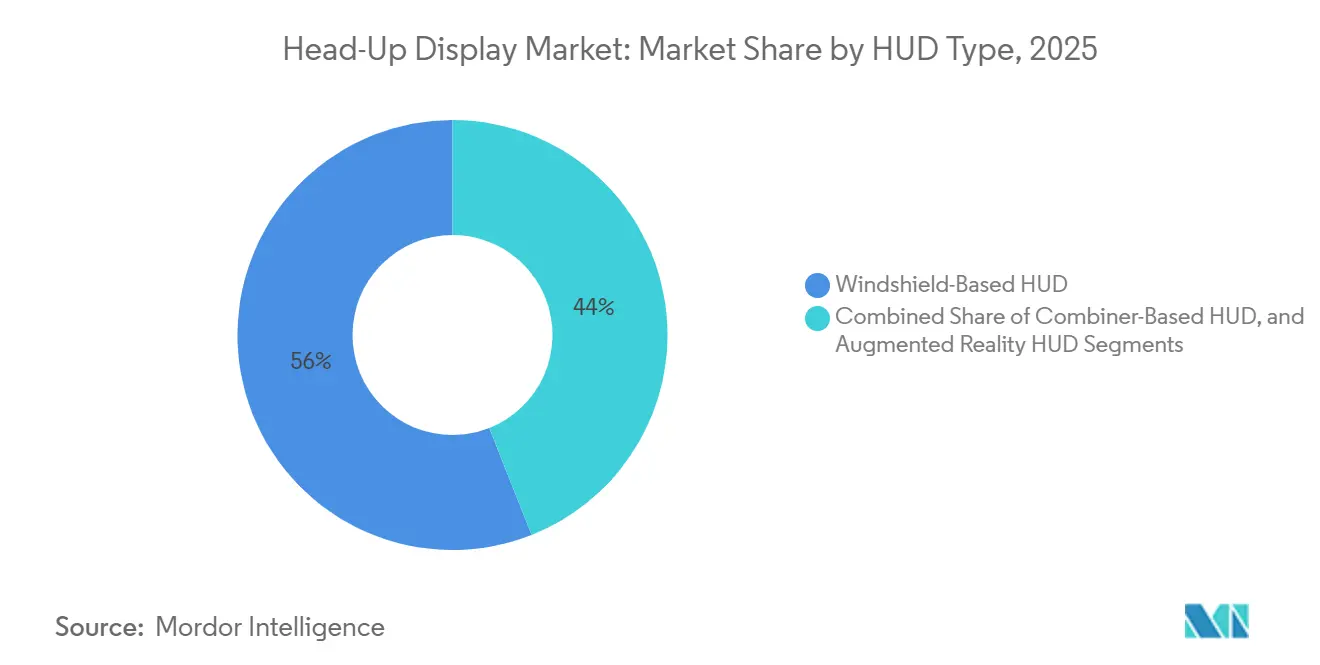
- By HUD type, windshield systems led with 56.00% revenue share in 2025, while augmented reality configurations are forecast to advance at a 19.40% CAGR through 2031.
- By dimension, two-dimensional units held 61.50% of the head-up display market size in 2025, but 3D systems are expected to register a 21.30% CAGR between 2026 and 2031.
- By vehicle class, Passenger cars captured 52.70% sales in 2025; Passenger cars represent the fastest growth at an 18.10% CAGR through 2031.
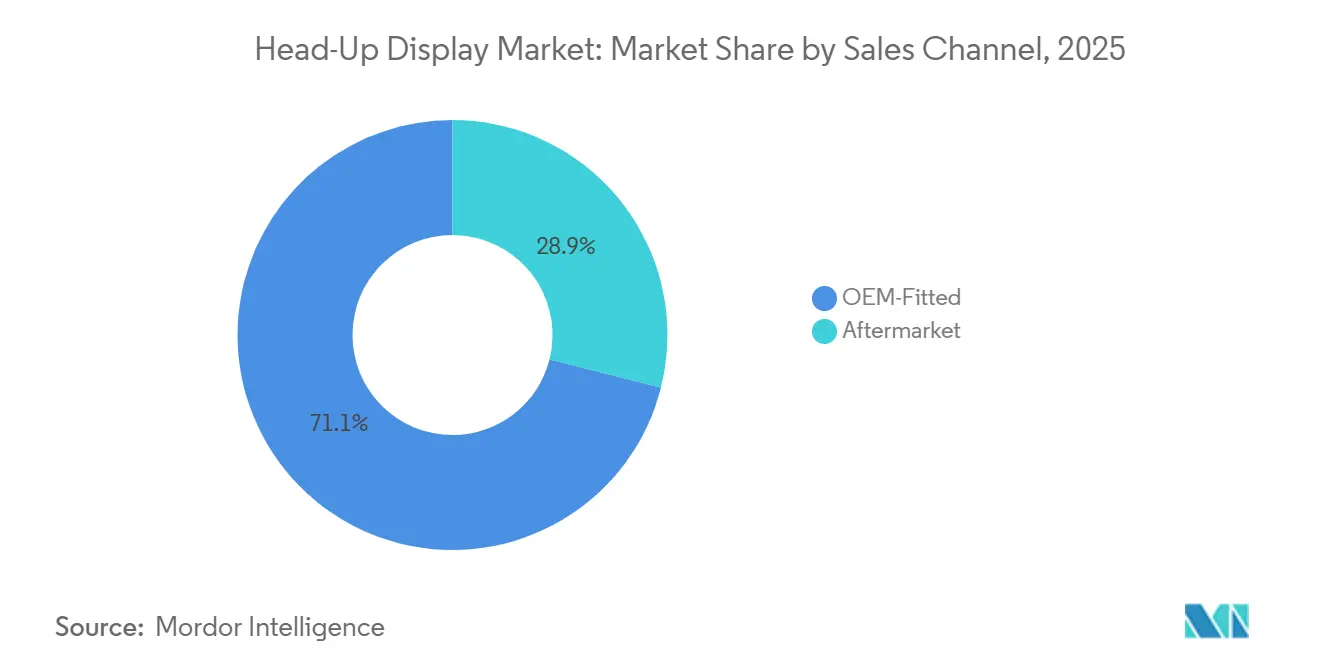
- By sales channel, OEM-fitted installations dominated with 71.20% share in 2025 and will expand at a 15.70% CAGR over the forecast horizon.
- By application, the Automotive sector held the largest share of 43.23% and the Others segment is anticipated to expand at a CAGR of 24.44%.
- By Geography, Asia Pacific retained 38.90% of the head-up display market share in 2025, and the same region is poised to grow at a 12.30% CAGR to 2031.
Note: Market size and forecast figures in this report are generated using Mordor Intelligence’s proprietary estimation framework, updated with the latest available data and insights as of January 2026.
Market Trends and Insights
Drivers Impact Analysis of Head-Up Display Market*
| Driver | (~) % Impact on CAGR Forecast | Geographic Relevance | Impact Timeline |
|---|---|---|---|
| Rising Integration of Augmented Reality HUDs in Mid-Range Vehicles | +4.5% | China, Germany, United States | Medium term (2-4 years) |
| Stringent Safety Regulations Mandating Driver Information Systems | +3.8% | Europe and North America, spillover to Asia-Pacific | Short term (≤ 2 years) |
| Accelerated Adoption of Electric and Software-Defined Vehicles | +4.2% | Global, led by China, Europe, United States | Medium term (2-4 years) |
| Component Cost Reduction through Waveguide and MicroLED Optics | +3.5% | Manufacturing concentrated in Asia-Pacific | Long term (≥ 4 years) |
| Monetization of HUD Software via Subscription-Based Feature Unlocks | +2.1% | North America and Europe | Medium term (2-4 years) |
| Automotive Tier-1 and Semiconductor Co-Design Partnerships Shortening HUD Development Cycles | +2.3% | Germany, United States, Japan | Short term (≤ 2 years) |
| Source: Mordor Intelligence | |||
Rising Integration of Augmented Reality HUDs in Mid-Range Vehicles
Chinese and European automakers are pushing AR projection from luxury lines into vehicles priced between USD 30,000 and USD 50,000, resetting buyer expectations in the head-up display market. Waveguide optics now shrink projector volume to under 1 liter, freeing dashboard space and lowering material cost below the USD 300 price point that unlocks mass-market adoption. Xpeng’s G7 launch in June 2025, using Huawei’s AR-HUD, projects an 87-inch virtual image at more than 12,000 nits brightness, proof that premium specifications can arrive early in mid-segment crossovers. Hyundai and Zeiss are developing a full-windshield holographic HUD for mainstream Tucson and Santa Fe models, aiming for 2027 production and signaling that the technology curve will continue to bend toward volume platforms. As attachment rates rise, tier-1 suppliers, in the head-up display market, must balance optical innovation with aggressive cost engineering to secure program awards across multiple price tiers.
Stringent Safety Regulations Mandating Driver Information Systems
UN Regulation 171 specifies handover prompts and driver-availability confirmations that benefit from gaze-aligned visual alerts, making HUDs a compliance accelerant in Level 2 and Level 3 automation programs.[1]UN Regulation 171 Text, UNECE, unece.org In the United States, FMVSS 127 requires collision-warning symbols to reside within a tight sight-line envelope, a target naturally met by windshield projection.[2]FMVSS 127 Final Rule, National Highway Traffic Safety Administration, nhtsa.gov Euro NCAP’s Driver Engagement Protocol, released in March 2025, awards higher ratings to vehicles that display automation status via augmented reality overlays, making safety scoring a competitive marketing lever.[3]Driver Engagement Protocol v1.0, Euro NCAP, euroncap.com These mandates are arriving quickly, forcing OEMs to integrate HUD hardware during base-platform development rather than as an optional afterthought. Suppliers that can certify luminance, ghost-image, and eyebox parameters under ISO/TS 21957 now win preferred-vendor status in new model programs across three continents in HUD market.
Accelerated Adoption of Electric and Software-Defined Vehicles
Energy-efficient cockpit electronics are critical as automakers chase ever-longer driving range, making low-power holographic projection an enabler for battery-electric lineups. Panasonic’s AR HUD uses digital light processing to deliver a 12°×5° field of view at a 10 m virtual distance while staying within stringent EV power budgets. Envisics claims its holographic waveguide cuts power draw in half relative to conventional optics, a figure that translates directly into additional kilometers of range for every charge. Software-defined vehicle architectures, such as GM’s NVIDIA-powered compute domain, update AR graphics over the air and fuse sensor data on a single board, letting HUD content evolve continuously during the vehicle life cycle. Map and location providers like HERE now sell SDKs that overlay live traffic and charger status onto HUD layers, opening persistent subscription revenue opportunities for OEMs. Taken together, electrification and connectivity turn the head-up display market into a frontline for both energy management and digital-service monetization.
Component Cost Reduction through Waveguide and MicroLED Optics
Waveguide combiners and MicroLED light engines cut bill-of-materials cost while improving brightness and lifespan, addressing two historical pain points for OEMs looking to scale HUD adoption. Texas Instruments’ DLP5534-Q1 chipset packages micromirror arrays optimized for AR projection into an automotive-qualified form factor, enabling suppliers to slash projector size by 50%. MicroLED emitters increase optical efficiency at high brightness, reducing thermal load and eliminating bulky cooling ducts that previously limited integration in compact cabins. Asian panel makers are ramping volume production of wafer-level waveguides, and that scale is expected to drop per-unit cost further over the next four years, supporting the long-term CAGR uplift in the head-up display market.
Restraints Impact Analysis of Head-Up Display Market*
| Restraint | (~) % Impact on CAGR Forecast | Geographic Relevance | Impact Timeline |
|---|---|---|---|
| Persistent High System Cost for Full-Windshield AR HUDs | -2.8% | Global, most acute in India, South America, Middle East | Medium term (2-4 years) |
| Limited Field of View and Windshield Compatibility Constraints | -1.5% | Global, notably retrofit market | Long term (≥ 4 years) |
| Tariff-Driven Optics and IC Supply Risks in North America | -1.2% | United States and Canada | Short term (≤ 2 years) |
| Growing Competition from Smart Glasses and Mixed Reality Headsets | -0.9% | North America and Europe | Medium term (2-4 years) |
| Source: Mordor Intelligence | |||
Persistent High System Cost for Full-Windshield AR HUDs
Full-windshield projection demands holographic optical elements, laser diode arrays, and continuous driver-eye tracking, driving the bill of materials above USD 1,000 and restricting adoption to ultra-luxury models. BMW’s Panoramic Vision, applied as a projection film across the entire windshield, remains an extra-cost option rather than standard equipment, illustrating OEM caution in absorbing these costs. Even with waveguides, production windshields must meet tight distortion limits, raising glass-sourcing expenses and extending validation schedules. The price barrier is especially severe in India, where ADAS penetration was only 8.3% in early 2025, leaving little budget headroom for premium cockpit features. Until component pricing falls sharply, mass-market vehicles will continue to rely on smaller windshield zones or combiner-based solutions.
Growing Competition from Smart Glasses and Mixed Reality Headsets
Apple’s Vision Pro and Meta’s Quest 3 introduce portable AR alternatives that can overlay navigation and diagnostics without permanent vehicle hardware, offering a cross-context experience valued by tech-savvy drivers. Although safety rules currently limit headset use during active driving, early adopters in North America and Europe are experimenting with passenger-side and stationary scenarios, eroding HUD’s exclusivity. Wearables also allow buyers to amortize the cost across home, work, and mobility contexts, challenging the single-purpose value proposition of factory HUDs. Suppliers must therefore emphasize seamless sensor fusion, regulatory compliance, and user comfort in order to defend the HUD market against this emerging substitute technology.
*Our forecasts treat driver/restraint impacts as directional, not additive. The impact forecasts reflect baseline growth, mix effects, and variable interactions.
Head-Up Display Market Segment Analysis
By HUD Type:
Windshield Systems Anchor Volume, AR Configurations Lead GrowthWindshield-integrated projection held 56.00% of 2025 revenue share in the head-up display market, as OEMs favored its larger virtual image and cleaner dashboard layout. That dominance will continue, yet the augmented reality subset is forecast to log a 19.40% CAGR through 2031, adding sensor-anchored arrows, hazard framing, and lane cues that elevate situational awareness. The head-up display market size for windshield units will therefore rise in absolute terms even as AR gains mix, creating dual demand streams for both conventional and holographic designs
AR HUD demand is reinforced by BMW’s plan to equip every Neue Klasse vehicle with a 3D overlay option by late 2025, setting a de facto standard for premium interiors. Tier-1 suppliers now quote sub-USD 300 bill-of-materials targets for waveguide designs, enabling mid-segment adoption without sacrificing margin. Combiner-type add-ons will linger in price-sensitive geographies, yet their share will erode as OEMs push integrated solutions that can be updated over the air and calibrated to ADAS sensors.



By Dimension Type:
3D HUD Systems Gain Traction in ADAS-Equipped VehiclesTwo-dimensional imaging retained a 61.50% share in 2025 in the head-up display market, yet 3D HUDs are projected to compound at 21.30% annually as Level 2 and Level 3 automation expand. Depth-separated layers present battery charge, speed, and automation mode close to the driver, while turn arrows and obstacle boxes appear 10-20 m ahead, cutting refocus time.
BMW’s 3D Head-Up Display demonstrates how dual-plane holography works in production, integrating with driver-monitor cameras to adapt imagery as head position shifts. Suppliers must therefore couple optics expertise with real-time gaze tracking and GPU-based rendering. Those that can do so within EV power budgets will earn an outsized share of upcoming model awards, lifting the head-up display market share for 3D solutions over the forecast window.
By Vehicle Class:
Passenger Vehicles Drive Volume Growth, Luxury Retains Premium FeaturesBy vehicle class, Passenger cars captured 52.70% sales in 2025; Passenger cars represent the fastest growth at an 18.10% CAGR through 2031 as Chinese and Korean OEMs slot waveguide AR units into crossovers and sedans priced below USD 50,000. This mainstreaming expands the head-up display market by an order of magnitude rather than percentage points because the mid-segment pool is far larger.
Hyundai’s collaboration with Zeiss to bring a film-based holographic HUD to Tucson and Santa Fe illustrates the democratization arc, while premium marques experiment with full-windshield immersion to maintain differentiation. Commercial vehicles represent an adjacent opportunity, especially where fleet managers tie HUD safety overlays to insurance savings, though price sensitivity and long replacement cycles temper near-term volume.
By Sales Channel:
OEM Integration Dominates, Aftermarket Constrained by Calibration ComplexityOEM accounted for 71.20% of 2025 revenue and will climb at a 15.70% CAGR as ADAS calibration and software update requirements intensify. Centralized compute architectures make windshield projection a native feature rather than a bolt-on accessory, locking in OEM control over user experience and data pathways.
Aftermarket suppliers still serve older vehicle fleets with compact combiner units, but lack access to factory sensor data and cannot match wide-field AR capabilities, keeping their volumes flat. Fleet operators may adopt portable systems that plug into telematics boxes for driver coaching, yet overall head-up display market size growth remains anchored in OEM build-lines where warranty, regulation, and lifecycle support converge.
By application, Automotive sector dominated the market in 2025
By application, the Automotive sector held the largest share of 43.23% and the Others segment is anticipated to expand at a CAGR of 24.44%.In the automotive sector, head-up displays (HUDs) dominate the market, primarily due to a heightened emphasis on the safety of drivers and passengers, coupled with the integration of Advanced Driver-Assistance Systems (ADAS). This trend is fueled by consumer desires for a more immersive, connected, and safer driving experience. Features such as navigation and speed alerts are now projected directly onto windshields, aiming to reduce driver distraction. Notably, the market is transitioning from premium vehicles to the mid-segment, witnessing substantial growth in both passenger and commercial vehicles.
Initially, HUD technology found its primary applications in the military and aviation sectors. While these segments still play a role, they account for a smaller share of the overall market. In military aircraft, HUDs play a pivotal role, presenting pilots with essential flight data right in their line of sight. This capability significantly boosts situational awareness and operational efficiency. With defense budgets on the rise and ongoing modernization programs, there's a sustained investment in these specialized, high-precision systems. Furthermore, the "Others (Inc.)" category highlights the technology's expanding footprint, encompassing applications in consumer electronics (like wearable HUDs for gaming or industrial purposes) and even in healthcare for surgical assistance.
Geography Analysis
APAC Head-Up Display Market
Asia-Pacific held 38.90% of global revenue in 2025 and is forecast to grow at a 12.30% CAGR through 2031, buoyed by China’s electric-vehicle production boom and Japan’s export strength in optoelectronics. Local brands like Xpeng, NIO, and Li Auto embed large AR images to stand out in a hypercompetitive domestic arena, accelerating feature diffusion down the price ladder. South Korea’s display ecosystem supplies waveguides and MicroLEDs at scale, compressing cost curves for regional automakers.
North America, Europe and APAC Head-Up Display Market
North America benefits from high luxury penetration and early software-defined architectures, although Section 301 tariffs on Chinese optics add 25% landed cost, prompting dual sourcing from Europe and Southeast Asia. U.S. federal rules on collision-warning visualization mandate HUD-friendly sight-line placement, nudging OEMs toward integrated projection. Canada’s parts suppliers align with these programs to keep assembly plants fully utilized despite tariff turbulence.
EMEA Head-Up Display Market
Europe marries stringent safety scoring with prestige brands that view cockpit digitalization as a hallmark. Euro NCAP’s 2025 engagement protocol rewards AR overlays, pushing Volkswagen, Mercedes-Benz, and BMW to accelerate full-windshield roadmaps. Yet the region also grapples with higher homologation costs for advanced optics. Emerging markets in the Middle East and Africa explore HUD for autonomous shuttle pilots, but harsh climate conditions and price sensitivity keep uptake modest for now.

Regulatory Landscape
HUD deployments are shaped by a mix of UNECE regulations, U.S. FMVSS requirements, and ISO technical specifications that govern driver visibility, illumination, and projected-image test methods. ISO TS 21957:2023 provides a dedicated framework for HUD definitions and measurement methods (image geometry, ergonomics, and test procedures) that suppliers use to validate luminance, eyebox, and optical artifacts across passenger and commercial vehicle programs.
In Europe, the 02 series amendments to UN Regulation No. 125, reflected in EU Regulation 2025/891, formalizes requirements for Field of Vision Assistant information presented in the forward field of view, including constraints that displayed content remain driving-related while driving, along with brightness adjustment, manual switch-off, and fail-safe deactivation on malfunction. In the United States, FMVSS 101 and related interpretations govern the visibility and illumination of vehicle displays, supporting dimmability/variable illumination approaches that help HUDs comply across ambient conditions, with manufacturers responsible for self-certifying compliance.
Competitive Landscape
The competitive field skews toward a handful of entrenched tier-1 suppliers that leverage scale and OEM relationships, yet disruptive entrants wield holographic IP, software platforms, or silicon integration to win new awards. Envisics secured USD 50 million in Series C funding led by Hyundai Mobis, underscoring OEM appetite for waveguide solutions that cut power use by 50% and shrink packaging by 40%. Visteon’s September 2025 pact with FUTURUS positions it to offer windshield, passenger, and AR modules across a single platform, hedging bets on form-factor diversity.
Bosch Ventures’ USD 21 million investment in 4screen reveals a shift toward software monetization, where third-party apps and subscription tiers can populate HUD real estate, turning static hardware into a revenue canvas. Semiconductor vendors such as Texas Instruments move upstream with DLP5534-Q1 chipsets that, when paired with Qualcomm compute, yield turnkey AR solutions, putting pressure on hardware-only suppliers.
Traditional leaders retain advantages in supply security, validation labs, and multi-year sourcing contracts, yet they must accelerate over-the-air feature pipelines to stay relevant. Partnerships that blend optics, compute, and content are becoming the norm, creating a head-up display industry dynamic in which speed of software iteration determines long-term winner status.
Head-Up Display Industry Leaders
Continental AG
Nippon Seiki Co. Ltd.
Denso Corporation
Visteon Corporation
Robert Bosch GmbH
- *Disclaimer: Major Players sorted in no particular order
Head-Up Display Market Companies Covered in this Report
- Denso Corporation
- Nippon Seiki Co., Ltd.
- Panasonic Automotive Systems
- Visteon Corporation
- Continental AG
- Robert Bosch GmbH
- Valeo SE
- BAE Systems PLC
- Thales Group
- Garmin Ltd.
- Elbit Systems Ltd.
- Pioneer Corporation
- SaaB AB
- Hudway LLC
- Collins Aerospace
- LG Display Co., Ltd.
- Harman International
- WayRay AG
- Envisics Ltd.
- Texas Instruments Incorporated

Market Opportunities and Future Outlook
A near-term whitespace is opening around software-led AR-HUD content stacks that fuse navigation, ADAS cues, and vehicle-state visualization on centralized compute, aligning with OEM pushes toward software-defined vehicles and subscription feature unlocks. Evidence of platformization includes Basemark and Lucid Motors announcing an AR-HUD integration partnership for the Lucid Gravity (March 2026), highlighting demand for real-time graphics pipelines that can be updated and tuned across trims without reworking core optics.
Another opportunity area is the emergence of panoramic and pillar-to-pillar visualization concepts that expand beyond classic driver-only HUD zones, including concept-to-production pathways for new optical architectures. Distance Technologies collaboration with Kia on a panoramic lightfield HUD concept (April 2026) illustrates experimentation with wider-format projection approaches, while China is tightening technical expectations for vision-assistance overlays through GB/T 46926-2025 (including a spatial alignment threshold such as 0.45 degrees for target icons). Together, these moves create room for suppliers that can deliver standards-aligned calibration toolchains (meeting ISO/TS 21957 methods and country-specific requirements) and cost-optimized optical engines (DLP, LCoS, laser scanning, MicroLED, and computer-generated holography) that fit mid-range vehicle bill-of-material constraints.
Recent Industry Developments in Head-Up Display Market
- June 2026: Visteon announced its 12.3-inch Narrow Border Driver Display is featured in the new Lexus ES, with production supported by Visteon operations in Thailand. While not a HUD launch, the win signals continued OEM demand for integrated cockpit display platforms that can be manufactured at scale in cost-competitive footprints, strengthening Visteon’s leverage when bundling clusters, infotainment, and HUD programs.
- September 2025: Visteon and FUTURUS announced a strategic partnership to co-develop augmented reality HUD, windshield HUD, and panoramic HUD solutions for global OEMs. The collaboration expands Visteon’s HUD portfolio breadth and positions both firms to pursue multi-display cockpit awards where a shared architecture can reduce integration time and validation cycles.
- December 2024: A major automotive supplier announced a large-scale cockpit program with a leading automaker to integrate AR-HUD across multiple models.


Head-Up Display Market Report Scope and Research Methodology
Market Definition and Coverage
The head-up display market is defined as revenue generated from systems that project key information into the user's forward field of view, mainly through windshield or combiner optics, across on-road vehicles and aircraft use cases.
Scope exclusions: This sizing excludes unrelated in-cabin displays that do not project into the forward view, such as standard instrument clusters, center infotainment screens, and rear seat displays.
Segments Covered in This Report
- By HUD Type
- Windshield-Based HUD
- Combiner-Based HUD
- Augmented Reality HUD
- By Dimension Type
- 2D HUD
- 3D HUD
- By Vehicle Class
- Commercial Vehicles
- Passenger Vehicles
- By Sales Channel
- OEM-Fitted
- Aftermarket
- By Application
- Automotive
- Military and Civil Aviation
- Others (Industrial, Wearable, and other Displays)
- Geography
- North America
- United States
- Canada
- Mexico
- South America
- Brazil
- Argentina
- Rest of South America
- Europe
- United Kingdom
- Germany
- France
- Rest of Europe
- Asia-Pacific
- China
- Japan
- South Korea
- India
- Rest of Asia-Pacific
- Middle East
- GCC
- Rest of Middle East
- Africa
- South Africa
- Rest of Africa
- North America
Data Sources, Market Sizing, and Validation
Desk Research
Desk research started with publicly available baselines that describe the demand pool and production context for HUD fitment. We reviewed sources such as International Organization of Motor Vehicle Manufacturers (OICA) production statistics, U.S. NHTSA safety publications, UNECE vehicle regulation texts, and International Civil Aviation Organization (ICAO) reference materials on aviation operations and safety.
To translate those signals into market inputs, we also used company annual reports, investor presentations, earnings call transcripts, and reputable press coverage to understand product roadmaps and how pricing moved over time. Patent databases were checked to see where optical and AR HUD innovation is concentrating, and an import and export shipment-level database was referenced selectively to sanity-check trade flows of related components. These desk sources are not exhaustive, and other public documents were used for data collection, validation, and clarification.
Primary Interviews and Surveys
Primary interviews and surveys were used to validate adoption timelines and price ranges across OEM-fitted and aftermarket HUDs, and to confirm how AR HUD content and optics complexity change bill-of-materials over time. We spoke with a mix of manufacturers, component ecosystem participants, integrators, and downstream users across the Americas, EMEA, and APAC, so assumptions could be stress-tested across different vehicle mixes and aircraft activity levels.
Distribution of primary research fieldwork respondents
| Company type | Respondent position | Region |
|---|---|---|
| Top tier: 38% | CXOs: 20% | APAC: 43% |
| Mid tier: 41% | Functional/Unit leaders: 37% | EMEA: 36% |
| Smaller Players: 21% | Managers: 43% | Americas: 21% |
Market-Sizing & Forecasting
The model was built using a top-down approach where vehicle production, aircraft activity, and estimated HUD fitment rates were used to reconstruct addressable unit demand, which was then converted to value using price ladders by HUD type and sales channel. Those totals were cross-checked with selective bottom-up approximations, such as sampled ASP times implied volumes from channel checks and supplier-side capacity conversations, and then adjusted when the two views did not align.
Key inputs used in the sizing included passenger and commercial vehicle output, penetration of OEM-fitted HUDs versus aftermarket installations, mix shift from combiner to windshield-based systems, the share of AR HUDs within new installations, and observed ASP progression as optics and software content scale. Where primary inputs were incomplete for smaller markets, we used proxy indicators such as vehicle trim mix and safety feature bundling rates, then normalized with interview-led adjustments.
For forecasting, scenario analysis was applied around adoption of AR HUDs and regulatory or safety-driven feature bundling, and the final path was selected based on what interviewees considered achievable under current supply and platform cycles. When the forecast was extended, the main drivers were refreshed first, and only then were pricing and mix assumptions rolled forward to keep outputs consistent with reported plans.
Data Validation & Update Cycle
Outputs were checked against independent signals, including production trends, installation mix shifts, and observed pricing direction, so the market value did not drift away from what buyers and suppliers report. If a region or application line showed unusual jumps, we revisited the underlying penetration and ASP inputs, and then re-contacted select respondents to confirm whether a real change had occurred.
Before sign-off, the dataset and calculations go through multi-step analyst reviews, with variance checks across regions and time periods to catch inconsistencies. The report is refreshed annually, and interim updates are made when material events occur, such as major platform launches or demand shocks. Right before delivery, a final review pass is done so clients receive the latest updated view.
Mordor Intelligence's Head Up Display Market Estimate Compared With Other Published Estimates
Published market values for head-up displays can look far apart because sources do not always count the same applications, and they also differ on whether they treat AR HUDs as a pricing uplift or as a separate category. Differences in the base year, FX conversion timing, and whether aftermarket installations are counted can also move the number even when the storyline is similar.
The main gap comes from sales channel coverage and the year chosen for the starting point, where Mordor Intelligence sizes 2026 at USD 3.83 B by explicitly modeling OEM-fitted and aftermarket demand, and then applying separate ASP ladders for conventional versus AR HUDs across automotive and aviation use cases.
Benchmark comparison
| Source | Market Size | Gaps in Research Methodology |
|---|---|---|
| Mordor Intelligence | USD 3.83 B (2026) | |
| Global Publisher A | USD 1.60 B (2024) | Uses an earlier starting year and is commonly interpreted as focusing on a narrower near-term revenue pool, which can undercount AR-driven ASP uplift and later-cycle OEM platform rollouts. |
| Industry Publisher B | USD 1.90 B (2025) | Uses a different base year and may apply more conservative penetration and pricing steps, which reduces the implied value when AR HUD adoption and channel mix are still developing. |
Taken together, the spread is mostly explained by time alignment and how pricing and channel mix are handled, rather than by a disagreement that HUD demand exists. By keeping inputs traceable to production, fitment, and realistic ASP steps, we can explain each change and keep the final market value repeatable when assumptions are refreshed.


Key Questions Answered in the Report
How big is the head-up display market in 2026?
It stood at USD 3.83 billion in 2026 and is projected to expand rapidly through 2031.
What CAGR is forecast for head-up displays to 2031?
The compound annual growth rate is projected at 21.16% for the 2026-2031 period.
Which region leads 2025 revenue for head-up displays?
Asia-Pacific led with 38.90% of global revenue in 2025.
Why are augmented reality HUDs gaining traction?
They anchor navigation and safety cues directly onto road objects, meeting new safety protocols and improving driver situational awareness.
What limits full-windshield HUD adoption today?
System cost above USD 1,000 per vehicle, windshield manufacturing complexity, and power requirements restrict deployment to ultra-luxury models.
Page last updated on:





