
UEM In Government and Defense Market Size and Share
Market Overview
| Study Period | 2020 - 2031 |
|---|---|
| Market Size (2026) | USD 1.01 Billion |
| Market Size (2031) | USD 3.15 Billion |
| Growth Rate (2026 - 2031) | 25.54 % |
| Fastest Growing Market | Middle East and Africa |
| Largest Market | North America |
| Market Concentration | Medium |
Major Players *Disclaimer: Major Players sorted in no particular order Image © Mordor Intelligence. Reuse requires attribution under CC BY 4.0. | |
UEM In Government and Defense Market Analysis by Mordor Intelligence
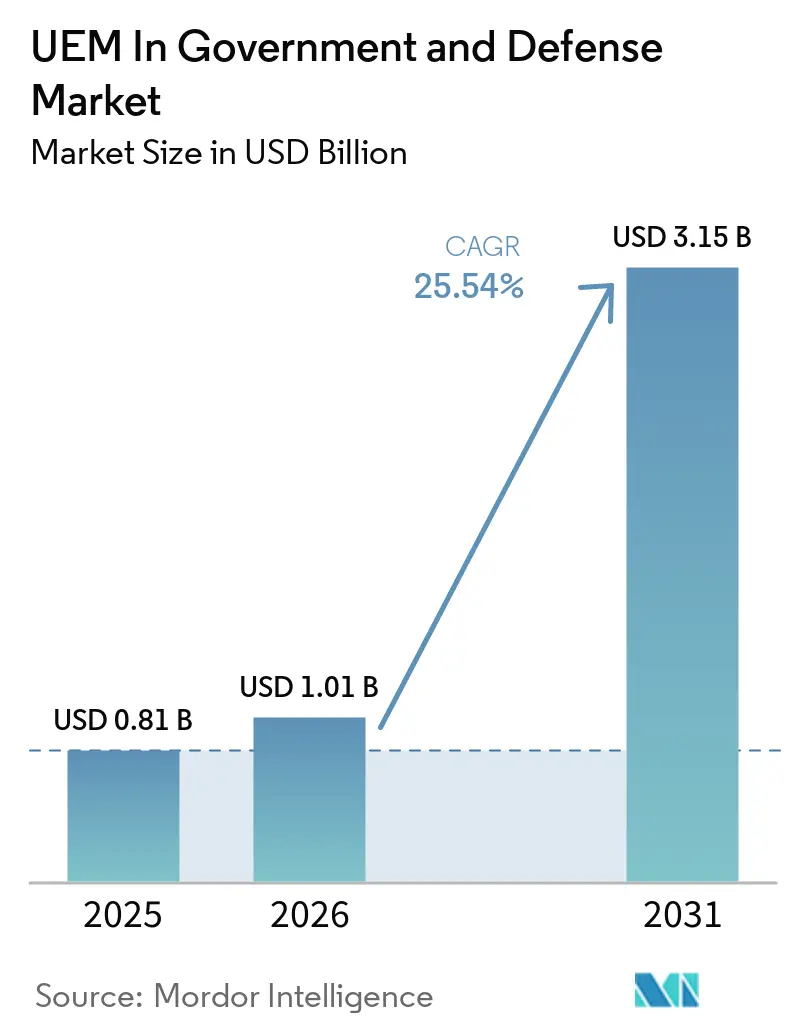
The UEM in government and defense market size was valued at USD 0.81 billion in 2025 and is estimated to grow from USD 1.01 billion in 2026 to reach USD 3.15 billion by 2031, at a CAGR of 25.54% during the forecast period 2026-2031. The UEM in government and defense market is expanding because agencies can no longer rely on perimeter-based security while managing mobile workers, classified systems, and a wider mix of endpoint types. The UEM in government and defense market is also gaining support from formal zero-trust programs, which are turning endpoint visibility and policy enforcement into required operating capabilities rather than optional IT upgrades. Procurement activity is favoring integrated platforms that combine device management, application control, compliance monitoring, and security telemetry in a single environment, thereby raising the value of vendors with deeper platform capabilities and public-sector credentials. At the same time, the UEM in the government and defense market is creating opportunities for cloud-native providers, sovereign deployment specialists, and vendors that can connect endpoint data to broader security operations. Expansion remains strong, though program timelines still depend on budget cycles, legacy system migration, and data sovereignty requirements that can slow full rollout decisions.
Key Report Takeaways
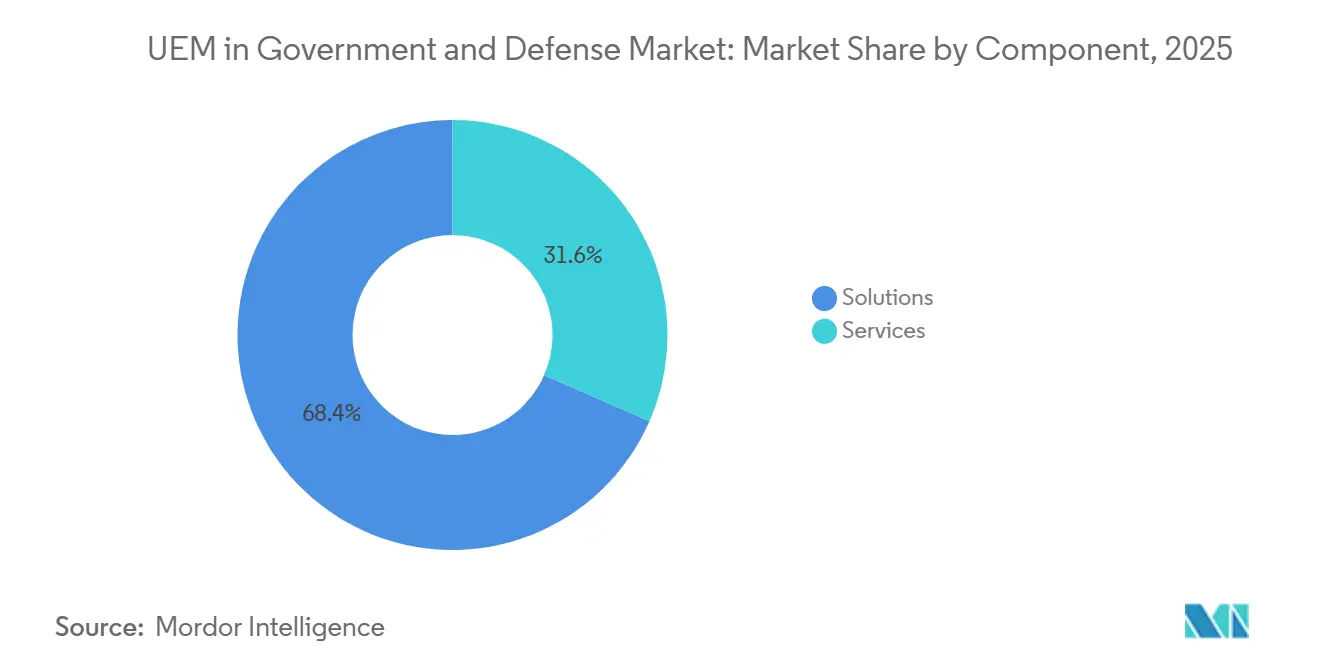
- By component, solutions held a 68.43% of the UEM in Government and Defense Market share in 2025, and are projected to expand at a 26.87% CAGR through 2031.
- By deployment mode, cloud-based deployment held a 57.92% share in 2025 and is projected to grow at a 26.41% CAGR through 2031.
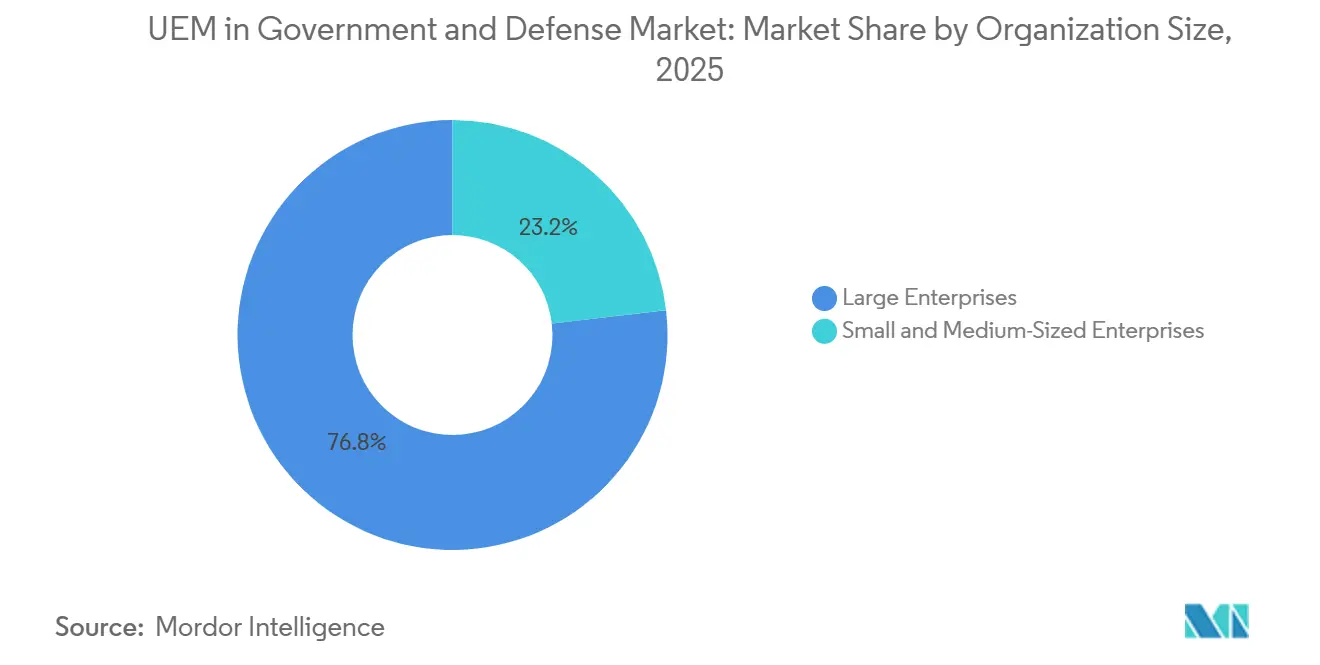
- By organization size, large enterprises held 76.84% of revenue in 2025, while small and medium-sized enterprises are projected to expand at a CAGR of 26.13% through 2031.
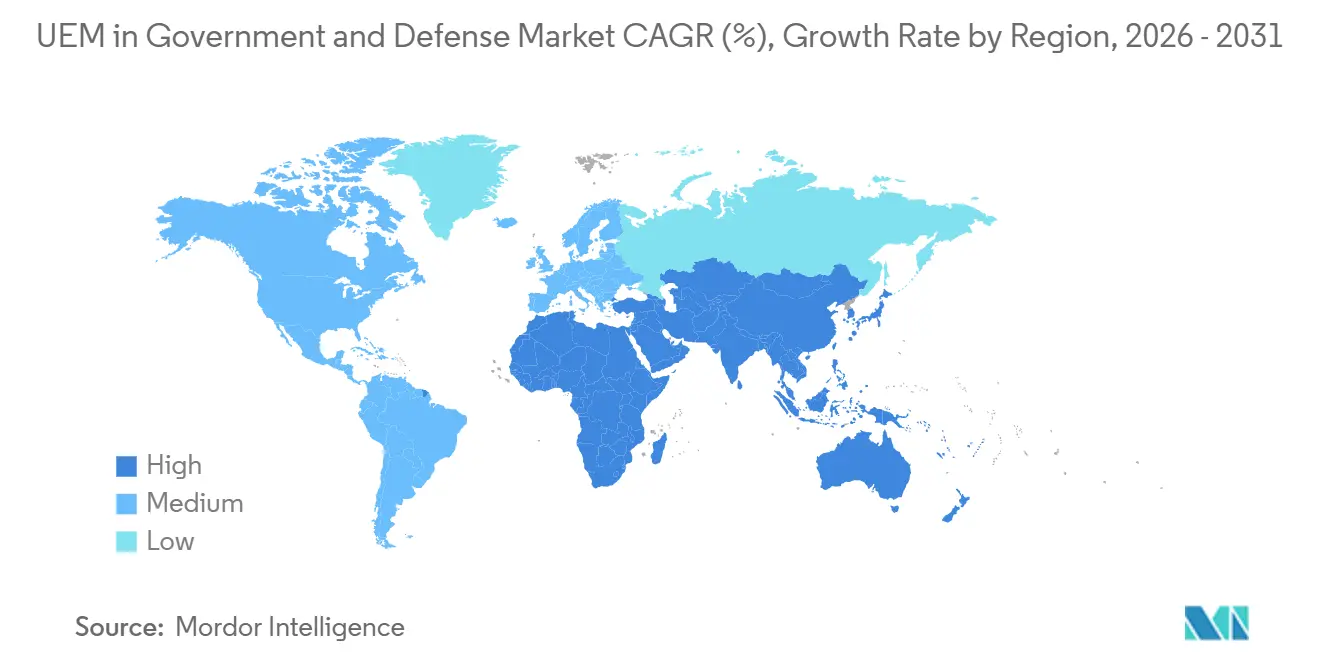
- By geography, North America held 41.56% share in 2025, while the Middle East and Africa are projected to expand at a 26.38% CAGR through 2031.
Note: Market size and forecast figures in this report are generated using Mordor Intelligence’s proprietary estimation framework, updated with the latest available data and insights as of January 2026.
Market Trends and Insights
Drivers Impact Analysis of UEM In Government and Defense Market*
| Driver | (~) % Impact on CAGR Forecast | Geographic Relevance | Impact Timeline |
|---|---|---|---|
| Escalating Endpoint Attack Surface and Zero Trust Rollouts | +6.8% | Global, concentrated in North America, Europe, and the Asia-Pacific | Short term (≤ 2 years) |
| Hybrid Work, BYOD, and Secure Mobility Expansion | +5.9% | Global, especially strong in North America and Europe | Short term (≤ 2 years) |
| Platform Convergence of Endpoint, Identity, and Access Management | +4.9% | Global, early adoption concentrated in North America | Medium term (2-4 years) |
| AI-Based Digital Employee Experience Optimization | +3.8% | North America and Europe, and emerging in the Asia-Pacific | Medium term (2-4 years) |
| Frontline and IoT Device Proliferation in Field Operations | +3.1% | Global, with Asia-Pacific as a core area and spillover into the Middle East and Africa, and North America | Medium term (2-4 years) |
| Device-Level Carbon Tracking and Sustainability Reporting Needs | +1.5% | Europe and North America | Long term (≥ 4 years) |
| Source: Mordor Intelligence | |||
Escalating Endpoint Attack Surface and Zero Trust Rollouts
The UEM in government and defense market is receiving its strongest push from the steady rise in endpoint risk and the policy response that followed. The DoD Inspector General reported in May 2025 that DISA’s Thunderdome program had completed 85 of 91 target-level zero trust activities, with unified endpoint and mobile device management forming part of the required device pillar for full certification.[1] The Department of Defense then formalized zero trust as mandatory enterprise architecture in July 2025, which moved endpoint control from a preferred security practice to a required operating standard across DoD components. CISA reinforced this direction in April 2025 by treating device compliance as a continuous control, supporting platforms that can monitor posture in real time rather than only during scheduled reviews. This is pushing the UEM in the government and defense markets toward vendors that can feed endpoint context directly into security operations, incident response, and access decisions without extensive integration work.
Hybrid Work, BYOD, and Secure Mobility Expansion
The UEM in government and defense market is also growing because government mobility programs now extend beyond agency-issued hardware and into personal devices used for official access. The DoD CIO memorandum on non-government-owned mobile devices expanded the scope for secure access to controlled unclassified information, increasing the number of endpoints that must be governed under centralized policy. This shift matters because BYOD governance brings enrollment, patching, configuration, and separation of personal and government data into one control framework. It also expands demand across defense contractors, especially those that must protect controlled unclassified information while supporting distributed staff and subcontractor networks. In practical terms, the UEM in government and defense market is being driven less by device replacement and more by the need to secure mixed endpoint estates under mobility-first operating models.
Platform Convergence of Endpoint, Identity, and Access Management
The UEM in government and defense market is moving toward broader platform buying as agencies combine device management, identity, and network policy into more unified security architecture. The GSA Zero Trust Architecture Technology Book identified UEM as one of the core zero trust pillars and linked it to modernization paths that align with secure access service edge models across civilian agencies. That framing changes procurement behavior because endpoint tools are no longer reviewed in isolation; they are being judged on how well they work with authentication systems, policy engines, and security monitoring layers. The same change is widening the role of device context in access control, which favors vendors with stronger integration into ICAM and security workflows. As a result, the UEM in the government and defense market is rewarding platforms that can demonstrate consistent policy enforcement across laptops, mobile devices, and other connected systems.
AI-Based Digital Employee Experience Optimization
The UEM in government and defense market is also benefiting from a shift toward proactive endpoint support rather than reactive service desk work. ServiceNow announced in June 2026 that it was extending its trusted AI capabilities to government environments, including community and national security cloud settings, to support stronger automation of employee workflows and digital experience management. Ivanti’s Q1 2026 release introduced autonomous endpoint management with predictive and self-healing capabilities, directly addressing agencies that need to maintain large device estates without proportional staffing growth. These changes matter because they reduce avoidable friction for end users and help IT teams fix endpoint issues before productivity is affected. In the UEM in government and defense market, that makes digital experience features are more relevant to retention, service quality, and operational continuity than they were in earlier procurement cycles.
Restraints Impact Analysis of UEM In Government and Defense Market*
| Restraint | (~) % Impact on CAGR Forecast | Geographic Relevance | Impact Timeline |
|---|---|---|---|
| Data Sovereignty and Privacy Compliance Hurdles | -3.2% | Europe, the Middle East and Africa, and Asia-Pacific, with secondary effects in North America for multi-jurisdiction contractors | Medium term (2-4 years) |
| High Migration and Integration Cost of Legacy Estates | -2.5% | Global, concentrated in North America and Europe | Short term (≤ 2 years) |
| Post Broadcom-VMware Procurement Uncertainty | -1.8% | Global, especially North America and Europe | Short term (≤ 2 years) |
| Talent Gap in Low-Code Automation and Scripting for UEM | -1.3% | Global, with acute pressure in Asia-Pacific and the Middle East and Africa | Long term (≥ 4 years) |
| Source: Mordor Intelligence | |||
Data Sovereignty and Privacy Compliance Hurdles
The UEM in government and defense market faces its strongest structural restraint in cloud deployment, where data sovereignty rules are becoming more detailed across major public sector jurisdictions. The NIS2 Directive widened compliance obligations across a large set of European organizations and increased the importance of supply chain security and lawful control over operational data generated by endpoint systems. The European Commission’s Cloud Sovereignty Framework then added a tiered structure in June 2026 that evaluates jurisdiction, residency, and key control through a formal sovereignty assurance model. Similar pressures are emerging in other regions, where governments seek local control over telemetry, audit trails, and security data flows tied to endpoint operations. This means the UEM in the government and defense market is not only competing on functionality, but also on where data sits, who can access it, and how vendors demonstrate those controls.
High Migration and Integration Cost of Legacy Estates
The UEM in government and defense market also slows when agencies must fit new platforms into old estates that were not designed for unified policy and real-time telemetry. The U.S. Government Accountability Office reported in 2025 that agencies still need stronger plans for modernizing decades-old systems, which shows why operations and maintenance spending continues to absorb resources that could otherwise support broader endpoint modernization. This becomes a practical barrier because many defense and civilian organizations still run aging directory tools, first-generation device managers, and custom security stacks that require parallel engineering during migration. The result is longer deployments, higher service spend, and more caution from procurement teams that do not want service disruption in sensitive environments. For the UEM in government and defense market, the issue is less about interest in modernization and more about whether agencies can fund and sequence the transition without destabilizing existing operations.
*Our forecasts treat driver/restraint impacts as directional, not additive. The impact forecasts reflect baseline growth, mix effects, and variable interactions.
UEM In Government and Defense Market Segment Analysis
By Component:
Integrated Solutions Lead as Security and Compliance Drive ExpansionSolutions held 68.43% of the UEM in government and defense market size in 2025, and the same segment is projected to expand at a 26.87% CAGR through 2031. That position reflects a clear preference for consolidated platforms over scattered service arrangements across endpoint, app, content, and compliance functions. Security and compliance management are taking the lead inside the solutions mix because zero-trust programs require ongoing device posture checks and faster enforcement of policy drift. In the UEM in government and defense, this gives integrated software greater strategic weight than support services alone.
Services still keep an important role because classified and regulated programs often need cleared personnel, local implementation support, and government-specific compliance knowledge. That allows services revenue to remain durable even while the solutions layer grows faster. BlackBerry’s FY2026 annual report noted that BlackBerry UEM holds NIAP certification and remains on the DoD Information Network Approved Products List, demonstrating how public-sector certifications create durable barriers for vendors that are not already qualified. Within the UEM market for government and defense, analytics and automation are also becoming more important, as agencies seek autonomous remediation and better visibility without expanding headcount at the same pace as endpoint growth.
By Deployment Mode:
Cloud Extends Its Lead While Sovereignty Requirements Sustain On-Premise DemandCloud-based deployment accounted for 57.92% share of the UEM in government and defense market size in 2025, and it is projected to grow at a 26.41% CAGR through 2031. That lead comes from lower infrastructure burden, easier remote provisioning, and faster rollout for distributed users operating across agencies and contractor networks. NinjaOne’s FedRAMP Moderate authorization in September 2025 strengthened the pool of cloud options that federal teams can procure through validated security frameworks.[2] The UEM in government and defense market is therefore seeing cloud adoption rise where policy, procurement, and operating models align around mobility and centralized administration.
On-premise deployment still matters because some defense and high-security environments cannot route endpoint telemetry through commercial cloud paths. BlackBerry’s June 2026 sovereign endpoint control announcement expanded macOS management within its on-premises model, supporting agencies that want a single console across Apple, Windows, and Android without a cloud dependency. Hybrid models are also gaining relevance for contractors or multi-jurisdictional users who need cloud flexibility for remote operations but local handling for contract-sensitive data. In the UEM in government and defense industry, that creates a durable split where cloud leads overall growth while on-premise and hybrid deployments remain important in specialized environments.
By Organization Size:
Large Enterprises Anchor Spending While SME Compliance Demand BuildsLarge enterprises held 76.84% of the UEM in government and defense in 2025, supported by multi-year agreements with defense ministries, military branches, and large federal agencies. These customers manage very large endpoint populations and usually buy through broader procurement vehicles that combine infrastructure, security, and platform support in one framework. Broadcom and Carahsoft secured a USD 970 million agreement with DISA in March 2026, which shows the scale and structure that define the upper tier of spending in the UEM in government and defense market. The segment remains attractive for incumbents because contract size is large, renewal cycles are long, and technical qualification standards limit the number of credible bidders.
Small and medium-sized enterprises are growing faster because compliance expectations are moving deeper into the defense supply chain. NinjaOne’s GovRAMP Moderate authorization in August 2025 highlighted the need for secure endpoint management among state, local, and education entities that often operate with lean IT teams and limited staffing depth. Similar pressure is reaching smaller contractors that must secure contractor-owned devices used to access controlled unclassified information. In the UEM in government and defense market, this creates a wider first-time buyer base with shorter buying cycles, stronger price sensitivity, and greater interest in automation-led deployment models.
Geography Analysis
North America UEM in Government and Defense Market
North America accounted for 41.56% of the UEM in government and defense market share in 2025, making it the largest regional cluster by revenue. The region benefits from high federal IT spending, mature security procurement channels, and a deep FedRAMP ecosystem that reduces friction for approved cloud offerings. The July 2025 DoD memorandum on zero trust accelerated this position by making endpoint control part of a wider enterprise compliance deadline that agencies cannot ignore. Canada is also supporting the UEM in government and defense market through sovereign procurement, as BlackBerry expanded its strategic partnership with the Government of Canada in March 2026 to scale secure communications and UEM use across federal departments.
Europe UEM in Government and Defense Market
Europe remained the second-largest regional market, and growth there is shaped by stronger security spending alongside stricter compliance screening. The European Commission’s sovereignty framework is making hosted architecture and jurisdictional control more important in public tenders, especially for sensitive workloads. BlackBerry’s September 2025 BSI certification for Apple Indigo and Samsung Knox device management strengthened the case for high-assurance endpoint administration in German and allied government settings.[3] The United Kingdom is adding another dimension through sustainable procurement, with Defra committing in February 2026 to source 90% of endpoints as refurbished or remanufactured devices under a GBP 150 million (USD 190 million) contract model that supports longer device life cycles. This keeps the UEM in government and defense market tied not only to security and sovereignty but also to hardware stewardship and lifecycle governance.
MEA and APAC UEM in Government and Defense Market
The Middle East and Africa is projected to expand at a 26.38% CAGR through 2031, which makes it the fastest-growing regional area in the UEM in government and defense market. Saudi Arabia is a major driver because military localization under Vision 2030 is supporting wider procurement of digital security and control systems across new defense activity. GAMI’s 2026 risk management guide for the military industries sector reflects that direction and strengthens the policy base for secure endpoint operations in the kingdom. Asia-Pacific is also expanding through formal endpoint rules, including India’s NIC-led deployment direction and Indonesia’s 2025 circular on endpoint security standards for government networks.
Competitive Landscape
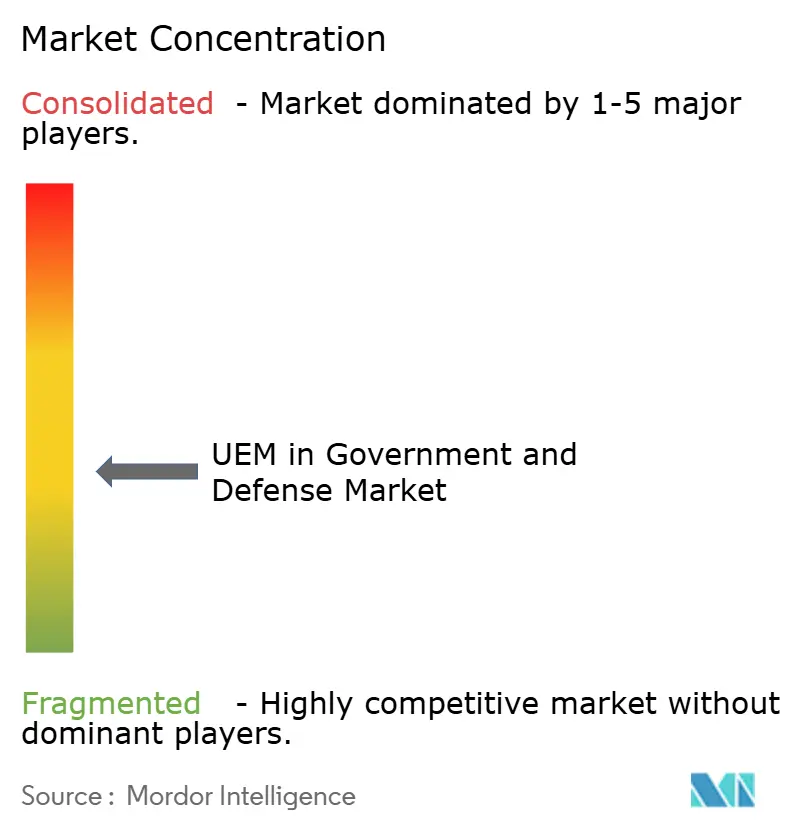
The UEM in government and defense market remains fragmented, with a small group of vendors controlling the most sensitive and highest-value contracts, while a broader group competes in mid-sized and sub-federal programs. Broadcom, Ivanti, and BlackBerry remain strong because procurement in this field depends heavily on contract vehicles, security accreditations, and long operating histories in regulated environments. Broadcom’s January 2026 OneGov agreement with GSA and its March 2026 DISA agreement show a clear strategy of using government-wide buying frameworks to deepen platform lock-in across defense and civilian accounts. That keeps the UEM market in government and defense markets tilted toward vendors that can meet scale, compliance, and procurement complexity simultaneously.
Competitive pressure is still rising because newer providers are winning the certifications needed to enter public sector buying cycles. NinjaOne’s FedRAMP and GovRAMP milestones moved it closer to direct competition in civilian federal and sub-federal programs where automation and ease of deployment are valued. Ivanti’s Sovereign Cloud launch in April 2026 addressed European data residency and auditability concerns, which positions it well in a region where compliance structure can decide vendor eligibility before product comparison even begins.[4] BlackBerry’s June 2026 sovereign endpoint update and its post-quantum roadmap disclosed in its FY2026 filing show a different path, which is to strengthen trust in high-assurance and long-horizon security use cases. In the UEM in government and defense market, these moves show that winning now depends on operating proof, not feature breadth alone.
Open space remains in areas where buying requirements are becoming clearer but vendor leadership is not yet fixed. One such area is management of operational technology and non-traditional field endpoints, where agencies want stronger policy control but still face uneven product maturity across device classes. Another area is the overlap between digital employee experience and endpoint administration, where vendors are trying to prove that better telemetry and automation can reduce tickets and improve user satisfaction in public sector environments. The UEM in government and defense market is therefore separating into mature competition for core enterprise contracts and emerging competition around sovereign cloud, AI-driven remediation, and broader endpoint categories.
UEM In Government and Defense Industry Leaders
-
Broadcom Inc.
-
International Business Machines Corporation
-
Ivanti, Inc.
-
SOTI Inc.
-
Jamf Holding Corp.
- *Disclaimer: Major Players sorted in no particular order
UEM In Government and Defense Market Companies Covered in this Report
- Broadcom Inc.
- International Business Machines Corporation
- Ivanti, Inc.
- SOTI Inc.
- Jamf Holding Corp.
- Matrix42 AG
- Zoho Corporation Pvt. Ltd.
- Cisco Systems, Inc.
- Google LLC
- Tanium Inc.
- Hexnode
- Kaseya Limited
- NinjaOne, LLC
- Automox, Inc.
- Quest Software Inc.
Recent Industry Developments in UEM In Government and Defense Market
- June 2026: The Defense Information Systems Agency posted a sources-sought notice for the consolidated Army Endpoint Security Event Management System, with a potential USD 850 million ceiling spanning a two-year base period and eight one-year option periods.
- June 2026: BlackBerry Limited announced enhanced capabilities for BlackBerry UEM targeting sovereign endpoint control, including expanded macOS management within the on-premises deployment model, eliminating cloud dependency for Apple, Windows, and Android device management, post-quantum cryptographic library upgrades aligned to NIST post-quantum standards, and multi-tenant console improvements for government and regulated-industry clients.
- April 2026: Ivanti launched its Sovereign Cloud solution for EU compliance, purpose-built for public institutions, critical infrastructure operators, and regulated-sector companies in the EU. The solution provides verifiable auditability, data residency within EU infrastructure, and resilience designed to meet the EU Cloud Sovereignty Framework and enable public tender eligibility across European member states.
- March 2026: Broadcom and Carahsoft secured a five-year, USD 970 million blanket purchase agreement with the Defense Information Systems Agency for VMware Cloud Foundation, consolidating procurement across Department of War agencies, including DISA, the Air Force, Space Force, and Combatant Commands, for private cloud infrastructure, zero trust security, and tactical edge operations.
Global UEM In Government and Defense Market Report Scope
The UEM in Government and Defense Market report provides a comprehensive analysis of the adoption and implementation of UEM solutions within the government and defense sectors. The scope of the report includes an in-depth examination of market trends, drivers, challenges, and opportunities influencing the deployment of UEM technologies. It also covers the evaluation of key players, technological advancements, and regional market dynamics during the forecast period.
The UEM in Government and Defense Market Report is Segmented by Component (Solutions [Device Management, Application Management, Content Management, Security and Compliance Management, and Analytics and Automation], and Services), Deployment Mode (Cloud-Based, On-Premise, and Hybrid), Organization Size (Large Enterprises, and Small and Medium Enterprises), and Geography (North America, South America, Europe, Asia-Pacific, Middle East, and Africa). The Market Forecasts are Provided in Terms of Value (USD).
Segmentation Overview
| Solutions | Device Management |
| Application Management | |
| Content Management | |
| Security and Compliance Management | |
| Analytics and Automation | |
| Services |
| Cloud-Based |
| On-Premise |
| Hybrid |
| Large Enterprises |
| Small and Medium Enterprises |
| North America | United States |
| Canada | |
| Mexico | |
| South America | Brazil |
| Argentina | |
| Chile | |
| Colombia | |
| Rest of South America | |
| Europe | Germany |
| United Kingdom | |
| France | |
| Italy | |
| Spain | |
| Netherlands | |
| Nordics | |
| Russia | |
| Rest of Europe | |
| Asia-Pacific | China |
| Japan | |
| India | |
| South Korea | |
| Australia and New Zealand | |
| Southeast Asia | |
| Rest of Asia-Pacific | |
| Middle East | Saudi Arabia |
| United Arab Emirates | |
| Turkey | |
| Israel | |
| Rest of Middle East | |
| Africa | South Africa |
| Egypt | |
| Nigeria | |
| Kenya | |
| Rest of Africa |
| By Component | Solutions | Device Management |
| Application Management | ||
| Content Management | ||
| Security and Compliance Management | ||
| Analytics and Automation | ||
| Services | ||
| By Deployment Mode | Cloud-Based | |
| On-Premise | ||
| Hybrid | ||
| By Organization Size | Large Enterprises | |
| Small and Medium Enterprises | ||
| By Geography | North America | United States |
| Canada | ||
| Mexico | ||
| South America | Brazil | |
| Argentina | ||
| Chile | ||
| Colombia | ||
| Rest of South America | ||
| Europe | Germany | |
| United Kingdom | ||
| France | ||
| Italy | ||
| Spain | ||
| Netherlands | ||
| Nordics | ||
| Russia | ||
| Rest of Europe | ||
| Asia-Pacific | China | |
| Japan | ||
| India | ||
| South Korea | ||
| Australia and New Zealand | ||
| Southeast Asia | ||
| Rest of Asia-Pacific | ||
| Middle East | Saudi Arabia | |
| United Arab Emirates | ||
| Turkey | ||
| Israel | ||
| Rest of Middle East | ||
| Africa | South Africa | |
| Egypt | ||
| Nigeria | ||
| Kenya | ||
| Rest of Africa | ||
Key Questions Answered in the Report
What is the current and projected value of UEM in government and defense?
The UEM in government and defense market was valued at USD 0.81 billion in 2025, stands at USD 1.01 billion in 2026, and is projected to reach USD 3.15 billion by 2031 at a 25.54% CAGR.
Why are defense agencies increasing spending on endpoint management platforms?
Spending is rising because zero trust programs, mobility needs, and wider endpoint exposure now require continuous device visibility, policy enforcement, and faster compliance controls across distributed users and systems.
Which deployment model is growing fastest across public sector defense environments?
Cloud-based deployment led with 57.92% share in 2025 and is projected to grow at a 26.41% CAGR through 2031, supported by FedRAMP-authorized platforms and easier centralized administration.
Which customer group drives the most revenue in this space?
Large enterprises led with 76.84% share in 2025 because defense ministries, military branches, and major federal agencies buy through large multi-year agreements and manage very large endpoint estates.
Which region is expanding the quickest through 2031?
The Middle East and Africa are projected to record the fastest regional growth at a 26.38% CAGR, supported by defense digitization, localization strategies, and stronger cybersecurity governance.
What is shaping vendor competition most strongly in 2026?
Vendor competition is being shaped by compliance credentials, sovereign deployment options, platform integration with security operations, and AI-based automation that reduces manual endpoint management effort.