
Colombia UEM Market Size and Share
Market Overview
| Study Period | 2020 - 2031 |
|---|---|
| Forecast Data Period | 2026 - 2031 |
| Base Year Market Size (2025) | USD 42.19 Million |
| Market Size (2026) | USD 53.56 Million |
| Market Size (2031) | USD 191.44 Million |
| Growth Rate (2026 - 2031) | 29.01 % |
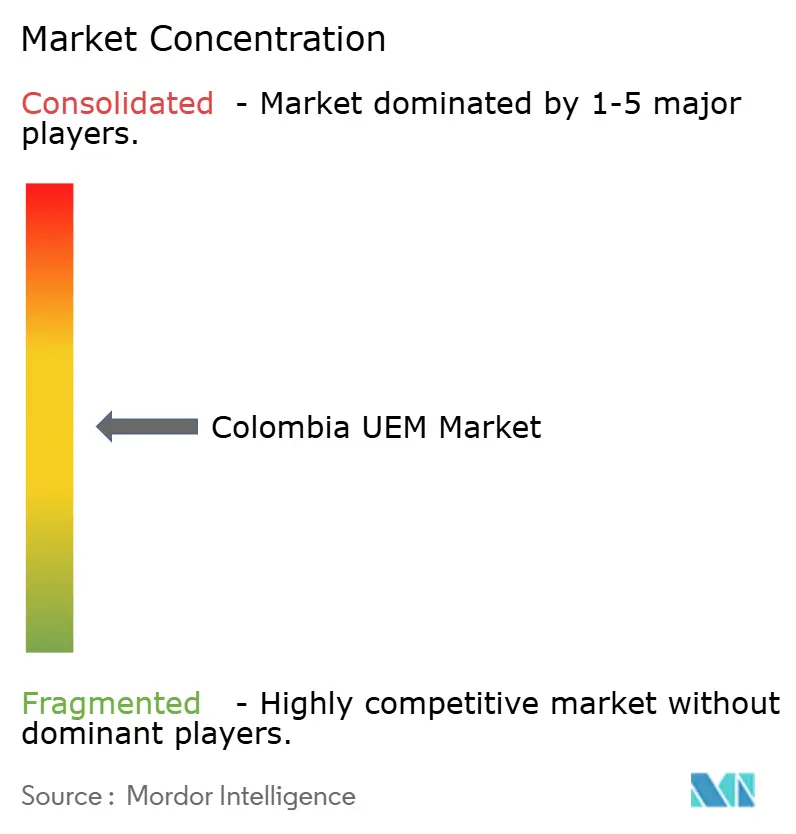
| Market Concentration | Medium |
Major Players *Disclaimer: Major Players sorted in no particular order Image © Mordor Intelligence. Reuse requires attribution under CC BY 4.0. | |
Colombia UEM Market Analysis by Mordor Intelligence
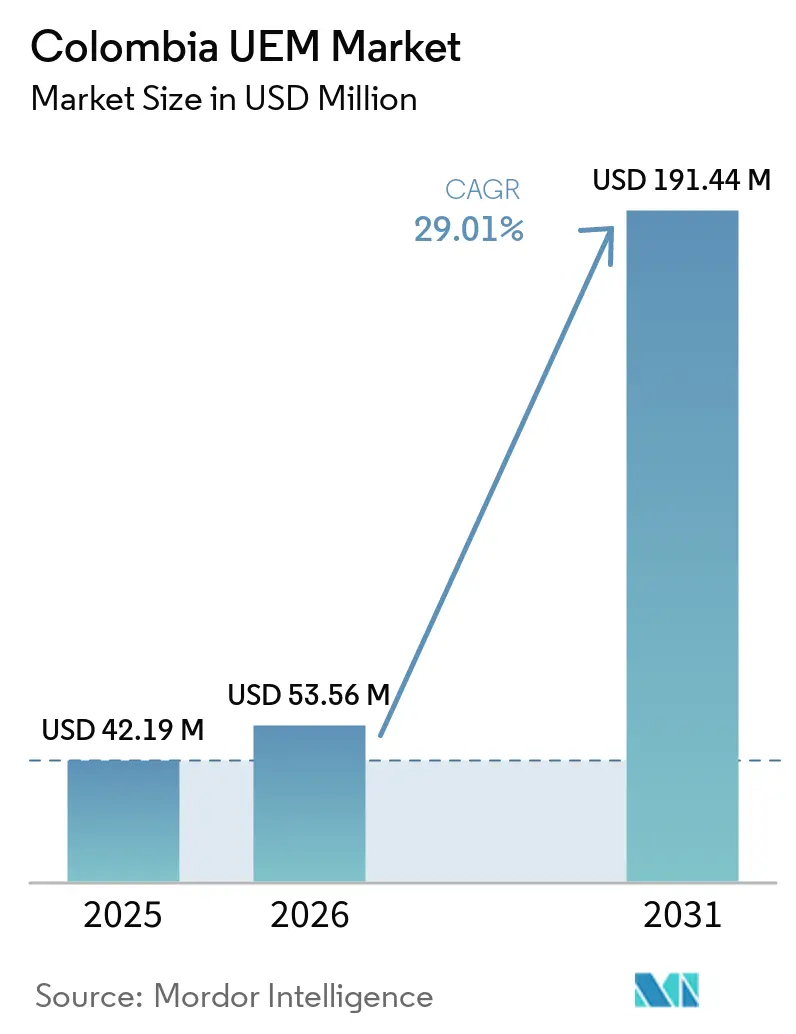
The Colombia UEM Market size is projected to expand from USD 42.19 million in 2025 and USD 53.56 million in 2026 to USD 191.44 million by 2031, registering a CAGR of 29.01% between 2026 to 2031. The Colombia Unified Endpoint Management (UEM) market is expanding because enterprises are managing more devices across remote, hybrid, and frontline settings, while cyber risk has moved endpoint control much closer to core security spending. Government digital modernization is also widening the buyer base by making centralized device oversight part of institutional technology readiness, especially in public services and regulated environments. Large vendors are strengthening their position through broader platforms, AI-led automation, and simpler deployment models, while channel-led providers are targeting companies that do not have deep in-house IT capacity. The Colombia Unified Endpoint Management (UEM) market also has a clear opportunity in healthcare and small and medium enterprises, where compliance needs and limited administrative capacity are pushing demand for easier and more automated tools. The main limit remains execution readiness, because many buyers still face skills shortages, older infrastructure, and longer internal review cycles before full deployment.
Key Report Takeaways
- By component, solutions held 67.66% of the Colombia UEM market size in 2025, confirming that software platforms remained the main spending priority within the category.
- By deployment mode, cloud deployment is projected to expand at a 30.01% CAGR through 2031, making it the fastest-growing deployment model in the Colombia UEM market.
- By organization size, large enterprises held 69.21% of the Colombia UEM market share in 2025, while small and medium enterprises are projected to expand at a 30.12% CAGR through 2031.
- By end-user industry, IT and telecommunications accounted for 20.32% of the market in 2025, while healthcare is projected to record the fastest growth at a 30.66% CAGR through 2031.
Note: Market size and forecast figures in this report are generated using Mordor Intelligence’s proprietary estimation framework, updated with the latest available data and insights as of January 2026.
Colombia UEM Market Trends and Insights
Drivers Impact Analysis*
| Driver | (~) % Impact on CAGR Forecast | Geographic Relevance | Impact Timeline |
|---|---|---|---|
| Accelerating Cybersecurity and Zero Trust Programs | +6.5% | National, with highest intensity in financial services, government, and healthcare sectors in Bogotá and Medellín | Short term (≤ 2 years) |
| Rising Hybrid Work and BYOD Adoption | +5.5% | National, concentrated in Bogotá, Medellín, and Cali metro areas, with spillover to secondary cities | Medium term (2-4 years) |
| Public-Sector Digital Modernization Under Colombia's National Digital Strategy | +5.0% | National, with early gains in central government entities and MinTIC-mandated agencies | Medium term (2-4 years) |
| Endpoint, Identity, and Access Stack Convergence | +4.0% | National, enterprise-level adoption in large Colombian corporations across BFSI, energy, and telecom | Long term (≥ 4 years) |
| AI-Enabled Digital Employee Experience Optimization | +3.5% | National, with early adoption in IT and telecom and spillover to BFSI and healthcare | Medium term (2-4 years) |
| Frontline Device Proliferation Across Logistics, Retail, and Field Operations | +2.5% | National, with early gains in Bogotá distribution corridors, Barranquilla port logistics, and retail hubs | Medium term (2-4 years) |
| Source: Mordor Intelligence | |||
Accelerating Cybersecurity And Zero Trust Programs
Cyber exposure has become one of the clearest growth drivers for the Colombia UEM market, because enterprises are now under pressure to verify the health and access status of every connected device. Fortinet reported 7.1 billion cyberattack attempts against Colombian organizations in the first half of 2025, which sharply increased management attention on continuous device control and policy enforcement.[1] Colombia’s CONPES 3995 cybersecurity policy also pushed zero-trust principles into the public domain, giving regulated sectors a clearer reference point for how device access should be governed.[2] In practice, zero trust depends on ongoing checks around device posture, user identity, and access context, which makes centralized endpoint management difficult to separate from broader security architecture. As a result, the Colombia UEM market is benefiting from a shift in buying behavior, where endpoint control is being treated less as optional IT support and more as a necessary operating layer for business continuity.
Rising Hybrid Work And BYOD Adoption
Hybrid and remote work patterns continue to expand the device base that employers must manage, which supports steady demand in the Colombia UEM market. More than 70% of Colombian companies had adopted hybrid or remote work models by late 2024, according to a study by ANDI and Deloitte, and this shift increased the number of personal and company-owned devices used for daily work. CCIT also reported 15% year-on-year growth in demand for corporate technology infrastructure in 2025, directly linking that rise to changing work models and broader digital workplace needs.[3] This matters because basic mobile device management tools do not fully address mixed operating systems, shared ownership models, or application separation needs across distributed employees. The Colombia UEM market, therefore, gains from a structural change in how work is organized, not only from one-time device purchases. The effect is especially important in the mid-market, where many employers historically operated with minimal endpoint governance and are now moving into more formal management frameworks.
Public-Sector Digital Modernization Under Colombia's National Digital Strategy
Public-sector modernization is widening the addressable base of the Colombia UEM market by creating demand that does not depend only on private-sector investment cycles. The National Digital Strategy 2023-2026, led by MinTIC and the Departamento Nacional de Planeación, set clear targets for e-government digitalization, cloud adoption, and cybersecurity resilience across national institutions. Each agency that digitizes services or expands cloud-backed workflows also adds new managed devices that must be monitored, updated, and secured through centralized controls. MinTIC’s 2025 strategic planning framework further tied technology maturity to governance practices, which raises the practical importance of coordinated device administration across public institutions. The impact extends beyond central government because national deployments often become reference points for departmental governments and municipal bodies that follow similar procurement paths. That cascading effect supports the Colombia UEM market by adding a deeper public buyer pipeline over the forecast period.
Endpoint, Identity, And Access Stack Convergence
The Colombia UEM market is also being shaped by a broader move toward fewer, more connected security and device management platforms. Large enterprises in banking, telecom, and energy are increasingly evaluating endpoint tools as part of a wider control layer that links identity, access, remediation, and analytics into one operating model. Ivanti’s January 2026 launch of Autonomous Endpoint Management reflected that direction by combining device oversight, AI-led actions, and broader discovery capabilities in a more unified product structure. When buyers move in this direction, vendors with stronger integration stories gain an advantage because procurement is no longer centered on feature checklists alone. The result is a more demanding competitive environment in which standalone tools face pressure at renewal, especially where enterprise clients want fewer consoles and tighter policy consistency. Over time, this convergence trend is likely to deepen the role of platform breadth in the Colombia UEM market.
Restraints Impact Analysis*
| Restraint | (~) % Impact on CAGR Forecast | Geographic Relevance | Impact Timeline |
|---|---|---|---|
| Data Localization, Privacy, and Cross-Border Compliance Complexity | -2.5% | National, with heightened impact on financial services and healthcare organizations operating under Law 1581 and CONPES 3995 | Medium term (2-4 years) |
| Legacy Infrastructure Integration and Migration Costs | -2.0% | National, most acute in public-sector entities and mid-size manufacturers outside major urban centers | Long term (≥ 4 years) |
| Limited In-House UEM Administration Skills in Mid-Market Firms | -1.5% | National, particularly pronounced outside Bogotá and Medellín where IT talent supply is constrained | Medium term (2-4 years) |
| Procurement Friction from Multi-Vendor Tool Overlap | -1.0% | National, concentrated in large enterprises managing legacy point-solution estates alongside newer platform investments | Short term (≤ 2 years) |
| Source: Mordor Intelligence | |||
Data Localization, Privacy, And Cross-Border Compliance Complexity
Privacy compliance remains a real brake on the Colombia UEM market, especially for cloud models that rely on telemetry, user, and device data moving across borders. Colombia’s data protection framework under Law 1581 limits transfers to jurisdictions with adequate protection standards, and the Superintendencia de Industria y Comercio reinforced this through Circular 002 in October 2025. In August 2025, the government also advanced a reform proposal that would strengthen oversight, expand consent expectations, and raise the importance of data residency in enterprise software environments. This is most sensitive in healthcare and financial services, where legal review can delay purchases if vendors do not show clear options for local handling, controlled transfers, or stronger processing safeguards. The restraint is structural because regulatory scrutiny is becoming tighter, not lighter, over the forecast period. That means parts of the Colombia Unified Endpoint Management (UEM) market may advance more slowly unless vendors adapt products and contracting models to Colombia’s compliance expectations.
Legacy Infrastructure Integration And Migration Costs
Older technology estates remain another practical limit on faster adoption in the Colombia UEM market. Many public institutions and mid-size manufacturers still operate mixed endpoint environments with legacy Windows systems, on-premise directory setups, and hardware that does not align easily with modern enrollment and policy methods. Minciencias acknowledged in its 2025 information technology strategic plan that regional public entities often lack the technical base needed for more advanced endpoint control, including compatible hardware and reliable connectivity conditions. This raises deployment costs because companies may need device refreshes, environment cleanup, and parallel operations before a new platform can function as intended. IBM’s January 2026 release of Smart Device Groups showed that vendors are responding to this issue by simplifying how older or changing devices are classified and managed inside the platform. Even so, the time and cost needed to modernize the installed base continue to slow some deals, especially outside the largest urban centers.
*Our forecasts treat driver/restraint impacts as directional, not additive. The impact forecasts reflect baseline growth, mix effects, and variable interactions.
Segment Analysis
By Component: Solutions Anchor Revenue While Services Expand Mid-Market Reach
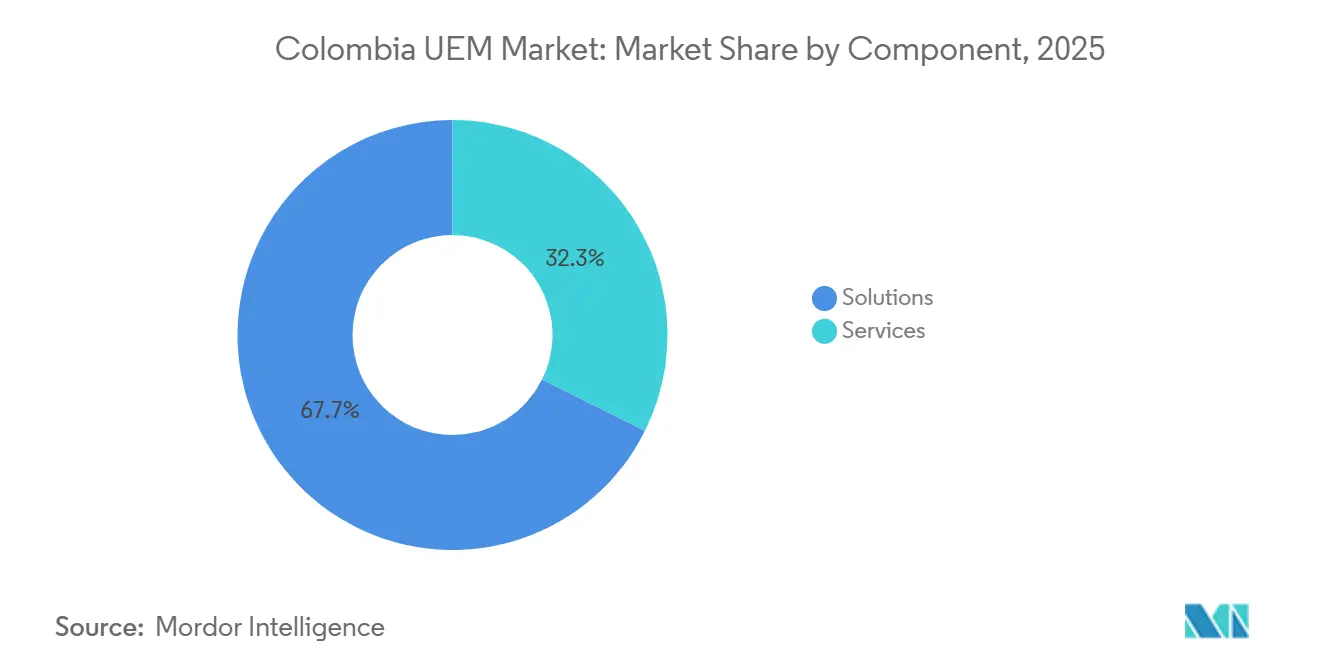
Solutions held 67.66% of the market in 2025, which shows that platform capability remained the main spending priority in the Colombia UEM market industry. Buyers placed more weight on direct control over devices, applications, and security policies than on standalone service spending. Device management and security compliance formed the core purchase case because distributed work settings require stronger visibility into inventory, policy status, and user access conditions. Application management also gained relevance as employers had to separate work and personal use across mixed ownership environments. Analytics and automation remained at an earlier stage, but interest was rising among larger buyers who manage more complex device fleets and want faster policy execution.
Services still represented the smaller revenue pool, but they are becoming more important as the Colombia UEM market moves into buyers with less internal expertise. Many organizations, especially outside the largest enterprise tier, need implementation support, managed services, and operating guidance before they can sustain full platform use. That pattern matters because growth is no longer driven only by software features, but also by the vendor ecosystem’s ability to reduce operational burden after deployment. Ivanti’s January 2026 Autonomous Endpoint Management release reflected this direction by emphasizing self-correcting policy enforcement and lower manual intervention for IT teams. As a result, the solutions lead is likely to remain intact, while services gain share through onboarding, optimization, and managed support needs in smaller organizations.
By Deployment Mode: Cloud Leadership Deepens As Hybrid Earns Regulated-Sector Ground
Cloud deployment is projected to expand at a 30.01% CAGR through 2031, making it the fastest-growing model in the Colombia UEM market. Cloud delivery fits the practical needs of employers that now manage devices across offices, homes, field operations, and shared work settings. It also reduces the burden of maintaining on-site management infrastructure for organizations that want quicker rollout and more centralized oversight. In Colombia, that advantage is strongest where banks, telecom operators, and service businesses already work through wider digital operating models. The appeal of cloud deployment is therefore tied not only to cost, but also to flexibility, visibility, and speed of policy action.
On-premise deployment still keeps a place in parts of the Colombia Unified Endpoint Management (UEM) market where data control remains a central concern. Government entities and some financial institutions continue to value direct infrastructure control because of privacy, transfer, and residency requirements that can complicate fully remote architectures. This is why hybrid models are gaining relevance, since they offer some of the scale and administrative convenience of cloud tools while retaining more control over sensitive processing. Ivanti’s 2026 sovereign cloud launch, though designed for European compliance settings, highlighted the broader vendor response to stricter data sovereignty expectations in regulated markets. Over time, this should help regulated buyers adopt more flexible structures without moving fully away from internal control needs.
By Organization Size: Large Enterprise Base Sustains Revenue While SME Urgency Accelerates
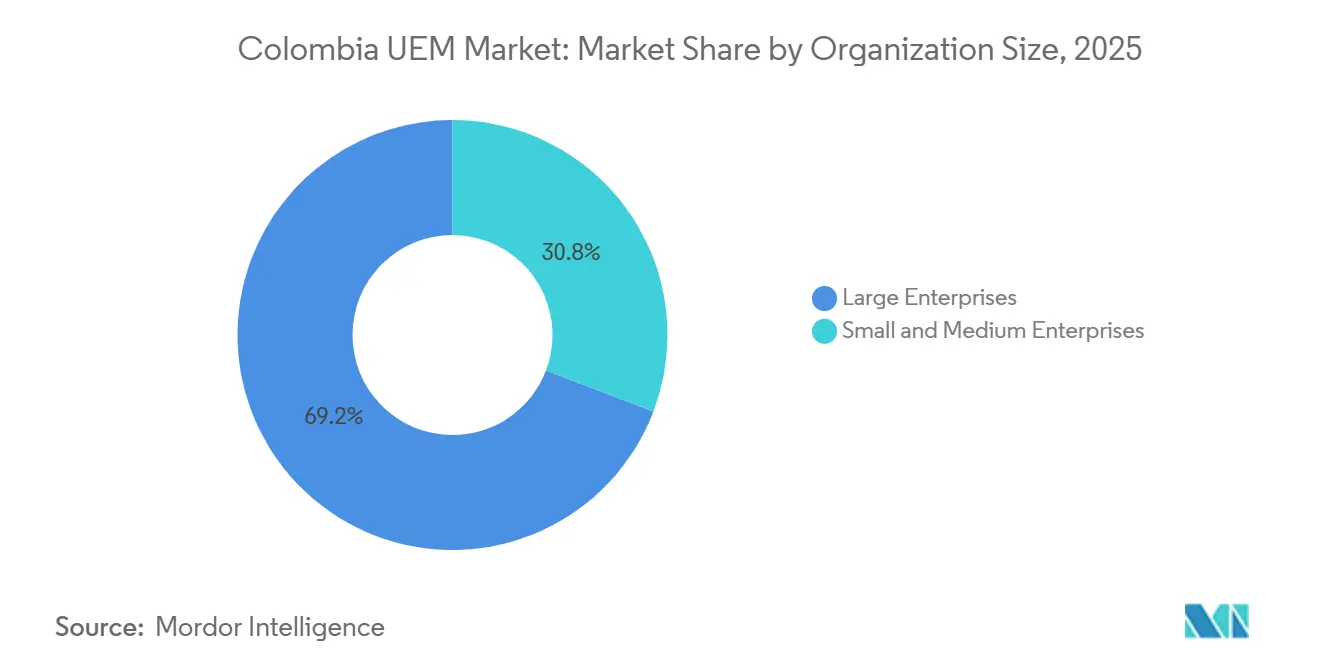
Large enterprises held 69.21% of the market in 2025, which reflected their larger device fleets, stricter governance duties, and stronger internal capacity to evaluate full-platform deployments. This leadership position meant that a major share of Colombia UEM market size still came from banks, telecom groups, energy companies, and other large organizations with broad endpoint exposure. These buyers have moved well beyond basic mobile controls and now place more emphasis on integration with identity tools, security operations, and cloud environments. Their procurement decisions tend to favor vendors that can support platform depth, policy consistency, and enterprise-wide administration at scale. That raises the entry barrier for smaller providers seeking to win larger and more regulated accounts.
Small and medium enterprises are projected to grow at a 30.12% CAGR through 2031, showing that the next expansion wave in the Colombia Unified Endpoint Management (UEM) market is broadening beyond the largest buyers. This segment is growing because pricing, packaging, and automation are making endpoint governance more feasible for firms with smaller budgets and leaner IT teams. Kaseya’s 2024 launch of its Kaseya 365 Endpoint subscription illustrated that vendors see commercial value in transparent per-device models for organizations with limited endpoint counts. Even so, adoption in this group is likely to remain uneven because many firms still move after a security event, a compliance requirement, or a clear operational pain point rather than through long-range planning. That means growth can be strong while buying maturity remains mixed across the SME base.
By End-User Industry: Vertical Complexity Deepens As Healthcare Outpaces IT And Telecom
IT and telecommunications accounted for 20.32% of the Colombia Unified Endpoint Management (UEM) market share in 2025, which kept the sector in the leading position by end-user demand. These organizations were early adopters because they manage complex multi-OS environments and already operate with stronger internal technology teams than many other sectors. Their endpoint estates also tend to be larger, more distributed, and more exposed to service continuity requirements, which supports ongoing investment in centralized policy control. BFSI followed closely because banking environments face stricter expectations around endpoint security, user access, and operational resilience. Together, these two verticals help define much of the current revenue base for the Colombia UEM industry.
Healthcare is projected to expand at a 30.66% CAGR through 2031, making it the fastest-growing vertical and one of the clearest future demand centers for the Colombia Unified Endpoint Management (UEM) market. Resolution 1888 of 2025 required Colombian healthcare institutions to adopt the interoperable Digital Health Summary under the HL7-FHIR standard, which raised the operational importance of secure device access across clinical settings. By June 2026, the system was already processing more than 7.7 million interoperable records across 2.7 million patients, while 1,087 additional institutions were in integration testing, showing how quickly the connected care environment was expanding. IBM’s March 2026 MaaS360 Kiosk Designer update also pointed to this need by making shared device workflows easier to configure for settings such as healthcare, logistics, and retail. As a result, healthcare growth is being driven by direct workflow and compliance needs rather than discretionary technology experimentation.
Geography Analysis
The Colombia UEM market is growing at a 29.01% CAGR through 2031, and most enterprise demand remains concentrated in Bogotá, Medellín, and Cali. Bogotá holds the strongest position because it combines national government presence with the headquarters of major banks, telecom operators, and technology-focused enterprises. That concentration gives the city the largest pool of regulated and device-intensive organizations in the country. It also benefits from the deepest ecosystem of systems integrators, resellers, and managed service providers, which strengthens how global vendors reach the local market. Medellín has emerged as the second key node in its innovation base, and digital business activity continues to broaden the buyer pool beyond the capital.
Cali and Barranquilla contribute a different kind of demand in the Colombia Unified Endpoint Management (UEM) market, with stronger exposure to manufacturing, logistics, and retail operations that depend on shared and frontline devices. The longer-term outlook is supported by Colombia’s digital infrastructure trend, since internet penetration rose from 38% in 2014 to 63% in 2023. MinTIC’s connectivity plan also targets 98% household coverage by 2033, which expands the potential managed endpoint base across more regions and business settings. As more enterprises, institutions, and field operations become digitally connected, the number of devices that require consistent oversight rises with them. That widens the future addressable base of the Colombia Unified Endpoint Management market beyond the traditional urban core.
Regulatory and institutional factors also shape geography because public and regulated deployments do not spread evenly across the country. CONPES 3995 and the National Digital Strategy 2023-2026 have made cybersecurity, trust controls, and digital readiness more central to public-sector technology decisions. Healthcare adds another layer because the interoperability mandate under Resolution 1888 of 2025 requires secure device-supported workflows across a broad national care network. Compared with larger South American peers, Colombia still has a smaller absolute base, but its adoption curve is moving faster as security pressure and digitalization needs shorten buyer decision cycles. That keeps the Colombia Unified Endpoint Management market attractive for both platform vendors and channel partners that want growth in a still-forming competitive environment.
Competitive Landscape
The Colombia Unified Endpoint Management (UEM) market is moderately consolidated in its upper tier, with Microsoft Intune, IBM MaaS360, and Workspace ONE, now operating as Omnissa, holding strong positions in large-enterprise buying cycles. Their strength comes from broad enterprise relationships, platform familiarity, and the ability to fit endpoint control into wider IT and security environments. This gives established vendors an advantage where buyers want fewer vendors, tighter policy consistency, and simpler governance across many devices. At the same time, the field is not closed because several providers compete effectively through easier deployment models and channel-led delivery. Vendors such as NinjaOne, SOTI, Hexnode, and others remain relevant where mid-market companies prioritize quick setup, lower operating strain, and managed service support.
Competitive differentiation in the Colombia UEM market has shifted toward automation and autonomous management. Ivanti’s April 2026 update expanded autonomous capabilities across its platform so IT teams could detect and remediate endpoint issues with less manual effort. Kaseya’s April 2026 launch of an agentic IT management platform showed the same direction, with more emphasis on systems that can analyze and resolve operational issues for resource-constrained teams. NinjaOne also introduced an AI-driven vulnerability management product in March 2026, adding faster patch and prioritization support inside its endpoint platform. These moves matter because buyers increasingly expect endpoint tools to reduce day-to-day workload rather than only centralize visibility. That expectation favors vendors that can show measurable operational simplification, especially in accounts with lean internal IT teams.
IBM’s MaaS360 platform has also been pushing deeper intelligence into endpoint operations, including AI-based policy recommendations that draw on anonymized cross-customer patterns to guide compliance and control decisions. This kind of functionality helps leading vendors defend enterprise accounts by linking endpoint control to broader operating discipline. A key opening remains in vertical-specific use cases, especially healthcare and logistics, where shared devices, compliance needs, and field workflows require more than generic policy templates. Vendors that align well with clinical interoperability demands or frontline device environments are likely to gain faster than their current base would suggest. In that sense, the Colombia Unified Endpoint Management market remains led by a few large platforms, but growth opportunities are still open for specialists that solve concrete operating problems better than general-purpose rivals.
Colombia UEM Industry Leaders
-
Microsoft Corporation
-
International Business Machines Corporation
-
Ivanti, Inc.
-
BlackBerry Limited
-
Citrix Systems, Inc.
- *Disclaimer: Major Players sorted in no particular order
Recent Industry Developments
- May 2026: SOTI released SOTI ONE Lockdown 2026.1, introducing centralized PIN authentication via SOTI Identity and NFC-based login enforcement for shared frontline devices, reducing session setup time and downtime in logistics and retail environments.
- April 2026: Kaseya unveiled the first agentic IT management platform powered by Kaseya Intelligence, enabling IT systems to autonomously detect, analyze, and resolve endpoint and security issues without manual intervention, targeting MSP and mid-market customers lacking dedicated endpoint management staff.
- April 2026: Ivanti announced enhanced autonomous capabilities across its Neurons platform, including automated self-healing in its Autonomous Endpoint Management product and agentic AI for IT service management workflows, targeting enterprise IT teams managing distributed, multi-OS environments.
- March 2026: NinjaOne launched NinjaOne Vulnerability Management, an AI-driven real-time vulnerability assessment and patch-prioritization product built natively into its endpoint management platform. The solution enables IT teams to reduce time-to-remediate without depending on separate security-team scan schedules.
Colombia UEM Market Report Scope
The Colombia Unified Endpoint Management (UEM) Market refers to the market for software and services used to centrally manage, secure, and monitor endpoints such as laptops, desktops, smartphones, tablets, and other connected devices across Colombia. It enables IT teams to enforce security policies, control device access, deploy applications, and maintain compliance from a single platform.
The Colombia UEM Market Report is Segmented by Component (Solutions, and Services), Deployment Mode (Cloud-Based, On-Premise, and Hybrid), Organization Size (Large Enterprises, and Small and Medium Enterprises), End-User Industry (IT and Telecommunications, BFSI, Government and Defense, Healthcare and Life Sciences, Manufacturing, Retail and E-Commerce, Education, Transportation and Logistics, and Energy and Utilities). The Market Forecasts are Provided in Terms of Value (USD).
| Solutions | Device Management |
| Application Management | |
| Content Management | |
| Security and Compliance Management | |
| Analytics and Automation | |
| Services |
| Cloud-Based |
| On-Premise |
| Hybrid |
| Large Enterprises |
| Small and Medium Enterprises |
| IT and Telecommunications |
| BFSI |
| Government and Defense |
| Healthcare and Life Sciences |
| Manufacturing |
| Retail and E-Commerce |
| Education |
| Transportation and Logistics |
| Energy and Utilities |
| Other End-User Industries |
| By Component | Solutions | Device Management |
| Application Management | ||
| Content Management | ||
| Security and Compliance Management | ||
| Analytics and Automation | ||
| Services | ||
| By Deployment Mode | Cloud-Based | |
| On-Premise | ||
| Hybrid | ||
| By Organization Size | Large Enterprises | |
| Small and Medium Enterprises | ||
| By End-User Industry | IT and Telecommunications | |
| BFSI | ||
| Government and Defense | ||
| Healthcare and Life Sciences | ||
| Manufacturing | ||
| Retail and E-Commerce | ||
| Education | ||
| Transportation and Logistics | ||
| Energy and Utilities | ||
| Other End-User Industries |
Key Questions Answered in the Report
What is the size of the Colombia unified endpoint management space?
The Colombia UEM market was valued at USD 42.19 million in 2025 and is forecast to reach USD 191.44 million by 2031 at a 29.01% CAGR.
What is driving demand for endpoint management tools in Colombia?
The main demand drivers are rising cyberattack pressure, zero-trust adoption, hybrid work expansion, and public-sector digital modernization.
Which component leads revenue in Colombia?
Solutions led with 67.66% of revenue in 2025, showing that software capability remains the main spending focus over services.
Which deployment model is growing the fastest?
Cloud deployment is the fastest-growing model, with a projected 30.01% CAGR through 2031, supported by distributed workforces and easier centralized control.
Which organization size offers the strongest growth potential?
Small and medium enterprises show the fastest growth outlook at 30.12% CAGR, even though large enterprises still held 69.21% of demand in 2025.
Which end-user vertical is expanding the quickest?
Healthcare is the fastest-growing vertical at 30.66% CAGR through 2031, supported by Colombia's national digital health interoperability rollout.