
Asia-Pacific UEM Market Size and Share
Market Overview
| Study Period | 2020 - 2031 |
|---|---|
| Forecast Data Period | 2026 - 2031 |
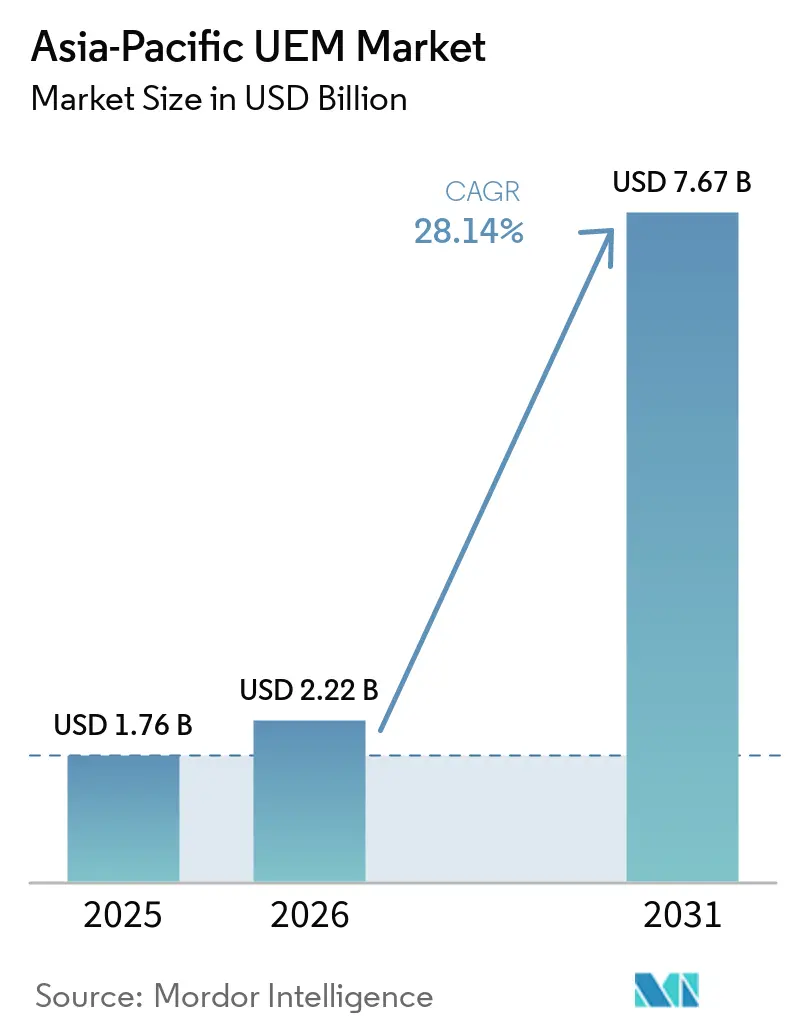
| Base Year Market Size (2025) | USD 1.76 Billion |
| Market Size (2026) | USD 2.22 Billion |
| Market Size (2031) | USD 7.67 Billion |
| Growth Rate (2026 - 2031) | 28.14 % |
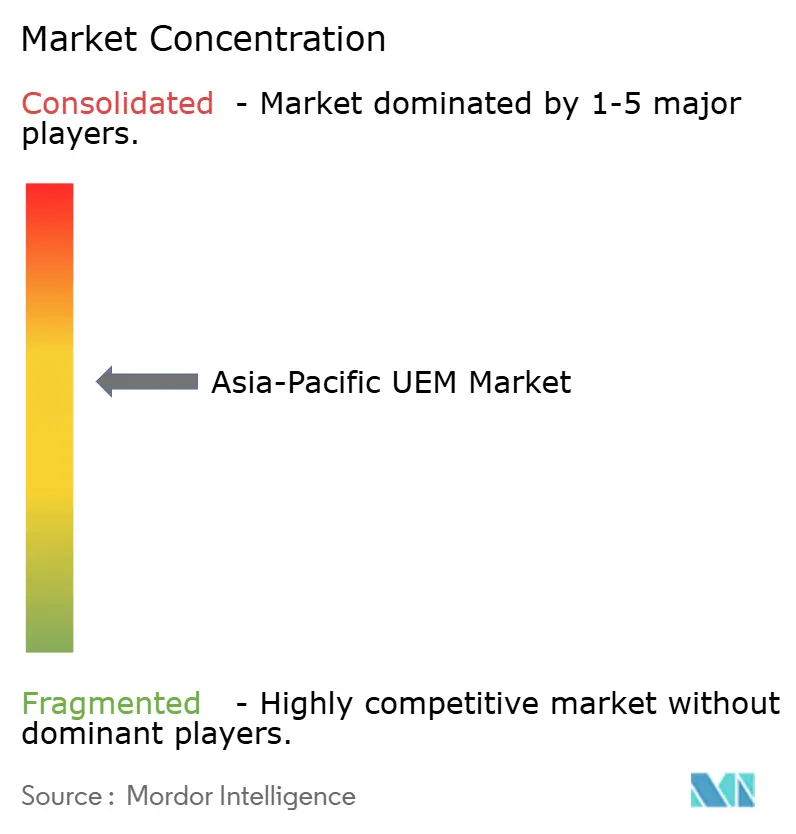
| Market Concentration | Medium |
Major Players *Disclaimer: Major Players sorted in no particular order Image © Mordor Intelligence. Reuse requires attribution under CC BY 4.0. | |
Asia-Pacific UEM Market Analysis by Mordor Intelligence
The Asia-Pacific UEM market size was valued at USD 1.76 billion in 2025 and is forecast to reach USD 7.67 billion by 2031 at a CAGR of 28.14% from 2026 to 2031. The Asia-Pacific unified endpoint management (UEM) market is expanding because enterprises across the region are replacing separate device, app, identity, and security tools with unified platforms that are easier to govern at scale. The demand base is widening because hybrid work, frontline mobility, and connected devices now sit under the same policy and compliance framework in many organizations. Buyers are also re-evaluating older on-premises estates as vendor roadmaps move toward cloud delivery, which is opening room for both large platform vendors and leaner challengers. At the same time, competitive decisions are being shaped by procurement uncertainty around legacy Workspace ONE environments and by the region’s uneven data residency rules, which make deployment design and vendor choice more important than before. The Asia-Pacific unified endpoint management market therefore remains a high-growth space where security depth, platform integration, migration support, and policy flexibility are all becoming central purchase criteria.
Key Report Takeaways
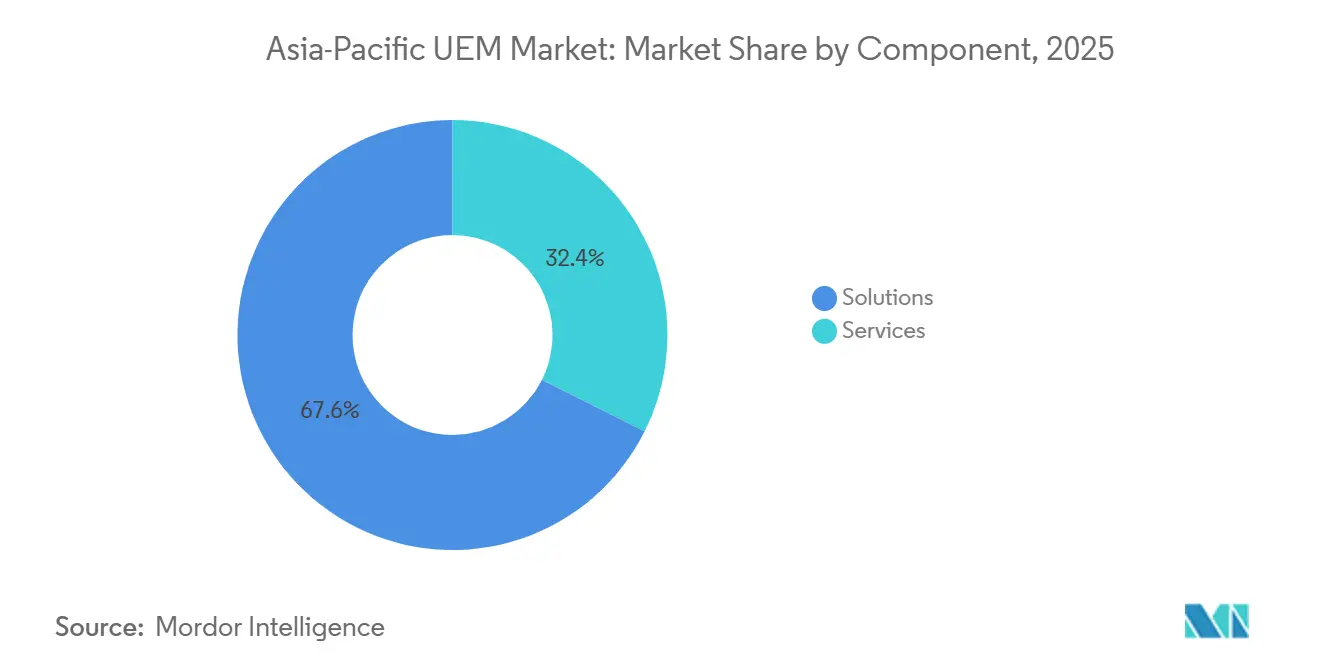
- By component, solutions held 67.62% of the Asia-Pacific UEM market share in 2025, while the same segment is projected to expand at 29.11% CAGR.
- By deployment mode, cloud-based deployment accounted for 61.45% of the Asia-Pacific unified endpoint management market size in 2025 and is projected to expand at a 29.54% CAGR through 2031.
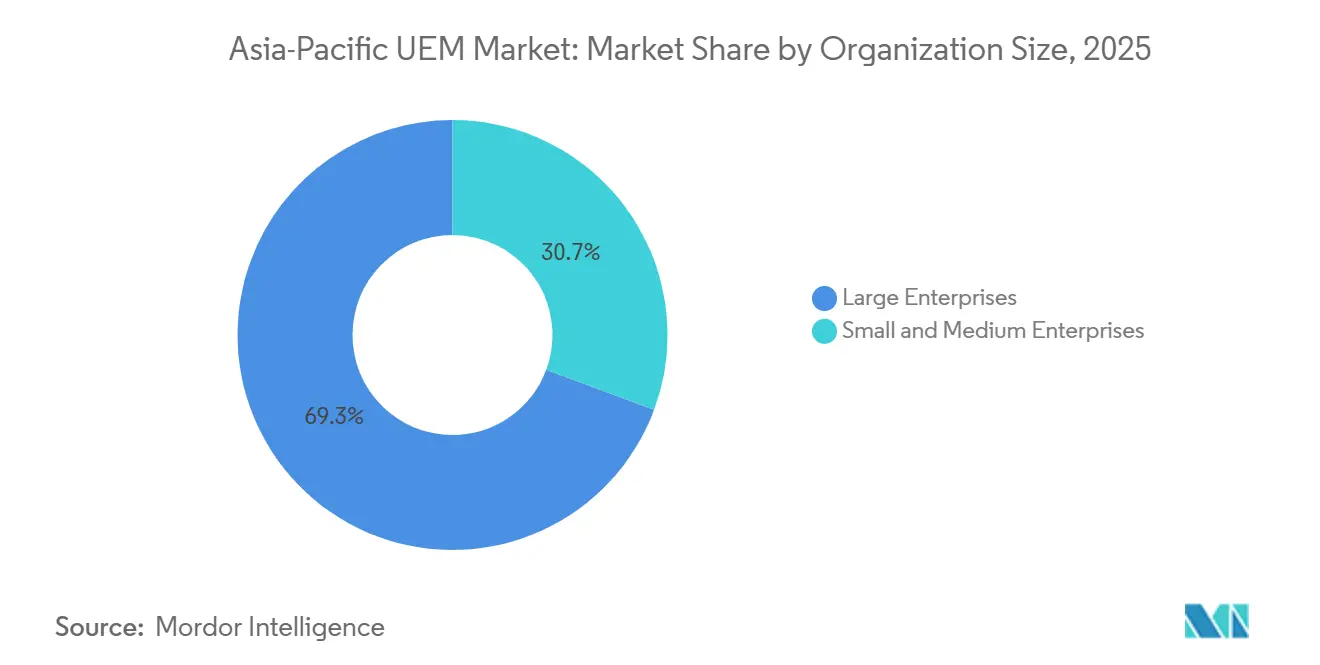
- By organization size, large enterprises held 69.34% of the Asia-Pacific UEM market in 2025, while small and medium-sized enterprises are projected to expand at a 29.61% CAGR through 2031.
- By end-user industry, IT and Telecommunications held the largest share at 23.25% of the Asia-Pacific unified endpoint management (UEM) market in 2025, while healthcare is projected to expand at a 29.27% CAGR through 2031.
- By country, China held 34.55% of the Asia-Pacific unified endpoint management market share in 2025, while India is projected to expand at a 29.21% CAGR through 2031.
Note: Market size and forecast figures in this report are generated using Mordor Intelligence’s proprietary estimation framework, updated with the latest available data and insights as of January 2026.
Market Trends and Insights
Drivers Impact Analysis of Asia-Pacific UEM Market*
| Driver | (~) % Impact on CAGR Forecast | Geographic Relevance | Impact Timeline |
|---|---|---|---|
| Hybrid Work and BYOD Acceleration | +6.5% | Global, with concentrated impact in India, Australia, Japan, and South Korea | Short term (≤ 2 years) |
| Escalating Cyber Threat Surface and Zero-Trust Rollouts | +5.8% | Global, Asia-Pacific core includes China, Southeast Asia, and India | Short term (≤ 2 years) |
| Platform Convergence of Endpoint, Identity, and Access Management | +4.2% | Global, Asia-Pacific leaders include Japan, South Korea, and Australia and New Zealand | Medium term (2-4 years) |
| AI-Based Digital Employee Experience Optimization | +3.5% | Global, Asia-Pacific leaders include India and South Korea | Medium term (2-4 years) |
| Frontline and IoT Device Expansion in Warehousing and Field Operations | +2.8% | Asia-Pacific core includes China, India, and Southeast Asia | Medium term (2-4 years) |
| Data Sovereignty-Driven Shift Toward Policy-Aware Cloud Management | +2.1% | Asia-Pacific core, with spillover into Australia and New Zealand and South Korea | Long term (≥ 4 years) |
| Source: Mordor Intelligence | |||
Hybrid Work and BYOD Acceleration
The Asia-Pacific UEM market is benefiting from a broader shift in work patterns, because personal devices, mixed operating systems, and distributed users are now common across enterprise estates. In practice, this is pushing buyers toward platforms that can separate work data from personal data and apply different controls by geography, user role, and device type. The Asia-Pacific UEM market is also gaining from the fact that many organizations now need one console to govern Android work profiles, Apple user enrollment, and Windows personal-use scenarios at the same time. That requirement is especially important in mobile-first business settings, where messaging apps and multi-device access create more compliance touchpoints than older desktop-heavy environments. The result is stronger demand for containerization, mobile application management, and policy segmentation features that sit inside unified platforms rather than as separate tools. This driver is making the Asia-Pacific unified endpoint management market more software-led, because enterprises are no longer buying only for inventory control and basic mobile device management.
Escalating Cyber Threat Surface and Zero-Trust Rollouts
The Asia-Pacific UEM market is also moving higher because the endpoint now acts as a control point for identity, access, and security policy rather than as a simple managed asset. Buyers are asking for continuous posture checks, conditional access support, and faster revocation workflows as zero-trust programs spread across cloud applications and internal networks. Ivanti introduced Autonomous Endpoint Management in its Q1 2026 release, shifting remediation closer to a continuous model instead of periodic maintenance cycles.[1] The same release also added Workspace AI Diagnostics in technical preview, which shows how vendors are tying device signals and automated problem resolution into the same platform.
Platform Convergence of Endpoint, Identity, and Access Management
The Asia-Pacific UEM market is being reshaped by vendor strategies that merge device governance, identity controls, and access management into one operating model. This shift matters in the region because many enterprises want fewer consoles, fewer policy conflicts, and less integration work across productivity, security, and endpoint teams. Secioss announced in April 2026 that SeciossLink had integrated with Omnissa Workspace ONE UEM so that security actions can respond automatically when endpoint compliance status changes.[2] That kind of workflow shows why buyers are moving toward platforms that can connect identity response with device posture inside one automated chain. The Asia-Pacific unified endpoint management market is therefore rewarding vendors that can reduce the operational gap between login control, compliance enforcement, and endpoint response. It is also reducing the appeal of siloed mobile device management tools that still depend on extensive custom integration for enterprise-scale use.
AI-Based Digital Employee Experience Optimization
The Asia-Pacific UEM market is also drawing support from a shift toward autonomous remediation and digital employee experience features. Buyers are no longer satisfied with dashboards alone, because they want tools that can detect device slowdowns, correlate them with app or patch issues, and fix them with less manual effort. Ivanti expanded its Neurons platform in 2026 with AI-driven capabilities across IT and security operations, including features designed to support autonomous workflows. NinjaOne said in January 2026 that it had launched Patch Intelligence AI while surpassing USD 500 million in annual recurring revenue, which points to strong market acceptance for automated endpoint operations. These moves matter in the Asia-Pacific unified endpoint management (UEM) market because many buyers manage large device fleets with lean IT teams, especially in retail, logistics, and distributed services. As a result, vendors with practical automation and self-healing features are improving their position faster than vendors that still focus on visibility alone.
Restraints Impact Analysis of Asia-Pacific UEM Market*
| Restraint | (~) % Impact on CAGR Forecast | Geographic Relevance | Impact Timeline |
|---|---|---|---|
| Data Sovereignty and Privacy Compliance Hurdles | -3.2% | Asia-Pacific core includes China, India, South Korea, Vietnam, and Thailand | Short term (≤ 2 years) |
| High Migration and Integration Cost of Legacy Estates | -2.8% | Global, with stronger impact in manufacturing-heavy Asia-Pacific markets including China, Japan, and South Korea | Medium term (2-4 years) |
| Procurement Uncertainty in Post-Broadcom VMware Environments | -1.5% | Global, with sharper impact on Asia-Pacific mid-market and large enterprises using legacy Workspace ONE deployments | Short term (≤ 2 years) |
| Talent Gap in Low-Code Automation and Scripting for UEM | -1.2% | Asia-Pacific includes Southeast Asia, India SME tier, and Rest of Asia-Pacific | Long term (≥ 4 years) |
| Source: Mordor Intelligence | |||
Data Sovereignty and Privacy Compliance Hurdles
The Asia-Pacific UEM market still faces friction because policy rules differ sharply across national jurisdictions. Enterprises that manage devices in several Asia-Pacific countries often cannot rely on one standard cloud design for telemetry, monitoring, audit retention, and breach response. This slows rollout timing and adds design work even when budget and product fit are already in place. The Asia-Pacific unified endpoint management market is especially exposed to this issue because endpoint platforms sit close to user data, device behavior, and incident records. That makes legal interpretation, hosting architecture, and workflow design part of the buying process rather than back-office tasks. The result is not weaker demand, but slower deployment and more customized implementation across regulated environments.
High Migration and Integration Cost of Legacy Estates
Migration cost remains a meaningful brake on the Asia-Pacific UEM market, especially for enterprises that still run older SCCM, early mobile device management, or on-premises Workspace ONE environments. Omnissa said Workspace ONE UEM on-premises v2410 is the final on-premises release and that support ends on April 30, 2027, which compresses migration timing for customers that delayed cloud transition.[3] In heavily regulated and industrial settings, moving to a new platform also means testing integrations with factory devices, internal apps, and strict change-control processes before full rollout. Tanium’s June 2026 NEC case study showed how deep the unification work can become when a large enterprise tries to bring heterogeneous endpoints under one visibility and control layer. The Asia-Pacific unified endpoint management market therefore continues to face delays that come more from integration effort than from license pricing alone. This restraint is keeping specialist migration support and services demand high across the Asia-Pacific unified endpoint management market.
*Our forecasts treat driver/restraint impacts as directional, not additive. The impact forecasts reflect baseline growth, mix effects, and variable interactions.
Asia-Pacific UEM Market Segment Analysis
By Component:
Solutions Architecture Powers UEM SpendSolutions held 67.62% of the 2025 market, growing at 29.11% CAGR through 2031, which shows that the commercial core of the Asia-Pacific UEM market still sits in software rather than delivery support. Buyers continue to prioritize device management, application management, content management, security and compliance management, and analytics and automation inside a single console because that reduces policy overlap and tool sprawl. Device management, security, and compliance management remain central purchases because device posture increasingly feeds access decisions and broader security workflows. This keeps bundled buying behavior strong and gives integrated platforms a clear edge when enterprises want fewer handoffs between endpoint and security teams. The Asia-Pacific unified endpoint management market is therefore rewarding solutions that can combine control, enforcement, and reporting without forcing clients into separate management stacks.
Content management remains a quieter but still important part of the solutions mix, because field tablets, kiosks, and shared devices need secure document distribution and offline governance in the same workflow as app and device control. Analytics and automation is still the smallest solutions sub-segment, but it is expanding fastest inside the solutions layer as organizations look for fewer service tickets and better operational efficiency. Ivanti’s Q1 2026 release, which brought Autonomous Endpoint Management into the product line, reflects how vendors are moving from static monitoring toward predictive and automated remediation. The services segment also continues to grow because many organizations understand that installing a platform and producing measurable operating gains are not the same task. Across the Asia-Pacific UEM industry, this split is creating one market for standardized deployments and another for more complex, multi-vendor integration support.
By Deployment Mode:
Cloud Ascendancy Reshapes UEM ArchitectureCloud-based deployment accounted for 61.45% of the 2025 market and is advancing at a 29.54% CAGR from 2026 to 2031, giving it the clearest lead within the Asia-Pacific UEM market size discussion. Its lead comes from the need to synchronize policy across distributed users and devices in real time rather than from a simple preference for hosted software. For many enterprises, especially those operating across several provinces, states, or national markets, cloud delivery supports faster updates and more consistent governance than older on-site models. That practical advantage becomes more important when device fleets include laptops, smartphones, tablets, and frontline endpoints under one policy structure. The Asia-Pacific UEM market is therefore moving toward cloud because the operating model fits the region’s scale and geographic spread better than legacy point infrastructure.
On-premises deployment still holds a defensible position in government, defense, and certain tightly controlled environments where sovereign hosting and air-gapped requirements remain essential. The hybrid model is also gaining ground because it offers a middle path for clients that want local policy control while using public cloud for analytics and reporting. Omnissa’s move toward a SaaS-only direction, with v2410 as the final perpetual on-premises release, is pushing customers to revisit long-term architecture choices. Ivanti also launched a Sovereign Edition in June 2026, showing that vendors see continued demand for cloud convenience shaped by stricter data boundary controls. Across the Asia-Pacific UEM industry, that means cloud wins on direction, while hybrid remains important wherever policy and hosting rules still limit a full public cloud design.
By Organization Size:
Large Enterprises Anchor Demand While SMEs Expand FasterLarge enterprises held 69.34% of the 2025 Asia-Pacific UEM market, which reflects their bigger device estates, wider operating system mix, and stricter internal compliance needs. These organizations also have the scale and budget to absorb per-seat pricing, migration projects, and integration work that smaller buyers often delay. Enterprise accounts are increasingly contested by vendors that can offer real-time visibility, stronger automation, and proof of performance in heavily regulated environments. Tanium’s enterprise traction in Japan, including case studies involving NEC and Mizuho Financial Group, illustrates how large accounts are prioritizing depth of visibility and operational control across complex estates. This keeps large enterprises at the center of current spending across the Asia-Pacific UEM market.
Small and medium-sized enterprises are the fastest-growing organization-size cohort, advancing at a 29.61% CAGR from 2026 to 2031. Their growth is being supported by cloud-native delivery, easier onboarding, and channel-led service models that remove the need for deep in-house endpoint expertise. NinjaOne said in January 2026 that it had more than 35,000 customers across more than 140 countries and had surpassed USD 500 million in annual recurring revenue, which supports the strength of the managed service provider and SME tier. Pax8 and NinjaOne also launched a global partnership in April 2026 that explicitly covered Asia-Pacific, giving managed service providers another route to deliver endpoint management, patching, backup, and remote access in one offer. This is widening access to the Asia-Pacific UEM market beyond the large enterprise base that defined earlier demand.
By End-User Industry:
Healthcare Emerges as the Fastest-Growing VerticalIT and Telecommunications held the largest end-user share at 23.25% in 2025, which shows how strongly the Asia-Pacific UEM market is tied to dense endpoint environments and service continuity needs. Telecom operators, network operations centers, call centers, and distributed service teams manage large device estates where configuration drift can quickly affect performance and customer commitments. BFSI followed as the second-largest vertical because banks and financial institutions have long invested in device compliance for audit readiness, secure access, and operational resilience. Tanium’s February 2026 Mizuho Financial Group case study shows how large financial institutions are pushing toward real-time estate visibility across thousands of managed devices instead of relying on slower scan-based oversight. This pattern keeps heavily regulated service sectors near the center of spending in the Asia-Pacific UEM market.
Healthcare is advancing at a 29.27% CAGR from 2026 to 2031, making it the fastest-growing vertical in the region. Growth is being driven by a rising mix of bedside tablets, connected infusion pumps, wearable monitors, telehealth endpoints, and other clinical devices that need consistent control across varied operating systems. Singapore’s Health Sciences Authority updated its GL-04 regulatory guidelines in December 2025 and required manufacturers to document cybersecurity plans related to operating system end-of-life risk for software medical devices. Manufacturing, Energy and Utilities, Government and Defense, Retail and E-Commerce, Transportation and Logistics, and Education are also expanding the device base that the Asia-Pacific unified endpoint management market must govern, because each vertical brings its own blend of shared terminals, mobile workers, or regulated workflows. Taken together, these sectors are pushing the Asia-Pacific UEM market well beyond the laptop-and-smartphone footprint that shaped earlier mobile device management demand.
Geography Analysis
Northeast Asia UEM Market
China held 34.55% of the regional market in 2025, giving it the largest position in the Asia-Pacific unified endpoint management market size profile. Its lead comes from the scale of enterprise IT estates, especially in state-linked energy, banking, and telecommunications organizations where endpoint density is high. The China Network Security Industry Alliance published the “Unified Endpoint Management Security Capability Requirements” group standard in February 2026, which formalized security and compliance expectations around UEM procurement. That publication matters because it shifts buyer evaluation beyond basic device control and toward security capability, compliance, and domestic technology alignment. Japan and South Korea also remain sophisticated markets where enterprise buyers place strong weight on compliance, scale, and controlled deployment models.
India UEM Market
Japan is seeing stronger executive attention around autonomous endpoint management, not just routine IT operations. Tanium’s Converge Tokyo 2026 event was its largest Japanese customer event to date and included the regional debut of the Tanium Atlas platform along with participation from Japan’s Ministry of Defense and NEC. South Korea remains important because its enterprise density is high and privacy protections continue to shape how employers monitor and separate corporate and personal data on devices. India is the fastest-growing country, advancing at a 29.21% CAGR from 2026 to 2031, and it is becoming one of the most important growth engines in the Asia-Pacific unified endpoint management market. That growth reflects strong hybrid-work adoption, wider endpoint visibility needs, and greater urgency around continuous control as enterprises scale digital operations.
Oceania and ASEAN UEM Market
Australia and New Zealand form a mature and security-aware market where the managed service provider route is especially influential. blueAPACHE announced a strategic partnership with NinjaOne in April 2026 to use NinjaOne’s unified IT operations platform as a core part of its managed services model across Australian mid-market clients. Southeast Asia remains one of the highest-potential sub-regions in the Asia-Pacific unified endpoint management market because enterprise digitization is moving quickly across Indonesia, the Philippines, Malaysia, Vietnam, and Thailand. Tanium also strengthened its regional commercial focus through Asia-Pacific leadership moves and dedicated ASEAN coverage, which reflects growing vendor interest in Southeast Asian expansion. Rest of Asia-Pacific, including Taiwan, Bangladesh, and Pacific economies, still contributes a smaller share, but demand is rising in financial services and government-led deployments where unified policy control is becoming harder to postpone.
Competitive Landscape
The Asia-Pacific UEM market is moderately concentrated, with Microsoft Intune, Workspace ONE under Omnissa, and IBM MaaS360 forming the most established installed-base group. Their position comes from scale, enterprise relationships, and the ability to connect endpoint governance with broader security and productivity ecosystems. At the same time, the Asia-Pacific UEM market is not closed, because cloud-native challengers are gaining room where buyers want faster deployment, more automation, and simpler pricing. Microsoft strengthened its competitive position in May 2026 when it highlighted its continued leadership in endpoint protection, supporting its broader enterprise defense narrative around integrated control. That matters because buyers increasingly prefer vendors that can connect endpoint, identity, and security response within one operating environment.
Competitive pressure is also rising around migration events and channel strategy. Omnissa’s published end-of-support timeline for Workspace ONE UEM on-premises v2410 has created a clear transition window that other vendors can target with migration tools, cloud-first messaging, and pricing alternatives. NinjaOne has been using this opening to strengthen its presence in the service provider and mid-market segment, supported by its January 2026 revenue milestone and its April 2026 Pax8 partnership across Asia-Pacific. blueAPACHE’s alliance with NinjaOne in Australia adds another example of how local channel strength is shaping market access in the region. The Asia-Pacific unified endpoint management market is therefore becoming more competitive not only at the product level, but also through service networks and migration execution.
A second line of competition is forming around AI-led remediation and frontline device use cases. Ivanti has pushed its Neurons platform further into autonomous operations and sovereign cloud positioning, which helps it address both automation demand and data control concerns. Tanium has also raised its profile in Japan with Atlas and large enterprise case studies that emphasize deep visibility and operational control. India-headquartered vendors such as Hexnode, 42Gears, and ManageEngine are also benefiting from regional cost structures and channel familiarity, especially in Southeast Asia and Australia and New Zealand. This keeps the Asia-Pacific UEM market active and contested, even though global incumbents still hold the strongest installed bases.
Asia-Pacific UEM Industry Leaders
-
Microsoft Corporation
-
Broadcom Inc.
-
IBM Corporation
-
Ivanti, Inc.
-
BlackBerry Limited
- *Disclaimer: Major Players sorted in no particular order
Asia-Pacific UEM Market Companies Covered in this Report
- Microsoft Corporation
- Broadcom Inc.
- International Business Machines Corporation
- Citrix Systems, Inc.
- Ivanti, Inc.
- BlackBerry Limited
- 42Gears Mobility Systems Pvt Ltd.
- Matrix42 AG
- SOTI Inc.
- Sophos Ltd.
- Zoho Corporation Pvt. Ltd.
- Cisco Systems, Inc.
- Jamf Software, LLC
- Google LLC
- Tanium Inc.
- Kaseya Limited
- NinjaOne, LLC
- Automox, Inc.
- Quest Software Inc.
- Open Text Corporation
Recent Industry Developments in Asia-Pacific UEM Market
- June 2026: Tanium launched Tanium Atlas, its AI-era IT and security operations platform, and hosted Converge Tokyo 2026, the company's largest Japanese customer event, featuring keynotes from Japan's Ministry of Defense and NEC. The event marked the regional debut of Atlas and reflected Tanium's accelerating government and enterprise traction in Japan, capped by the concurrent publication of its NEC enterprise implementation case study.
- June 2026: Ivanti launched Ivanti Neurons for MDM - Sovereign Edition - EU, a cloud-based autonomous endpoint management solution purpose-built for European data sovereignty and regulatory compliance, managed independently through BSI-certified data centers. While primarily EU-facing, the sovereign architecture design principles and the underlying Neurons for MDM platform are directly relevant to Asia-Pacific deployments navigating China MLPS and APAC data-residency requirements.
- May 2026: Microsoft was named a Leader in the 2026 Gartner® Magic Quadrant™ for Endpoint Protection for the seventh consecutive time, with Microsoft Defender's endpoint detection and response capabilities positioned as the foundation for coordinated defense spanning endpoints, identity, email, and cloud. The recognition reinforces Microsoft Intune's bundled UEM positioning in Asia-Pacific enterprise accounts.
- May 2026: Microsoft announced that advanced Intune capabilities previously sold as premium add-ons, including Endpoint Privilege Management, Enterprise Application Management, Cloud PKI, Remote Help, and Advanced Analytics, will be included in Microsoft 365 E3 and E5 licenses from July 2026, fundamentally shifting UEM from a separate procurement to an embedded enterprise entitlement.
Asia-Pacific UEM Market Report Scope
The Asia-Pacific Unified Endpoint Management (UEM) Market represents a comprehensive ecosystem of solutions, platforms, and services designed to centrally manage, monitor, and secure a diverse range of endpoint devices, including smartphones, tablets, laptops, desktops, wearables, IoT devices, and ruggedized enterprise hardware, across organizations.
The Asia-Pacific Unified Endpoint Management (UEM) Market Report is Segmented by Component (Solutions [Device Management, Application Management, Content Management, Security and Compliance Management, and Analytics and Automation] and Services), Deployment Mode (Cloud-Based, On-Premise, and Hybrid), Organization Size (Large Enterprises and Small and Medium Enterprises), End-User Industry (IT and Telecommunications, BFSI, Government and Defense, Healthcare and Life Sciences, Manufacturing, Retail and E-Commerce, Education, Transportation and Logistics, Energy and Utilities, and Other End-User Industries), and Country (China, Japan, India, South Korea, Australia and New Zealand, Southeast Asia, and Rest of Asia-Pacific). The Market Forecasts are Provided in Terms of Value (USD).
Segmentation Overview
| Solutions | Device Management |
| Application Management | |
| Content Management | |
| Security and Compliance Management | |
| Analytics and Automation | |
| Services |
| Cloud-Based |
| On-Premise |
| Hybrid |
| Large Enterprises |
| Small and Medium Enterprises |
| IT and Telecommunications |
| BFSI |
| Government and Defense |
| Healthcare and Life Sciences |
| Manufacturing |
| Retail and E-Commerce |
| Education |
| Transportation and Logistics |
| Energy and Utilities |
| Other End-User Industries |
| China |
| Japan |
| India |
| South Korea |
| Australia and New Zealand |
| Southeast Asia |
| Rest of Asia-Pacific |
| By Component | Solutions | Device Management |
| Application Management | ||
| Content Management | ||
| Security and Compliance Management | ||
| Analytics and Automation | ||
| Services | ||
| By Deployment Mode | Cloud-Based | |
| On-Premise | ||
| Hybrid | ||
| By Organization Size | Large Enterprises | |
| Small and Medium Enterprises | ||
| By End-User Industry | IT and Telecommunications | |
| BFSI | ||
| Government and Defense | ||
| Healthcare and Life Sciences | ||
| Manufacturing | ||
| Retail and E-Commerce | ||
| Education | ||
| Transportation and Logistics | ||
| Energy and Utilities | ||
| Other End-User Industries | ||
| By Country | China | |
| Japan | ||
| India | ||
| South Korea | ||
| Australia and New Zealand | ||
| Southeast Asia | ||
| Rest of Asia-Pacific |
Key Questions Answered in the Report
What is the current and future size of the Asia-Pacific UEM space?
It was valued at USD 1.76 billion in 2025 and is forecast to reach USD 7.67 billion by 2031, growing at a 28.14% CAGR from 2026 to 2031.
Which deployment model is leading adoption across Asia-Pacific?
Cloud-based deployment led with 61.45% of the 2025 total and is also the fastest-growing model, with a 29.54% CAGR through 2031.
Which country is leading regional demand and which one is growing fastest?
China held the largest share at 34.55% in 2025, while India is the fastest-growing country with a 29.21% CAGR through 2031.
Which customer group is creating the largest revenue base?
Large enterprises accounted for 69.34% of 2025 demand, mainly because they manage more devices, more operating systems, and stricter compliance programs.
Which vertical is expanding fastest in Asia-Pacific UEM?
Healthcare is the fastest-growing end-user vertical at a 29.27% CAGR through 2031, supported by the spread of connected clinical devices and tighter cybersecurity expectations.
What are the main factors shaping vendor competition in this category?
Competition is being driven by cloud migration, endpoint and identity convergence, AI-based remediation, and vendor support for complex migration from legacy on-premises estates.