
North America UEM Market Size and Share
Market Overview
| Study Period | 2020 - 2031 |
|---|---|
| Forecast Data Period | 2026 - 2031 |
| Base Year Market Size (2025) | USD 2.63 Billion |
| Market Size (2026) | USD 3.21 Billion |
| Market Size (2031) | USD 9.29 Billion |
| Growth Rate (2026 - 2031) | 23.65 % |
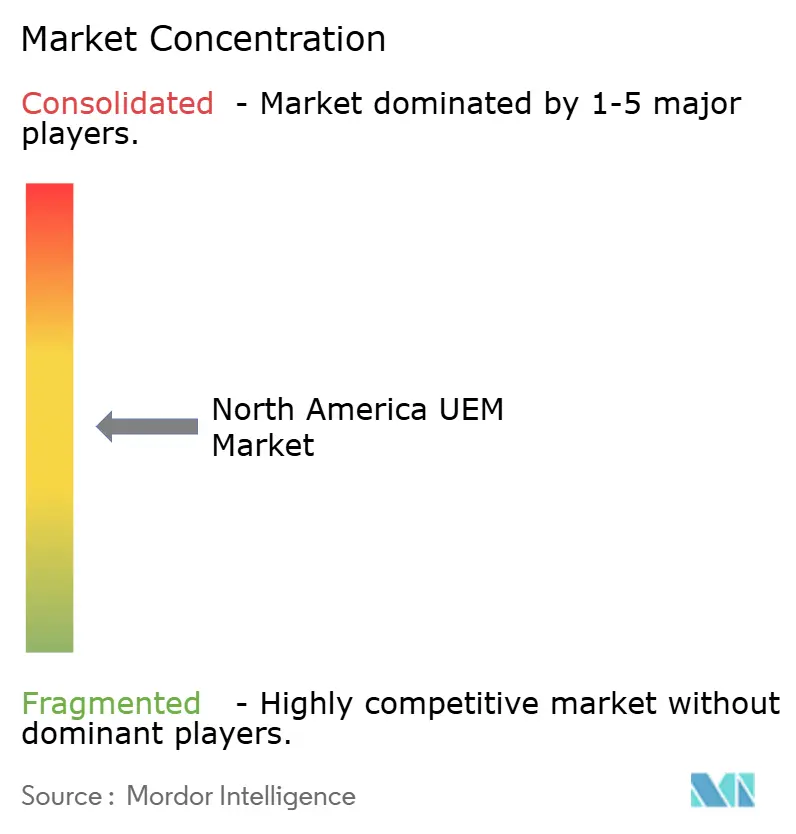
| Market Concentration | Medium |
Major Players *Disclaimer: Major Players sorted in no particular order Image © Mordor Intelligence. Reuse requires attribution under CC BY 4.0. | |
North America UEM Market Analysis by Mordor Intelligence
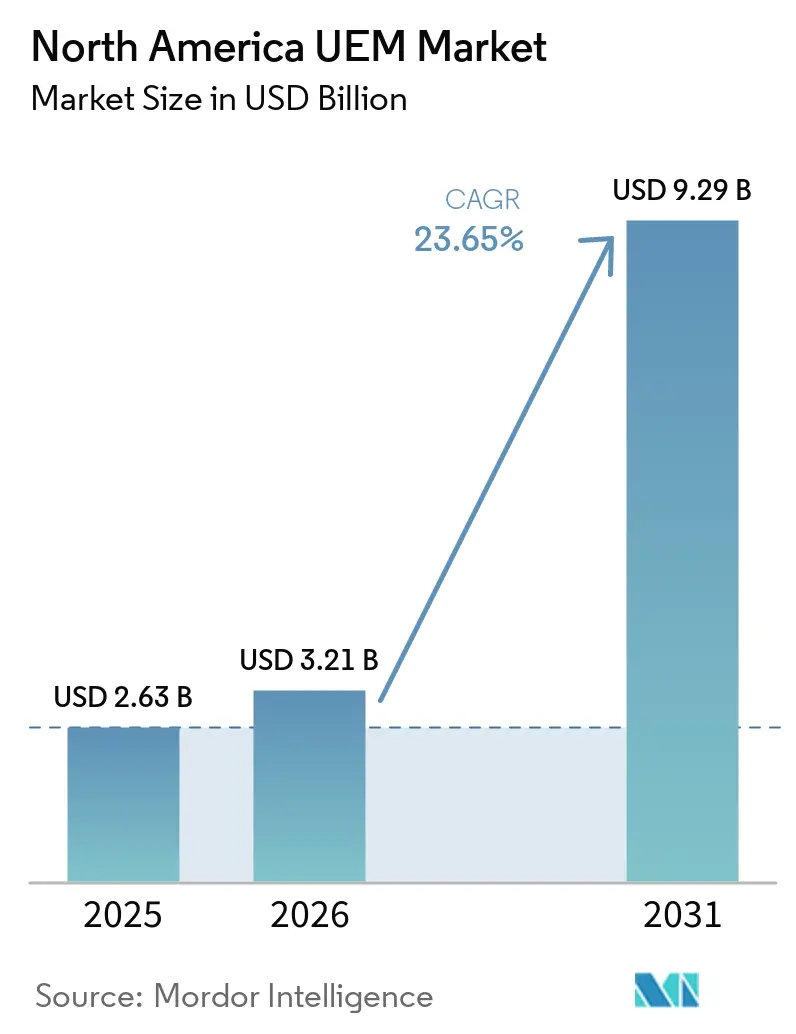
The North America unified endpoint management (UEM) market size is projected to expand from USD 2.63 billion in 2025 and USD 3.21 billion in 2026 to USD 9.29 billion by 2031, registering a CAGR of 23.65% between 2026 to 2031. The North America unified endpoint management market is growing because enterprises now need one control layer across laptops, phones, tablets, and connected devices that run on different operating systems. The shift from stand-alone mobile device management and enterprise mobility management tools toward unified, AI-enabled platforms is also changing how buyers define value in the North America UEM market. Compliance pressure, cyber insurance requirements, and distributed work models have moved endpoint control from an IT operations task to an executive priority across the North America unified endpoint management market. Competition is becoming tighter as large suite vendors use bundling to widen adoption, while focused specialists use automation and faster deployment to win migrations in the North America UEM market. Procurement uncertainty around the VMware transition is slowing some buying decisions, but it is also creating openings for vendors that can offer cleaner road maps and lower disruption in the North America unified endpoint management market.
Key Report Takeaways
- By component, Solutions accounted for 69.23% of revenue in 2025 in the North America UEM market, while the same segment grew at a 24.49% CAGR through 2031.
- By deployment mode, cloud-based platforms accounted for 66.76% share of the North America UEM market size in 2025 and are projected to expand at a 24.54% CAGR through 2031.
- By organization size, large enterprises held 74.22% of the North America unified endpoint management (UEM) market share in 2025, while SMEs are projected to grow at the fastest CAGR of 24.61% through 2031.
- By end-user industry, IT and Telecommunications accounted for 23.27% of revenue in 2025, while Healthcare and Life Sciences is projected to expand at a 24.45% CAGR through 2031.
- By country, the United States led with 83.22% revenue share in 2025, while Mexico is projected to record the fastest CAGR of 24.52% through 2031.
Note: Market size and forecast figures in this report are generated using Mordor Intelligence’s proprietary estimation framework, updated with the latest available data and insights as of January 2026.
Market Trends and Insights
Drivers Impact Analysis of North America UEM Market*
| Driver | (~) % Impact on CAGR Forecast | Geographic Relevance | Impact Timeline |
|---|---|---|---|
| Escalating Cyber Threat Surface and Zero-Trust Rollouts | +5.2% | Global, critical in North America and European Union | Short term (≤ 2 years) |
| Hybrid Work and BYOD Acceleration | +4.8% | Global, highest in United States and Canada | Medium term (2-4 years) |
| Platform Convergence of Endpoint, Identity, And Access Management | +3.9% | North America and Europe leading | Long term (≥ 4 years) |
| AI-Based Digital Employee Experience Optimization | +3.5% | Global, early adoption concentrated in North America | Medium term (2-4 years) |
| Frontline And IoT Device Explosion in Warehousing and Field Operations | +2.6% | Manufacturing-heavy and logistics-intensive regions | Medium term (2-4 years) |
| ESG-Driven Demand for Device-Level Carbon and Energy Analytics | +1.4% | North America and Europe | Long term (≥ 4 years) |
| Source: Mordor Intelligence | |||
Escalating Cyber Threat Surface and Zero-Trust Rollouts
The North America UEM market is benefiting from the way endpoint posture has become a gatekeeper for secure access across regulated sectors. Federal zero-trust guidance has pushed both public agencies and contractors toward continuous verification of device compliance before access is granted. That shift raises the value of platforms that can confirm patch status, encryption state, and policy adherence at scale across the North America UEM market. Financial services, healthcare, and government buyers are moving faster because endpoint evidence now supports audits, renewals, and incident response documentation. As a result, security budgets and endpoint management budgets are becoming more closely linked across the North America unified endpoint management (UEM) market.
Hybrid Work and BYOD Acceleration
Hybrid work has permanently expanded the range of devices that IT teams must secure and manage in the North America UEM market. Enterprises now support company laptops, personal phones, shared devices, and remote operational endpoints that all need consistent policy enforcement. BYOD adds another layer because organizations must separate business controls from personal data without weakening security. Cloud-based policy delivery is becoming more important because it works across remote environments without relying on older network assumptions. This is keeping demand strong in the North America UEM market, especially among firms that want broad coverage with limited internal staffing.
Platform Convergence of Endpoint, Identity, and Access Management
The North America UEM market is also being shaped by a broader move toward platform consolidation. Buyers increasingly want endpoint control, identity checks, security telemetry, and access policies to work as one operating layer instead of separate tools. This encourages longer contracts because once a buyer aligns device compliance with user access, switching costs rise. Jamf's April 2025 acquisition of Identity Automation shows how vendors are linking endpoint governance with role-based access controls in healthcare and education.[1] The vendors with stronger integrations across security and identity are therefore gaining an advantage as the North America UEM market matures.
AI-Based Digital Employee Experience Optimization
AI-based automation is changing how buyers evaluate the North America UEM market. IT teams want platforms that can detect issues early, recommend actions, and complete routine remediation without adding staff. That makes digital employee experience, scripting, and autonomous workflows part of the core buying decision rather than optional extras. Ivanti's 2026 Neurons updates added AI-driven capabilities aimed at autonomous detection, decision, and action across endpoint and security operations.[2] This trend is widening contract values because vendors can charge more for automation layers even when baseline UEM pricing remains steady in the North America unified endpoint management market.
Restraints Impact Analysis of North America UEM Market*
| Restraint | (~) % Impact on CAGR Forecast | Geographic Relevance | Impact Timeline |
|---|---|---|---|
| Post Broadcom-VMware Procurement Uncertainty | -2.9% | Global, highest in North America and Europe | Short term (≤ 2 years) |
| Data Sovereignty and Privacy Compliance Hurdles | -2.5% | North America, with spillover to European Union | Short term (≤ 2 years) |
| High Migration and Integration Cost of Legacy Estates | -2.0% | Global, acute in large enterprises | Medium term (2-4 years) |
| Talent Gap in Low-Code Automation and Scripting for UEM | -1.7% | Global, acute in SME segment | Long term (≥ 4 years) |
| Source: Mordor Intelligence | |||
Post Broadcom-VMware Procurement Uncertainty
The North America UEM market is still absorbing the disruption created by Broadcom's VMware acquisition and the later sale of the end-user computing division to KKR. Many organizations that had standardized on Workspace ONE were forced to reassess product road maps, contract terms, and migration timing. The reported shift from perpetual licensing toward subscription models, and the pressure placed on legacy users, made some enterprise buyers pause large commitments. That pause has helped challengers win evaluations, but it has also lengthened decision cycles across the North America UEM market. Buyers already in transition face added cost because they often need to run old and new environments side by side until governance risk is removed.
Data Sovereignty and Privacy Compliance Hurdles
Privacy and data control rules are another brake on the North America UEM market. US organizations often need to map endpoint controls to different frameworks such as HIPAA, GLBA, CCPA and CPRA, and CMMC 2.0, which increases configuration work and audit preparation. The burden becomes heavier for companies that operate across multiple states and regulated business lines at the same time. Healthcare buyers have faced extra scrutiny since the Department of Health and Human Services proposed updates to the HIPAA Security Rule in late 2024.[3] Large enterprises can absorb most of this work, but mid-sized organizations often slow deployments because the legal and technical workload is high relative to available staff.
*Our forecasts treat driver/restraint impacts as directional, not additive. The impact forecasts reflect baseline growth, mix effects, and variable interactions.
North America UEM Market Segment Analysis
By Component:
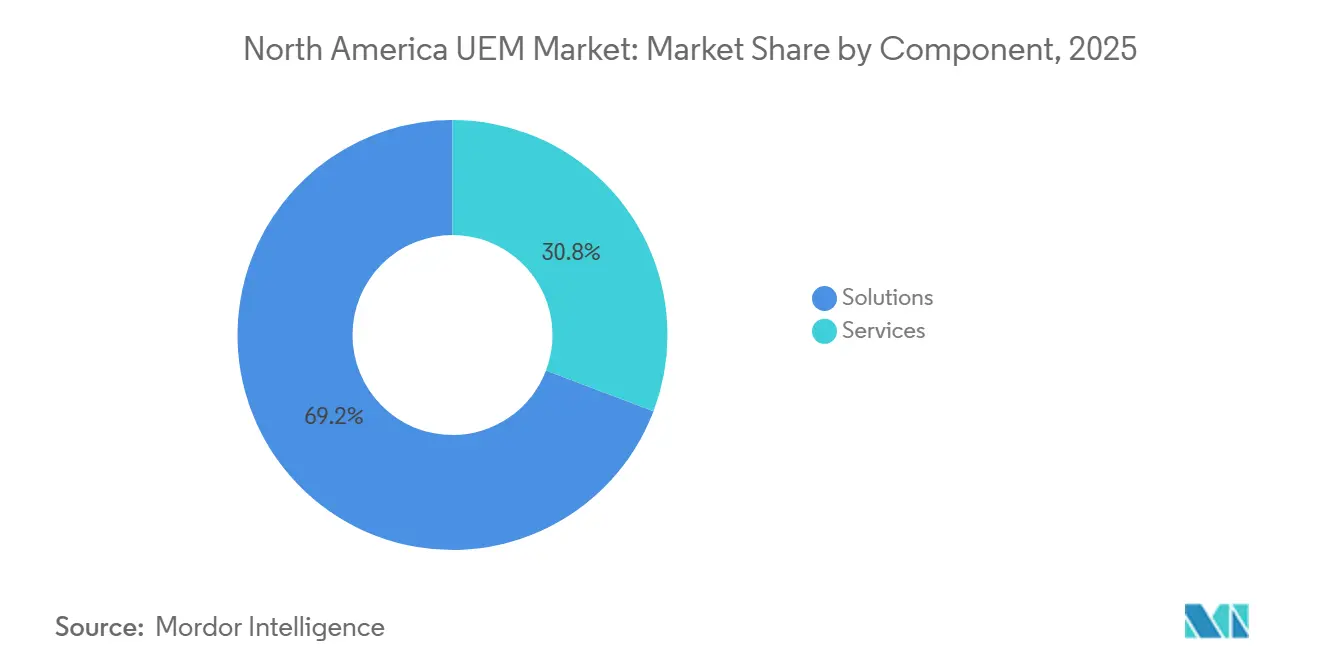
Analytics And Automation Gain Share Within A Solutions-Led MarketSolutions accounted for 69.23% of the North America UEM market size in 2025, growing at 24.49% CAGR through 2031, which kept the component structure clearly weighted toward software-led spending. Security and compliance management remained the largest solutions sub-segment because buyers needed stronger policy enforcement, audit trails, and posture validation across large device estates. Device management, application management, and content management still held meaningful roles, but they were more closely tied to core fleet administration than to new strategic spending. Analytics and automation drew the strongest fresh interest because enterprises wanted fewer manual tasks, faster remediation, and better evidence generation across the North America UEM market.
Services represented the remaining 30.77% of 2025 revenue, with managed services advancing faster than professional services as buyers favored ongoing operating support over one-time deployment work. This shift has been most visible among SMEs and mid-market firms that lack in-house specialists for scripting, compliance design, and cross-platform policy control. It is also changing vendor economics because recurring service layers can stay attached to the account long after the initial rollout is complete. Over time, the line between software and services will keep narrowing as automation, reporting, and remediation are packaged as continuing operational capabilities rather than isolated implementation steps.
By Deployment Mode:
Cloud Platforms Consolidate While On-Premises Use Cases PersistCloud-based UEM held 66.76% of revenue in 2025 and is projected to grow at a 24.54% CAGR through 2031, making it the clearest growth engine in the deployment mix. Its main advantage is architectural flexibility because policy delivery can reach remote users and distributed devices without depending on older VPN-centered processes. That benefit became more important as organizations moved from fixed office networks to hybrid work and multi-site operations. The North America UEM market is therefore tilting further toward cloud control planes that can support broader operating system coverage and faster updates.
Microsoft's April and May 2026 Intune updates expanded app inventory refreshes, Linux single sign-on, and Apple Automated Device Enrollment support for government cloud users. Those changes show how cloud-native platforms are extending into areas that once required separate tools or custom work. On-premises deployments still matter in government, defense, and some healthcare settings where residency, sovereignty, or air-gap conditions remain strict. Hybrid models will stay relevant for buyers that want central visibility but still need local enforcement nodes while they phase out older estates.
By Organization Size:
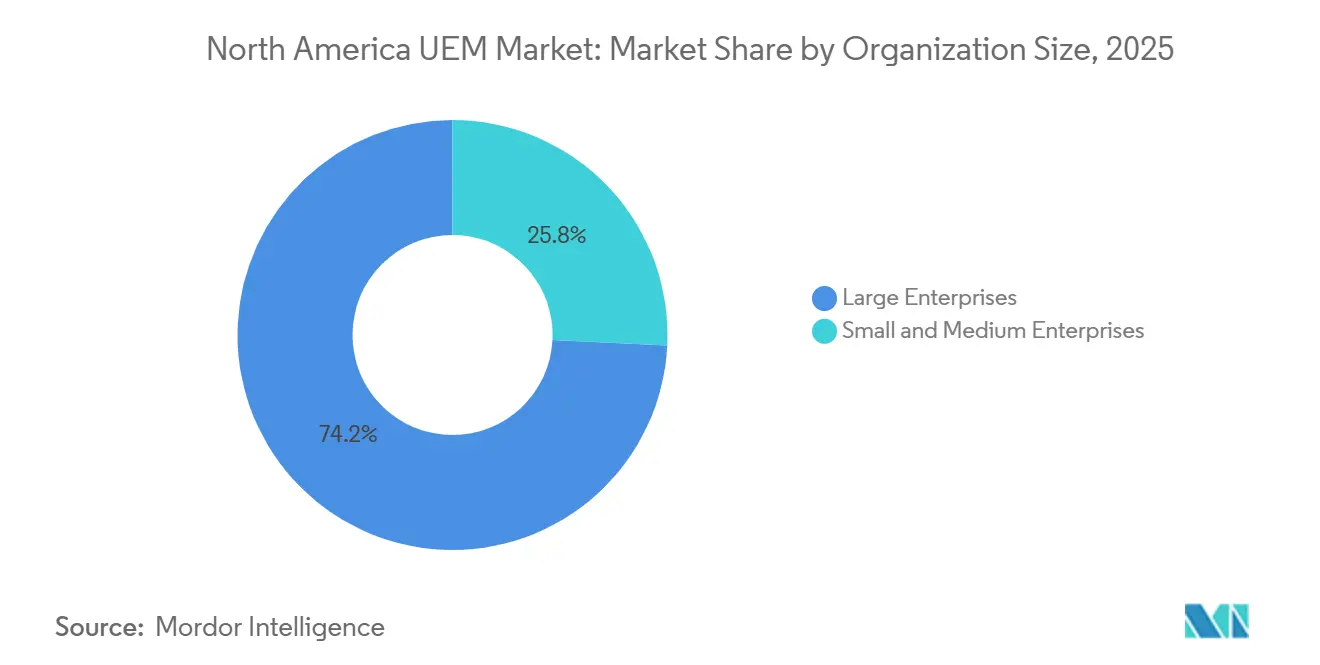
Large Enterprises Lead While SMEs Set The Pace For ExpansionLarge enterprises retained 74.22% of North America UEM market share in 2025, reflecting the scale and complexity of their device fleets across locations, business units, and operating systems. Their spending is now centered less on basic enrollment and more on consolidation, advanced analytics, digital employee experience, and autonomous management layers. Companies that have grown through mergers remain active buyers because overlapping tools create both cost duplication and compliance risk. This keeps large organizations central to revenue generation in the North America unified endpoint management market even when the broader economy is uneven.
SMEs are projected to grow at a 24.61% CAGR through 2031, which makes them the fastest expanding customer group. Much of that growth is tied to MSP-delivered operating models that reduce up-front effort and convert specialist tasks into subscription support. NinjaOne's June 2026 funding event, completed at a USD 12.3 billion valuation after strong 2025 revenue growth, highlights how much capital is flowing toward platforms built for managed and mid-market use cases. The North America UEM market will keep seeing SME adoption rise as cloud deployment, automation, and partner-led delivery lower the barrier that once favored only enterprise-class buyers.
By End-User Industry:
Healthcare Momentum Builds As Vertical Requirements TightenIT and Telecommunications held the largest end-user share at 23.27% in 2025, supported by the sector's large and diverse installed base of managed devices. This segment already had higher UEM maturity than most others, so current investment is aimed more at optimization, AI support, and policy consistency than at first-time rollout. Telecom operators and technology service providers also need stronger endpoint governance because their workforces, service teams, and device fleets are widely distributed. That keeps the sector important to the North America UEM market even if its growth rate is lower than in later-adopting verticals.
Healthcare and Life Sciences is projected to grow at a 24.45% CAGR through 2031, making it the fastest-growing vertical in the current mix. Clinical organizations are managing more connected endpoints across hospitals, remote care settings, and shared work environments, which raises the cost of fragmented administration. The proposed HIPAA Security Rule update issued by the U.S. Department of Health and Human Services in December 2024 raised the urgency around patching, safeguards, and audit readiness for covered entities. BFSI, government and defense, and manufacturing will remain strong follow-on buyers because each faces its own mix of security, sovereignty, and frontline device management requirements.
Geography Analysis
United States UEM Market
The United States held 83.22% of the regional revenue base in 2025 and remains the anchor of demand across the North America UEM market. Its lead reflects deep cloud adoption, the highest concentration of large enterprise buyers, and sustained federal pressure around zero-trust operating models. Public-sector requirements often flow into contractor environments, which broadens the commercial need for device compliance and conditional access controls. Microsoft strengthened that position when it moved advanced Intune capabilities into M365 E3 and E5 packaging, changing the cost comparison for many mid-market buyers. This keeps the United States at the center of product competition, partner activity, and migration volume in the North America UEM market.
Canada UEM Market
Canada held the second-largest country position in 2025, supported by steady enterprise demand in sectors where audit-ready endpoint control is a core requirement. Financial services, healthcare, and public-sector organizations remain important buyers because they need centralized policy enforcement across distributed workforces. The country also favors large account decisions, which means a limited number of standardization wins can materially shift vendor performance. In practice, Canada remains a high-value but selective part of the North America UEM market.
Mexico UEM Market
Mexico is projected to record the fastest growth at a 24.52% CAGR through 2031, which gives it the strongest expansion profile in the North America unified endpoint management market size. Enterprise digitization is moving quickly, and many buyers are choosing cloud-first architectures instead of building out large legacy estates. That pattern favors vendors that can offer easier deployment, strong remote management, and clear local compliance support. Mexico therefore represents the most important greenfield growth pocket in the regional North America UEM market over the forecast period.
Competitive Landscape
The North America UEM market remains moderately consolidated at the top, with Microsoft, Omnissa, IBM, Ivanti, and Jamf forming the leading group while a fragmented mid-tier competes for specialized and migration-led demand. Microsoft has the clearest structural advantage because Intune sits close to Microsoft 365, Azure Active Directory, and the broader security stack already used by many enterprises. Its December 2025 decision to embed advanced Intune capabilities inside M365 E3 and E5 licenses reshaped cost comparisons for many buyers and increased pressure on stand-alone vendors. The separation of VMware's end-user computing business and its rebranding as Omnissa also changed the field by creating migration openings for competing platforms. That opening has helped challengers position themselves around easier deployment, clearer pricing, and stronger automation in the North America UEM market.
Ivanti is pushing further into premium automation through AI-led endpoint and security workflows inside its Neurons platform. Jamf took a different route when it acquired Identity Automation in April 2025, which tied Apple device control more closely to dynamic identity and access management for healthcare and education. Francisco Partners completed its acquisition of Jamf in January 2026, which gives Jamf more room to pursue its roadmap as a private company. These moves show that the leading vendors are no longer competing only on device enrollment and patching, but also on identity, governance, and autonomous operations.
The mid-tier remains crowded with vendors such as NinjaOne, Automox, Kaseya, and ManageEngine that are targeting SMEs, MSPs, and customers displaced by platform disruption. NinjaOne's March 2026 launch of Vulnerability Management added AI-driven assessment and native remediation support, which strengthens its case with buyers that want fewer separate tools. Automox's February 2026 Turnkey Results launch paired autonomous endpoint management with a more prescriptive deployment model, which lowers the execution barrier for lean IT teams. This mix of bundling, migration opportunity, and AI upsell will keep competitive pressure high even as the largest platforms hold the broadest installed bases in the North America UEM market.
North America UEM Industry Leaders
-
Microsoft Corporation
-
Broadcom Inc.
-
International Business Machines Corporation
-
Ivanti Inc.
-
Citrix Systems Inc.
- *Disclaimer: Major Players sorted in no particular order
North America UEM Market Companies Covered in this Report
- Microsoft Corporation
- Broadcom Inc.
- International Business Machines Corporation
- Ivanti Inc.
- Citrix Systems Inc.
- BlackBerry Limited
- Zoho Corporation Pvt. Ltd.
- ManageEngine (Zoho Corporation)
- SOTI Inc.
- Sophos Ltd.
- Jamf Software LLC
- Cisco Systems Inc.
- Google LLC
- Tanium Inc.
- Hexnode
- 42Gears Mobility Systems Pvt Ltd.
- Kaseya Limited
- NinjaOne LLC
- Automox Inc.
- Quest Software Inc.
North America UEM Market Report Scope
The North America Unified Endpoint Management (UEM) Market represents a comprehensive ecosystem of solutions, platforms, and services designed to centrally manage, monitor, and secure a diverse range of endpoint devices, including smartphones, tablets, laptops, desktops, wearables, IoT devices, and ruggedized enterprise hardware, across organizations.
The North America Unified Endpoint Management (UEM) Market Report is Segmented by Component (Solutions, Services), Deployment Mode (Cloud-Based, On-Premise, and Hybrid), Organization Size (Large Enterprises and Small and Medium Enterprises), End-User Industry (IT and Telecommunications, BFSI, Government and Defense, Healthcare and Life Sciences, Manufacturing, Retail and E-Commerce, Education, Transportation and Logistics, Energy and Utilities, and Other End-User Industries), and Country (United States, Canada, and Mexico). The Market Forecasts are Provided in Terms of Value (USD).
Segmentation Overview
| Solutions | Device Management |
| Application Management | |
| Content Management | |
| Security and Compliance Management | |
| Analytics and Automation | |
| Services |
| Cloud-Based |
| On-Premise |
| Hybrid |
| Large Enterprises |
| Small and Medium Enterprises |
| IT and Telecommunications |
| BFSI |
| Government and Defense |
| Healthcare and Life Sciences |
| Manufacturing |
| Retail and E-Commerce |
| Education |
| Transportation and Logistics |
| Energy and Utilities |
| Other End-User Industries |
| United States |
| Canada |
| Mexico |
| By Component | Solutions | Device Management |
| Application Management | ||
| Content Management | ||
| Security and Compliance Management | ||
| Analytics and Automation | ||
| Services | ||
| By Deployment Mode | Cloud-Based | |
| On-Premise | ||
| Hybrid | ||
| By Organization Size | Large Enterprises | |
| Small and Medium Enterprises | ||
| By End-User Industry | IT and Telecommunications | |
| BFSI | ||
| Government and Defense | ||
| Healthcare and Life Sciences | ||
| Manufacturing | ||
| Retail and E-Commerce | ||
| Education | ||
| Transportation and Logistics | ||
| Energy and Utilities | ||
| Other End-User Industries | ||
| By Country | United States | |
| Canada | ||
| Mexico |
Key Questions Answered in the Report
What is the North America UEM market size in 2026 and 2031?
The market stands at USD 3.21 billion in 2026 and is forecast to reach USD 9.29 billion by 2031, growing at a 23.65% CAGR over 2026-2031.
Why is endpoint management becoming a higher priority for enterprises in North America?
Compliance demands, cyber insurance requirements, zero-trust access models, and hybrid work have made device posture and centralized policy control more important across large fleets.
Which deployment model is leading adoption across the region?
Cloud-based UEM leads with 66.76% share in 2025 and is also the fastest-growing deployment model at a 24.54% CAGR through 2031.
Why are SMEs growing faster than large enterprises in this space?
SMEs are expanding faster because MSP-delivered platforms lower the skill barrier, reduce up-front effort, and shift spending toward predictable subscription models.
Which end-user sector is expanding the fastest?
Healthcare and Life Sciences is the fastest-growing vertical, with a 24.45% CAGR through 2031, supported by rising compliance pressure and larger connected device fleets.
How is competition changing among UEM vendors in North America?
Competition is tightening as Microsoft uses suite bundling to widen adoption, while challengers such as NinjaOne, Automox, and Ivanti push automation, AI, and migration-led positioning.