
GCC UEM Market Size and Share
Market Overview
| Study Period | 2020 - 2031 |
|---|---|
| Forecast Data Period | 2026 - 2031 |
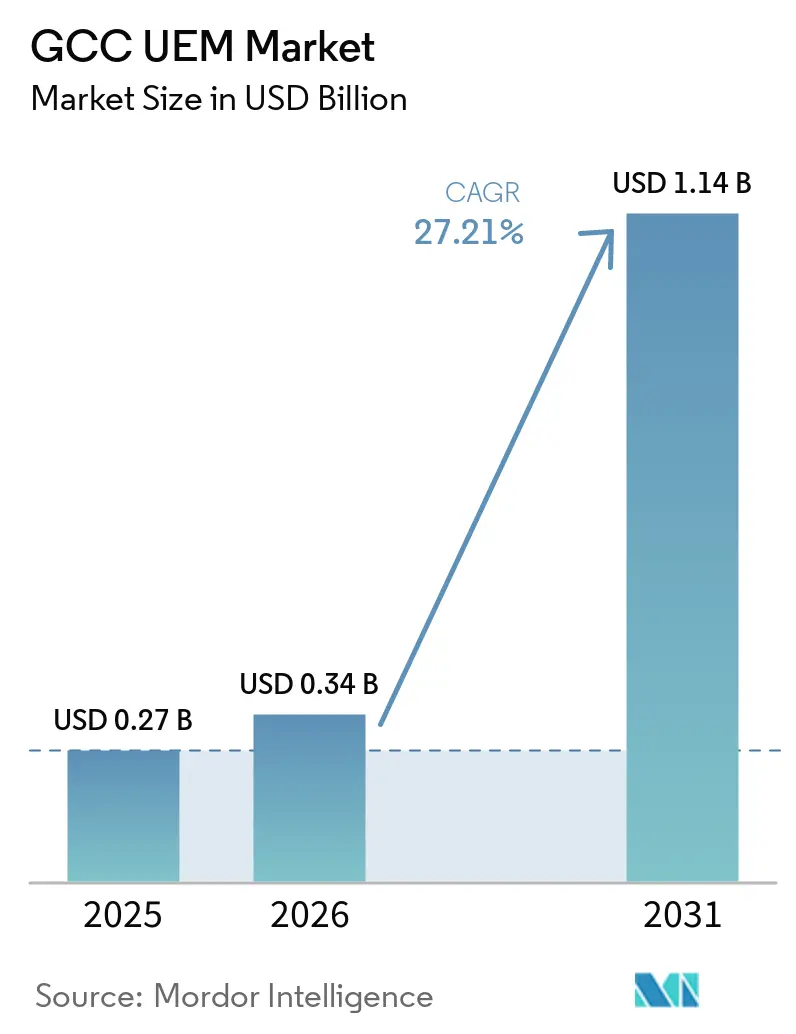
| Base Year Market Size (2025) | USD 0.27 Billion |
| Market Size (2026) | USD 0.34 Billion |
| Market Size (2031) | USD 1.14 Billion |
| Growth Rate (2026 - 2031) | 27.21 % |
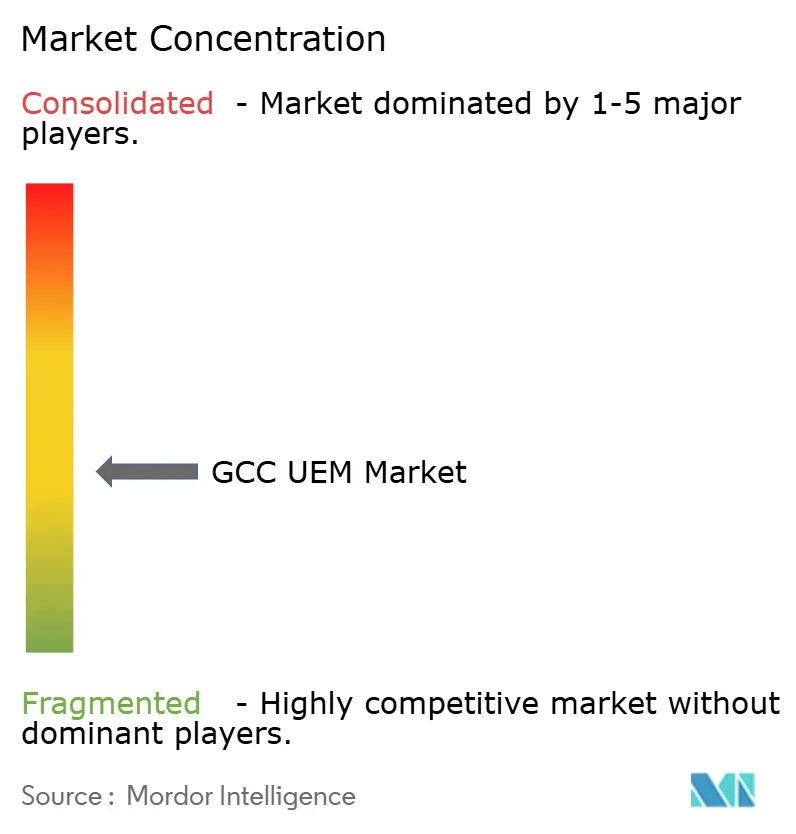
| Market Concentration | Medium |
Major Players *Disclaimer: Major Players sorted in no particular order Image © Mordor Intelligence. Reuse requires attribution under CC BY 4.0. | |
GCC UEM Market Analysis by Mordor Intelligence
The GCC UEM market size is expected to increase from USD 0.27 billion in 2025 to USD 0.34 billion in 2026 and reach USD 1.14 billion by 2031, growing at a CAGR of 27.21% over 2026-2031. Growth is being supported by the region’s move toward distributed work models and the rising difficulty of managing laptops, phones, tablets, and shared devices across cloud, on-premises, and hybrid environments. Cybersecurity rules in Saudi Arabia and the UAE are also pushing banks, government entities, healthcare providers, and critical infrastructure operators to enforce endpoint controls more consistently and at larger scale. The GCC UEM market is also benefiting from stronger demand for sovereign and compliance-aligned deployment models, which are narrowing vendor selection toward platforms that can support local control and regulated data handling. Competition is centered more on integration depth, compliance alignment, and automation capability than on price alone, which favors established vendors in complex enterprise accounts while still leaving room for newer cloud-native offerings in smaller organizations. Legacy migration work and uneven residency requirements continue to slow some rollouts, but they also create room for vendors that can simplify transitions and support regulated operating environments.
Key Report Takeaways
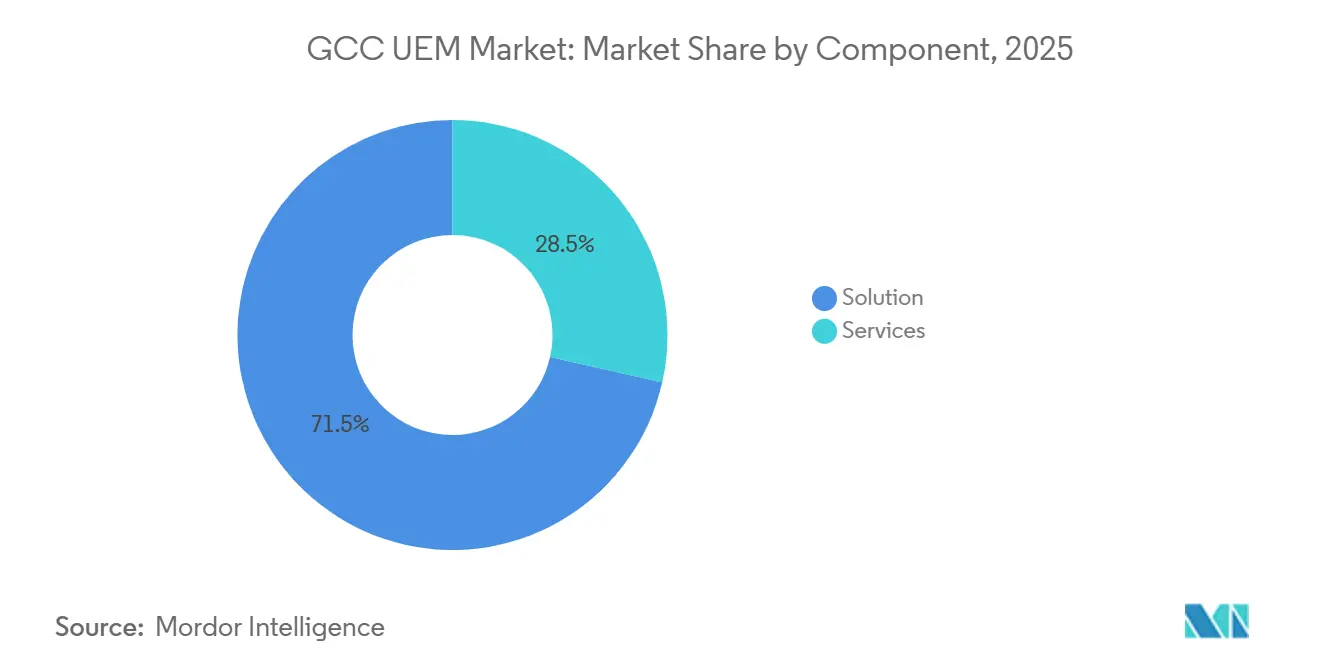
- By component, solutions held 71.46% share of the GCC UEM Market in 2025, while the same segment is projected to grow at 27.66% CAGR through 2031.
- By deployment mode, cloud-based deployment accounted for 67.21% share of the GCC UEM Market in 2025 and is expected to expand at 27.99% CAGR through 2031.
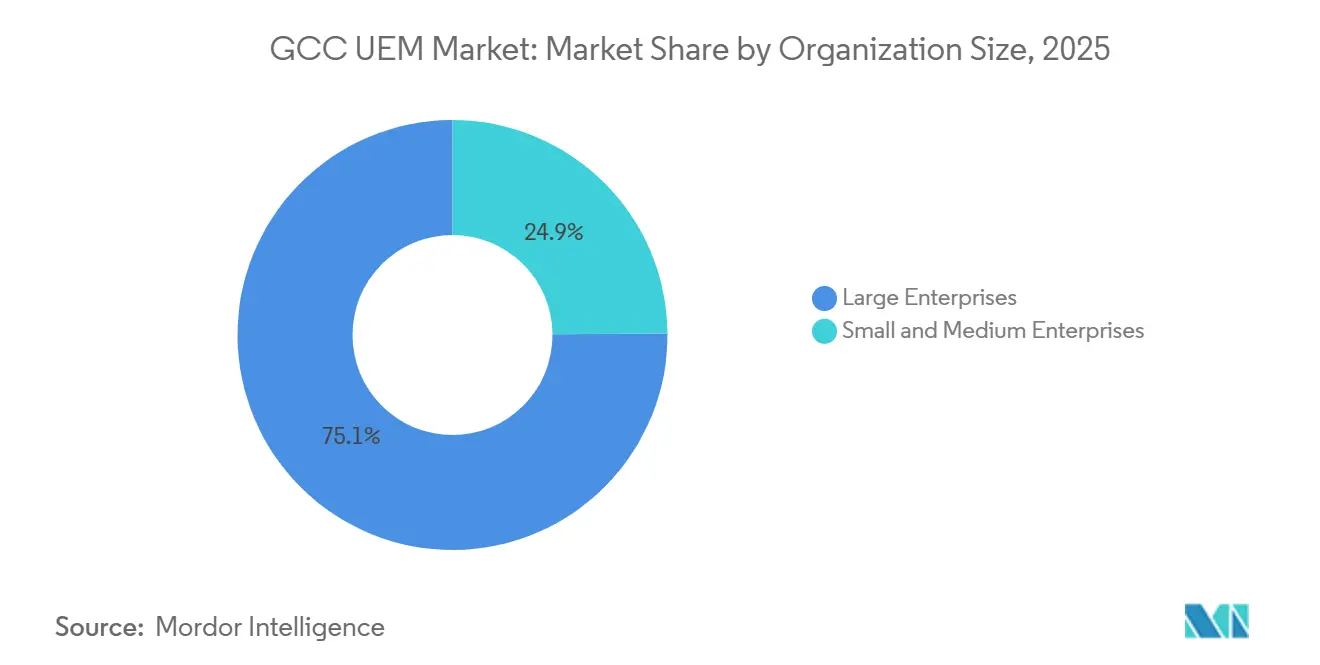
- By organization size, large enterprises held 75.11% of market share in 2025, while SMEs recorded the highest projected CAGR at 28.26% through 2031.
- By end-user industry, Government and Defense accounted for 24.52% market size in 2025, while healthcare is projected to advance at 28.34% CAGR through 2031.
- By geography, Saudi Arabia led with 54.14% share in 2025, while the United Arab Emirates is projected to grow at 28.22% CAGR through 2031.
Note: Market size and forecast figures in this report are generated using Mordor Intelligence’s proprietary estimation framework, updated with the latest available data and insights as of January 2026.
Market Trends and Insights
Drivers Impact Analysis of GCC UEM Market*
| Driver | (~) % Impact on CAGR Forecast | Geographic Relevance | Impact Timeline |
|---|---|---|---|
| Accelerating Remote And Hybrid Work Device Sprawl | +4.5% | GCC-wide, with peak demand in Saudi Arabia and UAE | Short term (≤ 2 years) |
| Rising Zero Trust And Identity-Centric Control Requirements | +4.2% | Saudi Arabia, UAE, Qatar | Medium term (2-4 years) |
| Government-Backed Cloud-First And Digital Sovereignty Programs | +3.8% | Saudi Arabia, UAE, Qatar | Medium term (2-4 years) |
| Fast Growth In Managed Mobility For Frontline And Field Workers | +3.3% | GCC-wide, especially energy, logistics, and healthcare | Short term (≤ 2 years) |
| AI-Driven Device Health And Self-Healing Automation Demand | +2.7% | UAE and Saudi Arabia | Medium term (2-4 years) |
| Expanding IoT And Rugged Device Orchestration In Smart Infrastructure | +2.1% | Saudi Arabia, UAE, Qatar | Long term (≥ 4 years) |
| Source: Mordor Intelligence | |||
Accelerating Remote And Hybrid Work Device Sprawl
Hybrid and remote work patterns continue to leave many GCC organizations managing laptops, phones, tablets, and shared devices across several operating systems and usage models. That mix raises the cost of relying on separate tools for enrollment, patching, policy enforcement, application control, and access decisions across the same employee base. The GCC UEM market is gaining from this pressure because enterprises increasingly want one console that can apply consistent rules across Windows, iOS, Android, macOS, and shared field devices. The issue is sharper in regulated sectors because unmanaged endpoints can create direct exposure around access control, auditability, and policy enforcement. As device fleets stretch across office, home, branch, and field settings, procurement is moving toward platforms that can handle both corporate and personal devices without disconnected workflows or duplicate administration. That pattern is also aligning day-to-day IT needs with stricter endpoint governance expectations in Saudi Arabia and the UAE.[1]
Rising Zero Trust And Identity-Centric Control Requirements
Zero trust adoption is turning endpoint management into a core part of access control rather than a separate IT administration task. Organizations now need device posture checks at the time of access, not only at the moment of enrollment or periodic compliance review. That requirement is pushing the GCC UEM market toward platforms that can connect device status, identity, privilege, and policy enforcement within one operating model. Large banks, ministries, and regulated enterprises are also trying to reduce the number of point tools they maintain for compliance reporting and day-to-day operations. The practical result is a stronger demand for platforms that can support continuous control over patch levels, privilege settings, configuration drift, and application usage. This direction fits the endpoint security baseline reflected in Saudi Arabia’s Essential Cybersecurity Controls and Endpoint Detection and Response Standard.
Government-Backed Cloud-First And Digital Sovereignty Programs
Government-backed cloud adoption is expanding the addressable base for compliant endpoint management across the Gulf. At the same time, sovereignty requirements mean cloud adoption does not remove the need for local control over management traffic, audit records, and device-related telemetry. The GCC UEM market is therefore moving toward cloud models that can operate inside national or approved hosting boundaries rather than standard offshore instances. That shift reduces the field of viable vendors in sensitive accounts and increases the value of deployment flexibility across cloud, hybrid, and on-premises models. The memorandum signed by PIF, SITE, and Microsoft to explore sovereign cloud services in Saudi Arabia shows that compliant cloud infrastructure is becoming part of formal digital programs.[2] The UAE Cabinet’s approval of the National Cybersecurity Strategy also reinforces the role of secure digital infrastructure in enterprise technology planning and spending.
Fast Growth In Managed Mobility For Frontline And Field Workers
Demand from frontline and field workers is changing how endpoint management is purchased and deployed across the Gulf. Shared devices, kiosk configurations, intermittent connectivity, and rugged hardware create operating needs that differ sharply from office-centered device estates. The GCC UEM market benefits when vendors can manage these conditions through offline policy support, role-based access, controlled app delivery, and simpler handover processes across shifts. This requirement is especially relevant in healthcare, logistics, construction, energy, and public services, where device uptime has a direct effect on service continuity and worker productivity. The use case also supports more managed service demand because many organizations do not have internal teams that specialize in these operational environments or in multi-site fleet administration. Vendors that can extend control to regulated and operational endpoints are gaining relevance as sovereign endpoint management becomes a stronger buying factor.
Restraints Impact Analysis of GCC UEM Market*
| Restraint | (~) % Impact on CAGR Forecast | Geographic Relevance | Impact Timeline |
|---|---|---|---|
| Legacy IT and Endpoint Toolchain Migration Complexity | -3.5% | Saudi Arabia, UAE | Short term (≤ 2 years) |
| Data Residency and Sectoral Compliance Constraints | -2.8% | GCC-wide, especially Saudi Arabia and UAE | Medium term (2-4 years) |
| Shortage of UEM Implementation and Automation Skills | -1.7% | GCC-wide | Medium term (2-4 years) |
| Procurement Friction from Vendor Lock-In Concerns | -1.2% | UAE and Saudi Arabia | Long term (≥ 4 years) |
| Source: Mordor Intelligence | |||
Legacy IT And Endpoint Toolchain Migration Complexity
Many large GCC organizations still run endpoint estates that were built around older Windows-focused tooling and layered administrative processes. Moving those estates to a modern platform often requires device reenrollment, policy redesign, role remapping, and retraining across security, infrastructure, and support teams. That work does not stop adoption, but it delays contract timing and pushes part of the GCC unified endpoint management (UEM) market growth toward later years of the forecast period. The challenge is greater in hybrid environments where older and newer policy engines must operate together during long transition phases. Conflicts between legacy controls and modern configuration models can lead to enrollment problems, inconsistent posture checks, and slower rollouts across large fleets. For regulated institutions, those operational risks make phased deployment more attractive than full replacement at once, even when the long-term business case for modernization is clear.
Data Residency And Sectoral Compliance Constraints
Data residency rules remain a practical constraint for multi-tenant cloud management in several regulated GCC sectors. Saudi Arabia’s Cloud Cybersecurity Controls require clear handling of data classification, residency, and incident reporting before deployment in controlled environments. The issue goes beyond user files because device inventory, usage records, and location-linked telemetry can also fall under regulated data handling expectations. This means some buyers cannot use standard offshore management consoles even when cloud delivery is technically available and operationally mature. The GCC UEM market still moves forward under these conditions, but vendors often need sovereign cloud or on-premises options to close deals in regulated accounts. Those options improve compliance fit, yet they also add configuration, audit, and governance work that can weaken the original cost case for standard cloud delivery.
*Our forecasts treat driver/restraint impacts as directional, not additive. The impact forecasts reflect baseline growth, mix effects, and variable interactions.
GCC UEM Market Segment Analysis
By Component:
Solutions Lead While Services Extend Platform ValueSolutions held 71.46% of GCC UEM market size in 2025 and are projected to grow at 27.66% CAGR through 2031. That lead reflects strong demand for device management and security and compliance management across ministries, banks, healthcare systems, and other regulated organizations that need consistent policy enforcement. Buyers are moving from reactive device administration toward broader governance models that combine enrollment, policy control, analytics, automation, and reporting within the same platform. This shift is raising the value of software-led control because endpoint teams increasingly need visibility across mixed fleets rather than isolated oversight by operating system or device category. Analytics and automation are drawing forward investment because self-healing capabilities can reduce manual workload in teams facing skills shortages and rising policy complexity. Application management and content management are also gaining relevance as organizations try to contain corporate data more carefully on both managed and personal devices. The GCC unified endpoint management (UEM) market is therefore rewarding platforms that can tie compliance, app control, and device health into a single operating layer rather than into separate administrative products.
Services are growing from a smaller base, but they remain important to the GCC unified endpoint management market because many deployments require integration, migration, policy design, and ongoing administrative support. Regional system integrators are expanding UEM-specific practices as customers ask for rollout planning, operating model design, and managed operations support across mixed endpoint fleets. This need is stronger in mid-market accounts that want zero trust alignment and stronger security controls without building large in-house endpoint teams. It is also visible in regulated enterprises where migration must happen in stages and where audit readiness matters as much as technical functionality. Managed and professional services can therefore act as an indirect multiplier for software demand by helping organizations move from pilot use into broader policy coverage. Over time, these service relationships also help sustain platform usage after initial deployment because customers tend to extend contracts when integrations, reporting processes, and operational playbooks are already in place.
By Deployment Mode:
Cloud Stays Ahead While Sovereign Models Gain WeightCloud-based deployment accounted for 67.21% of the GCC UEM market share in 2025 and is projected to expand at 27.99% CAGR through 2031. The lead comes from the ease of scaling one management console across distributed device fleets without new server investment at each location or business unit. For many buyers, cloud deployment also shortens rollout time and improves visibility across branch sites, hybrid users, and shared-device environments that would otherwise require several local tools. In the Gulf, however, cloud deployment increasingly means locally aligned or sovereign hosting rather than a generic offshore instance. That distinction matters because regulated buyers want cloud efficiency without weakening control over audit trails, policy records, and device telemetry. The GCC unified endpoint management market is therefore not moving away from cloud, but it is becoming more selective about where and how cloud-based management can be delivered. This is reshaping vendor positioning because deployment flexibility is becoming part of the value proposition rather than a back-end technical detail.
On-premises deployment keeps a protected role in defense, intelligence, and critical infrastructure accounts that cannot route management paths through external networks. Hybrid deployment is also gaining support because it lets large organizations manage classified and unclassified fleets under a more coordinated model while still respecting internal control boundaries. The GCC unified endpoint management (UEM) market continues to need these non-cloud options because migration rarely happens in one step and many enterprises run overlapping environments for several years. BlackBerry’s June 2026 release, which added on-premises macOS management and post-quantum tools, shows that sovereign endpoint control remains a live procurement requirement in regulated environments. Hybrid architectures also help organizations preserve earlier investments while moving selected workloads into compliant cloud models over time. This makes deployment mode less of a binary choice and more of a staged operating decision shaped by regulation, infrastructure maturity, and migration risk.
By Organization Size:
Large Enterprises Lead While SMEs Set The PaceLarge enterprises held 75.11% revenue share in 2025, while SMEs are projected to grow at 28.26% CAGR through 2031. Large accounts built formal endpoint governance programs earlier and usually manage broader fleets across subsidiaries, branch networks, contractor groups, and remote teams. Their lead reflects both purchasing power and the operational need to standardize policy across a much wider device base. SMEs are now entering the GCC UEM market faster because compliance expectations are moving through supply chains and sector-level obligations into smaller organizations. Modern self-service enrollment, automated policy enforcement, and remote administration are especially useful for firms that run lean IT teams and cannot support several point tools at the same time. This shift shows that UEM demand is no longer limited to the most mature enterprise buyers and is moving into a broader customer layer. The GCC unified endpoint management (UEM) market is therefore gaining depth as smaller firms adopt broader lifecycle control rather than relying only on basic mobile device management.
SMEs are also more sensitive to the total effort needed to deploy and maintain a platform over time, not just to subscription cost at the point of purchase. That makes simpler administration, guided rollout, and managed support more important than very large feature catalogs in this segment. Many smaller organizations previously relied on fragmented mobile-first tools, but that model becomes harder to sustain once laptops, tablets, and shared devices need to be governed under the same compliance expectations. The result is gradual movement toward fuller platform coverage across patching, access policy, app delivery, and endpoint visibility. Large enterprises will remain the main revenue base through the forecast period, but SMEs are likely to narrow the organizational gap as digital operations expand across retail, logistics, and professional services. This creates a two-speed demand pattern where enterprise buyers still dominate absolute spend while smaller firms drive a significant share of incremental adoption.
By End-User Industry:
Government Anchors Spending While Healthcare Gains SpeedGovernment and Defense accounted for 24.52% share in 2025, which made it the largest end-user segment in the GCC unified endpoint management (UEM) market. That position reflects mandatory device governance across ministries, public utilities, defense bodies, and other critical operators that cannot tolerate weak endpoint control. Public-sector spending is also more structural than opportunistic because compliance requirements, procurement cycles, and operational continuity all reinforce recurring demand for centralized management. Saudi Arabia’s Endpoint Detection and Response Standard reinforces the need for stronger endpoint visibility and control in public-sector environments.[3] BFSI also remains a major buyer because banks and insurers need continuous device compliance across branch networks, remote access points, and increasingly digital customer service environments. The GCC UEM market benefits from this because finance and government both tend to prefer formal operating models, stronger audit trails, and integrated policy enforcement. That combination helps sustain larger contract values and deeper platform usage in the region’s most regulated accounts.
Healthcare is projected to grow at 28.34% CAGR through 2031, the fastest pace among end-user segments. Electronic medical records, telehealth services, and connected clinical workflows are increasing the number of sensitive endpoints that must be governed under tighter security and access policies. Hospitals and healthcare networks also face a difficult mix of mobile staff devices, shared clinical hardware, and time-sensitive service settings that leave little room for inconsistent endpoint controls. This makes healthcare a strong fit for platforms that can support policy consistency, app control, and rapid issue response across distributed device estates. IT and telecommunications, manufacturing, and retail and e-commerce form a steady middle tier as enterprise digitization deepens across the region. Energy and utilities are also moving up the demand curve as smart infrastructure programs deploy more rugged and operational devices that require centralized control. Education and transportation and logistics remain earlier-stage adopters, but they are moving closer to broader UEM use as device fleets become more diverse and service delivery depends more on mobile operations.
Geography Analysis
Saudi Arabia UEM Market
Saudi Arabia held 54.14% of the GCC UEM market share in 2025. The country remains the largest revenue base because government digitization, financial sector compliance, and critical infrastructure oversight are all moving in the same direction. The National Cybersecurity Authority’s Essential Cybersecurity Controls and Endpoint Detection and Response Standard keep endpoint governance high on public-sector and enterprise agendas. Official cybersecurity indicators published in 2025 also show the importance attached to national cyber readiness, which supports continued spending discipline in regulated technology environments. The PIF, SITE, and Microsoft sovereign cloud memorandum further supports local deployment paths for large endpoint programs that need compliant hosting and stronger control over operational data.
United Arab Emirates UEM Market
The United Arab Emirates is projected to expand at 28.22% CAGR through 2031, the fastest pace in the region. Its growth is supported by a dense base of multinational firms, active smart city programs, and stronger attention to cyber resilience across both business and government operations. The UAE Cabinet’s approval of the National Cybersecurity Strategy and API-First Policy in February 2025 marked a stronger policy push behind secure digital operations and enterprise modernization. That environment favors vendors that can apply global policy frameworks while still respecting local control requirements and more structured governance expectations. The GCC unified endpoint management (UEM) market in the UAE is therefore benefiting from both domestic policy direction and the compliance needs of regional headquarters serving wider Middle East operations.
Qatar, Kuwait, Bahrain and Oman UEM Market
Qatar is also advancing as ministries, state enterprises, and infrastructure programs expand digital operating models across public and commercial settings. Kuwait, Bahrain, and Oman remain smaller bases, but adoption is widening as cybersecurity governance becomes more formal and device fleets become harder to manage through separate tools. Bahrain’s financial services activity and Oman’s diversification agenda are helping move demand beyond early pilot deployments and into more regular operational use. While Saudi Arabia and the UAE will likely capture most absolute spending through 2031, the rest of the region is positioned to grow faster than its starting base in selected government and financial services accounts.
Competitive Landscape
The GCC UEM market is moderately consolidated in large enterprise and government accounts, where Microsoft Intune, Omnissa Workspace ONE, IBM MaaS360, and Ivanti compete for complex deployments. These vendors are differentiated more by ecosystem fit and policy integration than by basic device administration features, which makes platform context important in major buying decisions. Microsoft benefits from its wider productivity and identity stack, while Omnissa remains relevant where VMware-linked infrastructure and earlier workspace investments are already embedded. The field is less settled in mid-market accounts, where faster deployment, simpler support, and easier administration can outweigh the depth of a broad enterprise platform. The GCC unified endpoint management (UEM) market therefore shows one competitive pattern in highly regulated large accounts and another in smaller, faster-moving organizations that focus more on speed and operational simplicity.
A clear strategy split is emerging between vendors that emphasize AI-led automation and vendors that emphasize sovereign control and compliant deployment flexibility. Cisco’s June 2026 Cloud Control launch pushed autonomous monitoring and remediation deeper into infrastructure operations, which strengthens its position where IT teams want fewer manual interventions and more governed automation. BlackBerry’s June 2026 update took the opposite route by reinforcing on-premises control, post-quantum readiness, and tighter support for regulated environments that cannot rely on public cloud management paths. ManageEngine also moved further into governed automation in February 2026, which shows that autonomous operations are becoming relevant even for buyers outside the hyperscaler ecosystem. These moves suggest that product direction in the GCC unified endpoint management market is now shaped by both operating efficiency and policy sensitivity rather than by endpoint visibility alone.
Apple-centered management remains a specialized lane, and Jamf’s December 2025 recognition for Apple-first UEM capabilities shows that focused platforms still have room where device standards are narrow and well defined. Open space remains in rugged and IoT device management, BYOD control for healthcare, and broader governance for organizations deploying more automated digital workflows. Vendors that can combine compliance-ready deployment models with stronger automation are better placed to win new contracts as buyer evaluation shifts toward execution quality and risk reduction. That keeps competition active even as a relatively small group of vendors retains an advantage in the highest-value accounts.
GCC UEM Industry Leaders
-
Microsoft Corporation
-
Broadcom Inc.
-
IBM Corporation
-
Ivanti, Inc.
-
BlackBerry Limited
- *Disclaimer: Major Players sorted in no particular order
GCC UEM Market Companies Covered in this Report
- Microsoft Corporation
- Broadcom Inc.
- International Business Machines Corporation
- Ivanti, Inc.
- BlackBerry Limited
- Citrix Systems, Inc.
- Zoho Corporation Pvt. Ltd.
- Sophos Ltd.
- 42Gears Mobility Systems Pvt Ltd.
- SOTI Inc.
- Matrix42 AG
- Jamf Holding Corp.
- JumpCloud, Inc.
- Tanium Inc.
- Cisco Systems, Inc.
- ManageEngine
- OpenText Corporation
- NinjaOne, LLC
- Automox, Inc.
- Quest Software Inc.
Recent Industry Developments in GCC UEM Market
- June 2026: BlackBerry announced enhanced UEM capabilities focused on sovereign endpoint control, including expanded on-premises macOS management, post-quantum cryptography tools, and multi-tenant console enhancements. The release targeted government, enterprise, and regulated-industry buyers in environments unable to rely on public cloud management paths.
- June 2026: Cisco unveiled Cloud Control at Cisco Live, a unified agentic platform enabling autonomous agents to monitor, detect, and remediate critical IT infrastructure issues without human intervention. The platform established Cisco’s AgenticOps model and directly integrated with endpoint management and security operations at enterprise scale.
- February 2026: ManageEngine introduced Causal Intelligence and Autonomous AI to IT operations via Site24x7, enabling AI agents to analyze observability data, reduce cognitive overload, and execute governed autonomous workflows for endpoint incident resolution.
- May 2025: Cisco announced a multi-year strategic initiative with HUMAIN, Saudi Arabia’s new AI enterprise, to build AI infrastructure and established a partnership with G42 in the UAE to advance AI innovation and sovereign infrastructure development. Both initiatives included endpoint security and management layers as part of the broader AI stack.
GCC UEM Market Report Scope
The GCC UEM market refers to the market for software and services used to centrally manage, secure, and monitor endpoints such as laptops, desktops, smartphones, tablets, and other connected devices across Mexico. It enables IT teams to enforce security policies, control device access, deploy applications, and maintain compliance from a single platform.
The GCC UEM Market Report is Segmented by Component (Solutions, and Services), Deployment Mode (Cloud-Based, On-Premise, and Hybrid), Organization Size (Large Enterprises, and Small and Medium Enterprises), End-User Industry (IT and Telecommunications, BFSI, Government and Defense, Healthcare and Life Sciences, Manufacturing, Retail and E-Commerce, Education, Transportation and Logistics, and Energy and Utilities), and Country (Saudi Arabia, United Arab Emirates, and Qatar). The Market Forecasts are Provided in Terms of Value (USD).
Segmentation Overview
| Solutions | Device Management |
| Application Management | |
| Content Management | |
| Security and Compliance Management | |
| Analytics and Automation | |
| Services |
| Cloud-Based |
| On-Premise |
| Hybrid |
| Large Enterprises |
| Small and Medium Enterprises |
| IT and Telecommunications |
| BFSI |
| Government and Defense |
| Healthcare and Life Sciences |
| Manufacturing |
| Retail and E-Commerce |
| Education |
| Transportation and Logistics |
| Energy and Utilities |
| Other End-User Industries |
| Saudi Arabia |
| United Arab Emirates |
| Qatar |
| Rest of GCC |
| By Component | Solutions | Device Management |
| Application Management | ||
| Content Management | ||
| Security and Compliance Management | ||
| Analytics and Automation | ||
| Services | ||
| By Deployment Mode | Cloud-Based | |
| On-Premise | ||
| Hybrid | ||
| By Organization Size | Large Enterprises | |
| Small and Medium Enterprises | ||
| By End-User Industry | IT and Telecommunications | |
| BFSI | ||
| Government and Defense | ||
| Healthcare and Life Sciences | ||
| Manufacturing | ||
| Retail and E-Commerce | ||
| Education | ||
| Transportation and Logistics | ||
| Energy and Utilities | ||
| Other End-User Industries | ||
| By Country | Saudi Arabia | |
| United Arab Emirates | ||
| Qatar | ||
| Rest of GCC |
Key Questions Answered in the Report
What is the size of the GCC UEM market?
The GCC UEM market was valued at USD 0.27 billion in 2025, stands at USD 0.34 billion in 2026, and is forecast to reach USD 1.14 billion by 2031 at a 27.21% CAGR.
Which deployment model leads across the Gulf?
Cloud-based deployment led with 67.21% share in 2025 and is projected to expand at 27.99% CAGR through 2031, although sovereign and hybrid delivery models remain important in regulated accounts.
Why does Saudi Arabia lead regional demand?
Saudi Arabia held 54.14% share in 2025 because public-sector digitization, critical infrastructure oversight, and formal cybersecurity controls keep endpoint governance high on spending agendas.
Why is the UAE growing faster than the rest of the region?
The UAE is projected to grow at 28.22% CAGR through 2031, supported by multinational company demand, smart city activity, and stronger cyber policy direction after the 2025 national strategy approval.
Which end-user group spends the most, and which one is growing fastest?
Government and Defense accounted for 24.52% share in 2025, while healthcare is expected to record the fastest growth at 28.34% CAGR as digital care workflows expand.
What are the main barriers to wider adoption?
The main barriers are migration complexity from older toolchains and tighter data residency rules, both of which can slow rollout timing and increase the need for sovereign or on-premises deployment options.