
Mexico UEM Market Size and Share
Market Overview
| Study Period | 2020 - 2031 |
|---|---|
| Forecast Data Period | 2026 - 2031 |
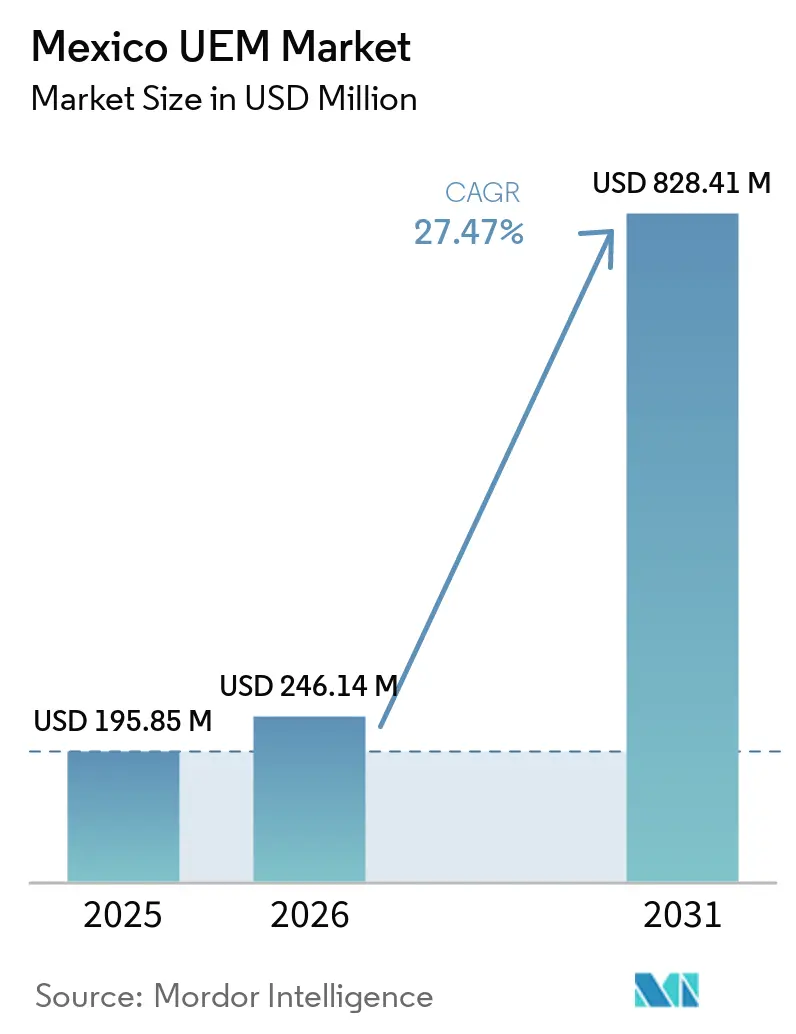
| Base Year Market Size (2025) | USD 195.85 Million |
| Market Size (2026) | USD 246.14 Million |
| Market Size (2031) | USD 828.41 Million |
| Growth Rate (2026 - 2031) | 27.47 % |
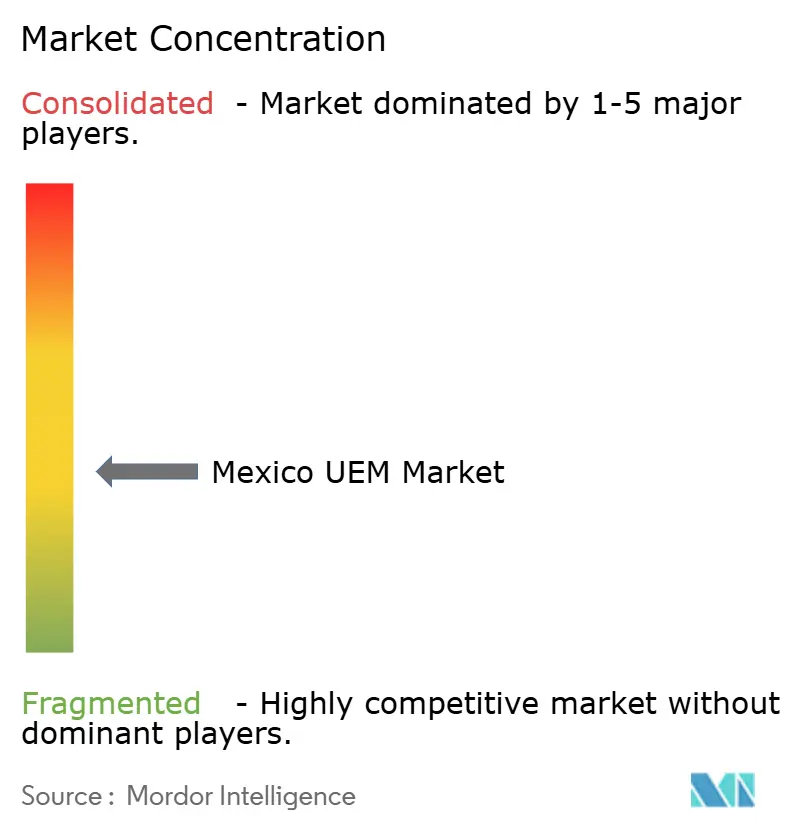
| Market Concentration | Medium |
Major Players *Disclaimer: Major Players sorted in no particular order Image © Mordor Intelligence. Reuse requires attribution under CC BY 4.0. | |
Mexico UEM Market Analysis by Mordor Intelligence
The Mexico UEM Market size was valued at USD 195.85 million in 2025 and is estimated to grow from USD 246.14 million in 2026 to reach USD 828.41 million by 2031, at a CAGR of 27.47% during the forecast period (2026-2031). The Mexico Unified Endpoint Management (UEM) market is moving from early adoption into broader enterprise rollout as mixed device fleets, cloud administration, and security enforcement become harder to manage through separate tools. The March 2025 privacy reform and the December 2025 federal cybersecurity policy are pushing endpoint control closer to a compliance requirement, especially where personal devices, automated decision-making, and third-party technology providers are involved. Cloud delivery, policy unification, and automation are becoming the main competitive themes because buyers want faster deployment, lower operational strain, and clearer audit trails across expanding endpoint estates. Growth potential remains broad because large enterprises still anchor current spending, while smaller firms, healthcare systems, and public institutions are opening new deployment paths. Vendor positioning is therefore shifting toward platforms that can combine device governance, security enforcement, analytics, and service support in a model that scales across mixed operating systems and regulated workflows.
Key Report Takeaways
- By component, solutions held 68.46% share of the Mexico UEM market in 2025, while the same segment is projected to expand at a 27.66% CAGR through 2031.
- By deployment mode, cloud-based deployment accounted for 64.21% of the Mexico UEM market in 2025, and is also projected to record the fastest CAGR at 27.99% through 2031.
- By organization size, large enterprises accounted for 71.18% of revenue in 2025, while small and medium enterprises are projected to expand at a 28.26% CAGR through 2031.
- By end-user industry, IT and Telecommunications accounted for 21.52% share in 2025, while healthcare is projected to advance at a 28.34% CAGR through 2031.
Note: Market size and forecast figures in this report are generated using Mordor Intelligence’s proprietary estimation framework, updated with the latest available data and insights as of January 2026.
Mexico UEM Market Trends and Insights
Drivers Impact Analysis*
| Driver | (~) % Impact on CAGR Forecast | Geographic Relevance | Impact Timeline |
|---|---|---|---|
| Hybrid Work And BYOD Expansion Across Enterprise Fleets | +5.2% | National, concentrated in Mexico City, Monterrey, and Guadalajara metro zones | Short term (≤ 2 years) |
| Rising Endpoint-First Cybersecurity And Zero Trust Rollouts | +5.8% | National, federal mandate covers all APF entities, private-sector spillover concentrated in financial hubs and CDMX | Short term (≤ 2 years) |
| Convergence Of Endpoint Management, Identity, And Compliance Controls | +4.6% | National, with early adoption gains in financial centers and regulated verticals | Medium term (2-4 years) |
| AI-Driven Digital Employee Experience And Autonomous Remediation | +3.9% | Platform-led globally, deployment concentrated in large enterprise clusters in CDMX, Monterrey, and Guadalajara | Medium term (2-4 years) |
| Industrial And Frontline Device Proliferation In Logistics, Manufacturing, And Field Services | +2.6% | Nuevo León, Jalisco, and Baja California industrial corridors, with spillover to Querétaro and Aguascalientes | Medium term (2-4 years) |
| Demand For Cloud-Delivered UEM In Distributed Mid-Market Accounts | +2.2% | National, with early gains in manufacturing SME clusters in Monterrey, Guadalajara, and Querétaro | Long term (≥ 4 years) |
| Source: Mordor Intelligence | |||
Hybrid Work And BYOD Expansion Across Enterprise Fleets
Hybrid work remained visible in Mexico during 2025, and the Pluxee Panorama Laboral 2025 study stated that 20% of Mexican enterprises used hybrid work arrangements in 2024.[1] That operating model makes the Mexico Unified Endpoint Management (UEM) market more relevant because companies must apply common security, access, and support rules across devices that sit outside the office for part of the workweek. The LFPDPPP entered into force on March 21, 2025, and it introduced BYOD privacy notices and selective-wipe obligations, which raised the bar for platforms managing personal devices.[2] This combination pushes buyers away from narrow mobile-only tools and toward broader platforms that can govern enrollment, data handling, and access policies in one environment. It also rewards vendors that can manage iOS, Android, Windows, and macOS under a single policy framework when work patterns become less centralized. In practical terms, the Mexico UEM market benefits when hybrid work stops being a temporary arrangement and becomes a normal operating model for professional and service organizations.
Rising Endpoint-First Cybersecurity And Zero Trust Rollouts
The federal government raised the security baseline when the General Cybersecurity Policy for the Federal Public Administration was published on December 18, 2025. The policy aligned federal Zero Trust requirements with NIST SP 800-207 and extended minimum security and audit requirements to cloud service providers and third-party contractors serving federal bodies. That broad scope matters for the Mexico UEM market because device posture and access control must now hold up across internal teams and external delivery chains. Vendors that can connect endpoint governance with identity, compliance, and conditional access are better placed to support those procurement needs. Private companies that sell into public-sector ecosystems are also likely to face earlier endpoint upgrades, as compliance pressure can flow through contracts before internal modernization plans are complete. This makes security-led buying more durable than a standard hardware refresh cycle and helps explain why UEM demand is widening beyond traditional IT administration needs.
Convergence Of Endpoint Management, Identity, And Compliance Controls
The March 2025 privacy law changed how organizations must think about device control because it explicitly addressed cross-border transfers and automated decision-making. Those rules make separate tools harder to defend when companies need consistent records across enrollment, access, policy enforcement, and data handling. The Mexico UEM market is benefiting from that shift because unified platforms reduce the number of handoffs between security, operations, and compliance teams. A single console also makes policy changes easier to track when personal devices and corporate devices coexist under one governance model. Buyers in regulated environments are therefore more likely to favor platforms that combine management, security, and audit functions instead of buying each function separately. Over time, that preference can raise the value of broader suites and reduce tolerance for fragmented endpoint tool stacks that create reporting gaps.
AI-Driven Digital Employee Experience And Autonomous Remediation
Product development in 2026 shows that automation is moving closer to the center of vendor competition in endpoint management.[3] Ivanti introduced AI-driven additions to Neurons, including an Autonomous Endpoint Management architecture that combines DEX, UEM, and security within one operating model. ManageEngine launched Zia Agents across its suite in 2026 to support autonomous incident analysis and automated recovery. These moves matter for the Mexico UEM market because buyers are looking for tools that reduce manual workload without adding new consoles or separate remediation workflows. As platforms automate routine fixes, vendors can compete on response speed, workflow depth, and operational consistency instead of only on device coverage. The commercial effect is that automation now supports both product differentiation and service efficiency, which strengthens the case for larger, more integrated endpoint platforms.
Restraints Impact Analysis*
| Restraint | (~) % Impact on CAGR Forecast | Geographic Relevance | Impact Timeline |
|---|---|---|---|
| Migration Complexity From Legacy MDM And Endpoint Tool Sprawl | -2.1% | National, most acute in large enterprises in CDMX and Monterrey running multi-vintage IT estates | Medium term (2-4 years) |
| Data Residency And Cross-Border Privacy Compliance Constraints | -1.7% | National, with concentrated impact in BFSI and healthcare verticals and US-Mexico nearshoring corridors | Long term (≥ 4 years) |
| Budget Pressure From Currency Volatility And Multi-Year SaaS Commitments | -1.3% | National, most acute in the SME segment given MXN and USD exchange exposure on multi-year contracts | Short term (≤ 2 years) |
| Shortage Of Endpoint Automation And Security Operations Skills | -1.6% | National, talent deficit most acute in second-tier cities beyond CDMX and Monterrey | Long term (≥ 4 years) |
| Source: Mordor Intelligence | |||
Migration Complexity From Legacy MDM And Endpoint Tool Sprawl
The move from first-generation MDM to full UEM still creates practical friction for many buyers in the Mexico UEM market. Policy migration, device re-enrollment, and contract alignment can slow decision-making when organizations already run several endpoint tools across different teams and budget centers. Mixed operating system estates add to the problem because personal smartphones, corporate notebooks, and rugged devices rarely fit a single legacy configuration. The LFPDPPP raises the burden further because organizations need audit-ready processes for personal data handling and automated decision-making before they consolidate around one platform. This is why service support remains important even when software accounts for most of the current revenue. It also explains why buyers often value migration planning and managed rollout capacity almost as much as the core endpoint features themselves.
Data Residency And Cross-Border Privacy Compliance Constraints
Data residency remains a live concern because the March 2025 privacy law tightened the treatment of personal data transfers and formalized new obligations around automated decision-making. That creates procurement caution when telemetry, policy data, and device posture records are processed outside Mexico. Ivanti launched a sovereign cloud MDM solution in 2026 for European data sovereignty and compliance, showing the kind of architecture that regulated buyers increasingly expect from platform vendors. For the Mexico UEM market, this means local hosting readiness can influence vendor selection even when core feature sets look similar. The issue matters most where employee, customer, or clinical information moves through endpoints that also feed wider cloud analytics and automation layers. As privacy enforcement becomes more operational, vendors without a clear data handling model may face longer sales cycles even in otherwise favorable demand segments.
*Our forecasts treat driver/restraint impacts as directional, not additive. The impact forecasts reflect baseline growth, mix effects, and variable interactions.
Segment Analysis
By Component: Solutions Lead Current Spend While Services Deepen Rollout Capacity
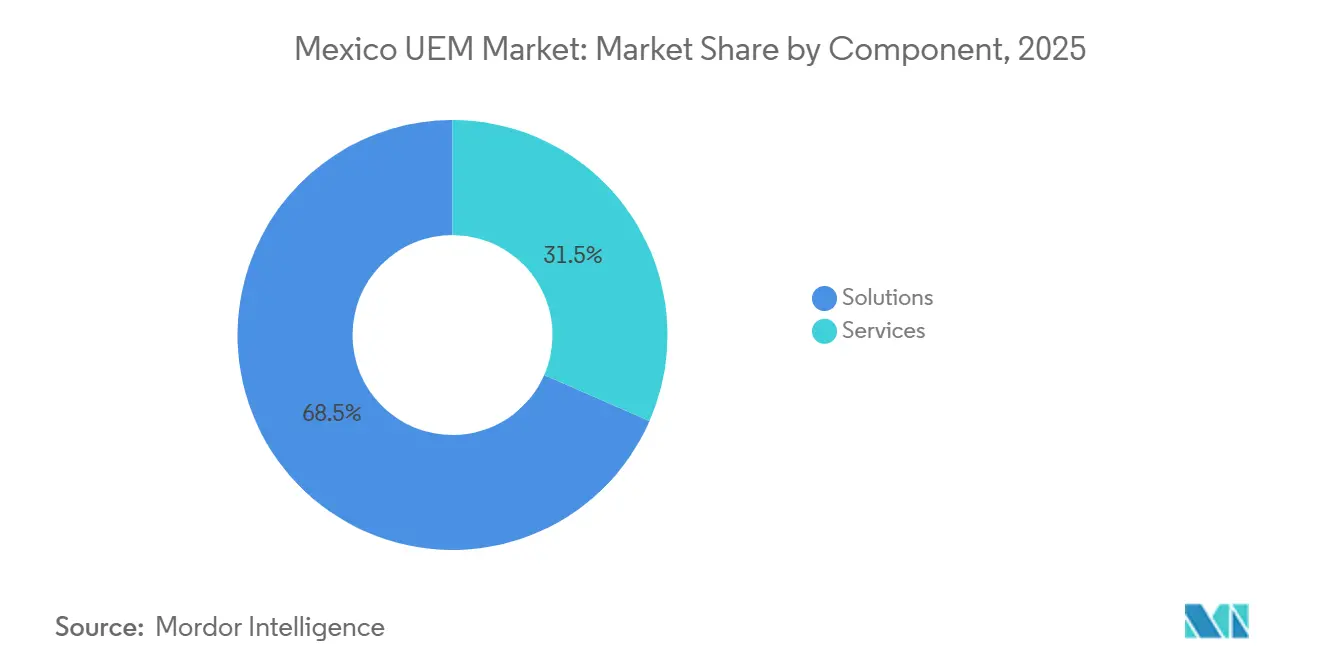
Solutions held 68.46% of the Mexico UEM market share in 2025 and are projected to expand at a 27.66% CAGR through 2031. That lead reflects the fact that buyers usually begin with the core control layers of device management, application management, content management, security and compliance management, and analytics and automation before adding broader service layers. In the Mexico UEM market, the strongest product value now sits with tools that can connect policy enforcement, visibility, and remediation instead of treating them as separate modules. Ivanti and ManageEngine both emphasized that direction in 2026 through autonomous management features, which support the view that software budgets are moving toward broader operational platforms. This keeps the center of gravity inside solutions because buyers want immediate control benefits and a clearer path to standardized endpoint governance.
Services represented the remaining 31.54% of revenue in 2025, and their role is larger than the share alone suggests. The March 2025 privacy law increased the need for implementation support because personal-device enrollment, selective wipe, and automated decision rules must be handled with clear internal controls. Service partners therefore matter when organizations migrate from separate tools to unified environments and need help redesigning workflows rather than only deploying software. This is especially relevant for the Mexico UEM industry because managed support can reduce rollout risk, shorten adoption timelines, and improve policy consistency across mixed device fleets. Over the forecast period, services are likely to stay closely tied to software demand because migration quality, compliance readiness, and post-deployment support still shape buyer confidence.
By Deployment Mode: Cloud Sets The Pace While Hybrid And On-Premise Retain Compliance Roles
Cloud-based deployment accounted for 64.21% share of the Mexico Unified Endpoint Management (UEM) market size in 2025 and is projected to expand at a 27.99% CAGR through 2031. That leadership shows buyers prefer faster rollout, centralized updates, and lighter internal infrastructure requirements over maintaining separate systems for endpoint administration. Movistar Empresas reported in December 2025 that 59% of Mexican SMEs had adopted SaaS platforms and 66% were already operating in multicloud environments, which supports the local readiness for cloud-delivered endpoint tools. In the Mexico UEM market, this behavior favors vendors that can keep policy control simple across distributed users, branch offices, and mobile work patterns. Cloud strength is therefore coming from both product preference and the wider business shift toward service-based software consumption.
On-premise and hybrid deployments still have a place where buyers want tighter control over sensitive workflows and staged migration paths. The federal cybersecurity policy requires security controls to be embedded across public administration technology environments, which supports continued interest in architectures that preserve strong internal oversight. Hybrid models also remain useful when organizations want cloud management advantages but are not ready to move every device workflow into a single external tenancy. Omnissa's May 2026 rollout of Windows Server management within Workspace ONE UEM showed how vendors are trying to bridge desktops, servers, mobile devices, rugged endpoints, and IoT through one cloud-native console rather than forcing customers to maintain separate management layers. This keeps hybrid and on-premise relevant as transition options, even while cloud remains the clear long-term center of deployment demand.
By Organization Size: Large Enterprises Anchor Revenue While SMEs Shape Future Expansion
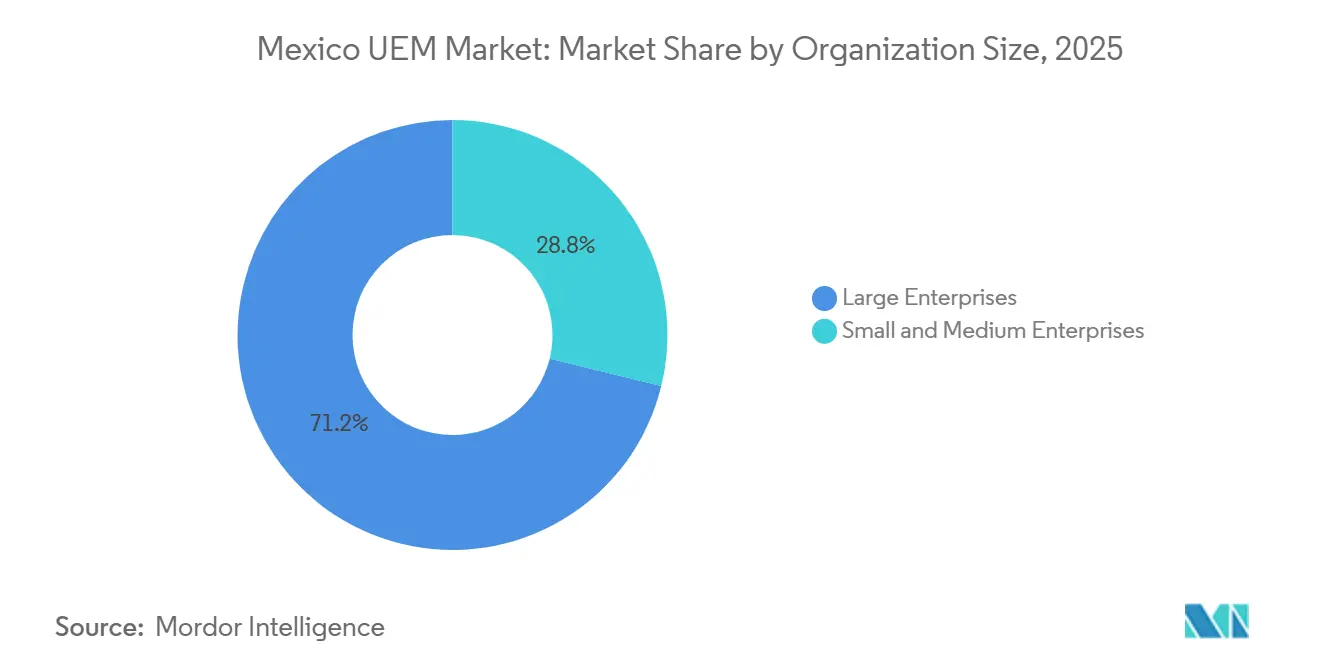
Large enterprises captured 71.18% of the Mexico Unified Endpoint Management (UEM) market in 2025, which shows that current spending still sits with buyers that have established IT teams, more formal procurement cycles, and broader device estates. These organizations are better placed to standardize policy, integrate endpoint controls with identity systems, and absorb the process changes that UEM adoption often requires. Their procurement behavior also favors vendors with wide device coverage and strong partner support because large rollouts rarely stay within one operating system family. For the Mexico Unified Endpoint Management (UEM) market, this keeps enterprise contracts central to near-term revenue even as adoption widens across smaller accounts. Enterprise demand also tends to reward vendors that can combine platform breadth with service consistency across multiple business units and locations.
Small and medium enterprises are projected to expand at a 28.26% CAGR through 2031, making them the fastest-growing size category in the report. INEGI stated that 99.8% of Mexico's economic units are micro, small, or medium enterprises, which explains why the long runway for new endpoint management adoption remains substantial. Movistar Empresas also reported that 68% of Mexican SMEs had adopted network cybersecurity, 61% had adopted device security solutions, and 64% planned to adopt generative AI, which points to a broader shift toward more software-intensive operations. The Mexico Unified Endpoint Management (UEM) industry is therefore likely to see stronger competition around managed onboarding, automation, simple subscription models, and cloud-native administration for smaller accounts. SMEs define the growth curve because they bring scale to the addressable base even when individual contract values remain below enterprise levels.
By End-User Industry: Telecom Leads Current Demand While Healthcare Emerges Fastest
IT and Telecommunications accounted for 21.52% share of the Mexico Unified Endpoint Management (UEM) market size in 2025, keeping the largest vertical position in the current demand base. The sector naturally carries high device density, service continuity expectations, and constant software administration needs, so endpoint governance becomes a daily operating requirement instead of a periodic IT project. Financial services remain important because security and audit readiness are tightly linked to endpoint posture when institutions modernize digital workflows, and Finastra reported that Mexican financial institutions expected security investment to rise by an average of 43% in 2026. Government demand also remains meaningful because the federal Zero Trust policy makes device attestation and access control part of wider administrative security requirements. Manufacturing, retail, education, transportation, and utilities also add breadth to the Mexico Unified Endpoint Management (UEM) market because each sector is expanding its base of mobile, shared, or field-connected devices.
Healthcare is projected to advance at a 28.34% CAGR through 2031, making it the fastest-growing end-user category in the Mexico Unified Endpoint Management (UEM) market. The January 15, 2026 reform to the General Health Law classified digital health as a matter of public interest and mandated digital connectivity and clinical record platforms across health institutions. Gobierno de México stated in 2026 that IMSS Bienestar had launched a MXN 13 billion investment program, equal to USD 756 million, targeting 32,000 modern medical devices and internet connectivity for 8,400 health centers. That rollout expands the managed endpoint base in healthcare and opens room for vendors that can support secure clinical workflows, remote assets, and ongoing service support. Healthcare stands out because new public investment, legal reform, and rising device counts are arriving at the same time rather than in separate stages.
Geography Analysis
Mexico City held the largest concentration of enterprise deployments within the Mexico Unified Endpoint Management (UEM) market in 2025, even though the report does not assign a separate numeric share to the city. The capital sits at the center of federal administration, financial services, and national headquarters, so endpoint control requirements tend to appear there first. The federal cybersecurity policy published in December 2025 placed Zero Trust requirements across the Federal Public Administration, and that makes CDMX the main starting point for public-sector rollout activity. Government demand in the capital also affects surrounding private suppliers because third-party cloud providers and contractors serving federal bodies must meet minimum security and audit requirements under the same policy. As a result, the Mexico UEM market in CDMX is shaped as much by compliance pull as by ordinary IT refresh cycles.
Northern and western industrial hubs form the second growth pole for the Mexico UEM market because manufacturing, logistics, and field operations run larger numbers of shared and specialized devices. Frontline deployments matter here because rugged handhelds, warehouse wearables, scanners, and mobile terminals require steady policy control outside classic office settings. Vuzix stated in May 2025 that Nadro had expanded its Vuzix M400 smart glass fleet to more than 500 units across 14 distribution centers in Mexico, showing that large operational device rollouts are already active in logistics. When those fleets scale across warehouses and routes, buyers need platforms that can manage uptime, shared usage, software consistency, and security from one console. This helps explain why vendors with rugged-device depth and strong service partners remain relevant outside the corporate desktop environment.
Querétaro and the wider Bajío corridor are becoming more important as the Mexico Unified Endpoint Management (UEM) market spreads beyond the capital and the main industrial metros. The shift is supported by the broader move of smaller firms into SaaS and multicloud environments, which Movistar Empresas documented in late 2025. Public health digitization also extends demand into a wider national footprint because the 2026 IMSS Bienestar program targeted health centers across the country rather than a single urban cluster. The combined effect is a market map that is still led by CDMX but is becoming more multi-city as cloud delivery and sector-specific deployments widen the addressable base.
Competitive Landscape
The competitive landscape in the Mexico UEM market is moderately fragmented, with Microsoft, Omnissa, and Ivanti holding strong positions in larger accounts through broad platform reach and established channels. Microsoft benefits when endpoint management is purchased alongside wider workplace software, which makes displacement harder even when buyers review dedicated alternatives. Omnissa strengthened its platform in May 2026 by making Windows Server management generally available within Workspace ONE UEM, giving IT teams a single cloud-native console for servers, desktops, mobile devices, rugged endpoints, and IoT. Ivanti advanced its position in 2026 by adding AI-driven capabilities to Neurons and by framing Autonomous Endpoint Management as a unified operating model across DEX, UEM, and security. These moves show that scale vendors are competing through platform breadth, workflow depth, and automation rather than only through basic device control.
Challengers are gaining room where buyers want faster rollout, simpler pricing, or stronger automation. NinjaOne sharpened that position in March 2026 when it launched AI-driven Vulnerability Management within its Unified IT Operations Platform, using existing device telemetry to identify and prioritize vulnerabilities without endpoint performance impact. ManageEngine also pushed further into autonomous operations in 2026 through Zia Agents, which moved parts of incident analysis and recovery closer to execution. In the Mexico Unified Endpoint Management (UEM) market, these challengers are most credible where customers need leaner deployment models or want to avoid buying several separate endpoint and operations tools. Their progress also increases pressure on incumbents to prove that bundled suites deliver clear operational gains rather than only procurement convenience.
SOTI remains relevant in frontline-heavy accounts because its 2026.1 update focused on shared-device authentication, predictive battery analytics, centralized firmware and patch management, and real-time Windows issue detection for operational fleets. The field also rewards vendors that show commitment to compliance-oriented deployment models, and Ivanti's 2026 sovereign cloud MDM launch for European data sovereignty points to the type of architecture regulated Mexican buyers may increasingly expect. Vendors with limited local channel depth or weak multi-OS coverage are less likely to shape the Mexico Unified Endpoint Management (UEM) market because buyers are standardizing around broader, service-backed platforms. Competition is therefore likely to stay active across enterprise suites, SME-first cloud platforms, and frontline specialists rather than collapsing quickly around a single dominant provider.
Mexico UEM Industry Leaders
-
Microsoft Corporation
-
Omnissa, LLC
-
Ivanti, Inc.
-
IBM Corporation
-
BlackBerry Limited
- *Disclaimer: Major Players sorted in no particular order
Recent Industry Developments
- June 2026: DE-CIX expanded its Mexico Cloud Exchange to include direct Google Cloud access via DirectCLOUD in Querétaro, establishing a fully integrated multi-cloud ecosystem covering Google Cloud, Microsoft Azure, and AWS from a single hub; this infrastructure upgrade meaningfully improves data-sovereignty posture and latency for cloud-delivered UEM tenants in the Bajío industrial region and beyond.
- May 2026: Omnissa announced the general availability of Windows Server management within Workspace ONE UEM, enabling IT teams to manage servers, desktops, mobile devices, rugged endpoints, and IoT from a single cloud-native console; the Workspace ONE Server Essentials offering provides full lifecycle management including onboarding, configuration, server apps, updates, and inventory tracking.
- April 2026: TeamViewer launched Tia's capability to generate automations grounded in customers' own proven fix histories within the TeamViewer ONE unified workplace platform, advancing autonomous endpoint management from conceptual to operationally grounded; the update is directly relevant to Mexico's logistics sector, where TeamViewer manages over 500 Vuzix M400 smart glasses across Nadro's 14 distribution centers.
- March 2026: NinjaOne launched AI-driven Vulnerability Management natively within its Unified IT Operations Platform, enabling identification, prioritization, and remediation of vulnerabilities server-side using existing device telemetry with zero endpoint performance impact; the solution was validated in a 500,000-plus endpoint beta prior to general availability.
Mexico UEM Market Report Scope
The Mexico UEM market refers to the market for software and services used to centrally manage, secure, and monitor endpoints such as laptops, desktops, smartphones, tablets, and other connected devices across Mexico. It enables IT teams to enforce security policies, control device access, deploy applications, and maintain compliance from a single platform.
The Mexico Unified Endpoint Management (UEM) Market Report is Segmented by Component (Solutions, and Services), Deployment Mode (Cloud-Based, On-Premise, and Hybrid), Organization Size (Large Enterprises, and Small and Medium Enterprises), End-User Industry (IT and Telecommunications, BFSI, Government and Defense, Healthcare and Life Sciences, Manufacturing, Retail and E-Commerce, Education, Transportation and Logistics, and Energy and Utilities), and Country. The Market Forecasts are Provided in Terms of Value (USD).
| Solutions | Device Management |
| Application Management | |
| Content Management | |
| Security and Compliance Management | |
| Analytics and Automation | |
| Services |
| Cloud-Based |
| On-Premise |
| Hybrid |
| Large Enterprises |
| Small and Medium Enterprises |
| IT and Telecommunications |
| BFSI |
| Government and Defense |
| Healthcare and Life Sciences |
| Manufacturing |
| Retail and E-Commerce |
| Education |
| Transportation and Logistics |
| Energy and Utilities |
| Other End-User Industries |
| By Component | Solutions | Device Management |
| Application Management | ||
| Content Management | ||
| Security and Compliance Management | ||
| Analytics and Automation | ||
| Services | ||
| By Deployment Mode | Cloud-Based | |
| On-Premise | ||
| Hybrid | ||
| By Organization Size | Large Enterprises | |
| Small and Medium Enterprises | ||
| By End-User Industry | IT and Telecommunications | |
| BFSI | ||
| Government and Defense | ||
| Healthcare and Life Sciences | ||
| Manufacturing | ||
| Retail and E-Commerce | ||
| Education | ||
| Transportation and Logistics | ||
| Energy and Utilities | ||
| Other End-User Industries |
Key Questions Answered in the Report
What is the current and forecast value of Mexico unified endpoint management?
The Mexico UEM Market stood at USD 198.85 million in 2025, reached USD 246.14 million in 2026, and is forecast to reach USD 828.41 million by 2031 at a 27.47% CAGR.
Which deployment model leads demand in Mexico UEM?
Cloud-based deployment led with 64.21% share in 2025 and is also the fastest-growing model, with a projected 27.99% CAGR through 2031.
Why is healthcare becoming important for endpoint management in Mexico?
Healthcare is projected to grow at 28.34% CAGR through 2031 because the 2026 health reform mandated digital connectivity and clinical record platforms, while IMSS Bienestar is funding large-scale device and connectivity rollout.
Which customer group offers the biggest long-term growth opportunity?
SMEs offer the broadest expansion path because they are projected to grow at 28.26% CAGR through 2031, and they represent 99.8% of Mexico's economic units.
What is driving vendor competition in this space?
Competition is centered on cloud-native delivery, automation, unified policy control, and support for mixed device environments, with vendors such as Omnissa, Ivanti, NinjaOne, ManageEngine, and SOTI making product moves in 2026.
Which end-user segment currently spends the most on UEM in Mexico?
IT and Telecommunications held the largest vertical share at 21.52% in 2025 because the sector manages dense device fleets and depends on strong service continuity and endpoint control.