
Middle East and Africa UEM Market Size and Share
Market Overview
| Study Period | 2020 - 2031 |
|---|---|
| Forecast Data Period | 2026 - 2031 |
| Base Year Market Size (2025) | USD 0.46 Billion |
| Market Size (2026) | USD 0.57 Billion |
| Market Size (2031) | USD 1.88 Billion |
| Growth Rate (2026 - 2031) | 26.86 % |
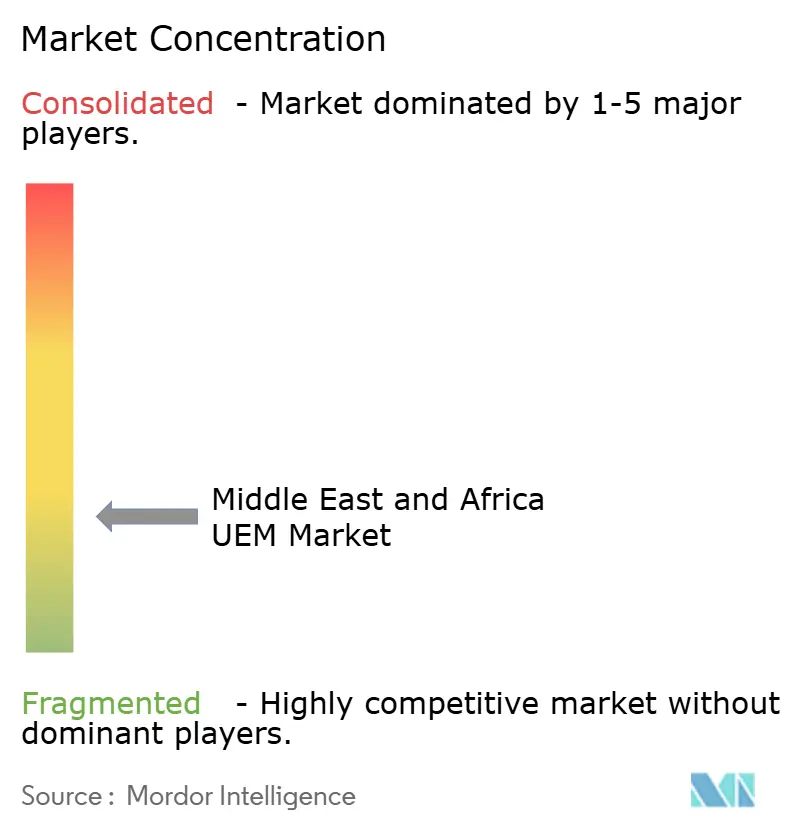
| Market Concentration | Low |
Major Players *Disclaimer: Major Players sorted in no particular order Image © Mordor Intelligence. Reuse requires attribution under CC BY 4.0. | |
Middle East and Africa UEM Market Analysis by Mordor Intelligence
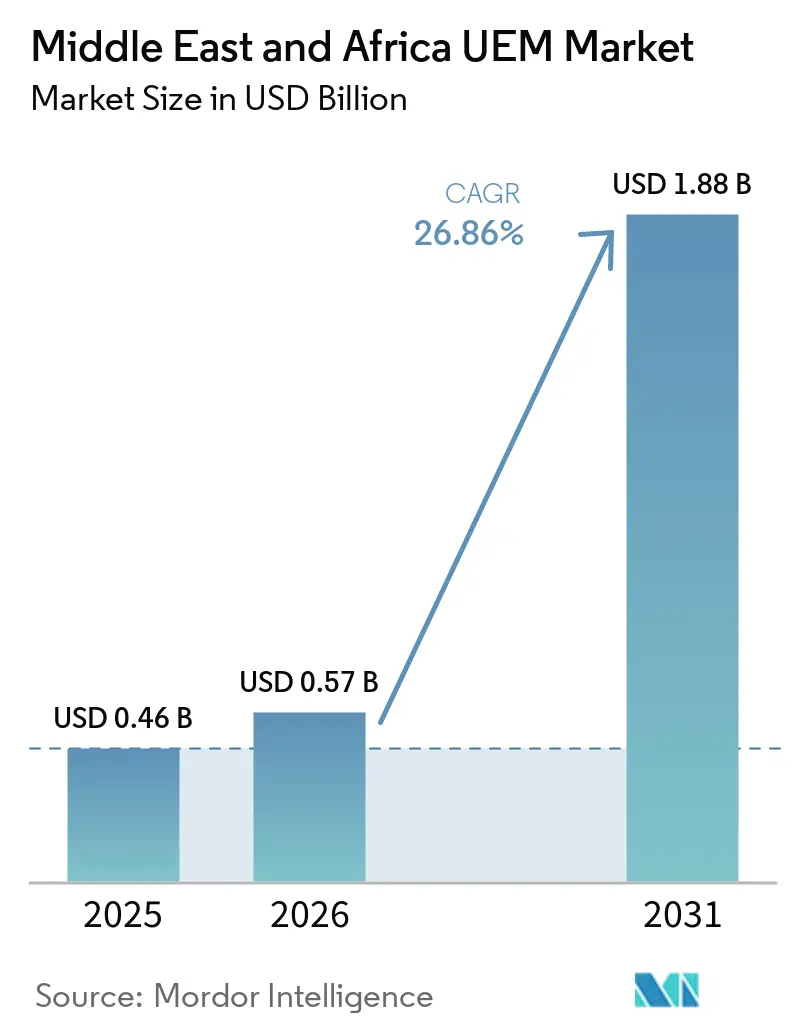
The Middle East and Africa UEM market size is projected to expand from USD 0.46 billion in 2025 and USD 0.57 billion in 2026 to USD 1.88 billion by 2031, registering a CAGR of 26.86% between 2026 to 2031. The Middle East and Africa UEM market is moving beyond basic device administration because enterprises now need one policy layer across laptops, mobile devices, shared endpoints, and frontline equipment. Hybrid work, wider cloud application use, and rising regulatory scrutiny are all shortening buying cycles, especially in markets where audit readiness and endpoint visibility now carry direct operating value. Buyers are also moving away from narrow mobile device management tools because application control, compliance checks, remediation, and analytics are now being assessed as part of one operational stack. Vendors that can support sovereign deployment models, lower the day-to-day workload of policy administration, and sell through strong regional channels are better placed to win regulated accounts and mid-market expansions. The clearest opportunity in the Middle East and Africa UEM market lies in platforms that simplify enrollment, automate policy enforcement, and reduce the staffing burden for organizations managing fast-growing and highly mixed endpoint estates.
Key Report Takeaways
- By component, Solutions held the largest share at 65.46% of the Middle East and Africa UEM market in 2025, while Solutions is also projected to expand at the fastest reported rate of 27.06% CAGR through 2031.
- By deployment mode, cloud-based deployments accounted for the largest share at 58.27% of the Middle East and Africa UEM market in 2025 and are expected to remain the fastest-growing deployment mode at 27.19% CAGR through 2031.
- By organization size, large enterprises led with 69.81% share in 2025, while SMEs are projected to expand at 27.26% CAGR through 2031.
- By end-user industry, Government and Defense accounted for the largest share at 24.54% in 2025, while Healthcare and Life Sciences are projected to grow at 27.34% CAGR through 2031.
Note: Market size and forecast figures in this report are generated using Mordor Intelligence’s proprietary estimation framework, updated with the latest available data and insights as of January 2026.
Market Trends and Insights
Drivers Impact Analysis of Middle East and Africa UEM Market*
| Driver | (~) % Impact on CAGR Forecast | Geographic Relevance | Impact Timeline |
|---|---|---|---|
| Increasing BYOD and Corporate Mobility Adoption | +4.5% | GCC core, including UAE, Saudi Arabia, and Qatar, with spillover to South Africa and Egypt | Short term (≤ 2 years) |
| Rising Need for Centralized Device and Application Governance | +3.8% | Broad regional relevance, with earlier enforcement concentration in UAE and Saudi Arabia | Short term (≤ 2 years) |
| Growing Endpoint Security Requirements in Regulated Industries | +3.2% | Saudi Arabia and UAE primary, with secondary relevance in Qatar and Kuwait | Medium term (2-4 years) |
| Expansion of Hybrid Workflows in Distributed Enterprises | +2.9% | UAE, Saudi Arabia, and South Africa | Short term (≤ 2 years) |
| Under-Managed SaaS and Mobile App Sprawl Across Mid-Market Firms | +2.4% | UAE, Qatar, and Saudi Arabia | Medium term (2-4 years) |
| Rising Demand for Automation-Driven Policy Enforcement and Remediation | +2.0% | Broad regional relevance | Medium term (2-4 years) |
| Source: Mordor Intelligence | |||
Increasing BYOD and Corporate Mobility Adoption
Personal devices are now a permanent part of daily work across large employers in the region, which means device diversity in the Middle East and Africa UEM market is no longer a temporary IT issue. That shift widens exposure when staff access business applications through phones and tablets that sit outside formal enrollment and policy coverage. Zylo stated in 2026 that 87% of enterprise applications were purchased outside IT, which shows how quickly unmanaged access patterns can spread across endpoints that central teams do not fully control.[1] Buyers are therefore placing more weight on UEM tools that can enroll bring-your-own devices with clear separation between work data and personal data. This preference is pushing vendors to emphasize light-touch enrollment, consistent app access controls, and lower-friction onboarding for mixed corporate and employee-owned fleets.
Rising Need for Centralized Device and Application Governance
The Middle East and Africa UEM market is seeing stronger demand for centralized control because separate tools for apps, identities, and devices leave gaps that security and IT teams cannot easily reconcile. When application entitlement and device compliance are managed on different tracks, organizations often end up with access paths that appear compliant in one system and risky in another. That is why integrated platforms are gaining budget support, especially when they reduce console sprawl and simplify reporting across distributed fleets. Microsoft announced 3 new validated partners for Intune for MSPs in March 2026, which widened multi-tenant endpoint management support for service-led delivery models and reinforced the push toward centralized administration.[2] As a result, the Middle East and Africa UEM market is rewarding platforms that combine device policy, application oversight, and service delivery under one operating layer.
Growing Endpoint Security Requirements in Regulated Industries
Security requirements in finance, healthcare, government, and defense are raising the floor for endpoint governance across the Middle East and Africa UEM market. Mastercard reported in 2026 that 71% of observed attacks across the region were financially motivated or disruptive, which keeps pressure on organizations to tighten control over every device that touches sensitive data.[3] In regulated environments, buyers are no longer looking only for inventory and remote management; they also need stronger policy enforcement, clearer audit records, and better control over data movement at the endpoint. That requirement is lifting demand for security and compliance management, especially where a failed device control can quickly become a legal, operational, or reputational issue. It also explains why vendors with stronger governance depth are gaining attention in the Middle East and Africa UEM market, even when their platform breadth is still catching up.
Expansion of Hybrid Workflows in Distributed Enterprises
Hybrid operating models have made distributed endpoint estates a routine condition rather than a temporary adjustment, and that change continues to widen demand in the Middle East and Africa UEM market. Enterprises now need to apply the same policy logic to office laptops, remote user devices, shared terminals, and field equipment without creating gaps between teams or locations. This is pushing buyers to replace scheduled and manual endpoint administration with more continuous forms of monitoring and remediation. SOTI released MobiControl 2026.1 with expanded automation, real-time monitoring, and automated policy actions across Android, Apple, and Windows fleets, which reflects the wider move toward steady management of diverse device environments. The practical effect is that the Middle East and Africa UEM market is favoring platforms that reduce operational friction across environments where employees, devices, and workloads no longer sit in one fixed location.
Restraints Impact Analysis of Middle East and Africa UEM Market*
| Restraint | (~) % Impact on CAGR Forecast | Geographic Relevance | Impact Timeline |
|---|---|---|---|
| Fragmented Legacy IT and Endpoint Tool Stacks | -3.5% | Africa-wide and non-GCC Middle East | Medium term (2-4years) |
| Data Residency and Sovereignty Constraints | -2.9% | Saudi Arabia, UAE, Qatar, and Nigeria | Long term (≥ 4 years) |
| Integration Complexity with Legacy Identity and Security Systems | -2.3% | Broad regional relevance, with concentration in large GCC enterprises | Medium term (2-4 years) |
| Skills Shortage for UEM Policy Design and Lifecycle Operations | -1.8% | MENA and Sub-Saharan Africa | Long term (≥ 4 years) |
| Source: Mordor Intelligence | |||
Fragmented Legacy IT and Endpoint Tool Stacks
Legacy-heavy environments still slow deployment in the Middle East and Africa UEM market because many organizations do not begin with a clean, validated inventory baseline. Mixed operating systems, overlapping security agents, and spreadsheet-led asset records make early rollout more complex and often stretch implementation timelines. That complexity also raises the risk that first deployments feel costly and difficult, which can reduce later expansion even after initial contracts are signed. Tanium extended real-time intelligence and remediation into operational technology environments and mobile devices in its 2026H1 platform update, which shows how vendors are trying to address estates that are broader and more fragmented than traditional office. Vendors that can onboard customers in stages, rather than forcing a full replacement of existing tools at the start, are in a better position to convert demand where legacy complexity remains high.
Data Residency and Sovereignty Constraints
Data residency rules are reshaping architecture choices across the Middle East and Africa Unified Endpoint Management (UEM) market because some buyers cannot allow device telemetry or administrative data to leave national borders. That constraint is especially important for public entities and regulated operators that may favor sovereign, in-country, or tightly controlled deployment models over standard public-cloud delivery. Microsoft said in October 2025 that it would enable in-country data processing for Microsoft 365 Copilot in the UAE from early 2026, which shows how local processing capability is becoming part of the value proposition for digital workplace platforms. Ivanti launched its Sovereign Edition cloud solution in April 2026, which further signaled that sovereign architecture is becoming a practical commercial requirement rather than a niche design option. This slows adoption for cloud-only approaches in sensitive accounts, even though the wider Middle East and Africa Unified Endpoint Management (UEM) market still favors cloud deployment for speed, updates, and lower infrastructure burden.
*Our forecasts treat driver/restraint impacts as directional, not additive. The impact forecasts reflect baseline growth, mix effects, and variable interactions.
Middle East and Africa UEM Market Segment Analysis
By Component:
Solutions Architecture Drives Enterprise ConsolidationSolutions held 65.46% share in 2025 and are projected to expand at 27.06% CAGR through 2031, which keeps this category at the center of spending in the Middle East and Africa UEM market. Buyers are clearly favoring fuller governance stacks over narrow mobile device management point tools because they want policy consistency across devices, applications, compliance, and remediation. Device management still anchors volume because every deployment begins with visibility, enrollment, and basic control over the endpoint estate. At the same time, security and compliance management is taking a larger share of attention as more customers need evidence-backed enforcement instead of simple configuration reporting. Analytics and automation are also moving into the center of product evaluation because buyers now value platforms that can detect drift, identify risk patterns, and trigger corrective action without waiting for manual review.
The Services segment remains smaller, but it is still important where internal IT resources are limited and managed delivery is the practical path to adoption. In these cases, service demand rises alongside platform complexity because customers often need help with policy design, migration, and lifecycle administration after deployment. The Middle East and Africa Unified Endpoint Management (UEM) market is therefore not treating services as a separate afterthought, it is using them to make broader platform adoption possible in thinner-staffed environments. As automation features improve, service providers are also likely to shift from manual administration toward exception-based management, which can lift service quality without adding the same staffing burden at each account.
By Deployment Mode:
Cloud Leads While Sovereignty Reshapes ArchitectureCloud-based deployments accounted for 58.27% of the Middle East and Africa Unified Endpoint Management market size in 2025 and are projected to expand at 27.19% CAGR through 2031. Their appeal is tied to capability velocity because cloud-managed platforms receive frequent updates, broader device support, and faster feature delivery than environments that rely on internal upgrade cycles. This matters in a market where policy needs are changing quickly and buyers want new controls without long implementation delays. Microsoft’s UAE in-country processing commitment from early 2026 also supports the cloud path by showing that local infrastructure can narrow one of the biggest objections for sovereign-sensitive customers. Even so, cloud leadership does not remove the architecture debate, because deployment decisions in the Middle East and Africa UEM market are still shaped by data control, contract conditions, and the regulatory profile of each buyer.
On-premise deployments continue to hold meaningful demand among defense organizations and highly restricted operators that cannot route endpoint telemetry through public networks under their own control models. Hybrid deployment is gaining ground as a transition path for organizations that keep some estates in-house while moving selected users or device classes to cloud management. That split can ease migration, but it also creates policy inconsistency and operating complexity when teams manage separate control planes for different endpoint groups. Vendors that can offer a credible path from hybrid to more unified administration, while preserving local control options, are likely to capture more of this transitional spending across the forecast period.
By Organization Size:
Enterprise Volume Anchors Revenue While SME Growth QuickensLarge enterprises held 69.81% share in 2025, which reflects their larger device estates, wider compliance exposure, and more formal procurement structures across the Middle East and Africa UEM market. These buyers usually have the broadest mix of endpoints, the deepest reporting needs, and the highest cost of unmanaged policy gaps across business units or geographies. Government-linked entities, telecom operators, financial institutions, and diversified groups all fit this profile, which is why large-enterprise demand still anchors current revenue. Their buying criteria also tend to be stricter because platform choice affects audit posture, vendor integration strategy, and long-cycle operating cost. This keeps the competitive bar high and favors vendors that can support scale, governance depth, and channel or service coverage at the same time.
SMEs are projected to expand at 27.26% CAGR through 2031, which slightly outpaces the broader market and changes where future account growth will come from. Cloud-native delivery is helping this shift because smaller organizations can now access stronger endpoint controls without the same infrastructure or staffing burden that older deployment models required. Jamf highlighted in 2026 that simpler management and intelligent automation remain core to its positioning in endpoint management, which reflects a wider market need for easier administration at leaner customer organizations. The MEA UEM market is therefore becoming more competitive in the SME tier, where pricing, onboarding simplicity, and policy automation matter as much as feature depth.
By End-User Industry:
Government Leads While Healthcare Builds Faster MomentumGovernment and Defense held 24.54% share in 2025, which made it the largest end-user category in the MEA Unified Endpoint Management (UEM) market. This position comes from the combination of large managed device fleets, stronger cybersecurity expectations, and a lower tolerance for endpoint blind spots in high-sensitivity environments. Government buyers also tend to formalize procurement around compliance, continuity, and control, which supports demand for platforms with stronger audit support and administrative depth. BFSI follows with strong structural demand because device-level access control, data handling discipline, and secure workforce mobility remain central to financial operations. IT and Telecommunications also carry significant weight because these operators manage dense employee fleets, field equipment, and customer-facing devices at the same time.
Healthcare and Life Sciences is projected to grow at 27.34% CAGR through 2031, which makes it the fastest-growing end-user segment. The expansion is tied to digital clinical workflows, connected devices, and the need to control who can access patient-related systems across tablets, terminals, and mobile endpoints. This category also faces tighter practical requirements around data handling, patching, and access governance because unmanaged clinical devices can create service disruption as well as compliance exposure. Manufacturing, Retail and E-Commerce, Transportation and Logistics, Education, Energy and Utilities, and other end-user groups are also opening new demand because they run shared, rugged, or frontline devices that require fast enrollment and consistent policy application across dispersed operating environments.
Geography Analysis
Saudi Arabia and United Arab Emirates UEM Market
Saudi Arabia held 23.44% of the Middle East and Africa UEM market share in 2025, which kept it as the largest country market in the region. Its position reflects a more structured buying environment where public digitization, security expectations, and enterprise modernization are all supporting endpoint governance demand. The market in the Kingdom also benefits from the scale of device estates inside ministries, public agencies, large enterprises, and regulated operators. The UAE is projected to expand at 27.42% CAGR through 2031, which makes it the fastest-growing geography in the Middle East and Africa Unified Endpoint Management (UEM) market. Microsoft’s early 2026 availability of in-country data processing for Microsoft 365 Copilot in the UAE points to deeper local digital infrastructure that can support sovereign-sensitive enterprise adoption.
Qatar and Kuwait UEM Market
Qatar and Kuwait are smaller in absolute volume, but both remain strategically relevant because compliance-heavy buyers there are formalizing device governance as digital operations expand. These markets matter less for sheer scale and more for the quality of demand, since contracts often come from financially sound and regulation-aware organizations. The MEA Unified Endpoint Management (UEM) market therefore sees Gulf growth not only through country size, but also through the depth of governance requirements within each account. That dynamic supports vendors that can localize delivery, meet higher control standards, and work through trusted regional channels.
Africa UEM Market
South Africa is the most established UEM market within the Africa subregion because it combines stronger corporate IT maturity with large enterprise headquarters and broader multinational presence. Mastercard reported in 2026 that only 20,000 certified cybersecurity professionals served the entire continent, which helps explain why automation-led endpoint management is becoming a practical need rather than a premium feature. Egypt is emerging as a growth market as digital programs expand the number of devices that need policy control across service delivery environments. The Rest of Africa, including markets such as Nigeria and Kenya, offers a longer-duration opportunity where growing digital services, local compliance pressures, and uneven staffing conditions can all support future platform adoption.
Competitive Landscape
The competitive structure of the Middle East and Africa Unified Endpoint Management (UEM) market remains moderately fragmented, with global platform providers leading broad enterprise demand while regional channels and specialist vendors compete for specific customer groups. In 2026, competition is centered less on basic enrollment and more on which platform can unify management, security, analytics, and user support with the least administrative burden. Vendors are trying to raise switching costs by making endpoint management part of a wider operating layer that also covers remediation, employee experience, and cross-platform visibility. This is why product breadth matters, but it is not the only issue, because sovereign readiness, local support coverage, and vertical credibility can decide larger contracts even when core feature sets look similar. The Middle East and Africa UEM market is therefore rewarding vendors that combine product depth with deployment flexibility and stronger regional execution.
Microsoft strengthened its position through ecosystem expansion when it added 3 new validated partners to the Intune for MSPs program in March 2026, which widened service-led reach for multi-tenant endpoint administration. Ivanti added another competitive signal in April 2026 when it launched a sovereign cloud solution, reinforcing how local control and jurisdiction are becoming a larger part of platform selection. SOTI’s MobiControl 2026.1 update showed a different strategic path by focusing on automation and real-time control for shared and frontline device environments that many broader office-first platforms do not serve as deeply. Recast Software also strengthened channel presence in September 2025 by appointing RidgePoint as its exclusive distributor for the Middle East and Africa, which highlighted how distribution strategy still matters when vendors want faster access to complex regional accounts.
There is still open space in the market for vendors that can combine sovereign deployment credibility, Arabic-language usability, and SME-friendly commercial models without sacrificing enterprise controls. The competitive set also needs to be defined carefully, since Oracle and Accenture do not represent direct UEM product competition in this market, while vendors such as Omnissa and 42Gears are more relevant comparators based on platform focus. That distinction matters because the MEA Unified Endpoint Management (UEM) market is being shaped by product capability, not by broad consulting presence or adjacent infrastructure software. The next phase of rivalry is likely to center on who can bring stronger automation and local deployment confidence into the same platform without making administration harder for already stretched customer teams.
Middle East and Africa UEM Industry Leaders
-
Microsoft Corporation
-
Broadcom Inc.
-
Ivanti, Inc.
-
BlackBerry Limited
-
IBM Corporation
- *Disclaimer: Major Players sorted in no particular order
Middle East and Africa UEM Market Companies Covered in this Report
- Microsoft Corporation
- Broadcom Inc.
- Ivanti, Inc.
- BlackBerry Limited
- IBM Corporation
- Sophos Group plc
- ManageEngine, A Division Of Zoho Corporation Private Limited
- SOTI Inc.
- Jamf Holding Corp.
- Cisco Systems, Inc.
- Samsung Electronics Co., Ltd.
- Google LLC
- Oracle Corporation
- Citrix Systems, Inc.
- Baramundi Software GmbH
- Matrix42 AG
- HCL Technologies Limited
- Accenture plc
- Fortinet, Inc.
- Tanium Inc.
Recent Industry Developments in Middle East and Africa UEM Market
- May 2026: SOTI released MobiControl 2026.1, introducing expanded automation for Android, Apple, and Windows device fleets, real-time monitoring, automated policy actions triggered by custom device states, and streamlined patch management for Windows endpoints. The update specifically targets organizations managing large frontline device populations in retail, transport, logistics, and healthcare, reducing manual IT intervention across shared-device environments.
- April 2026: Ivanti launched Ivanti Neurons for MDM Sovereign Edition EU, a purpose-built cloud-managed endpoint solution enabling organizations to maintain full data sovereignty, legal jurisdiction, auditability, and operational control over managed devices. The sovereign architecture establishes a commercial and technical template for similar in-country instances being evaluated for Gulf market deployment.
- March 2026: Microsoft announced 3 new validated partners joining the Intune for MSPs ecosystem, extending multi-tenant endpoint management capabilities built on Microsoft Intune to managed-service customers. The expansion is particularly relevant to MEA, where SMEs and mid-market organizations frequently consume enterprise IT through managed-service contracts rather than direct procurement.
- October 2026: Microsoft announced a strategic investment to enable in-country data processing for Microsoft 365 Copilot in the UAE, hosted within Microsoft’s Dubai and Abu Dhabi cloud data centers, available in early 2026. The initiative ensures Copilot interaction data is stored and processed within UAE borders and aligns with the UAE Cybersecurity Council’s AI policy, directly expanding Microsoft Intune’s sovereign cloud addressable market.
Middle East and Africa UEM Market Report Scope
The Middle East and Africa UEM market refers to the market for software and services used to centrally manage, secure, and monitor endpoints such as laptops, desktops, smartphones, tablets, and other connected devices across the Middle East and Africa. It enables IT teams to enforce security policies, control device access, deploy applications, and maintain compliance from a single platform.
The Middle East and Africa Unified Endpoint Management (UEM) Market Report is Segmented by Component (Solutions, and More), Deployment Mode (Cloud-Based, On-Premise, and Hybrid), Organization Size (Large Enterprises, and Small And Medium Enterprises), End-User Industry (IT And Telecommunications, Government and Defense, Healthcare and Life Sciences, and More), and Geography. The Market Forecasts are Provided in Terms of Value (USD).
Segmentation Overview
| Solutions | Device Management |
| Application Management | |
| Content Management | |
| Security and Compliance Management | |
| Analytics and Automation | |
| Services |
| Cloud-Based |
| On-Premise |
| Hybrid |
| Large Enterprises |
| Small and Medium Enterprises |
| IT and Telecommunications |
| BFSI |
| Government and Defense |
| Healthcare and Life Sciences |
| Manufacturing |
| Retail and E-Commerce |
| Education |
| Transportation and Logistics |
| Energy and Utilities |
| Other End-User Industries |
| Middle East | Saudi Arabia |
| United Arab Emirates | |
| Qatar | |
| Kuwait | |
| Rest of Middle East | |
| Africa | South Africa |
| Egypt | |
| Rest of Africa |
| By Component | Solutions | Device Management |
| Application Management | ||
| Content Management | ||
| Security and Compliance Management | ||
| Analytics and Automation | ||
| Services | ||
| By Deployment Mode | Cloud-Based | |
| On-Premise | ||
| Hybrid | ||
| By Organization Size | Large Enterprises | |
| Small and Medium Enterprises | ||
| By End-User Industry | IT and Telecommunications | |
| BFSI | ||
| Government and Defense | ||
| Healthcare and Life Sciences | ||
| Manufacturing | ||
| Retail and E-Commerce | ||
| Education | ||
| Transportation and Logistics | ||
| Energy and Utilities | ||
| Other End-User Industries | ||
| By Geography | Middle East | Saudi Arabia |
| United Arab Emirates | ||
| Qatar | ||
| Kuwait | ||
| Rest of Middle East | ||
| Africa | South Africa | |
| Egypt | ||
| Rest of Africa | ||
Key Questions Answered in the Report
What is the 2026 value of the Middle East and Africa UEM market?
The Middle East and Africa UEM market stands at USD 0.57 billion in 2026 and is forecast to reach USD 1.88 billion by 2031 at a 26.86% CAGR.
Which component generates the most revenue in this space?
Solutions leads the revenue mix with 65.46% share in 2025, supported by demand for integrated device, app, compliance, and automation capabilities.
Why is cloud deployment expanding faster than other delivery models?
Cloud-based deployment held 58.27% share in 2025 and is projected to grow at 27.19% CAGR because buyers value continuous updates, lower infrastructure burden, and faster rollout.
Which customer group is creating the fastest new demand?
SMEs are projected to grow at 27.26% CAGR through 2031 as cloud-native platforms make stronger endpoint controls easier to buy and manage.
Which end-user segment is expanding the fastest?
Healthcare and Life Sciences is projected to advance at 27.34% CAGR as digital clinical workflows and connected devices increase the need for secure endpoint control.
Which countries matter most for near-term growth?
Saudi Arabia leads current demand with 23.44% share in 2025, while the UAE is the fastest-growing country market at 27.42% CAGR through 2031.