
Europe UEM Market Size and Share
Market Overview
| Study Period | 2020 - 2031 |
|---|---|
| Forecast Data Period | 2026 - 2031 |
| Base Year Market Size (2025) | USD 1.86 Billion |
| Market Size (2026) | USD 2.27 Billion |
| Market Size (2031) | USD 6.71 Billion |
| Growth Rate (2026 - 2031) | 24.19 % |
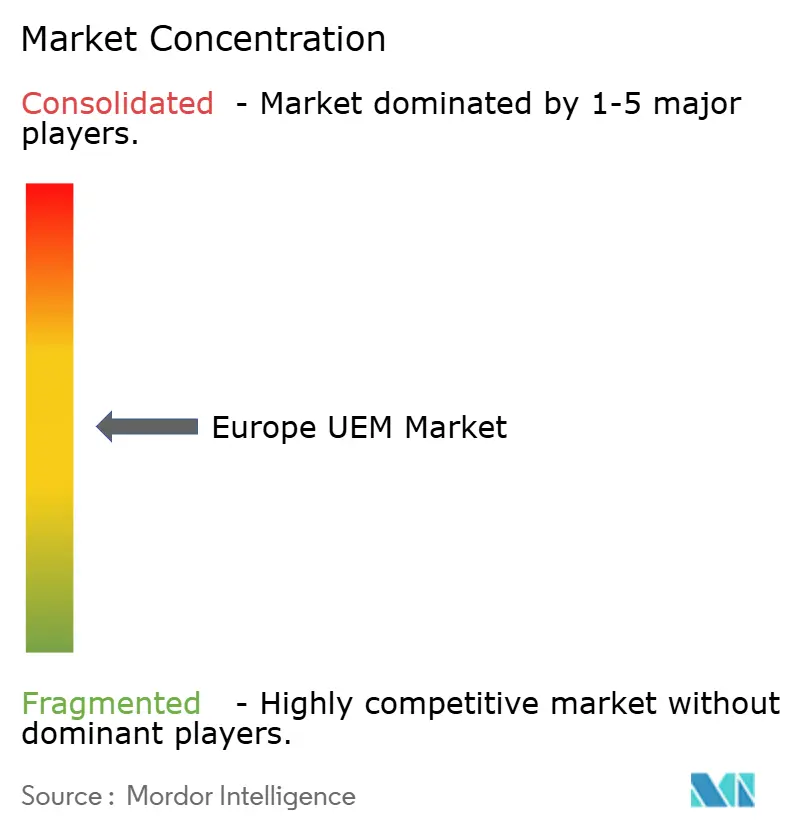
| Market Concentration | Medium |
Major Players *Disclaimer: Major Players sorted in no particular order Image © Mordor Intelligence. Reuse requires attribution under CC BY 4.0. | |
Europe UEM Market Analysis by Mordor Intelligence
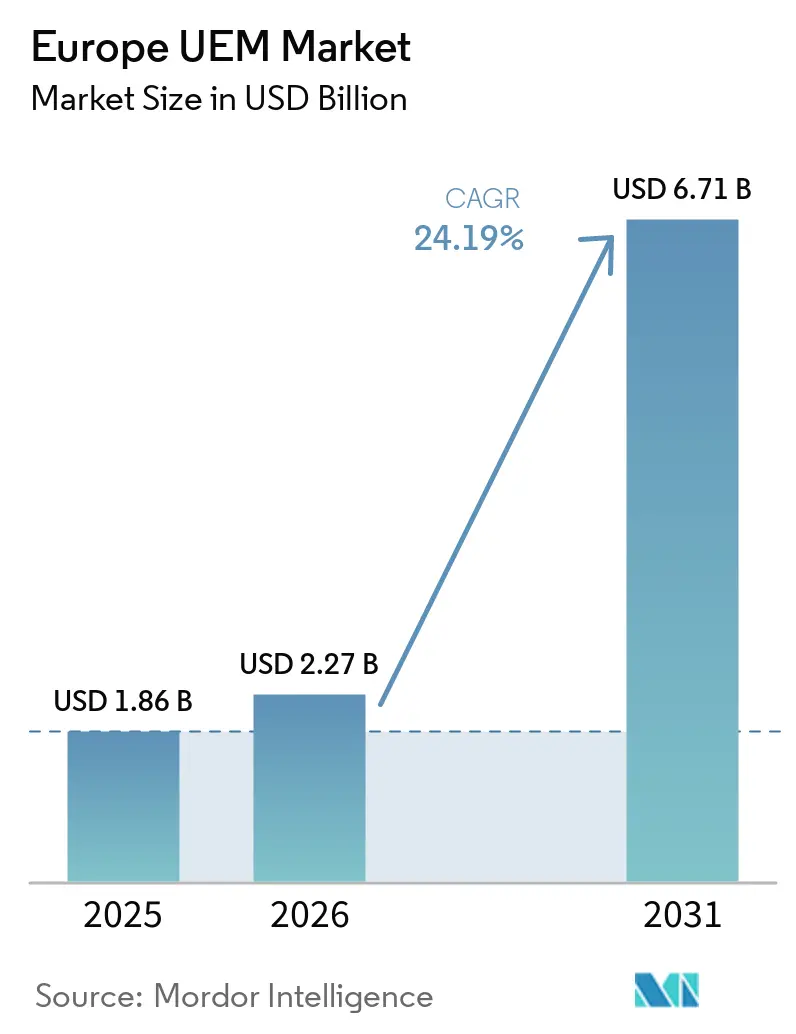
The Europe UEM market size is projected to be USD 1.86 billion in 2025, USD 2.27 billion in 2026, and reach USD 6.71 billion by 2031, growing at a CAGR of 24.19% from 2026 to 2031. The growth path reflects a broad reset in enterprise IT governance across Europe, where hybrid work, a larger device footprint, and stronger security oversight are pushing organizations away from separate management tools. NIS2 enforcement has made endpoint control a more formal operating requirement for many regulated entities, which is increasing demand for centralized policy, visibility, and compliance reporting. Sovereign cloud preferences are also shaping vendor selection, especially when buyers want clearer jurisdictional control over management data and hosted consoles. This is creating room for European vendors that combine local hosting, language support, and compliance-focused product design, even while large global platforms retain scale and bundling strength. Budget scrutiny still slows some mid-market decisions, yet vendors that can show lower tool overlap, simpler deployment, and faster compliance workflows should capture the strongest openings across the Europe unified endpoint management (UEM) market.
Key Report Takeaways
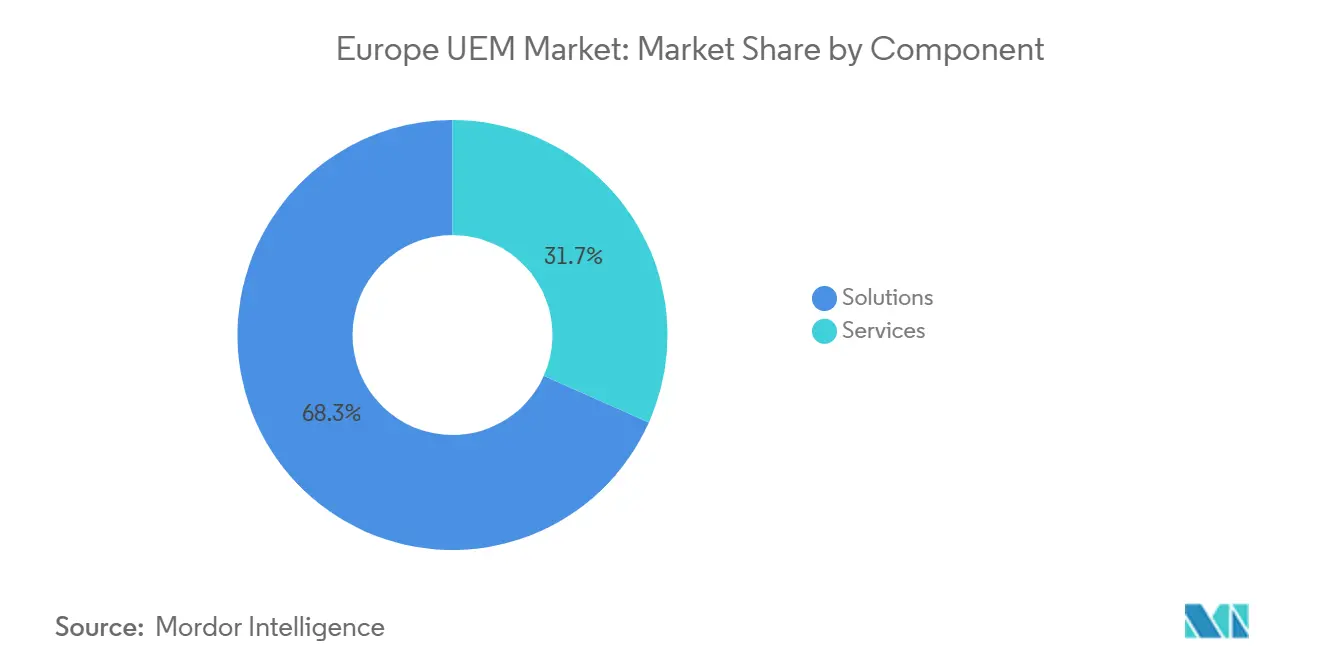
- By component, solutions held 68.33% share of the Europe UEM market in 2025 and are projected to expand at a 25.12% CAGR through 2031.
- By deployment mode, cloud-based deployment accounted for 63.55% of the Europe unified endpoint management market size in 2025 and is projected to expand at a 25.23% CAGR through 2031.
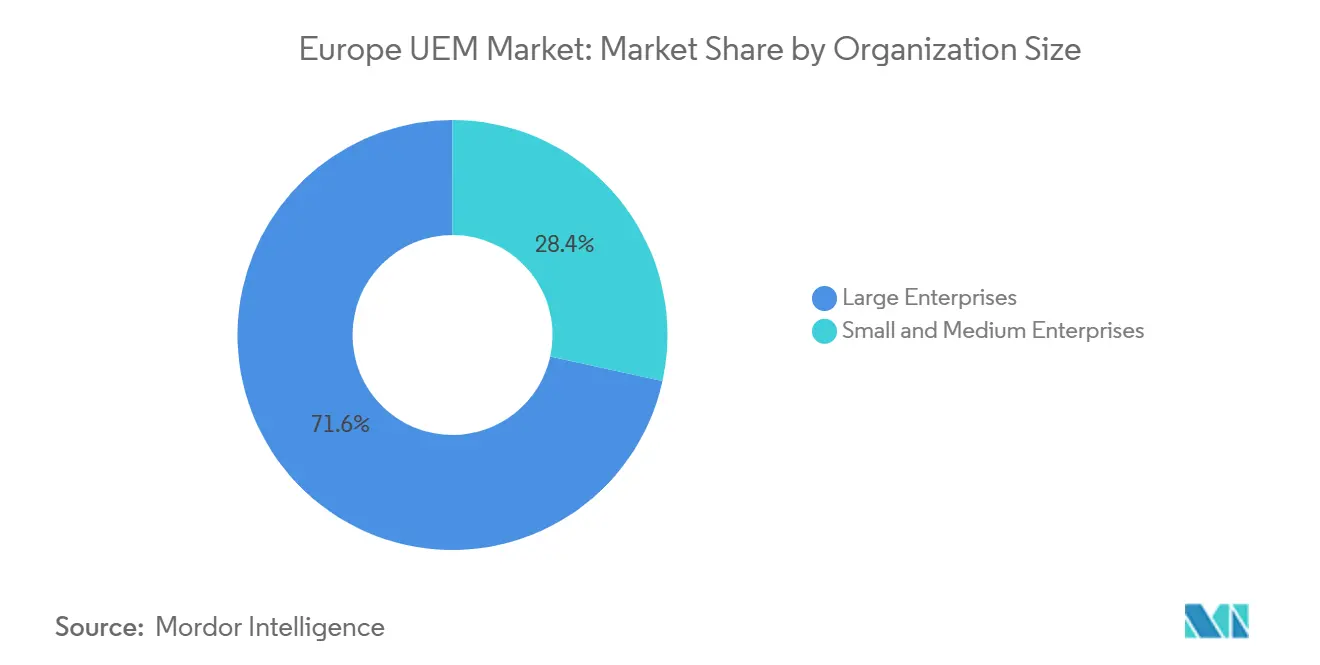
- By organization size, large enterprises held 71.56% of the Europe unified endpoint management market share in 2025, while SMEs are projected to expand at a 25.34% CAGR through 2031.
- By end-user industry, IT and telecommunications accounted for 23.32% share of the Europe UEM market in 2025, while healthcare is projected to expand at a 25.06% CAGR through 2031.
- By country, Germany held 21.25% of the Europe unified endpoint management market share in 2025, while Spain is projected to advance at a 25.27% CAGR through 2031.
Note: Market size and forecast figures in this report are generated using Mordor Intelligence’s proprietary estimation framework, updated with the latest available data and insights as of January 2026.
Market Trends and Insights
Drivers Impact Analysis of Europe UEM Market*
| Driver | (~) % Impact on CAGR Forecast | Geographic Relevance | Impact Timeline |
|---|---|---|---|
| Hybrid Work and BYOD Expansion Across Regulated Enterprises | +5.0% | Pan-European, early gains in Germany, United Kingdom, Netherlands | Short term (≤ 2 years) |
| Zero-Trust Rollouts Across Distributed Endpoint Environments | +4.5% | Germany, France, United Kingdom, Netherlands | Medium term (2-4 years) |
| Endpoint Consolidation Across Identity, Access, and Device Control | +4.0% | Pan-European, led by large enterprise hubs in Germany, United Kingdom, France | Medium term (2-4 years) |
| Cloud Migration of Endpoint Operations and Policy Orchestration | +3.5% | Germany, United Kingdom, Spain, sovereign cloud uptake in France, Italy | Medium term (2-4 years) |
| European Union Cyber Resilience and Data-Protection Compliance Spend | +3.0% | Pan-European, essential entities across all European Union member states | Short term (≤ 2 years) |
| AI-Enabled Endpoint Automation and Digital Employee Experience Optimization | +2.5% | United Kingdom, Germany, Netherlands, spillover to Spain, Nordics | Long term (≥ 4 years) |
| Source: Mordor Intelligence | |||
Hybrid Work and BYOD Expansion Across Regulated Enterprises
Hybrid work is now a durable operating model in many European organizations, so endpoint control has moved from a narrow IT task to a wider governance need across the Europe UEM market.[1] Each additional remote laptop, phone, and tablet widens the device surface that policy teams must manage through one operating framework instead of separate tools for separate device classes. BYOD policies in regulated sectors also require clear separation between corporate and personal data, along with stronger authentication and access control on shared devices. NIS2 reinforced this shift by requiring risk management and security measures that are harder to enforce consistently when desktop, mobile, and access policies sit in disconnected systems. That is why enterprises are favoring platforms that can apply one control model across Windows, macOS, iOS, Android, ChromeOS, and adjacent endpoint types without duplicating workflows. Vendors that ship ready-made compliance templates and centralized reporting are therefore better placed to turn hybrid-work demand into faster deployments across the Europe unified endpoint management (UEM) market.
Zero-Trust Rollouts Across Distributed Endpoint Environments
Zero-trust adoption is gaining more weight in Europe because device identity, access control, and continuous verification now sit closer to formal cybersecurity obligations. In practice, every endpoint that requests access to a corporate application or network resource must present a current state, a known identity, and a compliant posture. That requirement increases the value of a unified control layer because the same platform can tie enrollment, policy, telemetry, and enforcement together in one place. The MEDIATE project under Horizon funding also showed that federated zero-trust models across cloud, edge, and IoT settings need security controls that can be updated and reconfigured dynamically. This shifts buyer attention away from static rule sets and toward platforms that can automate policy changes as endpoint conditions change in real time. As a result, security budgets are absorbing a larger share of endpoint management spending, which supports higher-value contracts across the Europe UEM market.
Endpoint Consolidation Across Identity, Access, and Device Control
Tool consolidation is becoming a stronger buying theme because enterprises want fewer handoffs between device control, access policy, and compliance reporting inside the Europe UEM market.[2] When those controls sit in separate products, legal review, audit preparation, and data-governance checks become harder to coordinate across jurisdictions. A more unified stack reduces the number of systems that must be assessed for data handling, hosting location, and cross-border exposure. That matters more in Europe because the Cloud Sovereignty Framework is making infrastructure governance and assurance levels more visible in procurement decisions. Buyers that can connect device management, identity-linked access, and compliance evidence through one platform often face a cleaner operational path than buyers stitching several point products together. This makes consolidation a practical cost and governance lever, not only a feature preference, across the Europe unified endpoint management market.
Cloud Migration of Endpoint Operations and Policy Orchestration
Cloud migration is changing how endpoint programs are designed because centralized consoles, remote provisioning, and policy updates fit better with distributed workforces and multi-site estates. At the same time, European buyers are paying closer attention to where management data is hosted and who can exercise jurisdiction over it. The Cloud Sovereignty Framework gave that concern a more formal procurement language through SEAL classifications, which are now used as assurance signals beyond EU institutional buying. Ivanti responded in April 2026 with a sovereign European edition of Neurons for MDM that is hosted on BSI-certified infrastructure and positioned around EU data sovereignty and compliance.[3] Omnissa and GEMA also launched a sovereign Workspace ONE solution for Germany and Austria in October 2025, showing that cloud growth in Europe is moving toward locally governed architectures rather than generic regional hosting. These moves are reframing cloud adoption inside the Europe UEM market because buyers increasingly want both SaaS speed and stronger jurisdictional control.
Restraints Impact Analysis of Europe UEM Market*
| Restraint | (~) % Impact on CAGR Forecast | Geographic Relevance | Impact Timeline |
|---|---|---|---|
| Data Sovereignty and Cross-Border Control Constraints | -1.5% | Pan-European, Germany, France, Netherlands most affected | Medium term (2-4 years) |
| Broadcom-VMware Transition Friction in Installed Base Procurement | -0.8% | Pan-European, concentrated in large enterprise accounts across Germany, United Kingdom | Short term (≤ 2 years) |
| Integration Complexity Across Legacy Windows, Mobile, and Specialized Devices | -1.2% | Germany, industrial and OT environments, France, Italy, spillover to Rest of Europe | Medium term (2-4 years) |
| Security Tool Overlap and Budget Scrutiny in Midmarket Buyers | -0.7% | United Kingdom, Netherlands, Spain, Italy, SME-dominated markets | Short term (≤ 2 years) |
| Source: Mordor Intelligence | |||
Data Sovereignty and Cross-Border Control Constraints
Data sovereignty remains a real brake on buying speed because European organizations must weigh cloud convenience against strict obligations around data location, access, and transfer. The Data Act requires providers to take technical and organizational measures against unlawful non-EU government access, while European data-transfer guidance keeps attention on how personal data moves across jurisdictions. This means legal and security teams often review hosting models, encryption control, and key-management arrangements before procurement can move forward. When buyers cannot get comfortable with those issues, they either delay decisions, ask for sovereign variants, or narrow the vendor list to providers with stronger EU-jurisdiction positioning. Vendors then face extra cost to build and maintain regional environments that satisfy both operational needs and formal assurance expectations. The result is longer sales cycles and more cautious deployment planning across the Europe UEM market.
Broadcom-VMware Transition Friction in Installed Base Procurement
The installed Workspace ONE base is still working through a transition period, and that has slowed some procurement decisions in the Europe UEM market. Buyers that previously leaned on established deployment models are reassessing cost, roadmap visibility, and the practicality of future migrations before they commit to a new direction. That caution is especially visible when sovereignty concerns are involved, because some organizations want to avoid replacing one governance question with another. Omnissa and GEMA addressed part of that concern in October 2025 by launching a sovereign Workspace ONE solution for Germany and Austria with locally controlled infrastructure. Even so, the broader transition has created a pause window where some accounts delay purchases while they compare architecture options and total ownership implications. That pause can restrain near-term booking velocity, even though it also creates a later replacement opportunity for the wider Europe unified endpoint management (UEM) market.
*Our forecasts treat driver/restraint impacts as directional, not additive. The impact forecasts reflect baseline growth, mix effects, and variable interactions.
Europe UEM Market Segment Analysis
By Component:
Solutions Command the Endpoint Stack With AI-Driven Sub-Segments RisingSolutions held 68.33% of the market in 2025 and are projected to expand at a 25.12% CAGR from 2026 to 2031, which keeps software at the center of commercial value creation in the Europe UEM market. Device management and security and compliance management continue to form the base layer because enterprises usually start with enrollment, policy enforcement, patch visibility, and reporting. Application management and content management then address a second operational need, which is keeping software, access, and distributed files consistent across managed endpoints. This becomes more important as enterprise environments mix on-premises tools, SaaS workloads, and mobile-first work patterns in the same operating estate. Analytics and automation inside the solutions layer are also attracting more attention because buyers want earlier issue detection and fewer manual remediation steps.
The services layer is growing in step with those software deployments because configuration, policy design, and environment tuning become more demanding as fleets expand across multiple operating systems and locations. Professional services matter early in the cycle when enterprises need help with enrollment planning, policy architecture, integration choices, and reporting frameworks that align with regulated use cases. Managed services become more relevant when customers lack internal staff to run enterprise-grade endpoint control day after day with the consistency their risk posture requires. BlackBerry's June 2026 enhancement of optional AI-assisted operations also shows how vendors are widening the practical scope of the software layer, which in turn creates follow-on service demand for rollout and optimization. In that sense, solutions remain the core revenue driver, while services help organizations adopt the Europe unified endpoint management market at the operational standard the software now promises.
By Deployment Mode:
Cloud Architecture Leads, Sovereign Deployments Reframe the MarketCloud-based deployment accounted for 63.55% of the market in 2025 and is projected to expand at a 25.23% CAGR through 2031, which confirms that hosted management has become the default direction for many new projects in the Europe UEM market. Enterprises are drawn to zero-touch provisioning, remote policy updates, and centralized telemetry because these features fit distributed workforces better than site-bound administration models. On-premises deployments still matter in government, defense, and critical infrastructure settings where direct control over hosting and data handling remains a contractual or political priority. Hybrid models are also gaining relevance because some organizations want cloud convenience for standard employee fleets while keeping selected workloads or sensitive estates in controlled environments. This leaves deployment strategy less binary than it first appears, especially in regulated sectors.
The sovereignty layer is what gives the current cloud shift its distinctly European shape. Ivanti launched Neurons for MDM - Sovereign Edition - EU in April 2026 on BSI-certified infrastructure, and the company positioned it around EU data sovereignty, compliance, and multi-OS coverage through one console. Omnissa and GEMA made a similar move in October 2025 with a sovereign Workspace ONE service for Germany and Austria that aimed to combine SaaS-style delivery with local infrastructure control. These launches show that cloud growth is not simply moving toward more hosting, but toward more jurisdictional clarity, and that shift is creating a premium track within the Europe unified endpoint management market. The cloud-based segment therefore leads on scale, while sovereign cloud variants are raising the bar on what qualified growth looks like in Europe.
By Organization Size:
Large Enterprises Anchor Revenue, SMEs Drive Volume GrowthLarge enterprises held 71.56% of the market in 2025, supported by broad multi-OS estates, multi-country device fleets, and compliance-heavy operating environments that keep endpoint governance near the center of security operations. Their demand is also steadier because large organizations tend to run structured procurement cycles, recurring license programs, and formal service contracts that reduce churn once a platform is established. Many of these buyers operate in sectors where governance, resilience, and reporting obligations are already embedded in day-to-day IT management. That makes unified control more than a convenience feature because device posture, access policy, and audit evidence are often reviewed together. Large enterprise revenue therefore, remains the anchor that stabilizes the Europe UEM market while vendors compete for newer pockets of expansion.
SMEs are projected to expand at a 25.34% CAGR from 2026 to 2031, which makes them the faster-growth customer group even though they start from a smaller base. Much of that growth reflects simpler deployment architecture, more digestible subscription models, and better packaged offers that lower the entry barrier for organizations without deep in-house security teams. Sophos introduced Endpoint 100 in September 2025 as a fixed-price subscription for organizations with up to 100 employees, which illustrates how vendors are designing clearer purchase paths for smaller buyers. As cloud-native platforms remove setup friction and reduce the need for large upfront implementation work, the SME opportunity becomes easier to unlock across Southern and Central Europe. This is why the Europe unified endpoint management (UEM) market is likely to keep its revenue base in large enterprises, while drawing much of its volume expansion from smaller and mid-sized organizations.
By End-User Industry:
IT And Telecom Leads, Healthcare Drives New UrgencyIT and telecommunications accounted for 23.32% of the market in 2025, reflecting the sector's large managed device estates, higher operating complexity, and stronger familiarity with centralized endpoint control. These organizations often run large cross-platform fleets and already manage service continuity, patching, security policy, and support at a scale that aligns well with unified tooling. BFSI remains an important adjacent demand center because endpoint governance sits close to broader resilience, access control, and risk-management priorities in financial operations. Government and defense also stay relevant because deployment decisions in those environments often depend on certification signals and stricter infrastructure control. BlackBerry's certification status in German government environments shows how formal assurance can shape buying behavior when security validation matters as much as feature depth.
Healthcare is projected to expand at a 25.06% CAGR through 2031, making it the fastest-growing end-user segment in the Europe unified endpoint management market. The European Commission's January 2025 action plan on hospital cybersecurity explicitly pointed to centralized asset visibility, continuous monitoring, and risk-based endpoint management as baseline measures for healthcare providers. That guidance matters because many healthcare organizations historically treated endpoint control as secondary to frontline clinical systems, even while digitized records and connected devices kept expanding the attack surface. The operating case for UEM is therefore becoming more direct in hospitals and care networks, where every unmanaged endpoint can affect service continuity and patient data handling. As those planning cycles become more formal, healthcare should remain one of the strongest structural growth pockets inside the Europe UEM market.
Geography Analysis
Germany UEM Market
Germany held 21.25% of the Europe unified endpoint management (UEM) market share in 2025, supported by its large industrial base and demanding procurement expectations around digital infrastructure. BSI-related certification signals carry weight in German government and critical infrastructure buying, which means security validation can materially influence vendor selection. BlackBerry's certified position for managing Apple and Samsung devices in German government environments shows how national security alignment can strengthen vendor credibility in this market. Local vendors are also reinforcing their standing, with baramundi's May 2026 release adding Guardian Mode, expanded asset management, and Entra ID co-management support. Matrix42's May 2026 release and the ISEC7-BlackBerry sovereign cloud launch in Germany show that locally governed infrastructure remains a meaningful advantage in this part of the Europe UEM market.
Western Europe UEM Market
The United Kingdom remained the second-largest national market, supported by a large financial services base, high hybrid-work penetration, and sustained demand for multi-OS management across corporate fleets. France remains important because sovereign cloud preferences and strict security expectations keep endpoint governance close to broader infrastructure decisions. Italy also matters because regulated organizations are paying closer attention to centralized device oversight as cyber obligations tighten across Europe. Spain is projected to expand at a 25.27% CAGR from 2026 to 2031, which gives it one of the strongest momentum profiles in the Europe UEM market size. The U.S. Department of Commerce linked Spain's digital roadmap to substantial funding for cybersecurity and cloud infrastructure, which supports a favorable demand backdrop for future platform adoption.
Broader European Markets
The Netherlands continues to attract vendor attention because digitally mature SMEs and multinational employers make it a practical test ground for automation-heavy deployments. Russia remains part of the formal scope, but sanctions limits and data-localization rules keep its procurement environment materially different from the rest of Europe. The rest of Europe combines mature Nordic demand with earlier-stage adoption in Central and Eastern Europe, so the regional opportunity is broad rather than uniform. This mix means the Europe unified endpoint management market is led by a few large western economies, while many of the faster incremental gains should come from countries where compliance pressure, cloud adoption, and installed-base renewal are converging.
Competitive Landscape
The Europe UEM market remains moderately consolidated, with a limited group of platform vendors holding the strongest positions in large enterprise deployments and channel-led accounts. Microsoft's decision to include advanced Intune capabilities in Microsoft 365 E3 and E5 subscriptions from July 2026 is one of the most important competitive moves now shaping platform economics. By bundling endpoint privilege management, enterprise app management, and cloud PKI more tightly into an existing enterprise stack, Microsoft raises the hurdle for standalone vendors that must justify separate budget lines. Even so, buyers in government and tightly regulated sectors still separate vendors based on sovereignty depth, deployment control, and certified security posture rather than bundle price alone. BlackBerry continues to compete where government validation, controlled hosting, and security assurance matter more than broad suite packaging.
Ivanti and Omnissa are using sovereign cloud positioning to defend and expand enterprise accounts that need stronger jurisdictional data control. Ivanti's April 2026 European sovereign launch and Omnissa's 2025 arrangement with GEMA show that local infrastructure governance has become a direct commercial differentiator in the Europe unified endpoint management market. That response matters because buyers are no longer judging platforms only by feature breadth, but also by where control sits and who governs the operating environment. Regional vendors such as baramundi and Matrix42 also benefit from this shift when local support, domestic hosting alignment, and proximity to procurement norms carry weight. In the SME and mid-market tiers, competition is looser because buyers pay closer attention to speed of deployment, pricing clarity, and ease of administration than to the full depth of enterprise bundle integration.
A second competitive lane is opening around autonomous endpoint management, where vendors try to reduce manual remediation work instead of only reporting device status. TeamViewer's April 2026 AI-driven scripting launch and Kyndryl's April 2026 Digital Twin for the Workplace both point to a stronger push toward predictive, automation-led operations. These moves suggest that automation, sovereign architecture, and cross-platform lifecycle management will remain the main axes of differentiation through the forecast period. The Europe unified endpoint management (UEM) market therefore shows meaningful scale advantages at the top, but it still leaves enough room for focused vendors to win on compliance depth, automation quality, or local delivery models.
Europe UEM Industry Leaders
-
Microsoft Corporation
-
Ivanti, Inc.
-
Omnissa, LLC
-
IBM Corporation
-
Citrix Systems, Inc.
- *Disclaimer: Major Players sorted in no particular order
Europe UEM Market Companies Covered in this Report
- Microsoft Corporation
- Ivanti, Inc.
- Omnissa, LLC
- IBM Corporation
- Citrix Systems, Inc.
- BlackBerry Limited
- Sophos Ltd.
- SOTI Inc.
- Matrix42 AG
- baramundi software USA, Inc.
- 42Gears Mobility Systems Pvt Ltd.
- ManageEngine (Zoho Corporation Pvt. Ltd.)
- Jamf Holding Corp.
- Kandji, Inc.
- HCL Technologies Limited
- Microland Limited
- STEFANINI
- TANGOE
- SCALEFUSION (Promobi Technologies Pvt Ltd)
- Mitsogo Inc.
Recent Industry Developments in Europe UEM Market
- June 2026: BlackBerry Limited announced enhanced capabilities for BlackBerry UEM targeting sovereign endpoint control across enterprise, government, and regulated industries. The update extends macOS management through an on-premises model, advances post-quantum cryptography by upgrading cryptographic libraries toward FIPS 140-3 accreditation, introduces expanded multi-tenant management capabilities, and embeds optional AI-assisted operations. BlackBerry UEM is the only endpoint management solution certified by Germany's Federal Office for Information Security under Common Criteria for managing Apple and Samsung devices in government environments. New capabilities are expected in summer 2026.
- May 2026: baramundi software GmbH released baramundi Management Suite 2026, introducing Guardian Mode for detecting and removing unwanted local admin accounts, expanded asset management enabling assignment to individuals or groups, and preview co-management capabilities forwarding iOS and Android compliance status from baramundi to Microsoft Entra ID Conditional Access policies via Intune integration.
- May 2026: Matrix42 AG released Enterprise 26.1, adding Patch and Vulnerability Insights within the UEM module, a new Intune Booster add-on enabling structured device management for existing Intune customers without full UEM deployment, and an updated remote support interface. The release targeted IT teams seeking tighter integration between unified endpoint management and IT service management workflows.
- April 2026: Ivanti launched Ivanti Neurons for MDM - Sovereign Edition - EU at its Munich event on April 14, 2026. Hosted and independently operated by sector27 on BSI-certified infrastructure, the platform achieves at least SEAL-2 under the EU Cloud Sovereignty Framework and holds SOC 2 Type II and CSA STAR certifications. It manages iOS, Android, macOS, Windows, ChromeOS, and industrial devices through a unified console.
Europe UEM Market Report Scope
The Europe UEM Market represents a comprehensive ecosystem of solutions, platforms, and services designed to centrally manage, monitor, and secure a diverse range of endpoint devices, including smartphones, tablets, laptops, desktops, wearables, IoT devices, and ruggedized enterprise hardware, across organizations.
The Europe UEM Market Report is Segmented by Component (Solutions [Device Management, Application Management, Content Management, Security and Compliance Management, and Analytics and Automation] and Services), Deployment Mode (Cloud-Based, On-Premise, and Hybrid), Organization Size (Large Enterprises and Small and Medium Enterprises), End-User Industry (IT and Telecommunications, BFSI, Government and Defense, Healthcare and Life Sciences, Manufacturing, Retail and E-Commerce, Education, Transportation and Logistics, Energy and Utilities, and Other End-User Industries), and Country (Germany, United Kingdom, France, Italy, Spain, Netherlands, Russia, and Rest of Europe). The Market Forecasts are Provided in Terms of Value (USD).
Segmentation Overview
| Solutions | Device Management |
| Application Management | |
| Content Management | |
| Security and Compliance Management | |
| Analytics and Automation | |
| Services | Professional Services |
| Managed Services |
| Cloud-Based |
| On-Premise |
| Hybrid |
| Large Enterprises |
| Small and Medium Enterprises |
| IT and Telecommunications |
| BFSI |
| Government and Defense |
| Healthcare and Life Sciences |
| Manufacturing |
| Retail and E-Commerce |
| Education |
| Transportation and Logistics |
| Energy and Utilities |
| Other End-User Industries |
| Germany |
| United Kingdom |
| France |
| Italy |
| Spain |
| Netherlands |
| Russia |
| Rest of Europe |
| By Component | Solutions | Device Management |
| Application Management | ||
| Content Management | ||
| Security and Compliance Management | ||
| Analytics and Automation | ||
| Services | Professional Services | |
| Managed Services | ||
| By Deployment Mode | Cloud-Based | |
| On-Premise | ||
| Hybrid | ||
| By Organization Size | Large Enterprises | |
| Small and Medium Enterprises | ||
| By End-User Industry | IT and Telecommunications | |
| BFSI | ||
| Government and Defense | ||
| Healthcare and Life Sciences | ||
| Manufacturing | ||
| Retail and E-Commerce | ||
| Education | ||
| Transportation and Logistics | ||
| Energy and Utilities | ||
| Other End-User Industries | ||
| By Country | Germany | |
| United Kingdom | ||
| France | ||
| Italy | ||
| Spain | ||
| Netherlands | ||
| Russia | ||
| Rest of Europe | ||
Key Questions Answered in the Report
What is the 2026 size of the Europe UEM market?
The Europe UEM market stands at USD 2.27 billion in 2026 and is projected to reach USD 6.71 billion by 2031 at a CAGR of 24.19%.
What is driving demand for unified endpoint management across Europe?
Hybrid work, larger multi-OS device fleets, tighter cyber obligations, and rising demand for sovereign cloud control are the main factors pushing adoption.
Which deployment model leads in Europe?
Cloud-based deployment led with 63.55% share in 2025 and is also the fastest-growing deployment model with a 25.23% CAGR through 2031.
Which customer group is expanding fastest?
SMEs are growing fastest, with a projected 25.34% CAGR from 2026 to 2031, even though large enterprises still account for most current revenue.
Which end-user segment has the strongest momentum?
Healthcare is the fastest-growing end-user segment with a 25.06% CAGR, supported by stronger focus on hospital cybersecurity and centralized endpoint visibility.
Which countries matter most for near-term growth?
Germany leads current demand with 21.25% share in 2025, while Spain shows the fastest projected growth at a 25.27% CAGR through 2031.