
South Africa UEM Market Size and Share
Market Overview
| Study Period | 2020 - 2031 |
|---|---|
| Forecast Data Period | 2026 - 2031 |
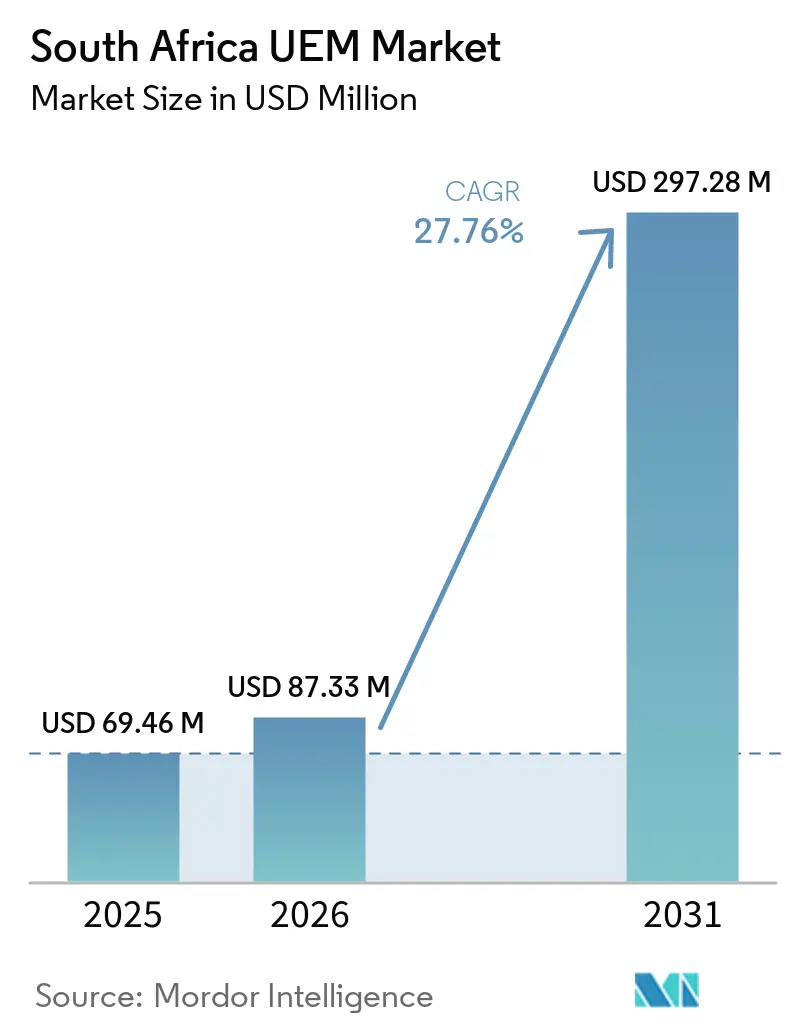
| Base Year Market Size (2025) | USD 69.46 Million |
| Market Size (2026) | USD 87.33 Million |
| Market Size (2031) | USD 297.28 Million |
| Growth Rate (2026 - 2031) | 27.76 % |
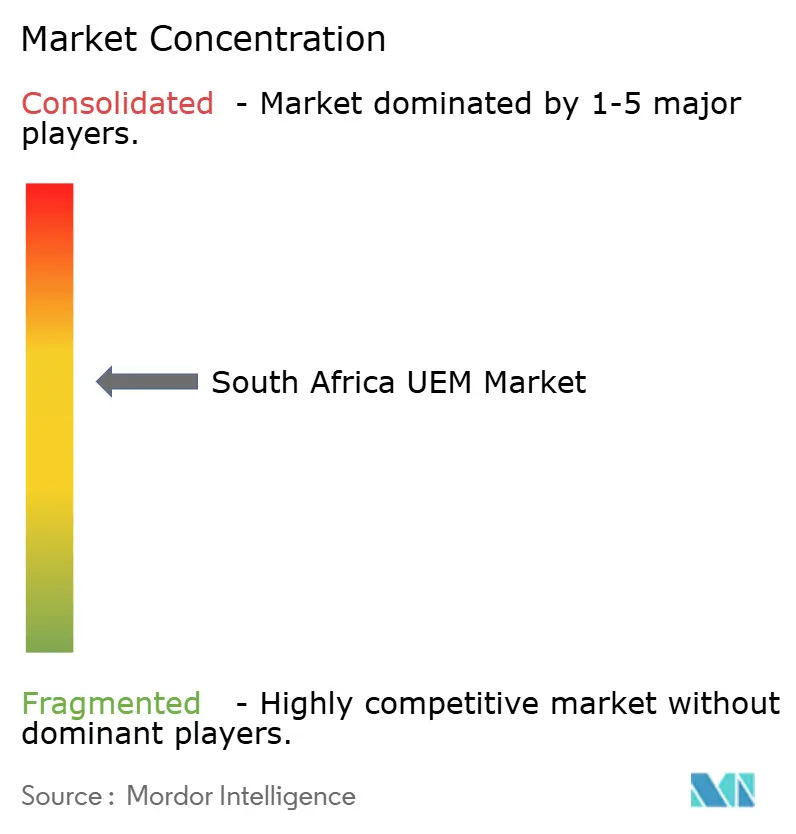
| Market Concentration | Medium |
Major Players *Disclaimer: Major Players sorted in no particular order Image © Mordor Intelligence. Reuse requires attribution under CC BY 4.0. | |
South Africa UEM Market Analysis by Mordor Intelligence
The South Africa UEM market size was valued at USD 69.46 million in 2025 and estimated to grow from USD 87.33 million in 2026 to reach USD 297.28 million by 2031, at a CAGR of 27.76% during the forecast period (2026-2031). Growth in the South Africa UEM Market is being supported by a higher threat environment, broader use of cloud-native IT, and tighter attention to endpoint governance across regulated organizations. Hybrid work has kept device estates spread across offices, homes, and field locations, which has made centralized policy enforcement more important than before. POPIA-related compliance needs and wider concern over identity exposure have also pushed endpoint control closer to board-level technology decisions. The South Africa UEM (Unified Endpoint Management) market is still in an early expansion phase, which leaves room for vendors to deepen platform adoption as automation, Zero Trust models, and centralized audit controls move into standard enterprise practice. Competitive conditions remain active, with Microsoft benefiting from its ecosystem position while specialist vendors continue to compete through device-specific depth, service support, and multi-platform management.
Key Report Takeaways
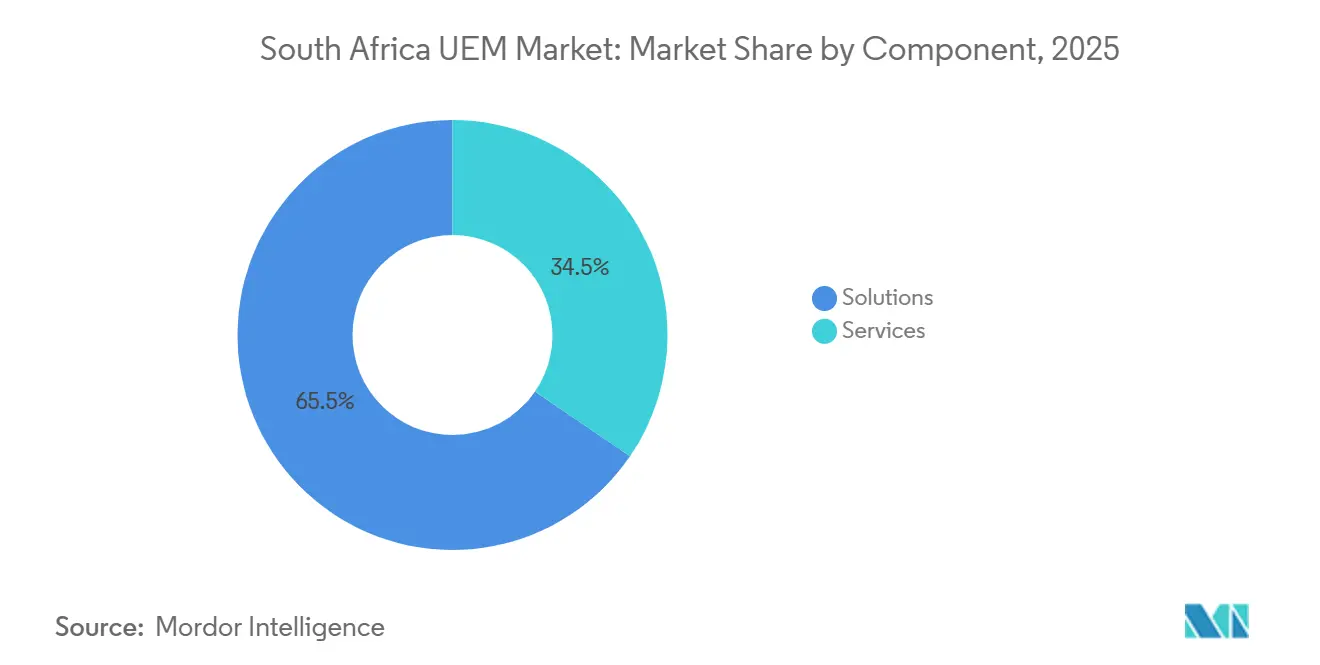
- By component, solutions held 65.46% share of the South Africa UEM market in 2025, while services continued to gain traction as buyers looked for outside support in deployment, policy management, and ongoing endpoint operations.
- By deployment mode, cloud-based deployment remained the leading model in the South Africa UEM market and is projected to expand at a 28.02% CAGR through 2031.
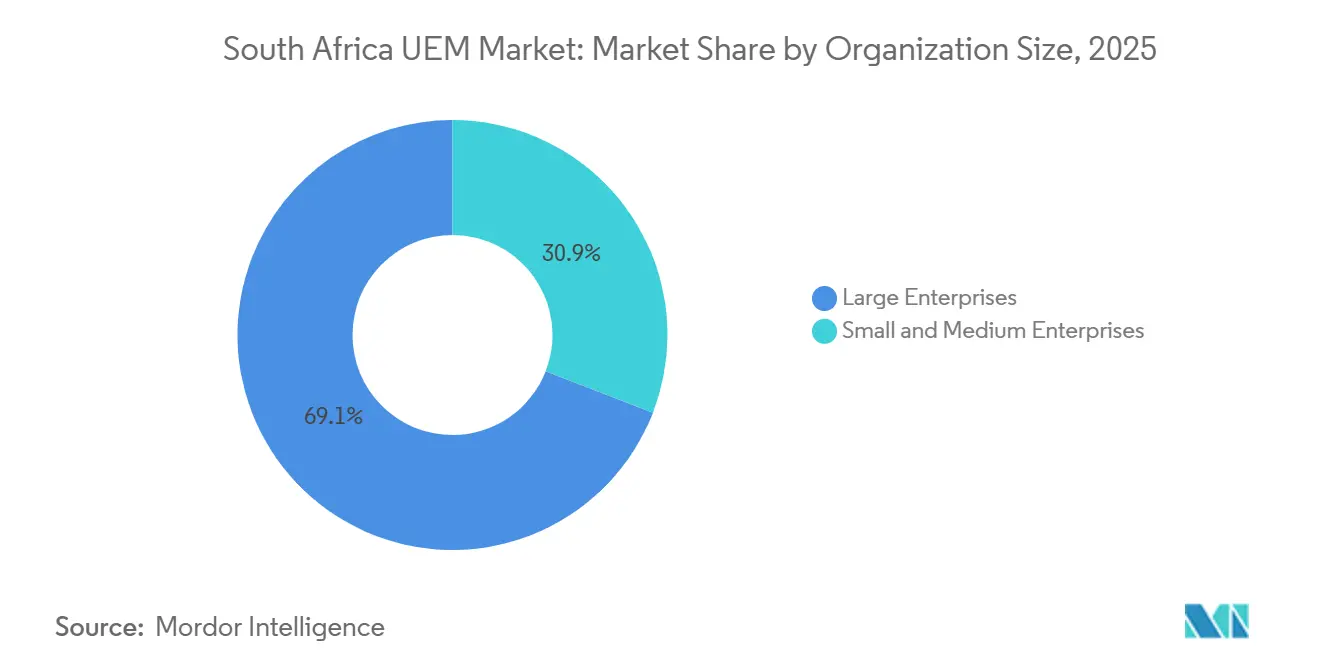
- By organization size, large enterprises held 69.11% share in 2025, while SMEs are projected to expand at a 28.27% CAGR through 2031.
- By end-user industry, government and defense accounted for 19.52% share in 2025, while healthcare is projected to advance at a 28.14% CAGR through 2031.
Note: Market size and forecast figures in this report are generated using Mordor Intelligence’s proprietary estimation framework, updated with the latest available data and insights as of January 2026.
South Africa UEM Market Trends and Insights
Drivers Impact Analysis*
| Driver | (~) % Impact on CAGR Forecast | Geographic Relevance | Impact Timeline |
|---|---|---|---|
| Escalating Endpoint Cyber Threats and Zero-Trust Adoption | +6.8% | National, with acute exposure in Johannesburg, Pretoria, and Cape Town enterprise hubs | Short term (≤ 2 years) |
| Rising Hybrid Work, BYOD, and Remote Access Needs | +5.2% | National, highest in financial services and technology sectors across Gauteng and Western Cape | Short term (≤ 2 years) |
| Expansion of Cloud-Native IT and SaaS Application Footprints | +4.5% | National, accelerating in metros with hyperscaler in-country infrastructure | Medium term (2-4 years) |
| Demand for Unified Visibility Across Windows, iOS, Android, and Rugged Devices | +3.8% | National, with strong concentration in logistics-heavy KwaZulu-Natal and manufacturing corridors | Medium term (2-4 years) |
| AI-Driven Digital Employee Experience and Self-Healing Endpoint Automation | +3.2% | Global, with early gains in large South African enterprises in financial services, telco, and government | Medium term (2-4 years) |
| Compliance Pressure for Device-Level Governance in Regulated and Public Sector Workloads | +2.5% | National, concentrated in government, BFSI, and healthcare verticals | Long term (≥ 4 years) |
| Source: Mordor Intelligence | |||
Escalating Endpoint Cyber Threats and Zero-Trust Adoption
South Africa faces one of the heaviest cyber threat loads in the region, which keeps endpoint governance high on enterprise security agendas. Phishing represented 45.7% of detected cyber threats in South Africa in H2 2025, above the 32.5% African average.[1] Kaspersky also reported more than 13 million online attack attempts blocked in South Africa during 2025, while spyware detections rose 117% year over year.[2] This pattern has made endpoint posture a live access control issue rather than a narrow device administration task. The South Africa UEM (Unified Endpoint Management) market is benefiting because device compliance checks now sit closer to identity enforcement and network admission decisions. Organizations therefore have less room to depend on older perimeter models when unmanaged or weakly governed endpoints can still become entry points for broader compromise.
Rising Hybrid Work, BYOD, and Remote Access Needs
Hybrid work has kept endpoint estates wide, mixed, and harder to govern across South African organizations. Personal devices continue to appear in day-to-day workflows, which makes ownership boundaries less useful than policy boundaries when sensitive information moves across employee endpoints. This issue becomes more serious when remote work, BYOD use, and inconsistent device states exist at the same time in regulated sectors. The South Africa UEM market is therefore drawing demand from employers that need auditable device enrollment, patch consistency, and access control across both corporate and employee-owned hardware. Load-related operating disruptions and uneven working conditions outside managed office environments also make automated policy enforcement more valuable. As a result, endpoint enrollment is moving from an optional IT preference to a more routine governance requirement in organizations that handle personal or business-sensitive data.
Expansion of Cloud-Native IT and SaaS Application Footprints
The shift toward cloud-native IT is widening the management gap that centralized endpoint platforms are built to address. As applications, identities, and workflows move away from fixed office networks, device compliance becomes harder to govern with older management approaches that depend on local infrastructure. The South Africa UEM market is seeing this effect most clearly in enterprises that now need policy visibility across multi-app and multi-user environments instead of a single controlled perimeter. Cloud delivery also fits organizations that want faster rollout, simpler updates, and broader reach across distributed users. At the same time, data governance expectations are keeping attention on audit trails and configuration discipline as device management becomes part of larger cloud operating models. This keeps cloud-native UEM adoption closely tied to broader enterprise efforts to modernize infrastructure without losing control over endpoint risk.
Demand for Unified Visibility Across Windows, iOS, Android, and Rugged Devices
South African enterprises often manage a wider mix of device types than many mature markets because offices, field teams, logistics fleets, and industrial operations all rely on different hardware environments. Separate tools for each operating system can leave blind spots when one device class falls outside the core management view. This challenge is especially visible where rugged Android terminals sit beside Windows laptops and iOS devices inside the same operational workflow. The South Africa UEM market is gaining support because buyers want one policy layer that can surface risk across all of those endpoints in a single console. Unified visibility also matters when device telemetry has to support both security decisions and operational continuity in mobile work settings. That combination makes cross-platform control less of a convenience purchase and more of a practical requirement for sectors with large field-device footprints.
Restraints Impact Analysis*
| Restraint | (~) % Impact on CAGR Forecast | Geographic Relevance | Impact Timeline |
|---|---|---|---|
| High Integration Complexity with Legacy Endpoint and Identity Stacks | -2.1% | National, most acute in state-owned enterprises, banking, and mining sectors | Medium term (2-4 years) |
| Data Sovereignty and Localized Hosting Constraints | -1.8% | National, with highest impact on government and financial services UEM deployments | Long term (≥ 4 years) |
| Budget Sensitivity Among Mid-Market Buyers and Public Institutions | -1.4% | National, concentrated in public sector and organizations outside the Gauteng financial hub | Short term (≤ 2 years) |
| Skills Gap in Endpoint Automation, Scripting, and Policy Orchestration | -1.1% | National, with disproportionate impact on SMEs and government IT departments | Medium term (2-4 years) |
| Source: Mordor Intelligence | |||
High Integration Complexity with Legacy Endpoint and Identity Stacks
Legacy infrastructure remains one of the hardest barriers in UEM rollouts across South Africa. Many deployments still need to connect with older directory environments, existing service management tools, and established access control layers before policy automation can work as intended. That means implementation difficulty often comes less from license cost and more from the engineering effort needed to align old and new control planes. The South Africa UEM market, therefore, advances faster in organizations that already have stronger integration capabilities and clearer modernization paths. Mid-market firms and public institutions can face more friction because their IT teams are smaller and more generalist. This slows adoption in accounts where endpoint control is needed, but the underlying infrastructure stack still resists clean migration.
Data Sovereignty and Localized Hosting Constraints
Data residency expectations add another layer of procurement complexity for cloud-based endpoint platforms in South Africa. Organizations that manage government, public interest, or critical workloads often need stronger clarity on where telemetry is processed, stored, and routed. This creates a practical advantage for vendors that can support local hosting models, in-country routing, or hybrid architectures that keep sensitive categories under closer domestic control. The South Africa UEM (Unified Endpoint Management) market still has room to grow under these conditions, but buyers in regulated sectors tend to move more carefully when hosting design and legal accountability are still being reviewed. These constraints matter most in government and financial services, where endpoint control cannot be separated from broader decisions on data location and compliance exposure.
*Our forecasts treat driver/restraint impacts as directional, not additive. The impact forecasts reflect baseline growth, mix effects, and variable interactions.
Segment Analysis
By Component: Solutions Drive Security-First Endpoint Consolidation
Solutions accounted for 65.46% of South Africa UEM market share in 2025, which shows that buyers preferred integrated platform capabilities over a mix of separate point tools. Security and compliance management, together with device management, remained the most active solution areas because organizations wanted continuous control over endpoint posture in a higher-risk environment. The South Africa UEM (Unified Endpoint Management) market has therefore leaned toward platforms that combine policy enforcement, visibility, and remediation inside one control layer. Application management and content management also mattered because employee-owned and distributed devices created added pressure to govern access to sensitive information more consistently. This kept the solutions side closely linked to both security budgets and broader enterprise governance priorities.
The solutions segment is also expanding in scope as endpoint management starts to absorb more automation and employee experience functions. ManageEngine has been positioning Endpoint Central more directly at the intersection of UEM and digital employee experience, which shows how vendors are trying to capture more workflow value from the same deployment. That shift rewards broader platforms because buyers can connect endpoint health, policy controls, and user productivity signals inside one operating environment. Services are gaining support at the same time because many organizations still need outside help to deploy, tune, and manage these systems over time. In the South Africa UEM (Unified Endpoint Management) industry, that service pull is especially relevant where internal security and endpoint operations teams remain thin relative to the size of the device estate.
By Deployment Mode: Cloud Leads as Hybrid Architectures Address Sovereign Constraints
Cloud-based deployment is projected to expand at a 28.02% CAGR during 2026-2031, which keeps it at the center of new buying activity in the South Africa UEM (Unified Endpoint Management) market. Buyers are favoring cloud delivery because it scales more easily across remote workers, branch networks, and mobile devices than server-dependent local environments. This model also aligns better with organizations that want faster policy changes and broader telemetry coverage without building more on-premise management capacity. The advantage is strongest where enterprises already use cloud collaboration, identity, and productivity tools across a large workforce. That has made cloud deployment the most practical route for many organizations that need quicker rollout and consistent control across distributed endpoints.
On-premise deployment still retains a durable role in settings where legal review, sensitive workloads, or internal hosting rules create friction for full cloud routing. Hybrid models are therefore becoming a practical middle ground for large enterprises that want cloud scalability while keeping selected data paths and management functions closer to internal control. The South Africa UEM market is reflecting that balance, especially in accounts where the endpoint estate is large but hosting design still needs to satisfy stricter governance expectations. Connectivity reliability outside major metro areas also supports the case for hybrid architecture in some operating environments. Over time, deployment choice is likely to remain less about ideology and more about how organizations match cloud convenience with sovereign, operational, and infrastructure realities.
By Organization Size: Large Enterprises Anchor Demand While SMEs Accelerate
Large enterprises held 69.11% of South Africa UEM market share in 2025, reflecting the scale and compliance burden of multi-site device estates spread across offices, branches, and field operations. These organizations tend to manage wider operating system mixes and larger volumes of corporate and shared devices, which makes unified control more valuable. The South Africa UEM (Unified Endpoint Management) market has therefore been anchored by banking, mining, telecom, and other large employers that need more structured policy orchestration. Their buying decisions also tend to favor vendors that can tie endpoint management into identity, compliance, and service workflows. That leaves large enterprises as the core base of current revenue, even as the addressable market broadens.
SMEs are projected to grow at a 28.27% CAGR during 2026-2031, making them the fastest-expanding organizational cohort in the South Africa bUnified Endpoint Management market over the forecast period. Lower entry barriers in cloud-native platforms are making centralized endpoint control more reachable for smaller employers that previously lacked the budget or staff for enterprise-grade tooling. This matters because smaller firms still face BYOD exposure and access-control needs, even when they do not operate dedicated security teams. JumpCloud's April 2026 launch of Agentic IAM showed how vendors are extending unified device and identity governance into a more automated control model that can also appeal to leaner IT environments. The result is a wider go-to-market opportunity for channel-led and managed-service-led vendors that can simplify adoption for buyers outside the top enterprise tier.
By End-User Industry: Government and Defense Anchors Demand as Healthcare Surges
Government and defense held the largest end-user share at 19.52% in 2025, supported by digital public service delivery, state security requirements, and mandatory device compliance frameworks. Public sector IT environments often span a wide range of endpoints, from standard office workstations to shared service terminals, which raises the value of centralized enrollment and policy control. The South Africa UEM market also draws steady demand from BFSI, IT, and telecommunications, where operational resilience and endpoint consistency remain standing requirements. Banking and financial services, in particular, need centralized patching and policy enforcement across large distributed device estates. That combination keeps government-facing and regulated verticals central to current spending patterns.
Healthcare is projected to advance at a 28.14% CAGR during 2026-2031, making it the fastest-growing end-user area in the South Africa UEM (Unified Endpoint Management) market size. Growth is being supported by digital health programs, wider use of clinical applications, and the need to control access across hospital and care-delivery endpoints. Mint Group's digitization work at Thelle Mogoerane Regional Hospital showed how Microsoft-based endpoint technologies are already being deployed across clinical and administrative workflows in South African healthcare settings.[3] Manufacturing, transportation, and logistics also represent strong adjacent demand because rugged Android devices, floor systems, and fleet tools create cross-platform control challenges that single-OS tools do not address well. Education and utilities remain smaller today, but both are moving into a more active adoption phase as digital operating models spread across their endpoint environments.
Geography Analysis
South Africa defines the full South Africa UEM market size in this report because it is the only geographic boundary covered. Within that boundary, Gauteng remains the main demand center because Johannesburg and Pretoria concentrate large corporations, government departments, and regional headquarters. This gives the province a strong lead in enterprise UEM deployments, especially where large and regulated employers shape buying volumes. The Western Cape follows as the second major center, supported by Cape Town's technology, fintech, retail, and professional services base. These 2 provinces carry the strongest alignment between cloud adoption, compliance needs, and large-scale endpoint estates.
KwaZulu-Natal and the Eastern Cape form the next layer of demand in the South Africa UEM (Unified Endpoint Management) market because logistics, manufacturing, and port-linked operations depend on larger field-device footprints. These environments often use rugged hardware and mobile work systems that require stronger cross-platform management than older MDM-only approaches can provide. Municipal digitization and field-service tooling are also expanding the need for centralized enrollment and policy oversight in public operating environments. Smaller provinces such as Limpopo, Mpumalanga, and the Northern Cape have different demand profiles driven by mining and agriculture, where device types are more dispersed and often operate outside standard office settings.
The compliance framework applies across all provinces, which makes endpoint governance a national requirement rather than a metro-only issue. That said, implementation conditions are not identical because access to in-country digital infrastructure and local support capacity is stronger in Gauteng and the Western Cape than in more remote operating regions. The South Africa Unified Endpoint Management (UEM) market, therefore, shows both national policy consistency and local differences in rollout speed. Government departments and critical operators outside major metro areas can face greater design scrutiny when local hosting, routing, and connectivity must be considered together. At the enterprise level, governance expectations are also elevating endpoint management from a narrow IT procurement line to a broader operational control decision.
Competitive Landscape
The South Africa Unified Endpoint Management (UEM) market is moderately concentrated at the top tier, with Microsoft holding a structural advantage through the depth of its enterprise productivity and endpoint ecosystem. Ivanti, SOTI, Jamf, and Omnissa maintain differentiated positions through IT operations integration, rugged-device management, Apple-focused administration, and broad endpoint platform coverage. The mid-market remains more fragmented because many deployments flow through channel partners, resellers, and local distributors rather than direct enterprise sales alone. This split gives the market a visible leadership group without creating a single-vendor lock on all buyer categories. It also means that platform breadth, ecosystem fit, and support delivery matter as much as brand scale.
Vendors are increasingly competing by linking UEM with automation, identity control, and digital employee experience. JumpCloud's Agentic IAM launch in April 2026 extended unified governance across human, non-human, and AI agent access, widening the control scope for managed devices. SOTI's release of MobiControl 2026.1 added SOTI AI Stella, Microsoft Entra ID authentication, and deeper Windows monitoring, which strengthened its appeal in larger managed device environments. ManageEngine has also been pushing convergence between endpoint management and DEX functions, which supports the view that broader platforms are becoming more competitive in the South Africa UEM Market.
Apple ecosystem management remains another clear area of differentiation. Jamf made its AI Assistant generally available for Jamf Pro users in 2025, which lowered the effort needed to manage macOS and iOS estates through plain-language queries. Competitive white space remains strongest in rugged-device fleets, regulated public deployments, and SME-focused managed services where device governance needs are rising faster than in-house IT capacity. The South Africa UEM market is therefore likely to keep rewarding vendors that can combine automation, local execution support, and platform depth without forcing buyers into narrow operating system constraints. Providers that lack a clear path in AI-driven remediation, hybrid deployment flexibility, or multi-platform control may find renewal and expansion harder as customer expectations continue to broaden.
South Africa UEM Industry Leaders
-
Microsoft Corporation
-
Ivanti, Inc.
-
IBM Corporation
-
BlackBerry Limited
-
Citrix Systems, Inc.
- *Disclaimer: Major Players sorted in no particular order
Recent Industry Developments
- June 2026: JumpCloud Inc. launched Agentic IAM on Google Cloud (June 11, 2026), deepening its collaboration with Google Cloud to extend unified identity and device management governance across human, non-human, and autonomous AI agents, with Gemini Enterprise integration. The platform is the first to apply Zero Trust principles uniformly to both human endpoint users and AI-agent sessions, addressing an emerging governance gap in enterprise AI adoption.
- June 2026: ManageEngine was recognized in the 2026 Gartner Magic Quadrant for Digital Employee Experience (DEX) Management Tools and named a Challenger in the 2026 Gartner Magic Quadrant for Endpoint Management Tools, confirming that its Endpoint Central platform has successfully converged UEM and DEX into a single product for enterprise deployment.
- April 2026: JumpCloud Inc. announced the launch of Agentic IAM (April 27, 2026), the first unified control plane designed to govern human, non-human, and AI agent access to managed devices across all operating systems using Zero Trust principles, directly addressing enterprise governance gaps created by rapid AI agent proliferation.
- March 2026: SOTI released MobiControl 2026.1, introducing SOTI AI Stella, an intelligent administrator chatbot, along with centralized malware visibility through Microsoft Defender for Endpoint integration, Microsoft Entra ID authentication, and real-time monitoring and automation capabilities for Windows device estates at scale.
South Africa UEM Market Report Scope
The South Africa Unified Endpoint Management (UEM) Market refers to the market for software and services used to centrally manage, secure, and monitor endpoints such as laptops, desktops, smartphones, tablets, and other connected devices across South Africa. It enables IT teams to enforce security policies, control device access, deploy applications, and maintain compliance from a single platform.
The South Africa UEM Market Report is Segmented by Component (Solutions, and Services), Deployment Mode (Cloud-Based, On-Premise, and Hybrid), Organization Size (Large Enterprises, and Small and Medium Enterprises), End-User Industry (IT and Telecommunications, BFSI, Government and Defense, Healthcare and Life Sciences, Manufacturing, Retail and E-Commerce, Education, Transportation and Logistics, and Energy and Utilities). The Market Forecasts are Provided in Terms of Value (USD).
| Solutions | Device Management |
| Application Management | |
| Content Management | |
| Security and Compliance Management | |
| Analytics and Automation | |
| Services |
| Cloud-Based |
| On-Premise |
| Hybrid |
| Large Enterprises |
| Small and Medium Enterprises |
| IT and Telecommunications |
| BFSI |
| Government and Defense |
| Healthcare and Life Sciences |
| Manufacturing |
| Retail and E-Commerce |
| Education |
| Transportation and Logistics |
| Energy and Utilities |
| Other End-User Industries |
| By Component | Solutions | Device Management |
| Application Management | ||
| Content Management | ||
| Security and Compliance Management | ||
| Analytics and Automation | ||
| Services | ||
| By Deployment Mode | Cloud-Based | |
| On-Premise | ||
| Hybrid | ||
| By Organization Size | Large Enterprises | |
| Small and Medium Enterprises | ||
| By End-User Industry | IT and Telecommunications | |
| BFSI | ||
| Government and Defense | ||
| Healthcare and Life Sciences | ||
| Manufacturing | ||
| Retail and E-Commerce | ||
| Education | ||
| Transportation and Logistics | ||
| Energy and Utilities | ||
| Other End-User Industries |
Key Questions Answered in the Report
What is the current and forecast value of the South Africa UEM market?
The South Africa UEM market was valued at USD 69.46 million in 2025, is estimated at USD 87.33 million in 2026, and is forecast to reach USD 297.28 billion by 2031.
What is driving growth in endpoint management demand across South Africa?
Stronger cyber threats, hybrid work, BYOD use, cloud-native IT adoption, and tighter compliance expectations are all pushing organizations toward centralized endpoint governance.
Which deployment model is expanding the fastest in South Africa?
Cloud-based deployment is the fastest-growing model, with a projected CAGR of 28.02% during 2026-2031, supported by distributed workforces and the need for broader device visibility.
Which organization size group is creating the fastest new demand?
SMEs are expanding the fastest, with a projected CAGR of 28.27% through 2031, as cloud-native platforms lower the entry barrier for structured endpoint control.
Which end-user group holds the largest share and which one is growing the fastest?
Government and defense held the largest end-user share at 19.52% in 2025, while healthcare is the fastest-growing vertical with a projected 28.14% CAGR through 2031.
Why do hybrid and cloud approaches matter so much for UEM adoption in South Africa?
Many buyers need the scale and convenience of cloud delivery, but they also face data residency, connectivity, and governance conditions that make hybrid architecture a practical fit.