
Brazil Renewable Gas Waste Feedstock Management Market Size and Share
Market Overview
| Study Period | 2020 - 2031 |
|---|---|
| Forecast Data Period | 2026 - 2031 |
| Base Year Market Size (2025) | USD 0.58 Billion |
| Market Size (2026) | USD 0.62 Billion |
| Market Size (2031) | USD 0.92 Billion |
| Growth Rate (2026 - 2031) | 8.21 % |
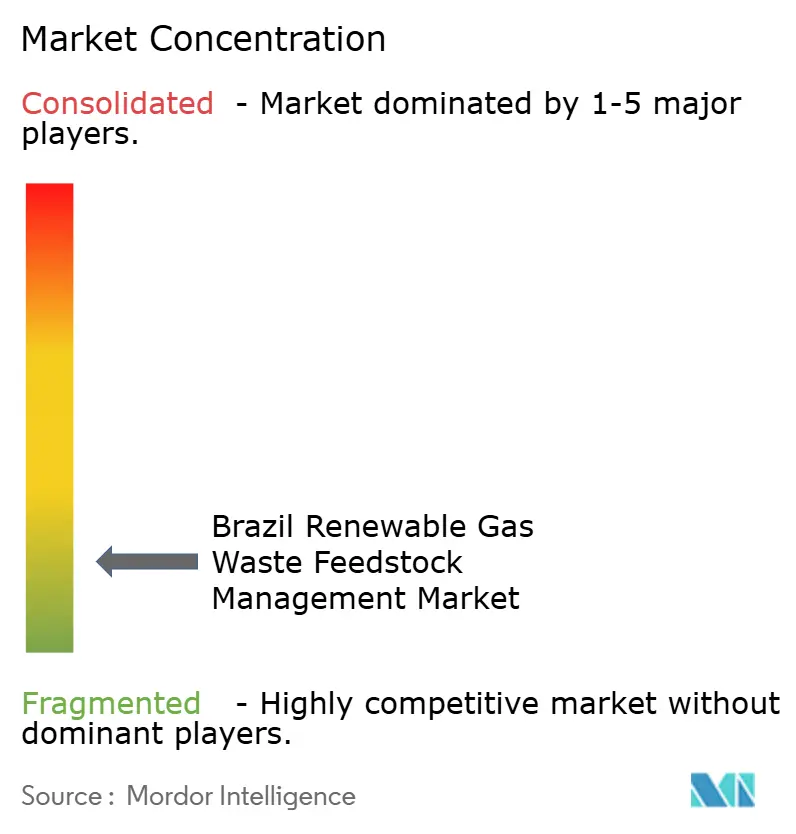
| Market Concentration | Low |
Major Players *Disclaimer: Major Players sorted in no particular order Image © Mordor Intelligence. Reuse requires attribution under CC BY 4.0. | |
Brazil Renewable Gas Waste Feedstock Management Market Analysis by Mordor Intelligence
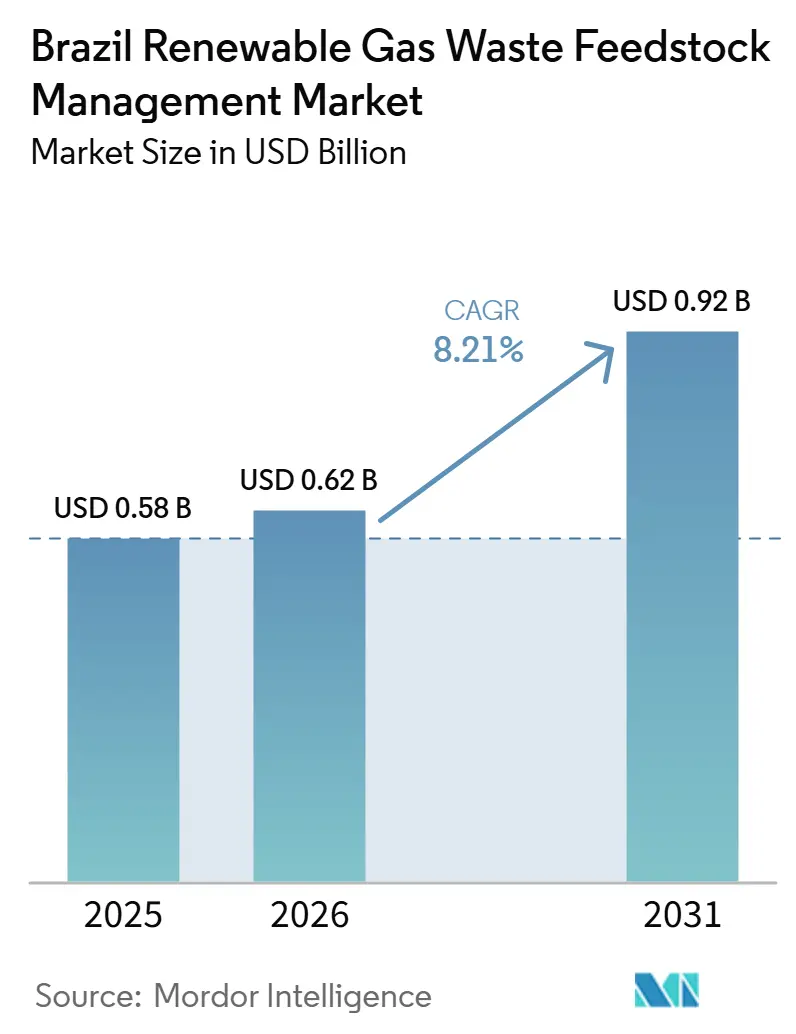
The Brazil Renewable Gas Waste Feedstock Management Market size is projected to expand from USD 0.58 billion in 2025 and USD 0.62 billion in 2026 to USD 0.92 billion by 2031, registering a CAGR of 8.21% between 2026 to 2031.
The Brazil renewable gas waste feedstock management market is transitioning from policy preparation toward investment and project execution as the Clean Fuel of the Future (Combustível do Futuro) framework strengthens demand for renewable gas and biomethane. The CGOB framework links feedstock documentation to biomethane commercialization, making feedstock collection, testing, certification, and quality control commercially important across the value chain. Brazil also has one of the world's largest supplies of agricultural residues, livestock manure, sugarcane by-products, agro-industrial waste, and municipal organic waste, providing a diverse and geographically distributed feedstock base for renewable gas production. Expanding interest from agribusinesses, sanitation companies, and energy developers is encouraging investments in feedstock aggregation networks, pre-treatment facilities, and logistics systems to improve supply reliability. However, inconsistent source segregation, long transportation distances in agricultural regions, and uneven waste collection infrastructure continue to constrain feedstock availability and increase operating costs. As biomethane production capacity expands and industrial and transport sectors seek low-carbon fuel alternatives, demand for specialized feedstock management services is expected to strengthen. The Brazil renewable gas waste feedstock management market is therefore increasingly shaped by operators that can combine reliable feedstock sourcing, traceability, efficient logistics, and conversion-ready feedstock quality while meeting evolving regulatory and sustainability requirements.
Key Report Takeaways
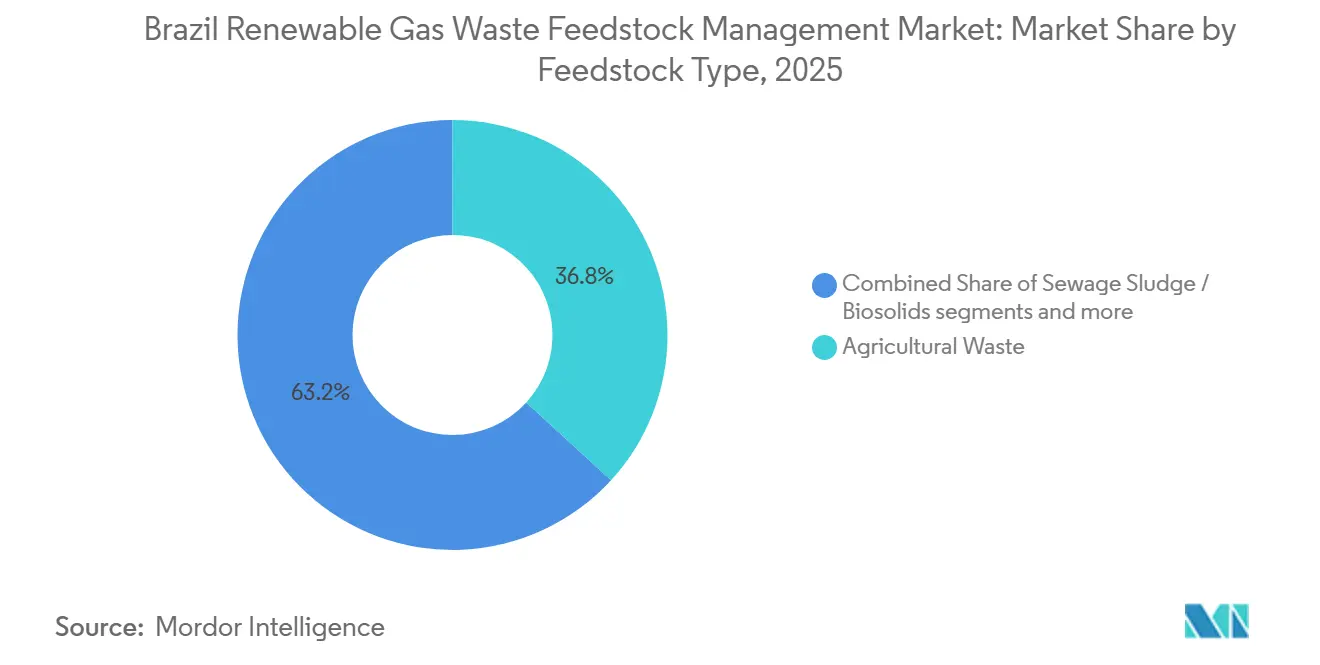
- By feedstock type, agricultural waste held 36.8% of the Brazil renewable gas waste feedstock management market share in 2025, while food waste is projected to grow at a 10.2% CAGR through 2031.
- By end-use facility type, anaerobic digestion plants held 45.1% of the Brazil renewable gas waste feedstock management market size in 2025, while gasification and thermal treatment facilities are projected to grow at a 10.5% CAGR through 2031.
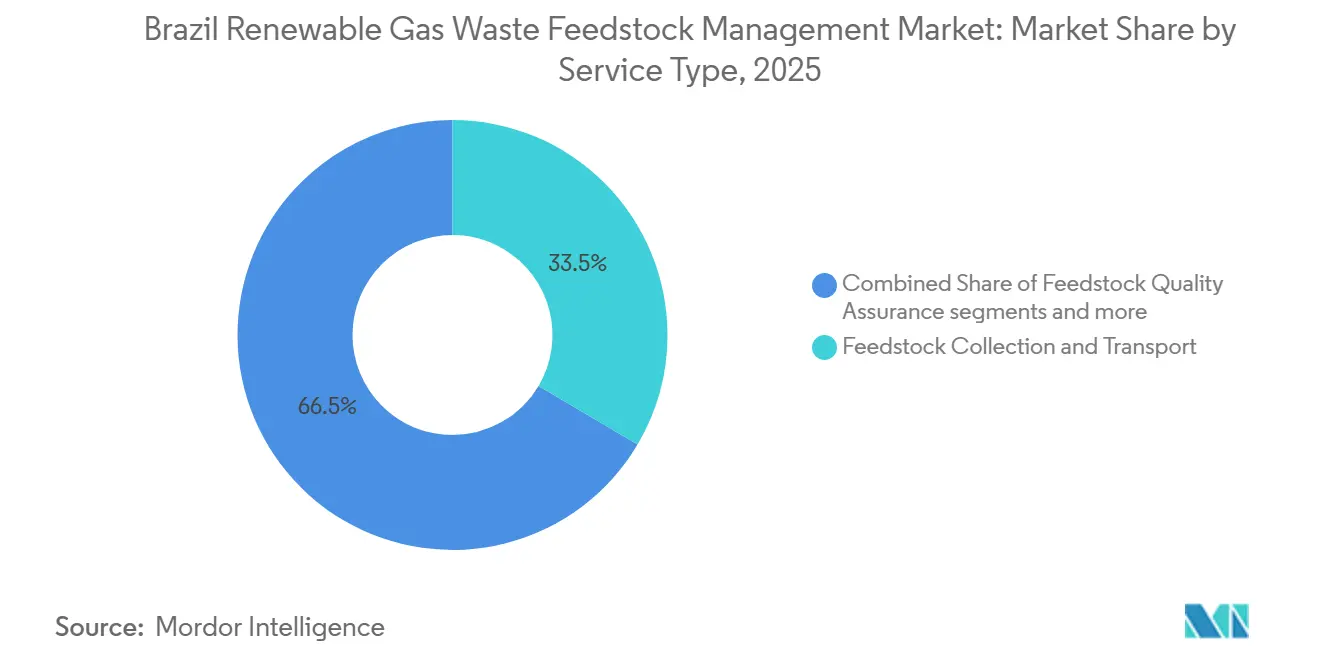
- By service type, feedstock collection and transport accounted for 33.5% of revenue in 2025, while digital feedstock monitoring platforms are projected to grow at a 12.9% CAGR through 2031.
Note: Market size and forecast figures in this report are generated using Mordor Intelligence’s proprietary estimation framework, updated with the latest available data and insights as of January 2026.
Brazil Renewable Gas Waste Feedstock Management Market Trends and Insights
Drivers Impact Analysis*
| Driver | (~) % Impact on CAGR Forecast | Geographic Relevance | Impact Timeline |
|---|---|---|---|
| National Biomethane Development Policies Accelerating Waste-to-Gas Investments | +2.4% | National | Short term (≤ 2 years) |
| Expansion of Sugarcane and Ethanol Industries Increasing Organic Feedstock Availability | +1.8% | Southeast and Center-West, including São Paulo, Mato Grosso, Goiás, and Paraná | Medium term (2-4 years) |
| Growth in Livestock Manure Collection Supporting Agricultural Feedstock Supply Chains | +1.3% | Center-West, South, and Southeast | Medium term (2-4 years) |
| Rising Municipal Solid Waste Generation Driving Organic Waste Recovery | +1.0% | National, with an urban Southeast priority | Short term (≤ 2 years) |
| Food and Beverage Industry Expansion Increasing Industrial Organic Waste Streams | +0.8% | Southeast and South | Medium term (2-4 years) |
| Landfill Gas Utilization Initiatives Strengthening Feedstock Collection Infrastructure | +0.5% | Southeast and major urban centers | Long term (≥ 4 years) |
| Source: Mordor Intelligence | |||
National Biomethane Development Policies Accelerating Waste-to-Gas Investments
Decree No. 12,614/2025, published on September 5, 2025, implemented the National Program for Decarbonization of Natural Gas Producers and Importers and for the Promotion of Biomethane under Law No. 14,993/2024. The decree establishes the regulatory framework for reducing greenhouse gas emissions in the natural gas sector while promoting biomethane production and use. The CGOB certificate links feedstock sourcing records to biomethane commercialization, making documented collection, pre-treatment, traceability, and quality assurance essential components of commercial transactions for operators supplying eligible biomethane projects. The Fuels of the Future Law provides the legal foundation for this framework, encouraging investment in certified feedstock management systems and strengthening the role of traceable organic waste supply chains in Brazil renewable gas waste feedstock management market.[1] The regulation also establishes penalties of up to BRL 50 million (USD 8.9 million) for non-compliance, reinforcing the importance of regulatory compliance and transparent feedstock documentation across the value chain.
Expansion of Sugarcane and Ethanol Industries Increasing Organic Feedstock Availability
Brazil's sugarcane sector provides one of the country's largest and most reliable sources of renewable gas feedstocks, with vinasse and filter cake generated in substantial volumes by the sugar and ethanol industry.[2] Brazil remains the world's largest producer of sugarcane, with cultivation concentrated in São Paulo, Goiás, Minas Gerais, and Paraná, ensuring a consistent year-round supply of agro-industrial residues. Each liter of ethanol produced generates approximately 13.82 liters of vinasse, creating a continuous feedstock stream for renewable gas production. The concentration of sugar and ethanol mills supports efficient collection, handling, and aggregation of vinasse and filter cake, reducing logistical complexity and strengthening feedstock availability for biomethane projects. A January 2025 study of facilities in Paraná also highlighted that integrating vinasse and filter cake through co-digestion improves the utilization and commercial value of sugarcane processing residues, reinforcing their role as important renewable gas feedstocks. As biomethane production expands, the Brazil renewable gas waste feedstock management market continues to benefit from established collection systems, reliable feedstock aggregation networks, and year-round availability of sugarcane residues, supporting sustained demand for feedstock collection, pre-treatment, and quality management services.[3]
Growth in Livestock Manure Collection Supporting Agricultural Feedstock Supply Chains
Brazil’s cattle, swine, and poultry industries generate one of the largest livestock manure resources for renewable gas production, providing a stable, widely distributed feedstock base for anaerobic digestion. The United States International Trade Administration reported that more than 930 biogas plants operate in Brazil, with approximately 80% using agricultural waste as their primary feedstock. Many of these facilities are farm-scale plants that process on-site manure. However, interest is growing in cooperative feedstock aggregation models that can improve economies of scale and supply reliability. A 2025 assessment of the Toledo mesoregion in Paraná found that optimized manure aggregation could generate annual profits of USD 249.7 million from 718.23 million m³ of biomethane while reducing greenhouse gas emissions by 10.55 billion kg of carbon dioxide equivalent. Research conducted by UNIFAL-MG and Usina Cocal also highlighted the benefits of combining livestock manure with sugarcane vinasse through integrated feedstock management, enabling more efficient utilization of agricultural and agro-industrial residues and strengthening feedstock availability for renewable gas production. These findings underscore the growing importance of integrated feedstock supply chains and feedstock blending strategies that improve resource utilization, strengthen feedstock security, and enhance the commercial value of agricultural residues in the Brazil renewable gas waste feedstock management market.
Rising Municipal Solid Waste Generation Driving Organic Waste Recovery
Brazil generated 81.6 million tons of municipal solid waste in 2024, of which close to half was organic material. Only 3.2% of this material was directed to biomethane production. This gap leaves a sizeable volume outside formal feedstock recovery systems that could otherwise be supplied with organized collection, pretreatment, and conversion activities. The Brazil renewable gas waste feedstock management market can benefit as cities improve collection and direct cleaner organic streams to digestion or landfill biomethane facilities. Brazil’s Ministry of Environment and Climate Change launched Planaro at COP30 in November 2025, with a planned investment of BRL 12 billion (USD 2.1 billion) through 2050 and a 31.6% urban organic waste valorization target by 2030. The industry association described a satellite-based landfill methane-detection initiative that could increase pressure to recover urban organic waste.
Restraints Impact Analysis*
| Restraint | (~) % Impact on CAGR Forecast | Geographic Relevance | Impact Timeline |
|---|---|---|---|
| Limited Source Segregation Reducing Organic Feedstock Quality | -1.1% | National, with acute pressure in the North, Northeast, and smaller municipalities | Short term (≤ 2 years) |
| Fragmented Agricultural Feedstock Collection Networks | -0.8% | Center-West, North, and Northeast | Medium term (2-4 years) |
| High Transportation Costs Across Geographically Dispersed Feedstock Sources | -0.6% | Center-West and remote agricultural zones in the North | Medium term (2-4 years) |
| Inadequate Organic Waste Collection Infrastructure in Smaller Municipalities | -0.4% | North, Northeast, and cities with fewer than 50,000 people | Long term (≥ 4 years) |
| Source: Mordor Intelligence | |||
Limited Source Segregation Reducing Organic Feedstock Quality
Separate collection remains essential to maintaining the quality of organic feedstock for anaerobic digestion and biomethane production. The Center for Applied Transition Finance (CATF) reported that 36% of Brazil’s population had access to separate organic waste collection in 2025. The same assessment found that 26% of collected waste was disposed of at inadequate facilities, while 9% of waste was not collected at all, highlighting persistent gaps in municipal waste management infrastructure. Contamination from plastics, inert materials, and hazardous substances requires additional sorting and mechanical pre-treatment before biological conversion, increasing processing costs and reducing feedstock conversion efficiency. These challenges can reduce feedstock quality, increase contamination risks, and raise pre-treatment and handling costs when unsuitable materials are identified late in the feedstock management process. A C40 case study of Rio de Janeiro’s biomethanization pilot identified limited source segregation and the high cost of mechanical-biological treatment as major operational barriers to scaling organic waste recovery. As biomethane investments expand, improving source separation, collection logistics, and feedstock quality will remain critical to enhancing project economics and supporting the long-term growth of the Brazil renewable gas waste feedstock management market.
Fragmented Agricultural Feedstock Collection Networks
Agricultural feedstock aggregation in Brazil faces significant logistical challenges due to the country's vast geography and dispersed farming operations. More than 930 biogas plants operate across Brazil, but many are standalone farm-scale facilities that process on-site agricultural residues rather than participating in coordinated regional feedstock collection networks. The country's large average farm sizes and wide distances between production sites make feedstock transportation more capital intensive, requiring greater investment in collection vehicles, storage infrastructure, and transfer stations than in markets with well-established cooperative supply chains. Brazil’s National Organic Waste Strategy also highlights that 90% of municipalities have fewer than 50,000 inhabitants, limiting the economic viability of centralized organic waste aggregation unless neighboring municipalities collaborate through shared logistics and processing infrastructure. A 2025 scientific review further identified inconsistent rural digester operation, limited technical expertise, and shortages of skilled personnel as key barriers to maintaining stable feedstock quality and plant performance. Seasonal fluctuations in agricultural residue availability and the high cost of transporting low-density biomass over long distances further complicate supply chain management. As a result, efficient transport planning, long-term feedstock supply agreements, decentralized pre-treatment facilities, and cooperative aggregation models are becoming increasingly important for improving feedstock security and supporting the long-term growth of the Brazil renewable gas waste feedstock management market.
*Our forecasts treat driver/restraint impacts as directional, not additive. The impact forecasts reflect baseline growth, mix effects, and variable interactions.
Segment Analysis
By Feedstock Type: Agricultural Residues Anchor Supply Chains
Agricultural waste held 36.8% of the Brazil renewable gas waste feedstock management market share in 2025, supported by sugarcane vinasse, filter cake, livestock manure, and crop residues. The 663.4 million-tonne 2025/26 sugarcane harvest provides a large base of residues across the sugarcane belt. These materials are available near mills and livestock areas, which can support scheduled collection and digestion. Vinasse is a high-volume liquid substrate, while filter cake and straw offer complementary properties when blended into a feedstock mix. The industry association described Usina Cocal’s September 2025 plant in Paraguaçu Paulista as a commercial example of co-digesting vinasse, filter cake, straw, and poultry litter. The plant produced biomethane and biofertilizer through a closed-loop model. Sewage sludge provides a stable year-round input from metropolitan wastewater treatment plants. Industrial organic waste from breweries, paper mills, and pharmaceutical effluent is entering managed feedstock systems. Fruit and vegetable residues from CEASA supply centers provide another input stream for decentralized operations.
The Brazil renewable gas waste feedstock management market size for food waste is projected to grow at a 10.2% CAGR through 2031. This category includes fats, oils, and grease, spent brewery grains, and off-specification product streams. Processing sites facing tighter environmental licensing are seeking contracted outlets for organic effluent. This supports more regular supply arrangements than irregular municipal collection. Municipal solid waste organic fractions are also gaining use in Southeast urban catchments where selective collection is progressing. The industry association identified energy generation through biogas as an outlet for organic municipal waste. Portaria Interministerial No. 3/2026, issued by MMA and MME in May 2026, extended utilization targets for residual oils and fats into biofuel production, with mandatory compliance beginning in January 2028. The measure broadened the commercial role of industrial organic waste in the Brazil renewable gas waste feedstock management market.

By End-Use Facility Type: Anaerobic Digestion Plants Lead Capacity Expansion
Anaerobic digestion plants commanded 45.1% of the Brazil renewable gas waste feedstock management market share in 2025. Their role reflects long experience with wet organic materials in agro-industrial operations and urban sanitation. Gate fees, predictable biogas yields, and CGOB-linked revenue can support longer-term supply contracts. This structure gives feedstock suppliers a clearer basis for collection, testing, and quality requirements before they commit material to a facility. Wastewater treatment plants using co-digestion with external organic inputs form a secondary offtake channel. Fats, oils, grease, and food waste blends are central to this channel. These plants can expand the usable range of feedstock without creating a separate collection system.Landfill operators are increasingly recovering value from organic waste streams through landfill gas capture while also diverting suitable organic waste to renewable gas projects. The Brazil renewable gas waste feedstock management market therefore supports both purpose-built anaerobic digestion facilities and established waste management infrastructure.
The Brazil renewable gas waste feedstock management market size for gasification and thermal treatment facilities is projected to grow at a 10.5% CAGR through 2031. These facilities can process mixed municipal solid waste fractions that are too contaminated for biological treatment. This widens the usable feedstock pool for collection operators beyond source-separated organic material. It also provides an outlet for lower-quality material that cannot meet anaerobic digestion specifications after sorting, testing, and pre-treatment have been considered. Operators can direct cleaner streams to higher-yielding digestion contracts and allocate mixed streams to thermal routes. International technology providers were funding research into these routes for Brazil’s varied organic feedstock base. The different conversion pathways make feedstock characterization more important before materials are contracted or transported. They also reinforce the need for pre-treatment and quality assurance services across the Brazil renewable gas waste feedstock management market.
By Service Type: Digital Monitoring Transforms Feedstock Operations
Feedstock collection and transport held 33.5% revenue share in 2025, making it the largest service revenue category. Organic inputs are dispersed across farms, municipalities, and industrial sites, which makes physical aggregation costly and operationally demanding. Operators are investing in dedicated fleets, transfer stations, and pre-treatment centers. The need is strongest in Southeast urban corridors, where biomethane offtake contracts can support long-cycle infrastructure investment. Collection services also require routing, storage, and timing controls to protect the quality of perishable feedstock. Supply chain management and consulting services are growing alongside capital investment. New entrants from energy and commodity businesses need support in developing procurement models for greenfield plants. These services help align feedstock volume, quality, and delivery schedules with the operating needs of new projects and established conversion facilities. The Brazil renewable gas waste feedstock management market relies on this groundwork before conversion assets can operate consistently.
The Brazil renewable gas waste feedstock management market size for digital feedstock monitoring platforms is projected to grow at a 12.9% CAGR through 2031. Internet-connected dosing systems and optimized blending tools are moving from pilot use into commercial deployment under CGOB compliance requirements. Digital records can support the traceability needed to demonstrate feedstock origin and handling. Real-time monitoring can also help operators manage fruit and vegetable residues and other variable inputs. Testing and laboratory services are also expanding as facilities seek more consistent substrate energy content and contaminant profiles. Feedstock quality assurance becomes more important when biomethane purity standards affect plant acceptance. These services can reduce uncertainty between collection providers and conversion facilities by creating a clearer record of inputs before acceptance. Digital capability also favors professional operators that can manage compliance records across several sites. This makes monitoring a practical component of the Brazil renewable gas waste feedstock management market rather than a standalone software function.
Geography Analysis
The Southeast holds the highest concentration of renewable gas processing infrastructure in Brazil, led by São Paulo, Rio de Janeiro, and Minas Gerais, which host the country's largest cluster of anaerobic digestion facilities and landfill gas recovery projects. São Paulo combines extensive sugarcane cultivation with high urban organic waste generation, supporting both agricultural and municipal feedstock management models. The state is also home to Brazil's largest biomethane production complex, reflecting its strong integration of agro-industrial residues, municipal waste streams, and natural gas infrastructure. Ongoing investments in landfill gas upgrading, sugarcane residue utilization, and biomethane distribution continue to reinforce the Southeast's leadership. Minas Gerais has also introduced fiscal incentives, including Reidi tax benefits, to encourage investment in biomethane infrastructure and renewable gas projects.
The Center-West and South represent Brazil's primary agricultural feedstock frontier and the fastest-growing regions for renewable gas development. Mato Grosso, Mato Grosso do Sul, Goiás, Paraná, and Rio Grande do Sul generate substantial volumes of livestock manure, sugarcane vinasse, and crop residues that support large-scale anaerobic digestion projects. However, the Brazil renewable gas waste feedstock management market in these regions depends heavily on efficient logistics because long transport distances between farms and processing facilities increase feedstock collection costs. A 2025 study in the Toledo mesoregion of Paraná estimated that optimized manure aggregation could generate USD 249.7 million in annual biomethane profits, highlighting the value of coordinated collection systems. The CGOB certification framework further increases the importance of professional feedstock aggregators capable of maintaining traceability, pre-treatment standards, and documentation throughout the supply chain.
The North and Northeast remain comparatively underserved but possess significant untapped organic waste resources from municipalities, agriculture, and landfill sites. Landfill disposal rates remain lower in parts of the North than in the more urbanized Southeast, indicating both infrastructure gaps and opportunities for future feedstock recovery. Pernambuco's Jaboatão dos Guararapes biomethane project demonstrates the potential to upgrade landfill gas into commercial biomethane, creating higher-value utilization pathways than electricity generation alone. Because around 90% of Brazilian municipalities have fewer than 50,000 inhabitants, decentralized collection systems, modular pre-treatment facilities, and intermunicipal cooperation will remain essential for expanding renewable gas feedstock management across interior regions where centralized infrastructure is less economically viable.
Competitive Landscape
The Brazil renewable gas waste feedstock management market exhibits a low level of market concentration, with competition remaining fragmented across feedstock collection, pre-treatment, renewable gas production, and supporting services. No single company has a nationwide presence across all feedstock sources or service categories, and market participation varies by region and feedstock type. Municipal waste managers, agricultural feedstock aggregators, integrated renewable gas developers, and technology providers each occupy distinct positions within the value chain.
Competitive positioning is increasingly determined by the ability to secure reliable feedstock supplies through long-term municipal contracts, agricultural partnerships, and integrated collection networks. Waste management companies leverage established collection infrastructure and landfill ecoparks to access municipal organic waste, while integrated renewable gas developers strengthen their market position by combining feedstock aggregation, pre-treatment, biomethane production, and gas commercialization within a single operating model. Technology providers compete by offering feedstock pre-treatment systems, digital traceability platforms, contamination detection solutions, and quality assurance technologies that help operators meet regulatory and sustainability requirements.
Strategic differentiation is shifting from processing capacity alone toward integrated feedstock management capabilities. Companies that combine diversified feedstock sourcing, efficient logistics, pre-treatment expertise, quality assurance, and digital traceability are better positioned to secure long-term supply agreements and comply with evolving certification standards. Looking ahead, competition is expected to intensify as biomethane production expands and sustainability regulations become more stringent, increasing the importance of integrated feedstock supply chains, traceability, and quality management as key competitive advantages.
Brazil Renewable Gas Waste Feedstock Management Industry Leaders
-
Orizon Valorização de Resíduos S.A.
-
Solví Essencis Ambiental S.A.
-
Gás Verde S.A.
-
Veolia Brasil
-
Raízen S.A.
- *Disclaimer: Major Players sorted in no particular order
Recent Industry Developments
- July 2026: Brazil's Senate Economic Affairs Committee approved PL 3,311/2025, National Metano Zero Program, integrating agricultural, industrial, and urban waste-to-energy policies with estimated investment potential of BRL 300 billion (USD 53.6 billion). The bill proceeds to the Senate Environment Committee and establishes a legislative basis for structured organic waste feedstock aggregation.
- June 2026: Brazil's Ministry of Mines and Energy approved Reidi tax benefits for 2 biomethane projects by Orizon Valorização de Resíduos in Paraná and Minas Gerais. The Fazenda Rio Grande project has 108,000 Nm³ per day of capacity. The measure exempts capital equipment procurement and construction services from PIS/Cofins levies.
- May 2026: MMA and MME jointly issued Portaria Interministerial No. 3/2026, establishing minimum utilization targets for residual oils and fats in biodiesel, sustainable aviation fuel, and green diesel production. The targets are voluntary in 2026 and 2027 and mandatory from January 2028.
- November 2025: Brazil's MMA launched the Planaro plan at COP30 in Belém. The plan commits BRL 12 billion (USD 2.1 billion) in capital investment by 2050 and sets a 31.6% target for valorizing urban organic waste by 2030.
Brazil Renewable Gas Waste Feedstock Management Market Report Scope
The Brazil Renewable Gas Waste Feedstock Management Market Report is Segmented by Feedstock Type (Municipal Solid Waste, Agricultural Waste, and more), by End-Use Facility Type (Anaerobic Digestion (AD) Plants, Landfill Gas Recovery Sites, and more), and Service Type (Feedstock Collection & Transport, Feedstock Testing & Laboratory Services, and more). The Market Forecasts are Provided in Terms of Value (USD).
| Municipal Solid Waste (Organic Fraction / Source-Separated) |
| Agricultural Waste (Manure, Slurry, Crop Residues) |
| Sewage Sludge / Biosolids |
| Food & Beverage Processing Waste (FOG, Spent Grains, Off-Spec Product) |
| Industrial Organic Waste (Breweries, Paper Mills, Pharma Effluent) |
| Others |
| Anaerobic Digestion (AD) Plants |
| Landfill Gas Recovery Sites |
| Gasification / Thermal Treatment Facilities |
| Wastewater Treatment Plants (Co-Digestion) |
| Others (Pyrolysis, Hydrothermal) |
| Feedstock Collection & Transport |
| Feedstock Testing & Laboratory Services |
| Feedstock Quality Assurance |
| Digital Feedstock Monitoring Platforms |
| Feedstock Supply Chain Management & Consultancy |
| By Feedstock Type | Municipal Solid Waste (Organic Fraction / Source-Separated) |
| Agricultural Waste (Manure, Slurry, Crop Residues) | |
| Sewage Sludge / Biosolids | |
| Food & Beverage Processing Waste (FOG, Spent Grains, Off-Spec Product) | |
| Industrial Organic Waste (Breweries, Paper Mills, Pharma Effluent) | |
| Others | |
| By End-Use Facility Type | Anaerobic Digestion (AD) Plants |
| Landfill Gas Recovery Sites | |
| Gasification / Thermal Treatment Facilities | |
| Wastewater Treatment Plants (Co-Digestion) | |
| Others (Pyrolysis, Hydrothermal) | |
| By Service Type | Feedstock Collection & Transport |
| Feedstock Testing & Laboratory Services | |
| Feedstock Quality Assurance | |
| Digital Feedstock Monitoring Platforms | |
| Feedstock Supply Chain Management & Consultancy |
Key Questions Answered in the Report
How large is the Brazil renewable gas waste feedstock management market?
The Brazil renewable gas waste feedstock management market is estimated at USD 0.62 billion in 2026 and is forecast to reach USD 0.92 billion by 2031 at an 8.2% CAGR. Growth depends on the ability to bring dispersed organic inputs into dependable supply networks.
Which feedstock type has the strongest position in Brazil?
Agricultural waste leads because Brazil has significant volumes of sugarcane residues, livestock manure, and crop residues. Vinasse and filter cake are particularly relevant to digestion projects near sugarcane operations.
Why are digital feedstock monitoring platforms gaining importance?
They help operators document origin, quality, and handling of feedstock under CGOB traceability requirements. They also support decisions on dosing and blending when feedstock composition varies.
What limits biomethane feedstock collection in Brazil?
Limited source separation, fragmented rural networks, high transport costs, and weak collection infrastructure in smaller municipalities remain key limits. These factors can lower feedstock quality and raise the cost of pre-treatment and delivery.
Which Brazilian regions offer the strongest feedstock opportunities?
The Southeast has the most processing infrastructure, while the Center-West and South have large agricultural residue resources. The North and Northeast have significant undeveloped potential, where modular aggregation is more practical for smaller municipalities.
What is driving renewable gas waste feedstock management in Brazil?
The 1% greenhouse gas reduction obligation from 2026, CGOB traceability requirements, and large supplies of agricultural and organic waste are key factors. These conditions make documented collection and quality control more important to biomethane projects.