
Stone Fruits Market Size and Share
Stone Fruits Market Analysis by Mordor Intelligence
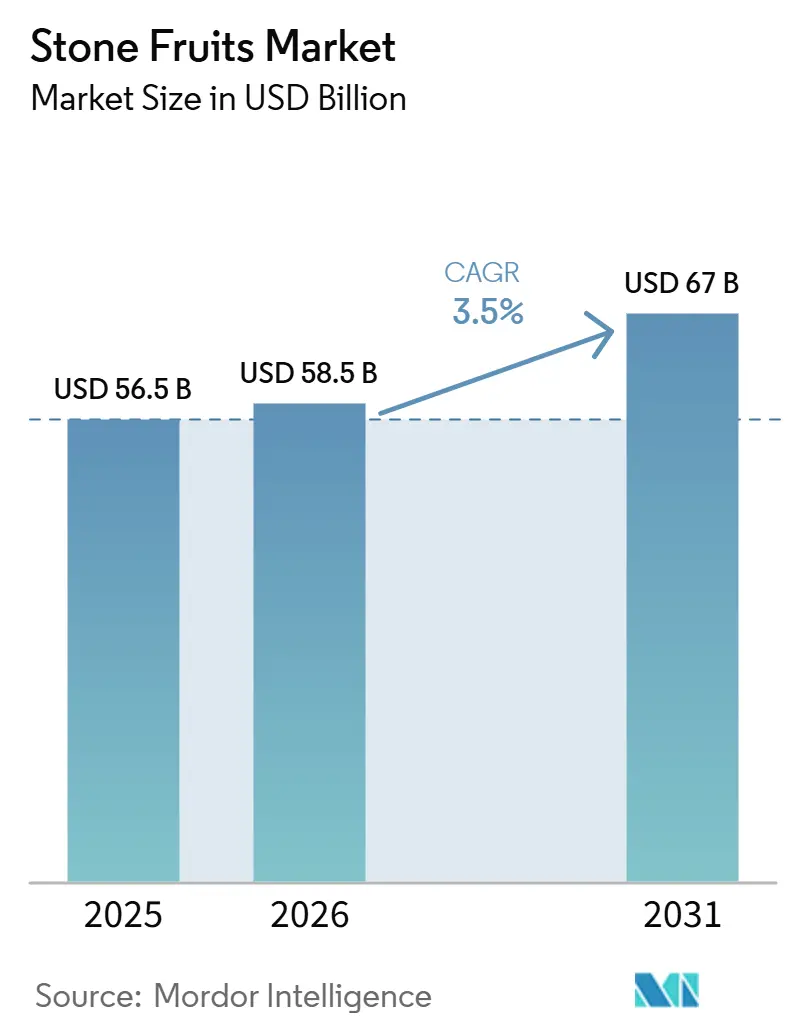
The stone fruit market was valued at USD 58.50 billion in 2026 and is projected to grow from USD 60.55 billion in 2027 to USD 71.91 billion by 2032, at a CAGR of 3.50% during the forecast period 2027 to 2032. Erratic weather, tightening labor pools, and shifting tariff regimes are reshaping production hubs and shipping corridors rather than lifting volume growth in a straight line. Extreme April 2025 frosts cut Turkey’s peach and nectarine output by 45% and cherry harvest by 60%, amplifying price volatility and pushing buyers to source from Spain, Greece, and South Africa. Asia-Pacific, anchored by China’s vast orchards and its appetite for imported cherries, is the largest consumption block, while Africa is logging the fastest regional advance as AfCFTA lowers internal trade barriers. Cost inflation in fertilizer and refrigerated logistics trims orchard margins, yet climate-resilient rootstocks, controlled-atmosphere reefer corridors, and artificial-intelligence harvesters broaden growers’ adaptive toolkit.
Key Report Takeaways
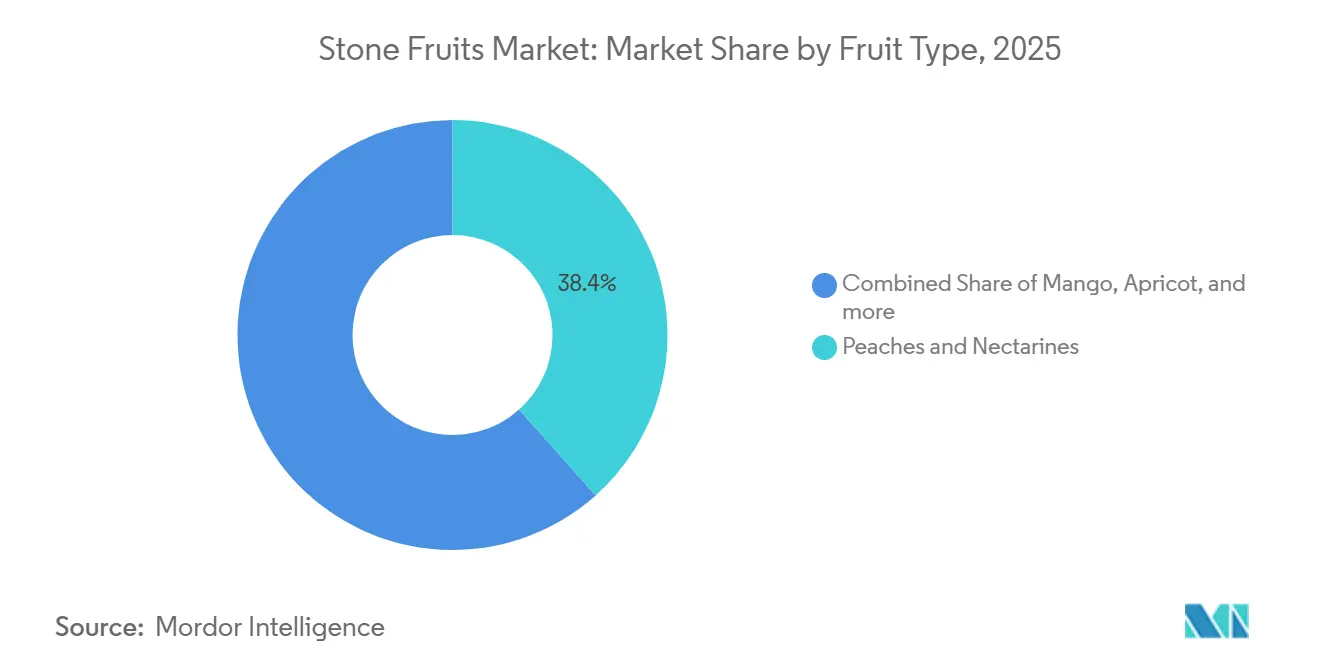
- By fruit type, peaches and nectarines were the largest segment and held 38.4% of the stone fruit market share in 2026, while cherries are the fastest-growing segment and are forecast to expand at a 6.4% CAGR between 2027 and 2032.
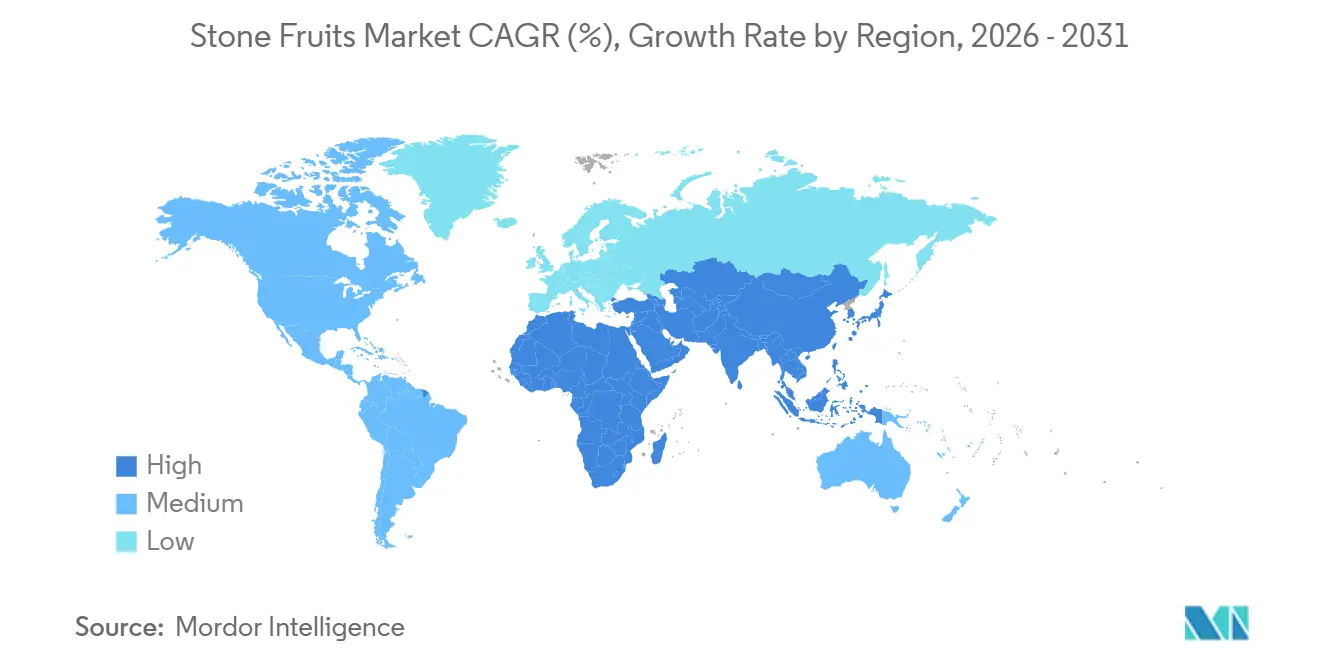
- By geography, Asia-Pacific was the largest region and accounted for 45.3% of the stone fruit market size in 2026, while Africa is the fastest-growing region and is forecast to expand at a 5.2% CAGR between 2027 and 2032.
Note: Market numbers in this report are based on Mordor Intelligence's proprietary estimation framework, which combines nine months of actuals with Q4 projections for base year 2026.
Global Stone Fruits Market Trends and Insights
Drivers Impact Analysis*
| Driver | (~) % Impact on CAGR Forecast | Geographic Relevance | Impact Timeline |
|---|---|---|---|
| Rising Consumer Focus on Low-Glycemic Index Natural Sugars | +0.8% | Global, strongest in North America, Europe, and urban Asia-Pacific | Medium term (2-4 years) |
| Expansion of Value-Added Puree and Concentrate Demand in Beverages | +0.6% | Global beverage hubs in North America, Europe, Asia-Pacific | Medium term (2-4 years) |
| Preferential Tariff Openings Under RCEP and AfCFTA | +0.7% | Asia-Pacific and Africa, spillover to the Middle East | Long term (≥ 4 years) |
| Commercialization of Climate-Resilient Dwarf Rootstocks | +0.5% | Drought-prone zones worldwide | Long term (≥ 4 years) |
| Growth of Controlled-Atmosphere Reefer Corridors in Emerging Trade Lanes | +0.4% | South America, Africa, Oceania, Asia-Pacific, and the Middle East | Medium term (2-4 years) |
| Artificial Intelligence (AI)-Enabled Orchard Robotics Lowering Per-Ton Labor Costs | +0.5% | North America, Europe, Oceania, and gradual Asia-Pacific uptake | Medium term (2-4 years) |
| Source: Mordor Intelligence | |||
Rising Consumer Focus on Low-Glycemic Index Natural Sugars
Clinical evidence published in 2025 linked fruit carbohydrate-to-fiber ratios to favorable glycemic responses, positioning peaches and nectarines as healthier snack alternatives. Retailers in the United States and Europe began labeling low-GI stone fruit selections, securing double-digit price premiums. Urban Asia-Pacific markets, where diabetes prevalence is rising, are adopting similar merchandising approaches. Growers who document varietal GI scores and maintain low residue levels can access specialty channels at 15-20% premiums. Growing consumer focus on blood sugar management and balanced nutrition is encouraging retailers to expand dedicated healthy-snacking fruit assortments, further strengthening demand for low-GI stone fruits. Nutrition-based product differentiation, supported by improved cultivar profiling and quality assurance practices, is also helping producers capture premium market segments and enhance long-term category value.
Expansion of Value-Added Puree and Concentrate Demand in Beverages
The Food and Agriculture Organization of the United Nations reported that mango puree exports surpassed 1.2 million metric tons in 2025, and beverage processors are extending similar contracts to peach and apricot purees[1]. In April 2026, Mission Produce and Sun World International signed a mango breeding agreement prioritizing high-Brix, processing-friendly genetics. Year-round puree supply is achieved by blending Northern and Southern Hemisphere harvests, which also stabilizes grower incomes. Clean-label reformulations in smoothies and baby food support long-term demand visibility. Beverage manufacturers are also incorporating stone fruit purees and concentrates into premium juices, functional drinks, and plant-based formulations to enhance natural flavor, color, and nutritional content without the use of artificial additives. The expansion of food processing infrastructure and aseptic packaging technologies is improving shelf life and supply chain efficiency, enabling stone fruit ingredients to reach a broader range of domestic and export-oriented beverage applications.
Preferential Tariff Openings Under RCEP and AfCFTA
The Regional Comprehensive Economic Partnership has eliminated import duties on select temperate fruits among its 15 signatories, encouraging Chile, New Zealand, and Australia to expand orchard investments targeting Asian markets. The African Continental Free Trade Area applies similar preferences, enabling Kenya and Egypt to displace European suppliers in West Africa. China approved Spanish cherries in April 2025, broadening sourcing options and reducing reliance on United States origins. Reduced trade barriers are improving market access for exporters while increasing supply diversity for importing nations, allowing stone fruit suppliers to reach a broader consumer base with greater pricing competitiveness. Preferential trade frameworks are also encouraging long-term investment in export-oriented orchard development, cold-chain infrastructure, and cross-border distribution networks, strengthening the resilience and efficiency of the global stone fruits supply chain.
Commercialization of Climate-Resilient Dwarf Rootstocks
The United States Department of Agriculture Agricultural Research Service released low-chill peach cultivars in 2024 that tolerate warmer winters and 30% lower irrigation[2]. Washington State University followed with the R19 self-fertile cherry in December 2025, trimming input costs for pollination and fungicides. Spain and South Africa are field-testing these genotypes in high-density orchard systems with positive early yield data. Furthermore, climate-resilient rootstocks are helping growers maintain productivity under increasingly variable weather conditions by improving tolerance to heat stress, water scarcity, and erratic winter chilling patterns. Their compatibility with high-density planting systems also enhances land-use efficiency, supports greater mechanization of orchard operations, and enables producers to achieve more consistent fruit quality and harvest outcomes across diverse growing regions.
Restraints Impact Analysis*
| Restraint | (~) % Impact on CAGR Forecast | Geographic Relevance | Impact Timeline |
|---|---|---|---|
| Volatile Temperature Swings and Late Frosts | −0.9% | Turkey, South Africa, the European Union, and parts of North America | Short term (≤ 2 years) |
| Rising Agricultural Input and Cold-Chain Energy Costs | −0.8% | Energy-import-dependent Europe, Asia-Pacific, Middle East | Short term (≤ 2 years) |
| Tightening Seasonal-Worker Visa Quotas in OECD Countries | −0.6% | United States, European Union, Australia | Medium term (2-4 years) |
| Stricter Maximum-Residue-Limit (MRL) Compliance Checks at Destination Ports | −0.6% | European Union and China import ports | Medium term (2-4 years) |
| Source: Mordor Intelligence | |||
Volatile Temperature Swings and Late Frosts
Turkey lost 60% of its cherries and 45% of its peaches and nectarines after April 2025 night temperatures reached −15 °C across 36 provinces, a development that affected European pricing. South Africa recorded a 15% volume drop in the 2024-2025 season when hail and sleet damaged Western Cape blooms. The European Investment Bank estimates that extreme weather events already erase EUR 28 billion (USD 30 billion) in annual EU farm output, with fruit crops being particularly exposed. Frost risk insurance remains prohibitively costly in many orchard districts. Increasing climate unpredictability is also making it difficult for growers to plan flowering, harvesting, and labor schedules accurately, resulting in greater operational inefficiencies and supply volatility across key producing regions. Repeated frost, hail, and temperature stress events are discouraging long-term orchard investments in vulnerable areas, as growers face rising costs for protective infrastructure, replanting, and risk management measures that can significantly impact profitability.
Rising Agricultural Input and Cold-Chain Energy Costs
Natural gas price spikes in Asia and Europe during 2025-2026 doubled ammonia costs and pushed nitrogen fertilizer invoices sharply higher, squeezing stone fruit margins[3]. Cold-storage operators in Germany and Japan reported 18-25% increases in electricity bills during the same period, adding surcharges that growers cannot immediately recoup. Longer shipping routes following Red Sea disruptions raised bunker fuel costs, widening the cost gap between export-reliant growers and those focused on domestic markets. Some integrated shippers have responded by securing multi-year power purchase agreements, though smallholders lack the leverage to do the same. Rising production and post-harvest handling costs are reducing profitability across the stone fruit value chain, particularly for small and medium-sized growers operating with limited financial flexibility. Higher costs for fertilizers, energy, refrigeration, packaging, and transportation are also constraining investment in orchard expansion and modernization, potentially limiting future production capacity and market competitiveness.
*Our forecasts treat driver/restraint impacts as directional, not additive. The impact forecasts reflect baseline growth, mix effects, and variable interactions.
Segment Analysis
By Fruit Type: Peaches and Nectarines Anchor Volume, Cherries Deliver the Fastest Growth
Peaches and nectarines accounted for 38.4% of the stone fruits market in 2026, supported by global production of approximately 24 million metric tons, with China contributing nearly 17 million metric tons, or around 70% of worldwide output. Their presence across both fresh consumption and processed applications, including canned products, purees, and concentrates, provides a balanced demand structure that helps reduce market volatility during periods of price fluctuation. Adverse weather events in major producing countries, including severe frost conditions in Turkey during 2025, highlighted the market's vulnerability to climatic disruption while creating opportunities for exporters in Spain, Greece, and South Africa to strengthen their positions. Advances in low-chill and climate-resilient cultivars are expanding production potential in warmer growing regions, supporting long-term supply growth and geographic diversification. Sustained demand from food processing industries and retail channels continues to reinforce the segment's stability, enabling consistent growth even as premium stone fruit categories attract higher value realization. Although peaches and nectarines remain the largest segment by volume, their growth is projected to be more moderate than that of the rapidly expanding cherry category.
Cherries are the fastest-growing segment of the stone fruits market, forecast to grow at a CAGR of 6.4% during 2027-2032. The segment continues to benefit from strong consumer demand for premium fresh fruit, particularly across East Asian markets where cherries are widely associated with quality, gifting, and seasonal celebrations. Leading producing countries such as Turkey, Chile, the United States, and several European nations continue to invest in orchard modernization, varietal improvement, and export-oriented production systems to meet rising international demand. The adoption of controlled-atmosphere storage, advanced cold-chain logistics, and high-efficiency reefer transportation has improved the ability of exporters to deliver premium-quality cherries to distant markets while preserving freshness and shelf life. Industry efforts to develop self-fertile and high-yielding cultivars are also helping growers improve orchard productivity and reduce dependence on pollination-related inputs. Strong penetration within premium retail, e-commerce fresh produce platforms, and high-end foodservice channels is projected to support continued volume and value growth, enabling the segment to absorb additional supply while maintaining favorable pricing and profitability.

Geography Analysis
Asia-Pacific remains the largest regional market, accounting for 45.3% of global stone fruits market value in 2026. This position is supported by China's dominant production base and its role as one of the world's largest import markets for premium fruit. China imported approximately 451,000 metric tons of cherries valued at USD 3.694 billion in 2024, with Chile accounting for the majority of shipments through established counter-seasonal supply arrangements. The region also benefits from rising disposable incomes, expanding modern retail networks, and growing consumer preference for premium fresh fruit across China, Japan, South Korea, and Southeast Asia. Australia, Japan, and New Zealand continue to differentiate themselves through strict quality standards, varietal branding, and export-focused premium fruit programs that command strong prices in international markets. Growing investments in cold-chain infrastructure, e-commerce distribution, and food processing capabilities are further supporting regional demand and strengthening Asia-Pacific's position in the global stone fruits market.
Africa is the fastest-growing regional market, forecast to grow a CAGR of 5.2% during 2027-2032, supported by expanding regional trade integration and growing investment in commercial horticulture. The progressive implementation of the African Continental Free Trade Area (AfCFTA) is improving market access for producers in countries such as Kenya, Egypt, Morocco, and South Africa, enabling broader distribution of fresh produce across the continent. Despite periodic weather-related production setbacks, South Africa remains a major exporter serving markets across Europe, the Middle East, and Asia. Growers across North Africa are increasingly evaluating water-efficient production systems, improved cultivars, and high-density orchard models to improve productivity under constrained climatic conditions. Continued investment in cold-chain logistics, storage facilities, and post-harvest handling infrastructure is projected to reduce product losses and support the region's long-term competitiveness in domestic and export markets.
North America and Europe are projected to experience moderate growth, constrained by labor shortages, climate-related production risks, and increasingly stringent environmental and food safety regulations. Producers in the United States and Europe are responding through greater adoption of mechanization, precision agriculture technologies, frost-protection systems, and improved orchard genetics to enhance productivity and resilience. In South America, Chile continues to strengthen its position as a major exporter of cherries and other premium fruit through established trade links with Asian markets, while Peru is expanding its presence in export-oriented fruit cultivation. The Middle East is also emerging as an attractive destination for stone fruit exporters, supported by rising household incomes, urbanization, expanding modern retail formats, and strong consumer demand for imported premium fresh produce. These factors are projected to support steady market expansion across the region over the forecast period.
Mordor Intelligence provides coverage of the stone fruits market across other key regional markets, including Europe, each with their regulatory frameworks and demand patterns.
Competitive Landscape
The stone fruits market is moderately consolidated, with a mix of multinational produce companies, regional exporters, grower cooperatives, and vertically integrated orchard operators competing across fresh and processed fruit channels. Dole plc maintains a significant global produce footprint through extensive sourcing networks and long-standing retail partnerships. Fresh Del Monte Produce Inc. strengthened its value-added food platform through the acquisition of select Del Monte Foods assets for approximately USD 285 million in March 2026. The transaction expanded Fresh Del Monte's presence in prepared and packaged food categories and enhanced its ability to leverage a globally recognized brand across multiple distribution channels.
Specialized players continue to differentiate themselves through proprietary genetics, premium branding, and supply chain capabilities. Stemilt Growers has established a strong position in premium cherry marketing, while Zhonglu Fruit benefits from large-scale production and integrated distribution infrastructure within China's expanding fruit market. Exporters across Oceania, Europe, and South America continue to invest in varietal development, cold chain efficiency, and premium retail positioning to strengthen margins and maintain competitiveness in key import markets. As consumer demand shifts toward premium-quality fruit, branded varieties and reliable year-round supply are becoming important competitive differentiators across the industry.
Future growth opportunities are projected to center on genetic innovation, orchard automation, precision agriculture, and greater vertical integration across the value chain. Breeding programs focused on improving fruit quality, climate resilience, yield performance, and shelf life are helping growers address both environmental and commercial challenges. Advances in automated harvesting, sorting, and post-harvest handling technologies are gradually improving labor productivity and operational efficiency. Combined with expanding trade liberalization initiatives and ongoing investments in cold chain infrastructure, these developments are projected to support broader market access, enhance supply chain resilience, and contribute to long-term growth in the global stone fruits market.
Recent Industry Developments
- April 2026: Sun World International and Mission Produce launched a mango genetics collaboration targeting three commercial cultivars and nine advanced selections. This initiative expands the proprietary genetics pipeline and is projected to deliver higher-Brix, processor-friendly fruit that can elevate value-added revenue and support long-term market growth.
- March 2026: Agricultural Robotics completed AutoHarvester field trials in Victoria, Australia. Proven mechanical picking performance accelerates commercial deployment, cutting labor costs and improving harvest efficiency, thereby boosting overall supply and stimulating market expansion.
- January 2026: Pacific Coast Producers bought Del Monte and S and W fruit inventory, with the transaction finalized in Mar 2026. The acquisition strengthens processing capacity and brand reach, likely increasing demand for raw stone fruits and boosting market growth.
Global Stone Fruits Market Report Scope
Stone fruits, or drupes, feature a fleshy exterior encasing a sizable inner stone. Globally, mangoes, cherries, nectarines, plums, and peaches are among the most popular stone fruits. The stone fruits market report is segmented by Type (Peaches and Nectarines, Cherries, Mangoes, Plums, Apricots, Others) and Geography (North America, Europe, Asia-Pacific, South America, and Africa). The Report Includes Production Analysis (Volume), Consumption Analysis (Value and Volume), Import Analysis (Value and Volume), Export Analysis (Value and Volume), Wholesale Price Trend Analysis, Regulatory Framework, List of Key Players, Logistics and Infrastructure, and Seasonality Analysis. The Market Forecasts are Provided in Terms of Value (USD) and Volume (Metric Tons).
| Peaches and Nectarines | Production Analysis | Production Volume |
| Area Harvested and Yield | ||
| Consumption Analysis (Value and Volume) | ||
| Trade Analysis (Value and Volume) | Import Market Analysis | |
| Export Market Analysis | ||
| Wholesale Price Trend Analysis and Forecast | ||
| Seasonality Analysis | ||
| Mango | Similar to Peaches and Nectarines | |
| Apricot | Similar to Peaches and Nectarines | |
| Plum | Similar to Peaches and Nectarines | |
| Cherry | Similar to Peaches and Nectarines | |
| North America | United States | Production Analysis (Area Harvested, Yield, and Production Volume) |
| Consumption Analysis (Consumption Value and Volume) | ||
| Import Market Analysis (Import Value, Volume, and Key Supplying Markets) | ||
| Export Market Analysis (Export Value, Volume, and Key Destination Markets) | ||
| Wholesale Price Trend Analysis and Forecast | ||
| Regulatory Framework | ||
| List of Key Players | ||
| Logistics and Infrastructure | ||
| Seasonality Analysis | ||
| Canada | Production Analysis (Area Harvested, Yield, and Production Volume) | |
| Consumption Analysis (Consumption Value and Volume) | ||
| Import Market Analysis (Import Value, Volume, and Key Supplying Markets) | ||
| Export Market Analysis (Export Value, Volume, and Key Destination Markets) | ||
| Wholesale Price Trend Analysis and Forecast | ||
| Regulatory Framework | ||
| List of Key Players | ||
| Logistics and Infrastructure | ||
| Seasonality Analysis | ||
| Mexico | Production Analysis (Area Harvested, Yield, and Production Volume) | |
| Consumption Analysis (Consumption Value and Volume) | ||
| Import Market Analysis (Import Value, Volume, and Key Supplying Markets) | ||
| Export Market Analysis (Export Value, Volume, and Key Destination Markets) | ||
| Wholesale Price Trend Analysis and Forecast | ||
| Regulatory Framework | ||
| List of Key Players | ||
| Logistics and Infrastructure | ||
| Seasonality Analysis | ||
| Europe | Germany | Production Analysis (Area Harvested, Yield, and Production Volume) |
| Consumption Analysis (Consumption Value and Volume) | ||
| Import Market Analysis (Import Value, Volume, and Key Supplying Markets) | ||
| Export Market Analysis (Export Value, Volume, and Key Destination Markets) | ||
| Wholesale Price Trend Analysis and Forecast | ||
| Regulatory Framework | ||
| List of Key Players | ||
| Logistics and Infrastructure | ||
| Seasonality Analysis | ||
| United Kingdom | Production Analysis (Area Harvested, Yield, and Production Volume) | |
| Consumption Analysis (Consumption Value and Volume) | ||
| Import Market Analysis (Import Value, Volume, and Key Supplying Markets) | ||
| Export Market Analysis (Export Value, Volume, and Key Destination Markets) | ||
| Wholesale Price Trend Analysis and Forecast | ||
| Regulatory Framework | ||
| List of Key Players | ||
| Logistics and Infrastructure | ||
| Seasonality Analysis | ||
| France | Production Analysis (Area Harvested, Yield, and Production Volume) | |
| Consumption Analysis (Consumption Value and Volume) | ||
| Import Market Analysis (Import Value, Volume, and Key Supplying Markets) | ||
| Export Market Analysis (Export Value, Volume, and Key Destination Markets) | ||
| Wholesale Price Trend Analysis and Forecast | ||
| Regulatory Framework | ||
| List of Key Players | ||
| Logistics and Infrastructure | ||
| Seasonality Analysis | ||
| Spain | Production Analysis (Area Harvested, Yield, and Production Volume) | |
| Consumption Analysis (Consumption Value and Volume) | ||
| Import Market Analysis (Import Value, Volume, and Key Supplying Markets) | ||
| Export Market Analysis (Export Value, Volume, and Key Destination Markets) | ||
| Wholesale Price Trend Analysis and Forecast | ||
| Regulatory Framework | ||
| List of Key Players | ||
| Logistics and Infrastructure | ||
| Seasonality Analysis | ||
| Russia | Production Analysis (Area Harvested, Yield, and Production Volume) | |
| Consumption Analysis (Consumption Value and Volume) | ||
| Import Market Analysis (Import Value, Volume, and Key Supplying Markets) | ||
| Export Market Analysis (Export Value, Volume, and Key Destination Markets) | ||
| Wholesale Price Trend Analysis and Forecast | ||
| Regulatory Framework | ||
| List of Key Players | ||
| Logistics and Infrastructure | ||
| Seasonality Analysis | ||
| Asia-Pacific | China | Production Analysis (Area Harvested, Yield, and Production Volume) |
| Consumption Analysis (Consumption Value and Volume) | ||
| Import Market Analysis (Import Value, Volume, and Key Supplying Markets) | ||
| Export Market Analysis (Export Value, Volume, and Key Destination Markets) | ||
| Wholesale Price Trend Analysis and Forecast | ||
| Regulatory Framework | ||
| List of Key Players | ||
| Logistics and Infrastructure | ||
| Seasonality Analysis | ||
| India | Production Analysis (Area Harvested, Yield, and Production Volume) | |
| Consumption Analysis (Consumption Value and Volume) | ||
| Import Market Analysis (Import Value, Volume, and Key Supplying Markets) | ||
| Export Market Analysis (Export Value, Volume, and Key Destination Markets) | ||
| Wholesale Price Trend Analysis and Forecast | ||
| Regulatory Framework | ||
| List of Key Players | ||
| Logistics and Infrastructure | ||
| Seasonality Analysis | ||
| Japan | Production Analysis (Area Harvested, Yield, and Production Volume) | |
| Consumption Analysis (Consumption Value and Volume) | ||
| Import Market Analysis (Import Value, Volume, and Key Supplying Markets) | ||
| Export Market Analysis (Export Value, Volume, and Key Destination Markets) | ||
| Wholesale Price Trend Analysis and Forecast | ||
| Regulatory Framework | ||
| List of Key Players | ||
| Logistics and Infrastructure | ||
| Seasonality Analysis | ||
| Australia | Production Analysis (Area Harvested, Yield, and Production Volume) | |
| Consumption Analysis (Consumption Value and Volume) | ||
| Import Market Analysis (Import Value, Volume, and Key Supplying Markets) | ||
| Export Market Analysis (Export Value, Volume, and Key Destination Markets) | ||
| Wholesale Price Trend Analysis and Forecast | ||
| Regulatory Framework | ||
| List of Key Players | ||
| Logistics and Infrastructure | ||
| Seasonality Analysis | ||
| South America | Brazil | Production Analysis (Area Harvested, Yield, and Production Volume) |
| Consumption Analysis (Consumption Value and Volume) | ||
| Import Market Analysis (Import Value, Volume, and Key Supplying Markets) | ||
| Export Market Analysis (Export Value, Volume, and Key Destination Markets) | ||
| Wholesale Price Trend Analysis and Forecast | ||
| Regulatory Framework | ||
| List of Key Players | ||
| Logistics and Infrastructure | ||
| Seasonality Analysis | ||
| Argentina | Production Analysis (Area Harvested, Yield, and Production Volume) | |
| Consumption Analysis (Consumption Value and Volume) | ||
| Import Market Analysis (Import Value, Volume, and Key Supplying Markets) | ||
| Export Market Analysis (Export Value, Volume, and Key Destination Markets) | ||
| Wholesale Price Trend Analysis and Forecast | ||
| Regulatory Framework | ||
| List of Key Players | ||
| Logistics and Infrastructure | ||
| Seasonality Analysis | ||
| Middle East | Saudi Arabia | Production Analysis (Area Harvested, Yield, and Production Volume) |
| Consumption Analysis (Consumption Value and Volume) | ||
| Import Market Analysis (Import Value, Volume, and Key Supplying Markets) | ||
| Export Market Analysis (Export Value, Volume, and Key Destination Markets) | ||
| Wholesale Price Trend Analysis and Forecast | ||
| Regulatory Framework | ||
| List of Key Players | ||
| Logistics and Infrastructure | ||
| Seasonality Analysis | ||
| United Arab Emirates | Production Analysis (Area Harvested, Yield, and Production Volume) | |
| Consumption Analysis (Consumption Value and Volume) | ||
| Import Market Analysis (Import Value, Volume, and Key Supplying Markets) | ||
| Export Market Analysis (Export Value, Volume, and Key Destination Markets) | ||
| Wholesale Price Trend Analysis and Forecast | ||
| Regulatory Framework | ||
| List of Key Players | ||
| Logistics and Infrastructure | ||
| Seasonality Analysis | ||
| Turkey | Production Analysis (Area Harvested, Yield, and Production Volume) | |
| Consumption Analysis (Consumption Value and Volume) | ||
| Import Market Analysis (Import Value, Volume, and Key Supplying Markets) | ||
| Export Market Analysis (Export Value, Volume, and Key Destination Markets) | ||
| Wholesale Price Trend Analysis and Forecast | ||
| Regulatory Framework | ||
| List of Key Players | ||
| Logistics and Infrastructure | ||
| Seasonality Analysis | ||
| Africa | Production Analysis (Area Harvested, Yield, and Production Volume) | |
| Consumption Analysis (Consumption Value and Volume) | ||
| Import Market Analysis (Import Value, Volume, and Key Supplying Markets) | ||
| Export Market Analysis (Export Value, Volume, and Key Destination Markets) | ||
| Wholesale Price Trend Analysis and Forecast | ||
| Regulatory Framework | ||
| List of Key Players | ||
| Logistics and Infrastructure | ||
| Seasonality Analysis | ||
| South Africa | Egypt | Production Analysis (Area Harvested, Yield, and Production Volume) |
| Consumption Analysis (Consumption Value and Volume) | ||
| Import Market Analysis (Import Value, Volume, and Key Supplying Markets) | ||
| Export Market Analysis (Export Value, Volume, and Key Destination Markets) | ||
| Wholesale Price Trend Analysis and Forecast | ||
| Regulatory Framework | ||
| List of Key Players | ||
| Logistics and Infrastructure | ||
| Seasonality Analysis | ||
| Kenya | Production Analysis (Area Harvested, Yield, and Production Volume) | |
| Consumption Analysis (Consumption Value and Volume) | ||
| Import Market Analysis (Import Value, Volume, and Key Supplying Markets) | ||
| Export Market Analysis (Export Value, Volume, and Key Destination Markets) | ||
| Wholesale Price Trend Analysis and Forecast | ||
| Regulatory Framework | ||
| List of Key Players | ||
| Logistics and Infrastructure | ||
| Seasonality Analysis | ||
| By Fruit Type | Peaches and Nectarines | Production Analysis | Production Volume |
| Area Harvested and Yield | |||
| Consumption Analysis (Value and Volume) | |||
| Trade Analysis (Value and Volume) | Import Market Analysis | ||
| Export Market Analysis | |||
| Wholesale Price Trend Analysis and Forecast | |||
| Seasonality Analysis | |||
| Mango | Similar to Peaches and Nectarines | ||
| Apricot | Similar to Peaches and Nectarines | ||
| Plum | Similar to Peaches and Nectarines | ||
| Cherry | Similar to Peaches and Nectarines | ||
| By Geography | North America | United States | Production Analysis (Area Harvested, Yield, and Production Volume) |
| Consumption Analysis (Consumption Value and Volume) | |||
| Import Market Analysis (Import Value, Volume, and Key Supplying Markets) | |||
| Export Market Analysis (Export Value, Volume, and Key Destination Markets) | |||
| Wholesale Price Trend Analysis and Forecast | |||
| Regulatory Framework | |||
| List of Key Players | |||
| Logistics and Infrastructure | |||
| Seasonality Analysis | |||
| Canada | Production Analysis (Area Harvested, Yield, and Production Volume) | ||
| Consumption Analysis (Consumption Value and Volume) | |||
| Import Market Analysis (Import Value, Volume, and Key Supplying Markets) | |||
| Export Market Analysis (Export Value, Volume, and Key Destination Markets) | |||
| Wholesale Price Trend Analysis and Forecast | |||
| Regulatory Framework | |||
| List of Key Players | |||
| Logistics and Infrastructure | |||
| Seasonality Analysis | |||
| Mexico | Production Analysis (Area Harvested, Yield, and Production Volume) | ||
| Consumption Analysis (Consumption Value and Volume) | |||
| Import Market Analysis (Import Value, Volume, and Key Supplying Markets) | |||
| Export Market Analysis (Export Value, Volume, and Key Destination Markets) | |||
| Wholesale Price Trend Analysis and Forecast | |||
| Regulatory Framework | |||
| List of Key Players | |||
| Logistics and Infrastructure | |||
| Seasonality Analysis | |||
| Europe | Germany | Production Analysis (Area Harvested, Yield, and Production Volume) | |
| Consumption Analysis (Consumption Value and Volume) | |||
| Import Market Analysis (Import Value, Volume, and Key Supplying Markets) | |||
| Export Market Analysis (Export Value, Volume, and Key Destination Markets) | |||
| Wholesale Price Trend Analysis and Forecast | |||
| Regulatory Framework | |||
| List of Key Players | |||
| Logistics and Infrastructure | |||
| Seasonality Analysis | |||
| United Kingdom | Production Analysis (Area Harvested, Yield, and Production Volume) | ||
| Consumption Analysis (Consumption Value and Volume) | |||
| Import Market Analysis (Import Value, Volume, and Key Supplying Markets) | |||
| Export Market Analysis (Export Value, Volume, and Key Destination Markets) | |||
| Wholesale Price Trend Analysis and Forecast | |||
| Regulatory Framework | |||
| List of Key Players | |||
| Logistics and Infrastructure | |||
| Seasonality Analysis | |||
| France | Production Analysis (Area Harvested, Yield, and Production Volume) | ||
| Consumption Analysis (Consumption Value and Volume) | |||
| Import Market Analysis (Import Value, Volume, and Key Supplying Markets) | |||
| Export Market Analysis (Export Value, Volume, and Key Destination Markets) | |||
| Wholesale Price Trend Analysis and Forecast | |||
| Regulatory Framework | |||
| List of Key Players | |||
| Logistics and Infrastructure | |||
| Seasonality Analysis | |||
| Spain | Production Analysis (Area Harvested, Yield, and Production Volume) | ||
| Consumption Analysis (Consumption Value and Volume) | |||
| Import Market Analysis (Import Value, Volume, and Key Supplying Markets) | |||
| Export Market Analysis (Export Value, Volume, and Key Destination Markets) | |||
| Wholesale Price Trend Analysis and Forecast | |||
| Regulatory Framework | |||
| List of Key Players | |||
| Logistics and Infrastructure | |||
| Seasonality Analysis | |||
| Russia | Production Analysis (Area Harvested, Yield, and Production Volume) | ||
| Consumption Analysis (Consumption Value and Volume) | |||
| Import Market Analysis (Import Value, Volume, and Key Supplying Markets) | |||
| Export Market Analysis (Export Value, Volume, and Key Destination Markets) | |||
| Wholesale Price Trend Analysis and Forecast | |||
| Regulatory Framework | |||
| List of Key Players | |||
| Logistics and Infrastructure | |||
| Seasonality Analysis | |||
| Asia-Pacific | China | Production Analysis (Area Harvested, Yield, and Production Volume) | |
| Consumption Analysis (Consumption Value and Volume) | |||
| Import Market Analysis (Import Value, Volume, and Key Supplying Markets) | |||
| Export Market Analysis (Export Value, Volume, and Key Destination Markets) | |||
| Wholesale Price Trend Analysis and Forecast | |||
| Regulatory Framework | |||
| List of Key Players | |||
| Logistics and Infrastructure | |||
| Seasonality Analysis | |||
| India | Production Analysis (Area Harvested, Yield, and Production Volume) | ||
| Consumption Analysis (Consumption Value and Volume) | |||
| Import Market Analysis (Import Value, Volume, and Key Supplying Markets) | |||
| Export Market Analysis (Export Value, Volume, and Key Destination Markets) | |||
| Wholesale Price Trend Analysis and Forecast | |||
| Regulatory Framework | |||
| List of Key Players | |||
| Logistics and Infrastructure | |||
| Seasonality Analysis | |||
| Japan | Production Analysis (Area Harvested, Yield, and Production Volume) | ||
| Consumption Analysis (Consumption Value and Volume) | |||
| Import Market Analysis (Import Value, Volume, and Key Supplying Markets) | |||
| Export Market Analysis (Export Value, Volume, and Key Destination Markets) | |||
| Wholesale Price Trend Analysis and Forecast | |||
| Regulatory Framework | |||
| List of Key Players | |||
| Logistics and Infrastructure | |||
| Seasonality Analysis | |||
| Australia | Production Analysis (Area Harvested, Yield, and Production Volume) | ||
| Consumption Analysis (Consumption Value and Volume) | |||
| Import Market Analysis (Import Value, Volume, and Key Supplying Markets) | |||
| Export Market Analysis (Export Value, Volume, and Key Destination Markets) | |||
| Wholesale Price Trend Analysis and Forecast | |||
| Regulatory Framework | |||
| List of Key Players | |||
| Logistics and Infrastructure | |||
| Seasonality Analysis | |||
| South America | Brazil | Production Analysis (Area Harvested, Yield, and Production Volume) | |
| Consumption Analysis (Consumption Value and Volume) | |||
| Import Market Analysis (Import Value, Volume, and Key Supplying Markets) | |||
| Export Market Analysis (Export Value, Volume, and Key Destination Markets) | |||
| Wholesale Price Trend Analysis and Forecast | |||
| Regulatory Framework | |||
| List of Key Players | |||
| Logistics and Infrastructure | |||
| Seasonality Analysis | |||
| Argentina | Production Analysis (Area Harvested, Yield, and Production Volume) | ||
| Consumption Analysis (Consumption Value and Volume) | |||
| Import Market Analysis (Import Value, Volume, and Key Supplying Markets) | |||
| Export Market Analysis (Export Value, Volume, and Key Destination Markets) | |||
| Wholesale Price Trend Analysis and Forecast | |||
| Regulatory Framework | |||
| List of Key Players | |||
| Logistics and Infrastructure | |||
| Seasonality Analysis | |||
| Middle East | Saudi Arabia | Production Analysis (Area Harvested, Yield, and Production Volume) | |
| Consumption Analysis (Consumption Value and Volume) | |||
| Import Market Analysis (Import Value, Volume, and Key Supplying Markets) | |||
| Export Market Analysis (Export Value, Volume, and Key Destination Markets) | |||
| Wholesale Price Trend Analysis and Forecast | |||
| Regulatory Framework | |||
| List of Key Players | |||
| Logistics and Infrastructure | |||
| Seasonality Analysis | |||
| United Arab Emirates | Production Analysis (Area Harvested, Yield, and Production Volume) | ||
| Consumption Analysis (Consumption Value and Volume) | |||
| Import Market Analysis (Import Value, Volume, and Key Supplying Markets) | |||
| Export Market Analysis (Export Value, Volume, and Key Destination Markets) | |||
| Wholesale Price Trend Analysis and Forecast | |||
| Regulatory Framework | |||
| List of Key Players | |||
| Logistics and Infrastructure | |||
| Seasonality Analysis | |||
| Turkey | Production Analysis (Area Harvested, Yield, and Production Volume) | ||
| Consumption Analysis (Consumption Value and Volume) | |||
| Import Market Analysis (Import Value, Volume, and Key Supplying Markets) | |||
| Export Market Analysis (Export Value, Volume, and Key Destination Markets) | |||
| Wholesale Price Trend Analysis and Forecast | |||
| Regulatory Framework | |||
| List of Key Players | |||
| Logistics and Infrastructure | |||
| Seasonality Analysis | |||
| Africa | Production Analysis (Area Harvested, Yield, and Production Volume) | ||
| Consumption Analysis (Consumption Value and Volume) | |||
| Import Market Analysis (Import Value, Volume, and Key Supplying Markets) | |||
| Export Market Analysis (Export Value, Volume, and Key Destination Markets) | |||
| Wholesale Price Trend Analysis and Forecast | |||
| Regulatory Framework | |||
| List of Key Players | |||
| Logistics and Infrastructure | |||
| Seasonality Analysis | |||
| South Africa | Egypt | Production Analysis (Area Harvested, Yield, and Production Volume) | |
| Consumption Analysis (Consumption Value and Volume) | |||
| Import Market Analysis (Import Value, Volume, and Key Supplying Markets) | |||
| Export Market Analysis (Export Value, Volume, and Key Destination Markets) | |||
| Wholesale Price Trend Analysis and Forecast | |||
| Regulatory Framework | |||
| List of Key Players | |||
| Logistics and Infrastructure | |||
| Seasonality Analysis | |||
| Kenya | Production Analysis (Area Harvested, Yield, and Production Volume) | ||
| Consumption Analysis (Consumption Value and Volume) | |||
| Import Market Analysis (Import Value, Volume, and Key Supplying Markets) | |||
| Export Market Analysis (Export Value, Volume, and Key Destination Markets) | |||
| Wholesale Price Trend Analysis and Forecast | |||
| Regulatory Framework | |||
| List of Key Players | |||
| Logistics and Infrastructure | |||
| Seasonality Analysis | |||
Key Questions Answered in the Report
What is the stone fruit market size?
The stone fruit market was valued at USD 58.50 billion in 2026 and is projected to grow from USD 60.55 billion in 2027 to USD 71.91 billion by 2032, at a CAGR of 3.50% during the forecast period 2027 to 2032.
Which fruit type is growing the fastest within global stone fruits?
Cherries posted the fastest CAGR of 6.4% during 2027-2032, driven by strong Asian demand and wider adoption of controlled-atmosphere shipping.
Which region currently dominates demand for stone fruits?
Asia-Pacific commands 45.3% of global consumption value, driven by China's production scale and import appetite for premium cherries.
Why are growers investing in climate-resilient rootstocks?
Low-chill and drought-tolerant rootstocks cut weather risk and allow expansion into warmer zones, adding up to 700,000 metric tons of incremental supply potential by 2032.
How is automation affecting labor economics in orchards?
Artificial-intelligence harvesters licensed in 2025 cut per-ton labor expenses by about 22% and reach payback in three to four seasons in high-wage regions.