
Almond Market Size and Share
Almond Market Analysis by Mordor Intelligence
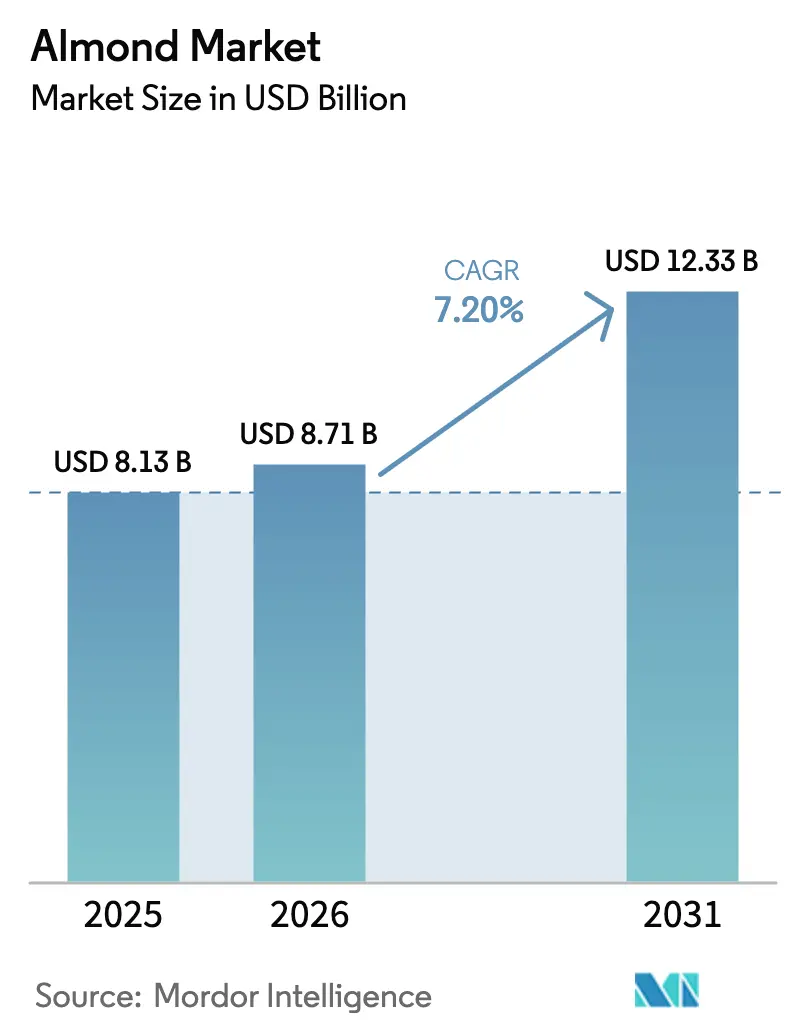
The almond market size is projected to expand from USD 8.13 billion in 2025 and USD 8.71 billion in 2026 to USD 12.33 billion by 2031, registering a CAGR of 7.20% between 2026 to 2031. Strong plant-based dairy uptake, orchard mechanization, and resilient breeding programs are shifting almonds from a snack into a strategic protein source that underpins large portions of the global plant-based food chain. Growing middle-class demand in Asia, premium ingredient positioning in Europe, and vertically integrated processing in California are creating opportunities for price realization, despite lingering farm-gate price pressure. Precision irrigation, genome-edited rootstocks, and carbon credit programs are reducing water risk exposure while increasing investor confidence in long-term orchard assets. Consolidation among processors is enabling capital-intensive upgrades such as steam sterilization that support stricter aflatoxin rules in importing nations. These developments position the almond market for sustained value creation, even as producers face groundwater quotas and spikes in pollination costs.
Key Report Takeaways
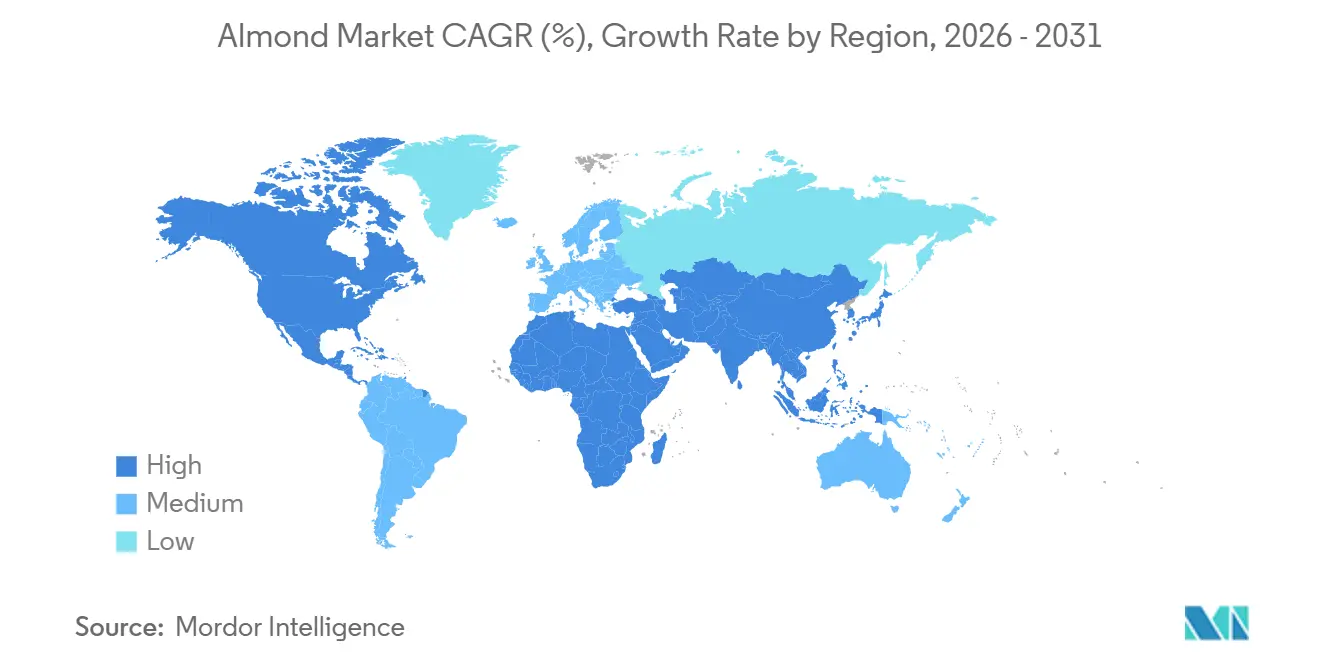
- By geography, North America led the almond market share in 2025, with 38.2%, while the Asia-Pacific region is forecast to expand at a 7.8% CAGR through 2031.
Note: Market size and forecast figures in this report are generated using Mordor Intelligence’s proprietary estimation framework, updated with the latest available data and insights as of January 2026.
Market Trends and Insights
Drivers Impact Analysis of Almond Market*
| Driver | (~) % Impact on CAGR Forecast | Geographic Relevance | Impact Timeline |
|---|---|---|---|
| Rising demand from plant-based dairy and confectionery industries | +1.8% | Global, with concentration in North America, and Asia-Pacific urban centers | Medium term (2-4 years) |
| Expansion of mechanized orchards | +1.2% | North America (California), Australia, and Spain (irrigated zones) | Long term (≥ 4 years) |
| Government subsidies for nut cultivation | +0.8% | North America (USDA MAP), Spain (CAP), Australia (MASC), and Chile | Short term (≤ 2 years) |
| Genome-edited rootstocks boost salinity tolerance | +0.6% | North America (California Central Valley), Australia (Murray-Darling Basin), and Spain (Andalucía) | Long term (≥ 4 years) |
| Carbon-credit premiums for low-water "blue-footer" almonds | +0.4% | North America (California) and Australia, with pilot programs in Spain | Medium term (2-4 years) |
| High-oleic almond varieties extend snack shelf life | +0.9% | Global, with early adoption in North America processing hubs | Medium term (2-4 years) |
| Source: Mordor Intelligence | |||
Rising Demand from Plant-Based Dairy and Confectionery Industries
Almond milk, yogurt alternatives, and chocolate fillings are capturing incremental volume from consumers who seek lactose-free and vegan options. The European Union imported 261,534 metric tons in the 2023-24 season, allocating most of this volume to food processing and confectionery. India’s imports climbed in the same year as urban snack demand accelerated. Saudi Arabia’s packaged food sales reached USD 22.9 billion in 2023, creating opportunities for almond inclusions in premium bars and bakery fillings [1]. Asia-Pacific beverage makers are increasingly substituting dairy ingredients with almond-based alternatives due to the high prevalence of lactose intolerance. Processors that invest in steam sterilization and slicing capacity can therefore secure premium contracts with multinational food brands that demand ready-to-use, shelf-stable almond inputs.
Expansion of Mechanized Orchards
Mechanical shakers, continuous-flow hullers, and AI-enabled irrigation controllers are cutting harvest labor costs while improving water productivity. Spain planted 765,541 hectares by 2023, with 15.5% still pre-bearing yet already fitted for mechanized harvest systems. Olam Food Ingredients has pledged to push irrigation distribution uniformity to 90% across all orchards by 2030, up from an 80% baseline, using smart sensors and AI to monitor tree health [2]. Australia’s hedgerow systems yield 0.463 kilograms per cubic meter of water, compared to 0.331 kilograms under open-vase configurations, underscoring the efficiency gain of mechanized layouts. Wonderful Pistachios and Almonds invested USD 500 million in Central Valley processing and employee programs that support large-scale orchard modernization. These capital-intensive upgrades favor cooperative and corporate growers over smallholders, hastening consolidation within the almond market.
Government Subsidies for Nut Cultivation
Public incentives are lowering entry barriers and accelerating the rollout of orchards in leading producer regions. The USDA Market Access Program funds overseas promotion that helps California growers build consumer awareness in China, Germany, and Japan. Spain utilizes European Union Common Agricultural Policy payments to expand organic almond acreage, enabling one-third of the national tree-nut area to achieve organic certification, with 82% of this area dedicated to almonds [3]. Chile’s tax deferral laws support the establishment of orchards targeting Asian buyers. Australia’s risk-mitigation schemes lower financing costs but exclude some almond blocks, creating uneven uptake. Subsidy asymmetry gives Spanish and United States growers a cost advantage over producers in Iran and Morocco, shaping trade flows within the almond market.
Genome-Edited Rootstocks Boost Salinity Tolerance
Researchers at the University of California, Davis, and the Commonwealth Scientific and Industrial Research Organisation (CSIRO) use CRISPR-Cas9 to create rootstocks that control sodium uptake, thereby stabilizing yields in saline soils common to the Central Valley and the Murray-Darling Basin. Field trials are underway under the oversight of the United States Department of Agriculture's Animal and Plant Health Inspection Service (USDA APHIS), with commercial releases projected late in the decade. Spain’s agricultural institute runs parallel programs for drought-prone Andalucía. Adoption in Europe may lag due to the hurdles posed by Directive 2001/18/EC, giving California and Australia a head start. Salinity-tolerant trees can extend orchard lifespans and open new growing zones, expanding the almond market production frontier.
Restraints Impact Analysis of Almond Market*
| Restraint | (~) % Impact on CAGR Forecast | Geographic Relevance | Impact Timeline |
|---|---|---|---|
| Water scarcity and irrigation caps | -1.3% | California (SGMA), Australia (Murray-Darling Basin), Spain (southeast), and Chile | Long term (≥ 4 years) |
| Volatile farm-gate prices from oversupply cycles | -0.9% | Global, with acute pressure in California and Spain | Short term (≤ 2 years) |
| Rising bee-rental costs following varroa-mite flare-ups | -0.7% | North America (California and Pacific Northwest) and Australia | Medium term (2-4 years) |
| Stricter aflatoxin action limits in emerging markets | -0.5% | Asia-Pacific (China, India, and Vietnam), Middle East (Egypt and Saudi Arabia), and Africa | Medium term (2-4 years) |
| Source: Mordor Intelligence | |||
Water Scarcity and Irrigation Caps
California’s Sustainable Groundwater Management Act forces basin-level sustainability by 2040, reducing pumping rights and raising compliance fees that erode grower margins. According to the Ministerio de Agricultura, Pesca y Alimentación (MAPA), rainfall deficits in 2024/25 resulted in a production decline of over 35% in Murcia and Valencia, while Aragón and Castilla-La Mancha reported increases. Chilean output remains constrained by the limited availability of surface water in northern zones. Growers invest in micro-sprinklers and deficit irrigation yet face capital recovery challenges, especially smallholders active in the almond market.
Volatile Farm-Gate Prices from Oversupply Cycles
Farm-gate price volatility, driven by cyclical oversupply and inventory drawdowns, erodes grower profitability and discourages orchard expansion. The challenge is that almond orchards have a 25- to 30-year productive lifespan, creating supply rigidity and delayed price responses to demand signals. Growers are exploring value-added processing, including almond flour, butter, and oil, to capture downstream margins, yet these investments require scale and market access that favor cooperatives and large processors over independent operators. Inventories continue to decline, yet supply growth still outpaces demand during some seasons, amplifying earnings volatility within the almond market.
*Our forecasts treat driver/restraint impacts as directional, not additive. The impact forecasts reflect baseline growth, mix effects, and variable interactions.
Geography Analysis
North America Almond Market
In 2025, North America accounted for 38.2% of the almond market share, supported by California’s crop forecast for 2026-2031, which is based on bearing acres. Vertically integrated cooperatives export domestic production to over 100 countries, leveraging logistical advantages through dedicated shipping programs. Canada relies on imports for its snack and foodservice channels due to the absence of domestic orchards, which is caused by climatic constraints. Regulatory changes, such as groundwater fees under the preventive control rules of the Food Safety Modernization Act, have increased compliance costs while enhancing transparency in the supply chain. Investments in deficit irrigation and micro-sprinkler retrofits demonstrate regional adaptation strategies aimed at maintaining the almond production base.
APAC and Europe Almond Market
The Asia-Pacific region is the fastest-growing, projected to grow at a CAGR of 7.8% through 2031. India's tariff rollback on United States almonds boosted imports for the 2023-24 period. China's recovery from the 2023 economic contraction led to increased purchases in 2024 and revitalized food-service demand. Vietnam experienced a surge in imports, driven by strong growth in bakery exports. Australia achieved a record almond harvest in 2024, with the majority of shipments directed to Asian buyers seeking counter-seasonal supply. Iran expanded shipments to Europe, while localized slicing and roasting units in India and China reduced lead times and enabled flavor customization, enhancing almond market penetration. Europe maintains a balance of significant domestic production alongside continued demand for imports. Italy's aging orchards are producing declining volumes, while Portugal and Greece focus on heritage varieties valued for their flavor. Spain's competitive position is supported by origin labeling and geographic proximity, which contribute to a strong and stable European almond market.
MEA and South America Almond Market
The Middle East and Africa offer rising consumption, rooted in confectionery traditions and driven by the modernization of snacks. Tunisia’s exports to the United States slipped in 2024, illustrating competitiveness challenges. In-shell consumption spikes during Ramadan, while kernel demand from bakery plants calls for diced and slivered formats. Suppliers that adjust packaging and product mix capture incremental almond market share. South America grows as a niche supplier. Limited processing capacity and water constraints curb the near-term upside, yet the counter-seasonal harvest window from January to March allows Chile to achieve attractive pricing when Northern Hemisphere stocks are low.
Mordor Intelligence provides coverage of the almond market across other key regional markets. Detailed country-level analysis extends to China incorporating local coverage and market participation, as required.
Regulatory Landscape
Almond trade is shaped by food-safety controls, including aflatoxin limits, pesticide residue rules, and origin-marking requirements in major importing regions. The European Union continues to recognize the US Almond Pre-Export Check (PEC) program under Regulation (EU) 2015/949, which reduces the frequency of physical aflatoxin checks for qualifying US shipments, while importers still operate against tighter EU aflatoxin tolerances than the United States. In Europe, updated marketing standards requiring single country-of-origin labeling for dried fruit and nuts have been implemented since January 2025, raising compliance expectations for packers and private-label suppliers.
In the United States, industry self-regulation is centered on USDA AMS Marketing Order 981 for California almonds, which governs handler obligations and funds research and compliance through the Almond Board of California. In March 2026, USDA advanced proposed amendments to the marketing order, including a seasonal line of credit mechanism for the Board and an extension of the inedible disposition obligation deadline for handlers, reflecting continued rulemaking activity around program administration. Separately, EU pesticide policy is tightening: in June 2026 the European Commission endorsed a proposal to lower maximum residue levels (MRLs) for carbendazim, benomyl, and thiophanate-methyl, pushing exporters toward stronger residue-management programs and more disciplined pre-shipment testing.
Value Chain Analysis
The almond value chain starts with orchard establishment and inputs, including rootstock varieties, irrigation systems, fertilizers and crop protection, and contracted pollination, followed by on-farm production and harvest that increasingly uses mechanized shaking and sweeping. Post-harvest, almonds move into primary processing (hulling and shelling) and then to handlers and secondary processors for pasteurization or steam sterilization, sizing, slicing/dicing, roasting, and packaging into in-shell and kernel formats. In California, cooperatives and large integrated processors coordinate aggregation, quality programs, and export documentation, with Blue Diamond Growers as one example providing processing, value-added formats such as flour and butter, and market access for a broad grower base.
Downstream distribution splits between domestic channels (snack, bakery, confectionery, and ingredient buyers) and exports, with California shipping a large share of production overseas. Almond Board of California position reporting highlights how shipment performance and inventory levels affect handler buying patterns and contract coverage, while export execution depends on grading, traceability, and compliance with importing-country requirements such as origin labeling and aflatoxin controls. Key bottlenecks include water and pollination costs at the farm level, along with the capital intensity of food-safety upgrades such as steam sterilization and enhanced sorting, plus logistics complexity for long-haul export programs. Together, these pressures favor scaled growers and processors and accelerate consolidation across handling capacity.
Competitive Landscape
Competitive intensity is moderate to high as vertically integrated cooperatives partner with large processors to command processing and export capacity. Wonderful Pistachios and Almonds oversees 250,000 acres and produces 650 million pounds annually, establishing itself as a global leader in scale. Blue Diamond Growers operates cooperative processing lines that deliver value-added flour and butter formats to international food companies. Olam Food Ingredients secured the first Rainforest Alliance certification for California almonds in June 2024, demonstrating supply-chain transparency that resonates with corporate buyers facing environmental reporting mandates.
Mid-tier players differentiate through sustainability and regional proximity. Select Harvests, Australia’s largest grower, mitigates climate exposure by balancing owned, leased, and third-party orchards. Spanish cooperative Almendras Llopis leverages mandatory origin labeling to promote locally sourced organic kernels across European retailers. Sahyadri Farms in India expands its sourcing programs to meet the rising demand for confectionery and shorten lead times. Technology investment accelerates across the board, with AI-driven irrigation controllers, drone canopy monitoring, and blockchain traceability improving input efficiency and buyer confidence in the almond market.
White-space areas include the adoption of high-oleic cultivars, carbon-credit monetization linked to water-efficient practices, and regional processing hubs in Asia that roast, slice, and pack almonds near consumption centers. Processors with steam sterilization, pasteurization, and micro-slicing lines command premiums by satisfying strict aflatoxin thresholds and extended shelf-life requirements. Independent growers lacking scale increasingly sign multi-year offtake agreements with cooperatives or downstream roasters to secure stable cash flow amid volatile spot prices.
Market Opportunities and Future Outlook
Opportunities are concentrated in compliance-led, value-added kernel supply for food manufacturers and in supply-risk reduction programs tied to water, carbon, and pollination. Importers and multinational buyers increasingly request verifiable sustainability and traceability, which creates room for certified and documented supply streams. For example, Olam Food Ingredients has already secured Rainforest Alliance certification for California almonds (June 2024), and in April 2026 it disclosed a regenerative agriculture pilot across 920 acres of California orchards that tests subsurface irrigation and digital-twin monitoring to support 2030 sustainability targets. These programs align with tighter regulatory scrutiny in core destinations, including EU origin labeling implementation (January 2025) and the European Commission's June 2026 endorsement of lower pesticide MRLs.
Operational efficiency investments are also opening new levers for growers and processors facing water and labor constraints. Orchard and processing automation, including sensor-driven irrigation, machine vision sorting, and robotic handling, supports consistent quality for diced, sliced, and blanched formats used in plant-based dairy and confectionery supply chains, where ready-to-use, shelf-stable inputs can support premium contracts. Pollination monitoring is emerging as a supply de-risking tool: in June 2026, Importaco and AgriSound reported deployment of AgriSound Polly technology in Spanish and Portuguese orchards to improve yield visibility and reduce sourcing risk. On the cost side, on-farm energy projects can lower operating expenses for processing and irrigation; in July 2026, Koompartu Farms commissioned a 9.2 MW solar-plus-battery microgrid in South Australia to cover most of its energy demand and reduce diesel generator reliance, showing how energy infrastructure is becoming part of the competitive toolkit for larger almond operations.
Recent Industry Developments in Almond Market
- July 2026: Blue Diamond Growers revised its 2026 almond crop estimate to 2.67 billion pounds. The update affected near-term contracting and inventory planning across buyers that use cooperative estimates as reference points for coverage decisions and export timing.
- June 2026: KIND Healthy Snacks announced that 50% of its almond supply chain is sourced from farms using regenerative agriculture practices. The announcement raises the bar for sustainability documentation and encourages upstream adoption of measurable practices to maintain access to branded snack programs.
- June 2024: Olam Food Ingredients secured the first Rainforest Alliance certification for California almonds in the United States, working with partners such as the Almond Board of California and the California Water Action Collaborative. The certification strengthened differentiation for certified lots in global ingredient procurement, where environmental claims and traceability are increasingly tied to supplier qualification.
Almond Market Report Scope and Research Methodology
Market Definition and Coverage
For this methodology, the almond market covers the global trade value of raw sweet almonds, in-shell and shelled, at the first commercial sale from growers and processors to buyers.
Scope exclusions: We exclude value added almond derivatives and blended products, such as almond milk, flour, oil, butter, and mixed nuts.
Segments Covered in This Report
- By Geography
- North America
- United States
- Production Analysis (Area Harvested, Yield, and Production Volume)
- Consumption Analysis (Consumption Value and Volume)
- Import Market Analysis (Import Value, Volume, and Key Supplying Markets)
- Export Market Analysis (Export Value, Volume, and Key Destination Markets)
- Wholesale Price Trend Analysis and Forecast
- Regulatory Framework
- List of Key Players
- Logistics and Infrastructure
- Seasonality Analysis
- Canada
- Production Analysis (Area Harvested, Yield, and Production Volume)
- Consumption Analysis (Consumption Value and Volume)
- Import Market Analysis (Import Value, Volume, and Key Supplying Markets)
- Export Market Analysis (Export Value, Volume, and Key Destination Markets)
- Wholesale Price Trend Analysis and Forecast
- Regulatory Framework
- List of Key Players
- Logistics and Infrastructure
- Seasonality Analysis
- United States
- Europe
- Spain
- Production Analysis (Area Harvested, Yield, and Production Volume)
- Consumption Analysis (Consumption Value and Volume)
- Import Market Analysis (Import Value, Volume, and Key Supplying Markets)
- Export Market Analysis (Export Value, Volume, and Key Destination Markets)
- Wholesale Price Trend Analysis and Forecast
- Regulatory Framework
- List of Key Players
- Logistics and Infrastructure
- Seasonality Analysis
- Italy
- Production Analysis (Area Harvested, Yield, and Production Volume)
- Consumption Analysis (Consumption Value and Volume)
- Import Market Analysis (Import Value, Volume, and Key Supplying Markets)
- Export Market Analysis (Export Value, Volume, and Key Destination Markets)
- Wholesale Price Trend Analysis and Forecast
- Regulatory Framework
- List of Key Players
- Logistics and Infrastructure
- Seasonality Analysis
- Portugal
- Production Analysis (Area Harvested, Yield, and Production Volume)
- Consumption Analysis (Consumption Value and Volume)
- Import Market Analysis (Import Value, Volume, and Key Supplying Markets)
- Export Market Analysis (Export Value, Volume, and Key Destination Markets)
- Wholesale Price Trend Analysis and Forecast
- Regulatory Framework
- List of Key Players
- Logistics and Infrastructure
- Seasonality Analysis
- Greece
- Production Analysis (Area Harvested, Yield, and Production Volume)
- Consumption Analysis (Consumption Value and Volume)
- Import Market Analysis (Import Value, Volume, and Key Supplying Markets)
- Export Market Analysis (Export Value, Volume, and Key Destination Markets)
- Wholesale Price Trend Analysis and Forecast
- Regulatory Framework
- List of Key Players
- Logistics and Infrastructure
- Seasonality Analysis
- Spain
- Asia-Pacific
- Iran
- Production Analysis (Area Harvested, Yield, and Production Volume)
- Consumption Analysis (Consumption Value and Volume)
- Import Market Analysis (Import Value, Volume, and Key Supplying Markets)
- Export Market Analysis (Export Value, Volume, and Key Destination Markets)
- Wholesale Price Trend Analysis and Forecast
- Regulatory Framework
- List of Key Players
- Logistics and Infrastructure
- Seasonality Analysis
- Australia
- Production Analysis (Area Harvested, Yield, and Production Volume)
- Consumption Analysis (Consumption Value and Volume)
- Import Market Analysis (Import Value, Volume, and Key Supplying Markets)
- Export Market Analysis (Export Value, Volume, and Key Destination Markets)
- Wholesale Price Trend Analysis and Forecast
- Regulatory Framework
- List of Key Players
- Logistics and Infrastructure
- Seasonality Analysis
- China
- Production Analysis (Area Harvested, Yield, and Production Volume)
- Consumption Analysis (Consumption Value and Volume)
- Import Market Analysis (Import Value, Volume, and Key Supplying Markets)
- Export Market Analysis (Export Value, Volume, and Key Destination Markets)
- Wholesale Price Trend Analysis and Forecast
- Regulatory Framework
- List of Key Players
- Logistics and Infrastructure
- Seasonality Analysis
- India
- Production Analysis (Area Harvested, Yield, and Production Volume)
- Consumption Analysis (Consumption Value and Volume)
- Import Market Analysis (Import Value, Volume, and Key Supplying Markets)
- Export Market Analysis (Export Value, Volume, and Key Destination Markets)
- Wholesale Price Trend Analysis and Forecast
- Regulatory Framework
- List of Key Players
- Logistics and Infrastructure
- Seasonality Analysis
- Vietnam
- Production Analysis (Area Harvested, Yield, and Production Volume)
- Consumption Analysis (Consumption Value and Volume)
- Import Market Analysis (Import Value, Volume, and Key Supplying Markets)
- Export Market Analysis (Export Value, Volume, and Key Destination Markets)
- Wholesale Price Trend Analysis and Forecast
- Regulatory Framework
- List of Key Players
- Logistics and Infrastructure
- Seasonality Analysis
- Iran
- South America
- Chile
- Production Analysis (Area Harvested, Yield, and Production Volume)
- Consumption Analysis (Consumption Value and Volume)
- Import Market Analysis (Import Value, Volume, and Key Supplying Markets)
- Export Market Analysis (Export Value, Volume, and Key Destination Markets)
- Wholesale Price Trend Analysis and Forecast
- Regulatory Framework
- List of Key Players
- Logistics and Infrastructure
- Seasonality Analysis
- Argentina
- Production Analysis (Area Harvested, Yield, and Production Volume)
- Consumption Analysis (Consumption Value and Volume)
- Import Market Analysis (Import Value, Volume, and Key Supplying Markets)
- Export Market Analysis (Export Value, Volume, and Key Destination Markets)
- Wholesale Price Trend Analysis and Forecast
- Regulatory Framework
- List of Key Players
- Logistics and Infrastructure
- Seasonality Analysis
- Chile
- Middle East
- Saudi Arabia
- Production Analysis (Area Harvested, Yield, and Production Volume)
- Consumption Analysis (Consumption Value and Volume)
- Import Market Analysis (Import Value, Volume, and Key Supplying Markets)
- Export Market Analysis (Export Value, Volume, and Key Destination Markets)
- Wholesale Price Trend Analysis and Forecast
- Regulatory Framework
- List of Key Players
- Logistics and Infrastructure
- Seasonality Analysis
- Egypt
- Production Analysis (Area Harvested, Yield, and Production Volume)
- Consumption Analysis (Consumption Value and Volume)
- Import Market Analysis (Import Value, Volume, and Key Supplying Markets)
- Export Market Analysis (Export Value, Volume, and Key Destination Markets)
- Wholesale Price Trend Analysis and Forecast
- Regulatory Framework
- List of Key Players
- Logistics and Infrastructure
- Seasonality Analysis
- Saudi Arabia
- Africa
- Morocco
- Production Analysis (Area Harvested, Yield, and Production Volume)
- Consumption Analysis (Consumption Value and Volume)
- Import Market Analysis (Import Value, Volume, and Key Supplying Markets)
- Export Market Analysis (Export Value, Volume, and Key Destination Markets)
- Wholesale Price Trend Analysis and Forecast
- Regulatory Framework
- List of Key Players
- Logistics and Infrastructure
- Seasonality Analysis
- Tunisia
- Production Analysis (Area Harvested, Yield, and Production Volume)
- Consumption Analysis (Consumption Value and Volume)
- Import Market Analysis (Import Value, Volume, and Key Supplying Markets)
- Export Market Analysis (Export Value, Volume, and Key Destination Markets)
- Wholesale Price Trend Analysis and Forecast
- Regulatory Framework
- List of Key Players
- Logistics and Infrastructure
- Seasonality Analysis
- Morocco
- North America
Data Sources, Market Sizing, and Validation
Desk Research
Desk research starts with mapping supply and demand in a way that can be checked against named market variables. We used public crop and acreage statistics, trade flow data, and price references to build the core market signals, then cross-checked them against shipment seasonality and inventory notes.
Common source types include government agriculture and trade statistics such as USDA reports, UN Comtrade, and ITC Trade Map, plus national statistics portals in major producing and importing countries. We also referenced publications from industry bodies such as the Almond Board of California and the International Nut and Dried Fruit Council, along with peer reviewed food and nutrition journals for consumption and use case context. Company annual reports, investor presentations, and reputable press were added to track capacity changes, processing expansions, and demand shifts. Where needed, paid subscriptions for company financials and news intelligence, patent databases, and shipment-level trade databases were used to validate directional movement in pricing and volumes. The sources listed here are illustrative, and additional public and paid references were used to collect, verify, and clarify data points.
Primary Interviews and Surveys
Primary work was used to stress-test the desk model against real pricing and contracting behavior. We spoke with growers, processors, traders, importers, and large buyers in snack and food manufacturing to understand how yield changes, form mix (in-shell versus shelled), and contract timing show up across APAC, EMEA, and the Americas.
Distribution of primary research fieldwork respondents
| Company type | Respondent position | Region |
|---|---|---|
| Top tier: 30% | CXOs: 13% | APAC: 42% |
| Mid tier: 49% | Functional/Unit leaders: 36% | EMEA: 36% |
| Smaller Players: 21% | Managers: 51% | Americas: 22% |
Market-Sizing & Forecasting
Sizing starts from a top-down build where production, domestic use, and cross-border trade are reconstructed into an addressable value pool for raw almonds, and then converted into USD using observed price ranges by form (in-shell versus shelled) and by major corridor. After the big picture is set, we corroborate it through selective bottom-up checks, such as sampled exporter and processor revenue checks, typical contract price bands discussed in interviews, and volume-to-value consistency against reported shipment patterns.
Key inputs in the model include bearing acreage trends, yield per acre, kernel-to-in-shell conversion factors, export and import volumes, and average realized prices by crop year and destination. We also track weather and water availability signals because they tend to move yields and sizing in the same year. Stock carryover is incorporated to avoid overstating supply when inventory drawdowns are heavy.
For forecasting, scenario analysis is used so the base case can be stress-tested for weather variability, water constraints in major producing areas, and demand elasticity in large import markets. The final trajectory is aligned to the most common expectations shared by primary respondents for acreage, yields, and price progression, and it is adjusted when recent trade data shows clear divergence.
Data Validation & Update Cycle
We triangulate outputs through cross-checks between value, volume, and price so the implied math remains consistent. If a price or volume change appears too sharp versus trade statistics or crop reports, we revisit the assumptions and re-contact experts to confirm whether it is a timing issue, a form mix change, or a genuine demand shift.
Before sign-off, the model goes through multi-step reviews that include variance checks by region and by form, followed by a final consistency pass on the USD conversion and base-year alignment. Reports are refreshed annually, and interim updates are added when material events occur, such as major crop revisions, trade restrictions, or clear step-changes in pricing. Right before delivery, an analyst runs a final update pass so the client receives the latest view.
Mordor Intelligence's Almond Market Size Versus Other Published Estimates
Published almond market values often vary because groups do not count the same elements, and they also handle price and year alignment differently. Some estimates focus on the supply-side trade value of raw almonds, while others broaden the scope to include downstream uses closer to retail.
A key driver is scope. Certain publications include kitchen ingredient forms and may also include dairy-alternative consumption values as part of the market. In Mordor Intelligence's model, only raw sweet almonds (in-shell and shelled) are counted at the first wholesale transaction, and derivative products like milk, flour, and oil are excluded so the price-volume logic can be traced back to crop and trade data.
Benchmark comparison
| Source | Market Size | Gaps in Research Methodology |
|---|---|---|
| Mordor Intelligence | USD 8.71 B (2026) | |
| Trade Portal A | USD 8.63 B (2024) | Uses an earlier base year and appears to mix raw almonds with some downstream kitchen ingredient value, which can shift totals when ingredient demand rises faster than farm-gate pricing. |
| Industry Blog B | USD 24.18 B (2024) | Scope is not clearly defined and the figure is consistent with a broader basket that likely includes value added almond products, which makes the number much higher than a raw almond trade-value build. |
The comparison shows that the spread is mostly explained by what gets counted and how the base year is set, not just growth assumptions. When scope is kept at raw almond first-sale value and then checked against production, trade flows, and realistic price bands, the result is easier to reproduce and simpler to use for planning.
Key Questions Answered in the Report
What is the current value of the almond market worldwide?
The almond market size is USD 8.71 billion in 2026 and is forecast to reach USD 12.33 billion by 2031.
Which region leads global almond production and exports in 2025?
In 2025, North America, anchored by California, accounted for 38.20% of almond market share and exports roughly 70% of its output.
Why are plant-based dairy makers driving almond demand?
Lactose-free and vegan formulations rely on almonds for clean flavor and protein, lifting almond milk and yogurt volumes across Europe and Asia.
How are growers dealing with water scarcity?
Producers adopt deficit irrigation, micro-sprinklers, and invest in salinity-tolerant rootstocks to comply with groundwater caps and sustain yields.
What premium opportunities exist for almond growers?
Carbon-credit payouts for low-water "blue-footer" almonds, high-oleic varieties that lengthen snack shelf life, and sustainability certifications offer added revenue streams.