
Banana Market Size and Share
Banana Market Analysis by Mordor Intelligence
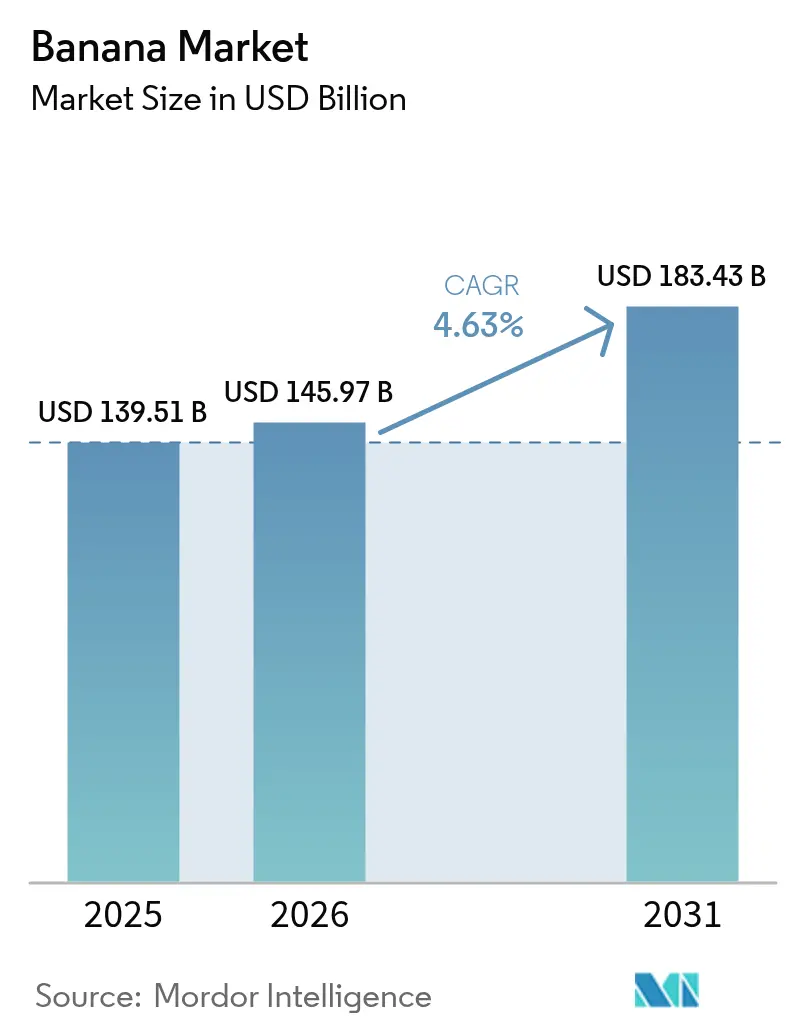
The banana market size is expected to grow from USD 139.51 billion in 2025 to USD 145.97 billion in 2026 and is forecast to reach USD 183.43 billion by 2031 at 4.63% CAGR over 2026-2031. Robust demand in health-focused consumer segments, steady growth in functional snack formats, and widening cold-chain coverage underpin this expansion, giving the banana market resilience against regional income swings. Asia-Pacific remains the largest regional contributor due to strong production bases and rising intra-regional trade, while Africa posts the fastest growth as urban buyers shift toward convenient fresh produce. Large multinationals continue to drive innovation in sustainability and logistics efficiency, and supermarket private-label programs tighten requirements for verifiable social and environmental standards. Disease management costs, volatile freight rates, and stricter pesticide regulations temper growth but do not overturn the long-term bullish outlook for the banana market as a staple food and premium snack item.
Key Report Takeaways
- By geography, Asia-Pacific led with 48.20% of the banana market share in 2025, while Africa is forecast to record a 5.63% CAGR through 2031.
Note: Market size and forecast figures in this report are generated using Mordor Intelligence’s proprietary estimation framework, updated with the latest available data and insights as of 2026.
Global Banana Market Trends and Insights
Drivers Impact Analysis*
| Driver | (~) % Impact on CAGR Forecast | Geographic Relevance | Impact Timeline |
|---|---|---|---|
| Escalating demand from health-conscious consumers | +0.8% | Global, with a concentration in North America and Europe | Medium term (2-4 years) |
| Trade liberalization in key importing nations | +0.6% | Asia-Pacific, the Middle East, and North America | Long term (≥ 4 years) |
| Rapid expansion of supermarket private labels | +0.5% | Europe, North America, and emerging Asia-Pacific markets | Medium term (2-4 years) |
| Emerging cold-chain hubs | +0.7% | Global, with emphasis on Africa and Southeast Asia | Long term (≥ 4 years) |
| Carbon-neutral banana initiatives by multinationals | +0.4% | Global, driven by regulatory requirements in Europe and North America | Long term (≥ 4 years) |
| Rise of functional banana-based snacks | +0.9% | North America, Europe, and urban Asia-Pacific centers | Short term (≤ 2 years) |
| Source: Mordor Intelligence | |||
Escalating Demand from Health-Conscious Consumers
Premium banana consumption accelerates as fitness-oriented buyers focus on the fruit’s potassium, fiber, and natural-sugar attributes. Organic and fair-trade labels command 20–30% price premiums in North America and Europe, enabling growers to recover higher farming costs while funding soil-health projects. Brand collaborations such as Givaudan and Dole’s upcycled green banana powder showcase a circular-economy approach that turns culls into ingredients for bakery and beverage lines[1]Source: Press Office, “Givaudan and Dole partner to create upcycled green banana powder,” Givaudan, givaudan.com. Retail data indicate a 15–20% uptick in purchases when bananas appear in wellness merchandising sets alongside sports drinks and protein bars. Higher margins gained from health positioning encourage exporters to upgrade quality protocols, which in turn deepen supplier–retailer partnerships in premium supermarket channels.
Trade Liberalization in Key Importing Nations
Lower tariffs and streamlined customs rules expand market access for emerging exporters. Agreements such as the Economic Partnership pacts between the European Union and Caribbean producers remove most quota barriers, giving small islands wider access to large retail chains. Parallel reforms in selected Asia-Pacific economies open high-value niches for varietals that were previously unviable due to duties. Exporters that couple duty-free access with modern ripening facilities capture early-mover advantages, yet stringent phytosanitary standards still filter out growers who lack compliance certification. Over the long term, smoother trade channels reduce landed costs, stimulate origin diversification, and reinforce the banana market as one of the most globally traded produce segments.
Rapid Expansion of Supermarket Private Labels
European and North American grocers intensify their private-label banana programs to cement shopper loyalty and lift produce margins by 15–25% over national brands. Contractual volumes give mid-tier farms predictable revenue, spurring capital upgrades in irrigation and post-harvest handling. Private-label procurement emphasizes transparency through QR-based traceability, which pressures packers to digitize inventory data and pesticide logs. Retailers leverage exclusive labels to showcase ethical sourcing, organic, fair-trade, and Rainforest Alliance, shifting competition from price to purpose. As more volume migrates into private signatures, traditional spot-market distributors may lose share, further concentrating volumes into vertically integrated pipelines governed by retail specification scorecards.
Emerging Cold-Chain Hubs
Investments in temperature-controlled infrastructure, typified by Edeka’s Hamburg center with 50 state-of-the-art ripening rooms, cut shrink and extend shelf life. New African facilities backed by public-private financing target a 50–70% reduction in post-harvest losses. In Southeast Asia, modern packhouses integrate forced-air precoolers and TarpLess ripening technology to stabilize color stages, unlocking longer transit windows. Investments in Kenya, Tanzania, and Ghana aim to cut post-harvest loss rates by more than half through solar-powered packhouses and cluster-based consolidation hubs[2]Source: United Nations Development Programme, “Horticulture Storage and Transport Infrastructure,” undp.org. Advanced hubs not only boost export volumes but also upgrade domestic retail quality, thereby spurring in-country demand for class-one bananas and supporting broader growth in the banana market.
Restraints Impact Analysis*
| Restraint | (~) % Impact on CAGR Forecast | Geographic Relevance | Impact Timeline |
|---|---|---|---|
| Incidence of Panama Disease TR4 | -1.2% | Global, with a severe impact in Southeast Asia and spreading to South America | Long term (≥ 4 years) |
| Volatile freight rates and container shortages | -0.8% | Global, particularly affecting long-distance trade routes | Short term (≤ 2 years) |
| Stricter pesticide residue regulations in Europe | -0.6% | Europe and exporters to European markets | Medium term (2-4 years) |
| Rising labor activism in South American plantations | -0.4% | South America, with spillover effects on global supply | Medium term (2-4 years) |
| Source: Mordor Intelligence | |||
Incidence of Panama Disease TR4
Tropical Race 4 poses an existential biological threat to Cavendish plantations across Asia, Australia, and, more recently, parts of North America. The pathogen remains latent in soil for decades, forcing farms to adopt quarantine trenches, disinfectant footbaths, and crop-rotation schemes. These biosecurity layers elevate unit costs and discourage greenfield expansion in high-risk zones. Breeders are trialing resistant cultivars, yet commercial roll-out remains years away, thereby holding back plantation investment and tempering growth in the banana market.
Volatile Freight Rates and Container Shortages
Spot freight quotes for refrigerated containers doubled in several key corridors during 2024 peaks, erasing thin exporter margins[3]Source: United Nations Conference on Trade and Development, “Freight rates remain elevated in first half of 2024,” unctad.org. Smallholders dependent on brokers could not hedge freight risk, triggering shipment postponements and spoilage. Although rates cooled in early 2025, forward contracts now carry surcharge clauses tied to fuel indexes, cementing higher baseline costs. Larger multinationals cushion volatility via long-term vessel charters, but ongoing uncertainty still weighs on the banana market’s profit profiles.
*Our forecasts treat driver/restraint impacts as directional, not additive. The impact forecasts reflect baseline growth, mix effects, and variable interactions.
Geography Analysis
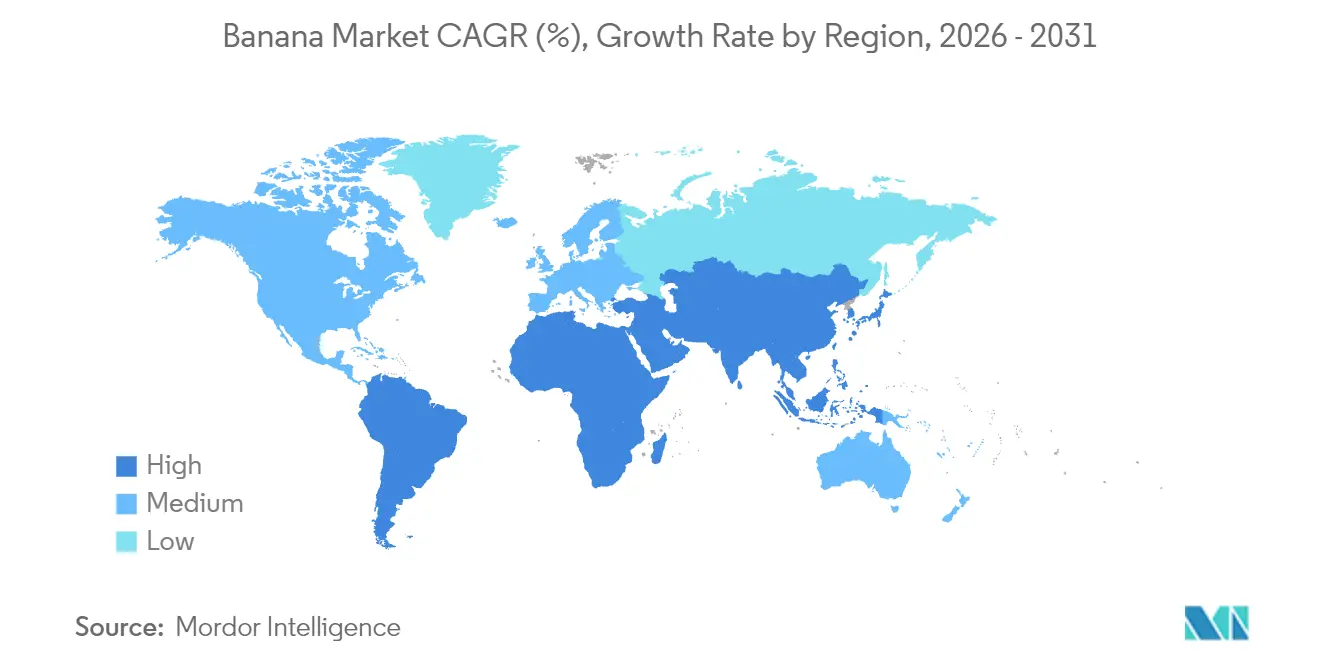
Asia-Pacific led with 48.20% of the banana market share in 2025, while Africa is forecast to record a 5.63% CAGR through 2031. Asia-Pacific retains primacy in both cultivation scale and local demand, delivering nearly half of global trade crates. While China scaled back imports, urban Indian households lifted fresh-fruit spend, and Indonesian supermarkets expanded controlled-temperature displays, muting the overall regional drag. India’s exporter INI Farms signed a direct farm-to-retail deal with LuLu Group to stock outlets across the Gulf, proving that outbound flows can coexist with robust domestic pull. Continuous growth in Vietnam’s shipments also reflects the low-land freight and tariff headroom available to regional producers, reinforcing the banana market’s strategic shift toward regional sourcing.
Africa’s growth narrative centers on untapped consumption and supply potential. Kenyan consumer-oriented food imports topped, underlining the appetite for ready-to-eat fruit. Tanzania plans to more than double horticulture output, backed by road and cold-store projects open to blended finance. Multinational retailers scout sourcing nodes in Uganda and Rwanda, encouraged by new packhouses and wider airline cargo links. These initiatives collectively sharpen Africa’s role from subsistence producer to competitive export origin, providing new depth to the banana market.
Europe and North America illustrate maturity and premiumization. Growth relies on higher-value organic, fair-trade, and functional spin-offs, not sheer volume. European Union policy updates on pesticides drive continuous agronomic innovation among South American exporters, who respond with integrated pest management and digital traceability. North American chains pilot carbon-footprint labels, giving suppliers with renewable energy credentials a clear advantage. The Middle East, led by the United Arab Emirates in banana imports, acts as a redistribution hub for North African and Gulf states. South America, despite disease and labor headwinds, leverages cost-efficient land, favorable weather, and established logistics to remain a crucial pillar of the banana market.


Regulatory Landscape
Global banana trade is shaped by importer marketing standards, pesticide maximum residue limits (MRLs), and phytosanitary controls that govern market access for fresh fruit. In the European Union, bananas fall under fruit and vegetable marketing rules referenced in Commission Delegated Regulation (EU) 2023/2429, with an Official Journal correction published on 11 June 2026 that exporters and importers monitor to keep labeling, classification, and conformity procedures aligned. Chemical compliance is reinforced through EU MRL requirements under Regulation (EC) No 396/2005 and coordinated official controls, including the multiannual pesticide-residue control program for 2027-2029 (with 2026 sampling continuing to be managed under the applicable implementing framework through 1 September 2027).
In the United States, banana imports are governed by USDA APHIS plant protection rules (7 CFR 319.56) and FDA requirements under FSMA, including the Foreign Supplier Verification Programs (FSVP) for importers. In March 2024, APHIS and CBP expanded risk-based sampling at ports of entry (RBS POE) for fresh bananas and plantains from multiple origins across Latin America and the Caribbean, increasing the operational upside for exporters that can demonstrate compliant, documented phytosanitary practices and consistent shipment performance into the US market.
Value Chain Analysis
The banana value chain runs from inputs and farm production through post-harvest handling, export logistics, ripening, and retail or foodservice marketing. Key upstream components include planting material, irrigation and soil-moisture systems, agrochemicals, and protective coverings, followed by harvesting, packhouse grading, and cartonization to meet buyer specifications and marketing standards. Exporters then depend on refrigerated logistics and global shipping networks, while destination-market ripening centers and distribution hubs manage color stage and shelf life ahead of sales through supermarkets and wholesale channels, increasingly under private-label programs that require traceability and verified social and environmental standards.
Bottlenecks concentrate in production risk (notably TR4 Fusarium wilt, confirmed across a wide set of producing countries and managed largely through biosecurity rather than eradication), and in cold-chain capacity and container availability that can disrupt long-distance flows. Coordination and bargaining power are strengthened through producer and exporter associations such as Ecuador's AEBE and Afruibana in Africa, and multi-stakeholder alignment on sustainability practices is supported by the FAO-hosted World Banana Forum. In North America, industry coordination also broadened with the October 2025 launch of the Banana Association of North America (BANA) by major importers (Chiquita, Dole, Fresh Del Monte, and Fyffes North America), reflecting value-chain efforts to address shared regulatory, production, and consumer-category challenges beyond spot-market pricing.
Market Opportunities and Future Outlook
Disease and climate resilience investments are creating whitespace for differentiated supply that reduces agronomic risk and helps retailers run year-round programs with more consistency. Company and research collaborations are moving beyond incremental farm practices toward genetic and data-led solutions: Chiquita's February 2026 collaboration with KeyGene, MusaRadix, and Wageningen University leverages the Yelloway banana pan-genome to identify markers linked to resistance against TR4 and Black Sigatoka, while research published in April 2026 reported CRISPR-based genome-edited banana lines with enhanced tolerance to Black Sigatoka and abiotic stress, and noted their non-GMO classification by Philippine authorities. Parallel initiatives, including feasibility work linking satellite connectivity, sensors, and AI monitoring across banana farms in Brazil and Ghana, point to opportunities for service providers and exporters to embed early warning, nutrition optimization, and compliance documentation into commercial supply programs.
Price volatility and buyer specifications are also shifting opportunity toward integrated sourcing, quality management, and downstream capability in ripening and distribution. Market and government signals show how quickly supply-demand imbalances translate into farmgate pressure, as illustrated by APEDA's March 2026 dashboard showing a sharp drop in Indian export-grade banana prices during a short period of domestic oversupply. In this environment, investments that connect producers to contracted demand (direct farm-to-retail models, improved ripening capacity, and digitized traceability demanded by private labels) and that diversify origin risk (including sourcing footprints across Asia-Pacific, Africa, and Latin America) support more stable participation in premium retail channels and ingredient applications such as upcycled green banana powder used in bakery and beverage formulations.
Recent Industry Developments
- June 2026: Chiquita Brands International announced completion of the Yelloway banana pan-genome through its Yelloway B.V. joint venture with KeyGene. The milestone strengthens trait discovery for disease resistance and climate resilience, supporting longer-term varietal pipelines aimed at reducing TR4 and Black Sigatoka risk across commercial supply programs.
- March 2026: Fresh Del Monte Produce Inc. completed the acquisition of select assets from Del Monte Foods Corporation II Inc. for USD 285 million following a court-supervised sale under Section 363 of the US Bankruptcy Code. The deal expands Fresh Del Monte's asset base and can enhance scale efficiencies across sourcing, processing, and distribution activities linked to fresh produce categories, including bananas.
- November 2024: Edeka opened its Fruchtkontor Nord distribution hub in Hamburg, a USD 65.4 million facility with 50 banana-ripening rooms and capacity to handle over 240,000 pallets annually of imported tropical fruits. The added ripening and cold-chain capability supports tighter quality control and higher throughput for banana imports into Germany and nearby European markets.


Research Methodology Framework and Report Scope
Market Definition and Coverage
This market covers bananas sold for food use, valued in USD, across the full set of producing and consuming regions. The sizing approach aligns supply, consumption, and trade movements, and we cross-check the results against observed price trends to keep the totals realistic.
Scope exclusions: We exclude banana-derived processed products (such as chips, puree, flour, and powders), and we do not count downstream retail margins beyond the tracked selling prices.
Segmentation Overview
- By Geography
- North America
- United States
- Canada
- South America
- Ecuador
- Colombia
- Brazil
- Europe
- Germany
- Netherlands
- Russia
- Asia-Pacific
- India
- China
- Indonesia
- Philippines
- Middle East
- Saudi Arabia
- United Arab Emirates
- Africa
- Egypt
- Kenya
- North America
Data Sources, Market Sizing, and Validation
Desk Research
Desk research was used to set the factual base for production, consumption, and trade flows before assumptions were built into the model. We relied on public agriculture and trade statistics such as FAOSTAT, UN Comtrade, USDA market and trade reports, and country agriculture ministries that publish crop and price updates. For validation, we also referenced sources such as World Bank macro indicators and port or customs releases where trade timing and seasonality were relevant.
On the commercial side, we reviewed annual reports, investor presentations, and sustainability updates from large growers, traders, and produce distributors to confirm shipment priorities and destination mixes. A paid subscription focused on shipment-level import and export records was used selectively to check routing patterns and to sanity check unit values when public data lagged. The desk research sources mentioned here are illustrative only, and many other public documents and data tables were also used for collection, validation, and clarification.
Primary Interviews and Surveys
Primary work focused on growers, exporters, importers, ripening and distribution specialists, and large produce buyers, since these groups explain real pricing, losses, and contract terms that are not visible in public series. We also spoke with logistics and cold-chain stakeholders to confirm how freight shocks and port congestion changed landed costs, then compared assumptions across APAC, EMEA, and the Americas to keep them consistent.
Distribution of primary research fieldwork respondents
| Company type | Respondent position | Region |
|---|---|---|
| Top tier: 37% | CXOs: 12% | APAC: 45% |
| Mid tier: 47% | Functional/Unit leaders: 33% | EMEA: 29% |
| Smaller Players: 16% | Managers: 55% | Americas: 26% |
Market-Sizing & Forecasting
The core model starts with a top-down build where production and trade data are reconstructed into an available supply pool by region, which is then aligned with consumption needs and typical post-harvest loss rates. Once that structure is in place, we corroborate it with selective bottom-up checks, such as sampled exporter volumes, importer channel checks, and an average price times volume approximation for key corridors, and we adjust totals only when the gap is explainable.
A few market-specific inputs are treated as required, because they move value quickly even when volumes are stable. These include production seasonality by major origin countries, export and import volumes by corridor, wholesale or border unit values, rejection and spoilage rates tied to cold-chain coverage, and currency conversion timing for large trading pairs. Where country data is missing or delayed, gap handling is done by proxying from nearby origins with similar yield and trade patterns, and by using three-year smoothing to avoid overreacting to weather-driven spikes.
For forecasting, scenario analysis is used with a short ARIMA-based projection on volume signals, while price is guided by expected supply tightness, freight conditions, and interview-based expectations for contract renegotiation cycles. Assumptions are kept transparent so a reader can trace each year's value back to the volume path and the applied price logic.
Data Validation & Update Cycle
Validation is done in layers so the final number does not rely on one dataset or one assumption. We compare outputs against independent signals like reported export totals from key origins, importer statistics from major destination markets, and observed unit value ranges, and we rework any variance that cannot be explained. When a large swing appears, analysts re-contact select interviewees to confirm whether it reflects a real price move, a trade disruption, or a reporting lag.
Before sign-off, the model and inputs are reviewed by another analyst to catch formula issues, unit mismatches, and currency timing errors. Reports are refreshed annually, and interim updates are added when material events occur, such as severe weather impacts, trade restrictions, or sustained freight shocks. Right before delivery, a final pass is completed so clients receive the latest consistent view.
Mordor Intelligence's Banana Market Size Compared With Other Published Estimates
Published banana market values can differ even when they appear to describe the same crop, because the scope boundary and the pricing point in the chain are not always the same. Differences also show up when the base year is not aligned, when exchange rates are applied at different times, or when a source mixes fresh fruit with processed banana categories.
By tracking export and import unit values alongside production volumes and updating the price and loss assumptions through recent interviews, Mordor Intelligence keeps the 2025 value tied to traded fresh bananas rather than broader banana-based foods. Some estimates lean more toward nominal wholesale price framing, while others include processed items like chips or puree, and those two choices can shift the total by tens of billions even before forecasting assumptions are applied.
Benchmark comparison
| Source | Market Size | Gaps in Research Methodology |
|---|---|---|
| Mordor Intelligence | USD 139.51 B (2025) | |
| Global Marketplace Publisher A | USD 141.97 B (2025) | The visible summary provides limited detail on price point and inclusions, and a slower growth path suggests a more conservative price progression or different treatment of trade and loss adjustments. |
| Industry Data Platform B | USD 118.20 B (2024) | This estimate is explicitly in nominal wholesale prices and framed around producer or importer value, which can understate totals versus approaches that align traded volumes with broader realized selling prices across destinations. |
The spread is mostly explained by what is counted and where pricing is taken in the chain, followed by timing differences in year selection and currency conversion. Keeping inputs anchored to observable trade volumes, unit values, and loss patterns makes the final number easier to replicate and to stress test when market conditions change.


Key Questions Answered in the Report
What is the forecast value of the banana market by 2031?
The banana market is expected to reach USD 183.43 billion by 2031.
How fast is Africa's banana consumption growing?
Africa's segment is projected to rise at a 5.63% CAGR through 2031, driven by urbanization and better cold-chain access.
Why are supermarket private labels important for banana suppliers?
Private-label programs provide long-term volume contracts, higher retail margins, and strong incentives for growers to meet strict sustainability standards.
What is Panama Disease TR4 and why does it matter?
TR4 is a soil-borne fungus that can devastate Cavendish plantations, imposing costly biosecurity measures and threatening supply continuity.
Which region currently holds the largest banana market share?
Asia-Pacific leads with 48.20% share of the banana market due to high production and consumption levels.
Page last updated on:


 Your data is secure and never sold or shared.


