
Fresh Peaches Market Size and Share
Fresh Peaches Market Analysis by Mordor Intelligence
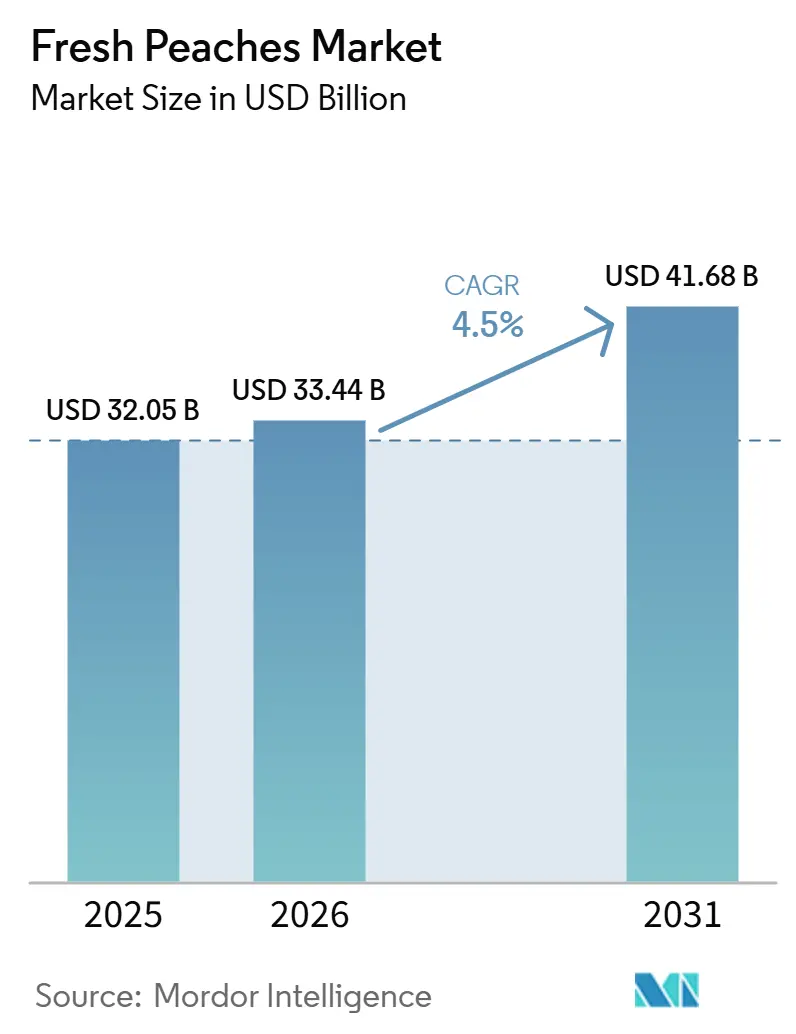
The fresh peaches market size is anticipated to increase from USD 32.05 billion in 2025 to USD 33.44 billion in 2026 and reach USD 41.68 billion by 2031, growing at a CAGR of 4.5% over 2026-2031. Freestone varieties dominate value because their easy pit removal aligns with modern snacking habits, while controlled-atmosphere logistics now allow South American exporters to maintain firmness during month-long ocean voyages. Precision farming, supported by climate-smart commodity programs, is boosting per-acre yields even as chill-hour deficits threaten traditional orchards. Online grocery platforms are accelerating their reach, with retailers racing to install temperature-controlled last-mile delivery to protect the quality of delicate fruit. Competitive intensity in the fresh peaches market is rising because vertically integrated players now combine proprietary cultivar licensing with sensor-guided harvesting to differentiate on quality rather than price.
Key Report Takeaways
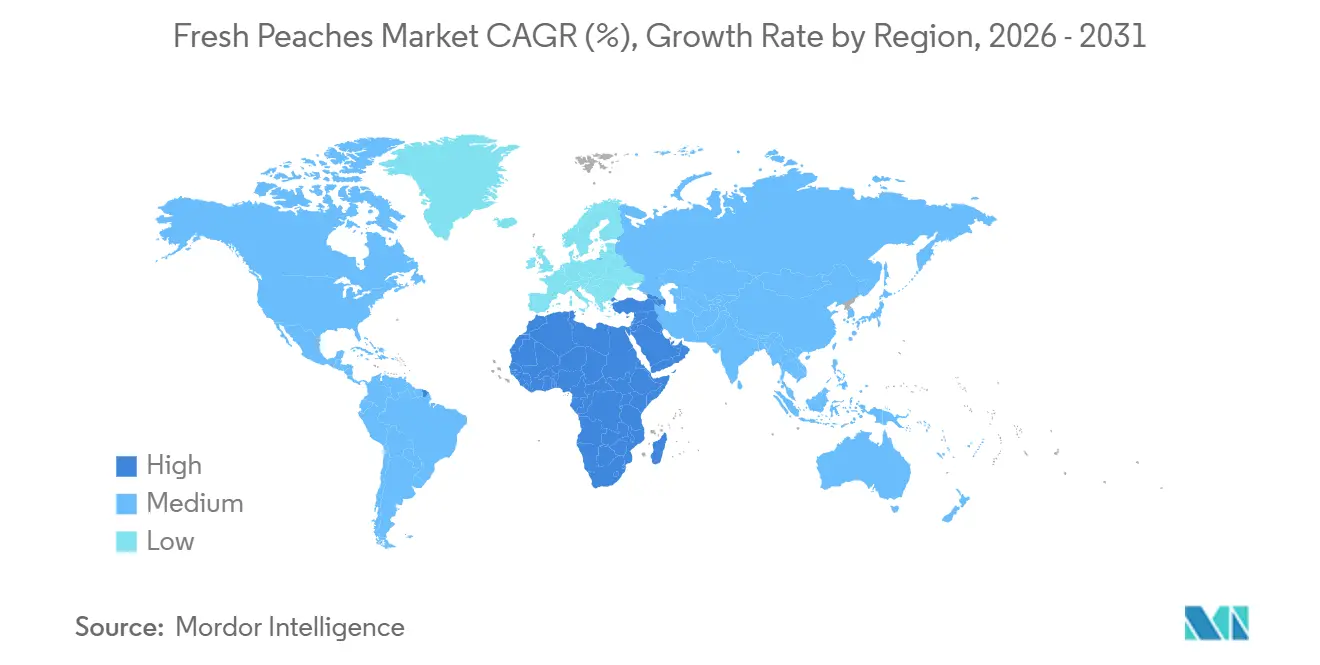
- Asia-Pacific held the largest share, accounting for 63.1% of the fresh peaches market share in 2025, while the Middle East is the fastest-growing region, expanding at a 7.7% CAGR during 2026-2031.
Note: Market size and forecast figures in this report are generated using Mordor Intelligence’s proprietary estimation framework, updated with the latest available data and insights as of January 2026.
Global Fresh Peaches Market Trends and Insights
Drivers Impact Analysis*
| Driver | (~) % Impact on CAGR Forecast | Geographic Relevance | Impact Timeline |
|---|---|---|---|
| Advanced farming automation boosting per-acre yields | +0.8% | North America, Europe, and the Asia‑Pacific orchards | Medium term (2–4 years) |
| Expansion of controlled-atmosphere shipping corridors | +0.7% | South America, Asia‑Pacific, and the Middle East hubs | Medium term (2–4 years) |
| Rising exports to high-income Asian markets | +1.0% | China, Japan, and South Korea | Short term (≤ 2 years) |
| Cultivar innovation targeting longer shelf life | +0.6% | Breeding centers in North America and Europe | Long term (≥ 4 years) |
| Growing consumer appetite for natural sugars over refined sugars | +0.5% | North America, Europe, and the Asia‑Pacific | Medium term (2–4 years) |
| Government subsidies for climate-smart horticulture | +0.4% | United States, European Union, Asia‑Pacific, and Middle East nations | Long term (≥ 4 years) |
| Source: Mordor Intelligence | |||
Advanced Farming Automation Boosting Per-Acre Yields
Robotic harvesters and mechanical thinning tools from the United States Department of Agriculture – Agricultural Research Service (USDA-ARS) can reduce orchard labor by 20% to 34%, streamlining tasks from blossom thinning to harvest in high-density orchards[1]Source: United States Department of Agriculture Agricultural Research Service, “Automated Thinning Reduces Labor Hours in Stone Fruit Orchards,” United States Department of Agriculture Agricultural Research Service, ars.usda.gov. Computer-vision robots developed at Georgia Institute of Technology match the cycle time of skilled pickers without bruising fruit. As per the United States Department of Agriculture – Agricultural Research Service (USDA-ARS), precision irrigation similarly reduces water use by 18% in California’s San Joaquin Valley, helping the fresh peaches market maintain volume during droughts. Capital costs remain high, so large growers lead adoption, yet cooperative packers increasingly offer shared robot fleets that reach mid-scale orchards. In Europe and Australia, where labor shortages are acute, rollouts are accelerating to support long-term productivity in the fresh peaches market.
Expansion of Controlled-Atmosphere Shipping Corridors
Advancements in reefer technology have strengthened Chile’s position as a top supplier of fresh peaches to China. ITC Trade Map data show that Chile exported 42,580 metric tons of fresh peaches to China in 2023, valued at USD 95.3 million, up 14% from the prior year.[2]Source: International Trade Centre, “Trade Map Database,” ITC Trade Map, trademap.org. Real-time temperature monitoring, now endorsed by the International Maritime Organization, has lowered spoilage on trans-Pacific routes by 12%. Port-side pre-cooling in Argentina and South Africa slashes the interval between harvest and loading, a critical gain for fragile white-flesh varieties. Middle East importers are now substituting costlier air freight for sealed-at-origin ocean containers, widening supply diversity. This logistics leap broadens the geographic footprint of the fresh peaches market and stabilizes year-round availability.
Rising Exports to High-Income Asian Markets
Japan is projected to import no fresh peaches in 2024/25 because of phytosanitary barriers, yet its agriculture ministry is actively promoting domestic peaches as luxury gifts across Southeast Asia. South Korea’s record USD 1.45 billion fresh-fruit import bill in 2024, driven by a 30–70 percent jump in local pear and apple prices, is projected to include a rising share of imported peaches that stabilize consumer inflation[3]Source: Korea Rural Economic Institute, “Fruit Import Trend and Outlook 2024,” Korea Rural Economic Institute, krei.re.kr. China, despite harvesting 17.6 million metric tons, continues to buy counter-seasonal and organic fruit from Chile and Australia to serve premium urban niches. United States exporters and Chilean shippers are improving cold-chain protocols, enabling consignments such as Chile’s forecast 106,400 metric tons in 2023/24 to secure high-margin shelf space in Asian supermarkets.
Cultivar Innovation Targeting Longer Shelf Life
United States Department of Agriculture's (USDA) Agricultural Research Service (ARS) research for 2024–2025 shows that stony-hard peach cultivars retain 85 to 90% of their firmness after 20 days of storage due to producing nearly zero ethylene. Retailers welcome these genetics because longer shelf-life lowers shrink and sustains display quality. Growers weigh the adoption risk because new flavor profiles need consumer acceptance, yet controlled pilots in Europe have yielded positive taste-test results. These cultivars extend shipment radius and strengthen premium tiers of the fresh peaches market.
Restraints Impact Analysis*
| Restraint | (~) % Impact on CAGR Forecast | Geographic Relevance | Impact Timeline |
|---|---|---|---|
| Climate-change-driven chill-hour deficits | -0.6% | Europe Mediterranean belt, United States Southeast, and Asia‑Pacific subtropics | Medium term (2–4 years) |
| Escalating agro-input costs are squeezing farmer margins | -0.5% | North America, Europe, and ‑import-dependent Middle East regions | Short term (≤ 2 years) |
| Increasing international pesticide-residue compliance barriers | -0.4% | Exporters to the European Union, Japan, and South Korea | Medium term (2–4 years) |
| Trade-policy volatility and tariff uncertainties | -0.3% | United States, China, Europe, and the Middle East corridors | Short term (≤ 2 years) |
| Source: Mordor Intelligence | |||
Climate-Change-Driven Chill-Hour Deficits
According to the American Society for Horticultural Science and the University of Georgia, warmer winters reduce the chill accumulation needed for bud dormancy, leading to a 15% decline in central Georgia over two decades. While California experienced gains, orchards in British Columbia's Okanagan region suffered a nearly 100% loss of peach yield in 2024 due to a sudden, extreme cold snap in January. This "weather whiplash" occurred after a brief warm spell, severely damaging the blossoms. Low-chill cultivars are under development, but sometimes trade flavor for adaptability, so uptake is cautious. Spanish researchers at the Instituto Valenciano de Investigaciones Agrarias aim to breed varieties that require fewer than 300 hours, yet new plantings take 3 to 4 years to reach commercial output. This biological risk subtracts momentum from the market for fresh peaches.
Escalating Agro-Input Costs are Squeezing Farmer Margins
According to the World Bank, Urea fertilizer prices, driven by natural gas volatility, settled at USD 350 per metric ton in 2024, down from USD 700 in 2022. According to the United States Department of Agriculture (USDA), U.S. peach farming saw a 11% rise in compensation costs, while European producers faced higher field operation costs, as tractor diesel averaged EUR 1.96 (USD 2.31) per liter in 2024-2025. These costs squeezed net returns, prompting some growers to delay replanting or reduce nutrition programs. Margin compression can slow investment in technology, hindering the competitiveness of the fresh peaches market.
*Our forecasts treat driver/restraint impacts as directional, not additive. The impact forecasts reflect baseline growth, mix effects, and variable interactions.
Geography Analysis
Asia-Pacific is the largest region, accounting for 63.1% of the fresh peaches market share in 2025. China anchored this dominance with 17.6 million metric tons of production in 2024, while Japan and South Korea tapped imports for premium white-flesh varieties when domestic orchards fell short. Consumers across the region favor organic and late-season cultivars, prompting China to import peaches despite its large crop.
The Middle East is the fastest-growing region, projected to expand at a 7.7% CAGR between 2026 and 2031, as the United Arab Emirates and Saudi Arabia upgrade cold chains to meet growing demand for premium fruit. Europe follows with steady but slower momentum, as Spain and Italy account for most regional output, yet Germany leads in imports because local production is negligible. Labor and water costs squeeze Mediterranean growers, while Greece and Poland face competitiveness gaps without widespread controlled-atmosphere storage. In North America, consistent United States demand pairs with Mexico’s counter-seasonal shipments under the United States-Mexico-Canada agreement, where Canada remains structurally import-oriented. Africa leans on Egypt, South Africa, and Morocco for growth, and South America’s Chile and Argentina serve as key counter-seasonal exporters to Asian and North American buyers.
Investment patterns now center on climate-resilient acreage, smart irrigation, and controlled-atmosphere logistics that stretch delivery windows across all producing zones. Asian breeders advance heat-tolerant cultivars, European Union incentives accelerate organic conversion, and North American orchards deploy precision robotics to offset labor shortages. Gulf importers secure multi-year supply agreements with Southern Hemisphere growers, while African and South Asian producers invest in post-harvest infrastructure to slash losses and unlock export potential. Collectively, these initiatives position every geography to broaden access to high-quality peaches and nectarines and sustain global market expansion through 2031.


Competitive Landscape
Prima Wawona capitalizes on extensive acreage in California and Washington, pairing large-scale orchards with automated packing to secure consistent shelf space in retail. Titan Produce differentiates through late-season varieties and vertically integrated orchards, extending its marketing window beyond most United States competitors. Both leaders funnel capital into harvest robotics and controlled-atmosphere storage, aiming to lower post-harvest shrink and reinforce long-term supply contracts.
Dole and Fresh Del Monte Produce use global cold-chain networks originally built for tropical fruit to place peaches in high-value Asian and European supermarkets. Pagoda Group dominates Chinese specialty retail by blending local sourcing with premium imports that meet urban consumer taste for white-flesh cultivars. Regional cooperatives in Spain, Chile, and South Africa coordinate grower-packer operations to reach export scale without ceding ownership to multinationals. These organizations invest in robust traceability systems that meet stringent residue and sustainability audits conducted by the European Union and Gulf buyers.
Looking ahead, all major players are expanding climate-resilient acreage and licensing proprietary cultivars that command retail premiums. Capital spending priorities include sensor-guided thinning, automated grading, and low-ethylene packaging that widens shipping radii. Strategic alliances between Southern Hemisphere growers and Northern Hemisphere marketers are set to tighten counter-seasonal supply chains and stabilize year-round availability. Continued technology adoption and exclusive variety branding are anticipated to reshape competitive dynamics and lift the overall value of the fresh peaches market through 2031.
Recent Industry Developments
- February 2026: Titan Farms, the largest peach grower on the East Coast, installed the LUCAi artificial intelligence module on its Spectrim grading line, enabling real-time learning that boosts classification accuracy and pack-out efficiency during peak-harvest volumes.
- November 2025: Instituto Nacional de Tecnología Agropecuaria introduced three commercial peach cultivars, Tehuelche INTA, Chamamé INTA, and Rosalinda INTA, through a partnership with growers in northern Buenos Aires, signaling Argentina’s renewed focus on color and size traits for domestic and export markets.
- September 2025: Lato Milk, a dairy manufacturer in Uganda, has introduced Peach Fruit Yogurt, combining tropical flavor with creamy texture to expand its product range. This new product contains real peach chunks, offering a refreshing, flavorful experience with every serving.


Global Fresh Peaches Market Report Scope
Peaches are sweet, juicy fruits widely consumed fresh and used in baked goods such as pies and cobblers. Rich in antioxidants and vitamin C, peaches help strengthen immunity. As an important deciduous tree fruit, peaches have thousands of cultivated varieties.
The Fresh Peaches Market Report is Segmented by Geography (North America, Europe, Asia Pacific, South America, the Middle East, and Africa). The Report Includes Production Analysis (Volume), Consumption Analysis (Value and Volume), Import Analysis (Value and Volume), Export Analysis (Value and Volume), Wholesale Price Trend Analysis, List of Key Players, and More. The Market Forecasts are Provided in Terms of Value (USD) and Volume (Metric Tons).
| North America | United States | Production Analysis (Area Harvested, Yield, and Production Volume) |
| Consumption Analysis (Consumption Value and Volume) | ||
| Import Market Analysis (Import Value, Volume, and Key Supplying Markets) | ||
| Export Market Analysis (Export Value, Volume, and Key Destination Markets) | ||
| Wholesale Price Trend Analysis and Forecast | ||
| Regulatory Framework | ||
| List of Key Players | ||
| Logistics and Infrastructure | ||
| Seasonality Analysis | ||
| Canada | Production Analysis (Area Harvested, Yield, and Production Volume) | |
| Consumption Analysis (Consumption Value and Volume) | ||
| Import Market Analysis (Import Value, Volume, and Key Supplying Markets) | ||
| Export Market Analysis (Export Value, Volume, and Key Destination Markets) | ||
| Wholesale Price Trend Analysis and Forecast | ||
| Regulatory Framework | ||
| List of Key Players | ||
| Logistics and Infrastructure | ||
| Seasonality Analysis | ||
| Mexico | Production Analysis (Area Harvested, Yield, and Production Volume) | |
| Consumption Analysis (Consumption Value and Volume) | ||
| Import Market Analysis (Import Value, Volume, and Key Supplying Markets) | ||
| Export Market Analysis (Export Value, Volume, and Key Destination Markets) | ||
| Wholesale Price Trend Analysis and Forecast | ||
| Regulatory Framework | ||
| List of Key Players | ||
| Logistics and Infrastructure | ||
| Seasonality Analysis | ||
| Europe | Germany | Production Analysis (Area Harvested, Yield, and Production Volume) |
| Consumption Analysis (Consumption Value and Volume) | ||
| Import Market Analysis (Import Value, Volume, and Key Supplying Markets) | ||
| Export Market Analysis (Export Value, Volume, and Key Destination Markets) | ||
| Wholesale Price Trend Analysis and Forecast | ||
| Regulatory Framework | ||
| List of Key Players | ||
| Logistics and Infrastructure | ||
| Seasonality Analysis | ||
| Italy | Production Analysis (Area Harvested, Yield, and Production Volume) | |
| Consumption Analysis (Consumption Value and Volume) | ||
| Import Market Analysis (Import Value, Volume, and Key Supplying Markets) | ||
| Export Market Analysis (Export Value, Volume, and Key Destination Markets) | ||
| Wholesale Price Trend Analysis and Forecast | ||
| Regulatory Framework | ||
| List of Key Players | ||
| Logistics and Infrastructure | ||
| Seasonality Analysis | ||
| France | Production Analysis (Area Harvested, Yield, and Production Volume) | |
| Consumption Analysis (Consumption Value and Volume) | ||
| Import Market Analysis (Import Value, Volume, and Key Supplying Markets) | ||
| Export Market Analysis (Export Value, Volume, and Key Destination Markets) | ||
| Wholesale Price Trend Analysis and Forecast | ||
| Regulatory Framework | ||
| List of Key Players | ||
| Logistics and Infrastructure | ||
| Seasonality Analysis | ||
| Spain | Production Analysis (Area Harvested, Yield, and Production Volume) | |
| Consumption Analysis (Consumption Value and Volume) | ||
| Import Market Analysis (Import Value, Volume, and Key Supplying Markets) | ||
| Export Market Analysis (Export Value, Volume, and Key Destination Markets) | ||
| Wholesale Price Trend Analysis and Forecast | ||
| Regulatory Framework | ||
| List of Key Players | ||
| Logistics and Infrastructure | ||
| Seasonality Analysis | ||
| Poland | Production Analysis (Area Harvested, Yield, and Production Volume) | |
| Consumption Analysis (Consumption Value and Volume) | ||
| Import Market Analysis (Import Value, Volume, and Key Supplying Markets) | ||
| Export Market Analysis (Export Value, Volume, and Key Destination Markets) | ||
| Wholesale Price Trend Analysis and Forecast | ||
| Regulatory Framework | ||
| List of Key Players | ||
| Logistics and Infrastructure | ||
| Seasonality Analysis | ||
| Russia | Production Analysis (Area Harvested, Yield, and Production Volume) | |
| Consumption Analysis (Consumption Value and Volume) | ||
| Import Market Analysis (Import Value, Volume, and Key Supplying Markets) | ||
| Export Market Analysis (Export Value, Volume, and Key Destination Markets) | ||
| Wholesale Price Trend Analysis and Forecast | ||
| Regulatory Framework | ||
| List of Key Players | ||
| Logistics and Infrastructure | ||
| Seasonality Analysis | ||
| Asia-Pacific | China | Production Analysis (Area Harvested, Yield, and Production Volume) |
| Consumption Analysis (Consumption Value and Volume) | ||
| Import Market Analysis (Import Value, Volume, and Key Supplying Markets) | ||
| Export Market Analysis (Export Value, Volume, and Key Destination Markets) | ||
| Wholesale Price Trend Analysis and Forecast | ||
| Regulatory Framework | ||
| List of Key Players | ||
| Logistics and Infrastructure | ||
| Seasonality Analysis | ||
| Japan | Production Analysis (Area Harvested, Yield, and Production Volume) | |
| Consumption Analysis (Consumption Value and Volume) | ||
| Import Market Analysis (Import Value, Volume, and Key Supplying Markets) | ||
| Export Market Analysis (Export Value, Volume, and Key Destination Markets) | ||
| Wholesale Price Trend Analysis and Forecast | ||
| Regulatory Framework | ||
| List of Key Players | ||
| Logistics and Infrastructure | ||
| Seasonality Analysis | ||
| India | Production Analysis (Area Harvested, Yield, and Production Volume) | |
| Consumption Analysis (Consumption Value and Volume) | ||
| Import Market Analysis (Import Value, Volume, and Key Supplying Markets) | ||
| Export Market Analysis (Export Value, Volume, and Key Destination Markets) | ||
| Wholesale Price Trend Analysis and Forecast | ||
| Regulatory Framework | ||
| List of Key Players | ||
| Logistics and Infrastructure | ||
| Seasonality Analysis | ||
| Australia | Production Analysis (Area Harvested, Yield, and Production Volume) | |
| Consumption Analysis (Consumption Value and Volume) | ||
| Import Market Analysis (Import Value, Volume, and Key Supplying Markets) | ||
| Export Market Analysis (Export Value, Volume, and Key Destination Markets) | ||
| Wholesale Price Trend Analysis and Forecast | ||
| Regulatory Framework | ||
| List of Key Players | ||
| Logistics and Infrastructure | ||
| Seasonality Analysis | ||
| New Zealand | Production Analysis (Area Harvested, Yield, and Production Volume) | |
| Consumption Analysis (Consumption Value and Volume) | ||
| Import Market Analysis (Import Value, Volume, and Key Supplying Markets) | ||
| Export Market Analysis (Export Value, Volume, and Key Destination Markets) | ||
| Wholesale Price Trend Analysis and Forecast | ||
| Regulatory Framework | ||
| List of Key Players | ||
| Logistics and Infrastructure | ||
| Seasonality Analysis | ||
| South America | Brazil | Production Analysis (Area Harvested, Yield, and Production Volume) |
| Consumption Analysis (Consumption Value and Volume) | ||
| Import Market Analysis (Import Value, Volume, and Key Supplying Markets) | ||
| Export Market Analysis (Export Value, Volume, and Key Destination Markets) | ||
| Wholesale Price Trend Analysis and Forecast | ||
| Regulatory Framework | ||
| List of Key Players | ||
| Logistics and Infrastructure | ||
| Seasonality Analysis | ||
| Argentina | Production Analysis (Area Harvested, Yield, and Production Volume) | |
| Consumption Analysis (Consumption Value and Volume) | ||
| Import Market Analysis (Import Value, Volume, and Key Supplying Markets) | ||
| Export Market Analysis (Export Value, Volume, and Key Destination Markets) | ||
| Wholesale Price Trend Analysis and Forecast | ||
| Regulatory Framework | ||
| List of Key Players | ||
| Logistics and Infrastructure | ||
| Seasonality Analysis | ||
| Chile | Production Analysis (Area Harvested, Yield, and Production Volume) | |
| Consumption Analysis (Consumption Value and Volume) | ||
| Import Market Analysis (Import Value, Volume, and Key Supplying Markets) | ||
| Export Market Analysis (Export Value, Volume, and Key Destination Markets) | ||
| Wholesale Price Trend Analysis and Forecast | ||
| Regulatory Framework | ||
| List of Key Players | ||
| Logistics and Infrastructure | ||
| Seasonality Analysis | ||
| Peru | Production Analysis (Area Harvested, Yield, and Production Volume) | |
| Consumption Analysis (Consumption Value and Volume) | ||
| Import Market Analysis (Import Value, Volume, and Key Supplying Markets) | ||
| Export Market Analysis (Export Value, Volume, and Key Destination Markets) | ||
| Wholesale Price Trend Analysis and Forecast | ||
| Regulatory Framework | ||
| List of Key Players | ||
| Logistics and Infrastructure | ||
| Seasonality Analysis | ||
| Middle East | Turkey | Production Analysis (Area Harvested, Yield, and Production Volume) |
| Consumption Analysis (Consumption Value and Volume) | ||
| Import Market Analysis (Import Value, Volume, and Key Supplying Markets) | ||
| Export Market Analysis (Export Value, Volume, and Key Destination Markets) | ||
| Wholesale Price Trend Analysis and Forecast | ||
| Regulatory Framework | ||
| List of Key Players | ||
| Logistics and Infrastructure | ||
| Seasonality Analysis | ||
| Iran | Production Analysis (Area Harvested, Yield, and Production Volume) | |
| Consumption Analysis (Consumption Value and Volume) | ||
| Import Market Analysis (Import Value, Volume, and Key Supplying Markets) | ||
| Export Market Analysis (Export Value, Volume, and Key Destination Markets) | ||
| Wholesale Price Trend Analysis and Forecast | ||
| Regulatory Framework | ||
| List of Key Players | ||
| Logistics and Infrastructure | ||
| Seasonality Analysis | ||
| Saudi Arabia | Production Analysis (Area Harvested, Yield, and Production Volume) | |
| Consumption Analysis (Consumption Value and Volume) | ||
| Import Market Analysis (Import Value, Volume, and Key Supplying Markets) | ||
| Export Market Analysis (Export Value, Volume, and Key Destination Markets) | ||
| Wholesale Price Trend Analysis and Forecast | ||
| Regulatory Framework | ||
| List of Key Players | ||
| Logistics and Infrastructure | ||
| Seasonality Analysis | ||
| Africa | South Africa | Production Analysis (Area Harvested, Yield, and Production Volume) |
| Consumption Analysis (Consumption Value and Volume) | ||
| Import Market Analysis (Import Value, Volume, and Key Supplying Markets) | ||
| Export Market Analysis (Export Value, Volume, and Key Destination Markets) | ||
| Wholesale Price Trend Analysis and Forecast | ||
| Regulatory Framework | ||
| List of Key Players | ||
| Logistics and Infrastructure | ||
| Seasonality Analysis | ||
| Egypt | Production Analysis (Area Harvested, Yield, and Production Volume) | |
| Consumption Analysis (Consumption Value and Volume) | ||
| Import Market Analysis (Import Value, Volume, and Key Supplying Markets) | ||
| Export Market Analysis (Export Value, Volume, and Key Destination Markets) | ||
| Wholesale Price Trend Analysis and Forecast | ||
| Regulatory Framework | ||
| List of Key Players | ||
| Logistics and Infrastructure | ||
| Seasonality Analysis | ||
| Morocco | Production Analysis (Area Harvested, Yield, and Production Volume) | |
| Consumption Analysis (Consumption Value and Volume) | ||
| Import Market Analysis (Import Value, Volume, and Key Supplying Markets) | ||
| Export Market Analysis (Export Value, Volume, and Key Destination Markets) | ||
| Wholesale Price Trend Analysis and Forecast | ||
| Regulatory Framework | ||
| List of Key Players | ||
| Logistics and Infrastructure | ||
| Seasonality Analysis | ||
| By Geography | North America | United States | Production Analysis (Area Harvested, Yield, and Production Volume) |
| Consumption Analysis (Consumption Value and Volume) | |||
| Import Market Analysis (Import Value, Volume, and Key Supplying Markets) | |||
| Export Market Analysis (Export Value, Volume, and Key Destination Markets) | |||
| Wholesale Price Trend Analysis and Forecast | |||
| Regulatory Framework | |||
| List of Key Players | |||
| Logistics and Infrastructure | |||
| Seasonality Analysis | |||
| Canada | Production Analysis (Area Harvested, Yield, and Production Volume) | ||
| Consumption Analysis (Consumption Value and Volume) | |||
| Import Market Analysis (Import Value, Volume, and Key Supplying Markets) | |||
| Export Market Analysis (Export Value, Volume, and Key Destination Markets) | |||
| Wholesale Price Trend Analysis and Forecast | |||
| Regulatory Framework | |||
| List of Key Players | |||
| Logistics and Infrastructure | |||
| Seasonality Analysis | |||
| Mexico | Production Analysis (Area Harvested, Yield, and Production Volume) | ||
| Consumption Analysis (Consumption Value and Volume) | |||
| Import Market Analysis (Import Value, Volume, and Key Supplying Markets) | |||
| Export Market Analysis (Export Value, Volume, and Key Destination Markets) | |||
| Wholesale Price Trend Analysis and Forecast | |||
| Regulatory Framework | |||
| List of Key Players | |||
| Logistics and Infrastructure | |||
| Seasonality Analysis | |||
| Europe | Germany | Production Analysis (Area Harvested, Yield, and Production Volume) | |
| Consumption Analysis (Consumption Value and Volume) | |||
| Import Market Analysis (Import Value, Volume, and Key Supplying Markets) | |||
| Export Market Analysis (Export Value, Volume, and Key Destination Markets) | |||
| Wholesale Price Trend Analysis and Forecast | |||
| Regulatory Framework | |||
| List of Key Players | |||
| Logistics and Infrastructure | |||
| Seasonality Analysis | |||
| Italy | Production Analysis (Area Harvested, Yield, and Production Volume) | ||
| Consumption Analysis (Consumption Value and Volume) | |||
| Import Market Analysis (Import Value, Volume, and Key Supplying Markets) | |||
| Export Market Analysis (Export Value, Volume, and Key Destination Markets) | |||
| Wholesale Price Trend Analysis and Forecast | |||
| Regulatory Framework | |||
| List of Key Players | |||
| Logistics and Infrastructure | |||
| Seasonality Analysis | |||
| France | Production Analysis (Area Harvested, Yield, and Production Volume) | ||
| Consumption Analysis (Consumption Value and Volume) | |||
| Import Market Analysis (Import Value, Volume, and Key Supplying Markets) | |||
| Export Market Analysis (Export Value, Volume, and Key Destination Markets) | |||
| Wholesale Price Trend Analysis and Forecast | |||
| Regulatory Framework | |||
| List of Key Players | |||
| Logistics and Infrastructure | |||
| Seasonality Analysis | |||
| Spain | Production Analysis (Area Harvested, Yield, and Production Volume) | ||
| Consumption Analysis (Consumption Value and Volume) | |||
| Import Market Analysis (Import Value, Volume, and Key Supplying Markets) | |||
| Export Market Analysis (Export Value, Volume, and Key Destination Markets) | |||
| Wholesale Price Trend Analysis and Forecast | |||
| Regulatory Framework | |||
| List of Key Players | |||
| Logistics and Infrastructure | |||
| Seasonality Analysis | |||
| Poland | Production Analysis (Area Harvested, Yield, and Production Volume) | ||
| Consumption Analysis (Consumption Value and Volume) | |||
| Import Market Analysis (Import Value, Volume, and Key Supplying Markets) | |||
| Export Market Analysis (Export Value, Volume, and Key Destination Markets) | |||
| Wholesale Price Trend Analysis and Forecast | |||
| Regulatory Framework | |||
| List of Key Players | |||
| Logistics and Infrastructure | |||
| Seasonality Analysis | |||
| Russia | Production Analysis (Area Harvested, Yield, and Production Volume) | ||
| Consumption Analysis (Consumption Value and Volume) | |||
| Import Market Analysis (Import Value, Volume, and Key Supplying Markets) | |||
| Export Market Analysis (Export Value, Volume, and Key Destination Markets) | |||
| Wholesale Price Trend Analysis and Forecast | |||
| Regulatory Framework | |||
| List of Key Players | |||
| Logistics and Infrastructure | |||
| Seasonality Analysis | |||
| Asia-Pacific | China | Production Analysis (Area Harvested, Yield, and Production Volume) | |
| Consumption Analysis (Consumption Value and Volume) | |||
| Import Market Analysis (Import Value, Volume, and Key Supplying Markets) | |||
| Export Market Analysis (Export Value, Volume, and Key Destination Markets) | |||
| Wholesale Price Trend Analysis and Forecast | |||
| Regulatory Framework | |||
| List of Key Players | |||
| Logistics and Infrastructure | |||
| Seasonality Analysis | |||
| Japan | Production Analysis (Area Harvested, Yield, and Production Volume) | ||
| Consumption Analysis (Consumption Value and Volume) | |||
| Import Market Analysis (Import Value, Volume, and Key Supplying Markets) | |||
| Export Market Analysis (Export Value, Volume, and Key Destination Markets) | |||
| Wholesale Price Trend Analysis and Forecast | |||
| Regulatory Framework | |||
| List of Key Players | |||
| Logistics and Infrastructure | |||
| Seasonality Analysis | |||
| India | Production Analysis (Area Harvested, Yield, and Production Volume) | ||
| Consumption Analysis (Consumption Value and Volume) | |||
| Import Market Analysis (Import Value, Volume, and Key Supplying Markets) | |||
| Export Market Analysis (Export Value, Volume, and Key Destination Markets) | |||
| Wholesale Price Trend Analysis and Forecast | |||
| Regulatory Framework | |||
| List of Key Players | |||
| Logistics and Infrastructure | |||
| Seasonality Analysis | |||
| Australia | Production Analysis (Area Harvested, Yield, and Production Volume) | ||
| Consumption Analysis (Consumption Value and Volume) | |||
| Import Market Analysis (Import Value, Volume, and Key Supplying Markets) | |||
| Export Market Analysis (Export Value, Volume, and Key Destination Markets) | |||
| Wholesale Price Trend Analysis and Forecast | |||
| Regulatory Framework | |||
| List of Key Players | |||
| Logistics and Infrastructure | |||
| Seasonality Analysis | |||
| New Zealand | Production Analysis (Area Harvested, Yield, and Production Volume) | ||
| Consumption Analysis (Consumption Value and Volume) | |||
| Import Market Analysis (Import Value, Volume, and Key Supplying Markets) | |||
| Export Market Analysis (Export Value, Volume, and Key Destination Markets) | |||
| Wholesale Price Trend Analysis and Forecast | |||
| Regulatory Framework | |||
| List of Key Players | |||
| Logistics and Infrastructure | |||
| Seasonality Analysis | |||
| South America | Brazil | Production Analysis (Area Harvested, Yield, and Production Volume) | |
| Consumption Analysis (Consumption Value and Volume) | |||
| Import Market Analysis (Import Value, Volume, and Key Supplying Markets) | |||
| Export Market Analysis (Export Value, Volume, and Key Destination Markets) | |||
| Wholesale Price Trend Analysis and Forecast | |||
| Regulatory Framework | |||
| List of Key Players | |||
| Logistics and Infrastructure | |||
| Seasonality Analysis | |||
| Argentina | Production Analysis (Area Harvested, Yield, and Production Volume) | ||
| Consumption Analysis (Consumption Value and Volume) | |||
| Import Market Analysis (Import Value, Volume, and Key Supplying Markets) | |||
| Export Market Analysis (Export Value, Volume, and Key Destination Markets) | |||
| Wholesale Price Trend Analysis and Forecast | |||
| Regulatory Framework | |||
| List of Key Players | |||
| Logistics and Infrastructure | |||
| Seasonality Analysis | |||
| Chile | Production Analysis (Area Harvested, Yield, and Production Volume) | ||
| Consumption Analysis (Consumption Value and Volume) | |||
| Import Market Analysis (Import Value, Volume, and Key Supplying Markets) | |||
| Export Market Analysis (Export Value, Volume, and Key Destination Markets) | |||
| Wholesale Price Trend Analysis and Forecast | |||
| Regulatory Framework | |||
| List of Key Players | |||
| Logistics and Infrastructure | |||
| Seasonality Analysis | |||
| Peru | Production Analysis (Area Harvested, Yield, and Production Volume) | ||
| Consumption Analysis (Consumption Value and Volume) | |||
| Import Market Analysis (Import Value, Volume, and Key Supplying Markets) | |||
| Export Market Analysis (Export Value, Volume, and Key Destination Markets) | |||
| Wholesale Price Trend Analysis and Forecast | |||
| Regulatory Framework | |||
| List of Key Players | |||
| Logistics and Infrastructure | |||
| Seasonality Analysis | |||
| Middle East | Turkey | Production Analysis (Area Harvested, Yield, and Production Volume) | |
| Consumption Analysis (Consumption Value and Volume) | |||
| Import Market Analysis (Import Value, Volume, and Key Supplying Markets) | |||
| Export Market Analysis (Export Value, Volume, and Key Destination Markets) | |||
| Wholesale Price Trend Analysis and Forecast | |||
| Regulatory Framework | |||
| List of Key Players | |||
| Logistics and Infrastructure | |||
| Seasonality Analysis | |||
| Iran | Production Analysis (Area Harvested, Yield, and Production Volume) | ||
| Consumption Analysis (Consumption Value and Volume) | |||
| Import Market Analysis (Import Value, Volume, and Key Supplying Markets) | |||
| Export Market Analysis (Export Value, Volume, and Key Destination Markets) | |||
| Wholesale Price Trend Analysis and Forecast | |||
| Regulatory Framework | |||
| List of Key Players | |||
| Logistics and Infrastructure | |||
| Seasonality Analysis | |||
| Saudi Arabia | Production Analysis (Area Harvested, Yield, and Production Volume) | ||
| Consumption Analysis (Consumption Value and Volume) | |||
| Import Market Analysis (Import Value, Volume, and Key Supplying Markets) | |||
| Export Market Analysis (Export Value, Volume, and Key Destination Markets) | |||
| Wholesale Price Trend Analysis and Forecast | |||
| Regulatory Framework | |||
| List of Key Players | |||
| Logistics and Infrastructure | |||
| Seasonality Analysis | |||
| Africa | South Africa | Production Analysis (Area Harvested, Yield, and Production Volume) | |
| Consumption Analysis (Consumption Value and Volume) | |||
| Import Market Analysis (Import Value, Volume, and Key Supplying Markets) | |||
| Export Market Analysis (Export Value, Volume, and Key Destination Markets) | |||
| Wholesale Price Trend Analysis and Forecast | |||
| Regulatory Framework | |||
| List of Key Players | |||
| Logistics and Infrastructure | |||
| Seasonality Analysis | |||
| Egypt | Production Analysis (Area Harvested, Yield, and Production Volume) | ||
| Consumption Analysis (Consumption Value and Volume) | |||
| Import Market Analysis (Import Value, Volume, and Key Supplying Markets) | |||
| Export Market Analysis (Export Value, Volume, and Key Destination Markets) | |||
| Wholesale Price Trend Analysis and Forecast | |||
| Regulatory Framework | |||
| List of Key Players | |||
| Logistics and Infrastructure | |||
| Seasonality Analysis | |||
| Morocco | Production Analysis (Area Harvested, Yield, and Production Volume) | ||
| Consumption Analysis (Consumption Value and Volume) | |||
| Import Market Analysis (Import Value, Volume, and Key Supplying Markets) | |||
| Export Market Analysis (Export Value, Volume, and Key Destination Markets) | |||
| Wholesale Price Trend Analysis and Forecast | |||
| Regulatory Framework | |||
| List of Key Players | |||
| Logistics and Infrastructure | |||
| Seasonality Analysis | |||


Key Questions Answered in the Report
How large is the fresh peaches market anticipated to be by 2031?
The fresh peaches market size is projected to reach USD 41.68 billion by 2031.
What is the forecast CAGR for fresh peach sales from 2026 to 2031?
Sales are anticipated to grow at a 4.5% CAGR during 2026-2031.
Which region is the fastest grower for peach consumption?
The Middle East has the fastest pace, with a 7.7% CAGR, owing to rising premium fruit imports in the United Arab Emirates and Saudi Arabia.
What restraint poses the greatest biological risk to peach growers?
Climate-driven chill-hour deficits reduce proper bud dormancy and can cut yields, subtracting 0.6 percentage points from the baseline CAGR.
Page last updated on:


 Your data is secure and never sold or shared.


