
Kiwi Fruit Market Analysis by Mordor Intelligence
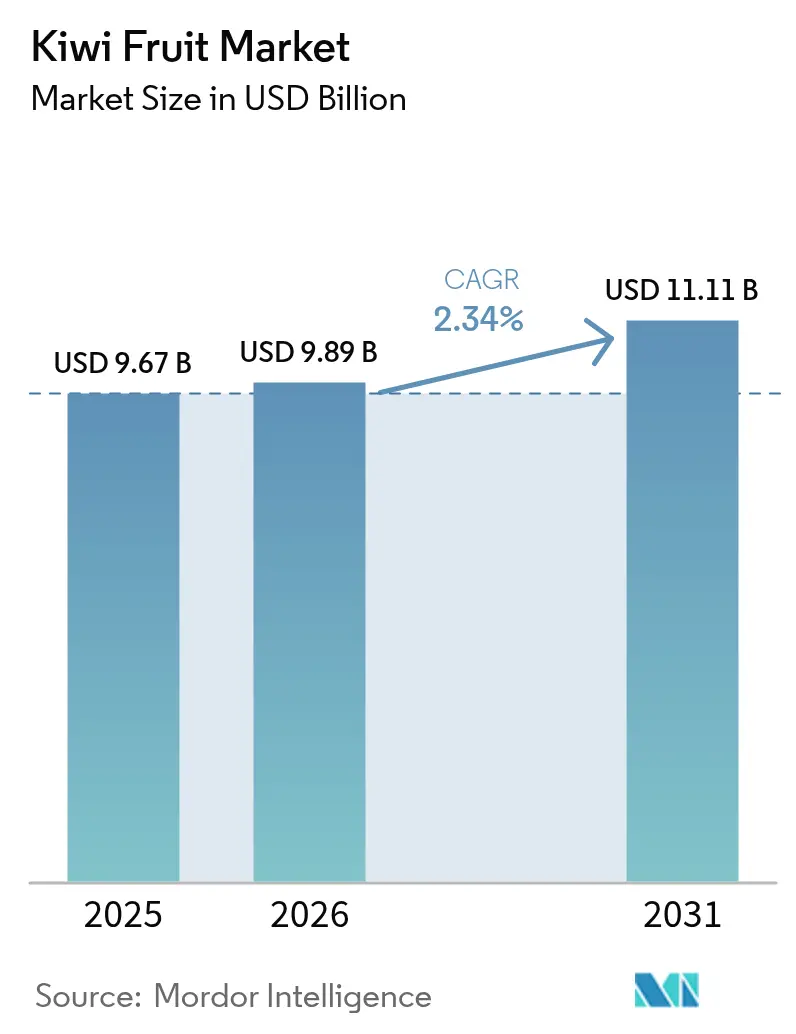
The kiwi market size was valued at USD 9.67 billion in 2025 and estimated to grow from USD 9.89 billion in 2026 to reach USD 11.11 billion by 2031, at a CAGR of 2.34% during the forecast period (2026-2031). Rising demand for vitamin-C-rich produce, steady orchard expansion in Chile and South Africa, and broader use of controlled-atmosphere containers that hold quality for six-week voyages are accelerating growth across the kiwi fruit market. Asia-Pacific drives consumption, driven by lower tariffs in India and Vietnam in 2025. New Zealand dominates export value at 46.8% by leveraging exclusive marketing rights and premium, yellow-fleshed cultivars that command a 25% price premium over green fruit. Market concentration sits at a moderate for the top five players, giving leaders pricing power yet still leaving room for regional cooperatives focused on organic and fair-trade channels.
Key Report Takeaways
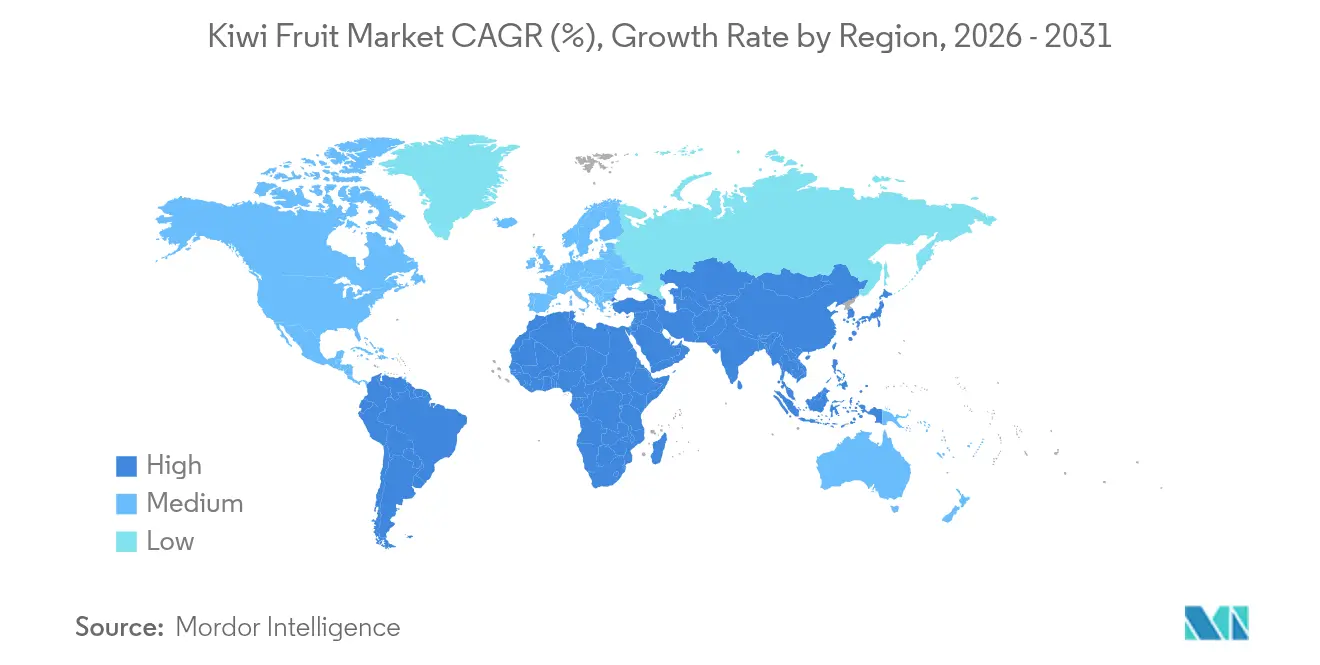
- By geography, Asia-Pacific commanded a 59.0% share of the kiwi fruit market size in 2025, and Asia-Pacific is tracking an 8.5% CAGR through 2031.
Note: Market size and forecast figures in this report are generated using Mordor Intelligence’s proprietary estimation framework, updated with the latest available data and insights as of 2026.
Global Kiwi Fruit Market Trends and Insights
Drivers Impact Analysis*
| Driver | (~) % Impact on CAGR Forecast | Geographic Relevance | Impact Timeline |
|---|---|---|---|
| Expanding demand for immunity-boosting produce | +1.2% | Global, with peak intensity in Asia-Pacific urban centers and North America's health-conscious segments | Medium term (2-4 years) |
| Commercial orchard acreage rise in Southern Hemisphere | +1.0% | South America (Chile, Argentina), Africa (South Africa, Kenya), and spill-over to Oceania | Long term (≥ 4 years) |
| High-density trellising and rootstock breakthroughs | +0.9% | Global, early adoption in New Zealand, Italy, and Chile | Medium term (2-4 years) |
| Controlled-atmosphere maritime logistics extend shelf-life | +0.8% | Global trade corridors, particularly the Southern Hemisphere to Asia-Pacific and Europe routes | Short term (≤ 2 years) |
| Rapid growth of premium yellow-fleshed cultivars in Asia-Pacific | +1.3% | Asia-Pacific core (China, Korea, Japan), spill-over to the Middle East | Medium term (2-4 years) |
| Blockchain-enabled provenance premiums in Europe | +0.7% | European Union, with pilot adoption in North America and select Asia-Pacific markets | Long term (≥ 4 years) |
| Source: Mordor Intelligence | |||
Expanding Demand for Immunity-Boosting Produce
Post-pandemic consumer preferences have shifted significantly toward nutrient-rich fresh produce, with kiwifruit gaining prominence due to clinical evidence demonstrating its high vitamin C content. In 2024, research indicates that consuming two SunGold kiwis daily provides 322 milligrams of vitamin C, surpassing the recommended daily intake by 300% and offering superior immune support compared to citrus fruits[1]Source: Plant and Food Research, “High-Density Plantation Results,” plantandfood.com. This vitamin C positioning has also opened opportunities in institutional channels, with hospitals in Japan and Singapore integrating kiwifruit into patient meal plans, contributing an additional 2,400 metric tons of demand annually by 2025. The market's premium depends on maintaining consistent supply quality. Any disruptions caused by Pseudomonas syringae pv. actinidiae (PSA) in key production regions such as New Zealand or Italy could undermine consumer confidence and shift demand toward fortified juice alternatives. Regulatory impact on this driver remains limited, as vitamin C content claims are governed by general food-labeling regulations rather than stringent health-claim approvals. This regulatory environment provides marketers with flexibility in crafting messaging across different jurisdictions.
Commercial Orchard Acreage Rise in Southern Hemisphere
Chile increased kiwifruit plantings, focusing on the Maule and O'Higgins regions. These areas benefit from Mediterranean microclimates and access to Andean snowmelt irrigation, supporting yields of 28 metric tons per hectare 15% higher than the global average. South African growers are targeting the Middle Eastern market, leveraging zero-tariff access under the Southern African Customs Union agreement, which provides a 12% landed-cost advantage compared to New Zealand fruit. Kenya also entered the kiwifruit market in 2024, planting 400 hectares in the Rift Valley. The focus is on supplying East African urban centers and reducing reliance on imports. Kenyan yields remain 30% below Chilean levels due to limited extension services. The counter-seasonal supply advantage is further enhanced by controlled-atmosphere shipping, allowing Chilean exporters to secure premium pricing in European supermarkets during the June to August window, a period when New Zealand is unable to supply fresh kiwifruit.
High-Density Trellising and Rootstock Breakthroughs
The adoption of high-density planting systems, which reduce vine spacing from 5 meters to 3 meters and standardize trellis heights at 1.8 meters, has resulted in a 30% increase in per-hectare yields, as observed in New Zealand trials conducted by Plant and Food Research between 2022 and 2024. These systems also advanced harvest timing by 8 days due to enhanced sunlight interception. Furthermore, the implementation of these systems has shown improved disease management by reducing humidity levels within the canopy.The technology remains capital-intensive, with establishment costs amounting to USD 42,000 per hectare for trellis infrastructure and grafted vines. This cost barrier continues to hinder adoption among smallholders in Turkey and Iran, despite government extension programs designed to promote the technology.
Controlled-Atmosphere Maritime Logistics Extend Shelf-Life
Controlled-atmosphere shipping containers, which regulate oxygen levels at 2% and carbon dioxide at 5% while maintaining temperatures at minus 0.5 degrees Celsius, extend the shelf-life of kiwifruit from 28 days to 42 days. This enables New Zealand exporters to access Middle Eastern and Southeast Asian markets using slower, cost-effective ocean shipping instead of air freight. The technology also reduces post-harvest losses. Trials conducted by the University of Bologna in 2024 showed that controlled-atmosphere storage reduced firmness loss by 35% and maintained soluble solids above 14 degrees Brix for 6 weeks, compared to 4 weeks under standard refrigeration. Additionally, the International Maritime Organization's 2024 guidelines on refrigerated container energy efficiency, which require a 15% reduction in power consumption by 2027, have prompted equipment manufacturers to develop hybrid cooling systems. These systems reduce operating costs by USD 180 per container per voyage.
Restraints Impact Analysis*
| Restraint | (~) % Impact on CAGR Forecast | Geographic Relevance | Impact Timeline |
|---|---|---|---|
| Pseudomonas syringae pv. actinidiae (PSA) canker recurrence | -0.9% | Europe (Italy, Greece), Asia-Pacific (China, New Zealand), and spill-over to South America | Medium term (2-4 years) |
| Post-harvest perishability in emerging cold-chain gaps | -0.7% | Africa, Southeast Asia, Middle East, with an acute impact on last-mile distribution | Short term (≤ 2 years) |
| Volatile seasonal farm-labor availability | -0.8% | New Zealand, North America (United States, Canada), Europe (Italy, Greece) | Short term (≤ 2 years) |
| Sudden bio-security driven import embargoes | -0.5% | Global, with an acute impact on New Zealand, Australia, and the European Union import flows | Short term (≤ 2 years) |
| Source: Mordor Intelligence | |||
Pseudomonas Syringae Pv. Actinidiae Canker Recurrence
Pseudomonas syringae pv. Actinidiae bacterial canker first caused significant damage and re-emerged in localized outbreaks across Greece and Italy in 2024. These outbreaks reduced orchard yields by 40-60% and, in severe cases, required the removal of vines. The pathogen's persistence is attributed to its ability to overwinter in dormant buds and spread through wind-driven rain, pruning tools, and pollinating insects, making eradication nearly impossible once it becomes established. New Zealand implemented measures such as mandatory orchard inspections and initiated a NZD 6.8 million (USD 4.1 million) research program in 2024. This program aims to develop copper-tolerant bacterial strains and biocontrol agents, though commercial availability is projected to be 3 to 5 years away. The economic impact of the canker extends beyond direct yield losses, as orchards require 2 to 3 years to return to full production after replanting. During this period, growers face negative cash flow and increased debt-service burdens, leading 8 to 12% of affected operators to exit the market.
Post-Harvest Perishability in Emerging Cold-Chain Gaps
Post-harvest losses in emerging markets surpass 12% of kiwifruit volume due to temperature abuse during last-mile distribution. Vietnam and Kenya reported the highest spoilage rates in 2024 at 15% and 18%, respectively[2]Source: Food and Agriculture Organization, “Crops and Livestock Products,” fao.org. These losses are primarily concentrated in the final distribution stage, where small retailers lack refrigerated storage and display fruit at ambient temperatures ranging from 28 to 32 degrees Celsius. This accelerates firmness loss and triggers ethylene-induced ripening, reducing shelf life from 14 days to just 4. India's kiwifruit imports, which increased by 24% to 43,270 metric tons in 2024 following the New Zealand free-trade agreement, face similar challenges. According to the National Horticulture Board, 11% of imported kiwifruit spoils before reaching consumers due to insufficient cold-storage capacity in tier-two and tier-three cities. This perishability constraint also limits market development, as retailers are reluctant to expand kiwifruit assortments when spoilage risks erode profit margins. This dynamic restricts consumption growth in price-sensitive segments, where green Hayward kiwifruit competes with lower-cost local alternatives such as bananas and papayas.
*Our forecasts treat driver/restraint impacts as directional, not additive. The impact forecasts reflect baseline growth, mix effects, and variable interactions.
Geography Analysis
Asia-Pacific is projected to dominate the kiwi market with a 59.0% share in 2025, driven by China's production of 2.4 million metric tons and an increasing focus on health among the middle class. The region's compound annual growth rate (CAGR) of 8.5% through 2031 reflects trends in urbanization and rising disposable incomes, particularly in secondary Chinese cities where health-conscious middle-class consumers are increasingly adopting kiwi fruit. New Zealand continues to lead in high-value kiwi exports, accounting for 40% of global trade. Japan remains a key market for premium golden kiwi varieties, while India's evolving consumption patterns indicate significant long-term growth potential as cold chain infrastructure improves.
Europe has become New Zealand's largest kiwi fruit market following the implementation of the European Union- New Zealand Free Trade Agreement in May 2024. The elimination of tariffs has enhanced price competitiveness, allowing Europe to surpass China as a key export destination. The Netherlands serves as the primary entry point for exotic fruits, including kiwi, leveraging established logistics networks to distribute them across the continent. Consumer preference studies in Italy, Spain, France, and Germany highlight a growing interest in premium red-pulp kiwi varieties, signaling readiness for innovation beyond traditional green and gold offerings. Additionally, the region's focus on sustainability and organic certification offers opportunities for producers that can meet stringent environmental standards while maintaining competitive pricing.
North America represents a mature yet evolving market for kiwi fruit. Canada and Mexico complement the region, with Mexico's participation in the North American Free Trade Agreement (NAFTA) facilitating kiwi distribution across the continent. The regional focus on premium varieties and organic certification aligns with consumer willingness to pay higher prices for quality and health benefits. South America's kiwi market is growing, led by Chile's export CAGR of 9.2%. Chile has capitalized on counter-seasonal supply windows from May to August, serving European and North American markets during New Zealand's off-season. This strategy has secured price premiums of 18% to 25% and generated USD 420 million in export revenue in 2025, according to ITC Trade Map data[3]Source: ITC Trade Map, “International Kiwi Fruit Exports,” trademap.org.


Regulatory Landscape
International kiwi fruit trade is shaped by plant-health compliance and border-control regimes. In the European Union, kiwifruit imports from non-EU countries generally require a phytosanitary certificate under the EU plant health framework (Regulation (EU) 2019/2072), and the European Commission periodically sets the frequency of identity and physical checks at border control posts. Implementing Regulation (EU) 2026/1101 (adopted 22 May 2026) updated the check-frequency rates for Actinidia (kiwifruit) consignments, which can affect clearance timelines for exporters and importers.
Tariff and import-duty administration also influences landed costs and trading behavior. Fresh kiwifruit is traded under HS code 08105000, and the EU updated operational rules for standard import values and additional import duties via Regulation (EU) 2025/2185. This shifted the establishment of import values to a weekly basis (from daily) and clarified conditions for applying additional duties. In the United States, market access for specific kiwifruit types and origins is managed through USDA APHIS processes, including pest risk analysis and Federal Register notices, while commodity authorization and requirements are tracked through APHIS import-requirements systems. As a result, pest-mitigation documentation and variety-specific approvals remain central to trade readiness.
Value Chain Analysis
The kiwifruit value chain starts with cultivar selection, nursery propagation, orchard establishment (trellising, irrigation, and plant protection), and on-farm management through harvest. Post-harvest handling is a key value-creation step, including packing, grading, pre-cooling, and controlled-atmosphere (CA) storage and transport to preserve firmness and soluble solids over long ocean voyages. Export-oriented supply chains are anchored by New Zealand, while China is the largest producer by volume with a strong domestic orientation. Italy and Greece remain important suppliers into European and nearby markets.
Marketing, export logistics, and channel access drive differentiation and pricing, especially for premium varieties. Zespri's model illustrates downstream coordination, with its Zespri Global Supply (ZGS) network using offshore production in countries such as Italy, Greece, France, Japan, and South Korea to support a 12-month supply strategy and maintain brand presence outside the New Zealand season. Cold-chain capacity and last-mile temperature control remain major bottlenecks in several emerging markets, where spoilage risks constrain retail expansion and increase the importance of importer-managed refrigeration, distribution partners, and port-to-DC logistics performance.
Competitive Landscape
Kiwi producers form the foundation of the global market, primarily located in countries such as China, Italy, New Zealand, Chile, Greece, and Iran. Their key responsibilities include cultivation, quality improvement, and supply stability. Producers adopt advanced varieties, implement improved orchard management practices, and use sustainable farming methods to enhance yields and fruit quality. Many producers invest in branding initiatives, such as premium varieties like gold kiwi, obtain certifications such as organic and GlobalG.A.P., and establish long-term contracts with exporters and retailers. By focusing on productivity and product differentiation through quality and branding, producers strengthen their competitive position in the global kiwi market.
Stakeholders maintain their position in the global kiwi market through a combination of quality differentiation, branding, technological innovation, and market diversification. Producers focus on premium varieties and sustainable practices, exporters develop strong global brands and logistics networks, importers ensure supply stability and responsiveness to market needs, and retailers influence consumer demand through marketing and distribution strategies. Collectively, these approaches enable stakeholders to strengthen their competitive advantage and sustain growth in the global kiwi fruit market.
Technology significantly improves productivity, quality, and supply chain efficiency in the kiwi market. Producers use precision agriculture, drip irrigation, climate monitoring, and advanced breeding techniques to improve yields and fruit quality. Post-harvest technologies, including controlled atmosphere storage, cold-chain logistics, and smart packaging, extend shelf life and minimize losses. Exporters and importers increasingly adopt digital platforms, blockchain-based traceability, and data analytics to enhance transparency and logistics efficiency. These technological advancements enable stakeholders to reduce costs, improve quality, and respond effectively to market demands.
Market Opportunities and Future Outlook
Premium varietal mix expansion and season-extension programs continue to open whitespace in branded retail channels, particularly where consumers trade up from green to yellow and toward emerging red-pulp offerings. New Zealand's export-oriented structure and Zespri's global supply model provide an operational template for maintaining shelf presence across seasons, while association and government programs add momentum on productivity and quality. In that context, New Zealand kiwifruit exports reached 915,261 tonnes in 2024/2025 (21% year-on-year increase), which highlights the scale available for downstream innovation in packing, storage, and category management.
Cold-chain buildout and post-harvest modernization are direct opportunities in import-dependent and fast-growing consumption markets where spoilage and quality variability limit penetration. India serves as a visible proof point on infrastructure-led category development, with policy-linked demand catalysts (including tariff changes referenced in the report context) alongside state-led programs that target integrated post-harvest systems and cold storage for horticulture supply chains. On-farm and packhouse automation also represent an opportunity linked to labor constraints, supported by applied R&D such as modular agritech decision-support frameworks validated for kiwifruit harvesting and labor planning, which helps growers and packers standardize operations across expanding orchard footprints.
Recent Industry Developments
- June 2026: Zespri partnered with the New Zealand Government on a five-year program aimed at lifting orchard productivity and improving sustainability outcomes across the kiwifruit sector. The initiative signals coordinated investment in on-orchard practices and system-level efficiency as export volumes expand, supporting consistent quality specifications for long-distance markets.
- December 2025: Zespri approved commercialization of the Red80 variety to extend the selling season for Zespri RubyRed Kiwifruit, following a step-up in RubyRed volumes and multi-market sales traction. Moving a red-fleshed cultivar toward broader commercialization strengthens premiumization and variety-led differentiation in retail programs.
- May 2024: Dunkin introduced the Kiwi Watermelon Dunkin Refresher, adding kiwi flavor to a mass-market, limited-time beverage platform. The launch broadened consumer exposure to kiwi as an ingredient and reinforced cross-category demand pull beyond fresh fruit purchases.


Research Methodology Framework and Report Scope
Market Definition and Coverage
For this methodology, the kiwi fruit market is defined as the value generated from kiwi fruit consumed in a country or region, expressed in USD, and supported by production and trade flows that move fruit into end markets.
Scope exclusions: we exclude downstream value add like retail markups, packaged fruit snacks, juices, and supplements where kiwi is only an ingredient.
Segmentation Overview
- By Geography
- North America
- United States
- Production Analysis (Area Harvested, Yield, and Production Volume)
- Consumption Analysis (Consumption Value and Volume)
- Import Market Analysis (Import Value, Volume, and Key Supplying Markets)
- Export Market Analysis (Export Value, Volume, and Key Destination Markets)
- Wholesale Price Trend Analysis and Forecast
- Regulatory Framework
- List of Key Players
- Logistics and Infrastructure
- Seasonality Analysis
- Canada
- Production Analysis (Area Harvested, Yield, and Production Volume)
- Consumption Analysis (Consumption Value and Volume)
- Import Market Analysis (Import Value, Volume, and Key Supplying Markets)
- Export Market Analysis (Export Value, Volume, and Key Destination Markets)
- Wholesale Price Trend Analysis and Forecast
- Regulatory Framework
- List of Key Players
- Logistics and Infrastructure
- Seasonality Analysis
- Mexico
- Production Analysis (Area Harvested, Yield, and Production Volume)
- Consumption Analysis (Consumption Value and Volume)
- Import Market Analysis (Import Value, Volume, and Key Supplying Markets)
- Export Market Analysis (Export Value, Volume, and Key Destination Markets)
- Wholesale Price Trend Analysis and Forecast
- Regulatory Framework
- List of Key Players
- Logistics and Infrastructure
- Seasonality Analysis
- United States
- Europe
- France
- Production Analysis (Area Harvested, Yield, and Production Volume)
- Consumption Analysis (Consumption Value and Volume)
- Import Market Analysis (Import Value, Volume, and Key Supplying Markets)
- Export Market Analysis (Export Value, Volume, and Key Destination Markets)
- Wholesale Price Trend Analysis and Forecast
- Regulatory Framework
- List of Key Players
- Logistics and Infrastructure
- Seasonality Analysis
- Germany
- Production Analysis (Area Harvested, Yield, and Production Volume)
- Consumption Analysis (Consumption Value and Volume)
- Import Market Analysis (Import Value, Volume, and Key Supplying Markets)
- Export Market Analysis (Export Value, Volume, and Key Destination Markets)
- Wholesale Price Trend Analysis and Forecast
- Regulatory Framework
- List of Key Players
- Logistics and Infrastructure
- Seasonality Analysis
- Italy
- Production Analysis (Area Harvested, Yield, and Production Volume)
- Consumption Analysis (Consumption Value and Volume)
- Import Market Analysis (Import Value, Volume, and Key Supplying Markets)
- Export Market Analysis (Export Value, Volume, and Key Destination Markets)
- Wholesale Price Trend Analysis and Forecast
- Regulatory Framework
- List of Key Players
- Logistics and Infrastructure
- Seasonality Analysis
- United Kingdom
- Production Analysis (Area Harvested, Yield, and Production Volume)
- Consumption Analysis (Consumption Value and Volume)
- Import Market Analysis (Import Value, Volume, and Key Supplying Markets)
- Export Market Analysis (Export Value, Volume, and Key Destination Markets)
- Wholesale Price Trend Analysis and Forecast
- Regulatory Framework
- List of Key Players
- Logistics and Infrastructure
- Seasonality Analysis
- France
- Asia-Pacific
- China
- Production Analysis (Area Harvested, Yield, and Production Volume)
- Consumption Analysis (Consumption Value and Volume)
- Import Market Analysis (Import Value, Volume, and Key Supplying Markets)
- Export Market Analysis (Export Value, Volume, and Key Destination Markets)
- Wholesale Price Trend Analysis and Forecast
- Regulatory Framework
- List of Key Players
- Logistics and Infrastructure
- Seasonality Analysis
- India
- Production Analysis (Area Harvested, Yield, and Production Volume)
- Consumption Analysis (Consumption Value and Volume)
- Import Market Analysis (Import Value, Volume, and Key Supplying Markets)
- Export Market Analysis (Export Value, Volume, and Key Destination Markets)
- Wholesale Price Trend Analysis and Forecast
- Regulatory Framework
- List of Key Players
- Logistic and Infrastructure
- Seasonality Analysis
- Japan
- Production Analysis (Area Harvested, Yield, and Production Volume)
- Consumption Analysis (Consumption Value and Volume)
- Import Market Analysis (Import Value, Volume, and Key Supplying Markets)
- Export Market Analysis (Export Value, Volume, and Key Destination Markets)
- Wholesale Price Trend Analysis and Forecast
- Regulatory Framework
- List of Key Players
- Logistics and Infrastructure
- Seasonality Analysis
- Bangladesh
- Production Analysis (Area Harvested, Yield, and Production Volume)
- Consumption Analysis (Consumption Value and Volume)
- Import Market Analysis (Import Value, Volume, and Key Supplying Markets)
- Export Market Analysis (Export Value, Volume, and Key Destination Markets)
- Wholesale Price Trend Analysis and Forecast
- Regulatory Framework
- List of Key Players
- Logistics and Infrastructure
- Seasonality Analysis
- Australia
- Production Analysis (Area Harvested, Yield, and Production Volume)
- Consumption Analysis (Consumption Value and Volume)
- Import Market Analysis (Import Value, Volume, and Key Supplying Markets)
- Export Market Analysis (Export Value, Volume, and Key Destination Markets)
- Wholesale Price Trend Analysis and Forecast
- Regulatory Framework
- List of Key Players
- Logistics and Infrastructure
- Seasonality Analysis
- China
- South America
- Brazil
- Production Analysis (Area Harvested, Yield, and Production Volume)
- Consumption Analysis (Consumption Value and Volume)
- Import Market Analysis (Import Value, Volume, and Key Supplying Markets)
- Export Market Analysis (Export Value, Volume, and Key Destination Markets)
- Wholesale Price Trend Analysis and Forecast
- Regulatory Framework
- List of Key Players
- Logistics and Infrastructure
- Seasonality Analysis
- Argentina
- Production Analysis (Area Harvested, Yield, and Production Volume)
- Consumption Analysis (Consumption Value and Volume)
- Import Market Analysis (Import Value, Volume, and Key Supplying Markets)
- Export Market Analysis (Export Value, Volume, and Key Destination Markets)
- Wholesale Price Trend Analysis and Forecast
- Regulatory Framework
- List of Key Players
- Logistics and Infrastructure
- Seasonality Analysis
- Chile
- Production Analysis (Area Harvested, Yield, and Production Volume)
- Consumption Analysis (Consumption Value and Volume)
- Import Market Analysis (Import Value, Volume, and Key Supplying Markets)
- Export Market Analysis (Export Value, Volume, and Key Destination Markets)
- Wholesale Price Trend Analysis and Forecast
- Regulatory Framework
- List of Key Players
- Logistics and Infrastructure
- Seasonality Analysis
- Brazil
- Middle East
- Saudi Arabia
- Production Analysis (Area Harvested, Yield, and Production Volume)
- Consumption Analysis (Consumption Value and Volume)
- Import Market Analysis (Import Value, Volume, and Key Supplying Markets)
- Export Market Analysis (Export Value, Volume, and Key Destination Markets)
- Wholesale Price Trend Analysis and Forecast
- Regulatory Framework
- List of Key Players
- Logistics and Infrastructure
- Seasonality Analysis
- Turkey
- Production Analysis (Area Harvested, Yield, and Production Volume)
- Consumption Analysis (Consumption Value and Volume)
- Import Market Analysis (Import Value, Volume, and Key Supplying Markets)
- Export Market Analysis (Export Value, Volume, and Key Destination Markets)
- Wholesale Price Trend Analysis and Forecast
- Regulatory Framework
- List of Key Players
- Logistics and Infrastructure
- Seasonality Analysis
- Saudi Arabia
- Africa
- South Africa
- Production Analysis (Area Harvested, Yield, and Production Volume)
- Consumption Analysis (Consumption Value and Volume)
- Import Market Analysis (Import Value, Volume, and Key Supplying Markets)
- Export Market Analysis (Export Value, Volume, and Key Destination Markets)
- Wholesale Price Trend Analysis and Forecast
- Regulatory Framework
- List of Key Players
- Logistics and Infrastructure
- Seasonality Analysis
- Kenya
- Production Analysis (Area Harvested, Yield, and Production Volume)
- Consumption Analysis (Consumption Value and Volume)
- Import Market Analysis (Import Value, Volume, and Key Supplying Markets)
- Export Market Analysis (Export Value, Volume, and Key Destination Markets)
- Wholesale Price Trend Analysis and Forecast
- Regulatory Framework
- List of Key Players
- Logistics and Infrastructure
- Seasonality Analysis
- Egypt
- Production Analysis (Area Harvested, Yield, and Production Volume)
- Consumption Analysis (Consumption Value and Volume)
- Import Market Analysis (Import Value, Volume, and Key Supplying Markets)
- Export Market Analysis (Export Value, Volume, and Key Destination Markets)
- Wholesale Price Trend Analysis and Forecast
- Regulatory Framework
- List of Key Players
- Logistics and Infrastructure
- Seasonality Analysis
- South Africa
- North America
Data Sources, Market Sizing, and Validation
Desk Research
Desk research starts with building a clean fact base for production, traded volumes, and indicative price signals that can be compared across countries. We mainly rely on public agriculture and customs series, including FAOSTAT for crop production, UN Comtrade for import and export values and quantities, and national agriculture ministries for orchard area and yield updates.
To keep the model realistic, we also review reference material such as USDA market and trade outlook notes, Eurostat trade statistics for the EU, and trade association publications that cover kiwifruit shipment patterns and seasonality. Company annual reports and investor presentations are used to understand shipping windows, variety mix, and the share of fruit sold through contracts versus spot markets. Where needed, we use a paid subscription for shipment level trade checks and patent databases to validate packaging and storage developments that can affect loss rates and marketable volumes. The sources listed here are illustrative only, and other public and paid references are used for cross-checks and clarification.
Primary Interviews and Surveys
Primary work is used to test the desk assumptions that most often move market value, especially season-level price swings and the split between domestic sales and exports. We speak with growers, exporter groups, importers, wholesale market participants, and retail category managers across major producing and consuming regions so gaps in grades, shrink, and contract pricing can be covered with practical ranges.
Distribution of primary research fieldwork respondents
| Company type | Respondent position | Region |
|---|---|---|
| Top tier: 34% | CXOs: 14% | APAC: 46% |
| Mid tier: 46% | Functional/Unit leaders: 32% | EMEA: 30% |
| Smaller Players: 20% | Managers: 54% | Americas: 24% |
Market-Sizing & Forecasting
The core build uses a top-down approach where production, net trade, and country consumption pools are reconstructed, then translated into value using observed wholesale price trends. When available series arrive in different units or time windows, we normalize first and then align them to the same marketing year so totals do not get inflated.
Next, we run selective bottom-up checks, such as sampled price per kilogram multiplied by estimated marketed volumes for key importing hubs, followed by exporter shipment direction checks for major origins. If price reporting is thin, we handle gaps through proxy pricing from similar grade and supply window markets, then discount for freight intensity and typical loss during storage.
Forecasting uses scenario analysis anchored on a simple regression that relates value growth to planted area and yield trends, exportable surplus, and a price factor reflecting premium variety mix and cold chain availability. Inputs tracked in the model include harvested area, yield per hectare, import dependence for large consuming markets, the export share of New Zealand and other key origins, and wholesale price movement around peak shipping months. Assumptions are reviewed with interview feedback so the forward curve reflects realistic supply responses rather than straight-line growth.
Data Validation & Update Cycle
Validation is done in layers so the final number is not driven by one dataset. Our team checks whether implied per capita consumption, net trade balances, and price levels make sense together, and then reviews outliers such as sudden jumps in value that are not supported by volume.
When a large variance appears, we recheck unit conversions, marketing year alignment, and currency timing, then reconnect with select respondents to confirm whether the change came from pricing, crop conditions, or trade disruptions. The report is refreshed annually, with interim updates when material events occur, such as major crop shocks, trade rule changes, or a sustained move in wholesale prices. Before delivery, a final analyst pass is completed so clients receive the most current view available at that time.
Mordor Intelligence's Kiwi Fruit Market Size Versus Other Published Estimates
Published kiwi fruit market values often differ because each publisher makes their own choices on which price point to use, how to treat re-exports, and how to align the trade and production series to a given year. Differences also come from whether the estimate is closer to border prices or closer to in-country wholesale pricing, which changes value even when volumes match.
Some sources lean heavily on customs value (FOB or CIF) and treat that as market value for consuming regions. This can miss domestic production sold locally and can also count the same fruit twice when it is re-exported. In Mordor Intelligence, consumption value is tied to in-market wholesale price trends and is reconciled back to production and net trade, so re-export loops and currency timing do not artificially lift totals.
Benchmark comparison
| Source | Market Size | Gaps in Research Methodology |
|---|---|---|
| Mordor Intelligence | USD 9.67 B (2025) | |
| Trade Analytics Platform A | USD 8.20 B (2025) | Often anchored to border-price signals and customs valuation conventions, which can understate domestic production sold within producing countries and can differ by FOB versus CIF treatment. |
| Syndicated Publisher B | USD 8.03 B (2026) | Uses a different base year and may apply faster price and value growth assumptions, and the estimate can shift depending on how wholesale price series are blended with trade values. |
Looking across the table, most of the spread comes from price-point selection and how trade values are translated into end-market value, not from big disagreements on volumes. By keeping the steps traceable to production, net imports, and wholesale pricing, we can explain the total clearly and update it cleanly when new crop, trade, or price data is released.


Key Questions Answered in the Report
What is the projected value of the kiwi fruit market by 2031?
The kiwi market size was valued at USD 9.67 billion in 2025 and estimated to grow from USD 9.89 billion in 2026 to reach USD 11.11 billion by 2031, at a CAGR of 2.34% during the forecast period (2026-2031).
Why are yellow-fleshed kiwifruit varieties gaining traction?
They offer higher vitamin C levels, a sweeter taste, and social-media buzz, allowing a 25% price premium over green fruit in Asia-Pacific.
How are controlled-atmosphere containers changing long-distance trade?
They extend shelf life to 42 days, cut freight cost USD 0.32 kg on Shanghai lanes, and open slow-steam routes to the Middle East and Europe.
What major threat does PSA canker pose?
Outbreaks can slash yields up to 60% and force costly vine replacement, dampening supply for several seasons.
Page last updated on:


 Your data is secure and never sold or shared.


