
Pakistan Fruits And Vegetables Market Analysis by Mordor Intelligence
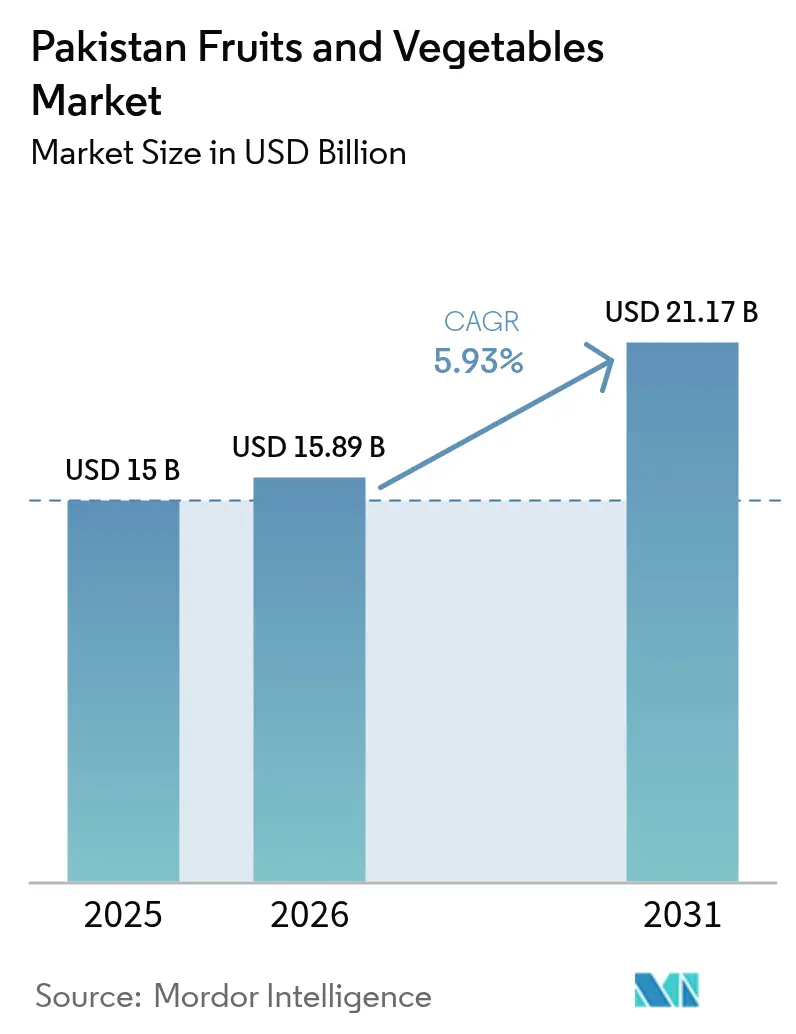
Pakistan fruit and vegetable market size in 2026 is estimated at USD 15.89 billion, growing from 2025 value of USD 15.0 billion with 2031 projections showing USD 21.17 billion, growing at 5.93% CAGR over 2026-2031. Export-diversification programs, the build-out of cold-chain assets under the China–Pakistan Economic Corridor, and deeper penetration of Gulf retail channels are the principal engines of growth. Ongoing supermarket rollouts in Karachi, Lahore, and Islamabad are widening consumer access to traceable produce, while e-grocery apps gain traction among urban millennials. Government interest-rate subsidies on horticulture loans are stimulating post-harvest investments, and AI-enabled quality-grading tools are reducing shipment rejections. At the same time, water scarcity in Balochistan, land-fragmentation in Punjab, and fruit-fly quarantines threaten to soften the pace of expansion.
Key Report Takeaways
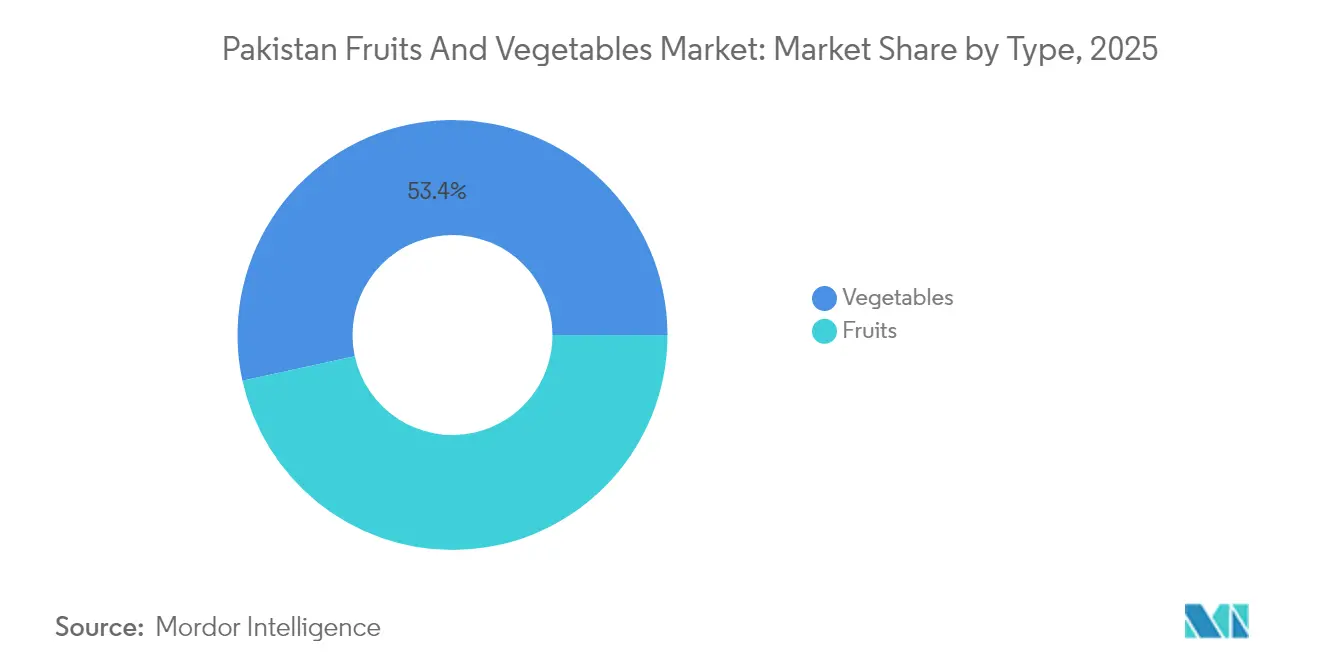
- By Type, vegetables held a 53.42% share of the Pakistan fruit and vegetable market in 2025. Fruits are poised to register an 8.05% CAGR through 2031.
Note: Market size and forecast figures in this report are generated using Mordor Intelligence’s proprietary estimation framework, updated with the latest available data and insights as of 2026.
Pakistan Fruits And Vegetables Market Trends and Insights
Drivers Impact Analysis*
| Driver | ( ~) % Impact on CAGR Forecast | Geographic Relevance | Impact Timeline |
|---|---|---|---|
| High export potential to Gulf and China | +1.2% | National, port-adjacent provinces | Medium term (2-4 years) |
| Supermarket and e-grocery expansion | +0.8% | Karachi, Lahore, Islamabad | Short term (≤ 2 years) |
| Government horticulture subsidies | +1.0% | National, notably Punjab and KPK | Medium term (2-4 years) |
| Climate-smart drip irrigation uptake | +0.7% | Punjab citrus belt, Balochistan orchards | Long term (≥ 4 years) |
| Quick-commerce contract farming growth | +0.5% | Urban peripheries | Short term (≤ 2 years) |
| Gulf impact-funded cold-storage hubs | +0.9% | Karachi-port corridor | Medium term (2-4 years) |
| Source: Mordor Intelligence | |||
High Export Potential to the Gulf and China
Pakistan's strategic positioning within the China-Pakistan Economic Corridor has fundamentally altered export logistics, with the Kashgar-Karachi rail corridor reducing transit time to 48 hours for premium citrus shipments to Chinese markets [1]. A 48-hour rail corridor from Karachi to Kashgar shortens citrus transit time to China and underpins a mango export target of 125,000 metric tons for 2025, 25% above the 2024 season. Shipments of fruit and nuts to China reached USD 15.8 million in 2024, while vegetable exports to the United Arab Emirates (UAE) neared USD 86.9 million. Although allegations of certification fraud have triggered European scrutiny, the lure of tariff parity with India in the United States market creates headroom for further gains.
Supermarket And E-Grocery Expansion
Organized retail’s share of fresh produce tripled to 9% in five years as traceability and cold-chain reliability became decisive purchase factors. E-Grocery platforms deepen farmer reach through AI-enabled crop-health dashboards that lower rejection rates and enable just-in-time replenishment. A telecom–ag-tech alliance covers 2 million acres with remote-sensing services, raising average yields by 27%. Precision farming adoption in Sindh has demonstrated 27% yield increases through IoT sensor deployment and satellite imagery analysis, creating supply chain efficiencies that benefit modern retail formats. The sector's transformation accelerates as Habib Bank Limited partners with Agrilift to digitize agricultural credit assessment, using crop performance data to optimize farmer lending limits.
Government Horticulture Subsidies
The federal budget for FY 2025-26 increases agricultural lending ceilings to PKR 2,066 billion (USD 7.4 billion) and allocates 30% of development funds to climate-aligned projects. A collateral-free micro-loan facility earmarks PKR 100,000 (approximately USD 360) per farmer, and the National Seed Development and Regulatory Authority is standardizing the distribution of certified seeds. Green-tunnel construction in Balochistan has already lengthened off-season vegetable availability. Balochistan's installation of 396 green tunnels for off-season crop production exemplifies targeted infrastructure investment that extends growing seasons and stabilizes supply chains.
Climate-Smart Drip Irrigation Uptake
Punjab's citrus belt has added 100,000 acres of drip irrigation systems since 2023, supported by 60% government subsidies that have boosted yields by 30% while reducing water consumption by 40%. Solar-powered irrigation systems demonstrate particular promise, with wheat farmers in Khyber Pakhtunkhwa experiencing 7.6% efficiency improvements when adopting photovoltaic energy solutions. Climate-smart agricultural practices adoption among 720 farmers across three provinces resulted in a 34% reduction in net farm return volatility and a 64% decrease in downside risk exposure, validating the economic benefits of precision water management. The province produces 83% of Pakistan's apples but requires immediate intervention to prevent further productivity losses from water stress [2].
Restraints Impact Analysis*
| Restraint | (~ ) % Impact on CAGR Forecast | Geographic Relevance | Impact Timeline |
|---|---|---|---|
| Post-harvest losses 30 % | -1.8% | Nationwide, rural hinterlands | Long term (≥ 4 years) |
| Fragmented landholdings | -1.2% | Punjab, and Sindh | Long term (≥ 4 years) |
| Phytosanitary rejections (fruit fly) | -0.9% | Export-oriented zones | Medium term (2-4 years) |
| Water scarcity in Balochistan orchards | -0.7% | Balochistan | Long term (≥ 4 years) |
| Source: Mordor Intelligence | |||
Post-Harvest Losses 30 %
Pakistan forfeits PKR 300 billion (USD 1.08 billion) in crop value each year to inadequate on-farm handling and sparse cold-chain coverage. Controlled-atmosphere space accounts for less than 3% of annual output, forcing distressed selling at harvest peaks. The lack of controlled-atmosphere storage facilities forces farmers to accept distressed pricing during peak harvest seasons, particularly affecting perishable crops like tomatoes and citrus fruits. Infrastructure deficiencies become pronounced during export operations, with mango shipments facing quality deterioration during the 15-day transit through alternative border crossings when primary routes experience closures. The establishment of the National Agri-Trade and Food Safety Authority in May 2025 aims to harmonize food standards across provinces, though implementation challenges with existing provincial authorities could delay effectiveness.
Fragmented Landholdings
86% of farms span under five hectares, making precision-farming kits prohibitively costly and complicating product traceability. A 52,000-acre corporate-farming concession in Sindh tests a scale-up model that shares 40% of gross revenue with the province while plowing 20% of net profit into local R&D. Cooperative farming models show promise, with rural women's cooperatives utilizing solar dehydration technology, achieving 25% revenue increases for sun-dried food production. However, land consolidation remains politically sensitive, limiting the pace of structural transformation needed for competitive agricultural modernization.
*Our forecasts treat driver/restraint impacts as directional, not additive. The impact forecasts reflect baseline growth, mix effects, and variable interactions.
Segment Analysis
By Type: Vegetables Anchor the Base, Fruits Accelerate Upside
Vegetables represented 53.42% of the Pakistan fruit and vegetable market share in 2025, supported by year-round onion, tomato, and potato rotations that stabilize grower cash flow. The vegetable share also benefits from a USD 210 million onion export surge that offset domestic price spikes. Fruits are set to outstrip vegetables at an 8.05% CAGR to 2031, driven by higher-margin mango and citrus exports, genome-garden R&D, and rising demand for processed juices.
Diversified vegetable cycles allow growers to hedge against climate volatility, whereas fruit orchards require longer capital lock-in yet deliver superior export premiums. In 2023, Hybrid seed adoption in Balochistan lifted tomato net income per acre to PKR 101,303 (USD 362). On the fruit side, AI-based sweetness meters speed kinnow grading and shrink export-rejection risk.

Geography Analysis
Punjab’s 63.35% slice of the Pakistan fruit and vegetable market size is anchored by fertile alluvial soils, a dense cold-storage grid, and fast highway links to Karachi’s reefer docks. Provincial spending of PKR 14,524 crore (USD 52.2 million) on input subsidies and power rebates keeps input costs manageable.
KPK’s 7.33% projected CAGR outpaces the national average as solar-pump adoption and micro-tunnel usage cushion growers against frost risk. The province’s proximity to the Torkham border positions it to serve Afghan and Central Asian demand once customs regimes stabilize. Balochistan’s high-value almond, grape, and apple orchards struggle with water stress, but green-tunnel projects and drip-line retrofits aim to stem output losses. Cross-provincial food-safety harmonization has accelerated since the 2025 launch of the National Agri-Trade and Food Safety Authority, though parallel provincial regulations still create compliance overlap. CPEC Phase 2.0 prioritizes rural road upgrades and a Karachi–Sukkur reefer rail spur, which could reduce post-harvest losses in remote districts by up to seven percentage points once operational.
Regulatory Landscape
Pakistan's fruits and vegetables trade is shaped by federal and provincial institutions that increasingly emphasize food safety, seed quality, and export compliance. On the export side, the Department of Plant Protection (DPP) administers plant quarantine requirements under the Pakistan Plant Quarantine Rules, 2019, including issuance of Phytosanitary Certificates, while traders use the Pakistan Single Window (PSW) portal to digitally apply for import permits and export certificates, which reduces manual documentation and clearance friction.
Recent policy actions have tightened quality gating and enabled prioritized shipments. The Seed (Amendment) Act, 2024 (assented on November 7, 2024) strengthens end-to-end oversight of the seed sector (registration, production, import/export, and internal trading) through an empowered authority, affecting varietal performance and traceability in horticulture. At the provincial level, Punjab established the Punjab Agriculture, Food and Drug Authority via the PAFDA Act 2025 to regulate and test agriculture inputs such as fertilizers and pesticides. In March 2026, a government special committee approved 40 food items including fruits and vegetables for export to Gulf markets, alongside logistics facilitation such as a 60% reduction in transport rates and permission for off-dock terminals for transshipment; in May 2026, the Ministry of Commerce extended the official start of the 2026 mango export season to June 1 under the Export Policy Order 2022 to align shipments with maturity and quality standards.
Value Chain Analysis
Pakistan's fruits and vegetables value chain is dominated by smallholders and multi-layered intermediation, moving from input suppliers (seed, fertilizer, crop protection) to dispersed farm production, aggregation through village traders and commission agents, and onward flow into wholesale markets, processors, modern retail, and export channels. Land fragmentation is a persistent constraint, with around 90% of farmers operating on less than five hectares, which limits adoption of standardized production protocols, traceability, and the economies of scale needed for consistent export-grade supply.
Post-harvest handling and logistics are the primary leakage points. Perishables face an estimated 15-40% loss range in the chain, while transport remains overwhelmingly non-refrigerated, with about 99% of goods moving in traditional trucks and only a small share using refrigerated transport. Public wholesale markets are often overcrowded and lack basic enablers such as clean water, waste disposal, and cold storage, while district-level price-setting interventions can distort incentives and planning for growers and traders. Against these bottlenecks, export-oriented upgrading is being pursued through structured programs: PHDEC approved a 3-year horticulture export plan in August 2025 targeting an increase from about USD 700 million to USD 2 billion by 2028, emphasizing kinnow, mangoes, dates, and value-added products, which increases the role of packhouses, grading, processing (pulp, concentrates, dehydration), and compliance systems across the chain.
Market Opportunities and Future Outlook
A key opportunity is shifting a larger share of output from spot-market fresh trade into compliant, export-ready, value-added flows supported by cold chain, packhouse grading, and processing. PHDEC and industry bodies have formalized this direction through time-bound export programs, including PHDEC's board-approved 3-year plan (August 2025) centered on kinnow, mangoes, dates, and value-added formats, and a PFVA-led three-year export strategy announced in December 2025 that emphasized product diversification (such as avocado, garlic, banana) alongside processed outputs (pulps, concentrates, pastes). The investable gap shows up in infrastructure indicators cited in-sector, including a limited IQF footprint (about 10 units in operation) and persistent post-harvest losses, commonly referenced as the mid-teens to around 20% in recent value-chain assessments. This combination creates room for capacity build-out across controlled storage, pre-cooling, reefer transport, and processing lines.
Export-market access and quality enforcement actions also influence where capability building is focused. In March 2026, a government special committee approved 40 food items including fruits and vegetables for export to Gulf markets, paired with logistics facilitation such as transport rate reductions and off-dock terminal use, supporting higher-throughput export corridors for standardized shipments. For mangoes, the Ministry of Commerce extended the 2026 export season start to June 1 to align exports with physiological maturity, and PHDEC launched a pilot mango bagging project in Multan in May 2026 to improve pre-harvest quality, targeting lower rejection rates and better price realization. In parallel, incentive structures cited by industry and government sources, including duty and tax relief for select inputs and machinery and availability of concessionary agriculture credit, support investment cases across seed quality, protected cultivation, dehydration, and processing that can reduce losses and broaden the portfolio beyond fresh shipments.
Recent Industry Developments
- May 2026: The Ministry of Commerce extended the official start of the 2026 mango export season to June 1 under the Export Policy Order 2022 to align shipments with physiological maturity and quality. The measure formalizes export timing discipline for a key fruit category and reinforces grading and compliance practices across exporters and packhouses.
- August 2025: Pakistan Horticulture Development and Export Company (PHDEC) approved a 3-year horticulture export plan targeting an increase in exports from about USD 700 million to USD 2 billion by 2028, focusing on kinnow, mangoes, dates, and value-added products. The plan concentrates sector efforts on post-harvest handling, processing, and market development rather than relying on spot-market fresh exports alone.
- May 2024: The Al Syed Group partnered with MG Agri Foods (Mahmood Group) to pursue a USD 15 million export initiative tied to agrifood supply and overseas market development. The collaboration highlights private-sector moves toward structured export programs that depend on better aggregation, quality control, and packaging for international channels.
Research Methodology Framework and Report Scope
Market Definition and Coverage
For this study, the Pakistan fruits and vegetables market is defined as the value generated from fresh fruits and fresh vegetables consumed domestically or traded across borders, measured in USD and supported by volume context in metric tons.
Scope exclusions: Processed formats such as frozen, canned, dried, and juice-based products are excluded from the market value in this sizing.
Segmentation Overview
- Type
- Vegetables
- Production Analysis
- Consumption Analysis
- Import Analysis
- Export Analysis
- Price Trend Analysis
- Fruits
- Production Analysis
- Consumption Analysis
- Import Analysis
- Export Analysis
- Price Trend Analysis
- Vegetables
Data Sources, Market Sizing, and Validation
Desk Research
Desk research was used to set the factual base of the model and to make sure crop and trade assumptions are realistic for Pakistan. We mainly relied on public agriculture production and area statistics, trade flows, and macro indicators that explain changes in demand and prices over time.
Typical source types included official agriculture and horticulture publications from Pakistan government departments, trade and tariff statistics published by customs and trade authorities, FAO datasets, and price bulletins from wholesale market committees and related public bodies. Supporting context was also taken from company filings and investor material of larger supply chain participants, credible press coverage on weather events and logistics disruptions, and peer reviewed papers on post-harvest losses and cold chain constraints. Where needed, paid subscriptions for shipment-level import and export data and patent databases were used to cross-check trade mixes and technology adoption signals. The desk research sources listed here are illustrative, and many other public and private references were consulted to collect, validate, and clarify data points.
Primary Interviews and Surveys
Expert interviews and short surveys with growers, wholesalers, importers, exporters, retailers, foodservice buyers, and agriculture specialists in Pakistan are used to test secondary production and price data. Respondents help clarify informal trade, post-harvest losses, and channel margins, including differences between wholesale and retail conditions. Responses are compared with the model before assumptions and final results are approved.
Distribution of primary research fieldwork respondents
| Company type | Respondent position |
|---|---|
| Top tier: 32% | CXOs: 15% |
| Mid tier: 48% | Functional/Unit leaders: 30% |
| Smaller Players: 20% | Managers: 55% |
Market-Sizing & Forecasting
Sizing starts from a top-down build where national production and trade data are reconstructed into an available fresh supply pool, which is then translated into value using observed price ranges and channel-level markups. Since the same crop can move through different routes, we apply crop-wise seasonality and loss factors before value is finalized at the market level.
To keep the totals realistic, results are then checked using selective bottom-up approximations such as sampled crop volumes multiplied by average wholesale prices, exporter shipment pricing, and channel checks on typical spreads between farmgate, wholesale, and modern retail. Key inputs used in the model include production volumes (metric tons), harvested area and yield trends, import and export values and volumes, wholesale price movements in major mandis, and cold-chain capacity signals that affect spoilage and marketed surplus. When specific crop prices or loss rates are not consistently available, gap handling is done through proxy series (nearby crop price indices and historical seasonal patterns) and then revalidated through interviews.
Forecasts are built using scenario analysis supported by trend-based smoothing on the core drivers, because weather shocks and policy moves can change short-term outcomes quickly. The forward view is anchored on expected shifts in yield, planted area, trade corridors, cold storage coverage, and retail penetration, and the final trajectory is adjusted after reconciling expert expectations with observed historical volatility.
Data Validation & Update Cycle
Validation is done in steps so the final number is consistent with real-world signals. We compare the model output against independent checks such as per-capita availability implied by supply, export intensity for key crops, and the direction of wholesale price changes during peak seasons.
Outliers are reviewed before sign-off, and the underlying assumptions are revisited when the model suggests shifts that are not supported by trade flows, production updates, or interview feedback. Reports are refreshed annually, and interim updates are triggered when material events occur, such as major weather disruptions, sudden trade restrictions, or sharp currency movements that can change USD-denominated values. Before delivery, an analyst performs a fresh pass across key inputs so clients receive the latest updated view.
Mordor Intelligence's Pakistan Fruits and Vegetables Market Size Measured Against Other Published Estimates
Published market values for Pakistan fruits and vegetables often vary because the scope and counting logic are not the same across sources, even when the title looks identical. Differences usually come from whether only fresh produce is counted, how imports and exports are treated, and which price points are used to convert volumes into USD value.
The biggest gaps typically show up when a study folds in processed formats like frozen and dried, or when it applies an aggressive price growth path without rechecking against mandi price signals and currency timing. Another recurring issue is mixing a broad horticulture definition with a narrower fruits and vegetables definition, which changes the demand pool and can push totals up or down depending on what is included.
Benchmark comparison
| Source | Market Size | Gaps in Research Methodology |
|---|---|---|
| Mordor Intelligence | USD 15.00 B (2025) | |
| Global Consultancy A | USD 8.49 B (2024) | This estimate appears to use a broader product scope that can include frozen, dried, and other processed forms, and it is reported on an earlier base year, which changes the USD value level and the price conversion point. |
| Regional Consultancy B | USD 9.10 B (2024) | The figure is presented with limited year clarity and tends to read like a demand-side value summary, where the treatment of trade flows and the price basis across farmgate versus wholesale is not fully spelled out. |
The table shows that the spread is mainly explained by what is counted as fruits and vegetables and the year and price basis used to translate volumes into USD value. By keeping the scope tied to fresh produce and reconciling production and trade volumes with observed wholesale pricing, the market size stays aligned to a measurable supply pool, a choice applied by Mordor Intelligence.
Key Questions Answered in the Report
How large is Pakistan’s fruit and vegetable market in 2026?
The sector is valued at USD 15.89 billion in 2026.
What share do vegetables hold in national produce sales?
Vegetables account for 53.42% of market revenue, supported by high-volume tomato, onion, and potato crops.
What is the main hurdle limiting export growth?
Post-harvest losses that exceed 30% nationwide erode quality and curb export-grade supply, reducing potential foreign exchange earnings.