
Venezuela Fruits and Vegetables Market Analysis by Mordor Intelligence
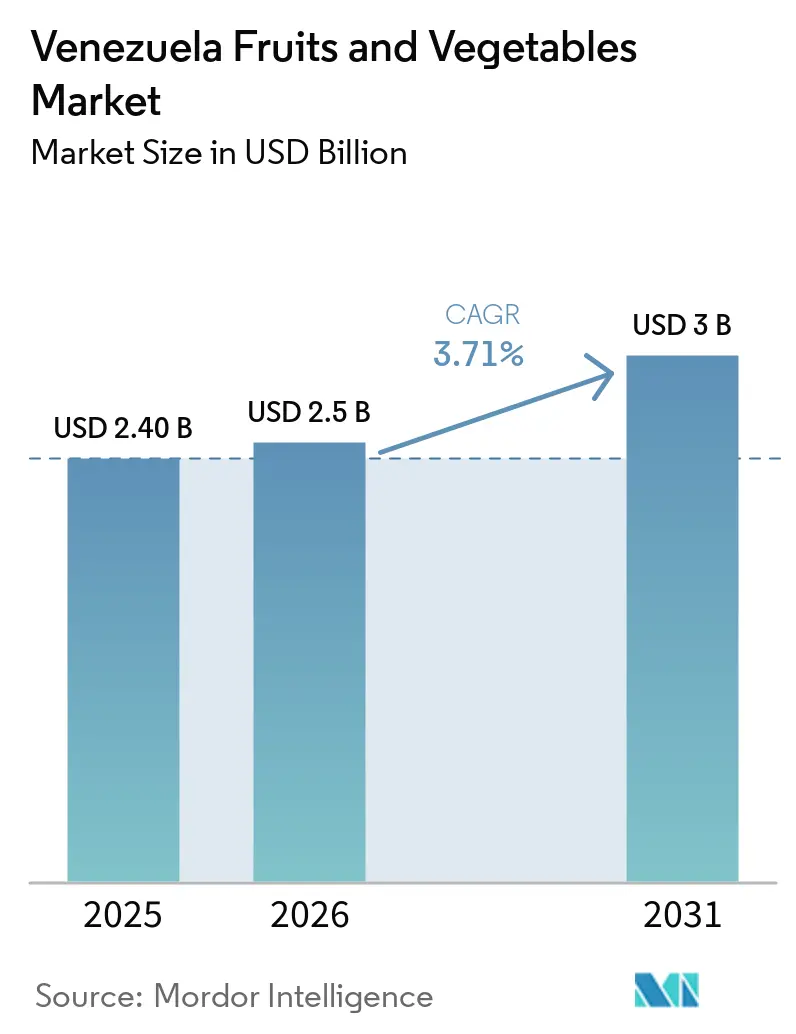
The Venezuela fruits and vegetables Market is projected to grow from USD 2.4 billion in 2025 to USD 2.5 billion in 2026 and to USD 3.0 billion by 2031, registering a CAGR of 3.71% between 2026 and 2031. The growth of Venezuela's fruits and vegetables market is supported by vegetable-centric production cycles, a dual-currency retail environment, and government-backed acreage expansions. However, persistent logistics challenges, fuel shortages, and biological threats contribute to post-harvest losses and slow the distribution of supplies to urban areas. Dollar transactions dominate fresh-produce sales in key cities, improving returns for farmers involved in modern retail or export channels. Vegetables benefit from shorter feedback loops and lower sunk costs, enabling growers to pivot varieties in response to input shortages or pest pressure, whereas fruit orchards require multi-year investments that remain vulnerable to infrastructure failures and disease outbreaks.
Key Report Takeaways
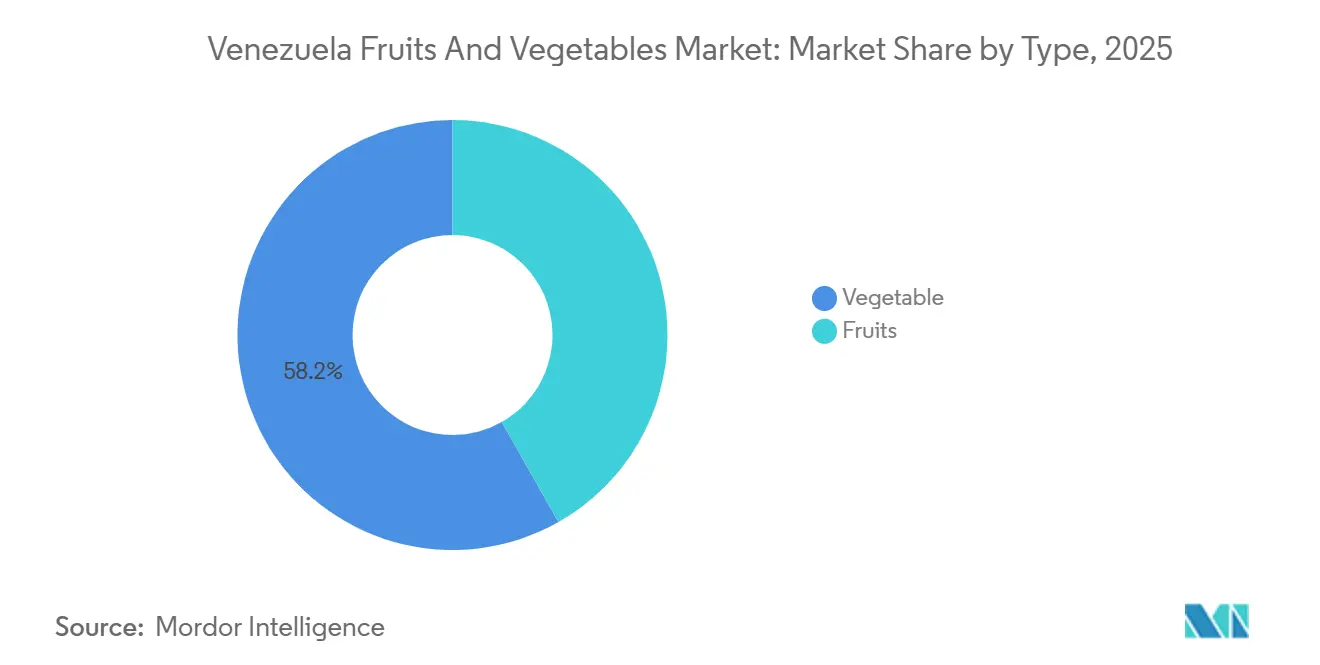
- By type, vegetables commanded the largest 58.2% of the Venezuela fruits and vegetables market share in 2025, while fruits market size is projected to grow at the fastest 6.8% CAGR from 2026 to 2031.
Note: Market size and forecast figures in this report are generated using Mordor Intelligence’s proprietary estimation framework, updated with the latest available data and insights as of January 2026.
Venezuela Fruits and Vegetables Market Trends and Insights
Drivers Impact Analysis*
| Driver | (~) % Impact on CAGR Forecast | Geographic Relevance | Impact Timeline |
|---|---|---|---|
| Government urban-farming programs | +0.8% | Capital Region, Carabobo, and Aragua | Medium term (2-4 years) |
| Expansion of irrigated vegetable acreage | +1.2% | Portuguesa, Guárico, Lara, and Aragua | Long term (≥ 4 years) |
| Rising consumer health consciousness | +0.5% | Capital Region, Zulia, and Carabobo | Short term (≤ 2 years) |
| Currency dualization boosting fruit returns | +1.0% | Táchira, Mérida, and other border states | Medium term (2-4 years) |
| WhatsApp direct-to-consumer produce trade | +0.6% | Capital Region, Valencia, and Maracaibo corridors | Short term (≤ 2 years) |
| Solar-powered peri-urban greenhouse uptake | +0.4% | Caracas, Valencia, and Barquisimeto suburbs | Long term (≥ 4 years) |
| Source: Mordor Intelligence | |||
Government Urban-Farming Programs
Government-supported food distribution and urban agriculture initiatives are impacting the fruits and vegetables market in Venezuela by bolstering localized supply chains and enhancing food accessibility. According to the World Food Programme, food assistance programs reached over 880,000 people in 2024, highlighting the extent of organized distribution efforts aimed at supporting household consumption[1]Source: World Food Programme, “Annual Country Report 2024 – Venezuela,” wfp.org. These initiatives help reduce food miles and improve community-level food security. However, urban farming and localized production account for a small portion of the national supply, limiting their overall influence on the broader fruits and vegetables market.
Expansion of Irrigated Vegetable Acreage
The expansion of irrigated vegetable acreage in Venezuela is driven by improving agro-climatic conditions and a gradual recovery in crop production, despite ongoing structural challenges. According to the Food and Agriculture Organization, abundant rainfall in 2025 ensured sufficient irrigation water availability, enhancing crop yields and supporting production growth, particularly in key agricultural regions. This improved water availability has facilitated the cultivation of vegetables and other high-value crops, increasing domestic supply and reducing import dependency, thereby aiding market growth.
Rising Consumer Health Consciousness
Increasing consumer awareness of food quality and dietary preferences is impacting Venezuela's fruit and vegetable market, particularly in urban areas. According to World Bank data, Venezuela's urban population reached 88.5% in 2024, which rounds up to roughly 89%. Projections tracking into 2026 put the country's urban density at 89.2%, solidifying its position as one of the most highly urbanized nations in South America[2]Source: World Bank, “Urban Population (% of Total Population) – Venezuela, 2024,” worldbank.org . In this high-urban-population area, organized retail channels significantly influence food purchasing patterns. This urban concentration enhances the availability and visibility of fresh produce, encouraging consumers to include fruits and vegetables in their diets despite economic challenges. Furthermore, higher-income urban households are driving demand for premium and organic produce, fostering a niche yet steady growth segment within the market.
Currency Dualization Boosting Fruit Returns
Currency dualization is significantly contributing to improved returns in Venezuela's fruits and vegetables market by promoting pricing stability and enhancing transaction efficiency. Venezuela's economy extensively utilizes the United States Dollar (USD) in daily transactions, particularly within retail and private sector activities, reflecting a persistent dual-currency system. This widespread adoption of the USD enables fruit and vegetable producers and traders to conduct transactions in more stable value terms, mitigating the risks associated with local currency volatility. Consequently, fresh produce prices are better aligned with market conditions, facilitating improved profit margins, faster trade cycles, and overall market growth.
Restraints Impact Analysis*
| Restraint | (~) % Impact on CAGR Forecast | Geographic Relevance | Impact Timeline |
|---|---|---|---|
| Poor post-harvest cold-storage capacity | −1.1% | Nationwide, acute in Táchira, Mérida, and Zulia | Medium term (2-4 years) |
| High pest and disease pressure | −0.9% | Yaracuy, Carabobo, Zulia, and Táchira | Long term (≥ 4 years) |
| Diesel shortages for refrigerated logistics | −0.7% | Nationwide and severe in remote states | Short term (≤ 2 years) |
| Restricted access to certified seed | −0.6% | All commercial growing zones | Medium term (2-4 years) |
| Source: Mordor Intelligence | |||
Poor Post-Harvest Cold-Storage Capacity
Inadequate post-harvest cold storage capacity remains a critical challenge in Venezuela fruits and vegetables market. This issue stems from inefficiencies in the storage, transportation, and distribution systems for perishable goods. Significant food losses occur during post-harvest stages, particularly in storage and transport, where cold-chain infrastructure is insufficient. Due to the highly perishable nature of fruits and vegetables, the lack of temperature-controlled logistics accelerates spoilage during handling and transit, reducing the volume of produce that reaches urban markets. Consequently, producers experience lower returns, while supply inconsistencies hinder market efficiency, restricting overall growth in the fruits and vegetables market.
High Pest and Disease Pressure
High pest and disease pressure continues to be a significant challenge in Venezuela's fruits and vegetables market, particularly affecting fruit production. According to the Food and Agriculture Organization (2026), the detection of Banana Fusarium Tropical Race 4 (TR4) in Venezuela triggered a phytosanitary emergency post 2023-2024 outbreak and has continued to date[3]Source: Food and Agriculture Organization, “Fighting the Fungus Foe of the Beloved Banana,” fao.org. This compelled farmers to destroy infected banana plantations and transition to alternative crops. The incident underscores the severe and lasting effects of plant diseases on fruit production systems, as the affected land becomes unsuitable for replanting and requires expensive recovery efforts. These disruptions reduce yield stability, constrain supply, and heighten production risks, thereby limiting overall growth in the fruits and vegetables market.
*Our forecasts treat driver/restraint impacts as directional, not additive. The impact forecasts reflect baseline growth, mix effects, and variable interactions.
Segment Analysis
By Product Type: Vegetables Lead on Volume, Fruits on Value Growth
Vegetables accounted for the largest 58.2% share of the Venezuela fruits and vegetables market in 2025. Crops like tomatoes, onions, and potatoes, with a growth cycle of 90-120 days, allow farmers to recycle cash quickly and manage inflation risks. Peri-urban tunnels improve the freshness of leafy greens, while cassava continues to serve as a key calorie source in rural areas. However, challenges such as limited access to certified seeds and fertilizer shortages have driven some farmers to adopt low-input organic farming practices to sustain production under constrained conditions.
The fruit market is projected to grow at the fastest 6.8% CAGR from 2026 to 2031. Bananas and plantains thrive with minimal inputs, though Fusarium quarantines threaten future production volumes. Mango and avocado cultivation is expanding, supported by border buyers paying in dollars, which boosts the premium value of this segment in the Venezuela fruits and vegetables market. However, citrus orchards face significant losses due to Huanglongbing disease, while papaya and pineapple remain niche products due to the limitations of cold chain infrastructure, restricting their broader market potential.



Geography Analysis
The Capital Region, encompassing Caracas and its surrounding states, serves as the primary consumption hub for Venezuela's fruits and vegetables market. This is driven by a high population density and a strong retail presence. Demand in this region is bolstered by purchasing power derived from remittances and dollar-based transactions, which promote higher consumption of fresh and high-value produce. However, local production is limited, making the region reliant on supplies from peri-urban farms and distant agricultural zones. This dependency heightens vulnerability to transport disruptions and fuel availability, directly affecting the supply chain to urban consumers.
The central plains and nearby western areas constitute the primary production base, supported by favorable land conditions and access to irrigation. States such as Portuguesa and Guárico are key for large-scale vegetable cultivation, while Lara and Aragua focus on supplying higher-value crops to nearby urban markets. Additionally, the western and Andean regions play a significant role in fruit production, benefiting from diverse agro-climatic conditions ideal for crops like bananas, avocados, and mangoes. However, disparities in infrastructure quality, input availability, and regional connectivity continue to impact the efficiency of moving produce from farms to markets.
Remote and peripheral regions contribute by supplying niche and region-specific produce, often catering to local consumption and tourism-driven demand. The transportation of produce over long distances relies on a combination of formal distribution systems and informal trade networks, ensuring steady availability in urban centers. Despite this, production areas remain geographically dispersed across multiple states, emphasizing the critical role of inter-regional trade flows. According to the Food and Agriculture Organization, agricultural production in Venezuela is concentrated in central-western regions such as Portuguesa and Guárico, underscoring the continued reliance of urban markets on these key supply areas.
Competitive Landscape
The competitive environment in Venezuela's fruits and vegetables market is characterized by a combination of organized retail players and specialized distributors operating alongside traditional supply channels. Companies such as Makro Venezuela, S.A. focus on bulk distribution and institutional buyers, establishing direct connections with commercial growers in key agricultural regions. Companies are increasingly strengthening sourcing relationships with peri-urban farms and regional suppliers to ensure a steady supply of fruits and vegetables.
Specialized and mid-scale participants, including Hortalizas La Colonia, C.A., Frutería El Placer, C.A., Frutas CMC, C.A., and Venezolana de Frutas, C.A., play a vital role in the aggregation, distribution, and localized trading of fresh produce. Additionally, internationally linked entities like Del Monte Andina C.A. contribute to processing and distribution networks. These players, associated with global supply chains, are introducing improved handling practices and product standards in specific market segments.
Market dynamics in Venezuela's fruits and vegetables sector are increasingly influenced by a gradual shift toward more structured retail and distribution practices. Enhanced coordination among suppliers, traders, and urban retail channels is leading to more consistent product availability and improved handling of fresh produce. This evolving ecosystem fosters closer alignment across the value chain, raising quality standards and reducing supply variability. As sourcing and distribution practices become more organized, they facilitate smoother movement of goods from production areas to consumption centers, supporting stable market activity and contributing to the overall development of the fruits and vegetables market.
Recent Industry Developments
- January 2026: Fresh Del Monte Produce Inc. has acquired Del Monte Foods’ vegetable and tomato businesses via a court-supervised sale. This move bolsters Fresh Del Monte's fresh produce portfolio and strengthens its foothold in fruit and vegetable supply chains, particularly in South American markets such as Venezuela.
- July 2025: The Ministry of People's Power for Productive Agriculture and Lands of the Bolivarian Republic of Venezuela has expanded communal and family farming initiatives under the country's 2025–2031 agricultural plan. The initiative focuses on strengthening domestic fruit and vegetable production, improving rural value chains, and enhancing food security.
- May 2025: Vietnam and Venezuela strengthened agricultural cooperation through discussions focused on production development, technology exchange, and investment promotion in the agriculture sector. The agreement aims to enhance agricultural productivity and support the broader development of Venezuela’s fruits and vegetables market.


Venezuela Fruits and Vegetables Market Report Scope
Fruits and vegetables are plant-based food products consumed in both fresh and processed forms. They are valued for their essential nutrients, vitamins, and dietary fiber. These products play a significant role in daily diets and are commonly used in cooking, beverages, and processed food applications. The Venezuela Fruits and Vegetables Market Report is Segmented by Type (Fruits and Vegetables). The Report Includes Production Analysis (Volume), Consumption Analysis (Value and Volume), Export Analysis (Value and Volume), Import Analysis (Value and Volume), Wholesale Price Trend Analysis and Forecast, and Seasonality Analysis. The Market Forecasts are Provided in Terms of Value (USD) and Volume (Metric Tons).
By Type
| Fruits | Citrus | Production Analysis | Production Volume | |
| Area Harvested and Yield | ||||
| Consumption Analysis (Value and Volume) | ||||
| Trade Analysis (Value and Volume) | Import Market Analysis | Import Value and Volume | ||
| Key Supplying Markets | ||||
| Export Market Analysis | Export Value and Volume | |||
| Key Destination Markets | ||||
| Wholesale Price Trend Analysis and Forecast | ||||
| Seasonality Analysis | ||||
| Banana | Production Analysis | Production Volume | ||
| Area Harvested and Yield | ||||
| Consumption Analysis (Value and Volume) | ||||
| Import Value and Volume | ||||
| Key Supplying Markets | ||||
| Export Value and Volume | ||||
| Key Destination Markets | ||||
| Wholesale Price Trend Analysis and Forecast | ||||
| Seasonality Analysis | ||||
| Mango | Production Analysis | Production Volume | ||
| Area Harvested and Yield | ||||
| Consumption Analysis (Value and Volume) | ||||
| Import Value and Volume | ||||
| Key Supplying Markets | ||||
| Export Value and Volume | ||||
| Key Destination Markets | ||||
| Wholesale Price Trend Analysis and Forecast | ||||
| Seasonality Analysis | ||||
| Avocado | Production Analysis | Production Volume | ||
| Area Harvested and Yield | ||||
| Consumption Analysis (Value and Volume) | ||||
| Import Value and Volume | ||||
| Key Supplying Markets | ||||
| Export Value and Volume | ||||
| Key Destination Markets | ||||
| Wholesale Price Trend Analysis and Forecast | ||||
| Seasonality Analysis | ||||
| Papaya | Production Analysis | Production Volume | ||
| Area Harvested and Yield | ||||
| Consumption Analysis (Value and Volume) | ||||
| Import Value and Volume | ||||
| Key Supplying Markets | ||||
| Export Value and Volume | ||||
| Key Destination Markets | ||||
| Wholesale Price Trend Analysis and Forecast | ||||
| Seasonality Analysis | ||||
| Pineapple | Production Analysis | Production Volume | ||
| Area Harvested and Yield | ||||
| Consumption Analysis (Value and Volume) | ||||
| Import Value and Volume | ||||
| Key Supplying Markets | ||||
| Export Value and Volume | ||||
| Key Destination Markets | ||||
| Wholesale Price Trend Analysis and Forecast | ||||
| Seasonality Analysis | ||||
| Vegetables | Tomato | Production Analysis | Production Volume | |
| Area Harvested and Yield | ||||
| Consumption Analysis (Value and Volume) | ||||
| Import Value and Volume | ||||
| Key Supplying Markets | ||||
| Export Value and Volume | ||||
| Key Destination Markets | ||||
| Wholesale Price Trend Analysis and Forecast | ||||
| Seasonality Analysis | ||||
| Onion | Production Analysis | Production Volume | ||
| Area Harvested and Yield | ||||
| Consumption Analysis (Value and Volume) | ||||
| Import Value and Volume | ||||
| Key Supplying Markets | ||||
| Export Value and Volume | ||||
| Key Destination Markets | ||||
| Wholesale Price Trend Analysis and Forecast | ||||
| Seasonality Analysis | ||||
| Bell Pepper | Production Analysis | Production Volume | ||
| Area Harvested and Yield | ||||
| Consumption Analysis (Value and Volume) | ||||
| Import Value and Volume | ||||
| Key Supplying Markets | ||||
| Export Value and Volume | ||||
| Key Destination Markets | ||||
| Wholesale Price Trend Analysis and Forecast | ||||
| Seasonality Analysis | ||||
| Lettuce and Leafy Green | Production Analysis | Production Volume | ||
| Area Harvested and Yield | ||||
| Consumption Analysis (Value and Volume) | ||||
| Import Value and Volume | ||||
| Key Supplying Markets | ||||
| Export Value and Volume | ||||
| Key Destination Markets | ||||
| Wholesale Price Trend Analysis and Forecast | ||||
| Seasonality Analysis | ||||
| Cassava | Production Analysis | Production Volume | ||
| Area Harvested and Yield | ||||
| Consumption Analysis (Value and Volume) | ||||
| Import Value and Volume | ||||
| Key Supplying Markets | ||||
| Export Value and Volume | ||||
| Key Destination Markets | ||||
| Wholesale Price Trend Analysis and Forecast | ||||
| Seasonality Analysis | ||||
| Potato | Production Analysis | Production Volume | ||
| Area Harvested and Yield | ||||
| Consumption Analysis (Value and Volume) | ||||
| Import Value and Volume | ||||
| Key Supplying Markets | ||||
| Export Value and Volume | ||||
| Key Destination Markets | ||||
| Wholesale Price Trend Analysis and Forecast | ||||
| Seasonality Analysis | ||||
| By Type | Fruits | Citrus | Production Analysis | Production Volume | |
| Area Harvested and Yield | |||||
| Consumption Analysis (Value and Volume) | |||||
| Trade Analysis (Value and Volume) | Import Market Analysis | Import Value and Volume | |||
| Key Supplying Markets | |||||
| Export Market Analysis | Export Value and Volume | ||||
| Key Destination Markets | |||||
| Wholesale Price Trend Analysis and Forecast | |||||
| Seasonality Analysis | |||||
| Banana | Production Analysis | Production Volume | |||
| Area Harvested and Yield | |||||
| Consumption Analysis (Value and Volume) | |||||
| Import Value and Volume | |||||
| Key Supplying Markets | |||||
| Export Value and Volume | |||||
| Key Destination Markets | |||||
| Wholesale Price Trend Analysis and Forecast | |||||
| Seasonality Analysis | |||||
| Mango | Production Analysis | Production Volume | |||
| Area Harvested and Yield | |||||
| Consumption Analysis (Value and Volume) | |||||
| Import Value and Volume | |||||
| Key Supplying Markets | |||||
| Export Value and Volume | |||||
| Key Destination Markets | |||||
| Wholesale Price Trend Analysis and Forecast | |||||
| Seasonality Analysis | |||||
| Avocado | Production Analysis | Production Volume | |||
| Area Harvested and Yield | |||||
| Consumption Analysis (Value and Volume) | |||||
| Import Value and Volume | |||||
| Key Supplying Markets | |||||
| Export Value and Volume | |||||
| Key Destination Markets | |||||
| Wholesale Price Trend Analysis and Forecast | |||||
| Seasonality Analysis | |||||
| Papaya | Production Analysis | Production Volume | |||
| Area Harvested and Yield | |||||
| Consumption Analysis (Value and Volume) | |||||
| Import Value and Volume | |||||
| Key Supplying Markets | |||||
| Export Value and Volume | |||||
| Key Destination Markets | |||||
| Wholesale Price Trend Analysis and Forecast | |||||
| Seasonality Analysis | |||||
| Pineapple | Production Analysis | Production Volume | |||
| Area Harvested and Yield | |||||
| Consumption Analysis (Value and Volume) | |||||
| Import Value and Volume | |||||
| Key Supplying Markets | |||||
| Export Value and Volume | |||||
| Key Destination Markets | |||||
| Wholesale Price Trend Analysis and Forecast | |||||
| Seasonality Analysis | |||||
| Vegetables | Tomato | Production Analysis | Production Volume | ||
| Area Harvested and Yield | |||||
| Consumption Analysis (Value and Volume) | |||||
| Import Value and Volume | |||||
| Key Supplying Markets | |||||
| Export Value and Volume | |||||
| Key Destination Markets | |||||
| Wholesale Price Trend Analysis and Forecast | |||||
| Seasonality Analysis | |||||
| Onion | Production Analysis | Production Volume | |||
| Area Harvested and Yield | |||||
| Consumption Analysis (Value and Volume) | |||||
| Import Value and Volume | |||||
| Key Supplying Markets | |||||
| Export Value and Volume | |||||
| Key Destination Markets | |||||
| Wholesale Price Trend Analysis and Forecast | |||||
| Seasonality Analysis | |||||
| Bell Pepper | Production Analysis | Production Volume | |||
| Area Harvested and Yield | |||||
| Consumption Analysis (Value and Volume) | |||||
| Import Value and Volume | |||||
| Key Supplying Markets | |||||
| Export Value and Volume | |||||
| Key Destination Markets | |||||
| Wholesale Price Trend Analysis and Forecast | |||||
| Seasonality Analysis | |||||
| Lettuce and Leafy Green | Production Analysis | Production Volume | |||
| Area Harvested and Yield | |||||
| Consumption Analysis (Value and Volume) | |||||
| Import Value and Volume | |||||
| Key Supplying Markets | |||||
| Export Value and Volume | |||||
| Key Destination Markets | |||||
| Wholesale Price Trend Analysis and Forecast | |||||
| Seasonality Analysis | |||||
| Cassava | Production Analysis | Production Volume | |||
| Area Harvested and Yield | |||||
| Consumption Analysis (Value and Volume) | |||||
| Import Value and Volume | |||||
| Key Supplying Markets | |||||
| Export Value and Volume | |||||
| Key Destination Markets | |||||
| Wholesale Price Trend Analysis and Forecast | |||||
| Seasonality Analysis | |||||
| Potato | Production Analysis | Production Volume | |||
| Area Harvested and Yield | |||||
| Consumption Analysis (Value and Volume) | |||||
| Import Value and Volume | |||||
| Key Supplying Markets | |||||
| Export Value and Volume | |||||
| Key Destination Markets | |||||
| Wholesale Price Trend Analysis and Forecast | |||||
| Seasonality Analysis | |||||


Key Questions Answered in the Report
What is the 2026 value of the Venezuela fruits and vegetables market?
The Venezuela fruits and vegetables market size reaches USD 2.5 billion in 2026.
How fast will the market grow through 2031?
It is projected to expand at a 3.71% CAGR over 2026-2031, driven by irrigated acreage gains and rising dollarized demand.
Which segment leads current revenue?
Vegetables hold the largest 58.2% of 2025 of market share, reflecting short crop cycles and low capital needs.
Which segment grows fastest?
Fruits market size projected to grow at the fastest 6.8% CAGR from 2026 to 2031.
Page last updated on:





