
Rack-Scale GPU Market Size and Share
Market Overview
| Study Period | 2020 - 2031 |
|---|---|
| Market Size (2026) | USD 9.27 Billion |
| Market Size (2031) | USD 40.60 Billion |
| Growth Rate (2026 - 2031) | 34.37 % |
| Fastest Growing Market | Asia-Pacific |
| Largest Market | North America |
| Market Concentration | Medium |
Major Players *Disclaimer: Major Players sorted in no particular order Image © Mordor Intelligence. Reuse requires attribution under CC BY 4.0. | |
Rack-Scale GPU Market Analysis by Mordor Intelligence
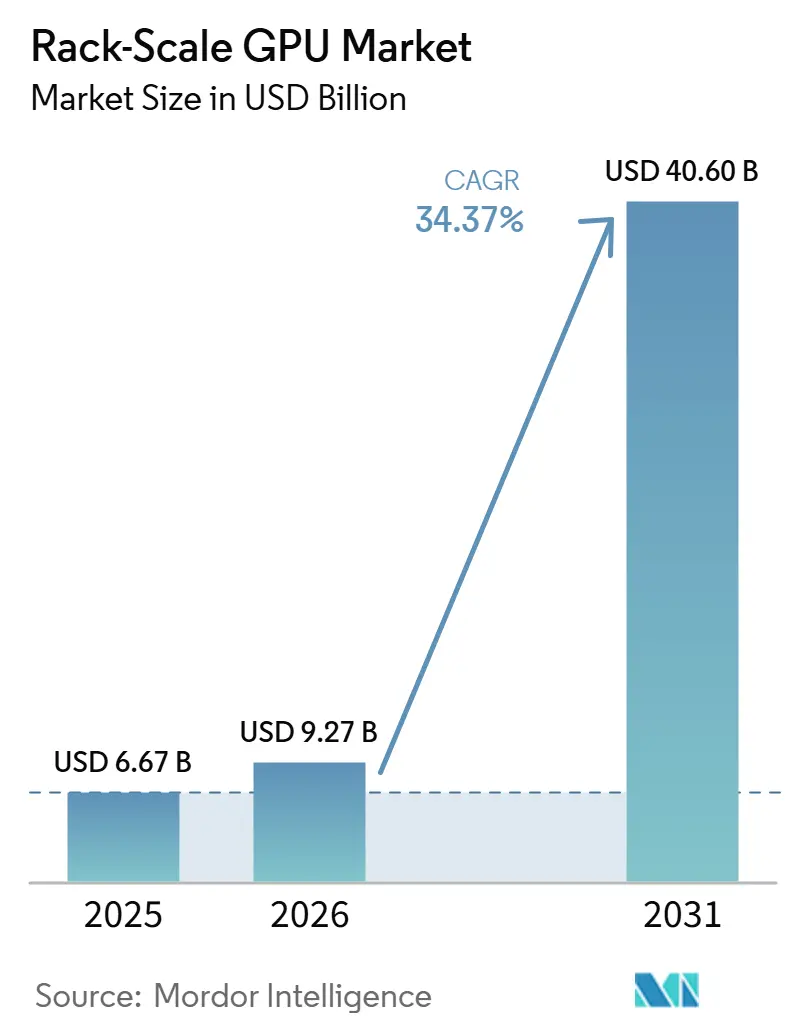
The rack-scale GPU market size is projected to expand from USD 6.67 billion in 2025 and USD 9.27 billion in 2026 to USD 40.60 billion by 2031, registering a CAGR of 34.37% between 2026 and 2031. Demand is rising because AI infrastructure buyers now need compute systems that treat the rack as the operating unit, not the individual server, and that change is lifting spending on tightly integrated power, cooling, networking, and software layers. The rack-scale GPU market is also benefiting from the fact that new accelerator generations are pushing rack power density far beyond what conventional air-cooled server halls were designed to handle, which is making liquid-cooled builds more common in both hyperscale and sovereign AI programs. The market is gaining support from cloud operators seeking faster cluster deployment, from public-sector buyers that need secure in-region compute, and from enterprises that increasingly depend on service partners to install and operate these systems. Competitive activity is centered on how quickly vendors can commercialize rack-native platforms, validate direct liquid cooling, and support full-rack deployment rather than shipping only component hardware. The rack-scale GPU market also has room to expand because buyers are no longer evaluating accelerators in isolation; they are instead evaluating full-system readiness across interconnects, thermal control, rack design, storage, and managed services.
Key Report Takeaways
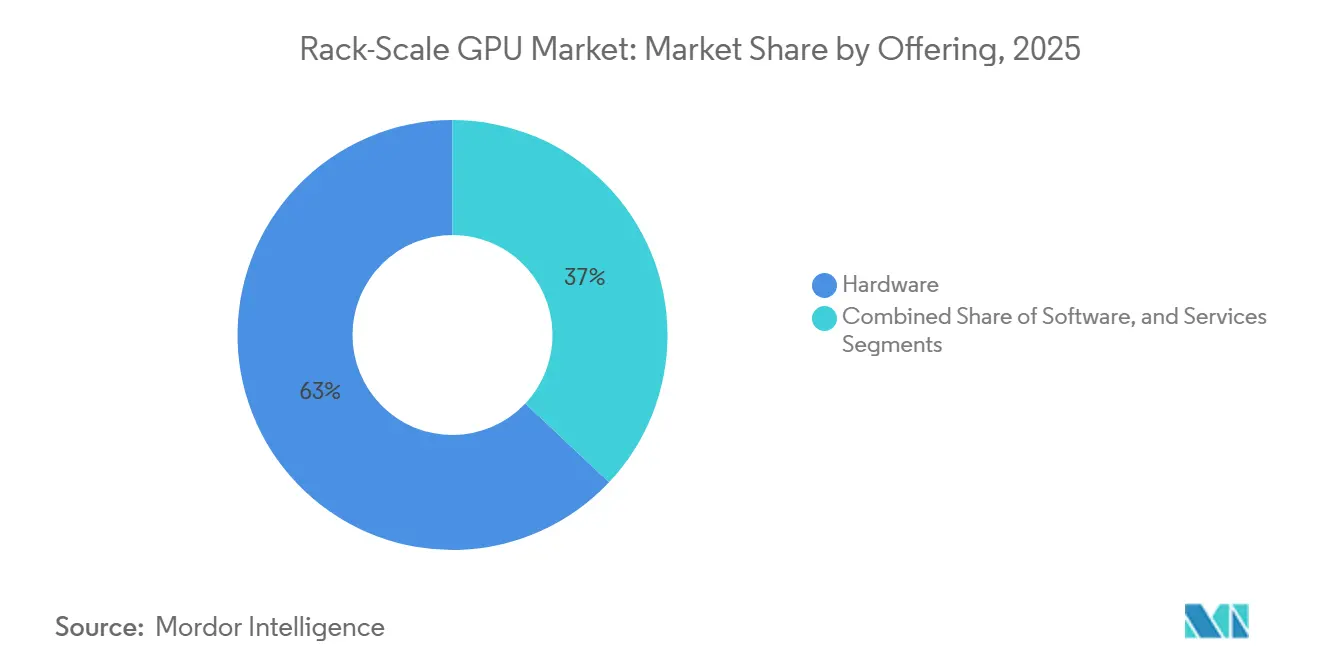
- By offering, hardware accounted for 62.98% of revenue in 2025, while services are projected to expand at a 34.96% CAGR through 2031 in the rack-scale GPU market.
- By rack density, the 17-64 GPU tier led with a 39.83% revenue share in 2025, while the above-128 GPU tier is expected to record the fastest CAGR of 35.17% through 2031.
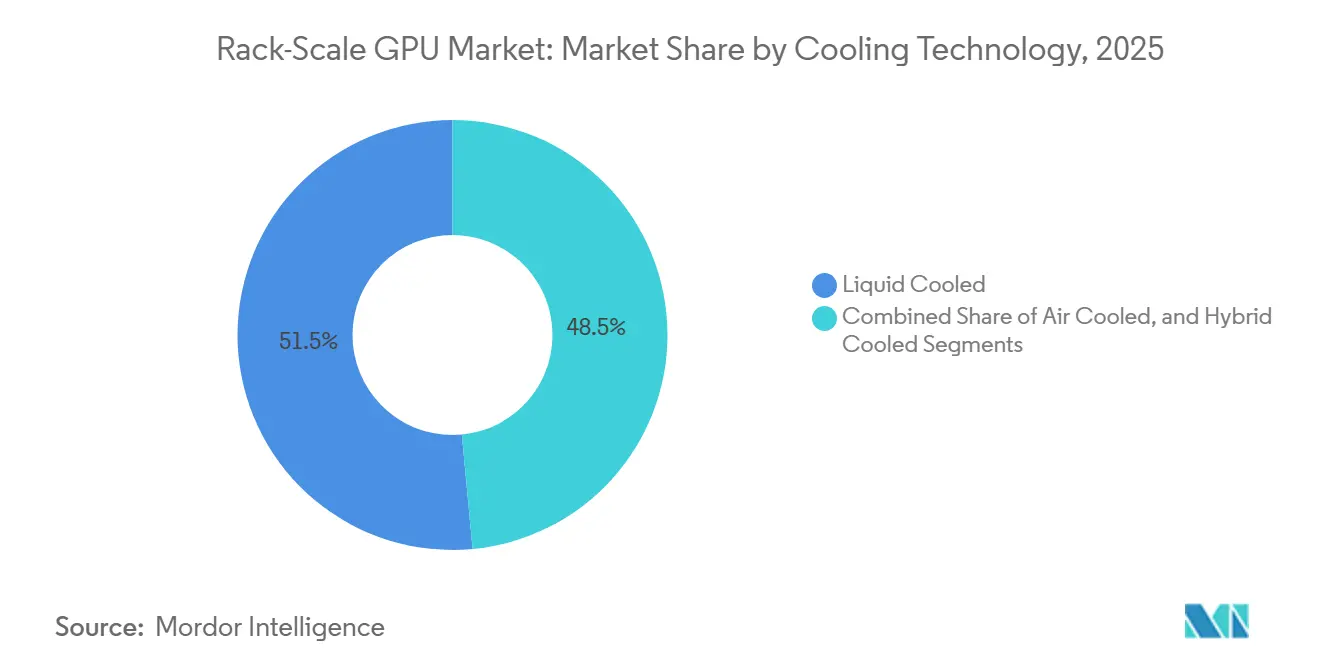
- By cooling technology, liquid cooling accounted for 51.49% of revenue in 2025, while the input draft positioned it as the architectural default for new deployments through the forecast period.
- By end user, cloud service providers captured 52.47% of revenue in 2025, while government and research institutions are projected to expand at a 35.08% CAGR through 2031.
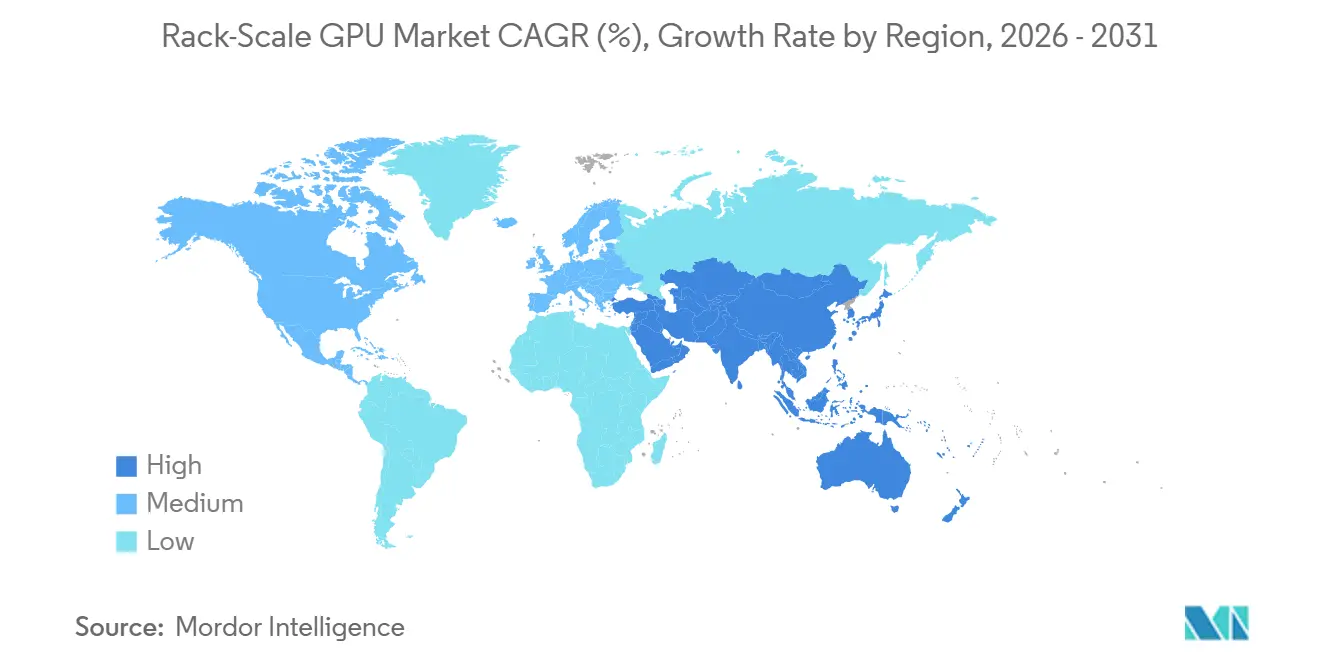
- By geography, North America held 53.34% of the rack-scale graphics processing unit (GPU) market in 2025, while Asia-Pacific is expected to register the fastest CAGR of 35.31% through 2031.
Note: Market size and forecast figures in this report are generated using Mordor Intelligence’s proprietary estimation framework, updated with the latest available data and insights as of January 2026.
Market Trends and Insights
Drivers Impact Analysis of Rack-Scale GPU Market*
| Driver | (~) % Impact on CAGR Forecast | Geographic Relevance | Impact Timeline |
|---|---|---|---|
| Rising Hyperscale AI Cluster Density Requirements | +8.2% | Global, concentrated in North America and Asia-Pacific | Short term (≤ 2 years) |
| Shift From GPU Nodes to Rack-Scale Fabrics | +6.5% | Global | Short term (≤ 2 years) |
| Liquid-Cooling Readiness in New AI Data Centers | +5.8% | North America, Europe, Asia-Pacific | Medium term (2-4 years) |
| Sovereign AI Infrastructure Buildouts | +4.9% | Middle East, South Asia, East Asia, Europe | Medium term (2-4 years) |
| Power-Availability Constraints Favoring High-Density Rack Design | +3.1% | North America and Europe, grid-constrained markets | Long term (≥ 4 years) |
| Multi-Tenant AI Service Monetization Pressure | +2.4% | Global, particularly North America and Asia-Pacific core | Medium term (2-4 years) |
| Source: Mordor Intelligence | |||
Rising Hyperscale AI Cluster Density Requirements
The rack-scale GPU market is being driven by hyperscale cloud operators building larger AI clusters that require denser infrastructure in every new deployment cycle. NVIDIA stated that the Vera Rubin NVL72 platform combines 72 Rubin GPUs and 36 Vera CPUs in a single rack-scale system, underscoring how the performance target has already shifted from isolated nodes to integrated fabrics.[1] NVIDIA also showed that GB200 NVL72-class systems reached 132 kW per rack in 2025, and that Vera Rubin-class platforms are moving toward far higher rack densities, making each expansion phase increasingly dependent on purpose-built power and cooling design. As a result, the rack-scale GPU market is drawing higher spending not only for accelerators, but also for rack delivery, liquid loops, optical scale-up, and factory-level validation before systems are installed. Dell confirmed the first shipment of systems built on the NVIDIA Vera Rubin platform to CoreWeave in June 2026, reflecting how hyperscale demand now favors integrated rack delivery over slower component-led installation cycles. The same shift is evident in NVIDIA's description of million-GPU AI factories, where the rack-scale GPU market is being shaped by platform-scale buildouts rather than typical server refresh cycles.
Shift From GPU Nodes To Rack-Scale Fabrics
The rack-scale GPU market is also advancing as AI buyers increasingly want racks that behave like a single logical compute system rather than a collection of separate GPU servers. NVIDIA described Vera Rubin NVL72 as a unified rack platform tied together by a 260 TB/s NVLink 6 fabric, and that architecture directly supports the move toward large shared memory domains for demanding AI workloads. Open Compute Project's work on open cluster designs for AI further shows that infrastructure standards are now being built around high-power cluster layouts, wider rack formats, and rack-native power distribution, rather than legacy node assumptions. That matters for the rack-scale GPU market because procurement is becoming more system-oriented, with buyers evaluating enclosures, networking, liquid cooling, and service readiness as one package. AMD also tied its Helios AI rack design to Meta's Open Compute work, suggesting that this fabric-led direction is not confined to a single supplier ecosystem. The rack-scale GPU market is therefore moving toward platform competition where switching costs, validation cycles, and operational familiarity matter almost as much as raw accelerator performance.
Liquid-Cooling Readiness in New AI Data Centers
Liquid-cooling readiness has become one of the clearest practical enablers for the rack-scale GPU market, as new accelerator racks now operate at thermal levels that standard air systems cannot support at scale. NVIDIA said the GB200 NVL72 requires direct-to-chip liquid cooling with a 20 L/min coolant flow and inlet temperatures below 30°C, while its 45°C warm-water approach for Vera Rubin can eliminate the need for chillers in favorable environments. That technical direction means the rack-scale GPU market is increasingly linked to facility engineering capacity, not only to semiconductor supply. IDC Frontier and Vertiv confirmed the stable operation of GPU server environments at 150 kW per rack in Japan, demonstrating that high-density liquid-cooled deployments are moving beyond a narrow set of hyperscale test sites. EXEO Group also announced Japan's first commercial two-phase deployment of direct liquid-cooled GPU servers in December 2025, reinforcing that the supporting thermal ecosystem is broadening in Asia. The rack-scale graphics processing unit (GPU) market is benefiting from this facility shift, as buyers who prepare liquid-ready buildings can adopt next-generation rack platforms faster than operators trying to stretch older air-cooled footprints.
Sovereign AI Infrastructure Buildouts
Sovereign AI programs are creating a distinct demand layer in the rack-scale GPU market, as national compute projects increasingly need secure, high-density systems that can be deployed within local jurisdictional boundaries. NVIDIA linked Vera Rubin systems with BlueField-4 DPUs and confidential computing capabilities that support hardware attestation, protected data movement, and tighter isolation for sensitive workloads. Oracle also positioned its next-generation OCI Supercluster with NVIDIA Vera Rubin, BlueField-4 DPUs, ConnectX-9 SuperNICs, and Spectrum-X switches as a scalable environment for training and production inference, which aligns with the full-stack control that sovereign programs often require. Lenovo's AI Cloud Gigafactory program and HPE's multi-tenant AI factory offerings show that system vendors are already packaging rack-native compute for public-sector and sovereign use cases, not just for commercial clouds. This is important for the rack-scale GPU market because sovereign demand often rewards integrated platforms that simplify compliance, deployment oversight, and workload segregation. It also widens the buyer base beyond hyperscalers, even if procurement cycles remain concentrated among well-funded institutions.
Restraints Impact Analysis of Rack-Scale GPU Market*
| Restraint | (~) % Impact on CAGR Forecast | Geographic Relevance | Impact Timeline |
|---|---|---|---|
| High Upfront Capital Intensity | -5.2% | Global, most acute in emerging markets and mid-tier enterprises | Short term (≤ 2 years) |
| Power and Cooling Retrofit Complexity | -4.1% | North America and Europe, legacy facilities | Medium term (2-4 years) |
| Limited Supply of Advanced Packaging and High-Bandwidth Memory | -3.4% | Global | Short term (≤ 2 years) |
| Rack-Level Standardization Gaps Across OEMs | -2.1% | Global | Long term (≥ 4 years) |
| Source: Mordor Intelligence | |||
High Upfront Capital Intensity
The rack-scale GPU market still faces a meaningful restraint because full-rack AI systems require a large upfront commitment across hardware, rack integration, cooling equipment, networking, and facility preparation. Vendor announcements themselves show how much value is concentrated in the full system, since buyers are no longer ordering only GPU boards and are instead procuring complete rack-scale environments with supporting infrastructure.[2] That cost profile keeps the rack-scale GPU market tilted toward hyperscalers, sovereign programs, and a small group of well-capitalized cloud specialists. Managed deployment and hosted AI compute can reduce the ownership burden for enterprises, and AMD's 30 MW agreement with Rackspace shows that service-led access models are becoming part of the response. Even so, the rack-scale GPU market remains harder to enter than conventional server markets because each deployment requires a matched investment in both compute and facility capability. This capital profile supports long-term growth but narrows the immediate customer pool.
Power And Cooling Retrofit Complexity
The rack-scale GPU market is also constrained by the fact that many existing facilities were not designed for the power density and thermal load of current rack-native AI systems. NVIDIA's published rack requirements for GB200 NVL72 and Vera Rubin-class platforms make clear that modern AI racks depend on direct liquid cooling, high-capacity power delivery, and tighter integration of networking and mechanical systems than traditional server rooms can offer. Equinix launched liquid-cooling services in Japan in 2025, suggesting operators are adapting, but it also highlights that facility retrofits and service upgrades are now a necessary part of participation in this space. The same pattern appears in vendor blueprints from Dell, HPE, and Supermicro, where direct liquid cooling and high-rack-power support are treated as baseline design requirements rather than premium options. Because of this, the rack-scale GPU market can move quickly in greenfield AI data centers, but it expands more slowly where operators must first rework older buildings. Retrofit complexity does not weaken demand, but it does delay conversion from planned procurement to live deployment.
*Our forecasts treat driver/restraint impacts as directional, not additive. The impact forecasts reflect baseline growth, mix effects, and variable interactions.
Rack-Scale GPU Market Segment Analysis
By Offering:
Services Poised To Narrow The Hardware Revenue GapHardware accounted for 62.98% of revenue in 2025, making it the largest offering in the rack-scale GPU market and reflecting the heavy spending required for accelerators, NVLink switches, rack enclosures, power systems, and cooling hardware. That position was consistent with an early build cycle, when many customers were still building new AI capacity and had to purchase the full physical stack before optimization layers became the primary focus of spending. Dell, HPE, Supermicro, Lenovo, and other system builders are commercializing full-rack AI platforms, keeping hardware at the center of buyers' budgets during the current expansion phase. Software remains smaller in revenue share, yet it has become operationally more important as fabrics, cooling controls, and workload orchestration become harder to manage with traditional HPC tools. That means the rack-scale GPU market is no longer defined solely by server hardware, even if hardware still anchors spending.
Services are projected to expand at a 34.96% CAGR through 2031, making it the fastest-growing offering and showing how quickly operating complexity is moving beyond the comfort level of many buyers. CoreWeave's June 2026 bring-up of NVIDIA Vera Rubin NVL72 involved liquid-cooled storage, custom software-defined cooling control, and unified rack management, which illustrates the depth of coordination required before a rack enters production use. Dell's Integrated Rack Scalable Systems model also points in the same direction, packaging validation, on-site deployment, and lifecycle support alongside the hardware rather than selling them as optional follow-on work. In the rack-scale GPU industry, this creates a wider role for commissioning, thermal tuning, firmware validation, optical interconnect setup, and security configuration. The rack-scale GPU market is therefore likely to see service revenue rise faster wherever enterprises, second-tier clouds, and public institutions want the capability of rack-native AI without building a full operations team internally.

By Rack Density:
Above-128 GPU Tiers Define The Next Expansion FrontierThe 17-64 GPU tier accounted for 39.83% of revenue in 2025, making it the leading density class in the rack-scale GPU market, as it meets a broad set of enterprise AI, regional cloud, and mid-scale sovereign requirements. This tier offered a practical middle ground where buyers could deploy meaningful compute density without immediately moving into the largest and most demanding rack footprints. The segment also matched the needs of organizations that wanted advanced training and inference capacity while still working within more manageable power envelopes and deployment schedules. For that reason, 17-64 GPUs held 39.83% of the rack-scale GPU market share in 2025, and it remained the workhorse bracket for buyers seeking scale without the full complexity of the highest-density formats. The rack-scale GPU market benefited from this segment, as it bridged early enterprise adoption and full hyperscale configurations.
The above-128 GPU tier is projected to expand at a 35.17% CAGR through 2031, which shows where the next wave of scale is heading as larger AI models demand tighter intra-rack communication and lower latency. Supermicro said its Vera Rubin NVL4 DCBBS blueprint can scale to 1,152 NVIDIA Rubin GPUs within a 3.2 MW unit, which demonstrates how suppliers are already designing around extremely dense AI deployment blocks. Dell also introduced the PowerEdge XE8812, which supports up to 144 GPUs per ORv3-standard rack, further confirming that the rack-scale GPU market is moving toward much denser rack classes. The Open Compute Project, which works on open cluster designs, adds a standards layer to this movement by preparing enclosures and power formats for future high-density AI clusters. In the rack-scale GPU industry, the up-to-16 and 65-128 GPU brackets still matter, but the strongest momentum is clearly shifting toward larger rack domains that can reduce communication overhead for frontier workloads.
By Cooling Technology:
Liquid Cooling Consolidates As The Architectural DefaultLiquid cooling accounted for 51.49% of revenue in 2025, giving it the largest share in this category and serving as one of the clearest structural signals in the rack-scale GPU market. Its lead reflects the reality that new platform generations are crossing thermal thresholds where direct-to-chip cooling is no longer optional for serious AI training and large-scale inference. NVIDIA explained that the GB200 NVL72 requires direct liquid cooling, and its 45°C warm-water design for Vera Rubin points to a future in which facility design and cooling efficiency become tightly linked competitive variables. Equinix's 2025 launch of liquid cooling in Japan showed that colocation operators are adapting their service offerings to meet these same rack requirements. The rack-scale GPU market is gaining strength from liquid cooling, which supports higher densities, better thermal stability, and more consistent deployment readiness in new AI data centers.
Air and hybrid configurations still have a place, particularly for lighter inference loads, telecom edge sites, and retrofit cases where a full liquid build is not yet practical. Supermicro highlighted liquid-to-air sidecar support in some of its designs, which shows that vendors still see value in transitional thermal approaches for selected customers. Even so, the rack-scale GPU market is moving in a clear direction, as each new performance generation makes liquid infrastructure more central to mainstream deployment rather than niche high-performance environments. Hybrid systems may expand where operators need a staged migration path, but they are unlikely to displace the liquid-first bias of the newest AI platforms. As a result, cooling technology is becoming a strategic buying criterion in the rack-scale GPU market, not simply a facilities decision made after hardware selection.
By End User:
Sovereign Demand Creates A Structurally New Buyer ClassCloud service providers captured 52.47% of revenue in 2025, making them the largest end-user group and underscoring how much the rack-scale GPU market still depends on buyers with very large capital budgets and rapid deployment cycles. Oracle's next-generation OCI Supercluster with NVIDIA Vera Rubin, scalable to 131,072 GPUs, shows how cloud providers are extending rack-scale infrastructure beyond model training and into production AI services. These buyers can absorb the cost of facility redesign, move quickly on annual accelerator refreshes, and standardize around a preferred software and networking stack more easily than most enterprises. Enterprises remain important, but many of them are still approaching the rack-scale GPU market through hosted compute, dedicated cloud capacity, or managed on-premises solutions rather than through direct full-rack ownership. IBM's expanded collaboration with NVIDIA at GTC 2026 reflected that pattern by combining storage, open AI services, and accelerated compute for organizations moving from pilot AI programs into production use.
Government and research institutions are projected to grow at a 35.08% CAGR through 2031, making it the fastest-growing end-user category in the rack-scale graphics processing unit (GPU) market. NVIDIA's science-focused Vera Rubin announcement named the Leibniz Supercomputing Center, NERSC, and Los Alamos National Laboratory among the organizations deploying these systems, underscoring that national research and public compute programs are becoming stronger demand anchors. The rack-scale GPU market is benefiting because these institutions often need tightly integrated systems with attestation, isolation, and large shared memory capability for advanced modeling and AI research. Telecom and edge operators are also emerging as a smaller but distinct user group as distributed AI services begin to move closer to network endpoints. Nokia and Indosat's June 2026 AI-RAN agreement illustrates how telecom infrastructure is starting to absorb AI compute more directly, even though this channel remains much smaller than cloud and government demand today. The rack-scale GPU market is therefore widening its customer base, but the strongest growth outside hyperscalers is currently coming from sovereign, research, and regulated compute environments.
Geography Analysis
North America Rack-Scale GPU Market
North America accounted for 53.34% of the rack-scale GPU market in 2025, making it the leading regional market and reflecting the concentration of hyperscale cloud buyers, AI infrastructure specialists, and early liquid-cooled buildouts. The United States remains the main anchor because the largest platform launches, first system shipments, and many of the most visible AI factory projects are centered there. Dell shipped Vera Rubin-based systems to CoreWeave in June 2026, showing that the rack-scale GPU market in North America still benefits from close vendor-customer coordination and fast commercialization cycles. NVIDIA also invested USD 2 billion in CoreWeave and expanded the partnership to support a 5+ GW AI factory buildout by 2030, underscoring the scale of the infrastructure commitment already underway in the region.[3] The regional lead is therefore not only a matter of current capacity, but also of faster execution across power, rack integration, and ecosystem support.
Europe Rack-Scale GPU Market
Europe is growing from a smaller base, but the rack-scale GPU market there is gaining traction through research computing, sovereign AI priorities, and rising interest in efficient high-density infrastructure. NVIDIA's 2026 science systems announcement included the Leibniz Supercomputing Center, demonstrating that the region remains active in deploying advanced rack-native AI and HPC platforms. HPE and Lenovo also positioned their 2026 AI factory and Vera Rubin programs for multi-tenant and large-scale deployments, which supports the view that European buyers are moving toward full-rack platforms rather than incremental node additions. The regional profile suggests steady growth where compute sovereignty, research workloads, and efficiency-oriented facility design come together.
APAC, South America and MEA Rack-Scale GPU Market
Asia-Pacific is projected to expand at a 35.31% CAGR through 2031, making it the fastest-growing regional segment in the rack-scale GPU market. Japan is already demonstrating stronger deployment readiness through high-density liquid-cooled operations and commercial liquid-cooling services from operators such as IDC Frontier, Vertiv, and Equinix. China is advancing along a distinct domestic path, and Huawei's CloudMatrix384 paper described a 384 NPU rack-scale supernode architecture with unified memory pooling across 16 racks. Huawei also said its Atlas 950 SuperPoD would scale to 8,192 NPUs, which shows how quickly local alternatives are moving toward system-level AI infrastructure. Outside Asia-Pacific, South America remains a smaller market, centered on selective hyperscale colocation demand, while the Middle East and Africa are becoming more visible through sovereign AI buildouts and large AI factory ambitions, even though the installed base remains more concentrated than in North America.
Competitive Landscape
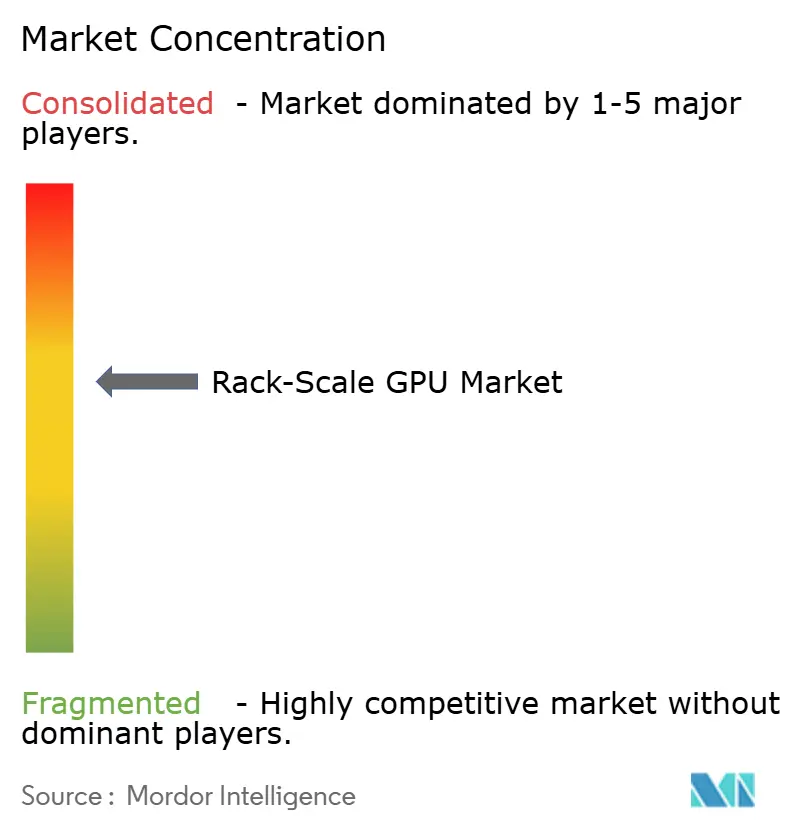
The rack-scale GPU market shows a moderately concentrated structure at the system-integrator level, where Dell Technologies, Hewlett Packard Enterprise, Super Micro Computer, Lenovo, and Inspur accounted for roughly 60% of 2025 GPU server shipments. That level of concentration gives large OEMs meaningful scale, but it does not make the field closed, as platform transitions still create room for newer designs, ODM participation, and service-led challengers. At the same time, NVIDIA holds an unusually strong upstream position because its NVLink fabrics, reference designs, and software ecosystem influence how the rack-scale GPU market is assembled across multiple vendor channels. Competitive success now depends less on server branding alone and more on how quickly a supplier can validate complete rack systems, cooling loops, optical fabrics, and lifecycle support. This keeps the rack-scale GPU market relatively concentrated but still open enough for capable OEMs and ODMs to gain share through execution.
Dell strengthened its position by becoming the first to ship systems built on the NVIDIA Vera Rubin platform to CoreWeave, which gave it an early proof point in one of the most visible AI deployment programs of 2026.[4] Supermicro reinforced its standing through DCBBS blueprints for NVIDIA Vera Rubin NVL72 and NVL4, linking high-density deployment with advanced direct liquid cooling and large, scalable unit design. Lenovo also confirmed full-scale production of NVIDIA Vera Rubin NVL72 systems and tied them to an AI Cloud Gigafactory program, which positions it well for sovereign and hyperscale demand. Foxconn, Wiwynn, and Wistron are relevant because hyperscale customers increasingly use ODM partners for direct sourcing and fast rack assembly, especially when deployment speed matters as much as hardware specification. In this setting, the rack-scale GPU market rewards manufacturers that can combine volume, thermal engineering, and rack-level validation without slowing down delivery schedules.
The competitive white space is most visible in managed rack-scale services, telecom edge AI, and alternative platform ecosystems below the largest hyperscale tier. AMD's agreement with Rackspace for a phased 30 MW deployment gives it a credible opening in governed enterprise AI compute, where buyers may want large-scale capability without full dependency on the leading hyperscaler route. Huawei remains a major force in China because it pairs Ascend silicon, UnifiedBus interconnect, and storage around a vertically integrated system architecture that functions as a local alternative in the rack-scale graphics processing unit (GPU) market. The result is a market where leadership is clear at the top, but competitive boundaries are still being redrawn as buyers weigh ecosystem depth, deployment speed, and geopolitical alignment.
Rack-Scale GPU Industry Leaders
-
Dell Technologies Inc.
-
Hewlett Packard Enterprise Company
-
Super Micro Computer, Inc
-
Lenovo Group Limited
-
Inspur Group Co., Ltd.
- *Disclaimer: Major Players sorted in no particular order
Rack-Scale GPU Market Companies Covered in this Report
- Dell Technologies Inc.
- Hewlett Packard Enterprise Company
- Super Micro Computer, Inc.
- Lenovo Group Limited
- Inspur Group Co., Ltd.
- NVIDIA Corporation
- Advanced Micro Devices, Inc.
- Cisco Systems, Inc.
- Huawei Technologies Co., Ltd.
- GIGABYTE Technology Co., Ltd.
- ASUSTeK Computer Inc.
- Fujitsu Limited
- International Business Machines Corporation
- Intel Corporation
- Oracle Corporation
- CoreWeave, Inc.
- Quanta Computer Inc.
- Wistron Corporation
- Wiwynn Corporation
- Hon Hai Precision Industry Co., Ltd.
Recent Industry Developments in Rack-Scale GPU Market
- June 2026: CoreWeave completed the industry-first bring-up and validation of NVIDIA Vera Rubin NVL72 on CoreWeave Cloud, deploying Dell Technologies PowerEdge XE9812 servers and Micron 7600 liquid-cooled NVMe storage, the rack integrates 72 NVIDIA Rubin GPUs with a 260 TB/s NVLink 6 fabric, delivering up to 10x better inference per watt versus prior-generation Blackwell systems.
- June 2026: Dell Technologies introduced the PowerEdge XE8812 server with NVIDIA Vera Rubin NVL4 architecture, accommodating up to 144 GPUs per ORv3-standard rack with 300+ kW power support and 100% direct liquid cooling, targeting demanding HPC and AI workloads at national laboratories and hyperscale deployments globally.
- June 2026: AMD and Rackspace Technology signed a definitive agreement for a phased deployment of 30 MW of AMD AI compute, delivering enterprise AI cloud, inference-as-a-service, and bare metal AMD Instinct MI-series infrastructure as a governed alternative to hyperscaler GPU offerings for enterprise workloads.
- May 2026: NVIDIA announced Vera Rubin has ramped into full production across 350+ manufacturing facilities in 30 countries, introducing NVIDIA Spectrum-X Ethernet Photonics, the first co-packaged-optics-based switches in production, providing 5x better power efficiency and forming the interconnect fabric for million-GPU AI factories.
Global Rack-Scale GPU Market Report Scope
The Rack-Scale GPU Market comprises integrated computing infrastructure solutions that deploy large numbers of graphics processing units (GPUs) within a single rack architecture to deliver high-density, scalable, and energy-efficient acceleration for artificial intelligence (AI), machine learning, high-performance computing (HPC), data analytics, scientific research, and other compute-intensive workloads. Rack-scale GPU systems combine GPUs, CPUs, networking, storage, power distribution, cooling technologies, and management software into unified platforms designed to maximize compute performance, resource utilization, and operational efficiency within modern data centers.
The Rack-Scale GPU Market is Segmented by Offering (Hardware, Software, and Services), Rack Density (Up to 16 GPUs, 17-64 GPUs, 65-128 GPUs, and Above 128 GPUs), Cooling Technology (Air Cooled, Liquid Cooled, and Hybrid Cooled), End-User (Cloud Service Providers, Enterprises, Government and Research Institutions, and Telecom and Edge Operators), and Geography (North America, Europe, Asia-Pacific, South America, and Middle East and Africa). The Market Forecasts are Provided in Terms of Value (USD).
Segmentation Overview
| Hardware |
| Software |
| Services |
| Up to 16 GPUs |
| 17-64 GPUs |
| 65-128 GPUs |
| Above 128 GPUs |
| Air Cooled |
| Liquid Cooled |
| Hybrid Cooled |
| Cloud Service Providers |
| Enterprises |
| Government and Research Institutions |
| Telecom and Edge Operators |
| North America | United States |
| Canada | |
| Mexico | |
| Europe | Germany |
| United Kingdom | |
| France | |
| Italy | |
| Rest of Europe | |
| Asia-Pacific | China |
| Japan | |
| South Korea | |
| India | |
| Southeast Asia | |
| Rest of Asia-Pacific | |
| South America | |
| Middle East and Africa |
| By Offering | Hardware | |
| Software | ||
| Services | ||
| By Rack Density | Up to 16 GPUs | |
| 17-64 GPUs | ||
| 65-128 GPUs | ||
| Above 128 GPUs | ||
| By Cooling Technology | Air Cooled | |
| Liquid Cooled | ||
| Hybrid Cooled | ||
| By End User | Cloud Service Providers | |
| Enterprises | ||
| Government and Research Institutions | ||
| Telecom and Edge Operators | ||
| By Geography | North America | United States |
| Canada | ||
| Mexico | ||
| Europe | Germany | |
| United Kingdom | ||
| France | ||
| Italy | ||
| Rest of Europe | ||
| Asia-Pacific | China | |
| Japan | ||
| South Korea | ||
| India | ||
| Southeast Asia | ||
| Rest of Asia-Pacific | ||
| South America | ||
| Middle East and Africa | ||
Key Questions Answered in the Report
What is the current and forecast value of the rack-scale GPU space?
The rack-scale GPU market size stood at USD 9.27 billion in 2026 and is projected to reach USD 40.6 billion by 2031, growing at a 34.37% CAGR over 2026-2031.
Why are rack-scale GPU systems gaining adoption so quickly?
Adoption is rising because newer AI accelerators require much higher rack density, tighter interconnects, and direct liquid cooling, which makes integrated rack systems more practical than separate node-based clusters.
Which offering leads revenue today and which one is growing the fastest?
Hardware led with 62.98% of revenue in 2025, while services is projected to expand at a 34.96% CAGR through 2031 as deployment and operations become more complex.
Which end-user group is the biggest buyer of these systems?
Cloud service providers held 52.47% of 2025 revenue because they can fund large deployments, redesign facilities faster, and align procurement with annual platform refresh cycles.
Which rack density category is showing the strongest long-term momentum?
The above-128 GPU segment is projected to grow at a 35.17% CAGR through 2031 as frontier model training and large inference systems require denser rack-scale fabrics.
Which region is likely to expand the fastest through 2031?
Asia-Pacific is expected to grow at a 35.31% CAGR through 2031, supported by rising deployment readiness in Japan and strong system-level development activity across China and other major regional markets.