
Rack-Scale GPU Infrastructure Market Size and Share
Market Overview
| Study Period | 2020 - 2031 |
|---|---|
| Market Size (2026) | USD 9.58 Billion |
| Market Size (2031) | USD 41.27 Billion |
| Growth Rate (2026 - 2031) | 33.92 % |
| Fastest Growing Market | Asia-Pacific |
| Largest Market | North America |
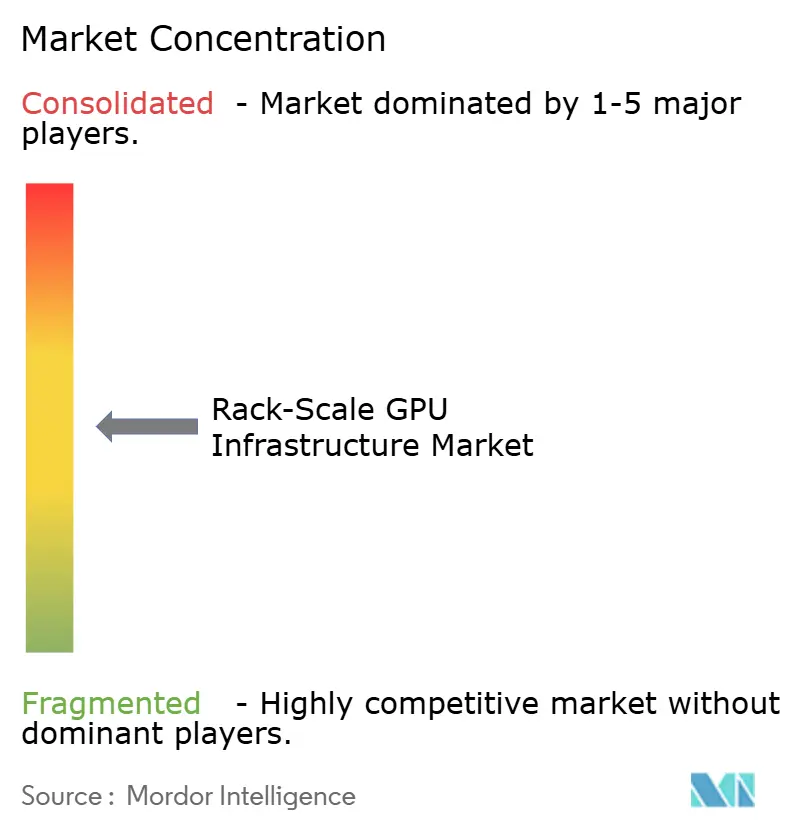
| Market Concentration | Medium |
Major Players *Disclaimer: Major Players sorted in no particular order Image © Mordor Intelligence. Reuse requires attribution under CC BY 4.0. | |
Rack-Scale GPU Infrastructure Market Analysis by Mordor Intelligence
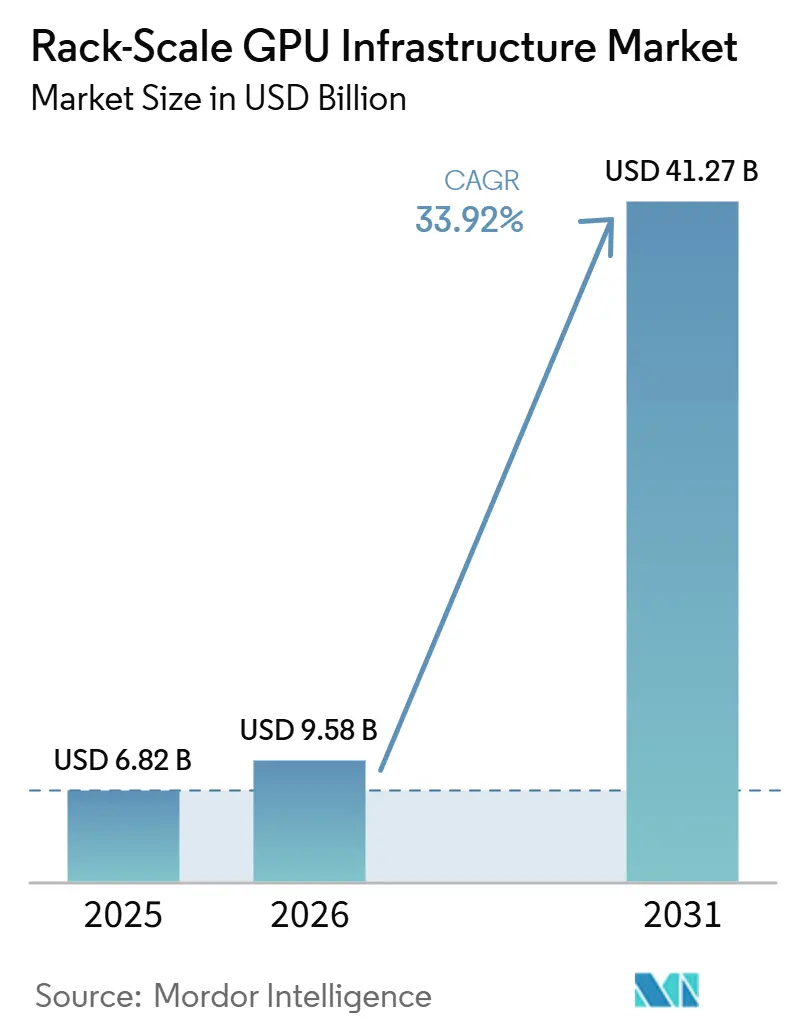
The Rack-Scale GPU infrastructure market size is projected to expand from USD 6.82 billion in 2025 and USD 9.58 billion in 2026 to USD 41.27 billion by 2031, registering a CAGR of 33.92% between 2026 and 2031. The rack-scale GPU infrastructure market is moving from loosely connected server estates toward integrated AI factory racks where compute, networking, power, and cooling are designed as one system. This shift is increasing revenue per deployment because each platform transition now triggers a broader hardware refresh rather than a narrower server upgrade. Large hyperscaler spending plans continue to set the pace for the rack-scale GPU infrastructure market, while sovereign compute programs are widening the customer base beyond commercial cloud buyers. Liquid-cooled and high-density designs are also changing procurement behavior because racks, manifolds, power shelves, and facility upgrades are increasingly purchased together. Supply constraints in advanced packaging and long grid connection timelines are not weakening demand, but they are changing the timing of revenue recognition across the rack-scale GPU infrastructure market.
Key Report Takeaways
- By solution type, Rack-Scale Compute Systems accounted for 70.34% share of the rack-scale GPU infrastructure market size in 2025, while Rack-Scale Cooling Systems are projected to expand at a 35.52% CAGR through 2031.
- By deployment scale, Multi-Rack Pod Deployments held 50.46% of revenues in 2025, while Cluster-Scale AI Factory Deployments are projected to grow at a 35.18% CAGR through 2031.
- By cooling architecture, Air-Cooled Rack Infrastructure led with a 54.68% share in 2025, while Direct-to-Chip Liquid-Cooled Rack Infrastructure is projected to advance at a 35.65% CAGR through 2031.
- By end user, Cloud Service Providers held 65.71% of revenues in 2025, while Government and Research Institutions are projected to grow at a 35.84% CAGR through 2031.
- By geography, North America held 45.29% of the rack-scale GPU infrastructure market share in 2025, while Asia-Pacific is projected to expand at a 35.42% CAGR through 2031.
Note: Market size and forecast figures in this report are generated using Mordor Intelligence’s proprietary estimation framework, updated with the latest available data and insights as of January 2026.
Market Trends and Insights
Drivers Impact Analysis of Rack-Scale GPU Infrastructure Market*
| Driver | (~) % Impact on CAGR Forecast | Geographic Relevance | Impact Timeline |
|---|---|---|---|
| Surging Hyperscale Demand for AI Factory Racks | +11.2% | Global | Short term (≤ 2 years) |
| Rapid Shift to Liquid-Cooled High-Density Infrastructure | +5.8% | Global | Short term (≤ 2 years) |
| Expanding Sovereign AI and National Compute Programs | +3.9% | APAC, Europe, North America | Medium term (2-4 years) |
| Rack-Level Interconnect Standardization and Disaggregation | +2.7% | Global | Medium term (2-4 years) |
| Rising Adoption of Inference-Optimized Neocloud Deployments | +2.2% | North America, Europe | Short term (≤ 2 years) |
| Power Density Redesign Favoring Prefabricated AI Racks | +1.5% | Global | Medium term (2-4 years) |
| Source: Mordor Intelligence | |||
Surging Hyperscaler Demand for AI Factory Racks
The rack-scale GPU infrastructure market is being led by hyperscaler capital plans that reached approximately USD 725 billion for 2026, up from USD 410 billion in 2025, with server and rack infrastructure absorbing an estimated USD 130 billion. Procurement has shifted from buying isolated servers to buying integrated rack-scale systems that combine compute trays, interconnect fabrics, liquid cooling, and power delivery into a single deployment package. That change increases revenue per installation because each platform cycle now carries more hardware and site infrastructure. Allocation queues for next-generation systems are also pushing some operators to secure current-generation capacity earlier, which supports near-term order flow. This keeps the rack-scale GPU infrastructure market tied not only to demand growth, but also to platform timing and facility readiness.
Rapid Shift to Liquid-Cooled High-Density Infrastructure
The rack-scale GPU infrastructure market is moving quickly toward liquid-cooled designs because Vera Rubin entered full production in May 2026 with a fully liquid-cooled, fanless rack architecture. Rubin rack configurations draw 300 kW or more, which means operators now need coolant distribution units, facility manifolds, and dedicated piping, in addition to the rack purchase. Open Rack Wide also shows that rack geometry, power, and cooling are being standardized together across dense AI environments.[1] This changes buying behavior because cooling vendors now need qualification much earlier in the project cycle than in traditional data center builds. It also broadens the addressable spend in the rack-scale GPU infrastructure market because cooling and power are no longer secondary add-ons to the compute order.
Expanding Sovereign AI And National Compute Programs
The rack-scale GPU infrastructure market is also being supported by public-sector funding that is moving from policy announcements into equipment contracts. Canada launched its AI Sovereign Compute Infrastructure Program with approximately CAD 890 million (USD 648 million) to build large-scale national AI supercomputing capacity. EuroHPC JU also signed a EUR 55 million (USD 62.2 million) contract with Hewlett Packard Enterprise for the HammerHAI system at HLRS Stuttgart HLRS.DE. These programs favor integrated delivery, which supports rack-scale vendors that can combine compute, cooling, power, and compliance into one turnkey build.
Rack-Level Interconnect Standardization and Disaggregation
The rack-scale GPU infrastructure market is benefiting from new open system designs that reduce the complexity of building large AI clusters. The Open Compute Project published the XOC-N and its Open Cluster Designs for AI white paper in January 2026, providing operators with a vendor-neutral blueprint for both air-cooled pod designs and liquid-cooled AI factory builds. NVIDIA also brought Spectrum-X Ethernet Photonics into production with Vera Rubin in 2026, extending the push toward higher-efficiency optical networking inside large clusters. The practical result is that operators can source more of the rack stack from separate vendors without losing alignment at the architecture level. That widens opportunity in the rack-scale GPU infrastructure market for networking specialists, power equipment suppliers, and cooling integrators that fit open standards.
Restraints Impact Analysis of Rack-Scale GPU Infrastructure Market*
| Restraint | (~) % Impact on CAGR Forecast | Geographic Relevance | Impact Timeline |
|---|---|---|---|
| Advanced Packaging and HBM Supply Bottlenecks | -2.5% | Global | Short term (≤ 2 years) |
| Grid Capacity and Site-Readiness Constraints | -1.6% | North America, Europe | Medium term (2-4 years) |
| Export Controls and Cross-Border Deployment Friction | -1.2% | APAC, Middle East, and Africa | Medium term (2-4 years) |
| Integration Complexity Across Compute, Power, Cooling, and Optical Fabrics | -0.7% | Global | Long term (≥ 4 years) |
| Source: Mordor Intelligence | |||
Advanced Packaging and HBM Supply Bottlenecks
The rack-scale GPU infrastructure market remains limited by supply at the packaging and memory layer, especially in CoWoS capacity and high-bandwidth memory output. These constraints cap the number of accelerators that can be assembled into finished racks, even when end demand exceeds available supply. Tight availability also increases cost pressure on system vendors, as packaging inflation moves faster than many procurement cycles. That weakens margin flexibility for OEMs and integrators that are trying to scale large AI factory deployments on fixed customer timelines. In the rack-scale GPU infrastructure market, this means demand is strong, but shipment timing still depends on upstream memory and packaging availability.
Grid Capacity and Site-Readiness Constraints
The rack-scale GPU infrastructure market is also facing a site-readiness problem, as grid interconnection timelines in key regions now extend well beyond typical data center build schedules. The International Energy Agency estimated that roughly 20% of planned data center projects are at risk of delay because of power constraints. This issue matters more as rack density rises, because advanced GPU systems require facility upgrades before they can be commissioned at scale. The delay does not reduce customer interest, but it does separate order intake from installation timing across large projects. As a result, the rack-scale GPU infrastructure market can remain oversold while revenue recognition continues to slip from one period to the next.
*Our forecasts treat driver/restraint impacts as directional, not additive. The impact forecasts reflect baseline growth, mix effects, and variable interactions.
Rack-Scale GPU Infrastructure Market Segment Analysis
By Solution Type:
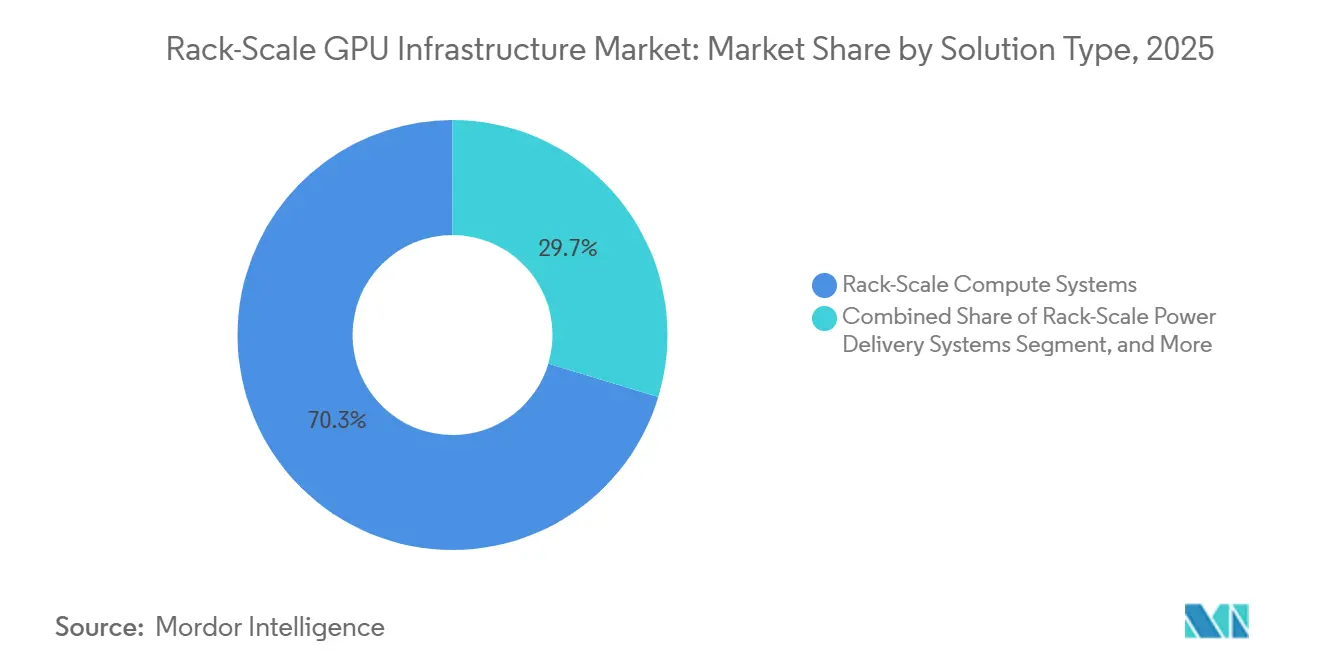
Compute Systems Hold the Revenue Core While Cooling Gains ImportanceRack-Scale Compute Systems accounted for 70.34% of total revenues in 2025, making it the largest segment of the rack-scale GPU infrastructure market. This lead reflects the continuing weight of GPU and accelerator trays in the total bill of materials for every rack deployment. Platform transitions from Hopper to Blackwell and now to Rubin have kept compute spending elevated because operators are replacing full rack systems rather than upgrading parts one server at a time. Rack-Scale Networking Systems remain the second-largest layer as buyers move toward high-radix Ethernet fabrics and optical interconnects that support larger AI clusters.
Rack-Scale Cooling Systems are projected to grow at a 35.52% CAGR from 2026 to 2031, the fastest pace among all solution types. That growth follows the move toward fully liquid-cooled architectures, where cooling design is specified alongside compute and networking rather than after rack selection. Rack-Scale Power Delivery Systems are also gaining strategic value as vendors align around 800 VDC architectures for denser AI deployments. In the rack-scale GPU infrastructure market, this means compute still anchors revenue, but cooling and power now play a larger role in determining who can actually deploy on time.

By Deployment Scale:
Cluster Builds Rise Fast While Pods Stay the Main Buying UnitCluster-Scale AI Factory Deployments are projected to grow at a 35.18% CAGR from 2026 to 2031, the fastest pace among deployment models. This reflects a shift among the largest operators from staged pod additions toward integrated campus-scale builds that can be repeated across multiple sites. Supermicro’s DCBBS blueprints for NVIDIA Vera Rubin NVL72 were designed to scale from a 1,152-GPU building block to 1 GW, demonstrating how vendors are packaging large AI deployments as repeatable construction units rather than one-off engineering projects.[2] The rack-scale GPU infrastructure market is therefore shifting toward larger contract structures that tie hardware strategy to long-term site planning.
Multi-Rack Pod Deployments held 50.46% of deployment-scale revenues in 2025 and remained the default procurement unit for many enterprises and mid-scale cloud builds. The pod model works well because 4 to 16 racks can be integrated around a shared network and cooling loop without the heavier design burden of a full campus program. Single-Rack Deployments still serve enterprise inference and first-time AI infrastructure programs where fabric overhead and facility changes would be harder to justify. In the rack-scale GPU infrastructure market, the move from single rack to pod and from pod to cluster is not just a size change, because each step adds more services, more facility coordination, and more integration revenue.
By Cooling Architecture:
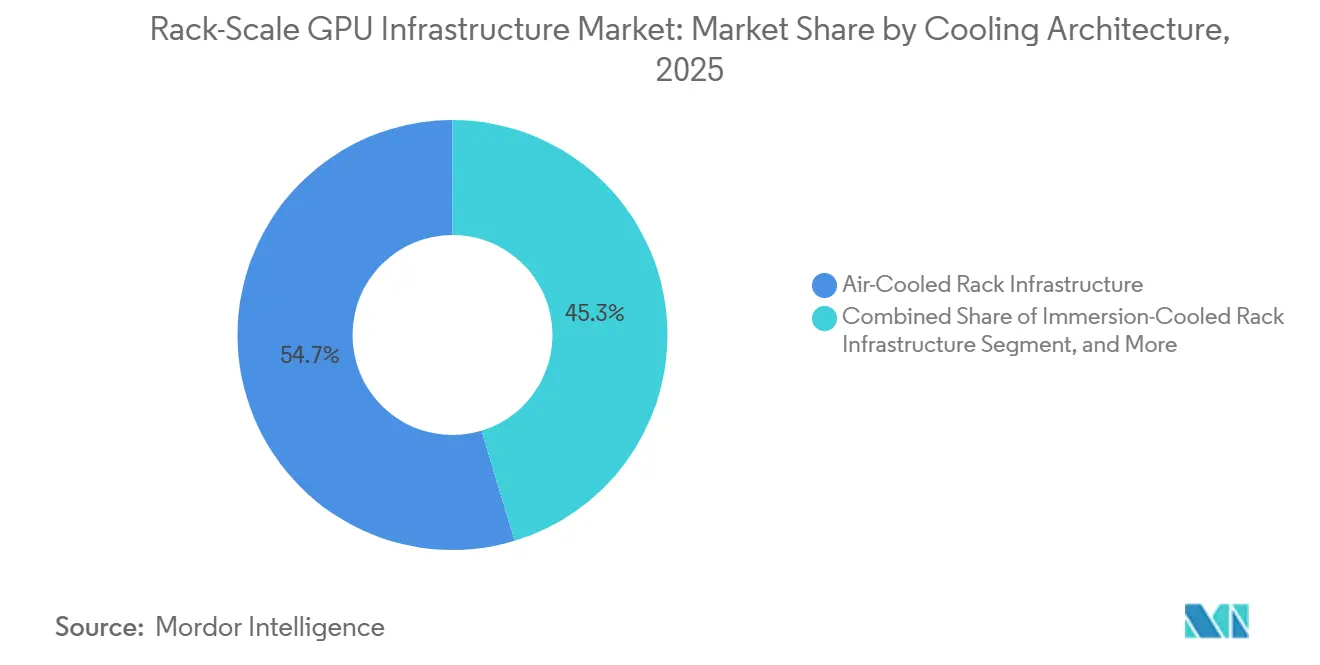
Air Cooling Leads Today While Direct-To-Chip Sets the Future PathAir-Cooled Rack Infrastructure held 54.68% of the segment in 2025 and remained the largest cooling architecture due to its large installed base of lower-density enterprise and colocation racks. It still fits inference workloads at moderate density and remains relevant in brownfield settings where liquid distribution infrastructure is not yet available. Even so, the power path of frontier GPU systems is narrowing that window, because NVIDIA GB200 NVL72 racks drew 120 kW, while Rubin NVL72 configurations exceed 300 kW. Hybrid cooling remains the transition option for operators that are adding liquid capacity in stages rather than rebuilding their facilities all at once.
Direct-to-Chip Liquid-Cooled Rack Infrastructure is projected to expand at a 35.65% CAGR from 2026 to 2031, making it the fastest-growing cooling architecture in the rack-scale GPU infrastructure market. Its rise follows the point at which high-density AI racks can no longer stay within practical thermal limits under air-only designs. This also changes facility economics: sites with pre-engineered liquid loops can support more cooling options, while air-only sites risk becoming less relevant as GPU density rises. Immersion cooling remains smaller in absolute terms, but it retains a durable role in the most extreme density ranges where direct-to-chip systems are no longer sufficient.
By End User:
Cloud Buyers Dominate While Public Programs Add a Faster-Growing LayerGovernment and Research Institutions are projected to grow at a 35.84% CAGR from 2026 to 2031, the fastest among end users in the rack-scale GPU infrastructure market. South Korea’s KISTI signed a KRW 382.5 billion (USD 278 million) contract with Hewlett Packard Enterprise for Supercomputer No. 6, equipped with 8,496 NVIDIA GH200 GPUs. EuroHPC JU also moved ahead with the HammerHAI contract at HLRS Stuttgart, reinforcing the role of public procurement in funding integrated GPU rack systems. These projects matter because sovereign buyers usually require full-system delivery, domestic participation, and longer planning visibility than commercial buyers.
Cloud Service Providers accounted for 65.71% of end-user revenues in 2025 and remained the primary demand center for the rack-scale GPU infrastructure market. Their leadership came from the simultaneous AI capacity expansion cycles of the largest hyperscalers, which kept server, rack, and facility orders elevated across 2025 and 2026. Enterprise demand is also building as newer platforms improve inference efficiency, but enterprise buying cycles still move more slowly than hyperscaler capex programs. Telecommunications providers and edge operators remain smaller, but they continue to drive demand for local GPU rack deployments where low-latency inference and AI-native network operations justify them.
Geography Analysis
North America Rack-Scale GPU Infrastructure Market
North America accounted for 45.29% of global revenues in 2025 and remained the largest regional market for rack-scale GPU infrastructure. The region benefits from the concentration of hyperscaler and neocloud campuses across Northern Virginia, Dallas, Phoenix, and the Pacific Northwest. At the same time, power availability has become the clearest brake on build speed, with the International Energy Agency warning that around 20% of planned data center projects are at risk of delay because of grid constraints. Canada added another layer of public demand when it launched its AI Sovereign Compute Infrastructure Program, with CAD 890 million (USD 648 million) for large-scale national AI compute capacity. This keeps North America central to the rack-scale GPU infrastructure market, even as site-readiness issues make delivery timing harder to predict.
APAC Rack-Scale GPU Infrastructure Market
Asia-Pacific is projected to expand at a 35.42% CAGR from 2026 to 2031, making it the fastest-growing geography in the rack-scale GPU infrastructure market. South Korea is part of that shift, with KISTI moving ahead on Supercomputer No. 6 under a KRW 382.5 billion (USD 278 million) contract with Hewlett Packard Enterprise. China also remains important to regional demand, but US export controls on advanced computing items under ECCNs 3A090 and 4A090 continue to limit access for China-headquartered entities to the most advanced classes of AI server systems. Japan added to the region’s momentum when RIKEN announced the completion and operational launch of ROQUO in June 2026.
Europe Rack-Scale GPU Infrastructure Market
Europe remained the third-largest region in the rack-scale GPU infrastructure market and continued to build around public-sector compute programs. EuroHPC JU signed the EUR 55 million (USD 62.2 million) with Hewlett Packard Enterprise for HLRS Stuttgart in March 2026.[3] The United Kingdom also committed GBP 1.1 billion (USD 1.4 billion) through its AI Hardware Plan and another GBP 750 million (USD 952.5 million) for a national supercomputer in Edinburgh, giving the region a meaningful sovereign infrastructure pipeline. This public funding base gives Europe steadier demand visibility than many privately led markets, even though project pacing still depends on site preparation and system integration capacity.
Competitive Landscape
The rack-scale GPU infrastructure market has a split competitive structure. NVIDIA still sets a large share of platform specifications through its Vera Rubin roadmap and DSX reference architecture, which gives it unusual influence over how commercial AI factories are configured. It's the May 2026 production update, named 30 system builders in full-scale production and more than 350 supply chain partners across 30 countries, showing that manufacturing capacity is broad even while platform control stays concentrated. Oracle’s plan to offer a publicly available AI supercluster powered by 50,000 AMD Instinct MI450 Series GPUs is one of the clearest signs that alternative silicon platforms are beginning to win hyperscaler-scale attention.
The rack-scale GPU infrastructure market also rewards companies that can shorten commissioning time and simplify operations after install. CoreWeave completed the first bring-up and validation of the NVIDIA Vera Rubin NVL72 in its cloud in June 2026, pairing the system with its Valvey liquid-cooling platform and Racky rack-control appliance. Dell introduced the PowerEdge XE8812 as part of the Dell AI Factory with NVIDIA, featuring up to 144 GPUs per rack and a 300 kW+ direct-liquid-cooled design.[4] Supermicro introduced DCBBS blueprints for Vera Rubin NVL72 and HGX Rubin NVL8 that scale from a 1,152-GPU building block to 1 GW, which supports faster and more repeatable campus deployments. These moves show that competition now depends as much on deployment speed, factory integration, and infrastructure software as it does on server hardware alone.
The rack-scale GPU infrastructure market still leaves meaningful room for specialists in power systems, open standards, and sovereign-compliant delivery. Open Compute Project designs such as XOC-N and Open Rack Wide reduce integration friction and let operators source more of the rack stack against common specifications. Vertiv’s alignment with NVIDIA’s 800 VDC roadmap points to another competitive layer, where rack-level power delivery becomes a design differentiator for high-density AI factories. That combination keeps the platform layer concentrated, but it still leaves a wide field of opportunity for OEMs, ODMs, cooling vendors, and infrastructure partners that can implement at scale.
Rack-Scale GPU Infrastructure Industry Leaders
-
NVIDIA Corporation
-
Advanced Micro Devices, Inc.
-
Intel Corporation
-
Super Micro Computer, Inc.
-
Hewlett Packard Enterprise Company
- *Disclaimer: Major Players sorted in no particular order
Rack-Scale GPU Infrastructure Market Companies Covered in this Report
- NVIDIA Corporation
- Advanced Micro Devices, Inc.
- Intel Corporation
- Super Micro Computer, Inc.
- Hewlett Packard Enterprise Company
- Dell Technologies Inc.
- Lenovo Group Limited
- Giga-Byte Technology Co., Ltd.
- Quanta Computer Inc.
- Quanta Cloud Technology Inc.
- Wiwynn Corporation
- Inventec Corporation
- Foxconn Technology Co., Ltd.
- Ingrasys Technology Inc.
- Pegatron Corporation
- ASUS Computer Inc.
- Giga Computing Technology Co., Ltd.
- Tyan Computer Corporation
- MiTAC Computing Technology Corporation
- FII Group
- Lambda, Inc.
- Penguin Solutions, Inc.
- H3C Technologies Co., Limited
Recent Industry Developments in Rack-Scale GPU Infrastructure Market
- June 2026: Supermicro introduced DCBBS blueprints for NVIDIA Vera Rubin NVL72 and NVIDIA HGX Rubin NVL8, designed to scale from a single 1,152-GPU scalable building block to 1 GW, with deployments scheduled for the second half of 2026. The blueprints cover compute, liquid cooling, power distribution, networking, and site infrastructure as an end-to-end total solution.
- June 2026: NVIDIA and SK Hynix announced a multiyear technology partnership for next-generation memory development aligned to NVIDIA's AI infrastructure roadmap, including co-development of memory for Vera Rubin AI supercomputers, Vera CPUs, RTX Spark PCs, and Jetson Thor robotic computing platforms. The agreement addresses the extended development cycles and capital investment required to sustain global AI factory buildouts.
- May 2026: NVIDIA announced that the Vera Rubin platform had entered full production, with production shipments scheduled for fall 2026. The pod-scale platform, integrating 5 purpose-built racks as a single AI supercomputer delivering 10x agent throughput versus Grace Blackwell, engaged over 350 supply chain partners across 30 countries, with 150 based in Taiwan.
- March 2026: Flex launched an 800 VDC Power Rack for the NVIDIA Vera Rubin platform, developed in collaboration with NVIDIA to support the Kyber and Rubin infrastructure roadmap. The disaggregated architecture shifts power conversion outside the IT rack, maximizing compute density and enabling high-power-density builds without costly data center retrofits.
Global Rack-Scale GPU Infrastructure Market Report Scope
Rack-scale GPU infrastructure refers to integrated computing systems that deploy multiple GPU-accelerated servers, along with networking, storage, power, and cooling components at the rack level, to support high-performance workloads. The report covers the market for rack-scale GPU infrastructure used across applications such as artificial intelligence, machine learning, high-performance computing, data analytics, and cloud computing, including deployments in data centers, enterprises, cloud service providers, and research institutions.
The Rack-Scale GPU Infrastructure Market Report is Segmented by Solution Type (Rack-Scale Compute Systems, Rack-Scale Networking Systems, Rack-Scale Cooling Systems, and Rack-Scale Power Delivery Systems), Deployment Scale (Single-Rack Deployments, Multi-Rack Pod Deployments, and Cluster-Scale AI Factory Deployments), Cooling Architecture (Air-Cooled Rack Infrastructure, Direct-to-Chip Liquid-Cooled Rack Infrastructure, Immersion-Cooled Rack Infrastructure, and Hybrid Cooling Rack Infrastructure), End User (Cloud Service Providers, Enterprises, Government and Research Institutions, Telecommunications Providers, and Edge Infrastructure Operators), and Geography (North America, Europe, Asia-Pacific, South America, and Middle East and Africa). The Market Forecasts are Provided in Terms of Value (USD).
Segmentation Overview
| Rack-Scale Compute Systems |
| Rack-Scale Networking Systems |
| Rack-Scale Cooling Systems |
| Rack-Scale Power Delivery Systems |
| Single-Rack Deployments |
| Multi-Rack Pod Deployments |
| Cluster-Scale AI Factory Deployments |
| Air-Cooled Rack Infrastructure |
| Direct-to-Chip Liquid-Cooled Rack Infrastructure |
| Immersion-Cooled Rack Infrastructure |
| Hybrid Cooling Rack Infrastructure |
| Cloud Service Providers |
| Enterprises |
| Government and Research Institutions |
| Telecommunications Providers |
| Edge Infrastructure Operators |
| North America | United States |
| Canada | |
| Mexico | |
| Europe | Germany |
| United Kingdom | |
| France | |
| Italy | |
| Rest of Europe | |
| Asia-Pacific | China |
| Japan | |
| South Korea | |
| India | |
| Southeast Asia | |
| Rest of Asia-Pacific | |
| South America | |
| Middle East and Africa |
| By Solution Type | Rack-Scale Compute Systems | |
| Rack-Scale Networking Systems | ||
| Rack-Scale Cooling Systems | ||
| Rack-Scale Power Delivery Systems | ||
| By Deployment Scale | Single-Rack Deployments | |
| Multi-Rack Pod Deployments | ||
| Cluster-Scale AI Factory Deployments | ||
| By Cooling Architecture | Air-Cooled Rack Infrastructure | |
| Direct-to-Chip Liquid-Cooled Rack Infrastructure | ||
| Immersion-Cooled Rack Infrastructure | ||
| Hybrid Cooling Rack Infrastructure | ||
| By End User | Cloud Service Providers | |
| Enterprises | ||
| Government and Research Institutions | ||
| Telecommunications Providers | ||
| Edge Infrastructure Operators | ||
| By Geography | North America | United States |
| Canada | ||
| Mexico | ||
| Europe | Germany | |
| United Kingdom | ||
| France | ||
| Italy | ||
| Rest of Europe | ||
| Asia-Pacific | China | |
| Japan | ||
| South Korea | ||
| India | ||
| Southeast Asia | ||
| Rest of Asia-Pacific | ||
| South America | ||
| Middle East and Africa | ||
Key Questions Answered in the Report
What is the current size of the rack-scale GPU infrastructure market?
The rack-scale GPU infrastructure market was valued at USD 6.82 billion in 2025, stands at USD 9.58 billion in 2026, and is forecast to reach USD 41.27 billion by 2031 at a 33.92% CAGR.
Which solution category leads revenue today?
Rack-Scale Compute Systems led in 2025 with a 70.34% revenue share, as GPU and accelerator trays still accounted for the largest share of rack spending.
Which part of the stack is growing the fastest?
Rack-Scale Cooling Systems are projected to grow at a 35.52% CAGR through 2031 as liquid-cooled high-density rack designs become standard for advanced AI deployments.
Which cooling approach is gaining the most traction?
Direct-to-Chip Liquid-Cooled Rack Infrastructure is the fastest-growing cooling architecture, with a projected 35.65% CAGR from 2026 to 2031.
Which buyers are driving most demand?
Cloud Service Providers held 65.71% of end-user revenues in 2025, while Government and Research Institutions are expanding fastest at a 35.84% CAGR through 2031.
Which region is leading and which is growing fastest?
North America led with 45.29% share in 2025, while Asia-Pacific is projected to record the fastest regional growth at a 35.42% CAGR through 2031.
What are the main issues slowing deployment?
The biggest constraints are advanced packaging and HBM supply bottlenecks, along with grid capacity and site-readiness delays that can postpone installation even when demand is already secured.