
More Electric Aircraft Market Size and Share
Market Overview
| Study Period | 2020 - 2031 |
|---|---|
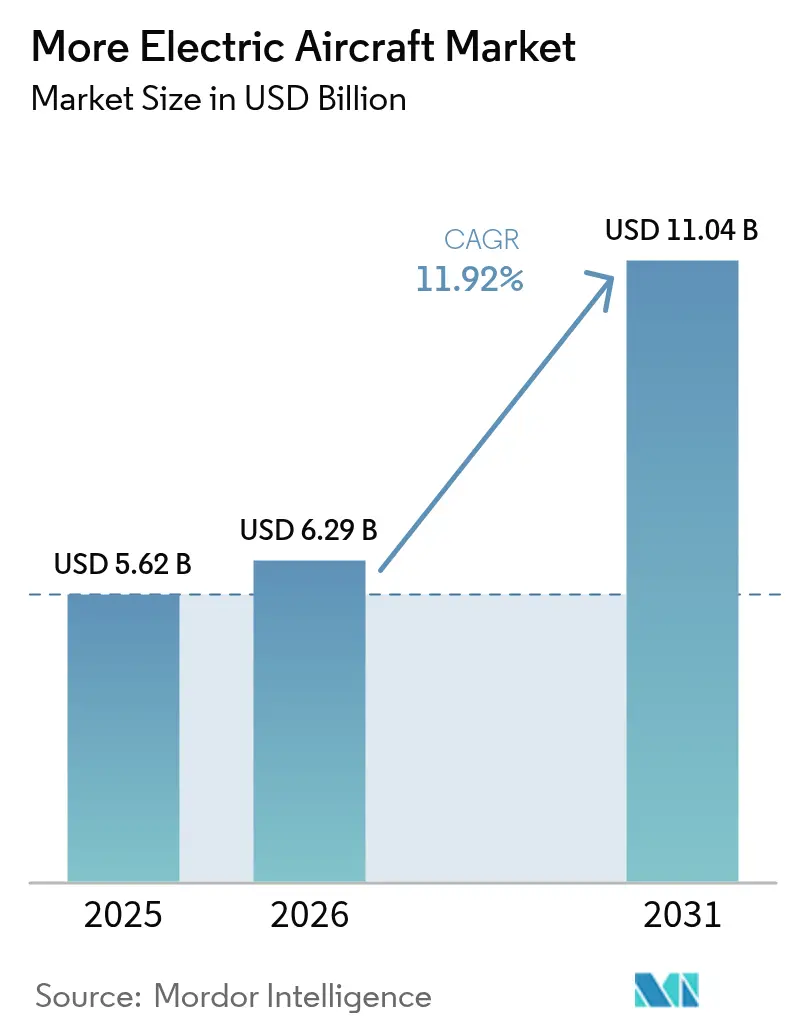
| Market Size (2026) | USD 6.29 Billion |
| Market Size (2031) | USD 11.04 Billion |
| Growth Rate (2026 - 2031) | 11.92% CAGR |
| Fastest Growing Market | Asia Pacific |
| Largest Market | North America |
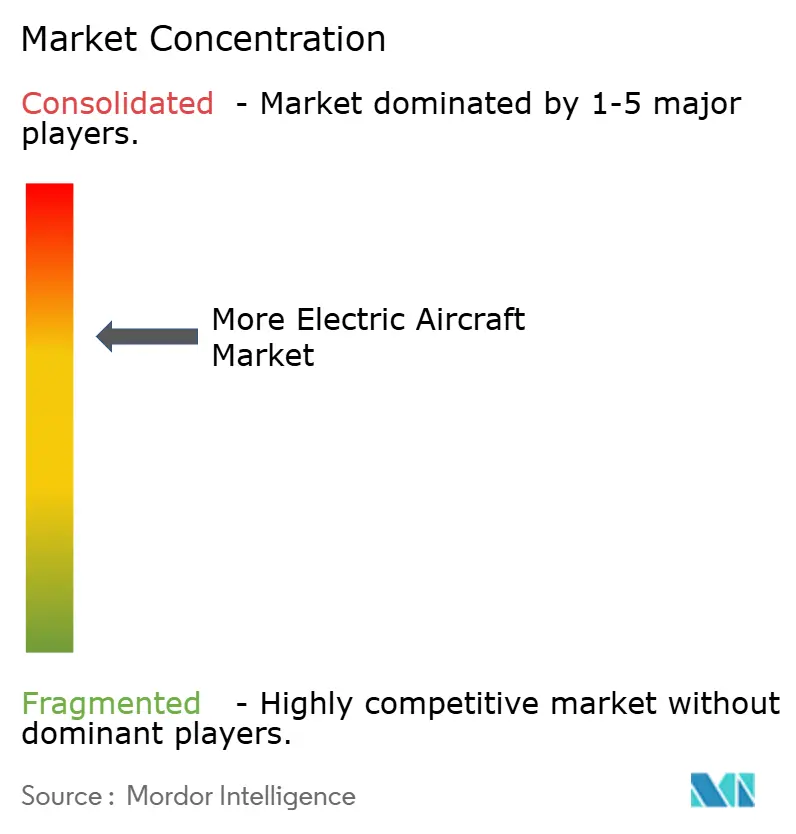
| Market Concentration | Medium |
Major Players *Disclaimer: Major Players sorted in no particular order Image © Mordor Intelligence. Reuse requires attribution under CC BY 4.0. | |
More Electric Aircraft Market Analysis by Mordor Intelligence
The more electric aircraft (MEA) market size in 2026 is estimated at USD 6.29 billion, growing from 2025 value of USD 5.62 billion with 2031 projections showing USD 11.04 billion, growing at 11.92% CAGR over 2026-2031. Rising fuel prices, carbon-reduction mandates, and the maturation of high-power electronics push airlines and airframers to swap hydraulic and pneumatic subsystems for electrical architectures. Airlines report fuel-burn savings of up to 20% when engines no longer bleed air for environmental control, while power-dense generators and solid-state batteries support longer electric endurance. Fixed-wing programs such as the B787 prove bleed-less operation in service, and eVTOL developers apply the same logic to urban missions. As a result, incumbents and start-ups race to secure wide-bandgap semiconductors, thermal control materials, and high-voltage certification slots to keep pace with demand.
Key Report Takeaways
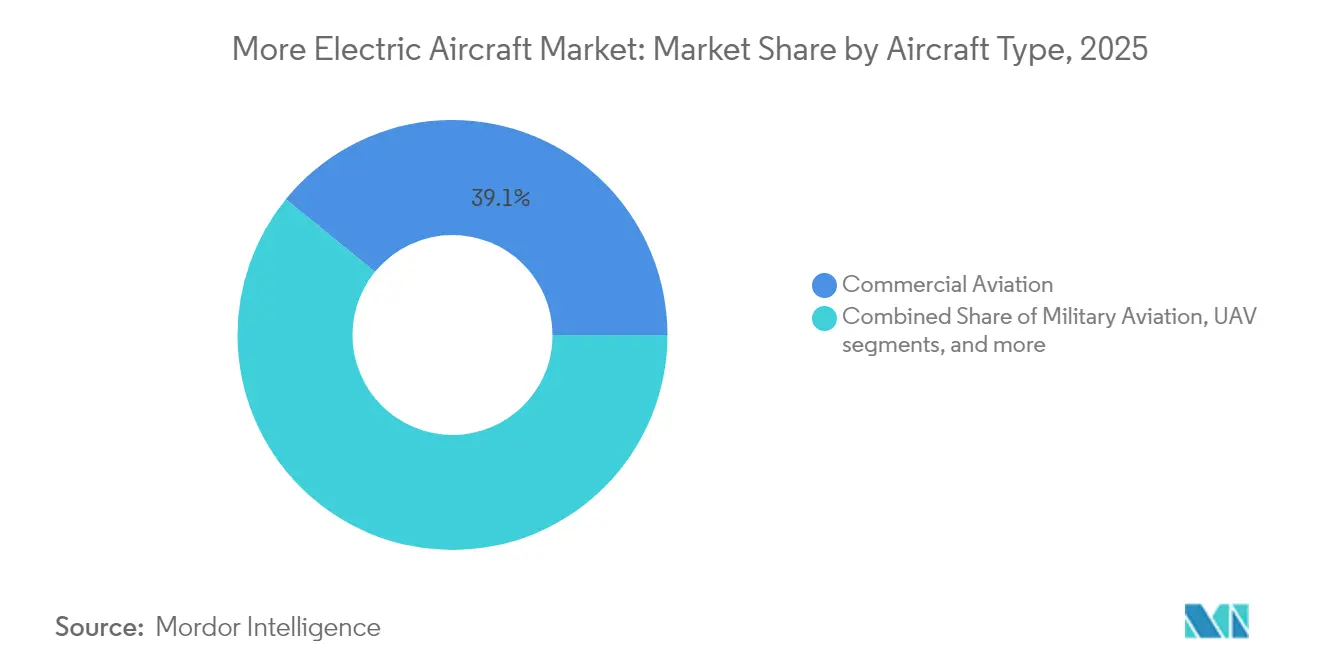
- By aircraft type, commercial aviation held 39.12% of the more electric aircraft market share in 2025, whereas urban air mobility and eVTOL platforms are poised for the fastest expansion at a 15.38% CAGR through 2031.
- By platform, fixed-wing designs led with 63.10% of the more electric aircraft market share in 2025; rotary-wing and powered-lift programs outpace at a 12.18% CAGR to 2031.
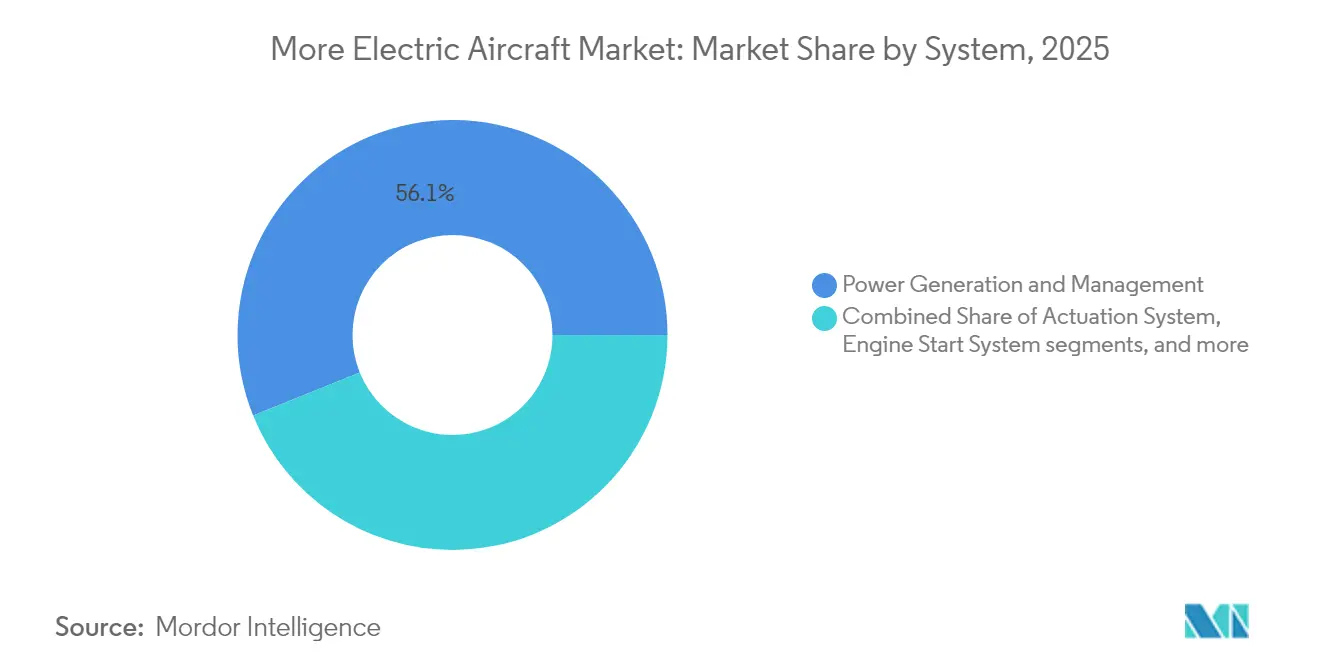
- By system, power-generation and management hardware accounted for 56.10% of the more electric aircraft market size in 2025, while electromechanical actuation grows quickest at an 12.14% CAGR through 2031.
- By end-user, OEMs controlled 53.21% of 2025 value, yet the aftermarket segment accelerates at 12.31% CAGR through 2031.
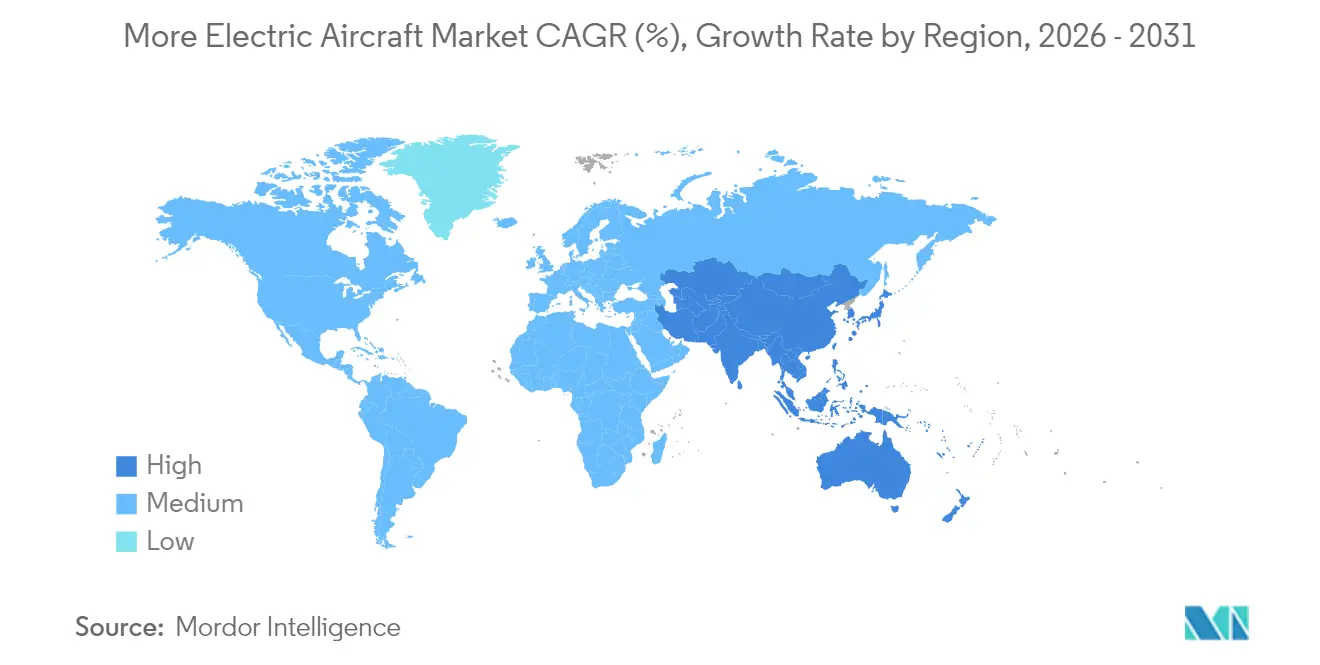
- By geography, North America commanded 34.96% revenue in 2025, whereas Asia-Pacific registers the highest regional CAGR at 12.24% to 2031.
Note: Market size and forecast figures in this report are generated using Mordor Intelligence’s proprietary estimation framework, updated with the latest available data and insights as of 2026.
Market Trends and Insights
Drivers Impact Analysis of More Electric Aircraft Market*
| Driver | (~) % Impact on CAGR Forecast | Geographic Relevance | Impact Timeline |
|---|---|---|---|
| Electrification drive to cut fuel burn and CO₂ | +3.2% | Global | Medium term (2-4 years) |
| Global emission regulations tightening | +2.8% | North America and EU; spill-over to APAC | Short term (≤ 2 years) |
| High-power motors and SiC/GaN electronics | +2.1% | Global; early adoption in North America | Medium term (2-4 years) |
| Solid-state batteries enable power-spike loads | +1.9% | APAC core; spill-over to North America | Long term (≥ 4 years) |
| ESG-driven retrofit demand for APUs | +1.4% | North America and EU | Short term (≤ 2 years) |
| Stealth-focused electric actuation (defense) | +0.9% | North America; selective EU markets | Medium term (2-4 years) |
| Source: Mordor Intelligence | |||


Electrification Drive to Cut Fuel Burn and CO₂
Fuel accounts for 20%-30% of airline operating expense, making kilowatt-class electric powertrains economically attractive in addition to their emission benefits. GE Aerospace’s CLEEN III demonstration delivers a 90 kW starter-generator that removes bleed-air plumbing and lets turbofan cores run closer to optimum thrust settings.[1]GE Aerospace, “CLEEN III Electric Propulsion Demonstration,” geaerospace.com Collins Aerospace’s bleed-less environmental control pack on the 787 illustrates how electrical subsystems lower carbon output while easing maintenance planning.[2]Collins Aerospace, “Bleed-less Environmental Control Systems,” collinsaerospace.com Airlines thus gain predictable inspection intervals and fewer fluid leaks, reducing unscheduled ground time. These dual financial and compliance rewards reinforce continuous investment in electrified line-fit and retrofit programs across fleet types.
Global Emission Regulations Tightening
Binding rules now supplant voluntary pledges. The US Federal Aviation Administration (FAA) adopted fuel-efficiency standards effective April 2024 that set maximum fuel per seat-kilometer for new jets.[3]Federal Aviation Administration, “Final Rule on Airplane Fuel-Efficiency Standards,” faa.gov The European “ReFuelEU” mandate obliges carriers to uplift 6% sustainable aviation fuel by 2030 and 70% by 2050, prompting hybrid-electric architectures that blend drop-in fuels with electric boost. ICAO’s global offset scheme requires verifiable emission cuts, forcing OEMs to accelerate electrical integration because incremental engine tweaks cannot satisfy near-term compliance windows. Airbus, for example, publicly targets a zero-emission commercial model by 2035 to stay within regulatory guardrails.
High-Power Motors and SiC/GaN Electronics
Silicon-carbide (SiC) and gallium-nitride (GaN) switches halve conduction losses relative to silicon, enabling megawatt-scale motors without prohibitive weight. A NASA-GE demonstrator pairs a 1 MW electric machine with SiC drives to show 20% cruise fuel savings on a single-aisle airframe. Device operation at 800 V-1,000 V reduces cable mass while tolerating higher junction temperatures, critical in cramped nacelle bays. Although automotive uptake has matured, wafer output has matured, and aerospace-grade lots remain limited, making strategic supply agreements a competitive differentiator. Collins Aerospace, therefore, opened a dedicated power-electronics lab in Rockford, Illinois, to design chips in-house and secure capacity ahead of volume needs.
Solid-State Batteries Enable Power-Spike Loads
Solid-state chemistries raise gravimetric energy above 500 Wh/kg and remove flammable liquid electrolytes. CATL’s condensed-battery prototype reached aviation testing in 2025 and aims for service entry by 2028 with stackable, fire-resistant packs. NASA’s sulfur-selenium cells double the current lithium-ion energy per kilogram and promise eVTOL ranges of 200 miles without hybrid backup.[4]NASA, “Megawatt-Class Electrified Powertrain Flight Demonstration,” nasa.gov High discharge rates cover peak lift and landing loads, slimming auxiliary power units in some architectures. Certification tracks for solid-state modules align with urban air-mobility timelines, suggesting technology and regulatory readiness may converge before decade-end.
Restraints Impact Analysis of More Electric Aircraft Market*
| Restraint | (~) % Impact on CAGR Forecast | Geographic Relevance | Impact Timeline |
|---|---|---|---|
| High-voltage certification hurdles | -2.1% | Global; standards vary | Medium term (2-4 years) |
| Thermal reliability of dense power modules | -1.8% | Global | Short term (≤ 2 years) |
| Scarcity of aero-grade SiC supply chain | -1.5% | Global; concentration in Asia | Medium term (2-4 years) |
| Airport MRO infrastructure lag | -1.2% | Global; slower adoption in emerging markets | Long term (≥ 4 years) |
| Source: Mordor Intelligence | |||
High-Voltage Certification Hurdles
Electric propulsion routinely exceeds 1,000 V DC, yet historical regulations focus on 270 V architectures. The FAA issued special conditions for BETA Technologies’ H500A to address new arc-fault and insulation-breakdown modes. Divergent rule-making between the FAA and EASA complicates global validation, obliging developers to engineer for multiple worst-case scenarios. Boeing’s B777-9 still faces additional scrutiny for operations without conventional electrical power, underscoring how legacy programs experience certification delays when voltage envelopes widen. These uncertainties lengthen development cycles and inflate budgets, tempering the headline growth rate of the more electric aircraft market.
Thermal Reliability of Dense Power Modules
Even at 99% efficiency, megawatt-class electronics shed kilowatts of waste heat into confined fuselage spaces. Honeywell’s European consortium found that hybrid-electric single-aisles must dissipate more than 1 MW during climb, surpassing the capacity of bleed-air environmental control systems. EU-funded ICOPE research, therefore, advances micro-channel heat sinks and phase-change materials tailored to high-altitude pressure regimes. Thermal cycling also stresses solder joints in SiC modules, endangering reliability if not mitigated through robust packaging. Until cooling architectures mature, manufacturers balance power density against service-life risk, constraining the pace of electrification.
*Our forecasts treat driver/restraint impacts as directional, not additive. The impact forecasts reflect baseline growth, mix effects, and variable interactions.
More Electric Aircraft Market Segment Analysis
By Aircraft Type:
Commercial Leadership and eVTOL SurgeCommercial airframes contributed 39.12% of the more electric aircraft market in 2025 as airlines replaced hydraulics with distributed electrical subsystems to curb maintenance outlay. Carriers highlight predictable life-cycle costs when line-replaceable units are solid-state rather than fluid-powered. Meanwhile, the eVTOL category posts a 15.38% CAGR to 2031, signaling rising investor confidence in city-pair air-taxi operations. Certification milestones by Joby and Archer shifted perceptions from concept to near-term service, unlocking fleet orders from regional operators. Military programs adopt electric actuation chiefly for radar-signature reduction, while business aviation follows for lower cabin noise and airport emissions.
The segment divergence suggests the more electric aircraft market may recalibrate traditional demand metrics. JSX’s plan to accept more than 300 hybrid-electric regional aircraft after 2028 illustrates how regional carriers will leapfrog older fleets when viable. Accelerated orders shrink developmental lead times, forcing supply chains to allocate semiconductors first to eVTOL founders. Limited cell production for high-cycle batteries thus becomes a gating item for legacy narrow-body retrofits. Still, retrofit kits for older commercial types gain traction where full fleet renewal is financially prohibitive, ensuring a balanced order mix across aircraft classes.


By Platform:
Fixed-Wing Dominance, Rotary-Wing MomentumFixed-wing designs held 63.10% of the more electric aircraft market size in 2025, thanks to certified reference programs such as the B787 and A350 demonstrating electric environmental control in revenue service. These examples reassure regulators and lessors when approving high-voltage retrofits to narrow-body fleets. At the same time, rotary-wing and powered-lift concepts expand at 12.18% CAGR, buoyed by the step-change in hover efficiency that direct-drive electric motors deliver.
DARPA’s XRQ-73 hybrid-electric drone blends rotor lift with fixed-wing cruise and showcases how power electronics endow vertical assets with stealth and endurance. Electra’s short-takeoff regional demonstrator collapses the divide further, hinting that future taxonomy will focus on mission profile rather than wing planform. Rotary programs also exploit the absence of gearbox lubrication lines, cutting weight and maintenance. This blurring of categories could spur unified certification frameworks, smoothing entry for unconventional layouts and sustaining platform diversity inside the more electric aircraft market.
By System:
Power Generation Leads as Actuation AcceleratesPower-generation and management units represented 56.10% of 2025 revenue, reflecting airlines’ need for stable, high-voltage buses before secondary subsystems transition. Modular starter-generators enable gate-to-gate electrical power, while smart converters stabilize frequency and mitigate fault cascades. Integrated racks simplify wiring runs and reduce electromagnetic interference, a critical trait when voltages approach 1 kV.
Actuation hardware advances fastest at an 12.14% CAGR through 2031, driven by demand for precision servo-controls that outperform hydraulics during dynamic maneuvers. Saab’s flight-qualified electromechanical actuators evidence higher positional accuracy, plus leak-free operation that improves aircraft dispatch reliability. Thermal-management elements gain relevance in lock-step, as compact pumps and liquid-cold plates become mandatory at megawatt scales. Engine-start converters, once pneumatic, turn fully electric to permit autonomous pushback without ground carts, cutting turnaround time. These trends re-order supplier hierarchies: semiconductor foundries and thermal specialists ascend alongside legacy propulsion primes.
By End-User:
OEM Control, Aftermarket UpsideOEMs retained 53.21% of the value share in 2025 due to design authority and direct line-fit sales. They embed integrated flight-by-wire and electric bleed-less packs at the build stage, capturing premium margins. In contrast, aftermarket revenue grows 12.31% annually to 2031 as electric subsystems demand new diagnostic tools and repair competencies. Predictive maintenance portals that ingest high-frequency power-quality data become subscription products for airlines.
Airbus projects the wider services pool to reach USD 290 billion by 2043, with electric-specific monitoring as a core pillar. Collins Aerospace already trains MRO technicians on arc-flash safety and high-energy battery handling, betting that post-delivery support will eclipse equipment margin across a 30-year aircraft life. Independent repair stations invest in insulated tooling and battery-storage bunkers to compete, but capital requirements act as a barrier, reinforcing OEM leverage. This shift underscores why competence in lifetime service propositions now influences aircraft selection alongside acquisition price.
Geography Analysis
North America More Electric Aircraft Market
North America held 34.96% of 2025 spending as defense budgets backed megawatt demonstrators and the FAA provided early pathways for electric propulsion certification. Established Tier-1 suppliers in the United States anchor a mature ecosystem that co-locates research laboratories, test rigs, and human-capital pipelines. NASA’s Electrified Powertrain Flight Demonstration program pairs GE and Boeing engineers to flight-test hybrid propulsion on a regional platform by 2027, reinforcing regional momentum.
Europe More Electric Aircraft Market
Europe ranks second by value, buoyed by Clean Aviation grants and airport decarbonization policies. EU projects such as GOLIAT and EcoPulse channel public funds into liquid-hydrogen handling, superconducting cables, and hybrid-electric flight tests. EASA harmonization with the FAA accelerates transatlantic validation for eVTOLs, shortening time-to-market for dual-registry operators. Nevertheless, European suppliers face currency inflation in semiconductor procurement, prompting joint ventures with Asian foundries to secure wafer allocations.
APAC More Electric Aircraft Market
Asia-Pacific records the highest growth at a 12.24% CAGR. China’s Civil Aviation Administration earmarked dedicated low-altitude corridors for eVTOL logistics and passenger shuttles, compressing commercial deployment timelines. State plans to build a trillion-yuan general-aviation industry by 2030, injecting subsidies and regulatory certainty to attract foreign Tier-2 suppliers. Japan and South Korea focus on urban demonstrator flights for Expo-type events, offering a showcase before broader certification. However, airport readiness lags. India explores electric regional turboprops for short-haul routes under the UDAN connectivity scheme. The region’s diverse market entries collectively translate into sustained order books for battery, motor, and avionics vendors, ensuring Asia-Pacific remains the principal volume driver in the more electric aircraft market.

Regulatory Landscape
Certification for more-electric and hybrid-electric propulsion continues to rely on performance-based pathways rather than fully prescriptive rules, particularly as architectures move beyond legacy 270 V systems. In the United States, the FAA has been issuing propulsion-focused special conditions under 14 CFR 21.16 for novel electric engines, including Final Special Conditions No. 33-031-SC in March 2026 for ZeroAvia's ZA601 electric engine and an amendment in January 2026 expanding Special Conditions No. 33-23-01-SC to include Safran ENGINe US100B1 and US100B2 models. In Europe, EASA maintains Special Condition SC E-19 for Electric and Hybrid Propulsion Systems (EHPS) as a dedicated certification reference for electric and hybrid applications across manned and unmanned aircraft.
Environmental and noise compliance is also tightening globally, which feeds into design choices for power generation, distribution, and thermal management. In March 2026, the ICAO Council adopted updated CO2 and noise technical standards for new aircraft designs, with an effective date of 3 August 2026 and an application date of 1 January 2027, including a 10% increase in CO2 stringency for large aeroplanes. Together, these frameworks raise the premium on validated high-voltage safety features (arc-fault detection, insulation coordination) and on certification-ready evidence packages for integrated electrical power generation and distribution systems.
Value Chain Analysis
The MEA value chain depends on close co-development between airframers, propulsion and systems integrators, and specialist electrical technology providers, with public programs increasingly used to de-risk technology maturity and certification. Upstream inputs include aero-grade SiC/GaN devices, high-voltage connectors and wiring, electrical steels and magnet materials for machines, and thermal materials such as cold plates, heat exchangers, and phase-change elements. Midstream, Tier-1 suppliers integrate generators, converters, distribution, and electromechanical actuation into certified LRUs and integrated racks, then validate them via stepwise demonstrations; for example, Collins Aerospace completed the Clean Aviation-funded HECATE project in March 2026 and reported TRL5 for hybrid-electric electrical power generation and distribution technologies.
Downstream, OEM line-fit and retrofit channels split demand between new-build aircraft electrical architectures and upgrades to subsystems such as actuation, ECS, and power conversion, with MRO capability and high-voltage handling as gating factors. Industrialization and capacity placement are becoming part of chain strategy: GE Aerospace completed ground testing in June 2026 of a megawatt-class hybrid-electric propulsion system under NASA's EPFD project, showing the path from lab validation to integrated test assets. On industrial footprint, Collins Aerospace highlighted its Wolverhampton engineering center advancing electric thrust reverser actuation (elecTRAS) for next-generation narrowbody aircraft, while airframer propulsion roadmaps are also moving toward structural partnerships, including Airbus and MTU Aero Engines announcing intent in July 2026 to form a joint venture around a fully electric hydrogen fuel cell engine for commercial aircraft.
Competitive Landscape
The more electric aircraft market is moderately concentrated. Legacy primes—Collins Aerospace, Honeywell, Safran, GE Aerospace, and Rolls-Royce—command program-management prowess and hold deep certification experience that newcomers cannot replicate quickly. All five invested in dedicated power-electronics test halls between 2024 and 2025, signaling a strategic pivot from turbine-only portfolios to full electrified propulsion stacks.
Acquisition remains the favoured route to close technology gaps. Honeywell purchased battery-management software start-ups to complement its flight-control line. Safran absorbed ePropelled’s motor IP, integrating stator manufacturing into its Villeurbanne facility. GE Aerospace partnered with magniX to co-develop megawatt generators for commuter aircraft, using GE’s additive manufacturing to speed stator prototyping. Such moves tighten vertical control over critical path items—power electronics, thermal loops, and certification data packages—leaving component-only firms vulnerable unless they join broader ecosystems.
Start-ups differentiate through agility and niche focus. Wright Electric emphasizes 186-seat short-haul missions to replace aging narrow-bodies, whereas Ampaire concentrates on hybrid conversions of existing regional aircraft to leverage current airframes. Joby Aviation’s FAA special conditions for its JAS4-1 grant early-mover status and potential licensing revenue, establishing regulatory barriers for later entrants. As wide-bandgap chips and advanced batteries trend toward commodity status by 2030, sustainable competitive advantage will likely hinge on integration skill and digital twins that optimize system-of-systems performance rather than on single component superiority.
More Electric Aircraft Industry Leaders
Airbus SE
The Boeing Company
Safran SA
Honeywell International Inc.
RTX Corporation
- *Disclaimer: Major Players sorted in no particular order
More Electric Aircraft Market Companies Covered in this Report
- Airbus SE
- The Boeing Company
- Collins Aerospace (RTX Corporation)
- Safran SA
- Honeywell International Inc.
- General Electric Company
- Rolls-Royce plc
- BAE Systems plc
- Parker-Hannifin Corporation
- Moog Inc.
- Eaton Corporation plc
- Thales Group
- Liebherr Group
- Crane Co.
- Diehl Aviation GmbH
- GKN Aerospace (Melrose plc)
- magniX USA, Inc.
- Ampaire Inc.
- Wright Electric Inc.

Market Opportunities and Future Outlook
A near-term opportunity is emerging in industrializing certification-aligned electrical building blocks, power distribution, conversion, and wiring harnesses as multiple programs shift from technology maturation into repeatable manufacturing. This can be seen in the transition from TRL demonstrations to scale-up initiatives, including Collins Aerospace completing the Clean Aviation Joint Undertaking HECATE work at TRL5 (March 2026) and Airbus defining the LEIA non-propulsive energy-architecture work with a stated TRL5 target by 2027. For suppliers, these efforts pull demand toward high-voltage distribution architectures, fault protection, and thermal solutions that can be reused across platforms, including fixed-wing regional hybrids, powered-lift programs, and next-generation single-aisle concepts.
Manufacturing footprint expansion and targeted public funding also create whitespace for new entrants and for Tier-2 specialists to join ramping ecosystems. Joby Aviation's acquisition of a 700,000 square foot manufacturing facility in Dayton, Ohio (January 2026) and VAE RIDION inaugurating an electric-propulsion manufacturing and test site at Oberpfaffenhofen Airport (March 2026) show capacity being positioned ahead of higher-rate builds in electric aircraft categories. On the supplier side, Safran Electrical and Power received a 14.7 million euro EU Innovation Fund grant in May 2026 to automate ENGINeUS motor production, and it inaugurated a 10,600 square meter electrical wiring factory in Chihuahua, Mexico in July 2026, highlighting wiring and motor industrialization as practical bottlenecks being addressed. Alongside NASA-linked concept activity, such as Electra's June 2026 100+ passenger turbo-electric airliner concept under AACES, the longer-cycle pipeline for megawatt-class generation, distribution, and actuation suppliers stays active even as near-term revenues concentrate in regional, training, and eVTOL architectures.
Recent Industry Developments in More Electric Aircraft Market
- June 2026: Electra unveiled a conceptual turbo-electric aircraft design for a 100+ passenger airliner under NASA's Advanced Aircraft Concepts for Environmental Sustainability (AACES) 2050 program. The concept frames a higher-power, transport-class demand signal for megawatt-scale power generation, conversion, and distribution components and supports the case for supplier investment beyond eVTOL-class power levels.
- March 2026: RTX's Collins Aerospace announced completion of the Clean Aviation Joint Undertaking HECATE project, reporting Technology Readiness Level 5 for hybrid-electric electrical power generation and distribution technologies validated with a 500 kW hybrid-electric system. The milestone advances certification-relevant evidence for high-voltage distribution architectures and accelerates a pathway from EU-funded demonstrations into OEM integration and aftermarket support toolchains.
- December 2024: Airbus stated that EcoPulse flight-test activity helped validate a distributed hybrid-electric propulsion demonstrator as part of broader work toward more sustainable aviation. Demonstration outcomes like EcoPulse support risk reduction in electrical propulsion integration, including power management and thermal constraints, and provide data that suppliers and regulators use to mature guidance for more-electric architectures.


More Electric Aircraft Market Report Scope and Research Methodology
Market Definition and Coverage
For this methodology, the more electric aircraft market covers the value of aircraft-level electrical architectures and onboard systems that replace or reduce hydraulic and pneumatic functions with electrical power across fixed-wing and rotary platforms.
Scope exclusions: We exclude pure airframe structures, conventional fuel and engine hardware, and airport-side charging infrastructure unless it is sold as part of an aircraft system package.
Segments Covered in This Report
- By Aircraft Type
- Commercial Aviation
- Military Aviation
- Business and General Aviation
- Unmanned Aerial Vehicles (UAV)
- Urban Air Mobility/eVTOL
- By Platform
- Fixed Wing
- Rotary Wing
- By System
- Power Generation and Management
- Electric Power Generation
- Power Conversion
- Power Distribution
- Actuation System
- Flight Control Actuation
- Landing Gear Actuation
- Thermal Management System
- Engine Start System
- Environmental Control System
- Others
- Power Generation and Management
- By End-user
- OEM
- Aftermarket
- By Geography
- North America
- United States
- Canada
- Mexico
- Europe
- United Kingdom
- France
- Germany
- Rest of Europe
- Asia-Pacific
- China
- Japan
- India
- South Korea
- Rest of Asia-Pacific
- South America
- Brazil
- Rest of South America
- Middle East and Africa
- Middle East
- Saudi Arabia
- United Arab Emirates
- Rest of Middle East
- Africa
- South Africa
- Rest of Africa
- Middle East
- North America
Data Sources, Market Sizing, and Validation
Desk Research
Desk research was first used to set the demand context and the technical boundaries for what counts as more-electric content on an aircraft. We leaned on public and repeatable sources such as FAA and EASA airworthiness and certification publications, ICAO and IATA fleet and traffic briefs, and aircraft program factsheets released through OEM and airline channels.
To anchor the numbers, we also reviewed government and defense budget documents for procurement timing, trade and customs statistics where electrical aircraft components are visible in import and export lines, and peer-reviewed journals that discuss no-bleed architectures, actuation shifts, and thermal limits. Company filings, investor decks, and trusted aerospace press were then used to check program ramp-ups and supplier mix, and a paid subscription covering company financials and public news helped track contract wins and delivery updates. These examples are not exhaustive, and we also checked other public sources for data collection, validation, and clarification.
Primary Interviews and Surveys
Primary work was used to confirm which systems are being electrified first and how content per aircraft is changing across commercial, military, and general aviation platforms. We spoke with a mix of engineering, program, supply-chain, and aftermarket respondents across major producing and operating regions, so assumptions on adoption timing, typical system fit, and price progression could be adjusted with real-world feedback.
Distribution of primary research fieldwork respondents
| Company type | Respondent position | Region |
|---|---|---|
| Top tier: 36% | CXOs: 16% | APAC: 45% |
| Mid tier: 45% | Functional/Unit leaders: 38% | EMEA: 34% |
| Smaller Players: 19% | Managers: 46% | Americas: 21% |
Market-Sizing & Forecasting
Our core model starts from a top-down build that reconstructs the addressable demand pool using aircraft production and delivery schedules by platform and end user, which are then translated into more-electric system content assumptions per aircraft. Once that demand pool was set, we applied selective bottom-up approximations, mainly sampled system ASPs multiplied by expected shipset volumes, followed by channel checks for aftermarket timing so the totals could be stress-tested and tuned.
Key inputs used in the model include announced aircraft program build rates, retrofit versus line-fit split, the share of no-bleed and electric actuation architectures in new deliveries, average electrical power generation capacity shifts by platform class, and expected thermal management content growth as power density rises. Where direct pricing was not consistently available, price bands were built from interview consensus and then adjusted using inflation and learning-curve style discounting tied to production scale.
For forecasting, we used scenario analysis, since ramp timing can shift with certification, supply constraints, and defense procurement cycles. A base case was created first, and then conservative and aggressive cases were applied to the same variables. The final forecast was selected based on what interviewees viewed as the most realistic delivery and retrofit cadence.
Data Validation & Update Cycle
Validation was done in several passes, because the same aircraft can be counted differently when platform, system, and end-user assumptions drift. Model outputs were compared against independent signals such as fleet additions, major program milestones, and stated electrification roadmaps, and then variances were re-checked with follow-up expert calls when results fell outside expected ranges.
Before sign-off, the numbers move through multi-step analyst review for logic, unit consistency, and year-on-year movement. Any outlier growth is forced to be explained by a clear driver such as a program entry-into-service, a retrofit wave, or a change in ASP assumptions. Reports refresh annually, and interim updates are made when material events occur, after which a final pre-delivery review is completed so clients receive the latest view.
Mordor Intelligence's More Electric Aircraft Market Sizing Compared With Other Published Estimates
Published estimates for more electric aircraft do not always match, mainly because each study draws the market line around different aircraft types, system boundaries, and timing assumptions. Differences also show up when one source emphasizes line-fit deliveries, while another leans more heavily on retrofit and aftermarket value.
In this market, the biggest gap drivers are usually whether the estimate counts only electrical power generation and distribution hardware, or it also includes adjacent items like broader avionics electronics, plus how aggressive the assumed shift from hydraulic and pneumatic systems is by aircraft program. Another common reason is refresh cadence, since delivery schedules, certification timing, and defense orders can move within a year, which then changes the near-term totals and the compounding forecast path.
Benchmark comparison
| Source | Market Size | Gaps in Research Methodology |
|---|---|---|
| Mordor Intelligence | USD 6.29 B (2026) | |
| Industry Publisher A | USD 5.51 B (2026) | Uses a narrower component scope that leans toward line-fit content and applies more conservative adoption shares for electric actuation and no-bleed architectures in early years. |
| Advisory Group B | USD 9.62 B (2025) | Rolls a wider set of electrical and electronic aircraft subsystems into the total and uses an earlier current-year base, which inflates the headline when compared year-to-year. |
The table shows that most of the spread comes from what is counted as more-electric system value and how quickly electrified architectures are assumed to penetrate new deliveries and retrofits. By keeping the total tied to aircraft delivery demand and system-level content rules, and by refreshing program timing before finalizing the current-year value, a more traceable total is produced by Mordor Intelligence, even when other sources use valid but different scope and timing choices.


Key Questions Answered in the Report
What is the current value of the more electric aircraft market?
The market stands at USD 6.29 billion in 2026 and is projected to climb to USD 11.04 billion by 2031, advancing at a 11.92% CAGR.
Which aircraft category is growing fastest?
Urban air-mobility and eVTOL platforms record the highest growth at a 15.38% CAGR through 2031.
Why do airlines favor electric actuation over hydraulics?
Electric actuators cut maintenance, prevent fluid leaks, and integrate seamlessly with predictive-maintenance software, improving dispatch reliability.
Which region leads demand today, and which region grows quickest?
North America leads in 2025 with 34.96% revenue, while Asia-Pacific posts the steepest growth at 12.24% CAGR.
What technologies most influence future adoption?
Wide-bandgap SiC/GaN power electronics, solid-state batteries above 500 Wh/kg, and megawatt-class starter-generators define the performance envelope for next-generation electric aircraft.
How will the aftermarket evolve for electric aircraft?
The aftermarket is expected to outpace OEM sales at 12.31% CAGR as airlines require specialized training, insulated tooling, and digital monitoring to service high-voltage systems.
Page last updated on:






