
Middle East and Africa Fruits and Vegetables Juice Market Size and Share
Market Overview
| Study Period | 2021 - 2031 |
|---|---|
| Forecast Data Period | 2026 - 2031 |
| Base Year Market Size (2025) | USD 8.03 Billion |
| Market Size (2026) | USD 8.5 Billion |
| Market Size (2031) | USD 11.47 Billion |
| Growth Rate (2026 - 2031) | 6.16 % |
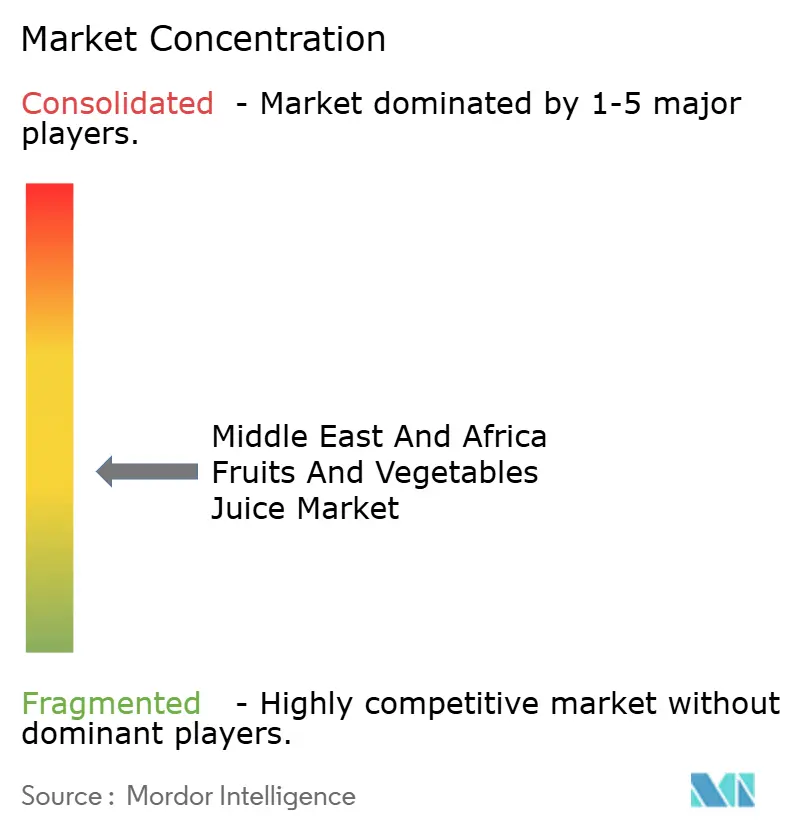
| Market Concentration | Medium |
Major Players *Disclaimer: Major Players sorted in no particular order Image © Mordor Intelligence. Reuse requires attribution under CC BY 4.0. | |
Middle East and Africa Fruits and Vegetables Juice Market Analysis by Mordor Intelligence
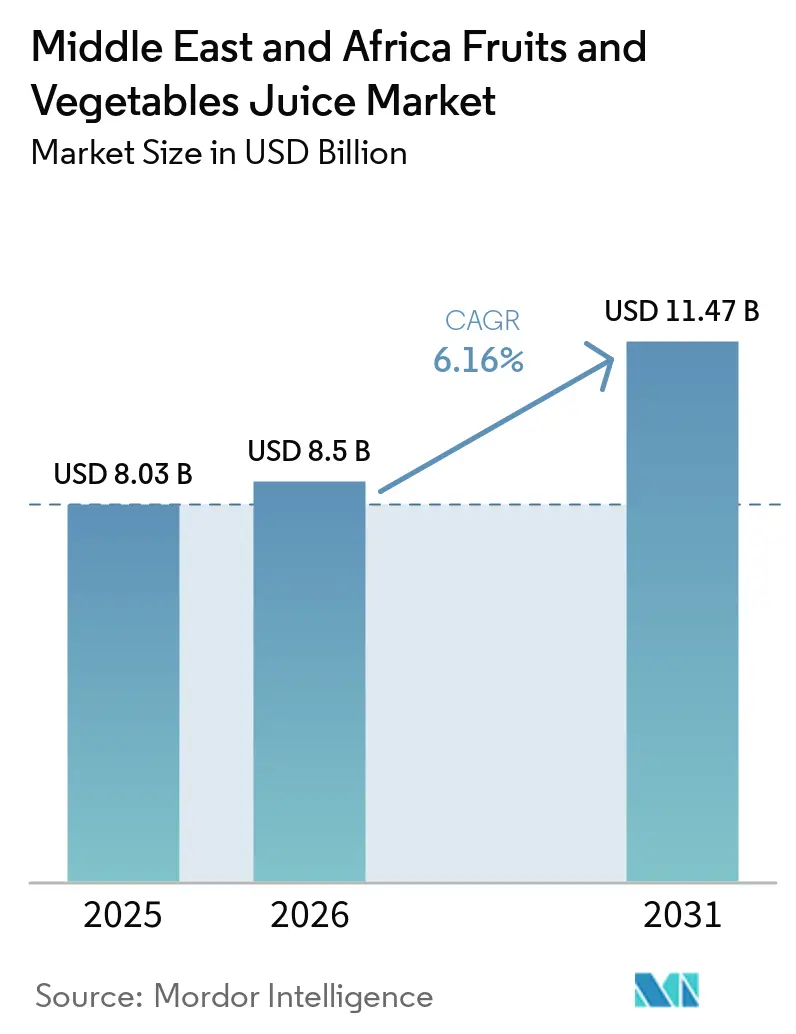
The Middle East and Africa fruit and vegetable juice market size was USD 8.03 billion in 2025 and is forecast to reach USD 11.47 billion by 2031 at a CAGR of 6.16% from 2026 to 2031. Urbanization, a shift towards health-focused consumption, and supportive nutrition policies drive demand in rapidly expanding modern retail channels across metropolitan areas. Climate-driven hydration needs, government initiatives promoting 100% juice, and advancements in cold-chain technologies collectively support volume growth. The increasing pace of urbanization has fueled demand for convenient, ready-to-drink beverages, making fruit and vegetable juices a preferred option for on-the-go consumers. Consumers are increasingly opting for juices free from added sugars, preservatives, and artificial colors, reinforcing the clean-label trend in retail. Manufacturers are focusing on flavor innovations, clean-label production, and halal certifications to secure premium shelf space and maintain brand equity. While competition remains moderate, regional players leverage local taste preferences and vertically integrated sourcing to counter the scale advantages of multinational companies. Growth opportunities are concentrated in functional blends, organic variants, and digital direct-to-consumer models, driven by the rising adoption of smartphones.
Key Report Takeaways
- By product type, 100% juice led with 55.67% revenue share in 2025, while nectar is forecast to expand at a 6.28% CAGR through 2031.
- By category, fruit juice accounted for 76.11% share in 2025, while vegetable juice is projected to grow at a 5.85% CAGR through 2031.
- By nature, conventional juice held 85.34% share in 2025, while organic juice is set to record the fastest CAGR at 7.04% through 2031.
- By packaging material, Tetra Pak cartons captured 41.27% share in 2025, while PET bottles are advancing at a 6.73% CAGR through 2031.
- By distribution channel, supermarkets and hypermarkets retained a 46.57% share in 2025, while online retail stores are expected to grow at a 7.06% CAGR through 2031.
- By geography, Saudi Arabia held 25.28% revenue share in 2025, while Nigeria is forecast to grow at a 6.39% CAGR through 2031.
Note: Market size and forecast figures in this report are generated using Mordor Intelligence’s proprietary estimation framework, updated with the latest available data and insights as of January 2026.
Market Trends and Insights
Drivers Impact Analysis of Middle East and Africa Fruits and Vegetables Juice Market*
| Driver | (~) % Impact on CAGR Forecast | Geographic Relevance | Impact Timeline |
|---|---|---|---|
| Growing Influence of Fitness and Wellness Lifestyles | +1.4% | Global, strongest in UAE (United Arab Emirates) and Saudi Arabia | Medium term (2-4 years) |
| Demand For Convenient on The Go Beverages Grows | +1.1% | GCC (Gulf Cooperation Council) wide, with spillover into urban Nigeria and South Africa | Short term (≤ 2 years) |
| Product Innovation Attracts Health Conscious Consumers | +1.0% | Global, with premium concentration in GCC and South Africa | Short term (≤ 2 years) |
| Growing Organic Juice Consumption Across Developed Markets | +0.8% | UAE, Saudi Arabia, Turkey | Medium term (2-4 years) |
| Strong Advertising Investments By Leading Juice Manufacturers | +0.6% | Saudi Arabia, UAE, Egypt | Short term (≤ 2 years) |
| Increasing Investment In Juice Processing Technologies | +0.5% | Saudi Arabia, UAE, Turkey | Long term (≥ 4 years) |
| Source: Mordor Intelligence | |||
Growing Influence of Fitness and Wellness Lifestyles
Health and wellness priorities are changing beverage buying patterns across the GCC, where public programs tied to quality of life, fitness, and nutrition are shaping consumer expectations for packaged drinks. In the Middle East and Africa fruit and vegetable juice market, juice is increasingly judged on perceived functional value rather than only on refreshment, which is supporting demand for cleaner ingredient lists and added nutrition claims. In the Middle East and Africa (MEA), intensified health awareness campaigns are driving a significant transition from carbonated beverages to pure fruit juices. According to the Saudi Food and Drug Authority, Saudi Arabia's government initiatives targeting 85% localization in food production by 2030 emphasize nutritional quality standards, favoring 100% juice products over artificially sweetened alternatives[1]. This shift is particularly prominent among urban millennials and Generation Z, who are willing to pay a premium for perceived health benefits. The Middle East and Africa fruit and vegetable juice market is therefore seeing stronger support for products that combine familiar taste profiles with clearer nutrition messaging and better label credibility
Demand for Convenient On-the-Go Beverages Grows
Urban lifestyles across the UAE, Saudi Arabia, Nigeria, and South Africa continue to favor portable juice formats that suit commuting, workplace, school, and quick-purchase occasions. In the Gulf, this demand is showing up in premium single-serve packs sold through convenience-led locations, while African cities are supporting more affordable formats that move through dense neighborhood retail networks. Extreme temperatures and water scarcity in the MENA region are significantly influencing beverage consumption patterns, with on-the-go options becoming increasingly popular. Juice products, valued for their hydration and nutritional properties, are gaining prominence due to convenient packaging. In 2023, the Federal Competitiveness and Statistics Centre recorded an average maximum temperature of 34.4 degrees Celsius in the United Arab Emirates [2]. To address climate-induced nutritional gaps, consumers are increasingly opting for functional juice formulations fortified with electrolytes and vitamins. The Middle East and Africa fruit and vegetable juice market is also benefiting because the same investment in last-mile distribution that helps e-commerce is improving replenishment speed for broader retail channels. This makes portable ambient products easier to scale than cold chain-dependent concepts in many parts of the region.
Product Innovation Attracts Health-Conscious Consumers
Product development in the Middle East and Africa fruit and vegetable juice market is moving in 2 clear directions: functional additions such as vitamins and fiber, and stronger ingredient stories built around local produce and authenticity. Almarai’s February 2025 investment of USD 50 million in sustainable packaging for its premium organic juice line showed how health claims, local ingredient appeal, and packaging upgrades are being combined into a single premium offer. Processing methods such as cold press and high-pressure processing are also helping brands extend shelf life while keeping a cleaner label position in premium retail. This is making premium innovation more technical and more capital-intensive, which favors manufacturers with better processing capabilities. The Middle East and Africa fruit and vegetable juice market is therefore rewarding companies that can link ingredient quality, functionality, and sustainability without losing shelf stability or price discipline
Growing Organic Juice Consumption Across Developed Markets
Organic demand remains concentrated in the UAE and Saudi Arabia, where high-income consumers, expatriate populations, and health-focused retail formats are supporting certified premium juice purchases. Turkey also matters because its broader organic agriculture base can support both domestic demand and supply for regional processors. In the Middle East and Africa fruit and vegetable juice market, this trend looks durable because retailers are expanding dedicated wellness shelf space rather than waiting for demand to build on its own. Organic positioning in the Gulf also often sits beside halal compliance, which raises certification demands and narrows the field to larger suppliers with stronger systems. That combination supports long-term premium growth but also keeps the segment more concentrated than the broader conventional category
Restraints Impact Analysis of Middle East and Africa Fruits and Vegetables Juice Market*
| Restraint | (~) % Impact on CAGR Forecast | Geographic Relevance | Impact Timeline |
|---|---|---|---|
| High Sugar Content Concerns Reduce Consumption | -0.7% | GCC wide, with growing relevance in Nigeria | Short term (≤ 2 years) |
| Short Shelf Life Challenges Distribution Efficiency | -0.5% | Sub Saharan Africa, rural MEA | Long term (≥ 4 years) |
| Rising Raw Material Costs Affect Profitability | -0.6% | Global, strongest in Turkey, Egypt, Nigeria | Medium term (2-4 years) |
| Seasonal Fruit Supply Fluctuations Impact Production | -0.4% | North Africa and Sub Saharan Africa | Long term (≥ 4 years) |
| Source: Mordor Intelligence | |||
High Sugar Content Concerns Reduce Consumption
Sugar-related regulation is becoming a more direct headwind for nectar and juice drink producers across the Gulf, especially after the shift to tiered excise structures in 2026. The Middle East and Africa fruit and vegetable juice market is feeling this pressure most clearly in products that sit between pure juice and sweeter value formats, because those recipes face the greatest reformulation burden. Producers now have to manage sugar levels, labeling, ingredient substitution, and portfolio architecture at the same time. This raises compliance costs even before any demand effect is measured at the shelf. The same regulatory direction is spreading beyond the GCC, which means sugar management will remain a lasting operating issue rather than a short policy event
Rising Raw Material Costs Affect Profitability
Concentrate costs for citrus and tropical fruits remain volatile, and that continues to pressure margins for manufacturers that rely on imported raw materials. Turkey and Egypt face added pressure because local currency weakness raises the landed cost of inputs priced in USD or EUR. Co Ro’s 2024 annual report noted that raw material inflation drove pricing pass-through decisions in Middle Eastern markets, including Saudi Arabia, Oman, and Jordan, and that volume softened in some channels as consumer resistance increased. In the Middle East and Africa fruit and vegetable juice market, this cost burden is heavier for mid-tier firms that lack procurement scale or hedging capacity. Freight delays and route disruption around the Red Sea are adding another layer of risk for imported juice inputs, which keeps cost planning difficult across several MEA supply chains
*Our forecasts treat driver/restraint impacts as directional, not additive. The impact forecasts reflect baseline growth, mix effects, and variable interactions.
Middle East and Africa Fruits and Vegetables Juice Market Segment Analysis
By Product Type:
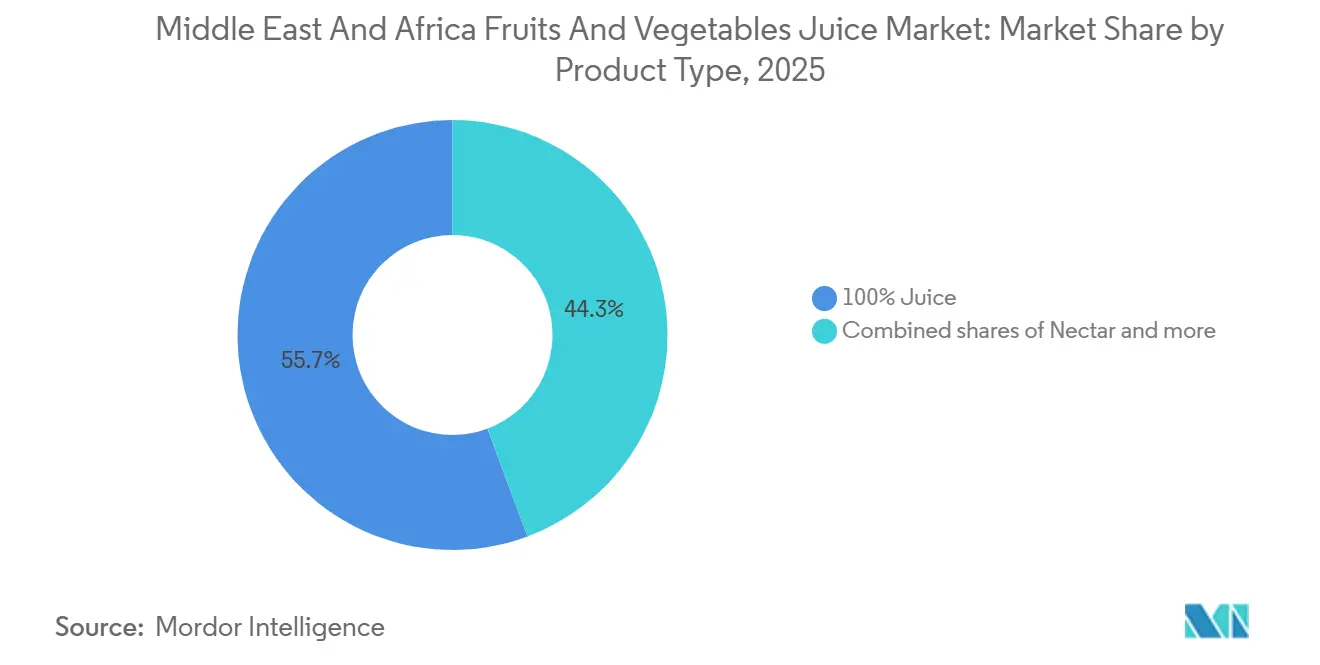
100% Juice Leads as Nectar Navigates Reformulation Pressure100% juice held 55.67% of the Middle East and Africa fruit and vegetable juice market share in 2025, which reflected strong demand for cleaner ingredient positioning and minimally processed formats in premium retail channels. The region's high fruit production further supports this market. For example, Africa's fruit production reached 137.15 million metric tons in 2023, according to the Food and Agriculture Organization [3]. Juice drinks remained important in mass market and food service settings where affordability still shaped purchase behavior. Nectar is projected to expand at a 6.28% CAGR through 2031, which makes it the fastest-growing product type despite its heavier exposure to new sugar-focused rules. Its growth is tied to the role it plays as an affordable premium option in African markets, where 100% juice has a narrower audience because of price.
That creates a mixed outlook for Nectar because demand remains real, but compliance and sugar reduction work are becoming harder to manage across country markets. The Middle East and Africa fruit juice industry is therefore pushing more strongly into hybrid products that can deliver health cues without moving too far from familiar juice taste profiles. Standards for fruit content declarations and labeling are also reinforcing consumer trust in the 100% juice segment. Producers with high pressure processing capability are better placed to grow premium 100% juice because they can preserve clean label positioning while still supporting commercial shelf life.

By Category:
Fruit Juice Dominates, Vegetable Juice Expands From a Small BaseFruit juice accounted for 76.11% of category revenue in 2025, which kept it far ahead of vegetable juice across the regional shelf. Citrus, mango, and other tropical flavors continued to anchor this leadership because they fit established taste preferences across many MEA countries. Vegetable juice is forecast to grow at a 5.85% CAGR through 2031, which is faster than the category average even though it starts from a smaller base. This growth is clustering in premium retail in the UAE and South Africa, where cold-pressed greens and mixed vegetable blends are gaining more shelf space.
The real movement in this segment is coming from blended products that soften the taste barrier of vegetables by keeping fruit at the center of the flavor profile. That helps brands introduce added nutrition without forcing a sharp shift in consumer habits. The Middle East and Africa fruit juice industry also faces a cost risk here because fruit-led portfolios remain exposed to volatile citrus and tropical concentrate pricing. Producers with stronger sourcing contracts or better access to the domestic fruit supply are in a better position to defend margins while still supporting category innovation.
By Nature:
Conventional Base Remains Large While Organic Grows FasterConventional juice held 85.34% share in 2025, which showed that mainstream price sensitivity still shapes the largest volume pools across Africa and much of the GCC. Organic juice is forecast to expand at a 7.04% CAGR through 2031, which makes it the fastest growing nature segment in the Middle East and Africa fruit and vegetable juice market. That gap shows that premium consumers are contributing a disproportionate share of incremental value growth. Almarai’s investment in packaging for its premium organic juice line in February 2025 reflected the view that organic can support both margin improvement and stronger long-term loyalty.
Supply remains a real limit because certified organic concentrate sourcing inside the region is still narrow and often depends on imported material. This creates a structural price floor that benefits domestic suppliers if they can build certified production at scale. Halal and organic certification often need to be managed together, which raises administrative demands and favors larger companies with deeper compliance systems. Ingredient and additive disclosure rules at the premium end also help protect consumer trust, which supports the longer runway for the organic tier
By Packaging Material:
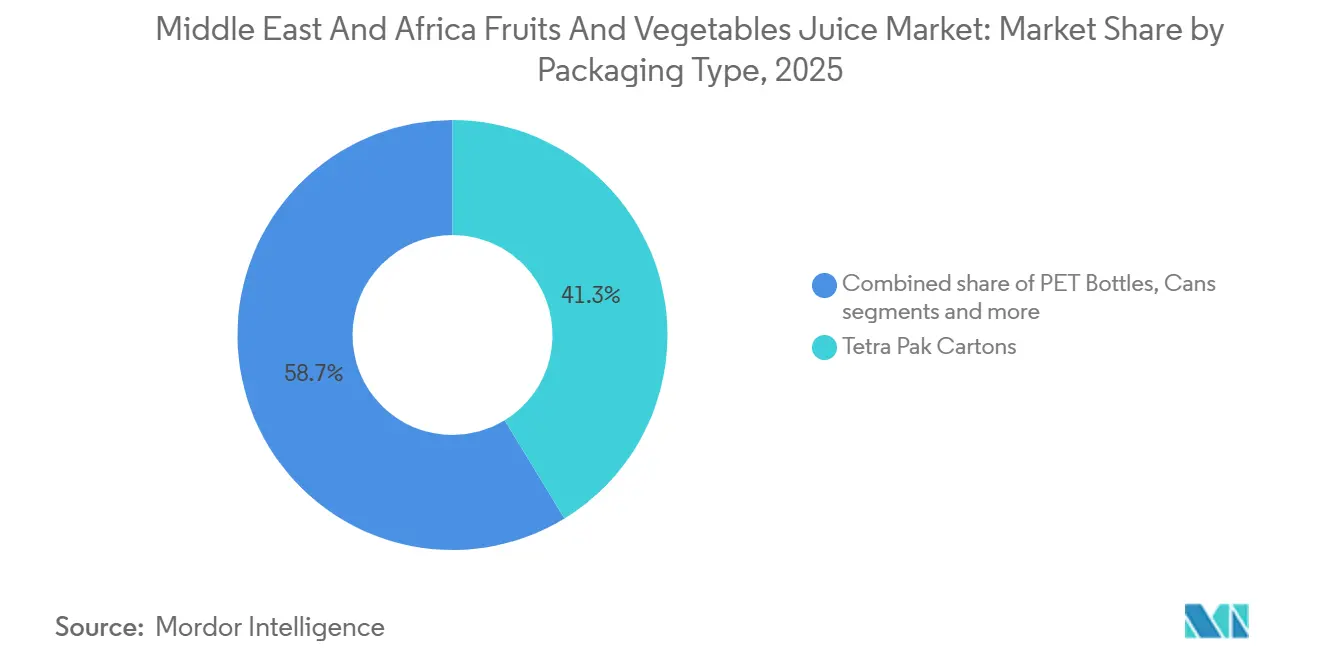
Aseptic Scale Holds While PET Gains Urban Premium MomentumTetra Pak cartons represented 41.27% of packaging revenue in 2025, giving them the largest position because aseptic storage is critical where cold chain reach remains uneven. PET bottles are projected to grow at a 6.73% CAGR through 2031, which is the fastest rate among packaging formats in the Middle East and Africa fruit and vegetable juice market. Their growth is tied to visibility, single-serve convenience, and stronger recycling appeal in urban Gulf markets. Glass bottles still carry premium cues, but their weight and transport cost keep them narrower in use, mostly in hospitality and select food service settings.
Tetra Pak’s FY2025 sustainability reporting showed an investment of EUR 100 million in packaging research and development, including a paper-based barrier for juice cartons that cuts carbon footprint by 43% versus aluminum foil aseptic packs. That response matters because PET’s rise is not only about convenience, it is also tied to sustainability perceptions. At the same time, packaging compliance is becoming more demanding as bottlers move toward better recyclability and more controlled material specifications. That keeps scale important in the packaging race because both cartons and PET now require sustained capital commitment to remain competitive
By Distribution Channel:
Modern Trade Leads While Online Broadens Premium ReachSupermarkets and hypermarkets held 46.57% of distribution revenue in 2025, which made them the largest retail channel for packaged juice across the region. Convenience and grocery stores remained the second largest route because they are essential in fragmented urban retail systems, especially in Nigeria and parts of North Africa. Online retail stores are projected to grow at a 7.06% CAGR through 2031, which makes them the fastest-growing channel across the Middle East and Africa fruit and vegetable juice market size structure. Same-day delivery networks in the UAE and Saudi Arabia, along with stronger e-grocery use in South Africa and Egypt, are supporting that expansion.
Online growth is not simply taking volume from supermarkets, because it is also opening access to premium and niche juice products that may not win physical shelf space in every store. This gives brand owners a wider assortment strategy and helps smaller premium lines reach consumers without full-scale listing costs. It also shifts some marketing focus toward digital discovery and repeat order retention instead of only in-store activation. The broader channel mix still leaves room for food service and hospitality demand, which can support premium juice sales outside mainstream retail pricing pressure
Geography Analysis
Saudi Arabia and United Arab Emirates Fruits and Vegetables Juice Market
Saudi Arabia accounted for 25.28% of the Middle East and Africa fruit and vegetable juice market size in 2025, which kept it as the largest country market in the region. Its position rests on a mature modern trade base, strong seasonal demand peaks such as Ramadan, and a manufacturing ecosystem led by large domestic beverage players. Almarai’s 2025 annual reporting showed the scale of that domestic base and confirmed the continued importance of dairy and juice within its broader consumer portfolio. The UAE plays a different role because it acts as a regional testing ground for premium, functional, and organic juice concepts. High retail density, a large expatriate population, and stronger demand for labeled premium products keep the UAE ahead of much of the region in newer juice formats.
Africa Fruits and Vegetables Juice Market
Nigeria is projected to expand at a 6.39% CAGR through 2031, which makes it the fastest-growing national market in the region. Its growth is tied to population scale, a very young consumer base, and the gradual shift from informal juice consumption toward branded packaged products. South Africa remains one of the most mature markets, where local premium brands and multinational labels compete more directly than in many neighboring countries. Egypt is becoming more important as both a consumption market and a supply base for processed juice inputs. Sahara for Fruit Processing’s January 2025 inauguration of a 150,000 tonne citrus concentrate facility in Egypt points to a stronger regional sourcing role over time.
MEA Fruits and Vegetables Juice Market
Turkey, Morocco, and the rest of MEA complete a diverse second tier of country markets with very different supply and demand conditions. Turkey combines export strength in fruit concentrate with domestic cost pressure from currency weakness, which creates a mixed operating picture for local processors. Morocco has upstream agricultural strength in citrus, but its domestic juice processing base still has room to deepen relative to raw produce potential. Across remote Sub Saharan markets, cold chain gaps and shelf life limits still slow penetration even where demographics and income trends support long term demand.
Competitive Landscape
The Middle East and Africa fruit and vegetable juice market remains fragmented, with regional leaders, multinational beverage groups, and import-led brand operators competing across different price tiers and channel mixes. Competition is shaped by 3 broad models: integrated dairy and juice groups with supply chain depth, local category specialists with strong domestic loyalty, and brand builders that use licensing or distribution reach to scale across several countries. Almarai, Juhayna, and Al Rawabi represent the first model, while Al Rabie, Al Ain National for Juice, and Barakat Group fit the second model more closely. Co Ro’s Suntop, Suncola, and Sunquick portfolio shows how a distribution-heavy strategy can still secure a deep regional presence when brands are adapted to local price and taste points. PepsiCo and The Coca-Cola Company remain important in premium and adjacent beverage spaces, but the field is still open enough for regional producers to defend strong home market positions.
Recent strategic moves show that scale players are trying to widen their advantage through capability building rather than only through basic volume growth. Almarai completed the acquisition of Pure Beverages Industry Co. in July 2025 for SAR 1.04 billion, which expanded its non-dairy beverage base and strengthened cross category distribution leverage in Saudi Arabia. Almarai also invested USD 50 million in sustainable packaging for its premium organic juice line in February 2025, which signaled a clear push toward higher margin premium formats. Tetra Pak’s 2025 packaging research investment added another layer to competition because suppliers are now shaping packaging performance and sustainability claims that influence brand positioning. These moves show that leadership in the Middle East and Africa fruit and vegetable juice market is increasingly tied to packaging, procurement, and route to market strength, not only to brand familiarity.
White space remains strongest in functional juice, organic premium offers, and fresh pressed concepts linked to food service and premium retail in select urban markets. Companies with high pressure processing, aseptic filling, or stronger certification systems have a practical edge because they can support cleaner labels, longer shelf life, and broader compliance across countries. Regulatory complexity is also raising the burden on smaller mid tier firms, especially in markets dealing with both input cost inflation and shifting sugar policy. That keeps the Middle East and Africa fruit and vegetable juice market competitive, but it also increases the odds of slower consolidation around players that can fund reformulation, packaging upgrades, and deeper distribution networks.
Middle East and Africa Fruits and Vegetables Juice Industry Leaders
-
The Coca-Cola Company
-
PepsiCo, Inc.
-
Del Monte Foods Inc.
-
National Agricultural Development Company (NADEC)
-
Al Ain National for Juice
- *Disclaimer: Major Players sorted in no particular order
Middle East and Africa Fruits and Vegetables Juice Market Companies Covered in this Report
- Almarai Company
- Al Rabie Saudi Foods Co.
- Del Monte Foods Inc.
- The Coca-Cola Company
- PepsiCo Inc.
- Aujan Coca-Cola Beverages
- National Agricultural Development Company (NADEC)
- Juhayna Food Industries
- Al Ain National for Juice
- Masafi Co. LLC
- Gulf Union Foods Co.
- Al Safi Farm
- Unikai Foods PJSC
- Barakat Group
- National Food Products Co.
- Alesayi Beverages Co. Ltd.
- Co-Ro A/S
- Arrow Juice Factory (AJF)
- Al Rawabi Dairy Company
- PRAN Foods Ltd.
Recent Industry Developments in Middle East and Africa Fruits and Vegetables Juice Market
- August 2025: Rubicon Arabia launched the "Rubicon Kids" line of 100% natural juices formulated specifically for children in the UAE, targeting growing parental demand for additive free, single serve juice formats within GCC modern trade channels
- July 2025: Almarai completed the acquisition of Pure Beverages Industry Co., owner of the Ival and Oska bottled water brands, for SAR 1.04 billion, or USD 277 million, expanding its non-dairy beverage portfolio and reinforcing its distribution infrastructure across Saudi Arabia’s modern trade.
- January 2025: Sahara for Fruit Processing inaugurated a new citrus juice concentrate processing facility in Egypt with an annual capacity of 150,000 tons, positioning Egypt as a potential regional supply hub for North African and GCC juice manufacturers and reducing regional import dependence for citrus inputs.
Middle East and Africa Fruits and Vegetables Juice Market Report Scope
The Middle East and Africa Fruits and Vegetable Juice Market Report is Segmented by Category (Fruit, Vegetable), Product Types (100% Juice, and More), Nature (Conventional, Organic), Packaging Material (Tetra Pak, PET, Glass, and More), Distribution Channel (Supermarkets/Hypermarkets, and More), and Geography (UAE, South Africa, and More). The Market Forecasts are Provided in Terms of Value (USD) and Volume (Liters).
Segmentation Overview
| 100% Juice |
| Nectar (25–99% Juice) |
| Juice Drinks (Below 25% Juice) |
| Fruit Juice |
| Vegetable Juice |
| Conventional |
| Organic |
| Tetra Pak Cartons |
| PET Bottles |
| Glass Bottles |
| Cans |
| Pouches and Others |
| Supermarkets/Hypermarkets |
| Convenience/Grocery Stores |
| Online Retail Stores |
| Others |
| United Arab Emirates |
| South Africa |
| Saudi Arabia |
| Nigeria |
| Egypt |
| Morocco |
| Turkey |
| Rest of Middle East and Africa |
| Product Type | 100% Juice |
| Nectar (25–99% Juice) | |
| Juice Drinks (Below 25% Juice) | |
| Category | Fruit Juice |
| Vegetable Juice | |
| Nature | Conventional |
| Organic | |
| Packaging Material | Tetra Pak Cartons |
| PET Bottles | |
| Glass Bottles | |
| Cans | |
| Pouches and Others | |
| Distribution Channel | Supermarkets/Hypermarkets |
| Convenience/Grocery Stores | |
| Online Retail Stores | |
| Others | |
| Geography | United Arab Emirates |
| South Africa | |
| Saudi Arabia | |
| Nigeria | |
| Egypt | |
| Morocco | |
| Turkey | |
| Rest of Middle East and Africa |
Key Questions Answered in the Report
What is the projected value of the Middle East and Africa fruit juice sector by 2031?
It is forecast to reach USD 11.47 billion by 2031, rising from USD 8.03 billion in 2025 at a 6.2% CAGR from 2026 to 2031.
Which product type currently leads regional revenue?
100% juice leads product type revenue with a 55.67% share in 2025, supported by stronger clean label and premium demand.
Which channel is growing the fastest across the region?
Online retail stores are growing the fastest, with a projected 7.1% CAGR through 2031, helped by stronger e grocery and premium assortment access.
Which country leads revenue and which one is growing the fastest?
Saudi Arabia led with 25.28% revenue share in 2025, while Nigeria is the fastest growing country market at a 6.4% CAGR through 2031.