
Medical Scrubs Market Size and Share
Market Overview
| Study Period | 2020 - 2031 |
|---|---|
| Market Size (2026) | USD 96.13 Billion |
| Market Size (2031) | USD 130.91 Billion |
| Growth Rate (2026 - 2031) | 6.37 % |
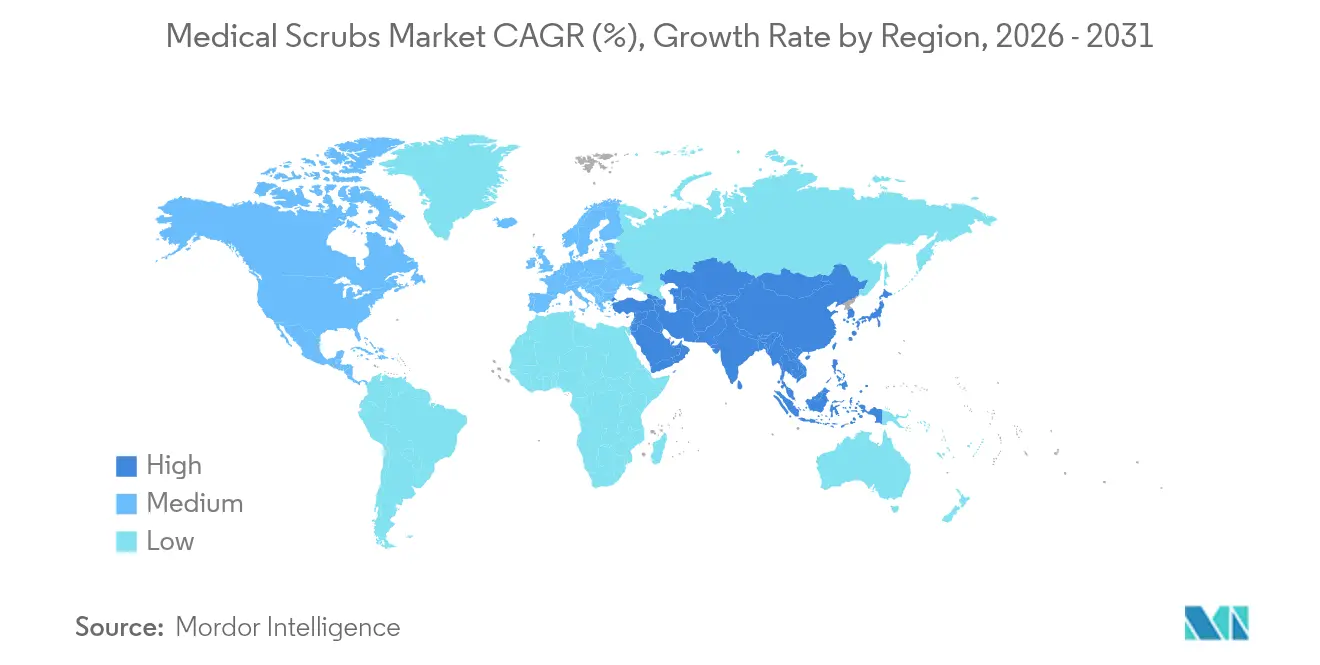
| Fastest Growing Market | Asia Pacific |
| Largest Market | North America |
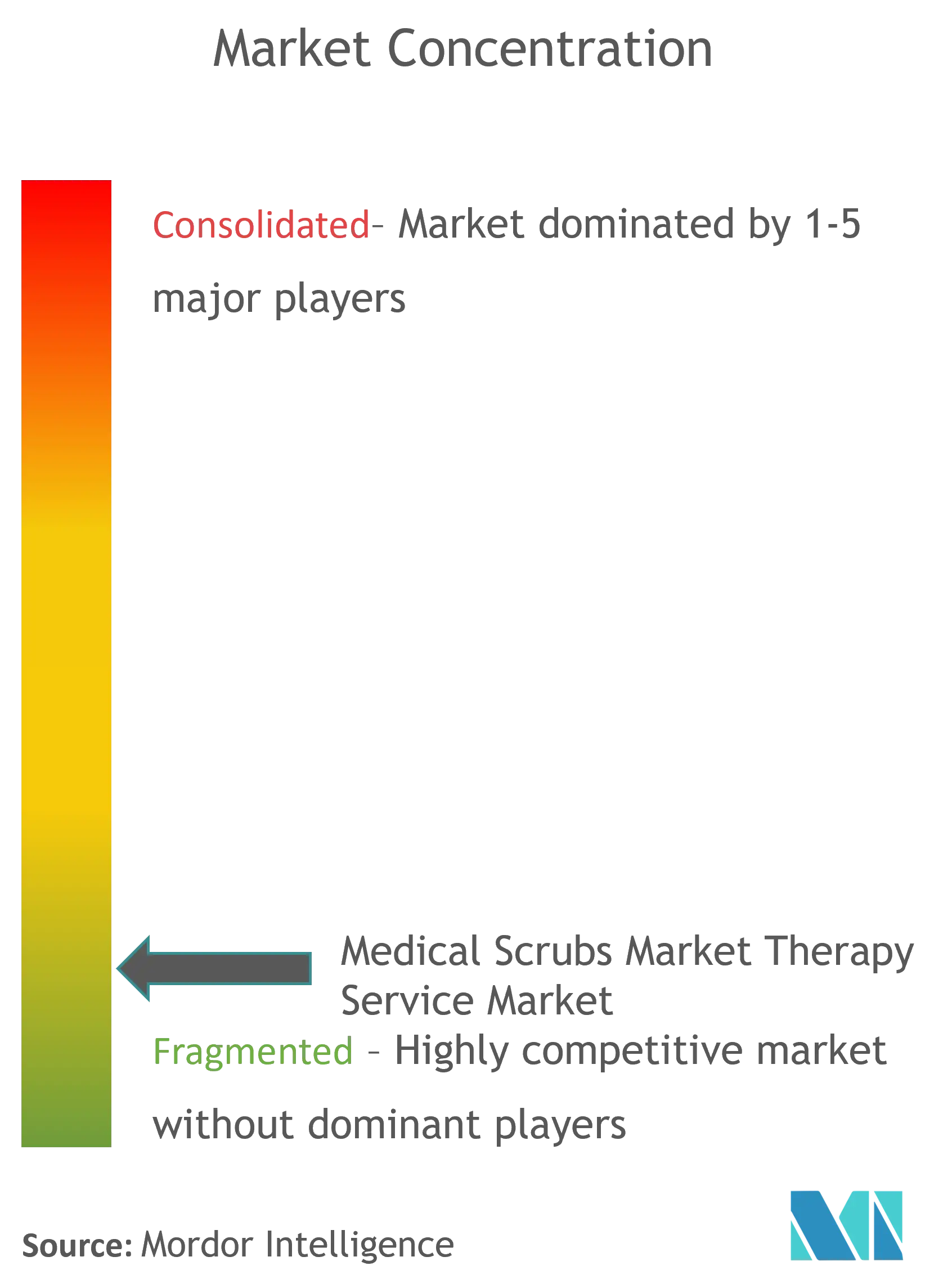
| Market Concentration | High |
Major Players *Disclaimer: Major Players sorted in no particular order Image © Mordor Intelligence. Reuse requires attribution under CC BY 4.0. | |
Medical Scrubs Market Analysis by Mordor Intelligence
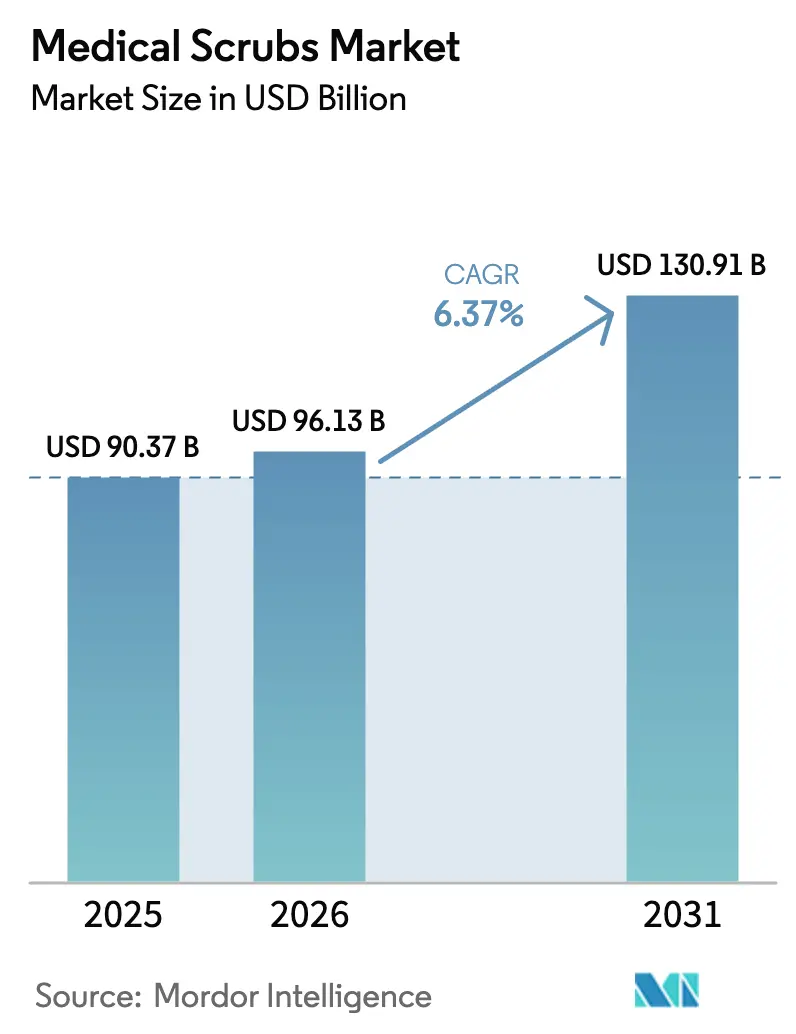
The medical scrubs market size was valued at USD 90.37 billion in 2025 and estimated to grow from USD 96.13 billion in 2026 to reach USD 130.91 billion by 2031, at a CAGR of 6.37% during the forecast period (2026-2031). Demand is being buoyed by stricter infection-control mandates, expanded outpatient care delivery, and rapid adoption of antimicrobial fabrics. Hospitals are moving from employee-owned apparel to employer-provided, laundered uniforms, while ambulatory surgical centers (ASCs) and home-health providers add fresh volume. North America leads purchases, yet Asia-Pacific manufacturing capacity is reshaping price dynamics. Direct-to-consumer (D2C) innovators are redefining procurement models, and forthcoming PFAS bans are forcing material reformulations that could redraw competitive boundaries in the medical scrubs market Morgan Lewis.
Key Report Takeaways
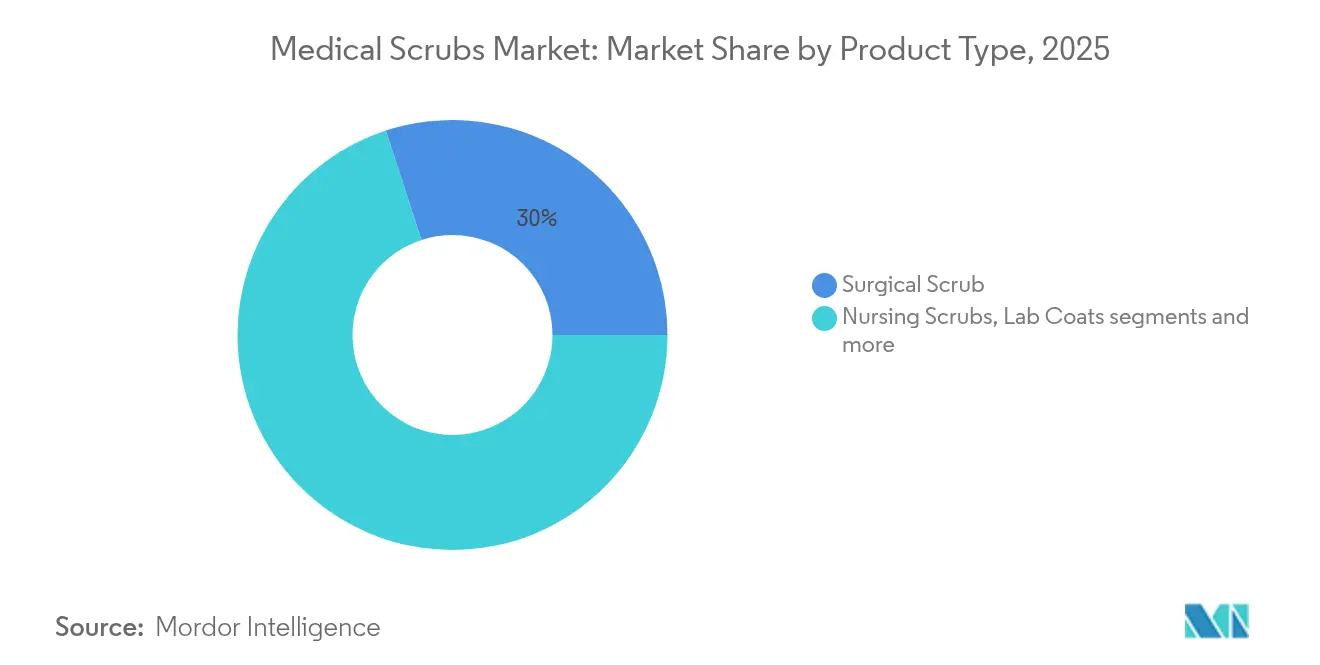
- By product type, surgical scrubs held 30.02% of the medical scrubs market share in 2025, while specialty scrubs are set to expand at a 7.78% CAGR through 2031 .
- By usability, disposable scrubs accounted for 55.78% of the medical scrubs market size in 2025 and are advancing at an 8.14% CAGR to 2031.
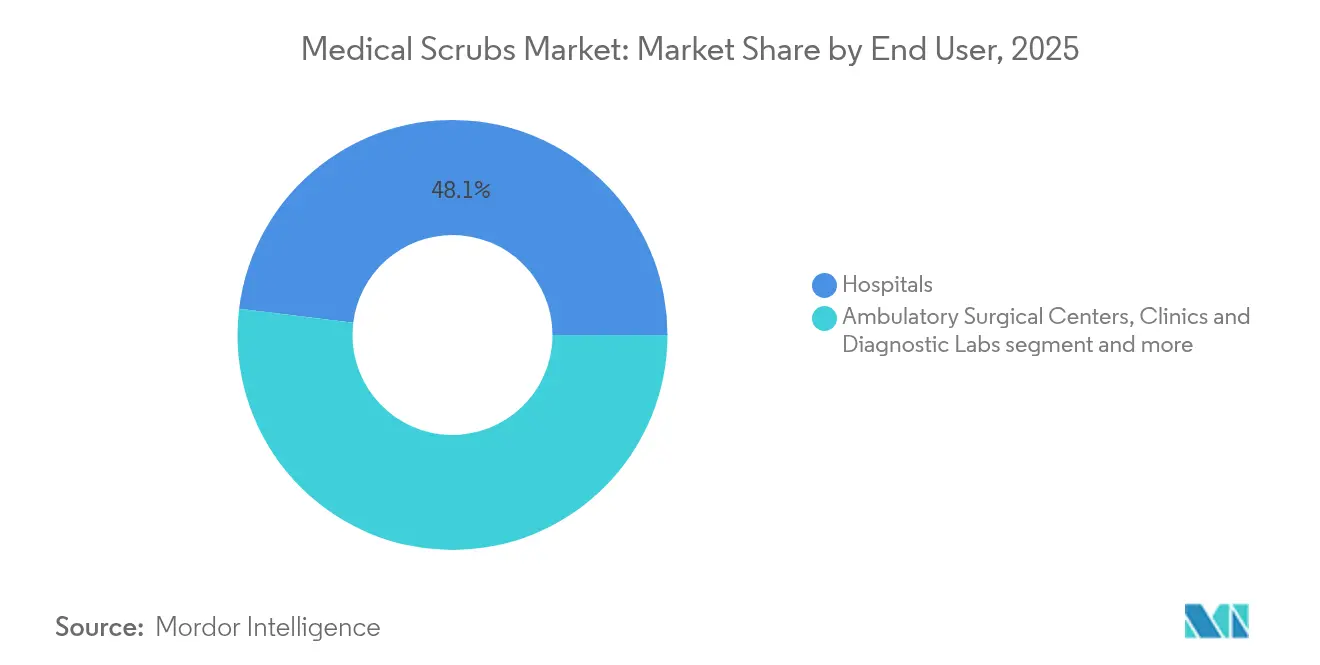
- By end user, hospitals captured 48.05% of the medical scrubs market share in 2025; ASCs are projected to grow at an 8.47% CAGR through 2031.
Note: Market size and forecast figures in this report are generated using Mordor Intelligence’s proprietary estimation framework, updated with the latest available data and insights as of 2026.
Market Trends and Insights
Drivers Impact Analysis of Medical Scrubs Market*
| Driver | (~) % Impact on CAGR Forecast | Geographic Relevance | Impact Timeline |
|---|---|---|---|
| Rising global healthcare workforce & facility expansion | +1.8% | North America & Asia-Pacific | Medium term (2-4 years) |
| Stricter post-COVID-19 infection-control attire mandates | +1.2% | North America & Europe | Short term (≤ 2 years) |
| Demand surge for antimicrobial & performance fabrics | +0.9% | North America & Europe | Medium term (2-4 years) |
| E-commerce D2C procurement shift | +0.7% | North America & Europe | Long term (≥ 4 years) |
| Hospital ESG targets for recycled-fiber scrubs | +0.5% | Europe & North America | Long term (≥ 4 years) |
| RFID-enabled smart scrubs for asset tracking | +0.3% | North America pilots | Long term (≥ 4 years) |
| Source: Mordor Intelligence | |||
Rising Global Healthcare Workforce & Facility Expansion
The American Hospital Association’s 2025 Workforce Scan flags outpatient migration and digital care as prime hiring catalysts, translating into more scrub sets per clinician. Capital expansion in North America and Asia-Pacific is accelerating uniform demand, boosted by a 10.4% jump in U.S. health spending during 2023. Standardized attire across new facilities simplifies procurement, further enlarging the medical scrubs market. Integration of AI-enabled training also promotes uniformity to ensure role-based identification.
Stricter Post-COVID-19 Infection-Control Attire Mandates
OSHA’s healthcare standard requires employer-provided PPE policies that now encompass scrub laundering. APIC guidelines oblige facilities to clean soiled scrubs at no cost to staff, reinforcing institutional ownership. AORN’s 2024 surgical attire update specifies changing intervals for scrubs and accessories, closing loopholes for home-laundering. As scrubs shift from optional attire to regulated PPE, bulk institutional purchasing enlarges the medical scrubs market. CDC’s HICPAC continues refining attire hierarchies, ensuring long-term adherence .
Demand Surge for Antimicrobial & Performance-Fabric Scrubs
Novel chemistries inhibit >99% of Staphylococcus aureus and Escherichia coli, transforming garments into active infection-control tools[1]. Copper-polyester blends deliver 5-log reductions in 4 hours, suiting high-acuity settings. FIGS’ FIONx fabric—moisture-wicking, anti-odor, four-way stretch—has set user comfort benchmarks . Adoption of performance fabrics lifts average selling prices, enlarging revenue within the medical scrubs market.
E-commerce D2C Brands Shifting Procurement Dynamics
FIGS generated USD 545.6 million revenue in 2023 via a primarily digital model, capturing roughly 10% of U.S. healthcare workers. The firm’s Community Hubs blend online discovery with tactile retail Business Wire. D2C convenience, personalized sizing, and rapid fulfillment encourage clinicians to bypass legacy distributors, raising competitive intensity across the medical scrubs market.
Restraints Impact Analysis of Medical Scrubs Market*
| Restraint | (~) % Impact on CAGR Forecast | Geographic Relevance | Impact Timeline |
|---|---|---|---|
| Price pressure from low-cost Asian producers | -0.8% | North America & Europe | Short term (≤ 2 years) |
| Uptick in single-use disposable PPE substituting scrubs | -0.6% | High-risk settings worldwide | Medium term (2-4 years) |
| Hospital uniform-rental contracts dampening new sales | -0.4% | North America & Europe | Medium term (2-4 years) |
| PFAS fabric-ban supply-chain disruption | -0.3% | North America & Europe | Short term (≤ 2 years) |
| Source: Mordor Intelligence | |||
Hospital ESG Targets Driving Sustainable Recycled-Fiber Scrubs
European and North American health systems now integrate apparel sustainability metrics into tenders. FIGS aims for 75% recycled content by 2030 and recycled 40,000 scrub sets in 2024. Facilities pursuing carbon-reduction pledges prefer vendors with closed-loop programs, nudging demand toward eco-designed ranges.
RFID-Enabled Smart Scrubs for Real-Time Asset Tracking
Pilot programs in U.S. systems affix RFID chips to uniforms, cutting loss rates and enabling digital laundry records OR Manager. As electronic textiles mature, smart scrubs will relay staff location and vitals, adding premium value layers within the medical scrubs market
*Our forecasts treat driver/restraint impacts as directional, not additive. The impact forecasts reflect baseline growth, mix effects, and variable interactions.
Medical Scrubs Market Segment Analysis
By Product Type:
Surgical Scrubs Anchor High-Value DemandSurgical scrubs generated the largest slice of the medical scrubs market size, holding 30.02% share in 2025 amid tightened sterile-field protocols AORN. Specialty scrubs, tailored for interventional radiology and infectious-disease wards, are advancing at a 7.78% CAGR, supported by rising procedure complexity. In the second half of the period, hospital RFQ documents increasingly specify antimicrobial finishes and RFID tagging, stimulating premium upgrades. Nursing scrubs continue to supply bulk volumes, while lab coats benefit from pathogen-shielding treatments popular in diagnostic labs. Product differentiation now spans color-coded role identification and moisture-wicking blends that improve shift-long comfort. As premium features proliferate, average selling prices remain on an upward slope, strengthening revenue growth in the medical scrubs market.
FIGS’ Extremes collection, priced at USD 78 for pants and USD 68 for tops, confirms clinicians’ willingness to pay for stretch, anti-odor, and anti-wrinkle benefits. Public health systems likewise endorse innovation: England’s NHS introduced color-coded “smart scrubs” to streamline workflow and elevate visibility. Coupled with robust R&D into copper-infused fabrics, the product landscape is poised for higher technology content and deeper segmentation, supporting the expansion trajectory of the medical scrubs market

By Usability:
Disposable Formats Dominate but Sustainability Revives ReusablesDisposable garments controlled 55.78% of the medical scrubs market share in 2025, an edge amplified by an 8.14% CAGR through 2031 as hospital infection-control boards prefer single-use apparel for high-acuity zones. Procurement officers view the cost of potential cross-contamination as exceeding disposable premiums, locking in demand. Conversely, reusable scrubs regain momentum via recycling initiatives and institutional ESG targets. FIGS processed 40,000 returned sets in 2024 and aims for 75% recycled fiber content by 2030. Service-based rental models blend sustainability with convenience, permitting hospitals to monitor garment lifecycles and laundering compliance in real time. Emerging smart-fabric applications may blur disposable-reusable distinctions by embedding patient-monitoring sensors that necessitate longer garment life, thus reshaping future allocation inside the medical scrubs market.
By End User:
Hospitals Hold Volume; ASCs Speed AheadHospitals accounted for 48.05% of the medical scrubs market size in 2025 as they procure attire across surgery, nursing, and ancillary departments. Yet ASCs post the fastest 8.47% CAGR, propelled by a migration of cost-sensitive procedures and policy incentives that reimburse outpatient settings at competitive rates. Clinics and diagnostic labs provide recurring demand for lab coats and specialized scrubs, while home-health expansion—driven by aging populations—creates a new frontier for lightweight, performance-oriented garments. Uniform standardization across these diverse sites fuels incremental volumes, keeping the medical scrubs market on its steady growth path. Integration of AI-enabled scheduling in ASCs necessitates role-based color coding, further escalating scrub turnover rates in outpatient facilities.
Geography Analysis
North America Medical Scrubs Market
North America commanded 39.35% of 2025 value thanks to advanced healthcare infrastructure and stringent PPE rules. U.S. states such as California and New York instituted PFAS bans effective 2025, accelerating innovation in fluorine-free repellents and boosting premium prices. Direct-to-consumer channels flourished; FIGS serves 2.67 million active customers—nearly 10% of U.S. clinicians—underscoring digital procurement’s scale inside the medical scrubs market. Tariff escalations with China complicate sourcing but simultaneously encourage regional manufacturing investments.
Europe Medical Scrubs Market
Europe’s market momentum stems from ESG mandates and uniform harmonization. France’s PFAS prohibition, complete by 2030, pushes suppliers toward compliant chemistries. The NHS rolled out national color-coded smart scrubs to heighten staff identification, demonstrating demand for system-wide. Continental buyers evaluate life-cycle impacts and antimicrobial efficacy, sustaining mid-single-digit growth within the regional medical scrubs market.
APAC Medical Scrubs Market
Asia-Pacific is the fastest-growing geography, powered by healthcare infrastructure expansion and robust export manufacturing. Vietnam’s cost-competitive production fuels global price competition, while Chinese device firms leverage integrated supply chains to penetrate Western buyers. Premium brands recorded success: FIGS’ international revenue leapt 45% year-on-year, validating appetite for higher-end apparel across urban centers. Regional R&D produces advanced antimicrobial treatments, reinforcing Asia-Pacific’s role in technology diffusion across the medical scrubs market.
Competitive Landscape
The medical scrubs market features moderate fragmentation, yet consolidation pressure is rising. Medline Industries is preparing a potential USD 50 billion IPO in 2025 and recently unveiled a USD 125 million Illinois distribution hub spanning 1.4 million sq ft, illustrating scale-driven investment. Conversely, Careismatic Brands shuttered Dallas facilities and shed 404 positions under restructuring, highlighting mid-tier vulnerability.
PFAS compliance forms a new competitive filter. Early movers investing in fluorine-free repellents gain tender advantages, while laggards risk fines or lost contracts. Technology is the next frontier: pilots embedding RFID chips and biosensors signal convergence of textiles with digital health, opening white-space opportunities for entrants that blend apparel and IoT competencies. As pressure from low-cost Asian suppliers persists, differentiation by performance, sustainability, and digital engagement decides share shifts within the medical scrubs market.
Medical Scrubs Industry Leaders
-
O&M Halyard
-
FIGS, INC.
-
Superior Group of Companies, Inc.
-
Adar Medical Uniforms, LLC.
-
Barco Uniforms
- *Disclaimer: Major Players sorted in no particular order
Medical Scrubs Market Companies Covered in this Report
- FIGS Inc.
- Careismatic Brands Inc.
- Barco Uniforms Inc.
- Landau Uniforms Inc.
- Medline Industries
- Jaanuu Inc.
- Adar Medical Uniforms LLC
- Maevn Inc.
- KOI Design LLC
- WonderWink (Wink Uniforms)
- Uniform Advantage Brands LLC
- Healing Hands Apparel LLC
- Carhartt Inc.
- Tafford Uniforms LLC
- Blue Sky Scrubs LLC
- Superior Group of Companies Inc.
- Uniform Advantage
- Cherokee Uniforms
- Barco One
- Molnlycke Health Care
Recent Industry Developments in Medical Scrubs Market
- January 2025: S&S Activewear intends to divest its Jaanuu scrub brand, creating acquisition room for strategic buyers
- September 2024: FIGS opened its second Community Hub in Philadelphia, expanding omnichannel reach
Global Medical Scrubs Market Report Scope
As per the scope of the report, medical scrubs are protective garments designed to be worn by doctors and nurses in the operating room. The medical scrubs market is segmented into type, application, end user, and geography. By type, the market is segmented into surgical scrubs, nursing scrubs, and lab coats. By usage, the market is segmented into disposable and reusable. By end user, the market is segmented into hospitals and clinics, diagnostic centers, and other end users (surgical centers and nursing homes). By geography, the market is segmented into North America, Europe, Asia-Pacific, the Middle East and Africa, and South America. The market report also covers the estimated market sizes and trends for 17 countries across major regions globally. The report offers market size and forecasts in value (USD) for the above segments.
Segmentation Overview
| Surgical Scrubs |
| Nursing Scrubs |
| Lab Coats |
| Specialty Scrubs |
| Disposable |
| Reusable |
| Hospitals |
| Ambulatory Surgical Centers |
| Clinics & Diagnostic Labs |
| Home Healthcare |
| North America | United States |
| Canada | |
| Mexico | |
| Europe | Germany |
| United Kingdom | |
| France | |
| Italy | |
| Spain | |
| Rest of Europe | |
| Asia-Pacific | China |
| India | |
| Japan | |
| South Korea | |
| Australia | |
| Rest of Asia-Pacific | |
| South America | Brazil |
| Argentina | |
| Rest of South America | |
| Middle East and Africa | GCC |
| South Africa | |
| Rest of Middle East and Africa |
| By Product Type (Value) | Surgical Scrubs | |
| Nursing Scrubs | ||
| Lab Coats | ||
| Specialty Scrubs | ||
| By Usability (Value) | Disposable | |
| Reusable | ||
| By End User (Value) | Hospitals | |
| Ambulatory Surgical Centers | ||
| Clinics & Diagnostic Labs | ||
| Home Healthcare | ||
| By Geography (Value) | North America | United States |
| Canada | ||
| Mexico | ||
| Europe | Germany | |
| United Kingdom | ||
| France | ||
| Italy | ||
| Spain | ||
| Rest of Europe | ||
| Asia-Pacific | China | |
| India | ||
| Japan | ||
| South Korea | ||
| Australia | ||
| Rest of Asia-Pacific | ||
| South America | Brazil | |
| Argentina | ||
| Rest of South America | ||
| Middle East and Africa | GCC | |
| South Africa | ||
| Rest of Middle East and Africa | ||
Key Questions Answered in the Report
What is the current value of the medical scrubs market?
The Medical ScThe medical scrubs market was valued at USD 90.37 billion in 2025 and is projected to reach USD 130.91 billion by 2031.rubs Market size is expected to reach USD 96.13 billion in 2026 and grow at a CAGR of 6.37% to reach USD 130.91 billion by 2031.
Which product segment leads the medical scrubs market?
Surgical scrubs lead with a 30.02% share, supported by stringent sterile-field requirements.
Why are disposable scrubs growing faster than reusable ones?
Post-pandemic infection-control priorities make single-use garments attractive, giving disposables an 8.14% CAGR through 2031.
How are PFAS bans affecting scrub manufacturers?
California, New York, and France are banning PFAS in textiles, prompting costly fabric reformulations but opening opportunities for fluorine-free innovators.